Customer Survey
Research
Constructing Customer Satisfaction
Questions
Learning Objectives
 Recall the tips for designing good customer
satisfaction surveys
 Recall the question types you can use to write
customer satisfaction surveys
Constructing Questions
 Understand purpose of survey to include only
relevant questions
 Write clear and unambiguous questions
 Accurately communicate what is required of
customers to answer each question
 Don’t assume customers understand questions or
instructions
Questionnaire Design - Instructions
 Providing instructions directly after question
stem helps ensure respondents see & process
it before providing answer
 Example:
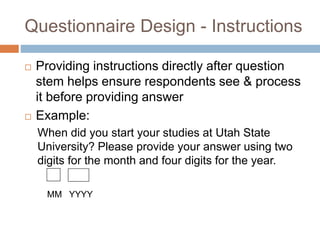
When did you start your studies at Utah State
University? Please provide your answer using two
digits for the month and four digits for the year.
MM YYYY
Asking Effective Questions
 Make questions clear
 Be precise
 Avoid difficult or specialized words, acronyms, &
pretentious language
 Keep questions short
 Contain no more than 2 short sentences
Asking Effective Questions
 Avoid double-barreled questions
Example:
How do you describe your experience with Agri-Service
and Massey Ferguson tractors?
Replace with:
How do you describe your experience with Agri-
Service?
How do you describe your experience with Massey
Ferguson tractors?
Asking Effective Questions
 Avoid leading questions
 Do not suggest a certain response
▪ Poor Example: Wouldn’t it be great to purchase
Anderson Bean boots at C-A-L Ranch?
▪ Better: What boot brands would you like to purchase
from C-A-L Ranch?
 Ask reliable questions
 Understood and interpreted in the same way by
all readers
 Poor Example: Where are you from?
Asking Effective Questions
 Do not use questions that ask for highly
detailed information
 Don’t ask for details: in the past 30 days, how
many hours did you spend repairing your water
trough?
Asking Effective Questions
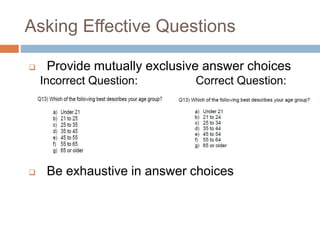
 Provide mutually exclusive answer choices
Incorrect Question: Correct Question:
 Be exhaustive in answer choices

Customer Satisfaction Survey Design

  • 1.
  • 2.
    Learning Objectives  Recallthe tips for designing good customer satisfaction surveys  Recall the question types you can use to write customer satisfaction surveys
  • 3.
    Constructing Questions  Understandpurpose of survey to include only relevant questions  Write clear and unambiguous questions  Accurately communicate what is required of customers to answer each question  Don’t assume customers understand questions or instructions
  • 4.
    Questionnaire Design -Instructions  Providing instructions directly after question stem helps ensure respondents see & process it before providing answer  Example: When did you start your studies at Utah State University? Please provide your answer using two digits for the month and four digits for the year. MM YYYY
  • 5.
    Asking Effective Questions Make questions clear  Be precise  Avoid difficult or specialized words, acronyms, & pretentious language  Keep questions short  Contain no more than 2 short sentences
  • 6.
    Asking Effective Questions Avoid double-barreled questions Example: How do you describe your experience with Agri-Service and Massey Ferguson tractors? Replace with: How do you describe your experience with Agri- Service? How do you describe your experience with Massey Ferguson tractors?
  • 7.
    Asking Effective Questions Avoid leading questions  Do not suggest a certain response ▪ Poor Example: Wouldn’t it be great to purchase Anderson Bean boots at C-A-L Ranch? ▪ Better: What boot brands would you like to purchase from C-A-L Ranch?  Ask reliable questions  Understood and interpreted in the same way by all readers  Poor Example: Where are you from?
  • 8.
    Asking Effective Questions Do not use questions that ask for highly detailed information  Don’t ask for details: in the past 30 days, how many hours did you spend repairing your water trough?
  • 9.
    Asking Effective Questions Provide mutually exclusive answer choices Incorrect Question: Correct Question:  Be exhaustive in answer choices

Editor's Notes

  • #6 Use words and expressions that are simple, direct, and familiar to all respondents. Ask precise questions. Avoid things that are too general, too complex or undefined. Stay away from using words like “often,” “usually,” “generally,” etc. Each person’s thought process is different and some people may infer a different meaning. “Often” to one person may be once or twice a week and to someone else it could be a few times a month. Avoid technical jargons or concepts. Adopt the same definitions throughout the form. Do not use abbreviations and spell words out when necessary so it will not lead to potential confusion for the respondents Avoid Negative or Double Negative Expressions. The use of universal words or “absolutes” like “always” or “never” may cause the respondents to avoid answering a question. These tend to extend the question to an extreme. In addition, try not to use words such as “only” or “just.” These could be perceived negatively worded by the respondents.
  • #7 Avoid using Double-Barreled questions. Double-Barreled questions split questions into more than one part, idea or meaning. The answer choice for each part might have separate meanings to the ideas presented within the one question. These may lead the respondent to answer only one aspect of it; ultimately leading him/her to fail in answering both aspects of the question. Survey questions should always be written in a way that only one thing is being measured. If a single question has two subjects, it’s impossible to tell how the respondent is weighing the different elements involved.
  • #8 Leading Questions Questions should never be worded in a way that’ll sway the reader to one side of the argument. Usually you can tell a question is leading if it includes non-neutral wording.
  • #10 Mutually Exclusive Answer Choices The answer choices should not overlap. Exhaustive Answer Choices All answers given for the question need to cover the entire realm of possible answers. Survey writers listing answers in an single or multiple response questions need to make sure that all potential answers to the particular question are listed.  And remember, when in doubt, use other (please specify).