Dr. Kitipan Kitbamroong
Definitions of E-business
 E-business - businesses run on the Internet, or utilizing Internet
  technologies to improve the productivity or profitability of a business.

 Business Intelligence - defined as the ability for an organization to take
  all its capabilities and convert them into knowledge, ultimately, getting
  the right information to the right people, at the right time, via the right
  channel.

 E-Commerce - buying and selling of products or services over
  electronic systems such as the Internet and other computer networks

 Customer Relationship Management (CRM)- model for managing a
  company’s interactions with customers, clients, and sales prospects.
Definitions of E-business
 Supply Chain Management (SCM) - management of a network of
  interconnected businesses involved in the provision of product and
  service packages required by the end customers in a supply chain

 Enterprise Resource Planning (ERP) - systems integrate internal and
  external management information across an entire organization,
  embracing finance/accounting, manufacturing, sales and service,
  CRM.
Types of e-business
 Business-to-business (B2B)
  Business that sells products or provides services to other businesses
    Intel selling microprocessor to DELL
    Heinz selling ketchup to McDonalds

 Business-to-consumer (B2C)
  Business that sells products or provides services to end-user consumers
    www.dell.com

 Consumer-to-consumer (C2C)
  Consumers sell directly to other consumers
    www.ebay.com , www.Thaisecondhand.com

 Business-to-government (B2G)
  Government buys or provides goods, services or information to/from businesses or
  individual citizens
     Business pay taxes, file reports or sell goods and services to Govt. (www.rd.go.th)
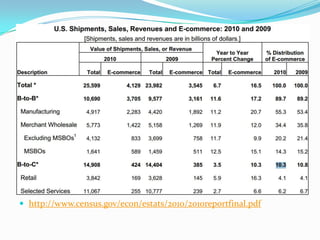
 http://www.census.gov/econ/estats/2010/2010reportfinal.pdf
Types of e-business
 Mobile commerce (m-commerce)
  E-commerce transactions and activities conducted in a wireless environment
     Mobile ticketing, Mobile banking
     M.scbeasy.com

 Business-to-employee (B2E)
  Information and services made available to employees online
    employee and corporate benefits solution, education opportunities, digital
      library systems

 Facebook Commerce (F-commerce)

 Collaborative commerce (c-commerce)
  Individuals or groups communicate or collaborate online
     www.transora.com.br
e-Business vs e-Commerce
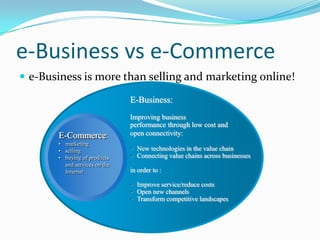
 e-Business is more than selling and marketing online!

                               E-Business:
                               Improving business
                               performance through low cost and
       E-Commerce:             open connectivity:
       • marketing
       • selling               • New technologies in the value chain
       • buying of products    • Connecting value chains across businesses
         and services on the
         Internet              in order to :

                               • Improve service/reduce costs
                               • Open new channels
                               • Transform competitive landscapes
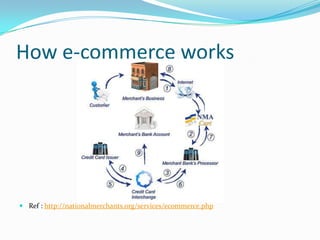
How e-commerce works


 Ref : http://nationalmerchants.org/services/ecommerce.php
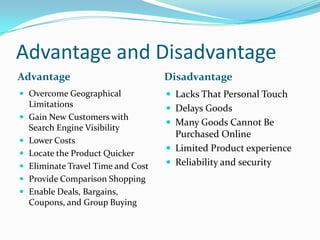
Online Payment Options
 Credit card processing
 Paypal
 Debit cards


 Give them offline payment options too
 The more online payment options, the better
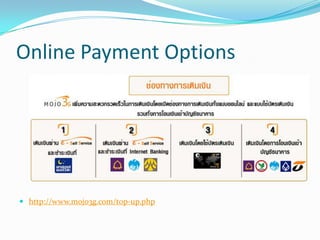
Online Payment Options


 http://www.mojo3g.com/top-up.php
Advantage and Disadvantage
Advantage                            Disadvantage
 Overcome Geographical               Lacks That Personal Touch
    Limitations                       Delays Goods
   Gain New Customers with
                                      Many Goods Cannot Be
    Search Engine Visibility
                                       Purchased Online
   Lower Costs
                                      Limited Product experience
   Locate the Product Quicker
   Eliminate Travel Time and Cost    Reliability and security
   Provide Comparison Shopping
   Enable Deals, Bargains,
    Coupons, and Group Buying
E-Marketing
 the marketing (generally promotion) of products or
  services over the Internet.
 How is important?
Types of E-Marking
 Display advertising
 Search engine marketing (SEM)
 Search engine optimization (SEO)
 Email marketing
 Referral marketing
 Affiliate marketing
 Inbound marketing
 Video marketing
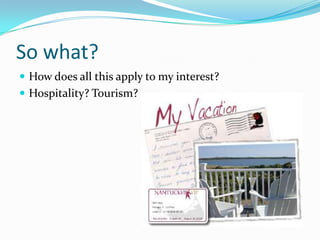
So what?
 How does all this apply to my interest?
 Hospitality? Tourism?
Related activities
 Planning
 Surveying / shopping / deals
 Tickets booking
 Hotel booking
 Activities booking
 Insurances
 Claims and reciepts
 Feedback and royalty programs
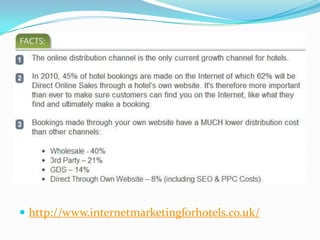
 http://www.internetmarketingforhotels.co.uk/
E-Marketing examples

E business

  • 1.
  • 2.
    Definitions of E-business E-business - businesses run on the Internet, or utilizing Internet technologies to improve the productivity or profitability of a business.  Business Intelligence - defined as the ability for an organization to take all its capabilities and convert them into knowledge, ultimately, getting the right information to the right people, at the right time, via the right channel.  E-Commerce - buying and selling of products or services over electronic systems such as the Internet and other computer networks  Customer Relationship Management (CRM)- model for managing a company’s interactions with customers, clients, and sales prospects.
  • 3.
    Definitions of E-business Supply Chain Management (SCM) - management of a network of interconnected businesses involved in the provision of product and service packages required by the end customers in a supply chain  Enterprise Resource Planning (ERP) - systems integrate internal and external management information across an entire organization, embracing finance/accounting, manufacturing, sales and service, CRM.
  • 4.
    Types of e-business Business-to-business (B2B) Business that sells products or provides services to other businesses  Intel selling microprocessor to DELL  Heinz selling ketchup to McDonalds  Business-to-consumer (B2C) Business that sells products or provides services to end-user consumers  www.dell.com  Consumer-to-consumer (C2C) Consumers sell directly to other consumers  www.ebay.com , www.Thaisecondhand.com  Business-to-government (B2G) Government buys or provides goods, services or information to/from businesses or individual citizens  Business pay taxes, file reports or sell goods and services to Govt. (www.rd.go.th)
  • 5.
  • 6.
    Types of e-business Mobile commerce (m-commerce) E-commerce transactions and activities conducted in a wireless environment  Mobile ticketing, Mobile banking  M.scbeasy.com  Business-to-employee (B2E) Information and services made available to employees online  employee and corporate benefits solution, education opportunities, digital library systems  Facebook Commerce (F-commerce)  Collaborative commerce (c-commerce) Individuals or groups communicate or collaborate online  www.transora.com.br
  • 7.
    e-Business vs e-Commerce e-Business is more than selling and marketing online! E-Business: Improving business performance through low cost and E-Commerce: open connectivity: • marketing • selling • New technologies in the value chain • buying of products • Connecting value chains across businesses and services on the Internet in order to : • Improve service/reduce costs • Open new channels • Transform competitive landscapes
  • 8.
    How e-commerce works Ref : http://nationalmerchants.org/services/ecommerce.php
  • 9.
    Online Payment Options Credit card processing  Paypal  Debit cards  Give them offline payment options too  The more online payment options, the better
  • 10.
    Online Payment Options http://www.mojo3g.com/top-up.php
  • 11.
    Advantage and Disadvantage Advantage Disadvantage  Overcome Geographical  Lacks That Personal Touch Limitations  Delays Goods  Gain New Customers with  Many Goods Cannot Be Search Engine Visibility Purchased Online  Lower Costs  Limited Product experience  Locate the Product Quicker  Eliminate Travel Time and Cost  Reliability and security  Provide Comparison Shopping  Enable Deals, Bargains, Coupons, and Group Buying
  • 12.
    E-Marketing  the marketing(generally promotion) of products or services over the Internet.  How is important?
  • 13.
    Types of E-Marking Display advertising  Search engine marketing (SEM)  Search engine optimization (SEO)  Email marketing  Referral marketing  Affiliate marketing  Inbound marketing  Video marketing
  • 14.
    So what?  Howdoes all this apply to my interest?  Hospitality? Tourism?
  • 15.
    Related activities  Planning Surveying / shopping / deals  Tickets booking  Hotel booking  Activities booking  Insurances  Claims and reciepts  Feedback and royalty programs
  • 16.
  • 17.