THE KINGDOM OF THAILAND
MINISTRY OF NATURAL RESOURCES AND ENVIRONMENT
- POLICY FORMULATION AND NATIONAL FOCAL POINT
OFFICE OF NATURAL RESOURCES AND ENVIRONMENTAL POLICY AND PLANNING
CLIMATE CHANGE MANAGEMENT AND COORDINATION DIVISION
HONORARY ADVISOR
Dr. Raweewan Bhuridej
Secretary-General, Office of Natural Resources and Environmental Policy and Planning
Dr. Phirun Saiyasitpanich
Deputy Secretary-General, Office of Natural Resources and Environmental Policy
and Planning
Dr. Natthanich Asvapoositkul
Director of Climate Change Management and Coordination Division
DEVELOPMENT TEAM
Dr.	 Bundit Limmeechokchai
Dr.	 Kraichat Tantrakarnapa
Dr.	 Patthra Pengthamkeerati
Dr.	 Chalor Jarusutthirak
Dr.	 Sapit Diloksumpun
Mrs.	 Katunchalee Thammakul
Dr.	 Kollawat Sakhakara
Dr.	 Kittisak Prukkanone
Mr.	 Sivach Kaewcharoen
Mr.	 Teerapong Laopongpith
Ms.	 Chompunut Songkhao
Mr.	 Worapon Mathurosmatanee
Ms.	 Chanutsakul Supirak
CONTRIBUTORS
Ministry of Industry
Ministry of Interior
Ministry of Natural Resources and Environment
Ministry of Public Health
Ministry of Tourism and Sports
Ministry of Transport
Bangkok Metropolitan Administration
The Prime Minister's Office
Ministry of Agriculture and Cooperatives
Ministry of Education
Ministry of Energy
Ministry of Finance
Ministry of Foreign Affairs
Ministry of Higher Education, Science,
Research and Innovation
Ms.	 Krittaya Chunhaviriyakul
Dr.	 Anuporn Wanwisade
Ms.	 Seetala Chantes
Mr.	 Suphat Phengphan
Ms.	 Tippawan Photiwut
Ms.	 Karnpanich Tunskul
Ms.	 Sasiwimon Wichadee
Ms.	 Chanitsa Warachit
Ms.	 Kamonporn Phukpanasun
Ms.	 Apirugee Buadok
Mr.	 Boonrod Yaowapruek
Ms.	 Yung-Hsin Lin
Ms.	 Kornkanok Laoprasertsuk
THAILAND THIRD BIENNIAL UPDATE REPORT
FOREWORD
Climate change continues to be a defining challenge to the global community, with
intensified and devastating consequences on human survival and the environment.
Greenhouse gases emissions continue to rise and accumulate in the atmosphere and
the ocean, causing the increase in the global average temperature of more than 1.1 °C
warmer than in pre-industrial level. The consequences of this warming are enormous
and irreversible such as extreme weather events, rising sea levels, and biodiversity loss.
Despite its universal adverse impacts, the most vulnerable groups with the least
adaptive capacity are suffering the most.
Thailand is among the most vulnerable countries to the adverse impact of
climate change, as it has constantly faced with climate variability and change and
extreme weather events such as flood and drought, causing severe impacts on its
economy and ecosystem. Despite these challenges, Thailand attaches high priority
to take collectively responsible for addressing climate change. As a Party to
the UNFCCC, Thailand has been implementing its mitigation actions under
the Nationally Appropriate Mitigation Action (NAMA) with the primary focus on energy
and transport sectors. The recent tracking record provides a promising result that
Thailand is on a strong track to meet this pre-2020 target. As a Party to the Paris
Agreement, Thailand has submitted its Nationally Determined Contribution
(NDC), aiming to reduce its greenhouse gas emissions by 20 to 25 percent from
the projected BAU by 2030, which enhances ambition from its NAMA. Domestically,
various policies, plans, and actions plans have been developed to provide concrete
implementations towards a low greenhouse gas emission and climate-resilient
development and in line with the sustainable development goals.
Thailand’s third Biennial Update Report (BUR) has been prepared in accordance
with UNFCCC guideline. The main purposes are to present updated information on
the national circumstances, institutional arrangements, national greenhouse gas
(GHG) inventory, and achievement of GHG emissions reduction under NAMA;
together with constraints, gaps, and supports needed and received to implement its
adaptation and mitigation actions as well as fulfilling its transparency requirement under
the Paris Agreement.
I would like to express my appreciation to representatives of Ministries, sub-national
government agencies, academic institutions, private sectors, civil societies, non-governmental
organizations and international agencies, for their contributions in preparing this report.
I would also like to take this opportunity to thank the Global Environment Facility (GEF)
and the United Nations Development Programme (UNDP) for their funding and
technical support, respectively.
Lastly, despite the global outbreak of COVID-19, Thailand reaffirms its commitment to
taking collective actions under UNFCCC to address the global challenges of climate
change and staying on the path of building back better and more sustainable future.
THAILAND THIRD BIENNIAL UPDATE REPORT
Dr. Raweewan Bhuridej
Secretary - General
Office of Natural Resources and Environmental Policy and Planning
CONTENTS
CHAPTER 1:
NATIONAL CIRCUMSTANCES 						 2
CHAPTER 2:
NATIONAL GREENHOUSE GAS INVENTORY 				 38
1.1 Physical Context								 2
1.2 Climate									 7
1.3 Natural Resources								 10	
1.4 State of the Environment							 14
1.5 Energy									 19
1.6 Current State of the National Economy					 24
1.7 Institutional Arrangements							 29
FOREWORD
CONTENTS
LIST OF TABLES
LIST OF FIGURES
LIST OF ACRONYMS, ABBREVIATIONS AND UNITS
EXECUTIVE SUMMARY
2.1 Inventory Process in Thailand						 38
2.2 Key Findings from the National GHG Inventory 				 46
2.3 Greenhouse Gas Emission by Sector					 50
2.4 Constraints, Gaps, and Needs in the National GHG Inventory 	 60
	 by Sector	
CHAPTER 3:
INFORMATION ON MITIGATION ACTIONS					66
CHAPTER 4:
CONSTRAINTS, GAPS, NEEDS AND SUPPORT RECEIVED			 76
BIBLIOGRAPHY								108
4.1 Constraints and Gaps							 76
4.2 Support Needed in Finance, Technology Development and Transfer,
	 and Capacity Building							 78
4.3 International Support Received						 86
3.1 Nationally Appropriate Mitigation Action (NAMA)				 67
3.2 Nationally Determined Contribution (NDC)				 71
THAILAND THIRD BIENNIAL UPDATE REPORT
LIST OF TABLES
Table 1-1 Thailand’s population projections from 2020-2040				 5
Table 1-2 Development aspects of the 20-Year Master Plan
	 on Water Resources Management						 12
Table 1-3 Final energy consumption by fuel type 2016-2018				 20
Table 1-4 Energy production by fuel type 2016-2018					 21
Table 1-5 Alternative energy consumption 2016-2018					23
Table 1-6 Thailand’s economic indicators						25
Table 1-7 Economy impact generated by tourism					 26
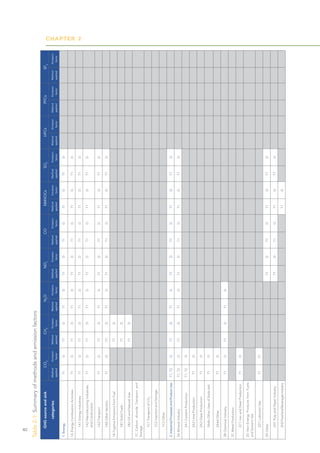
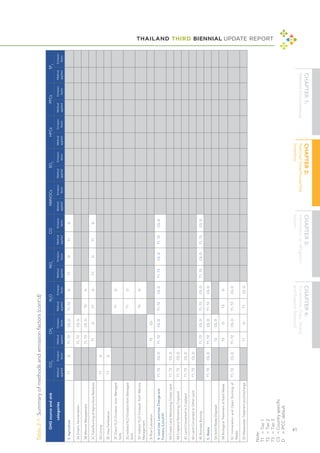
Table 2-1 Summary of methods and emission factors					 40
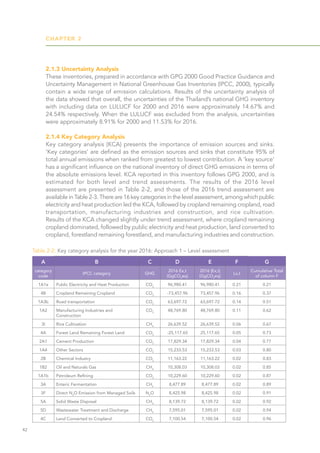
Table 2-2 Key category analysis for the year 2016: Approach 1 – Level assessment	 42
Table 2-3 Key category analysis for the year 2016: Approach 2 – Trend assessment	 43
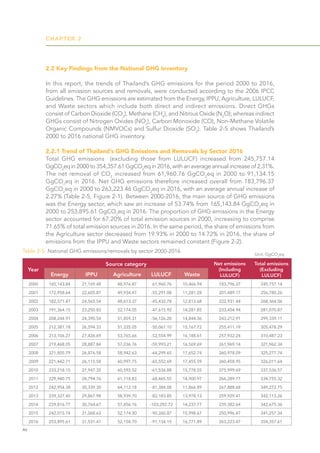
Table 2-4 National greenhouse gas inventory of Thailand 2016			 44
Table 2-5 National GHG emissions/removals by sector 2000-2016			 46
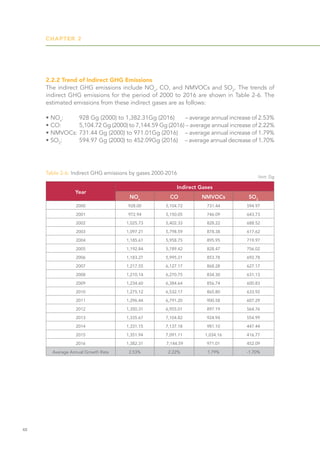
Table 2-6 Indirect GHG emissions by gases 2000-2016				 48
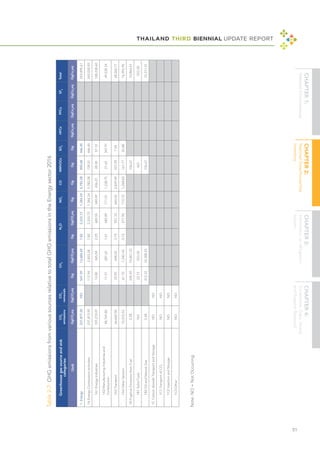
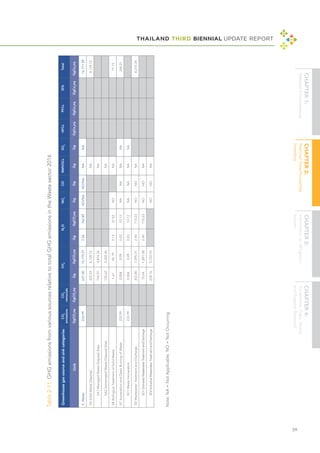
Table 2-7 GHG emissions from various sources relative to total GHG
	 emissions in the Energy sector 2016						 51
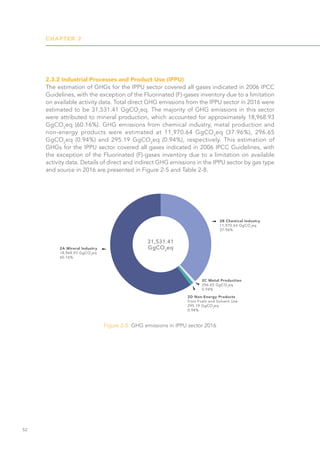
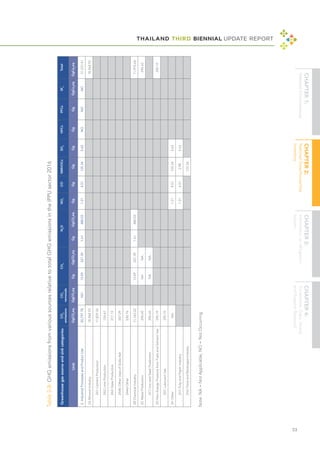
Table 2-8 GHG emissions from various sources relative to total GHG
	 emissions in the IPPU sector 2016						 53
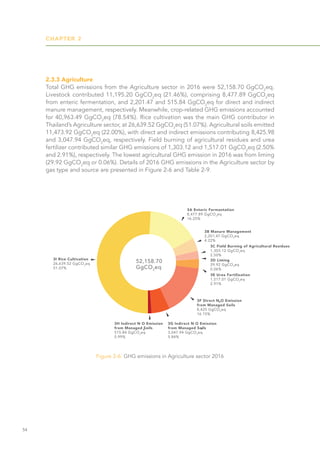
Table 2-9 GHG emissions from various sources relative to total GHG
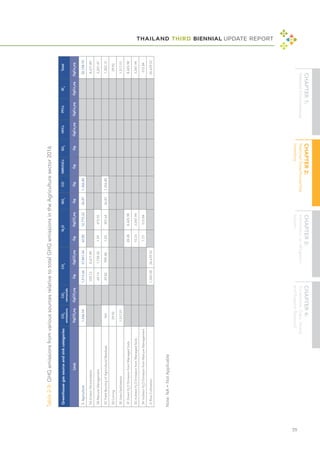
	 emissions in the Agriculture sector 2016					 55
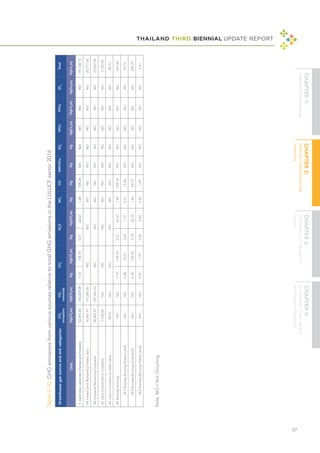
Table 2-10 GHG emissions from various sources relative to total GHG
	 emissions in the LULUCF sector 2016					 57
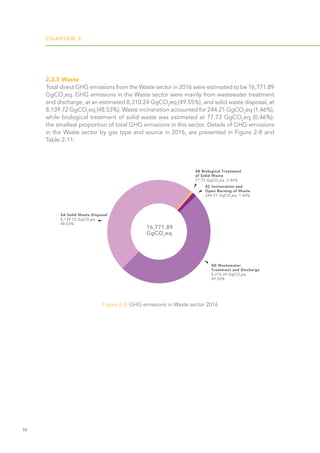
Table 2-11 GHG emissions from various sources relative to total GHG
	 emissions in the Waste sector 2016						 59
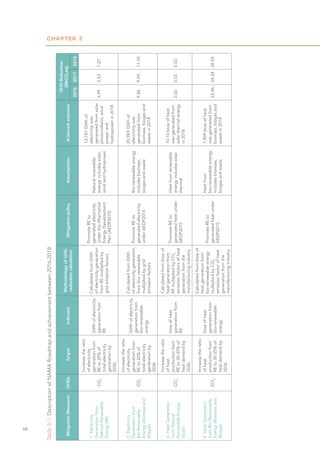
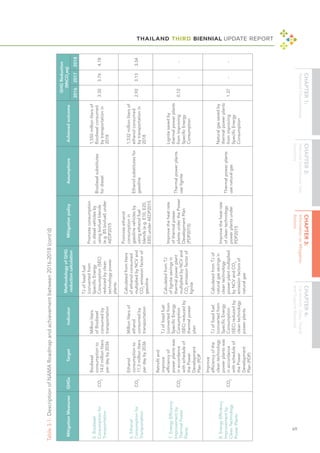
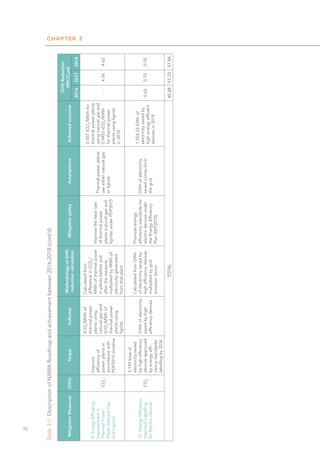
Table 3-1 Description of NAMA Roadmap and achievement between 2016-2018		 68
Table 3-2 Mitigation measures under Thailand’s NDC Action Plan (2021-2030)		 71
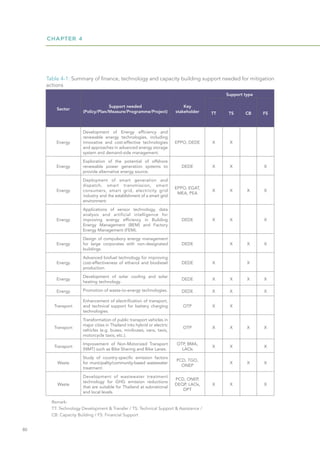
Table 4-1 Summary of finance, technology and capacity building support needed
	 for mitigation actions							 80
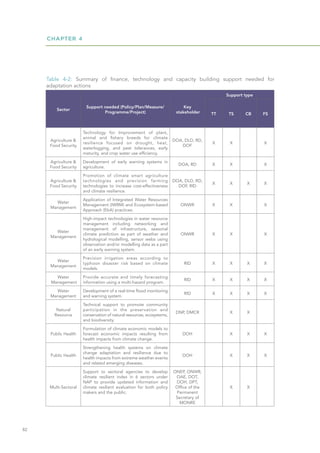
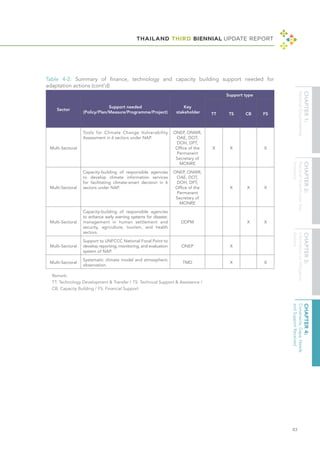
Table 4-2 Summary of finance, technology and capacity building support needed
	 for adaptation actions							 82
Table 4-3 Summary of finance, technology and capacity building support needed
	 for enabling environment							 84
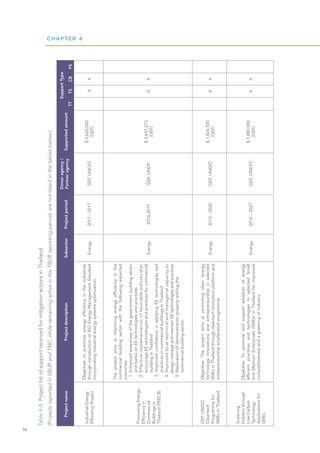
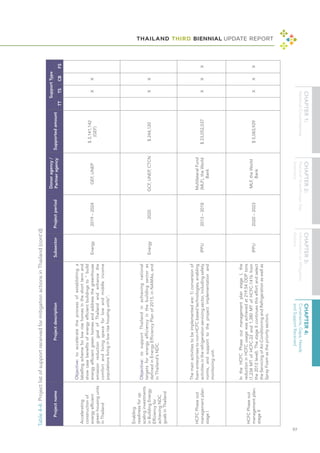
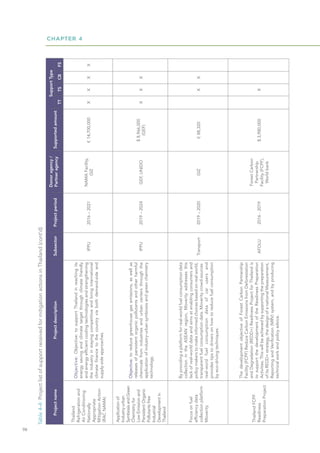
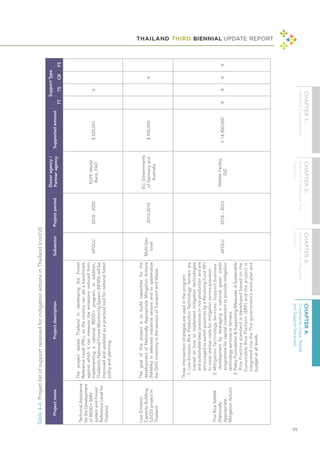
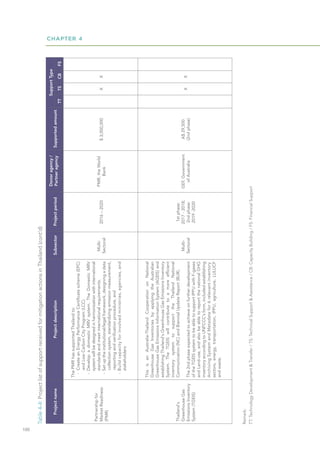
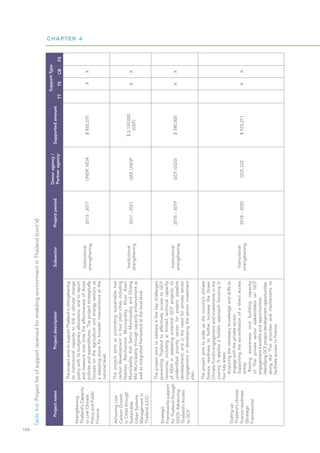
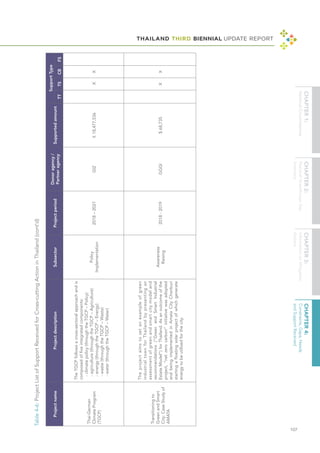
Table 4-4 Project list of support received for mitigation actions in Thailand		 96
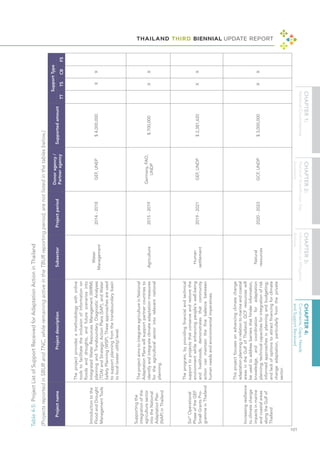
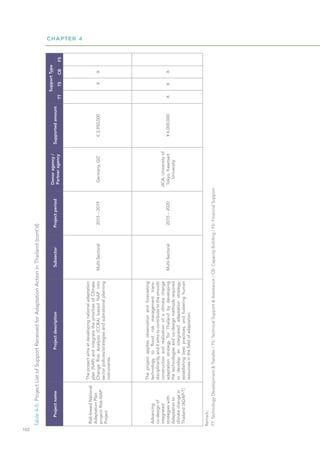
Table 4-5 Project list of support received for adaptation actions in Thailand		 101
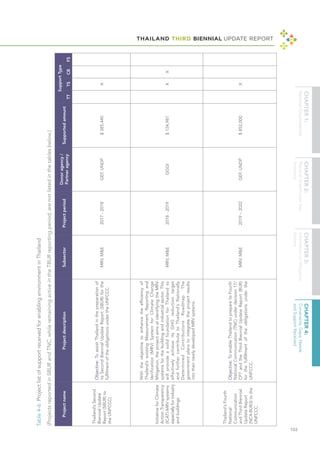
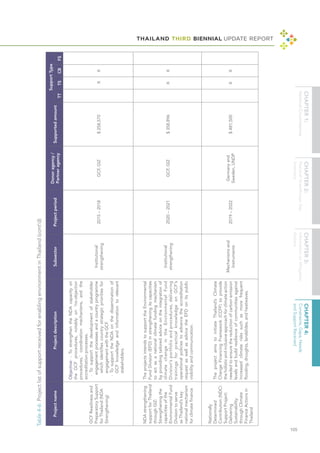
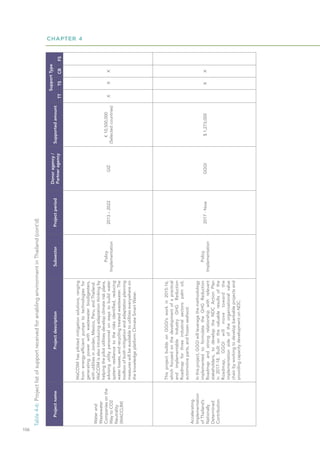
Table 4-6 Project list of support received for enabling environment in Thailand		 103
THAILAND THIRD BIENNIAL UPDATE REPORT
LIST OF FIGURES
Figure 1-1 Map of the Kingdom of Thailand						 3
Figure 1-2 Thailand’s six regions division						3
Figure 1-3 Population and annual growth rate 1995-2018				 4
Figure 1-4 Age structure of Thailand 2020-2040					 5
Figure 1-5 Aging index and total projected population 2020-2040			 6
Figure 1-6 Urbanization rate 2010-2040						6
Figure 1-7 Annual mean maximum temperature in Thailand (°C) 1981-2019		 7
Figure 1-8 Annual mean minimum temperature in Thailand (°C) 1981-2019		 8
Figure 1-9 Annual mean temperature (dry bulb) in Thailand (°C) 1981-2019		 8
Figure 1-10 Annual mean rainfall in Thailand (mm) 1981-2019				 9
Figure 1-11 Share of land use in Thailand in 2018					 10
Figure 1-12 National biodiversity target for 2017-2021					 14
Figure 1-13 State of surface water quality 2009-2018					 16
Figure 1-14 State of coastal water quality 2009-2018					 16
Figure 1-15 The proportion of solid waste generated, re-utilized, disposed
	 appropriately and disposed inappropriately 2009-2018			 17
Figure 1-16 Final energy consumption by fuel type 2018				 19
Figure 1-17 Share of final energy consumption by economic sectors 2018		 20
Figure 1-18 Share of final energy production by fuel type 2018				 21
Figure 1-19 Share of imported energy 2018						22
Figure 1-20 Share of exported energy 2018						22
Figure 1-21 Agriculture and Non-agriculture contribution to employment		 26
Figure 1-22 Poverty line, poverty rate and number of the poor 2014-2018		 27
Figure 1-23 Inequality of poor household between urban and rural areas 2014-2018	 27
Figure 1-24 Biennial Gini coefficient in Thailand, showing urban, rural and
	 national levels 2009-2017							 28
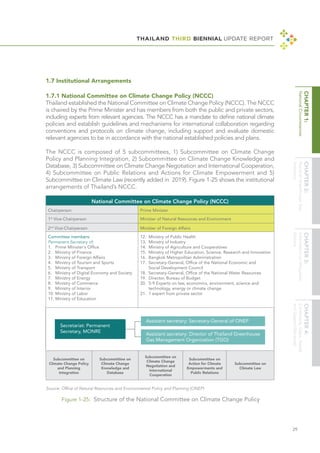
Figure 1-25 Structure of the National Committee on Climate Change Policy		 29
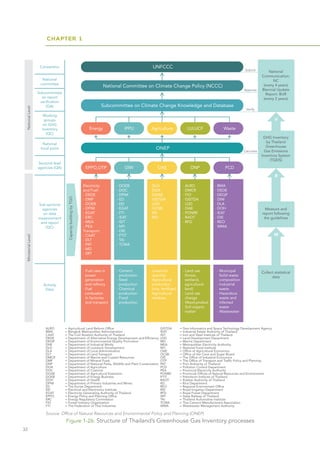
Figure 1-26 Structure of Thailand’s Greenhouse Gas Inventory processes		 32
Figure 1-27 The structure of domestic MRV system					 34
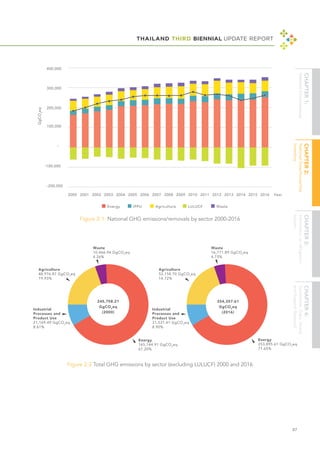
Figure 2-1 National GHG emissions/removals by sector 2000-2016			 47
Figure 2-2 Total GHG emissions by sector (exclude LULUCF) 2000 and 2016		 47
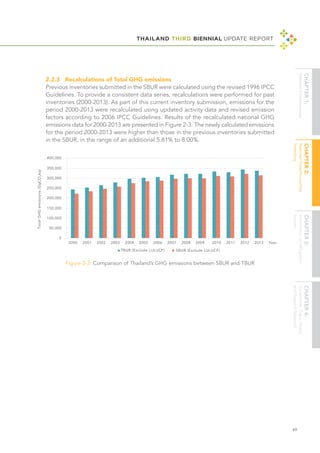
Figure 2-3 Comparison of Thailand’s GHG emissions between SBUR and TBUR		 49
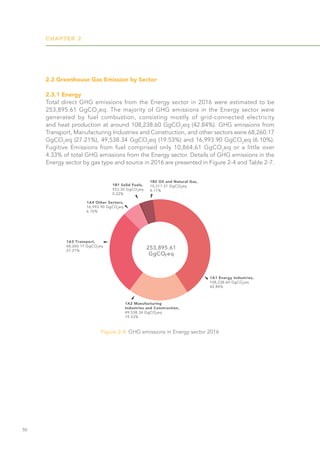
Figure 2-4 GHG emissions in Energy sector 2016					 50
Figure 2-5 GHG emissions in IPPU sector 2016					 52
Figure 2-6 GHG emissions in Agriculture sector 2016					 54
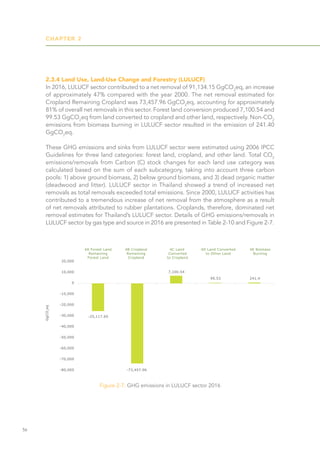
Figure 2-7 GHG emissions in LULUCF sector 2016					 56
Figure 2-8 GHG emissions in Waste sector 2016					 58
Figure 4-1 Summary of all support received						90
Figure 4-2 Support received for mitigation actions					 91
Figure 4-3 Support received for adaptation actions					 92
Figure 4-4 Support received for enhancing enabling environment			 93
Figure 4-5 Support received by support type						94
LIST OF ACRONYMS, ABBREVIATIONS AND UNITS
3Rs 			 Reduce, Reuse and Recycle
AEDP 			 Alternative Energy Development Plan
AFOLU 			 Agriculture, Forest and Other Land Use
AI 			 Artificial Intelligence
BAU 			Business-As-Usual
BUR 			 Biennial Update Report
COP 			 Conference of the Parties
EEC			 Eastern Economic Corridor
EEP 			 Energy Efficiency Plan
EF 			 Emission Factor
EI 			 Energy Intensity
FNC 			 Fourth National Communication
F-Gases 		 Fluorinated Gases
GCF 			 Green Climate Fund
GDP 			 Gross Domestic Product
GEF 			 Global Environment Facility
GHG 			 Greenhouse Gas
GWP 			 Global Warming Potential
IKI 			 International Climate Initiative
INDC 			 Intended Nationally Determined Contribution
IPPU 			 Industrial Processes and Product Use
JCM 			 Joint Crediting Mechanism
KCA 			 Key Category Analysis
LULUCF 		 Land Use, Land-Use Change and Forestry
MRV 			 Measurement, Reporting and Verification
MSW 			 Municipal Solid Waste
NA 			 Not Applicable
THAILAND THIRD BIENNIAL UPDATE REPORT
NAMA	 		 Nationally Appropriate Mitigation Action
NAP 			 National Adaptation Plan
NBSAPs		 National Biodiversity Strategies and Action Plans
NC 			 National Communication
NCCC 			 National Committee on Climate Change Policy
NDC 			 Nationally Determined Contribution
NE 			 Not Estimated
NO 			 Not Occurring
PM 			 Particulate Matter
PMR 			 Partnership for Market Readiness
PPP 			 Polluter Pays Principle
QA 			 Quality Assurance
QC 			 Quality Control
RAC 			 Refrigeration and Air Conditioning
REDD+ 		 Reducing Emissions from Deforestation and Forest Degradation in
			
			 Developing Countries (REDD); and the role of conservation, sustainable
			
			 management of forests and enhancement of forest carbon stocks in
			
			Developing countries (+)
SBUR 			 Second Biennial Update Report
SDGs 			 Sustainable Development Goals
SMEs 			 Small and Medium-sized Enterprises
TBUR 			 Third Biennial Update Report
TGCP 			 Thai-German Climate Programme
TGEIS 			 Thailand Greenhouse Gas Emission Inventory System
T-PLAT	 		 Thailand Climate Change Adaptation Information Platform
WEEE 			 Waste Electrical and Electronic Equipment
GASES
CH4
			Methane
CO 			 Carbon Monoxide
CO2
			 Carbon Dioxide
HFCs 			 Hydrofluorocarbons
N2
O 			 Nitrous Oxide
NMVOCs 		 Non-Methane Volatile Organic Compounds
NOX
			 Nitrogen Oxides
O3
			Ozone
PFCs 			 Perfluorocarbons
SF6
			 Sulphur Hexafluoride
SO2
			 Sulphur Dioxide
UNITS
$ 			 United States Dollar (USD)
¥			Japanese Yen
€ 			 Euro (EUR)
°C 			 Degree Celsius
A$ 			 Australian Dollar
Gg 			 Giga (represents a factor of 109
)
kg 			 Kilogram (represents a factor of 103
)
km 			 Kilometer (represents a factor of 103
)
km2
			Square kilometer
ktoe 			 Kilo ton of oil equivalent
M 			 Million (represents a factor of 106
)
m3
			 Cubic meter
mm 			 Millimeter (represents a factor of 10-3
)
tCO2
eq 		 Ton of Carbon Dioxide Equivalent
THB			Thai Baht
THAILAND THIRD BIENNIAL UPDATE REPORT
ORGANIZATIONS
ADB 			 Asian Development Bank
ALRO 			 Agricultural Land Reform Office
BB 			 Bureau of the Budget
BMA 			 Bangkok Metropolitan Administration
BMU 			 Federal Ministry for the Environment, Nature Conservation,
			 Building and Nuclear Safety
CAAT 			 The Civil Aviation Authority of Thailand
DDPM			 Department of Disaster Prevention and Mitigation
DEDE 			 Department of Alternative Energy Development and Efficiency
DEQP 			 Department of Environmental Quality Promotion
DIO 			 Department of International Organizations
DIW 			 Department of Industrial Works
DLA 			 Department of Local Administration
DLD 			 Department of Livestock Development
DLT 			 Department of Land Transport
DMCR 			 Department of Marine and Coastal Resources
DMF 			 Department of Mineral Fuels
DNP 			 Department of National Parks, Wildlife and Plant Conservation
DOA 			 Department of Agriculture
DOAE 			 Department of Agricultural Extension
DOC 			 Department of Customs
DOEB 			 Department of Energy Business
DOF 			 Department of Fisheries
DOH 			 Department of Health
DOPA 			 Department of Provincial Administration
DOT			 Department of Tourism
DPIM 			 Department of Primary Industries and Mines
ED			 The Excise Department
EEI 			 Electrical and Electronics Institute
EGAT 			 Electricity Generating Authority of Thailand
EPPO 			 Energy Policy and Planning Office
ERC 			 Energy Regulatory Commission
EU 			 European Union
FAO 			 Food and Agriculture Organization
FIO 			 Forest Industry Organization
FPO			 Fiscal Policy Office
FTI 			 The Federation of Thai Industries
GISTDA 		 Geo-Informatics and Space Technology Development Agency
GIZ 			 The Deutsche Gesellschaft für Internationale Zusammenarbeit (GIZ)
GmbH (German development agency)
IEAT			 Industrial Estate Authority of Thailand
IPCC 			 Intergovernmental Panel on Climate Change
ISIT 			 Iron and Steel Institute of Thailand
JICA 			 Japan International Cooperation Agency
LAOs 			 Local Administrative Organizations
LDD 			 Land Development Department
MD 			 Marine Department
MEA 			 Metropolitan Electricity Authority
MOE			 Ministry of Education
MOI			 Ministry of Interior
MONRE 		 Ministry of Natural Resources and Environment
NESDC 		 Office of the National Economic and Social Development Council
NFI 			 National Food Institute
NRCT 			 National Research Council of Thailand
NSO 			 National Statistical Office
THAILAND THIRD BIENNIAL UPDATE REPORT
OAE 			 Office of Agricultural Economics
OCSB 			 Office of the Cane and Sugar Board
OIE 			 The Office of Industrial Economics
ONEP 			 Office of Natural Resources and Environmental Policy and Planning
ONWR 			 Office of the National Water Resources
OTP 			 The Office of Transport and Traffic Policy and Planning
PAT			 Port Authority of Thailand
PCD 			 Pollution Control Department
PEA 			 Provincial Electricity Authority
PONRE 		 Provincial Offices of Natural Resources and Environment
PTIT 			 Petroleum Institute of Thailand
RAOT 			 Rubber Authority of Thailand
RD 			 Rice Department
REO 			 Regional Environment Office
RFD 			 Royal Forest Department
RID 			 Royal Irrigation Department
SRT 			 State Railway of Thailand
TAI 			 Thailand Automotive Institute
TCMA 			 Thai Cement Manufacturers Association
TGO 			 Thailand Greenhouse Gas Management Organization
TMD 			 Thai Meteorological Department
UN 			 United Nations
UNDP 			 United Nations Development Programme
UNEP 			 United Nations Environment Programme
UNFCCC 		 United Nations Framework Convention on Climate Change
UNIDO 		 United Nations Industrial Development Organization
WMA 			 Wastewater Management Authority
Ⅰ
EXECUTIVE SUMMARY
As a developing country highly vulnerable to the impacts of climate change, Thailand attaches
great importance to the global efforts to address this common and pressing challenge. Climate
change is currently addressed at the highest policy level in Thailand under the National Strategy
2018-2037 to ensure a long-term continuity of the issue alongside other economic and social
considerations, including poverty eradication. The Climate Change Master Plan 2015-2050 was
developed to reflect Thailand’s strategy on climate change mitigation, adaptation, capacity
building and cross-cutting issues. Climate change adaptation and mitigation are becoming more
deeply embedded in governmental structures in line with the increasing profile of climate actions
in national agendas.
Thailand as a Non-Annex I Party to the United Nations Framework Convention on Climate
Change (UNFCCC), is obligated to submit National Communications (NCs) every 4 years and
Biennial Update Reports (BURs) every 2 years. Thailand submitted its first BUR on 29 December
2015 and its second BUR on 29 December 2017. Thailand has actively implemented climate
actions and shared the results to UNFCCC and the global community. Thailand has established
the inter-ministerial committees to oversee climate policy development and implementation
and comprehensive national systems to monitor, evaluate and report on progress. Thailand will
continue to work relentlessly with the global community in order to address the challenges of
climate change. The global outbreak of novel coronavirus (COVID-19) has dramatically threatened
the way people conduct their daily life. The so-called “New Normal” that emerges after the
pandemic will reshape many economic and social activities. As Thailand plans its recovery from
this pandemic, Thailand aims to use this opportunity to build back better an ecosystem and
economy that promotes climate-resilient and sustainable development, including through the
implementation of NDC.
This report, the third BUR (TBUR), has demonstrated the country’s intention to work with the
global community to tackle climate change. According to Conference of the Parties (COP) guidelines,
the TBUR has been updated and strengthened to provide information regarding national
circumstances, national greenhouse gas (GHG) inventories, progress made on climate actions,
as well as national gaps, international support received, and international support needs in terms
of finance, technology development and transfer, and capacity building in order to overcome
the existing constraints on tackling climate change. This BUR consists of 4 chapters as follows:
THAILAND THIRD BIENNIAL UPDATE REPORT
Ⅱ
NATIONAL CIRCUMSTANCES
Thailand is a developing country highly vulnerable to the impacts of climate change and is ranked,
by Global Climate Risk Index (CRI), as the 8th
most affected countries in the period 1999-2018.
This shows that Thailand is increasingly at risk of either frequent events or rare, but extraordinary
catastrophes and is vulnerable to future climate change impacts over the next thirty years.
The Kingdom of Thailand is located in Southeast Asia and covers an area of 513,115 km2
with
total coastline of about 2,815 km. Under the climate change crisis, Thailand's coastal zone is one
of the most vulnerable areas and it is at greater risk of intensive flooding resulting from sea-level
rising and coastal erosion in several provinces, including the capital and its perimeter provinces.
The total population of Thailand as of 2018 was 66,413,979; making it the 20th
most populated
country in the world. The national population trend is predicted to move Thailand towards an
aging society by around 2025, with the urban population comprising three quarters of the total,
leaving only a quarter of the total population living in rural areas by 2040. Although Thailand is a
small country, there are considerable variations in the topography and climate patterns of each
region. Thailand’s climate is under the influence of two main monsoon winds, which produce three
seasons: hot, cool and wet. Temperature fluctuations and changes in Thailand in recent years have
produced above average temperatures and this trend is likely to continue. While the number of
rainy days has decreased, total annual rainfall trends have shown an increase. Precipitation has
frequently fluctuated over time.
The majority of land use in Thailand is for agriculture for about 47% and almost half of agricultural
land is attributed to paddy use. In terms of water resources, Thailand has had periodic issues
with household water shortages in villages, in addition to experiencing periodic droughts and
flooding. In order to facilitate more effective management of national water resources, Thailand
has formulated a Water Resource Management Strategy (2015-2026) as well as a 20-Year National
Water Resources Management Plan (2018-2037). Thailand has furthermore developed similar
strategies to address other aspects of the environment, including the 20-Year Master Plan on
Air Quality Management (2018-2037), the 20-Year National Plan for Water Quality Management
(2018-2037), the 20-Year Master Plan on Prevention and Mitigation of Solid Waste Problems and
the 20-Year Pollution Management Strategy (2018-2037). Regarding Thailand’s environmental
quality, levels of both air and water quality in 2018 were relatively stable. The main air pollutants
that have continued to exceed guidelines are PM2.5
, PM10
and ozone. Overall water quality has
improved and remained within ‘fair’ or ‘good’ quality ranges. The amount of waste generated in
2018 from both municipal solid waste (27.93 million tons) and municipal hazardous waste (638,000
tons) has increased, although waste management practices have shown signs of improvement.
Meanwhile, the amount of infectious waste in 2018 decreased alongside the amount of industrial
waste that was pulled into the managing system (which decreased by 33% compared to 2017).
In 2018, the majority of final energy consumption came from petroleum products, which totaled
49.29% of total consumption, followed by electricity, natural gas and coal. Within the economic
sector, transportation was responsible for the largest consumption of energy at 39.41%, followed
by the industrial sector (36.26%), residential sector (13.10%), commercial (7.80%), and finally the
Ⅲ
agricultural sector (3.43%). Total energy production was 72,609 ktoe, with natural gas in commercial
energy contributing the largest source of energy, comprising 42.86% of the total, followed by
renewable energy (23.63%) and traditional renewable energy (9.66%). Thailand’s alternative
energy consumption was 12,996 ktoe; a figure that has increased steadily from 2013-2018.
Alternative energy consumption in terms of electricity, heat, and biofuel (ethanol and biodiesel)
shared 15.5% of the total final energy consumption.
Thailand’s economy has operated under the 12th
National Economic and Social Development Plan
(2017-2021) and constitutes a mix of agriculture, industry, tourism, service and natural resources.
The Thai economy in 2018 grew by 4.1%, up from 4.0% in 2017; the highest expansion rate in 6
years. Export value grew by 7.7%, while private consumption and total investment grew by 4.6
and 3.8% respectively. While the agricultural sector typically accounts for over 30% of employment,
it only contributes around 8% of Thailand’s GDP – although this contribution remained relatively
constant between 2016-2018. Conversely, the tourism industry generated around 15% of GDP
during this same time period, while providing only 10.9% of total employment. As the agriculture
and tourism are key sectors in socio-economy aspect of the country, actions must be taken to
build resilient for climate crisis.
Thailand established the National Committee on Climate Change Policy (NCCC) in 2007 in order to
fulfill Thailand’s commitments under the UNFCCC and to define national climate policies. Currently, the
NCCC is composed of 5 subcommittees: 1) Subcommittee on Climate Change Policy and Planning
Integration, 2) Subcommittee on Climate Change Knowledge and Database, 3) Subcommittee on
Climate Change Negotiation and International Cooperation, 4) Subcommittee on Public Relations
and Actions for Climate Empowerment, and 5) Subcommittee on Climate Law (added in 2019).
Furthermore, Thailand has updated its National Greenhouse Gas Inventory in accordance with
the 2006 Intergovernmental Panel on Climate Change (IPCC) Guidelines, including by applying
Thailand Greenhouse Gas Emission Inventory System (TGEIS). Adjustments have also been made
to the sub-sectoral working groups responsible for data collection in estimating GHG emissions
for 5 sectors in the GHG inventory.
THAILAND THIRD BIENNIAL UPDATE REPORT
Ⅳ
NATIONAL GREENHOUSE GAS INVENTORY
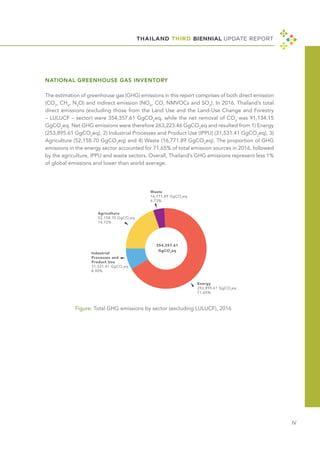
The estimation of greenhouse gas (GHG) emissions in this report comprises of both direct emission
(CO2
, CH4
, N2
O) and indirect emission (NOX
, CO, NMVOCs and SO2
). In 2016, Thailand’s total
direct emissions (excluding those from the Land Use and the Land-Use Change and Forestry
– LULUCF – sector) were 354,357.61 GgCO2
eq, while the net removal of CO2
was 91,134.15
GgCO2
eq. Net GHG emissions were therefore 263,223.46 GgCO2
eq and resulted from 1) Energy
(253,895.61 GgCO2
eq), 2) Industrial Processes and Product Use (IPPU) (31,531.41 GgCO2
eq), 3)
Agriculture (52,158.70 GgCO2
eq) and 4) Waste (16,771.89 GgCO2
eq). The proportion of GHG
emissions in the energy sector accounted for 71.65% of total emission sources in 2016, followed
by the agriculture, IPPU and waste sectors. Overall, Thailand’s GHG emissions represent less 1%
of global emissions and lower than world average.
Figure: Total GHG emissions by sector (excluding LULUCF), 2016
Ⅴ
INFORMATION ON MITIGATION ACTIONS
Thailand have incorporated climate change into its national economic and social development
plans since 2007. Climate change is currently addressed at the highest policy level under the
National Strategy (2018-2037) to ensure a long-term continuity of the issue alongside other economic
and social considerations. The Climate Change Master Plan 2015-2050 reflects on climate change
mitigation, adaptation, capacity building and enabling environment issues.
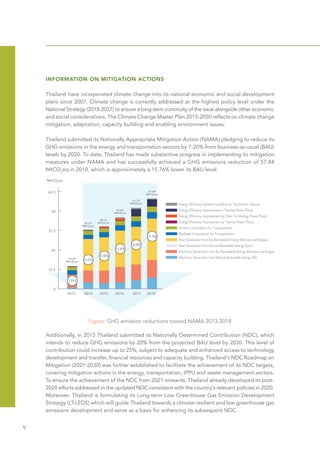
Thailand submitted its Nationally Appropriate Mitigation Action (NAMA) pledging to reduce its
GHG emissions in the energy and transportation sectors by 7-20% from business-as-usual (BAU)
levels by 2020. To date, Thailand has made substantive progress in implementing its mitigation
measures under NAMA and has successfully achieved a GHG emissions reduction of 57.84
MtCO2
eq in 2018, which is approximately a 15.76% lower its BAU level.
Additionally, in 2015 Thailand submitted its Nationally Determined Contribution (NDC), which
intends to reduce GHG emissions by 20% from the projected BAU level by 2030. This level of
contribution could increase up to 25%, subject to adequate and enhanced access to technology
development and transfer, financial resources and capacity building. Thailand's NDC Roadmap on
Mitigation (2021-2030) was further established to facilitate the achievement of its NDC targets,
covering mitigation actions in the energy, transportation, IPPU and waste management sectors.
To ensure the achievement of the NDC from 2021 onwards, Thailand already developed its post-
2020 efforts addressed in the updated NDC consistent with the country’s relevant policies in 2020.
Moreover, Thailand is formulating its Long-term Low Greenhouse Gas Emission Development
Strategy (LT-LEDS) which will guide Thailand towards a climate-resilient and low greenhouse gas
emissions development and serve as a basis for enhancing its subsequent NDC.
Figure: GHG emission reductions toward NAMA 2013-2018
THAILAND THIRD BIENNIAL UPDATE REPORT
Ⅵ
CONSTRAINTS, GAPS, NEEDS AND SUPPORT RECEIVED
Key constraints and gaps were identified which include capacities and resources of governmental
agencies, private sectors, and public for preparing and implementing climate actions. The provision
of support and cooperation are important to achieving mitigation and adaptation objectives and
increasing ambition. To enhance Thailand’s effective implementation of mitigation, adaptation
and climate resilient actions towards the ultimate objective of the UNFCCC and the goal of Paris
Agreement, adequate and predictable means of implementation in terms of finance, technology
development and transfer, and capacity building are needed.
Several of the proposed measures and actions in climate mitigation and adaptation plans require
extremely high investment, strong institutional structure, innovative technology as well as human
capacity. Main support needed were identified which include an increase in capacities and
resources of governmental agencies, private sectors, and public to take climate actions. At
present, the responsible public agencies still have limited capacity to develop information services
for facilitating climate-smart decision. Therefore, Thailand needs international supports to build
proper enabling environment and take climate actions in both mitigation and adaptation. To
enhance Thailand’s effective implementation of mitigation, adaptation, and climate resilient
actions towards the goal of Paris Agreement, the support needed by Thailand and the support
provided by international partners shall be aligned.
1
CHAPTER 1
NATIONAL CIRCUMSTANCES
THAILAND THIRD BIENNIAL UPDATE REPORT
CHAPTER 1
2
CHAPTER 1: NATIONAL CIRCUMSTANCES
Source: 1) Department of Marine and Coastal Resources 2) Thailand’s Second Assessment Report on Climate Change
2016, Thailand Research Fund
1.1 Physical Context
1.1.1 Geography
Thailand, officially the Kingdom of Thailand, is situated in Southeast Asia between latitudes
5° 37’ N and 20° 27’ N and longitudes 97° 22’ E and 105° 37’ E, covering a total area of
513,115 km2. To the north, it borders with Myanmar and Laos, and to the east with Laos
and Cambodia. To the south lies Malaysia and the Gulf of Thailand, while westwards sits
Myanmar and the Andaman Sea. The dominant topography of the country is littoral area
with the coastal zone including the Gulf of Thailand coast and the Andaman sea coast.
The total coastal length is about 2,815 km including Andaman Sea coast 937 km and Gulf
of Thailand coast 1,878 km Thailand's coastal zone is one of the most vulnerable area
from climate change. In the recent years, Thailand coastal areas around 155 locations
with approximately 600 km (23% of Thailand coastline) has been encountered a coastal
erosion crisis with an erosion rate from 1 - 5 meters per year which refer to the land loss
at 2 km2
per year or the value of economic damage up to 6,000 million Baht. They are
economic important areas where 23 provinces are located with approximately 12 million
of population living in the areas. The area is not only an economic area for tourism and
fishery industry but also is home to coastal fishery communities which those coastal
communities are hardly inevitably affected by climate crisis. On top of that, Bangkok and
its perimeter provinces surrounded by the coast and rivers are ranked as one of the top
cities in the world at the highest risk of intensive flooding resulting from precipitation
change, sea-level rising and coastal erosion under climate change.
Thailand is a developing country highly vulnerable to the impacts of climate change and
is ranked, by Global Climate Risk Index (CRI), as the 8th
most affected countries in the
period 1999-2018.
Thailand has established the inter-ministerial committees to oversee climate policy
development and implementation and comprehensive national systems to monitor,
evaluate and report on progress. Thailand will continue to work relentlessly with the global
community in order to address the challenges of climate change.
THAILAND THIRD BIENNIAL UPDATE REPORT
3
Bhumibol
Dam
Sirikit
Dam
Ko Samui
Ko Phangan
Ko Kut
Ko Chang
Ko Phuket
Isthmus of Kra
Ko
Phra Thong
Ko
Lanta
Ko
Tarutao
D
a
w
n
a
R
a
n
g
e
Tanen Range
K h o r a t
P l a t e a u
Dangrek Range
Nakhon Pathom
Ratchaburi
Phetchaburi
Mae Sot
Uthai Thani
Tak
Sukhothai
Sattahip
Bua Yai
Aranyaprathet
Loei
Uttaradit
Fang
Phayao
Kota Baharu
Hat Yai
Betong
Thung Song
Ranong
Trang
Sungai
Kolok
Sungai
Petani
Nam
Tok
Nakhon
Phanom
Sakon
Nakhon
Ubon
Ratchathani
Rayong
Ban
Takhun
Samut
Prakan
Si Ayutthay
a
Phra Nakhon
Kanchanaburi
Chaiyaphum
Buriram
Surin
Chachoengsao
Chon Buri
Trat
Phrae
Lampang
Phetchabun
Nong Khai
Kalasin
Yasothon
Nan
Chiang Rai
Roi Et
Ho Chi Minh
City
Narathiwat
Yala
Pattani
Phangnga
Chumphon
Mae
Hong Son
Mae
Sariang
Nakhon
Sawan
Suphan
Buri
Prachuap
Khiri Khan
Nakhon
Si Thammarat
Surat
Thani
Udon Thani
Chiang Mai
Phitsanulok
Songkhla
Phuket
Khon
Kaen
Nakhon
Ratchasima
Phnom Penh
V
ientiane
(
Viengchan)
Bangkok
(Krung Thep)
VIET NAM
MALAYSIA
MYANMAR
C A M B O D I A
LAO PEOPLE'S
DEM
O
C
R
A
T
I
C
R
E
P
U
B
L
I
C
A ND A MA N
S E A
Gulf of Thailand
Tonle Sap
SOUTH CHINA
SEA
Gulf of
Martaban
Gulf of
Tonkin
S t r a i t o f M
a l a c ca
Mekong
S
a
l
w
e
e
n
A
y
e
y
a
r
w
a
d
y
(
I
r
r
a
w
a
d
d
y
)
M
e
k
ong
Mun
Ch
i
Y
o
m
N
a
n
P
a
S
a
k
W
a
n
g
Songkhram
M
a
e
K
h
l
o
n
g
C
h
a
o
P
h
r
a
y
a
Pin
g
Me
k
o
n
g
THAILAND
0 50 100 150 200 km
0 50 100 150 mi
National capital
Town, village
Major airport
International boundary
Expressway
Main road
Railroad
Department of Field Support
Cartographic Section
Map No. 3853 Rev. 2 UNITED NATIONS
July 2009
The boundaries and names shown and the designations
used on this map do not imply official endorsement or
acceptance by the United Nations.
THAILAND
Naypyitaw
Source: Department of Field Support Cartographic Section, United Nations
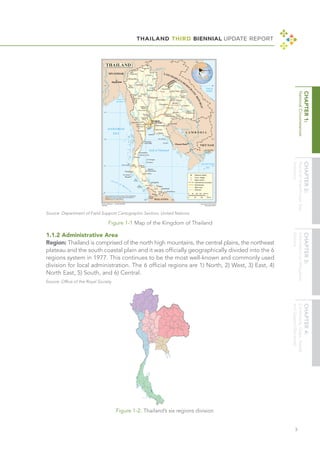
Source: Office of the Royal Society
Figure 1-1 Map of the Kingdom of Thailand
Figure 1-2: Thailand’s six regions division
1.1.2 Administrative Area
Region: Thailand is comprised of the north high mountains, the central plains, the northeast
plateau and the south coastal plain and it was officially geographically divided into the 6
regions system in 1977. This continues to be the most well-known and commonly used
division for local administration. The 6 official regions are 1) North, 2) West, 3) East, 4)
North East, 5) South, and 6) Central.
CHAPTER 1
4
1.1.3 Population
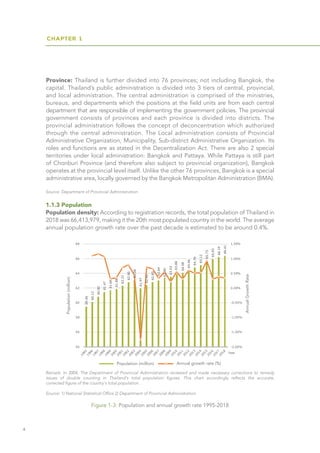
Population density: According to registration records, the total population of Thailand in
2018 was 66,413,979, making it the 20th most populated country in the world. The average
annual population growth rate over the past decade is estimated to be around 0.4%.
Remark: In 2004, The Department of Provincial Administration reviewed and made necessary corrections to remedy
issues of double counting in Thailand's total population figures. This chart accordingly reflects the accurate,
corrected figure of the country's total population.
Source: 1) National Statistical Office 2) Department of Provincial Administration
Figure 1-3: Population and annual growth rate 1995-2018
Source: Department of Provincial Administration
Province: Thailand is further divided into 76 provinces; not including Bangkok, the
capital. Thailand’s public administration is divided into 3 tiers of central, provincial,
and local administration. The central administration is comprised of the ministries,
bureaus, and departments which the positions at the field units are from each central
department that are responsible of implementing the government policies. The provincial
government consists of provinces and each province is divided into districts. The
provincial administration follows the concept of deconcentration which authorized
through the central administration. The Local administration consists of Provincial
Administrative Organization, Municipality, Sub-district Administrative Organization. Its
roles and functions are as stated in the Decentralization Act. There are also 2 special
territories under local administration: Bangkok and Pattaya. While Pattaya is still part
of Chonburi Province (and therefore also subject to provincial organization), Bangkok
operates at the provincial level itself. Unlike the other 76 provinces, Bangkok is a special
administrative area, locally governed by the Bangkok Metropolitan Administration (BMA).
THAILAND THIRD BIENNIAL UPDATE REPORT
5
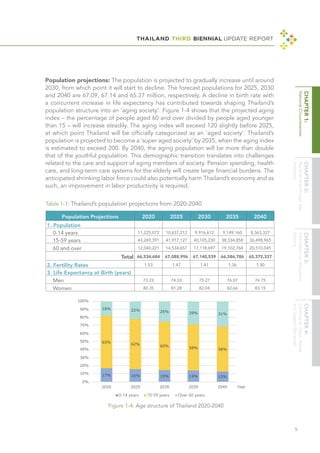
Population projections: The population is projected to gradually increase until around
2030, from which point it will start to decline. The forecast populations for 2025, 2030
and 2040 are 67.09, 67.14 and 65.37 million, respectively. A decline in birth rate with
a concurrent increase in life expectancy has contributed towards shaping Thailand’s
population structure into an ‘aging society’. Figure 1-4 shows that the projected aging
index – the percentage of people aged 60 and over divided by people aged younger
than 15 – will increase steadily. The aging index will exceed 120 slightly before 2025,
at which point Thailand will be officially categorized as an ‘aged society’. Thailand’s
population is projected to become a ‘super aged society’ by 2035, when the aging index
is estimated to exceed 200. By 2040, the aging population will be more than double
that of the youthful population. This demographic transition translates into challenges
related to the care and support of aging members of society. Pension spending, health
care, and long-term care systems for the elderly will create large financial burdens. The
anticipated shrinking labor force could also potentially harm Thailand’s economy and as
such, an improvement in labor productivity is required.
Table 1-1: Thailand’s population projections from 2020-2040
Population Projections 2020 2025 2030 2035 2040
1. Population
0-14 years 11,225,072 10,637,212 9,916,612 9,149,160 8,363,327
15-59 years 43,269,391 41,917,127 40,105,230 38,334,858 36,498,965
60 and over 12,040,221 14,534,657 17,118,697 19,102,768 20,510,045
Total 66,534,684 67,088,996 67,140,539 66,586,786 65,372,337
2. Fertility Rates 1.53 1.47 1.41 1.36 1.30
3. Life Expectancy at Birth (years)
Men 73.23 74.33 75.27 76.07 76.75
Women 80.35 81.28 82.04 82.66 83.15
Figure 1-4: Age structure of Thailand 2020-2040
CHAPTER 1
6
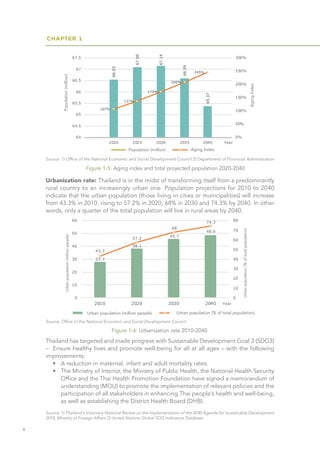
Urbanization rate: Thailand is in the midst of transforming itself from a predominantly
rural country to an increasingly urban one. Population projections for 2010 to 2040
indicate that the urban population (those living in cities or municipalities) will increase
from 43.3% in 2010, rising to 57.2% in 2020, 68% in 2030 and 74.3% by 2040. In other
words, only a quarter of the total population will live in rural areas by 2040.
Source: Office of the National Economic and Social Development Council
Source: 1) Thailand's Voluntary National Review on the Implementation of the 2030 Agenda for Sustainable Development
2018, Ministry of Foreign Affairs 2) United Nations Global SDG Indicators Database
Figure 1-6: Urbanization rate 2010-2040
Thailand has targeted and made progress with Sustainable Development Goal 3 (SDG3)
– Ensure healthy lives and promote well-being for all at all ages – with the following
improvements:
•	 A reduction in maternal, infant and adult mortality rates.
•	 The Ministry of Interior, the Ministry of Public Health, the National Health Security
Office and the Thai Health Promotion Foundation have signed a memorandum of
understanding (MOU) to promote the implementation of relevant policies and the
participation of all stakeholders in enhancing Thai people’s health and well-being,
as well as establishing the District Health Board (DHB).
Source: 1) Office of the National Economic and Social Development Council 2) Department of Provincial Administration
Figure 1-5: Aging index and total projected population 2020-2040
THAILAND THIRD BIENNIAL UPDATE REPORT
7
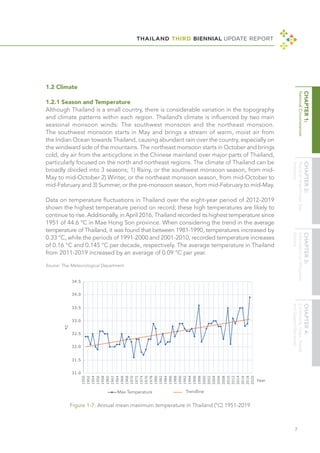
Source: Thai Meteorological Department
Figure 1-7: Annual mean maximum temperature in Thailand (°C) 1951-2019
1.2 Climate
1.2.1 Season and Temperature
Although Thailand is a small country, there is considerable variation in the topography
and climate patterns within each region. Thailand’s climate is influenced by two main
seasonal monsoon winds: The southwest monsoon and the northeast monsoon.
The southwest monsoon starts in May and brings a stream of warm, moist air from
the Indian Ocean towards Thailand, causing abundant rain over the country, especially on
the windward side of the mountains. The northeast monsoon starts in October and brings
cold, dry air from the anticyclone in the Chinese mainland over major parts of Thailand,
particularly focused on the north and northeast regions. The climate of Thailand can be
broadly divided into 3 seasons; 1) Rainy, or the southwest monsoon season, from mid-
May to mid-October 2) Winter, or the northeast monsoon season, from mid-October to
mid-February and 3) Summer, or the pre-monsoon season, from mid-February to mid-May.
Data on temperature fluctuations in Thailand over the eight-year period of 2012-2019
shown the highest temperature period on record; these high temperatures are likely to
continue to rise. Additionally, in April 2016, Thailand recorded its highest temperature since
1951 of 44.6 °C in Mae Hong Son province. When considering the trend in the average
temperature of Thailand, it was found that between 1981-1990, temperatures increased by
0.33 °C, while the periods of 1991-2000 and 2001-2010, recorded temperature increases
of 0.16 °C and 0.145 °C per decade, respectively. The average temperature in Thailand
from 2011-2019 increased by an average of 0.09 °C per year.
CHAPTER 1
8
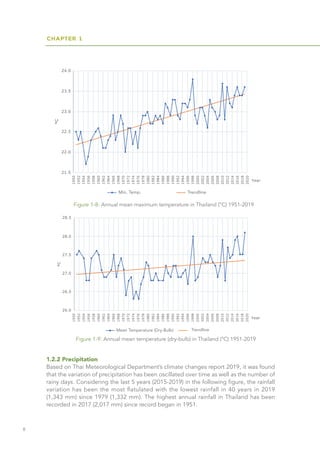
Figure 1-8: Annual mean maximum temperature in Thailand (°C) 1951-2019
Figure 1-9: Annual mean temperature (dry-bulb) in Thailand (°C) 1951-2019
1.2.2 Precipitation
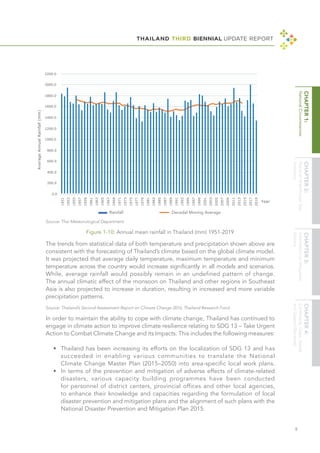
Based on Thai Meteorological Department’s climate changes report 2019, it was found
that the variation of precipitation has been oscillated over time as well as the number of
rainy days. Considering the last 5 years (2015-2019) in the following figure, the rainfall
variation has been the most flatulated with the lowest rainfall in 40 years in 2019
(1,343 mm) since 1979 (1,332 mm). The highest annual rainfall in Thailand has been
recorded in 2017 (2,017 mm) since record began in 1951.
THAILAND THIRD BIENNIAL UPDATE REPORT
9
Figure 1-10: Annual mean rainfall in Thailand (mm) 1951-2019
In order to maintain the ability to cope with climate change, Thailand has continued to
engage in climate action to improve climate resilience relating to SDG 13 – Take Urgent
Action to Combat Climate Change and its Impacts. This includes the following measures:
•	 Thailand has been increasing its efforts on the localization of SDG 13 and has
succeeded in enabling various communities to translate the National
Climate Change Master Plan (2015–2050) into area-specific local work plans.
•	 In terms of the prevention and mitigation of adverse effects of climate-related
	 disasters, various capacity building programmes have been conducted
	 for personnel of district centers, provincial offices and other local agencies,
	 to enhance their knowledge and capacities regarding the formulation of local
	 disaster prevention and mitigation plans and the alignment of such plans with the
National Disaster Prevention and Mitigation Plan 2015.
The trends from statistical data of both temperature and precipitation shown above are
consistent with the forecasting of Thailand’s climate based on the global climate model.
It was projected that average daily temperature, maximum temperature and minimum
temperature across the country would increase significantly in all models and scenarios.
While, average rainfall would possibly remain in an undefined pattern of change.
The annual climatic effect of the monsoon on Thailand and other regions in Southeast
Asia is also projected to increase in duration, resulting in increased and more variable
precipitation patterns.
Source: Thailand’s Second Assessment Report on Climate Change 2016, Thailand Research Fund
Source: Thai Meteorological Department
CHAPTER 1
10
•	 Thailand has also managed to reduce the number of deaths and missing persons
attributed to disasters per 100,000 population from 0.19 in 2015 to 0.13 in 2018.
The number of people whose dwellings were damaged by disasters has also been
significantly reduced from 114,600 in 2015 to 88,452 in 2018.
•	 From the perspective of local governance, the proportion of local governments
that have adopted and implemented local disaster risk reduction strategies in line
with national disaster risk reduction strategies increased from 31.8% in 2016 to
35.4% in 2018.
Source: 1) Thailand's Voluntary National Review on the Implementation of the 2030 Agenda for Sustainable Development
2018, Ministry of Foreign Affairs 2) United Nations Global SDG Indicators Database
1.3 Natural Resources
1.3.1 Land Resources and Forestry
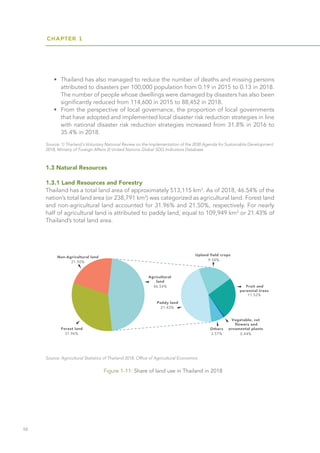
Thailand has a total land area of approximately 513,115 km2
. As of 2018, 46.54% of the
nation’s total land area (or 238,791 km2
) was categorized as agricultural land. Forest land
and non-agricultural land accounted for 31.96% and 21.50%, respectively. For nearly
half of agricultural land is attributed to paddy land, equal to 109,949 km2
or 21.43% of
Thailand’s total land area.
Figure 1-11: Share of land use in Thailand in 2018
Source: Agricultural Statistics of Thailand 2018, Office of Agricultural Economics
THAILAND THIRD BIENNIAL UPDATE REPORT
11
1.3.2 Water Resources
Thailand has 25 major river basins and 254 sub-basins and has an average annual rainfall
of approximately 1,455 mm. Although natural surface flow from rainfall is roughly 285
billion m3
, with groundwater from 27 basins contributing around 1,130 billion m3
, of
this only roughly 45 billion m3
per year has the potential to be extracted for utilization.
Furthermore, the average amount of natural flow in Thailand is 3,449 m3
per person per
year, lower than averages in other countries in Southeast Asia. Whereas the total water
demand in 2015 was 147 billion m3
, the accessible amount was only 102 billion m3
,
leaving a shortfall of water to meet agricultural and consumer needs of roughly 45 billion m3
.
Over the last 40 years, Thailand has experienced water shortage problems, which have
been compounded by a number of droughts, hugely impacting farmers' incomes and
the country's economic output. Severe droughts that occurred in the years 1979, 1994
and 1999 affected almost every part of the country and there have been an increasing
number of recurring droughts over the course of the last 10 years, which have affected a
total area of around 42,280 km2
. For household water shortage problems, it was found
that as of 2017, around 75,000 villages in Thailand had no centrally controlled plumbing
system.
In addition to droughts, over the past 30 years Thailand has experienced flooding in
almost all provinces of the country, causing damage to life, property and the economy.
In 2011, Thailand faced major flooding, which impacted over 13 million people, with
resultant economic damage costing more than 1.44 trillion THB.
Therefore, in order to effectively manage the country's water resources, Thailand has
formulated the National Water Resources Management Strategies (2015-2026) and
the 20-Year Master Plan on Water Resources Management (2018-2037), both of which
are in line with the plans of the 20-Year National Strategy (2018-2037). The 20-Year
Master Plan on Water Resources Management has been defined according to 6 aspects,
outlined in Table 1-2.
The current estimate of forest area by the Royal Forest Department as of 2018 is almost
164,000 km2
, which is equivalent to 16.40 million hectares. The forest area in Thailand has
been recorded as being stable since 2014, accounting for 31.62% in 2014, 31.60% in 2015,
31.58% in 2016, 31.58% in 2017, and 31.68% in 2018. There are a number of laws in place
in Thailand related to the management and maintenance the national forest estate, the
most important of which include: The 20-Year Forestry Strategy (2017-2036), the Forest
Act (1941), National Park Act (1961), National Reserved Forest Act (1964), Wild Animal
Reservation and Protection Act (1992), Commercial Forest Plantation Act (1992), Chain
Saws Act (2002), and the Community Forest Act (2019). In addition to these legislative
measures, a range of projects have also been implemented to solve issues surrounding
forest loss, such as activities related to Reducing Emissions from Deforestation and
Forest Degradation (REDD+).
Source: 1) Department of National Parks, Wildlife, and Plant Conservation 2) Royal Forest Department
CHAPTER 1
12
Table 1-2: Development aspects of the 20-Year Master Plan on Water Resources Management
Aspect Target
Management of water use
• Tap water for villages
• Tap water for urban/economic zones
• Improve drinking water standards and affordability
• Water saving in all sectors
Security of water production
• Better management
• Increase water efficiency
• Water allocation in rainfed areas
• New water storage capacity
• Develop water distribution systems
• Increase water productivity
• Increase water through artificial rainfall
Inundation control
• Increase drainage efficiency
• Urban flood protection
• Flood area/retention pond management
• Area-based flood management
Water quality conservation
• Wastewater reduction at source of origin
• Increase treatment efficiency
• Preserve ecological balance
• Recover national water resources
Afforestation in watershed areas and soil erosion
protection
• Conserve upstream forest
• Soil erosion protection in upstream areas
Managerial approach
• Strengthen water laws and institutional management
• Develop a water management plan
• Improve monitoring and evaluation
• Develop a decision support system database
• R&D
• Improve communication and citizen participation
Source: The 20-Year Master plan on Water Resources Management 2018-2037, Office of National Water Resources
1.3.3 Biodiversity
One of the most biodiverse countries in Southeast Asia, Thailand is located in two
Bio-geographies: the Indo-Chinese Region in the north and the Sundaic Region in the south.
Based on the plant biodiversity studied and surveyed under the Flora of Thailand Project,
Thailand was found to be home to 11,000 plant species, equating to approximately 3%
of the world’s total plant species. Additionally, there were 4,731 species of vertebrate
recorded in 2016, an increase of 123 species from 2005.
Thailand's unique biodiversity is supported by seven diverse ecosystems, 1) Forest:
forest areas in Thailand comprised roughly 31.6% of the total land area in 2017. Whilst
this has decreased from 43.2% in 1973, the rates of decline have stabilized as of 2014
due to government policies on forest plantation; 2) Mountain: total mountainous areas
comprise 29.3% of the country; 3) Agricultural: due to government policies, the total
area devoted to agriculture increased between 2008 and 2016, with notable increases
THAILAND THIRD BIENNIAL UPDATE REPORT
13
in the three main cash crops of Pará rubber, oil palm and eucalyptus. An increase in
agricultural lands, however, often comes at the expense of forested areas. 4) Marine
and coastal: these ecosystems are in the east and south of the country and consist of:
mangrove forests, which decreased from 3,679 km2
in 1961 to 2,455 km2
in 2014, beach
forests, some of which have been destroyed in order to be converted to tourism sites,
seagrass which covers a total area of 256 km2
(new areas of seagrass spanning 0.69 km2
were found in 2016), and finally, coral reefs, which cover a total area of 238 km2
; 5) Island:
there are 936 islands distributed along the Gulf of Thailand and Andaman Coast with
a total length of 3,724.32 km and total area of 2,720 km2
; 6) Inland water: this includes
swamps and seasonal flooded forests along the floodplain, comprising a total area of
17,432 km2
and 7) Dry and semi-humid: these ecosystems are found in the northeast of
Thailand due to necessary climate and soil conditions, and constitute an area of 104,000
km2
or 62% of the entire northeast region.
As reported in Thailand’s Sixth National Report on the Implementation of the Convention
on Biological Diversity, in order to protect the country’s rich biodiversity, Thailand has
revised the National Biodiversity Strategies and Action Plans (NBSAPs) since its first
adoption in 2008. The latest revision, the 4th
Master Plan for Integrated Biodiversity
Management (2015-2021), consists of 2 phases of operation with 4 strategies: 	
	
1) Integrate biodiversity values and management with participation at all levels
2) Conserve and restore biodiversity
3) Protect the country’s rights and enable management to enhance and share benefits
from biodiversity in line with a green economy
4) Develop biodiversity knowledge and database systems to be consistent with
internationally recognized standards
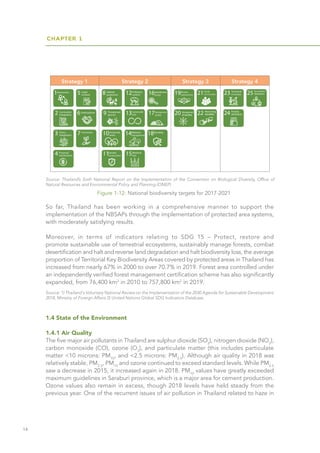
Its second phase (2017-2021) comprises action plans for meeting 25 targets, as indicated
in Figure 1-12:
CHAPTER 1
14
So far, Thailand has been working in a comprehensive manner to support the
implementation of the NBSAPs through the implementation of protected area systems,
with moderately satisfying results.
Moreover, in terms of indicators relating to SDG 15 – Protect, restore and
promote sustainable use of terrestrial ecosystems, sustainably manage forests, combat
desertification and halt and reverse land degradation and halt biodiversity loss, the average
proportion of Territorial Key Biodiversity Areas covered by protected areas in Thailand has
increased from nearly 67% in 2000 to over 70.7% in 2019. Forest area controlled under
an independently verified forest management certification scheme has also significantly
expanded, from 76,400 km2
in 2010 to 757,800 km2
in 2019.
1.4 State of the Environment
1.4.1 Air Quality
The five major air pollutants in Thailand are sulphur dioxide (SO2
), nitrogen dioxide (NO2
),
carbon monoxide (CO), ozone (O3
), and particulate matter (this includes particulate
matter <10 microns: PM10
, and <2.5 microns: PM2.5
). Although air quality in 2018 was
relatively stable, PM2.5
, PM10
and ozone continued to exceed standard levels. While PM2.5
saw a decrease in 2015, it increased again in 2018. PM10
values have greatly exceeded
maximum guidelines in Saraburi province, which is a major area for cement production.
Ozone values also remain in excess, though 2018 levels have held steady from the
previous year. One of the recurrent issues of air pollution in Thailand related to haze in
Strategy 1 Strategy 2 Strategy 3 Strategy 4
Figure 1-12: National biodiversity targets for 2017-2021
Source: Thailand’s Sixth National Report on the Implementation of the Convention on Biological Diversity, Office of
Natural Resources and Environmental Policy and Planning (ONEP)
Source: 1) Thailand's Voluntary National Review on the Implementation of the 2030 Agenda for Sustainable Development
2018, Ministry of Foreign Affairs 2) United Nations Global SDG Indicators Database
THAILAND THIRD BIENNIAL UPDATE REPORT
15
Source: Thailand State of Pollution Report 2018, Pollution Control Department
the northern regions caused by open crop burning and forest fires. These conditions
have, however, improved since 2016.
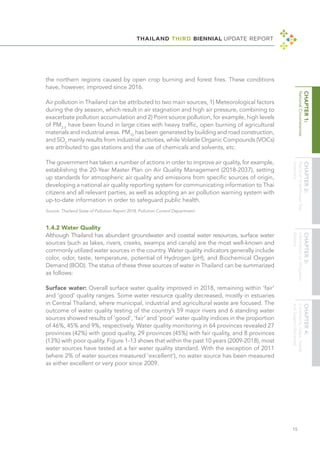
Air pollution in Thailand can be attributed to two main sources, 1) Meteorological factors
during the dry season, which result in air stagnation and high air pressure, combining to
exacerbate pollution accumulation and 2) Point source pollution, for example, high levels
of PM2.5
have been found in large cities with heavy traffic, open burning of agricultural
materials and industrial areas. PM10
has been generated by building and road construction,
and SO2
mainly results from industrial activities, while Volatile Organic Compounds (VOCs)
are attributed to gas stations and the use of chemicals and solvents, etc.
The government has taken a number of actions in order to improve air quality, for example,
establishing the 20-Year Master Plan on Air Quality Management (2018-2037), setting
up standards for atmospheric air quality and emissions from specific sources of origin,
developing a national air quality reporting system for communicating information to Thai
citizens and all relevant parties, as well as adopting an air pollution warning system with
up-to-date information in order to safeguard public health.
1.4.2 Water Quality
Although Thailand has abundant groundwater and coastal water resources, surface water
sources (such as lakes, rivers, creeks, swamps and canals) are the most well-known and
commonly utilized water sources in the country. Water quality indicators generally include
color, odor, taste, temperature, potential of Hydrogen (pH), and Biochemical Oxygen
Demand (BOD). The status of these three sources of water in Thailand can be summarized
as follows:
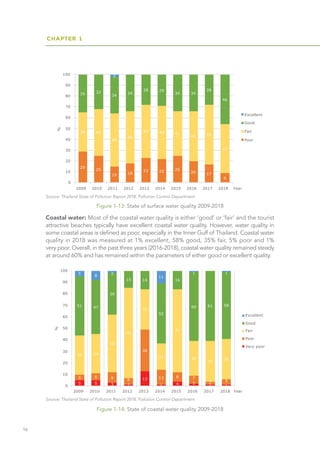
Surface water: Overall surface water quality improved in 2018, remaining within ‘fair’
and ‘good’ quality ranges. Some water resource quality decreased, mostly in estuaries
in Central Thailand, where municipal, industrial and agricultural waste are focused. The
outcome of water quality testing of the country’s 59 major rivers and 6 standing water
sources showed results of ‘good’, ‘fair’ and ‘poor’ water quality indices in the proportion
of 46%, 45% and 9%, respectively. Water quality monitoring in 64 provinces revealed 27
provinces (42%) with good quality, 29 provinces (45%) with fair quality, and 8 provinces
(13%) with poor quality. Figure 1-13 shows that within the past 10 years (2009-2018), most
water sources have tested at a fair water quality standard. With the exception of 2011
(where 2% of water sources measured ‘excellent’), no water source has been measured
as either excellent or very poor since 2009.
CHAPTER 1
16
Figure 1-13: State of surface water quality 2009-2018
Figure 1-14: State of coastal water quality 2009-2018
Coastal water: Most of the coastal water quality is either ‘good’ or ‘fair’ and the tourist
attractive beaches typically have excellent coastal water quality. However, water quality in
some coastal areas is defined as poor, especially in the Inner Gulf of Thailand. Coastal water
quality in 2018 was measured at 1% excellent, 58% good, 35% fair, 5% poor and 1%
very poor. Overall, in the past three years (2016-2018), coastal water quality remained steady
at around 60% and has remained within the parameters of either good or excellent quality.
Source: Thailand State of Pollution Report 2018, Pollution Control Department
THAILAND THIRD BIENNIAL UPDATE REPORT
17
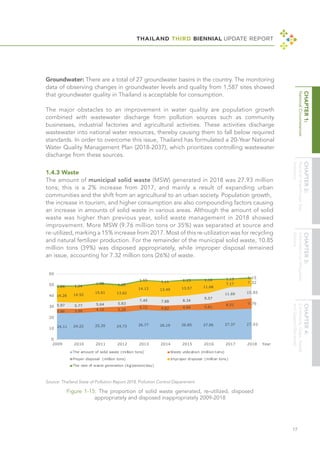
Figure 1-15: The proportion of solid waste generated, re-utilized, disposed
appropriately and disposed inappropriately 2009-2018
Groundwater: There are a total of 27 groundwater basins in the country. The monitoring
data of observing changes in groundwater levels and quality from 1,587 sites showed
that groundwater quality in Thailand is acceptable for consumption.
The major obstacles to an improvement in water quality are population growth
combined with wastewater discharge from pollution sources such as community
businesses, industrial factories and agricultural activities. These activities discharge
wastewater into national water resources, thereby causing them to fall below required
standards. In order to overcome this issue, Thailand has formulated a 20-Year National
Water Quality Management Plan (2018-2037), which prioritizes controlling wastewater
discharge from these sources.
Source: Thailand State of Pollution Report 2018, Pollution Control Department
1.4.3 Waste
The amount of municipal solid waste (MSW) generated in 2018 was 27.93 million
tons; this is a 2% increase from 2017, and mainly a result of expanding urban
communities and the shift from an agricultural to an urban society. Population growth,
the increase in tourism, and higher consumption are also compounding factors causing
an increase in amounts of solid waste in various areas. Although the amount of solid
waste was higher than previous year, solid waste management in 2018 showed
improvement. More MSW (9.76 million tons or 35%) was separated at source and
re-utilized, marking a 15% increase from 2017. Most of this re-utilization was for recycling
and natural fertilizer production. For the remainder of the municipal solid waste, 10.85
million tons (39%) was disposed appropriately, while improper disposal remained
an issue, accounting for 7.32 million tons (26%) of waste.
CHAPTER 1
18
The volume of municipal hazardous waste generated in 2018 was 638,000 tones
– a 3.2% increase from 2017. 65% of this hazardous waste (414,600 tons) was Waste
Electrical and Electronic Equipment (WEEE), with the remaining 35% (223,400 tons)
consisting of other municipal hazardous waste, such as batteries, dry cell batteries,
chemical containers and spray bottles. A municipal hazardous waste management
system has been installed, with local administrative organizations and relevant
agencies collecting hazardous waste from villages or communities, and then transferring
this waste to provincial hazardous waste collection centers. This system allows hazardous
waste to be managed and treated properly, and has resulted in a 13% improvement
(equal to about 83,600 tons). However, this result is still deficient as there are no
regulations to separate hazardous waste from general solid waste. Further regulations
are needed to enforce responsibility on the part of the private sector for WEEE
management. A draft of the Waste Electrical and Electronic Equipment Management
Act was approved by the Council of Ministers on 25 December 2018. In addition
to this, the government has created the 20-Year Master Plan on the Prevention and
Management of Pollution Caused by Solid and Hazardous Waste (2018-2037). This plan
includes a focus on the ‘3Rs’ (reduce, reuse, recycle), circular economy, the Polluter
Pays Principle (PPP) and further aims to encourage private sector participation in joint
investment (through Public Private Partnership) on waste management.
The amount of industrial waste managed by an appropriated treatment in 2018 was
22.02 million tons, which decreased 33% from 2017. From that total amount, the 20.82
million tons is non-hazardous industrial waste, of which 7.2 million tons were used as
fuel to generate electric power, and 1.2 million tons were hazardous industrial waste.
There are industrial waste treatment and disposal facilities in each region of the country.
The highest treatment and disposal capacity are in the East, followed by the Central
region, West, Northeast, South and North.
The amount of infectious waste in 2018 decreased 4.2% from 57,954 tons in 2017 to
55,497 tons. Most of the infectious waste was generated from public hospitals, private
hospitals, private clinics, veterinary clinics and hazardous pathogen laboratories,
constituting more than 38,235 locations. 50% of the infectious waste was from public
hospitals operated under the Ministry of Public Health and 24% came from private
hospitals and clinics. The amount of infectious waste that was treated properly was
49,897.86 tons (89.91%), which most of this waste were eliminated by infectious waste
incinerators and autoclaving at the infirmaries themselves. For small clinics, infectious
waste is collected and transferred to host hospitals, which acts as disposal centers or
hubs for the network.
Source: Thailand State of Pollution Report 2018, Pollution Control Department
THAILAND THIRD BIENNIAL UPDATE REPORT
19
1.5 Energy
1.5.1 Energy Consumption
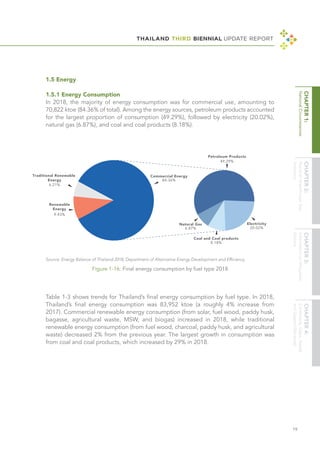
In 2018, the majority of energy consumption was for commercial use, amounting to
70,822 ktoe (84.36% of total). Among the energy sources, petroleum products accounted
for the largest proportion of consumption (49.29%), followed by electricity (20.02%),
natural gas (6.87%), and coal and coal products (8.18%).
Table 1-3 shows trends for Thailand’s final energy consumption by fuel type. In 2018,
Thailand’s final energy consumption was 83,952 ktoe (a roughly 4% increase from
2017). Commercial renewable energy consumption (from solar, fuel wood, paddy husk,
bagasse, agricultural waste, MSW, and biogas) increased in 2018, while traditional
renewable energy consumption (from fuel wood, charcoal, paddy husk, and agricultural
waste) decreased 2% from the previous year. The largest growth in consumption was
from coal and coal products, which increased by 29% in 2018.
Figure 1-16: Final energy consumption by fuel type 2018
Source: Energy Balance of Thailand 2018, Department of Alternative Energy Development and Efficiency
CHAPTER 1
20
Table 1-3: Final energy consumption by fuel type 2016-2018
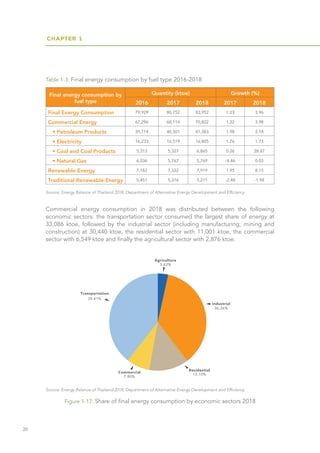
Figure 1-17: Share of final energy consumption by economic sectors 2018
Final energy consumption by
fuel type
Quantity (ktoe) Growth (%)
2016 2017 2018 2017 2018
Final Energy Consumption 79,929 80,752 83,952 1.03 3.96
Commercial Energy 67,296 68,114 70,822 1.22 3.98
• Petroleum Products 39,714 40,501 41,383 1.98 2.18
• Electricity 16,233 16,519 16,805 1.76 1.73
• Coal and Coal Products 5,313 5,327 6,865 0.26 28.87
• Natural Gas 6,036 5,767 5,769 -4.46 0.03
Renewable Energy 7,182 7,322 7,919 1.95 8.15
Traditional Renewable Energy 5,451 5,316 5,211 -2.48 -1.98
Source: Energy Balance of Thailand 2018, Department of Alternative Energy Development and Efficiency
Commercial energy consumption in 2018 was distributed between the following
economic sectors: the transportation sector consumed the largest share of energy at
33,086 ktoe, followed by the industrial sector (including manufacturing, mining and
construction) at 30,440 ktoe, the residential sector with 11,001 ktoe, the commercial
sector with 6,549 ktoe and finally the agricultural sector with 2,876 ktoe.
THAILAND THIRD BIENNIAL UPDATE REPORT
21
Table 1-4: Energy production by fuel type 2016-2018
Energy Production
Quantity (ktoe) Growth (%)
2016 2017 2018 2017 2018
Total Energy Production 80,298 74,191 72,609 -7.61 -2.13
Commercial Energy 50,144 47,673 45,828 -4.93 -3.87
• Crude Oil 8,124 7,155 6,453 -11.93 -9.81
• Lignite 4,306 4,105 3,756 -4.67 -8.50
• Natural Gas 33,408 31,962 31,122 -4.33 -2.63
• Condensates 4,306 4,491 4,497 4.30 0.13
Renewable Energy* 17,391 15,423 17,156 -11.32 11.24
Traditional Renewable Energy** 10,861 8,646 7,012 -20.39 -18.90
Biofuel 1,682 1,976 2,113 17.48 6.93
Other Energy*** 220 473 500 115.00 5.71
* solar, wind, hydro geothermal, fuel wood, paddy husk, bagasse, agricultural waste, MSW and biogas
** fuel wood, charcoal, paddy husk and agricultural waste
*** black liquor and residual gas
1.5.2 Energy Production
Energy production in 2018 measured 72,609 ktoe, a 2.13% decrease from the previous
year (Table 1-4). Commercial energy contributed the largest share of energy production at
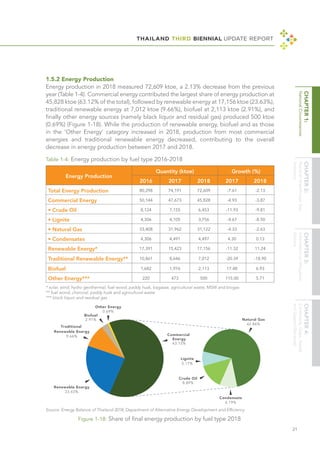
45,828 ktoe (63.12% of the total), followed by renewable energy at 17,156 ktoe (23.63%),
traditional renewable energy at 7,012 ktoe (9.66%), biofuel at 2,113 ktoe (2.91%), and
finally other energy sources (namely black liquor and residual gas) produced 500 ktoe
(0.69%) (Figure 1-18). While the production of renewable energy, biofuel and as those
in the ‘Other Energy’ category increased in 2018, production from most commercial
energies and traditional renewable energy decreased, contributing to the overall
decrease in energy production between 2017 and 2018.
Figure 1-18: Share of final energy production by fuel type 2018
Source: Energy Balance of Thailand 2018, Department of Alternative Energy Development and Efficiency
CHAPTER 1
22
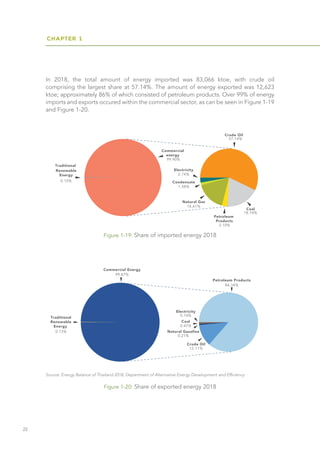
In 2018, the total amount of energy imported was 83,066 ktoe, with crude oil
comprising the largest share at 57.14%. The amount of energy exported was 12,623
ktoe; approximately 86% of which consisted of petroleum products. Over 99% of energy
imports and exports occured within the commercial sector, as can be seen in Figure 1-19
and Figure 1-20.
Figure 1-19: Share of imported energy 2018
Figure 1-20: Share of exported energy 2018
Source: Energy Balance of Thailand 2018, Department of Alternative Energy Development and Efficiency
THAILAND THIRD BIENNIAL UPDATE REPORT
23
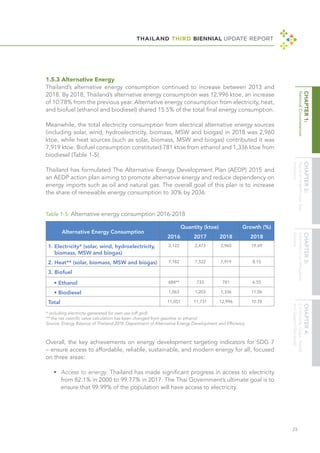
Table 1-5: Alternative energy consumption 2016-2018
1.5.3 Alternative Energy
Thailand’s alternative energy consumption continued to increase between 2013 and
2018. By 2018, Thailand’s alternative energy consumption was 12,996 ktoe, an increase
of 10.78% from the previous year. Alternative energy consumption from electricity, heat,
and biofuel (ethanol and biodiesel) shared 15.5% of the total final energy consumption.
Meanwhile, the total electricity consumption from electrical alternative energy sources
(including solar, wind, hydroelectricity, biomass, MSW and biogas) in 2018 was 2,960
ktoe, while heat sources (such as solar, biomass, MSW and biogas) contributed it was
7,919 ktoe. Biofuel consumption constituted 781 ktoe from ethanol and 1,336 ktoe from
biodiesel (Table 1-5).
Thailand has formulated The Alternative Energy Development Plan (AEDP) 2015 and
an AEDP action plan aiming to promote alternative energy and reduce dependency on
energy imports such as oil and natural gas. The overall goal of this plan is to increase
the share of renewable energy consumption to 30% by 2036.
Alternative Energy Consumption
Quantity (ktoe) Growth (%)
2016 2017 2018 2018
1. Electricity* (solar, wind, hydroelectricity,
biomass, MSW and biogas)
2,122 2,473 2,960 19.69
2. Heat** (solar, biomass, MSW and biogas) 7,182 7,322 7,919 8.15
3. Biofuel
• Ethanol 684** 733 781 6.55
• Biodiesel 1,063 1,203 1,336 11.06
Total 11,051 11,731 12,996 10.78
* including electricity generated for own use (off grid)
** the net calorific value calculation has been changed from gasoline to ethanol
Source: Energy Balance of Thailand 2018, Department of Alternative Energy Development and Efficiency
Overall, the key achievements on energy development targeting indicators for SDG 7
– ensure access to affordable, reliable, sustainable, and modern energy for all, focused
on three areas:
•	 Access to energy: Thailand has made significant progress in access to electricity
from 82.1% in 2000 to 99.77% in 2017. The Thai Government’s ultimate goal is to
ensure that 99.99% of the population will have access to electricity.
CHAPTER 1
24
•	 Uptake in renewable energies: Thailand aims to increase the percentage of
	 renewable energy in gross final consumption to 24.08 % by 2030. In December 2017,
renewable energy constituted 14.49% of gross final consumption.
•	 Improve energy efficiency: Thailand’s Government aims to reduce Energy
	 Intensity (EI) by 30% by 2036 compared to levels from 2010. In 2017, EI was 7.77
ktoe3
per billion THB.
Source: Thailand's Voluntary National Review on the Implementation of the 2030 Agenda for Sustainable Development
2018, Ministry of Foreign Affairs
1.6 Current State of the National Economy
1.6.1 Economic Profile
Thailand’s economy has been developed under the 12th
National Economic and Social
Development Plan (2017-2021), which adhered to the 20-Year National Strategy
Framework (2017-2036), a commitment to the SDGs, a philosophy of Sufficiency
Economy, the Thailand 4.0 Policy, and other reform agendas. In order to set out
development directions and strategies to achieve the objectives of “Security, Prosperity, and
Sustainability”, the Thailand 4.0 Policy lays out a long-term vision to shift the country’s
economy from a heavy manufacturing to be a high-value-added and innovation-driven
economy. Thailand 4.0 will develop a knowledge-based economy by encouraging
creativity, innovation, science, technology and research and development, aiming to
increase the added value in the technology sector and other targeted industries. One
of the strategies to support the Thailand 4.0 roadmap is the Eastern Economic Corridor
(EEC), launched in 2017. The EEC is expected to enhance Thailand’s competitiveness as
it is located in the potential area suitable for being a regional economic center.
Thailand is regarded as a mix-typed economy, constituting agriculture, industry, tourism,
service and natural resources. The Thai economy expanded by 4.1% in 2018, up from
4.0% the year prior, which was the highest expansion rate in the past 6 years. Export value
grew by 7.7% while private consumption and total investment grew by 4.6% and 3.8%,
respectively. Headline inflation averaged at 1.1% and the Current Account to Gross
Domestic Product (GDP) recorded a surplus of 7.4%.
THAILAND THIRD BIENNIAL UPDATE REPORT
25
Source: NESDC Economic Report and National Income of Thailand 2018, Office of the National Economic and Social
Development Council
1.6.2 Agriculture
In 2018, overall agricultural production expanded by 5.5%, accelerating from 4.7% in
2017. This was propelled by annual crops, perennial crops, livestock, and agricultural
services with a growth of 6.7%, 5.3%, 2.5%, and 2.9%, respectively, together with a rise
of 2.4% and 5.3% expansion of forestry and fishing production. Prices of agricultural
products in 2018 decreased by 3.1%, in contrast to a 0.4% increase the previous year.
The contribution of agriculture to Thailand’s GDP remained relatively constant between
2016-2018 (8.5%, 8.4% and 8.1%, respectively). Although the agricultural sector only
contributes around 8% of the country GDP, it accounts for over 30% of total employment
in Thailand. The agriculture and food security are essential to support an increasing of
population growth and has high impact on the quality of life of Thai citizen. Sustainable
farming that strengthens ecological immunity and approaches to reducing GHG
emissions will help to ensure the stability of livelihoods that rely on agricultural management
amid the climate change crisis, especially in commercial scale agriculture which would
benefits the national economy.
Indicators 2016 2017 2018
Growth in Real GDP 3.3 4.0 4.1
Investment 2.8 1.8 3.8
• Private 0.5 2.9 3.9
• Public 9.5 -1.2 3.3
Private Consumption 3.0 3.0 4.6
Government Consumption 2.2 0.1 1.8
Export of Goods 0.1 9.8 7.7
• Volume 0.5 6.0 4.2
Import of Goods -5.1 13.2 14.3
• Volume -2.5 7.2 8.2
Current Account to GDP (%) 11.7 11.0 7.4
Inflation (%) 0.2 0.7 1.1
Table 1-6: Thailand’s economic indicators
CHAPTER 1
26
Figure 1-21: Agriculture and Non-agriculture contribution to employment
Table 1-7: Economy impact generated by tourism
Source: 1) Office of the National Economic and Social Development Council 2) World Bank
Source: Ministry of Tourism and Sports
1.6.3 Tourism
According to the 2018 Tourism Satellite Account (TSA), the tourism industry has
continued to play an important role in Thailand 's economy, generating around
15% of GDP and providing 10.9% of total employment (equating to 4,154,947 jobs).
Average annual expenditure of domestic and overseas tourists over the past 10 years
was approximately 2.116 trillion Baht. In regard to tourism management,
Thailand has integrated the concept of sustainable tourism into its local
socio-cultural context namely traditions, cultures, beliefs as well as communities’
livelihood and needs that could contribute economic benefits equally to both public
and private sectors.
1.6.4 Poverty and Inequality
Between 2015 and 2018, Thailand’s poverty line increased from 2,644 to 2,710 THB
per person per month. The poverty rate, or the percentage of people living under the
poverty line, has fluctuated from 2016 onwards. The number of poor people in 2018
increased by almost 1.5 million, or 2.1% of the total population, compared with rates
from 2017.
Economy impac 2017 2018
Tourism Expenditure (trillion THB) 2.855 2.984
Tourism GDP (trillion THB) 2.780 2.907
Tourism GDP/ Total GDP (%) 17.95 17.76
Tourism Direct GDP/ Total GDP (%) 7.32 7.25
Tourism Indirect GDP/ Total GDP (%) 10.63 10.51
Total Employment in Tourism Sector (person) 4,318,297 4,393,294
Tourism Employment/Total Employment (%) 11.53 11.60
THAILAND THIRD BIENNIAL UPDATE REPORT
27
Figure 1-22: Poverty line, poverty rate and number of poor 2014-2018
Figure 1-23: Inequality of poor household between urban and rural areas 2014-2018
Source: Office of the National Economic and Social Development Council
As Figure 1-23 shows, poverty is more concentrated in rural, as opposed to urban areas
according to the higher percentage of poor households living in rural. Although the gap
between the proportion of households in poverty in rural and urban areas has overall
decreased, as of 2018 there remained a difference of over 3% between these groups.
CHAPTER 1
28
As the Gini coefficient has fallen from 0.490 in 2009 to 0.445 in 2015, income inequality
is considered to be moderate and improving, although this figure did increase slightly in
2017. Inequality in urban areas was found to be typically higher than that of rural areas
but was not significantly different to levels from 2013. In 2017, the Gini coefficient was
0.441 in urban areas and 0.426 in rural areas.
Figure 1-24: Biennial Gini coefficient in Thailand, showing urban, rural and national
levels 2009-2017
Source: Office of the National Economic and Social Development Council
Remark: The Gini coefficient is a tool for measuring inequality, where the value is between 0 and 1. The closer the value
is to 1, the greater the income inequality.
Source: 1) Thailand's Voluntary National Review on the Implementation of the 2030 Agenda for Sustainable Development
2018, Ministry of Foreign Affairs 2) United Nations Global SDG Indicators Database
In terms of the national economic status in relation to economic growth and inequality,
the progress made towards SDGs are as follows:
•	 SDG 8 – Promote sustained, inclusive and sustainable economic growth, full and
productive employment and decent work for all: Thailand has been able to keep
an extremely low unemployment rate at less than 1% for the population for both
sexes aged above 15. Fatal occupational injuries among employees have been
reduced from 11.3 per 100,000 employees in 2000 to 6.84 per 100,000 employees
in 2014. Likewise, nonfatal occupational injuries have decreased significantly from
925.1 per 100,000 employees in 2000 to 321.13 per 100,000 employees in 2014.
•	 SDG 10 – Reduce Inequality within and among countries: Thailand has been able
to reduce the proportion of people living below 50% of median income from 15%
in 2006 to 11% in 2016. The country has also either partially or fully met migration
policies in the domains outlined by the United Nations in order to facilitate
the orderly, safe, regular, and responsible migration and mobility of people.
THAILAND THIRD BIENNIAL UPDATE REPORT
29
Figure 1-25: Structure of the National Committee on Climate Change Policy
Source: Office of Natural Resources and Environmental Policy and Planning (ONEP)
1.7 Institutional Arrangements
1.7.1 National Committee on Climate Change Policy (NCCC)
Thailand established the National Committee on Climate Change Policy (NCCC). The NCCC
is chaired by the Prime Minister and has members from both the public and private sectors,
including experts from relevant agencies. The NCCC has a mandate to define national climate
policies and establish guidelines and mechanisms for international collaboration regarding
conventions and protocols on climate change, including support and evaluate domestic
relevant agencies to be in accordance with the national established policies and plans.
The NCCC is composed of 5 subcommittees, 1) Subcommittee on Climate Change
Policy and Planning Integration, 2) Subcommittee on Climate Change Knowledge and
Database, 3) Subcommittee on Climate Change Negotiation and International Cooperation,
4) Subcommittee on Public Relations and Actions for Climate Empowerment and 5)
Subcommittee on Climate Law (recently added in 2019). Figure 1-25 shows the institutional
arrangements of Thailand’s NCCC.
Subcommittee on
Climate Change Policy
and Planning
Integration
Subcommittee on
Climate Change
Knowledge and
Database
Subcommittee on
Climate Change
Negotiation and
International
Cooperation
Subcommittee on
Action for Climate
Empowerments and
Public Relations
Subcommittee on
Climate Law
National Committee on Climate Change Policy (NCCC)
Chairperson Prime Minister
1st
Vice-Chairperson Minister of Natural Resources and Environment
2nd
Vice-Chairperson Minister of Foreign Affairs
Committee members:
Permanent Secretary of;
1. Prime Minister's Office
2. Ministry of Finance
3. Ministry of Foreign Affairs
4. Ministry of Tourism and Sports
5. Ministry of Transport
6. Ministry of Digital Economy and Society
7. Ministry of Energy
8. Ministry of Commerce
9. Ministry of Interior
10. Ministry of Labor
11. Ministry of Education
12. Ministry of Public Health
13. Ministry of Industry
14. Ministry of Agriculture and Cooperatives
15. Ministry of Higher Education, Science, Research and Innovation
16. Bangkok Metropolitan Administration
17. Secretary-General, Office of the National Economic and
Social Development Council
18. Secretary-General, Office of the National Water Resources
19. Director, Bureau of Budget
20. 5-9 Experts on law, economics, environment, science and
technology, energy or climate change
21. 1 expert from private sector
Secretariat: Permanent
Secretary, MONRE
Assistant secretary: Secretary-General of ONEP
Assistant secretary: Director of Thailand Greenhouse
Gas Management Organization (TGO)
CHAPTER 1
30
The Subcommittee on Climate Change Policy and Planning Integration is responsible
to provide input on policy integration, strategy and planning linked with climate mitigation
and adaptation; provide suggestions on mechanisms and measures, such legal regulations
and financial measures; and push forward an integrated budget allocation system on
climate change.
The Subcommittee on Climate Change Knowledge and Database is responsible to
provide comments on the country report under the agreement of UNFCCC; support
the development of the GHG inventory; provide suggestions on the development of
databases and climate change knowledge in the areas of mitigation, adaptation and
Measurement, Reporting and Verification (MRV) systems.
The Subcommittee on Climate Change Negotiation and International Cooperation
is responsible to provide recommendations on Thailand’s positions for negotiations on
climate change under multilateral agreements and other international frameworks; prepare
and develop knowledge and data in relation to international negotiations on climate
change; provide guidance in international aspects of climate change implementation and
the composition of Thailand’s delegation for international negotiation on climate change.
The Subcommittee on Action for Climate Empowerments and Public Relations is
responsible to publicize news and knowledge on the causes, impacts, and solutions
related to climate change under the Paris Agreement, Thailand’s NDC targets and the
SDGs. This committee also works to promote and support activities related to climate
change by conducting training, raising awareness and implementing capacity building
across all sectors.
The Subcommittee on Climate Law is responsible to provide comments on policies for
the development, improvement, cancellation or amendment of laws related to climate
change according to the NCCC; to arrange and propose draft laws, rules, regulations,
or notifications; provide legal opinions on tackling issues related to climate change; and
finally to provide advice on the enforcement of laws related to national climate change.
1.7.2 Institutional Arrangements of National Greenhouse Gas Inventory
Calculations of the national GHG inventory for the purposes of reporting in the Third
Biennial Update Report (TBUR) have been made in accordance with 2006 IPCC Guidelines
for National Greenhouse Gas Inventories. The key components in estimating GHG
emissions are activity data and emission factors. Activity data is sourced from a collaboration
between the Office of Natural Resources and Environmental Policy and Planning (ONEP)
and lead agencies of the following 5 sectors.
	 1)	 Energy: led by the Energy Policy and Planning Office (EPPO) and the Office of
		 Transport and Traffic Policy and Planning (OTP)
	 2)	 IPPU: led by the Department of Industrial Works (DIW)
	 3)	 Agriculture: led by the Office of Agricultural Economics (OAE)
	 4)	 LULUCF: led by Department of National Parks, Wildlife and Plant Conservation (DNP)
	 5)	 Waste: led by the Pollution Control Department (PCD).
THAILAND THIRD BIENNIAL UPDATE REPORT
31
After these lead agencies have collected activity data according to ONEP’s required
template from relevant agencies responsible for data collection (e.g., agencies under
their supervisors, local government, and the private sector), ONEP will verify the data to
be used for the GHG inventory by using the Thailand Greenhouse Gas Emission Inventory
System (TGEIS). Results will then be interpreted into graphs and tables according to
reporting format laid out by UNFCCC. Results from TGEIS will then be submitted to 5
working groups, comprising appointed representatives of the 5 sectors outlined above.
Each working group then reviews the methodology of the GHG emission estimation as
part of quality control (QC) to ensure that GHG emission estimates for their sectors are
valid, accurate, and complete. Following this, the GHG inventories of the 5 sectors are
submitted to the Climate Change Knowledge and Database Subcommittee for verification.
Finally, as Secretariat of the NCCC, ONEP will submit the final GHG inventories as part
of the BUR to the NCCC for approval before submission to UNFCCC. For a complete list
of the sub-sectoral support agencies under each leading sector, please see Figure 1-27.
The lead agencies and their responsibility in reporting data activity are as follows:
Energy: EPPO and OTP are the 2 lead agencies, responsible for gathering the data
from relevant agencies within the Ministry of Energy, the Ministry of Transport and others.
the activity data used for GHG emissions calculations are derived from fossil fuel/
electricity consumption used in different activities.
Industrial Processes and Product Use (IPPU): DIW is the lead agency, responsible for
gathering the data from relevant agencies within Ministry of Industry and others. The
activity data used for GHG emissions calculations are production volume, import
volume and export volume in each industry group.
Agriculture: OAE is the lead agency, responsible for gathering the data from relevant
agencies within the Ministry of Agriculture and Cooperatives and others. The activity
data used for GHG emissions calculations are derived from livestock farming, rice cultivation,
agricultural soils, field burning and open burning of agricultural residues.
Land Use, Land-Use Change and Forestry (LULUCF): DNP is the lead agency,
responsible for gathering the data from relevant agencies within the Ministry of Natural
Resources and Environment (MONRE) and others. The activity data used for GHG
emissions calculations are derived from land use, land use change and wood product.
Waste: PCD is the lead agency, responsible for gathering the data from relevant agencies
within the MONRE and others. the activity data used for GHG emissions calculations are
derived from sources of waste, waste production rate, waste composition, wastewater
volume, including Emission Factors.
Source: Office of Natural Resources and Environmental Policy and Planning (ONEP)
CHAPTER 1
32
Figure 1-26: Structure of Thailand’s Greenhouse Gas Inventory processes
Source: Office of Natural Resources and Environmental Policy and Planning (ONEP)
UNFCCC
Energy
EPPO,OTP
Capacity
building
by
TGO
National
Level
National
Communication:
NC
(every 4 years)
Biennial Update
Report: BUR
(every 2 years)
ALRO	 = Agricultural Land Reform Office
BMA	 = Bangkok Metropolitan Administration
CAAT	 = The Civil Aviation Authority of Thailand
DEDE	 = Department of Alternative Energy Development and Efficiency
DEQP	 = Department of Environmental Quality Promotion
DIW	 = Department of Industrial Works
DLD	 = Department of Livestock Development
DLA	 = Department of Local Administration
DLT	 = Department of Land Transport
DMCR	 = Department of Marine and Coastal Resources
DMF	 = Department of Mineral Fuels
DNP	 = Department of National Parks, Wildlife and Plant Conservation
DOA	 = Department of Agriculture
DOC	 = Department of Customs
DOAE	 = Department of Agricultural Extension
DOEB	 = Department of Energy Business
DOH	 = Department of Health
DPIM	 = Department of Primary Industries and Mines
ED	 = The Excise Department
EEI	 = Electrical and Electronics Institute
EGAT	 = Electricity Generating Authority of Thailand
EPPO	 = Energy Policy and Planning Office
ERC	 = Energy Regulatory Commission
FIO	 = Forest Industry Organization
FTI	 = The Federation of Thai Industries
GISTDA	 = Geo-Informatics and Space Technology Development Agency
IEAT	 = Industrial Estate Authority of Thailand
ISIT	 = Iron and Steel Institute of Thailand
LDD	 = Land Development Department
MD	 = Marine Department
MEA	 = Metropolitan Electricity Authority
NFI	 = National Food Institute
OAE	 = Office of Agricultural Economics
OCSB	 = Office of the Cane and Sugar Board
OIE	 = The Office of Industrial Economics
OTP	 = The Office of Transport and Traffic Policy and Planning
PAT	 = Port Authority of Thailand
PCD	 = Pollution Control Department
PEA	 = Provincial Electricity Authority
PONRE	 = Provincial Offices of Natural Resources and Environment
PTIT	 = Petroleum Institute of Thailand
RAOT	 = Rubber Authority of Thailand
RD	 = Rice Department
REO	 = Regional Environment Office
RID	 = Royal Irrigation Department
RFD	 = Royal Forest Department
SRT	 = State Railway of Thailand
TAI	 = Thailand Automotive Institute
TCMA	 = Thai Cement Manufacturers Association
WMA	 = Wastewater Management Authority
GHG Inventory
by Thailand
Greenhouse
Gas Emissions
Inventory System
(TGEIS)
Measure and
report following
the guidelines
Collect statistical
data
Convention
National
committee
Subcommittee
on report
verification
(QA)
Working
groups
on GHG
inventory
(QC)
National
focal point
Sectoral lead
agencies (QA)
Sub-sectoral
agencies
on data
measurement
and report
(QC)
Activity
Data
Ministerial
Level
Electricity
and Fuel:
- DEDE
- DMF
- DOEB
- DPIM
- EGAT
- ERC
- MEA
- PEA
Transport:
- CAAT
- DLT
- PAT
- MD
- SRT
- Fuel uses in
power
generation
and refinery
- Fuel
combustion
in factories
and transport
IPPU
DIW
- DOEB
- DOC
- DPIM
- ED
- EEI
- EGAT
- FTI
- IEAT
- ISIT
- NFI
- OIE
- PTIT
- TAI
- TCMA
- Cement
production
- Steel
production
- Chemical
production
- Food
production
Agriculture
OAE
- DLD
- DOA
- DOAE
- GISTDA
- LDD
- OCSB
- RD
- RID
- Livestock
quantity
- Agricultural
production
(rice, fertilizer)
- Agricultural
residues
LULUCF
DNP
- ALRO
- DMCR
- FIO
- GISTDA
- LDD
- OAE
- PONRE
- RAOT
- RFD
- Land use
(forest,
wetland,
agricultural
land)
- Land use
change
- Wood product
- Soil organic
matter
Waste
PCD
- BMA
- DEDE
- DEQP
- DIW
- DLA
- DOH
- IEAT
- OIE
- REO
- WMA
- Municipal
Solid waste
composition
- Industrial
waste
- Hazardous
waste and
infected
waste
- Wastewater
National Committee on Climate Change Policy (NCCC)
Subcommittee on Climate Change Knowledge and Database
ONEP
Submit
Approve
Verify
Calculate
THAILAND THIRD BIENNIAL UPDATE REPORT
33
1.7.3 The Institutional Arrangements of Domestic MRV System
To monitor the implementation progress of the NAMA Roadmap, Thailand has developed
a domestic MRV system, which operates according to the following structure:
National level:
•	 The working groups on GHG inventory and mitigation measures is responsible for
1) selecting appropriate measures/policies for monitoring and evaluation (M&E)
of GHG emissions reduction, identifying Coefficient/Emission Factors, and
implementing MRV processes for activity data, and 2) reviewing and providing
feedback on the GHG emissions reduction report.
	
•	 Subcommittee on Climate Change Knowledge and Database is responsible for
further approval on the pre-approved report submitted from sectoral level.
	
•	 National Committee on Climate Change Policy (NCCC) is responsible for the final
approval on the GHG emissions reduction report which will later be included in
national reports, the Biennial Update Report (BUR) and National Communication
(NC).
Sectoral level:
•	 The main agencies at the sectoral level is responsible for the verification of the
following key data and approaches after the finalization by the working groups on
GHG inventory and mitigation measures as follows: 1) the appropriate measures/
policies for M&E of GHG emissions reduction, 2) the methodology for calculation
GHG emissions reduction, 3) MRV process for activity data, and 4) the final results
and GHG emissions reduction report.	
The structure of the domestic MRV system is shown in Figure 1-27.
CHAPTER 1
34
Figure 1-27: The structure of domestic MRV system
National level
Working Group on GHG Inventory and
Mitigation Measures
Sectoral level (measures/policies)
NCCC
Sectoral level
Approve GHG emission reduction results as
included in NC and BUR
Sectoral level: Climate change coordination
working group at sectoral level
Approved
Rejected
/ edited
Subcommitee on Climate Change Knowledge
and Database
Verify GHG estimation methodology and amount
of GHG emission reduction
Develop the GHG emission reduction report
according to the mitigation measures
Determine evaluation criteria for GHG
emissions reduction including:
1. Selection of GHG emission reduction policies
and measures to be monitored
2. MRV process and structure
3. Appropriate GHG reduction methodology
4. Emission factors
Verify GHG emission reduction results by
considering of:
1. GHG emission reduction measures
2. Appropriate GHG reduction methodology
3. MRV process and activity data
4. GHG reduction by measures
THAILAND THIRD BIENNIAL UPDATE REPORT
35
36
37
CHAPTER 2
NATIONAL GREENHOUSE GAS
INVENTORY
THAILAND THIRD BIENNIAL UPDATE REPORT
CHAPTER 2
38
CHAPTER 2: NATIONAL GREENHOUSE GAS
INVENTORY
2.1 Inventory Process in Thailand
Thailand’s GHG inventory was developed and submitted according to the UNFCCC Article
4.1(a) of the Convention in accord with Article 12: national inventories of anthropogenic
emissions by sources and removals by sinks of all greenhouse gases not controlled by
the Montreal Protocol. The inventory report was prepared using the 2006 IPCC
Guidelines for National Greenhouse Gas Inventories (referred to as the 2006 IPCC
Guidelines), and presented Thailand’s national GHG emissions from 2000 to 2016 by
sources, and removals by sinks. The GHG emissions estimated in this report include both
direct emissions (carbon dioxide, methane, and nitrous oxide) and indirect emissions
(nitrogen oxides, carbon monoxide, non-methane volatile organic compounds, and
sulfur dioxide).
2.1.1 Transition to 2006 IPCC Guidelines and TGEIS
Previously, ONEP had coordinated and worked with sectoral lead agencies to compile
GHG inventory data for five sectors according to the Revised 1996 Guidelines for National
Greenhouse Gas Inventories (referred to as the 1996 IPCC Guidelines) without a proper
supporting tool for GHG inventory development.
At present, TGEIS: Thailand Greenhouse Gas Emissions Inventory System, a tool to support
robust and clear national inventory system governance and institutional arrangements,
has been used in the process of calculating the national GHG inventory for Thailand.
The national GHG inventory reported in this TBUR have been made in accordance with
2006 IPCC Guidelines for National Greenhouse Gas Inventories and the developed TGEIS,
which TGIES is an information system designed to enhance the national GHG inventory.
In 2016, total GHG emissions (excluding those from LULUCF) were 354,357.61 GgCO2
eq
and Net GHG emissions were 263,223.46 GgCO2
eq. (including those from LULUCF).
The Energy sector has been the largest contributor to Thailand’s GHG emission, accounting
for 71.65% of total GHG emissions. While emissions from the Agriculture, IPPU and Waste
sectors account for 14.72%, 8.90% and 4.73%, respectively. LULUCF sector contributed to
a net removal of 91,134.15 GgCO2
eq, showing a trend of increased net removals as total
removals exceeded total emissions.
Overall, Thailand’s greenhouse gas (GHG) emissions represent less 1% of global emissions
and lower than world average.
THAILAND THIRD BIENNIAL UPDATE REPORT
39
TGEIS is designed to produce timely, high quality and transparent greenhouse gas
emissions data by using primarily on 2006 IPCC Guidelines for National Greenhouse
Gas Inventories (referred to as the 2006 IPCC Guidelines) and Thailand’s own country
context. Basically, ONEP remains the coordination and work with sectoral lead agencies,
however, all activity data and supplementary information have been collected through
the MRV system by sectoral lead agencies. Then, the data will be entered and
transferred to TGEIS by ONEP, as TGEIS authorized user, for the assessment of national GHG
emissions and also recalculated historical data of GHG emissions from 2000-2013 from
the Second BUR (SBUR), to report in this Third Biennial Update Report.
2.1.2 Methodology for GHG Emissions and Removals Calculation
Overall, this GHG inventory report has improved on the previous submission. All of
the methodologies and tools used for GHG inventory reporting followed 2006 IPCC
Guidelines, LULUCF Good practice guidance for Land Use, Land-Use Change and
Forestry (referred to as GPG 2003), as well as the IPCC’s 2000 Good Practice Guidance and
Uncertainty Management in National Greenhouse Gas Inventories (referred to as GPG
2000).
Either Tier 1 or Tier 2 methodologies were applied wherever activity data and
country-specific emission factors were available. Tier 1 methodologies were employed
for all activity data in the Energy sector, and almost all in Industrial Processes and Product
Use (IPPU) sector. Tier 2 was adopted in most categories under the Agriculture, Forest
and Other Land Use (AFOLU), and Waste sectors, in addition to some categories under
the IPPU sector. GHG emissions from the Energy and IPPU sectors were calculated using
default emission factors provided in 2006 IPCC Guidelines.
Country specific emission factors were used for some sub-sectors of the Waste and
AFOLU sectors, when available. Global Warming Potential (GWP) was recommended for
data on aggregated GHG emissions and removal, expressed in CO2
equivalents (CO2
eq).
The use of GWP was provided by the IPCC in its Fourth Assessment Report (2007 IPCC
GWP Values) based on the effects of GHGs over a 100-year time horizon.
CHAPTER 2
40
GHG
source
and
sink
categories
CO
2
CH
4
N
2
O
NO
x
CO
NMVOCs
SO
2
HFCs
PFCs
SF
6
Method
applied
Emission
factor
Method
applied
Emission
factor
Method
applied
Emission
factor
Method
applied
Emission
factor
Method
applied
Emission
factor
Method
applied
Emission
factor
Method
applied
Emission
factor
Method
applied
Emission
factor
Method
applied
Emission
factor
Method
applied
Emission
factor
1.
Energy
T1
D
T1
D
T1
D
T1
D
T1
D
T1
D
T1
D
1A
Energy
Combustion
Activities
T1
D
T1
D
T1
D
T1
D
T1
D
T1
D
T1
D
	
1A1
Energy
Industries
T1
D
T1
D
T1
D
T1
D
T1
D
T1
D
T1
D
	
1A2
Manufacturing
Industries
	
and
Construction
T1
D
T1
D
T1
D
T1
D
T1
D
T1
D
T1
D
	
1A3
Transport
T1
D
T1
D
T1
D
T1
D
T1
D
T1
D
T1
D
	
1A4
Other
Sectors
T1
D
T1
D
T1
D
T1
D
T1
D
T1
D
T1
D
1B
Fugitive
Emissions
from
Fuel
T1
D
	
1B1
Solid
Fuels
T1
D
	
1B2
Oil
and
Natural
Gas
T1
D
1C
Carbon
dioxide
Transport
and
Storage
	
1C1
Transport
of
CO
2
	
1C2
Injection
and
Storage
	
1C3
Other
2.
Industrial
Processes
and
Product
Use
T1,
T2
D
T1
D
T1
D
T1
D
T1
D
T1
D
T1
D
2A
Mineral
Industry
T1,
T2
D
T1
D
T1
D
T1
D
T1
D
T1
D
T1
D
	
2A1
Cement
Production
T1,
T2
D
	
2A2
Lime
Production
T1
D
	
2A3
Glass
Production
T1
D
	
2A4b
Other
Uses
of
Soda
Ash
T1
D
	
2A4d
Other
T1
D
2B
Chemical
Industry
T1
D
T1
D
T1
D
2C
Metal
Production
	
2C1
Iron
and
Steel
Production
T1
D
2D
Non-Energy
Products
from
Fuels
and
Solvent
Use
	
2D1
Lubricant
Use
T1
T1
2H
Other
T1
D
T1
D
T1
D
T1
D
	
2H1
Pulp
and
Paper
Industry
T1
D
T1
D
T1
D
T1
D
	
2H2
Food
and
Beverages
Industry
T1
D
Table
2-1:
Summary
of
methods
and
emission
factors
THAILAND THIRD BIENNIAL UPDATE REPORT
41
GHG
source
and
sink
categories
CO
2
CH
4
N
2
O
NO
x
CO
NMVOCs
SO
2
HFCs
PFCs
SF
6
Method
applied
Emission
factor
Method
applied
Emission
factor
Method
applied
Emission
factor
Method
applied
Emission
factor
Method
applied
Emission
factor
Method
applied
Emission
factor
Method
applied
Emission
factor
Method
applied
Emission
factor
Method
applied
Emission
factor
Method
applied
Emission
factor
3.
Agriculture
T1
D
T1,
T2
CS,
D
T1,
T2
D
T1
D
T1
D
3A
Enteric
Fermentation
T1,
T2
CS,
D
3B
Manure
Management
T1,
T2
CS,
D
T2
D
3C
Field
Burning
of
Agriculture
Residues
T1
D
T1
D
T1
D
T1
D
3D
Liming
T1
D
3E
Urea
Fertilization
T1
D
3F
Direct
N
2
O
Emission
from
Managed
Soils
T1
D
3G
Indirect
N
2
O
Emission
from
Managed
Soils
T1
D
3H
Indirect
N
2
O
Emission
from
Manure
Management
T2
D
3I
Rice
Cultivation
T2
CS
4.
Land
Use,
Land-Use
Change
and
Forestry
(LULUCF)
T1,
T2
CS,
D
T1,
T2
CS,
D
T1,
T2
CS,
D
T1,
T2
CS,
D
T1,
T2
CS,
D
4A
Forest
Land
Remaining
Forest
Land
T1,
T2
CS,
D
4B
Cropland
Remaining
Cropland
T1,
T2
CS,
D
4C
Land
Converted
to
Cropland
T1,
T2
CS,
D
4D
Land
Converted
to
Other
Land
T1,
T2
CS,
D
4E
Biomass
Burning
T1,
T2
CS,
D
T1,
T2
CS,
D
T1,
T2
CS,
D
T1,
T2
CS,
D
5.
Waste
T1,
T2
CS,
D
T1,
T2
CS,
D
T1,
T2
CS,
D
5A
Solid
Waste
Disposal
T2
CS,
D
5B
Biological
Treatment
of
Solid
Waste
T2
D
T2
D
5C
Incineration
and
Open
Burning
of
Waste
T1,
T2
CS,
D
T1,
T2
CS,
D
T1,
T2
CS,
D
5D
Wastewater
Treatment
and
Discharge
T1
D
T1
CS,
D
Note:
T1
T2
T3
CS
D
=
Tier
1
=
Tier
2
=
Tier
3
=
Country
specific
=
IPCC
default
Table
2-1:
Summary
of
methods
and
emission
factors
(cont’d)
CHAPTER 2
42
2.1.3 Uncertainty Analysis
These inventories, prepared in accordance with GPG 2000 Good Practice Guidance and
Uncertainty Management in National Greenhouse Gas Inventories (IPCC, 2000), typically
contain a wide range of emission calculations. Results of the uncertainty analysis of
the data showed that overall, the uncertainties of the Thailand’s national GHG inventory
with including data on LULUCF for 2000 and 2016 were approximately 14.67% and
24.54% respectively. When the LULUCF was excluded from the analysis, uncertainties
were approximately 8.91% for 2000 and 11.53% for 2016.
2.1.4 Key Category Analysis
Key category analysis (KCA) presents the importance of emission sources and sinks.
‘Key categories’ are defined as the emission sources and sinks that constitute 95% of
total annual emissions when ranked from greatest to lowest contribution. A ‘key source’
has a significant influence on the national inventory of direct GHG emissions in terms of
the absolute emissions level. KCA reported in this inventory follows GPG 2000, and is
estimated for both level and trend assessments. The results of the 2016 level
assessment are presented in Table 2-2, and those of the 2016 trend assessment are
available in Table 2-3. There are 16 key categories in the level assessment, among which public
electricity and heat production led the KCA, followed by cropland remaining cropland, road
transportation, manufacturing industries and construction, and rice cultivation.
Results of the KCA changed slightly under trend assessment, where cropland remaining
cropland dominated, followed by public electricity and heat production, land converted to
cropland, forestland remaining forestland, and manufacturing industries and construction.
A B C D E F G
category
code
IPCC category GHG
2016 Ex,t
(GgCO2
eq)
2016 |Ex,t|
(GgCO2
eq)
Lx,t
Cumulative Total
of column F
1A1a Public Electricity and Heat Production CO2
96,980.41 96,980.41 0.21 0.21
4B Cropland Remaining Cropland CO2
-73,457.96 73,457.96 0.16 0.37
1A3b Road transportation CO2
63,697.72 63,697.72 0.14 0.51
1A2 Manufacturing Industries and
Construction
CO2
48,769.80 48,769.80 0.11 0.62
3I Rice Cultivation CH4
26,639.52 26,639.52 0.06 0.67
4A Forest Land Remaining Forest Land CO2
-25,117.65 25,117.65 0.05 0.73
2A1 Cement Production CO2
17,829.34 17,829.34 0.04 0.77
1A4 Other Sectors CO2
15,233.53 15,233.53 0.03 0.80
2B Chemical Industry CO2
11,163.22 11,163.22 0.02 0.83
1B2 Oil and Naturals Gas CH4
10,308.03 10,308.03 0.02 0.85
1A1b Petroleum Refining CO2
10,229.60 10,229.60 0.02 0.87
3A Enteric Fermentation CH4
8,477.89 8,477.89 0.02 0.89
3F Direct N2
O Emission from Managed Soils N2
O 8,425.98 8,425.98 0.02 0.91
5A Solid Waste Disposal CH4
8,139.72 8,139.72 0.02 0.92
5D Wastewater Treatment and Discharge CH4
7,595.01 7,595.01 0.02 0.94
4C Land Converted to Cropland CO2
7,100.54 7,100.54 0.02 0.96
Table 2-2: Key category analysis for the year 2016: Approach 1 – Level assessment
THAILAND THIRD BIENNIAL UPDATE REPORT
43
A B C D E F G H
category
code
IPCC category GHG 2000 Ex,0
(GgCO2
eq)
2016 Ex,t
(GgCO2
eq)
Lx,t % contribution to
trend
Cumulative Total
of column G
4B Cropland Remaining Cropland CO2
-36,665.42 -73,457.96 0.13 28.75 28.75
1A1a Public Electricity and Heat Production CO2
58,182.12 96,980.41 0.07 16.79 45.55
4C Land Converted to Cropland CO2
22,654.63 7,100.54 0.06 13.15 58.70
4A Forest land Remaining Forest land CO2
-50,240.79 -25,117.65 0.04 9.12 67.82
1A2 Manufacturing Industries and
Construction
CO2
31,940.86 48,769.80 0.03 6.35 74.17
1A3b Road transport CO2
45,479.14 63,697.72 0.02 5.35 79.52
3I Rice Cultivation CH4
26,553.26 26,639.52 0.02 3.65 83.18
2B Chemical Industry CO2
5,089.85 11,163.22 0.01 3.19 86.37
5A Solid Waste Disposal CH4
3,447.59 8,139.72 0.01 2.53 88.90
3A Enteric Fermentation CH4
9,386.19 8,477.89 0.01 1.89 90.79
1B2 Oil and Naturals Gas CH4
6,186.22 10,308.03 0.01 1.78 92.58
1A4 Other Sectors CO2
11,044.67 15,233.53 0.00 1.15 93.72
1A1b Petroleum Refining CO2
6,948.61 10,229.60 0.00 1.14 94.86
4E2 Biomass Burning (Cropland) CH4
1,408.27 154.94 0.00 1.00 95.86
Table 2-3: Key category analysis for the year 2016: Approach 2 – Trend assessment
2.1.5 Time Series
Activity data for each source category presented in this inventory was based on the same
sources as the national statistics for all years (2000-2016). The same emission factors were
also used, in line with 2006 IPCC Guidelines. Thus, this inventory allows for consistent
comparison of data points across time, with good confidence in the emission trends.
2.1.6 Quality Assurance and Quality Control
As dictated by 2006 IPCC Guidelines, quality control (QC) and quality assurance (QA)
procedures were implemented during the preparation of this inventory. In addition,
Thailand has utilized its own national system for quality control of data collection among
ministerial agencies (Figure 1-27). Data was controlled at each stage of the data collection
process by each respective institute, and further underwent a final quality assurance
process, conducted by the lead agency for each sector.
2.1.7 Completeness Assessment
A completeness assessment of the inventory was conducted within each source
category, following 2006 IPCC Guidelines. Results of the assessment for the Energy, IPPU,
Agriculture, LULUCF, and Waste sectors are presented in Table 2-4. The following
notation keys are used in the assessment.
•	 NA		 Not Applicable		
•	 NO		 Not Occurring		
•	 NE		 Not Estimated
CHAPTER 2
44
Table
2-4:
National
greenhouse
gas
inventory
of
Thailand
2016
Greenhouse
gas
source
and
sink
categories
CO
2
emissions
CO
2
removals
CH
4
N
2
O
NO
x
CO
NMVOCs
SO
2
HFCs
PFCs
SF
6
Total
national
emissions
and
removals
322,507.46
-143,427.09
2,712.28
55.06
1,384.01
7,253.94
971.02
452.09
1.
Energy
237,877.20
NO
547.38
7.83
1,344.24
5,783.29
845.68
446.46
1A
Energy
Combustion
Activities
237,873.92
112.93
7.83
1,344.24
5,783.29
739.01
446.46
	
1A1
Energy
Industries
107,210.01
13.80
2.29
340.49
436.21
28.30
57.12
	
1A2
Manufacturing
Industries
and
Construction
48,769.80
11.51
1.61
171.01
1,238.75
21.65
347.91
	
1A3
Transport
66,660.58
25.93
3.19
660.62
2,839.49
527.29
7.54
	
1A4
Other
Sectors
15,233.53
61.70
0.73
172.12
1,268.83
161.77
33.88
1B
Fugitive
Emissions
from
Fuel
3.28
434.45
106.67
	
1B1
Solid
Fuels
NO
22.13
NO
	
1B2
Oil
and
Natural
Gas
3.28
412.32
106.67
1C
Carbon
dioxide
Transport
and
Storage
NO
NO
	
1C1
Transport
of
CO
2
NO
NO
	
1C2
Injection
and
Storage
NO
NO
	
1C3
Other
NO
NO
2.
Industrial
Processes
and
Product
Use
30,797.78
NO
13.09
1.61
1.21
4.51
125.34
5.63
NO
NO
NO
2A
Mineral
Industry
18,968.93
	
2A1
Cement
Production
17,829.34
	
2A2
Lime
Production
124.61
	
2A3
Glass
Production
217.13
	
2A4b
Other
Uses
of
Soda
Ash
267.09
	
2A4d
Other
530.76
2B
Chemical
Industry
11,163.22
13.09
1.61
2C
Metal
Production
296.65
NA
	
2C1
Iron
and
Steel
Production
296.65
NA
2D
Non-Energy
Products
from
Fuels
and
Solvent
Use
295.19
	
2D1
Lubricant
Use
295.19
2H
Other
NA
1.21
4.51
2.98
5.63
	
2H1
Pulp
and
Paper
Industry
1.21
4.51
2.98
5.63
Unit:
Gg
THAILAND THIRD BIENNIAL UPDATE REPORT
45
Greenhouse
gas
source
and
sink
categories
CO
2
emissions
CO
2
removals
CH
4
N
2
O
NO
x
CO
NMVOCs
SO
2
HFCs
PFCs
SF
6
	
2H2
Food
and
Beverages
Industry
122.36
3.
Agriculture
1,546.94
1,513.66
42.85
36.87
1,356.80
3A
Enteric
Fermentation
339.12
3B
Manure
Management
69.14
1.59
3C
Field
Burning
of
Agricultural
Residues
NA
39.82
1.03
36.87
1,356.80
3D
Liming
29.92
3E
Urea
Fertilization
1,517.01
3F
Direct
N
2
O
Emission
from
Managed
Soils
28.28
3G
Indirect
N
2
O
Emission
from
Managed
Soils
10.23
3H
Indirect
N
2
O
Emission
from
Manure
Management
1.73
3I
Rice
Cultivation
1,065.58
4.
Land
Use,
Land-Use
Change
and
Forestry
52,015.55
-143,427.09
7.15
0.21
1.69
109.34
4A
Forest
Land
Remaining
Forest
Land
16,467.91
-41,585.56
4B
Cropland
Remaining
Cropland
28,383.57
-101,841.53
4C
Land
Converted
to
Cropland
7,100.54
NO
4D
Land
Converted
to
Other
land
99.53
NO
4E
Biomass
Burning
NO
NO
7.15
0.21
1.69
109.34
NO
NO
NO
NO
NO
5.
Waste
233.99
631.00
2.56
NO,
NA
NO,
NA
NA
NA
5A
Solid
Waste
Disposal
325.59
NA
5B
Biological
Treatment
of
Solid
Waste
1.61
0.13
NO
NA
5C
Incineration
and
Open
Burning
of
Waste
233.99
0.004
0.03
NA
NA
NA
NA
5D
Wastewater
Treatment
and
Discharge
303.80
2.40
NO
NO
NA
6.
Other
Memo
Items
(not
accounted
in
Total
Emissions)
NA
NA
NA
NA
NA
NA
NA
NA
NA
NA
International
Bunkers
NA
NA
NA
NA
NA
NA
NA
NA
NA
NA
CO
2
from
Biomass
NA
NA
NA
NA
NA
NA
NA
NA
NA
NA
Table
2-4:
National
greenhouse
gas
inventory
of
Thailand
2016
(Cont'd)
Unit:
Gg
CHAPTER 2
46
2.2 Key Findings from the National GHG Inventory
In this report, the trends of Thailand’s GHG emissions for the period 2000 to 2016,
from all emission sources and removals, were conducted according to the 2006 IPCC
Guidelines. The GHG emissions are estimated from the Energy, IPPU, Agriculture, LULUCF,
and Waste sectors which include both direct and indirect emissions. Direct GHGs
consist of Carbon Dioxide (CO2
), Methane (CH4
), and Nitrous Oxide (N2
O); whereas indirect
GHGs consist of Nitrogen Oxides (NOx
), Carbon Monoxide (CO), Non-Methane Volatile
Organic Compounds (NMVOCs) and Sulfur Dioxide (SO2
). Table 2-5 shows Thailand’s
2000 to 2016 national GHG inventory.
2.2.1 Trend of Thailand’s GHG Emissions and Removals by Sector 2016
Total GHG emissions (excluding those from LULUCF) increased from 245,757.14
GgCO2
eqin 2000 to 354,357.61 GgCO2
eq in 2016, with an average annual increase of 2.31%.
The net removal of CO2
increased from 61,960.76 GgCO2
eq in 2000 to 91,134.15
GgCO2
eq in 2016. Net GHG emissions therefore increased overall from 183,796.37
GgCO2
eq in 2000 to 263,223.46 GgCO2
eq in 2016, with an average annual increase of
2.27% (Table 2-5, Figure 2-1). Between 2000-2016, the main source of GHG emissions
was the Energy sector, which saw an increase of 53.74% from 165,143.84 GgCO2
eq in
2000 to 253,895.61 GgCO2
eq in 2016. The proportion of GHG emissions in the Energy
sector accounted for 67.20% of total emission sources in 2000, increasing to comprise
71.65% of total emission sources in 2016. In the same period, the share of emissions from
the Agriculture sector decreased from 19.93% in 2000 to 14.72% in 2016, the share of
emissions from the IPPU and Waste sectors remained constant (Figure 2-2).
Year
Source category Net emissions
(Including
LULUCF)
Total emissions
(Excluding
LULUCF)
Energy IPPU Agriculture LULUCF Waste
2000 165,143.84 21,169.48 48,976.87 -61,960.76 10,466.94 183,796.37 245,757.14
2001 172,958.64 22,605.87 49,934.47 -55,291.08 11,281.28 201,489.17 256,780.26
2002 182,371.47 24,565.54 48,613.37 -45,432.78 12,813.68 222,931.44 268,364.06
2003 191,364.15 23,250.83 52,174.05 -47,615.92 14,281.85 233,454.94 281,070.87
2004 208,244.91 24,390.54 51,859.31 -56,126.20 14,844.36 243,212.91 299,339.11
2005 212,381.18 26,594.33 51,335.05 -50,067.10 15,167.72 255,411.19 305,478.29
2006 213,106.27 27,426.69 53,765.66 -52,554.99 16,188.61 257,932.24 310,487.23
2007 219,468.05 28,887.84 57,036.76 -59,993.21 16,569.69 261,969.14 321,962.34
2008 221,805.79 26,876.58 58,942.63 -64,299.65 17,652.74 260,978.09 325,277.74
2009 221,442.71 26,115.58 60,997.75 -65,552.69 17,455.59 260,458.95 326,011.64
2010 233,218.15 27,947.35 60,592.52 -61,536.88 15,778.55 275,999.69 337,536.57
2011 229,940.75 28,794.76 61,118.83 -68,465.55 14,900.97 266,289.77 334,755.32
2012 242,954.38 30,339.30 64,112.18 -81,384.08 11,866.89 267,888.68 349,272.75
2013 239,327.45 29,867.98 58,939.70 -82,183.85 13,978.13 259,929.41 342,113.26
2014 239,816.77 30,764.67 57,856.16 -103,292.72 14,237.77 239,382.64 342,675.36
2015 242,015.74 31,068.63 52,174.30 -90,260.87 15,998.67 250,996.47 341,257.34
2016 253,895.61 31,531.41 52,158.70 -91,134.15 16,771.89 263,223.47 354,357.61
Table 2-5: National GHG emissions/removals by sector 2000-2016
Unit: GgCO2
eq
THAILAND THIRD BIENNIAL UPDATE REPORT
47
Figure 2-1: National GHG emissions/removals by sector 2000-2016
Figure 2-2 Total GHG emissions by sector (excluding LULUCF) 2000 and 2016
CHAPTER 2
48
Table 2-6: Indirect GHG emissions by gases 2000-2016
Unit: Gg
2.2.2 Trend of Indirect GHG Emissions
The indirect GHG emissions include NOx
, CO, and NMVOCs and SO2
. The trends of
indirect GHG emissions for the period of 2000 to 2016 are shown in Table 2-6. The
estimated emissions from these indirect gases are as follows:
• NOx
: 	 928 Gg (2000) to 1,382.31Gg (2016) 	 – average annual increase of 2.53%
• CO: 	 5,104.72 Gg (2000) to 7,144.59 Gg (2016) – average annual increase of 2.22%
• NMVOCs: 	
731.44 Gg (2000) to 971.01Gg (2016) 	 – average annual increase of 1.79%
• SO2
: 	 594.97 Gg (2000) to 452.09Gg (2016) 	 – average annual decrease of 1.70%
Year
Indirect Gases
NOx
CO NMVOCs SO2
2000 928.00 5,104.72 731.44 594.97
2001 972.94 5,150.05 746.09 643.73
2002 1,025.73 5,402.33 828.22 688.52
2003 1,097.21 5,798.59 878.38 617.62
2004 1,185.61 5,958.75 895.95 719.97
2005 1,192.84 5,789.42 828.47 756.02
2006 1,183.27 5,995.21 853.78 692.78
2007 1,217.55 6,127.17 868.28 627.17
2008 1,210.14 6,270.75 834.30 631.13
2009 1,234.60 6,384.64 856.74 600.83
2010 1,275.12 6,532.17 865.80 633.92
2011 1,296.44 6,791.20 900.58 607.29
2012 1,350.31 6,955.01 897.19 564.76
2013 1,335.67 7,104.82 924.94 554.99
2014 1,331.15 7,137.18 981.10 447.44
2015 1,351.94 7,091.11 1,034.16 416.77
2016 1,382.31 7,144.59 971.01 452.09
Average Annual Growth Rate 2.53% 2.22% 1.79% -1.70%
THAILAND THIRD BIENNIAL UPDATE REPORT
49
2.2.3 	 Recalculations of Total GHG emissions
Previous inventories submitted in the SBUR were calculated using the revised 1996 IPCC
Guidelines. To provide a consistent data series, recalculations were performed for past
inventories (2000-2013). As part of this current inventory submission, emissions for the
period 2000-2013 were recalculated using updated activity data and revised emission
factors according to 2006 IPCC Guidelines. Results of the recalculated national GHG
emissions data for 2000-2013 are presented in Figure 2-3. The newly calculated emissions
for the period 2000-2013 were higher than those in the previous inventories submitted
in the SBUR, in the range of an additional 5.81% to 8.00%.
Figure 2-3: Comparison of Thailand’s GHG emissions between SBUR and TBUR
CHAPTER 2
50
2.3 Greenhouse Gas Emission by Sector
2.3.1 Energy
Total direct GHG emissions from the Energy sector in 2016 were estimated to be
253,895.61 GgCO2
eq. The majority of GHG emissions in the Energy sector were
generated by fuel combustion, consisting mostly of grid-connected electricity
and heat production at around 108,238.60 GgCO2
eq (42.84%). GHG emissions from
Transport, Manufacturing Industries and Construction, and other sectors were 68,260.17
GgCO2
eq (27.21%), 49,538.34 GgCO2
eq (19.53%) and 16,993.90 GgCO2
eq (6.10%).
Fugitive Emissions from fuel comprised only 10,864.61 GgCO2
eq or a little over
4.33% of total GHG emissions from the Energy sector. Details of GHG emissions in the
Energy sector by gas type and source in 2016 are presented in Figure 2-4 and Table 2-7.
Figure 2-4: GHG emissions in Energy sector 2016
THAILAND THIRD BIENNIAL UPDATE REPORT
51
Greenhouse
gas
source
and
sink
categories
CO
2
emissions
CO
2
removals
CH
4
N
2
O
NO
x
CO
NMVOCs
SO
2
HFCs
PFCs
SF
6
Total
Unit
GgCO
2
eq
GgCO
2
eq
Gg
GgCO
2
eq
Gg
GgCO
2
eq
Gg
Gg
Gg
Gg
GgCo
2
eq
GgCo
2
eq
GgCo
2
eq
GgCo
2
eq
1.
Energy
237,877.20
NO
547.39
13,684.69
7.82
2,333.72
1,344.24
5,783.28
845.68
446.45
253,895.61
1A
Energy
Combustion
Activities
237,873.92
112.94
2,823.28
7.82
2,333.72
1,344.24
5,783.28
739.01
446.45
243,030.92
	
1A1
Energy
Industries
107,210.01
13.80
345.04
2.29
683.55
340.49
436.21
28.30
57.12
108,238.60
	
1A2
Manufacturing
Industries
and
	
Construction
48,769.80
11.51
287.65
1.61
480.89
171.01
1,238.75
21.65
347.91
49,538.34
	
1A3
Transport
66,660.58
25.93
648.25
3.19
951.33
660.62
2,839.49
527.29
7.54
68,260.17
	
1A4
Other
Sectors
15,233.53
61.70
1,542.42
0.73
217.95
172.12
1,268.83
161.77
33.88
16,993.90
1B
Fugitive
Emissions
from
Fuel
3.28
434.45
10,861.33
106.67
10,864.61
	
1B1
Solid
Fuels
NO
22.13
553.30
NO
553.30
	
1B2
Oil
and
Natural
Gas
3.28
412.32
10,308.03
106.67
10,311.31
1C
Carbon
dioxide
Transport
and
Storage
NO
NO
	
1C1
Transport
of
CO
2
NO
NO
	
1C2
Injection
and
Storage
NO
NO
	
1C3
Other
NO
NO
Table
2-7:
GHG
emissions
from
various
sources
relative
to
total
GHG
emissions
in
the
Energy
sector
2016
Note:
NO
=
Not
Occurring
CHAPTER 2
52
Figure 2-5: GHG emissions in IPPU sector 2016
2.3.2 Industrial Processes and Product Use (IPPU)
The estimation of GHGs for the IPPU sector covered all gases indicated in 2006 IPCC
Guidelines, with the exception of the Fluorinated (F)-gases inventory due to a limitation
on available activity data. Total direct GHG emissions from the IPPU sector in 2016 were
estimated to be 31,531.41 GgCO2
eq. The majority of GHG emissions in this sector
were attributed to mineral production, which accounted for approximately 18,968.93
GgCO2
eq (60.16%). GHG emissions from chemical industry, metal production and
non-energy products were estimated at 11,970.64 GgCO2
eq (37.96%), 296.65
GgCO2
eq (0.94%) and 295.19 GgCO2
eq (0.94%), respectively. This estimation of
GHGs for the IPPU sector covered all gases indicated in 2006 IPCC Guidelines, with
the exception of the Fluorinated (F)-gases inventory due to a limitation on available
activity data. Details of direct and indirect GHG emissions in the IPPU sector by gas type
and source in 2016 are presented in Figure 2-5 and Table 2-8.
THAILAND THIRD BIENNIAL UPDATE REPORT
53
Greenhouse
gas
source
and
sink
categories
CO
2
emissions
CO
2
removals
CH
4
N
2
O
NO
x
CO
NMVOCs
SO
2
HFCs
PFCs
SF
6
Total
Unit
GgCO
2
eq
GgCO
2
eq
Gg
GgCO
2
eq
Gg
GgCO
2
eq
Gg
Gg
Gg
Gg
Gg
Gg
GgCo
2
eq
GgCo
2
eq
2.
Industrial
Processes
and
Product
Use
30,797.78
NO
13.09
327.39
1.61
480.03
1.21
4.51
125.34
5.63
NO
NO
NO
31,531.41
2A
Mineral
Industry
18,968.93
18,968.93
	
2A1
Cement
Production
17,829.34
	
2A2
Lime
Production
124.61
	
2A3
Glass
Production
217.13
	
2A4b
Other
Uses
of
Soda
Ash
267.09
	
2A4d
Other
530.76
2B
Chemical
Industry
11,163.22
13.09
327.39
1.61
480.03
11,970.64
2C
Metal
Production
296.65
NA.
NA.
296.65
	
2C1
Iron
and
Steel
Production
296.65
NA
NA.
2D
Non-Energy
Products
from
Fuels
and
Solvent
Use
295.19
295.19
	
2D1
Lubricant
Use
295.19
2H
Other
NA
1.21
4.51
125.34
5.63
	
2H1
Pulp
and
Paper
Industry
1.21
4.51
2.98
5.63
	
2H2
Food
and
Beverages
Industry
122.36
Table
2-8:
GHG
emissions
from
various
sources
relative
to
total
GHG
emissions
in
the
IPPU
sector
2016
Note:
NA
=
Not
Applicable,
NO
=
Not
Occurring
CHAPTER 2
54
2.3.3 Agriculture
Total GHG emissions from the Agriculture sector in 2016 were 52,158.70 GgCO2
eq.
Livestock contributed 11,195.20 GgCO2
eq (21.46%), comprising 8,477.89 GgCO2
eq
from enteric fermentation, and 2,201.47 and 515.84 GgCO2
eq for direct and indirect
manure management, respectively. Meanwhile, crop-related GHG emissions accounted
for 40,963.49 GgCO2
eq (78.54%). Rice cultivation was the main GHG contributor in
Thailand’s Agriculture sector, at 26,639.52 GgCO2
eq (51.07%). Agricultural soils emitted
11,473.92 GgCO2
eq (22.00%), with direct and indirect emissions contributing 8,425.98
and 3,047.94 GgCO2
eq, respectively. Field burning of agricultural residues and urea
fertilizer contributed similar GHG emissions of 1,303.12 and 1,517.01 GgCO2
eq (2.50%
and 2.91%), respectively. The lowest agricultural GHG emission in 2016 was from liming
(29.92 GgCO2
eq or 0.06%). Details of 2016 GHG emissions in the Agriculture sector by
gas type and source are presented in Figure 2-6 and Table 2-9.
Figure 2-6: GHG emissions in Agriculture sector 2016
THAILAND THIRD BIENNIAL UPDATE REPORT
55
Greenhouse
gas
source
and
sink
categories
CO
2
emissions
CO
2
removals
CH
4
N
2
O
NO
x
CO
NMVOCs
SO
2
HFCs
PFCs
SF
6
Total
Unit
GgCO
2
eq
GgCO
2
eq
Gg
GgCO
2
eq
Gg
GgCO
2
eq
Gg
Gg
Gg
Gg
GgCo
2
eq
GgCo
2
eq
GgCo
2
eq
GgCo
2
eq
3.
Agriculture
1,546.94
1,513.66
37,841.44
42.85
12,770.32
36.87
1,356.80
52,158.70
3A
Enteric
Fermentation
339.12
8,477.89
8,477.89
3B
Manure
Management
69.14
1,728.55
1.59
472.92
2,201.47
3C
Field
Burning
of
Agricultural
Residues
NA
39.82
995.48
1.03
307.64
36.87
1,356.80
1,303.12
3D
Liming
29.92
29.92
3E
Urea
Fertilization
1,517.01
1,517.01
3F
Direct
N
2
O
Emission
from
Managed
Soils
28.28
8,425.98
8,425.98
3G
Indirect
N
2
O
Emission
from
Managed
Soils
10.23
3,047.94
3,047.94
3H
Indirect
N
2
O
Emission
from
Manure
Management
1.73
515.84
515.84
3I
Rice
Cultivation
1,065.58
26,639.52
26,639.52
Table
2-9:
GHG
emissions
from
various
sources
relative
to
total
GHG
emissions
in
the
Agriculture
sector
2016
Note:
NA
=
Not
Applicable
CHAPTER 2
56
2.3.4 Land Use, Land-Use Change and Forestry (LULUCF)
In 2016, LULUCF sector contributed to a net removal of 91,134.15 GgCO2
eq, an increase
of approximately 47% compared with the year 2000. The net removal estimated for
Cropland Remaining Cropland was 73,457.96 GgCO2
eq, accounting for approximately
81% of overall net removals in this sector. Forest land conversion produced 7,100.54 and
99.53 GgCO2
eq from land converted to cropland and other land, respectively. Non-CO2
emissions from biomass burning in LULUCF sector resulted in the emission of 241.40
GgCO2
eq.
These GHG emissions and sinks from LULUCF sector were estimated using 2006 IPCC
Guidelines for three land categories: forest land, cropland, and other land. Total CO2
emissions/removals from Carbon (C) stock changes for each land use category was
calculated based on the sum of each subcategory, taking into account three carbon
pools: 1) above ground biomass, 2) below ground biomass, and 3) dead organic matter
(deadwood and litter). LULUCF sector in Thailand showed a trend of increased net
removals as total removals exceeded total emissions. Since 2000, LULUCF activities has
contributed to a tremendous increase of net removal from the atmosphere as a result
of net removals attributed to rubber plantations. Croplands, therefore, dominated net
removal estimates for Thailand’s LULUCF sector. Details of GHG emissions/removals in
LULUCF sector by gas type and source in 2016 are presented in Table 2-10 and Figure 2-7.
Figure 2-7: GHG emissions in LULUCF sector 2016
THAILAND THIRD BIENNIAL UPDATE REPORT
57
Table
2-10:
GHG
emissions
from
various
sources
relative
to
total
GHG
emissions
in
the
LULUCF
sector
2016
Note:
NO
=
Not
Occurring
Greenhouse
gas
source
and
sink
categories
CO
2
emissions
CO
2
removals
CH
4
N
2
O
NO
x
CO
NMVOCs
SO
2
HFCs
PFCs
SF
6
Total
Unit
GgCO
2
eq
GgCO
2
eq
Gg
GgCO
2
eq
Gg
GgCO
2
eq
Gg
Gg
Gg
Gg
GgCo
2
eq
GgCo
2
eq
GgCo
2
eq
GgCo
2
eq
4.
Land
Use,
Land-Use
Change
and
Forestry
52,015.55
-143,427.09
7.15
178.74
0.21
62.67
1.69
109.34
NO
NO
NO
NO
NO
-91,134.15
4A
Forest
Land
Remaining
Forest
Land
16,467.91
-41,585.56
NO
NO
NO
NO
NO
NO
NO
NO
NO
-25,117.65
4B
Cropland
Remaining
Cropland
28,383.57
-101,841.53
NO
NO
NO
NO
NO
NO
NO
NO
NO
-73,457.96
4C
Land
Converted
to
Cropland
7,100.54
NO
NO
NO
NO
NO
NO
NO
NO
NO
NO
7,100.54
4D
Land
Converted
to
Other
Land
99.53
NO
NO
NO
NO
NO
NO
NO
NO
NO
NO
99.53
4E
Biomass
Burning
NO
NO
7.15
178.74
0.21
62.67
1.69
109.34
NO
NO
NO
NO
NO
241.40
	
4E1
Biomass
Burning
(Forest
Land)
NO
NO
0.88
22.01
0.03
7.72
0.21
13.46
NO
NO
NO
NO
NO
29.72
	
4E2
Biomass
Burning
(Cropland)
NO
NO
6.20
154.94
0.18
54.32
1.46
94.79
NO
NO
NO
NO
NO
209.27
	
4E3
Biomass
Burning
(Other
Land)
NO
NO
0.07
1.79
0.00
0.63
0.02
1.09
NO
NO
NO
NO
NO
2.41
CHAPTER 2
58
2.3.5 Waste
Total direct GHG emissions from the Waste sector in 2016 were estimated to be 16,771.89
GgCO2
eq. GHG emissions in the Waste sector were mainly from wastewater treatment
and discharge, at an estimated 8,310.24 GgCO2
eq (49.55%), and solid waste disposal, at
8,139.72 GgCO2
eq (48.53%). Waste incineration accounted for 244.21 GgCO2
eq (1.46%),
while biological treatment of solid waste was estimated at 77.72 GgCO2
eq (0.46%):
the smallest proportion of total GHG emissions in this sector. Details of GHG emissions
in the Waste sector by gas type and source in 2016, are presented in Figure 2-8 and
Table 2-11.
Figure 2-8: GHG emissions in Waste sector 2016
THAILAND THIRD BIENNIAL UPDATE REPORT
59
Table
2-11:
GHG
emissions
from
various
sources
relative
to
total
GHG
emissions
in
the
Waste
sector
2016
Note:
NA
=
Not
Applicable,
NO
=
Not
Occurring
Greenhouse
gas
source
and
sink
categories
CO
2
emissions
CO
2
removals
CH
4
N
2
O
NO
x
CO
NMVOCs
SO
2
HFCs
PFCs
SF6
Total
Unit
GgCO
2
eq
GgCO
2
eq
Gg
GgCO
2
eq
Gg
GgCO
2
eq
Gg
Gg
Gg
Gg
GgCo
2
eq
GgCo
2
eq
GgCo
2
eq
GgCo
2
eq
5.
Waste
233.99
631.00
15,775.01
2.56
762.89
NO/NA
NO/NA
NA
NA
16,771.89
5A
Solid
Waste
Disposal
325.59
8,139.72
NA
8,139.72
	
5A1
Managed
Waste
Disposal
Sites
194.97
4,874.26
NA
	
5A2
Unmanaged
Waste
Disposal
Sites
130.62
3,265.46
NA
5B
Biological
Treatment
of
Solid
Waste
1.61
40.19
0.13
37.53
NO
NA
77.72
5C
Incineration
and
Open
Burning
of
Waste
233.99
0.004
0.09
0.03
10.13
NA
NA
NA
NA
244.21
	
5C1
Waste
Incineration
233.99
0.004
0.09
0.03
10.13
NA
NA
NA
NA
5D
Wastewater
Treatment
and
Discharge
303.80
7,595.01
2.40
715.23
NO
NO
NA
8,310.24
	
5D1
Domestic
Wastewater
Treatment
and
Discharge
75.64
1,891.08
2.40
715.23
NO
NO
NA
	
5D2
Industrial
Wastewater
Treatment
and
Discharge
228.16
5,703.93
NO
NO
NA
CHAPTER 2
60
2.4 Constraints, Gaps, and Needs in the National GHG Inventory by Sector
During the TBUR’s national GHG inventory development, Thailand faced several
constraints and gaps that need to be addressed. This includes limitations and barriers
that affect the quality of GHG inventory estimation and compilation. It is important to
improve the quality of the national statistics compiled by relevant agencies to further
improve the overall quality of the national GHG inventory.
Thailand aims to improve its inventory quality in terms of transparency, accuracy,
completeness, consistency, and comparability. Two key areas of support needed are
1) activity data and 2) emission factors which can be summarized as follows:
•	 Country-specific emission factors should be developed and introduced for the main
fuels used in Thailand, including bio-fuels.
•	 Approaches need to be developed to collect activity data up to a Tier 3 standard for
Manufacturing and Construction categories, for the benefit of both inventory quality
and transparency in mitigation.
•	 Although Thailand already adopted 2006 IPCC Guidelines in all sectors, Thailand
needs to enhance the professional capacities of national experts involved
in the inventory process. A transition from default emission factors and Tier 1
methodologies to country-specific emission factors and Tier 2 and 3 methodologies
is needed, with particular focus on key categories.
With international level supports through bilateral collaboration and international
organizations, Thailand’s national inventory has been drastically improved the
calculation and reporting in all sectors. However, several supports needed remain which
can be identified by sector, as follows.
The main areas of support needed in the Energy sector are:
•	 The Ministry of Transport, via the Department of Land Transport, is developing
an approach to collect data on vehicle characteristics such as mileage, vehicle
kilometer traveled (VKT), and fuel economy which needs some technical assistance;
and
•	 The Ministry of Transport, via the Civil Aviation Authority of Thailand (CAAT), is
developing an approach to collect data on fuel consumption for international
aviation.
The main areas of support needed in the IPPU sector are:
•	 Estimation of GHG emissions from the IPPU sector is considered a challenge for
Thailand due to the diversity of GHG sources and gas types, as well as the
complexity of calculation methodologies and data requirements. Currently, the
emissions from most sub-categories under the IPPU sector can be estimated using
Tier 1 approach with adequate activity data and the use of default EF values. Tier 2
estimation is only possible for the cement industry, of which country-specific
THAILAND THIRD BIENNIAL UPDATE REPORT
61
emission factors are available. For other sub-categories, specific emission
factors need to be developed in order to shift to a more accurate Tier 2
estimation. Other key issues/challenges include a lack of regulatory requirements
to collect plant-specific data, and confidentiality of data from some unique
industries.
•	 Currently, F-gases are not yet included in Thailand’s GHG emission inventory due
to difficulty in data collection and classification, as well as a lack of specific technical
data, such as, initial charge, lifetime of equipment, and emission factors.
The Department of Industrial Works, Thailand, has imposed reporting
requirements on F-gases consumption and import-export statistics. However,
such aggregate data can be useful and possible for Tier 1 estimation.
Improvement of data reporting forms are underway to collect disaggregate data
at application or sub-application levels. Advanced techniques, such as,
monitoring and modeling approaches, are also required to obtain the activity
and emission data for F-gas estimation in order to fulfill the gaps according to
the 2006 IPCC guideline.
•	 Further works and supports are needed to improve the inventory quality,
particularly in terms of transparency, accuracy, completeness, consistency
and comparability. The existing TGEIS database also needs to be
updated periodically to reflect the progress of GHG inventory quality.
Enhancing the knowledge and understanding of GHG estimation methodologies
among key stakeholders, particularly industrial partners, including a training on
sensitivity analysis and calculation, is also needed to strengthen the national GHG
inventory development for the IPPU sector.
The main areas of support needed in the Agriculture sector are:
•	 To achieve more accurate GHG estimations and to adopt higher IPCC
methodologies in the Agriculture sector, specific data needs to be collected or
revised; this includes data on updated livestock characteristics and fractions of
manure in management systems. More appropriate methods to estimate areas
burnt in croplands through the use of satellite images is also required,
in addition to revising fractions of crop residues, gathering data on lime
application to croplands from the private sector, determining fertilizer
application rates of major crops according to bottom-up approaches, and
developing or revising country-specific emission factors for agricultural soils and
rice cultivation with water management (e.g. from alternative wetting and drying).
•	 Due to limitations in quality assurance and quality control (QA/QC) in addition to
the uncertainty of the country’s activity data and emission factors, improving QA/
QC procedures coupled with conducting uncertainty analysis of this data may
enhance the accuracy of the inventory systems.
•	 Better understanding of 2006 IPCC Guidelines, GHG estimation methodologies
and quality control systems, through activities on capacity building and technical
transfer, should be provided for relevant government agencies and other parties.
This may be of importance for strengthening the capacity of institutions in data
collection, quality control of data, and enhancing mitigation measures.
CHAPTER 2
62
The main areas of support needed in the LULUCF sector are:
•	 Although MRV systems for the LULUCF sector have been developed and
implemented among relevant stakeholders, activity data relevant to forest land
remains incomplete because forest areas in the LULUCF sector are under
the purview of multiple departments (including the Royal Forest Department and
the Forest Industry Organization). There is also a gap between public and private
data on forest plantation areas. In addition, activity data for biomass burning in
forest land reported by various departments remains unclear in terms of burned
areas and/or land categories. To provide more accurate GHG estimations and
adopt higher levels of IPCC methodologies, remote-sensing-based monitoring of
land use and land cover is needed to classify types of natural forests and forest
plantations and monitor their changes, as well as to detect forest area burning.
•	 Although cropland and forest land are key land categories contributing to net
GHG removals in the LULUCF sector, wood harvested from either cropland or
forest plantations was not reported, only from the Forest Industry Organization.
Thus, a standardized approach must be developed for the government and
private sector to enhance MRV systems of essential activity data within
the LULUCF sector.
•	 Country-specific values have been applied in most LULUCF categories, however
some emission factors have continued to be adopted from IPCC defaults due to
the use of the 2006 IPCC Guidelines (i.e. the below-ground to above-ground
biomass ratio for natural forest and woody crops, dead wood and organic litter,
trace gases emission ratio and uncertainty estimation). Furthermore, some
parameters are not adequate to be used as national representatives due to
a limitation on available information (i.e. country-specific values relevant to
croplands). A new process for the development of country-specific values is
therefore recommended to improve the accuracy of the GHG inventory and adopt
higher tier methodologies for the LULUCF sector.
The main areas of support needed in the Waste sector are:
•	 Although MRV systems in the Waste sector has been developed and implemented
among relevant stakeholders, some parameters are still out-of-date; for example,
those of solid waste composition and annual per capita protein consumption.
Other parameters are not adequate to be used as nationally representative,
including industrial production, wastewater generated and Chemical Oxygen
Demand (COD) in specific industrial wastewater. Meanwhile some other
parameters are not available altogether, such as the degree of utilization of
treatment discharge pathways or systems including septic tanks, latrines, sewers,
centralized wastewater treatment, and no treatment. Therefore, data collection
systems and the creation of a centralized database need to be developed.
THAILAND THIRD BIENNIAL UPDATE REPORT
63
Technical and funding support is required for capacity building within relevant
agencies.
•	 Development of country-specific values of emission factors for solid waste
disposal and wastewater treatment and discharge of both domestic and
industrial sources are also needed to improve data collection according
to 2006 IPCC Guidelines. This includes, for example, reaction constants and
half-lives in the degradation of specific compositions of solid waste, the maximum
methane producing capacity and a methane correction factor for the wastewater
treatment and discharge system. Technical and funding support is needed for
initiating these studies.
•	 Some cross-cutting issues need to be addressed including archiving procedures,
in addition to the planning, development and implementation of a QA/QC
system, and a process for uncertainty assessment.
64
65
CHAPTER 3
INFORMATION ON
MITIGATION ACTIONS
THAILAND THIRD BIENNIAL UPDATE REPORT
CHAPTER 3
66
CHAPTER 3: INFORMATION ON MITIGATION
ACTIONS
Thailand has made significant efforts, as a signatory Party under the UNFCCC, in mitigating
the country’s GHG emissions with available resources and capabilities according to its
capabilities. Thailand has incorporated climate change into its national economic and
social development plans since 2007. Climate change is currently addressed at the highest
policy level under the National Strategy (2018-2037) to ensure a long-term continuity of
the issue alongside other economic and social considerations, including poverty
eradication.
Thailand’s NAMA target to reduce GHG emission by 7-20% by 2020 below BAU includes
measures in energy and transport sectors. Under NAMA, we have achieved a GHG
emission reduction of 15.76% in 2018 which lays a solid foundation for our post-2020 efforts.
Thailand intends to reduce its GHG emissions by 20% from the projected BAU level
by 2030. The level of contribution could increase up to 25%, subject to adequate and
enhanced access to technology development and transfer, financial resources and
capacity building support. Thailand's NDC target has been integrated into the National
Strategy. It will be implemented through the NDC Roadmap on Mitigation 2021 – 2030 and
the NDC Action Plan. Moreover, Thailand is in the process of formulating its Long-term
Low Greenhouse Gas Emission Development Strategy (LT-LEDS) which will guide Thailand
towards a climate-resilient and low GHG emissions development and serve as a basis for
enhancing its subsequent NDC.
As one of the top vulnerable countries in the world facing climate risk, Thailand has taken
urgent step to address climate change and established GHG mitigation goal committed
to UNFCCC, which can be divided into 2 phases:
	 1) Pre-2020: Thailand’s NAMA pledge in 2014 with the highlight that Thailand
will endeavor, on a voluntary basis, to reduce its GHG emissions in the range of 7-20%
below the business-as-usual (BAU) in energy and transportation sectors by 2020, subject
to the level of international support provided.
	 2) Post-2020: On 1 October 2015, Thailand submitted its Intended Nationally
Determined Contribution (INDC) to UNFCCC, which was later become Thailand’s NDC.
With the target to reduce its GHG emissions by 20% from the projected BAU level by
2030. This level of contribution could increase up to 25%, subject to adequate and
enhanced access to technology development and transfer, financial resources and capacity
building support through a balanced and ambitious global agreement under UNFCCC
for the implementation of mitigation actions.
THAILAND THIRD BIENNIAL UPDATE REPORT
67
The progress and information updated toward NAMA and NDC are as follows:
3.1 Nationally Appropriate Mitigation Action (NAMA)
3.1.1 NAMA Roadmap
In 2014, Thailand submitted its Nationally Appropriate Mitigation Action (NAMA) pledging to
reduce its GHG emissions by 7-20% from the projected BAU level by 2020, with subject
to the level of international supports provided in the form of technology, finance, and
capacity building for NAMA preparation and implementation. The key mitigation actions
committed and implemented in Thailand’s NAMA Roadmap to serve the target under
energy and transportation sectors are as following group of measures:
•	 Development of renewable energy and alternative energy sources;
•	 Energy efficiency improvements in power generation, industries, buildings, and
transportation;
•	 Substitution of bio-fuels for fossil fuels in the Transportation sector; and
•	 Thailand’s Transport Infrastructure Development Plan.
Roadmap to Thailand’s NAMA presents the pathway on a voluntary basis for GHG
mitigations within 2020. The mitigation measures under NAMA specific in energy and
transportation sectors are under 3 main plans: the Alternative Energy Development Plan
(AEDP 2015), the Energy Efficiency Plan (EEP 2015) and the Power Development Plan
(PDP 2015). To date, NAMA implementation has offered promising mitigation outcomes
and has ensured that Thailand is on a strong track to meet its 2020 target.
3.1.2 Progress toward NAMA Roadmap between 2016-2018
In this BUR, Thailand reported NAMA achievement of a 57.84 MtCO2eq GHG reduction
in 2018; accounting to a 15.76% reduction from the BAU level. The majority of GHG
reduction has been conducted from the measure of Heat Generation from Bio-Renewable
Energy, while the measure of Heat Generation from Natural Renewable Energy (Solar)
has contributed the least of GHG reduction. The Energy Efficiency Improvement by
Thermal Power Plants and Clean Technology Power Plants measures (measure no. 7 and
8) were classified into the new group unitedly under the measure no. 9; Energy Efficiency
Improvement in Thermal Power Plants (Natural Gas and Lignite) since 2017. The details
of the progress toward NAMA Roadmap between 2016 -2018 additionally updated from
the SBUR are presented in Table 3-1.
CHAPTER 3
68
Mitigation
Measures
GHGs
Target
Indicator
Methodology
of
GHG
reduction
calculation
Mitigation
policy
Assumptions
Achieved
outcome
GHG
Reduction
(MtCO
2
eq)
2016
2017
2018
1.
Electricity
Generation
from
Natural
Renewable
Energy
(RE)
CO
2
Increase
the
ratio
of
electricity
generation
from
RE
to
20%
of
total
electricity
generation
by
2036
GWh
of
electricity
generation
from
RE
Calculated
from
GWh
of
electricity
generation
from
RE
multiplied
by
grid
emission
factors
Promote
RE
to
generated
electricity
under
the
Alternative
Energy
Development
Plan
(AEDP2015)
Natural
renewable
energy
includes
solar,
wind
and
hydropower
13,747
GWh
of
electricity
was
generated
from
solar
photovoltaics,
wind
power
and
hydropower
in
2018
3.99
5.53
7.27
2.
Electricity
Generation
from
Bio-Renewable
Energy
(Biomass
and
Biogas)
CO
2
Increase
the
ratio
of
electricity
generation
from
RE
to
20%
of
total
electricity
generation
by
2036
GWh
of
electricity
generation
from
bio-renewable
energy
Calculated
from
GWh
of
electricity
generation
from
bio-
renewable
multiplied
by
grid
emission
factors
Promote
RE
to
generated
electricity
under
AEDP2015
Bio-renewable
energy
includes
biomass,
biogas
and
waste
20,983
GWh
of
electricity
was
generated
from
biomass,
biogas
and
waste
in
2018
9.86
9.95
11.10
3.
Heat
Generation
from
Natural
Renewable
Energy
(Solar)
CO
2
Increase
the
ratio
of
heat
production
from
RE
to
30-35%
of
heat
demand
by
2036
ktoe
of
heat
generation
from
RE
Calculated
from
ktoe
of
heat
generation
from
RE
multiplied
by
CO
2
emission
factors
of
heat
generation
from
the
manufacturing
industry
Promote
RE
to
generated
heat
under
AEDP2015
Heat
from
renewable
energy
includes
solar
thermal
10.10
ktoe
of
heat
was
generated
from
solar
thermal
energy
in
2018
0.02
0.03
0.03
4.
Heat
Generation
from
Bio-Renewable
Energy
(Biomass
and
Biogas)
CO
2
Increase
the
ratio
of
heat
production
from
RE
to
30-35%
of
heat
demand
by
2036
ktoe
of
heat
generation
from
bio-renewable
energy
Calculated
from
ktoe
of
heat
generation
from
bio-renewable
energy
multiplied
by
CO
2
emission
factor
of
heat
generation
from
the
manufacturing
industry
Promote
RE
to
generated
heat
under
AEDP2015
Heat
from
bio-renewable
energy
includes
biomass,
biogas
and
waste
7,909
ktoe
of
heat
was
generated
from
biomass,
biogas
and
waste
in
2018
23.46
24.04
26.55
Table
3-1:
Description
of
NAMA
Roadmap
and
achievement
between
2016-2018
THAILAND THIRD BIENNIAL UPDATE REPORT
69
Mitigation
Measures
GHGs
Target
Indicator
Methodology
of
GHG
reduction
calculation
Mitigation
policy
Assumptions
Achieved
outcome
GHG
Reduction
(MtCO
2
eq)
2016
2017
2018
5.
Biodiesel
Consumption
for
Transportation
CO
2
Biodiesel
consumption
to
14.0
million
liters
per
day
by
2036
Million
liters
of
Biodiesel
consumed
by
transportation
TJ
of
fossil
fuel
(converted
from
Specific
Energy
Consumption
(SEC)
reduced
by
clean
technology
power
plants
Promote
consumption
in
diesel
vehicles
by
using
biofuel
blends
(e.g.
B5
biofuel)
under
AEDP2015
Biodiesel
substitutes
for
diesel
1,550
million
liters
of
Biodiesel
consumed
by
transportation
in
2018
3.32
3.76
4.18
6.
Ethanol
Consumption
for
Transportation
CO
2
Ethanol
consumption
to
11.3
million
liters
per
day
by
2036
Million
liters
of
ethanol
consumed
by
transportation
Calculated
from
liters
of
ethanol
consumed
multiplied
by
NCV
and
CO
2
emission
factor
of
gasoline
Promote
ethanol
consumption
in
gasoline
vehicles
by
using
ethanol
fuel
blends
(e.g.
E10,
E20,
E85)
under
AEDP2015
Ethanol
substitutes
for
gasoline
1,532
million
liters
of
ethanol
consumed
by
transportation
in
2018
2.92
3.13
3.34
7.
Energy
Efficiency
Improvement
by
Thermal
Power
Plants
CO
2
Retrofit
and
improve
efficiency
of
power
plants
was
in
accordance
with
schedule
of
the
Power
Development
Plan
(PDP
TJ
of
fossil
fuel
(converted
from
Specific
Energy
Consumption
(SEC)
reduced
by
thermal
power
plan
Calculated
from
TJ
of
lignite
savings
in
thermal
power
plant
multiplied
by
NCV
and
CO
2
emission
factor
of
lignite
Improve
the
heat
rate
of
thermal
power
plants
under
the
Power
Development
Plan
(PDP2015)
Thermal
power
plants
use
lignite
Lignite
saved
by
thermal
power
plants
from
improving
Specific
Energy
Consumption
0.12
-
-
8.
Energy
Efficiency
Improvement
by
Clean
Technology
Power
Plants
CO
2
Improve
efficiency
of
the
clean
technology
power
plants
was
in
accordance
with
schedule
of
the
Power
Development
Plan
(PDP)
TJ
of
fossil
fuel
(converted
from
Specific
Energy
Consumption
(SEC)
reduced
by
clean
technology
power
plants
Calculated
from
TJ
of
natural
gas
savings
in
clean
technology
power
plant
multiplied
by
NCV
and
CO
2
emission
factors
of
natural
gas
Improve
the
heat
rate
of
clean
technology
power
plants
under
PDP2015
Thermal
power
plants
use
natural
gas
Natural
gas
saved
by
thermal
power
plants
from
improving
Specific
Energy
Consumption
1.37
-
-
Table
3-1:
Description
of
NAMA
Roadmap
and
achievement
between
2016-2018
(cont’d)
CHAPTER 3
70
Mitigation
Measures
GHGs
Target
Indicator
Methodology
of
GHG
reduction
calculation
Mitigation
policy
Assumptions
Achieved
outcome
GHG
Reduction
(MtCO
2
eq)
2016
2017
2018
9.
Energy
Efficiency
Improvement
in
Thermal
Power
Plants
(Natural
Gas
and
Lignite)
CO
2
Improve
efficiency
of
power
plants
in
accordance
with
PDP2015
timeline
tCO
2
/MWh
of
thermal
power
plants
using
natural
gas
and
tCO
2
/MWh
of
thermal
power
plants
using
lignite
Calculated
from
difference
in
tCO
2
/
MWh
of
thermal
power
in
plants
before
and
after
the
measure,
multiplied
by
MWh
of
electricity
generated
from
that
plant
Improve
the
heat
rate
of
thermal
power
plants
(natural
gas
and
lignite)
under
PDP2015
Thermal
power
plants
use
either
natural
gas
or
lignite
0.457
tCO
2
/MWh
for
thermal
power
plants
using
natural
gas
and
0.9455
tCO
2
/MWh
for
thermal
power
plants
using
lignite
in
2018
-
4.56
4.62
10.
Energy
Efficiency
Standard
Labelling
for
Electric
Devices
CO
2
4,149
ktoe
of
electricity
saved
by
high
efficiency
devices
approved
by
energy
effi-
ciency
standards/
labelling
by
2036
GWh
of
electricity
saved
by
high
efficiency
devices
Calculated
from
GWh
of
electricity
saved
by
high
efficiency
devices
multiplied
by
grid
emission
factor
Promote
energy
efficiency
standards
for
electric
devices
under
the
Energy
Efficiency
Plan
(EEP2015)
GWh
of
electricity
saved
comes
from
the
grid
1,554.33
GWh
of
electricity
saved
by
high
energy
efficient
devices
in
2018
0.62
0.72
0.75
TOTAL
45.68
51.72
57.84
Table
3-1:
Description
of
NAMA
Roadmap
and
achievement
between
2016-2018
(cont’d)
THAILAND THIRD BIENNIAL UPDATE REPORT
71
3.2 Nationally Determined Contribution (NDC)
3.2.1	 NDC Roadmap
As Thailand’s NDC committing to a 20-25% emissions reduction compared to BAU
by 2030, Thai Cabinet endorsed an NDC Roadmap (2021-2030) in 2017 to deliver on
the country’s NDC targets. Developed through a national consultative process which
identified a set of mitigation actions in the energy, transportation, IPPU and waste
management sectors, the NDC Roadmap constitutes a tangible action plan to achieve
ambitious gals.
The NDC Action Plan 2021-2030, together with supportive plan as a driven mechanism
for action plan were carried out with the wild range of stakeholder consultation and
public participation processes at the national and local levels and were identified emission
reduction targets in each measure to facilitate the relevant agencies to be able to achieve
the target under the assigned mitigation measures. Under the responsibility of sectoral
agencies, action plans for each sector have been conducted to determine activities/
projects, goals, indicators and funding/budget sources to support NDC implementation
starting in 2021. The NDC Action Plan is currently approved by the NCCC and it consists
of 15 groups of mitigation measures summarized as shown in Table 3-2.
Sector Mitigation measure
1. Energy A total of 5 measures are as follows:
Energy Generation
1.	 Increase power generation efficiency
2.	 Renewable energy generation
Energy Consumption in Households
3.	 Increase energy efficiency in households
4.	 Renewable energy in households
Energy Consumption in Buildings (Commercial and Public)
5.	 Increase energy efficiency in buildings
2. Transportation A total of 3 measures are as follows:
1.	 Avoid/Reduce traveling
2.	 Shift/Maintain travel modes
3.	 Improve energy efficiency in transport
3. IPPU and Industrial Wastewater A total of 3 measures are as follows:
1.	 Clinker substitution
2.	 Refrigerant replacement/modification
3.	 Industrial wastewater management
4. Municipal Waste Management A total of 4 measures are as follows:
Waste Management
1.	 Reducing the amount of waste (e.g. reducing
	 disposal rates, increasing recycling and waste
	 utilization, etc.)
Wastewater Management
2.	 Increasing biogas production from industrial
	 wastewater through re-utilization of methane
3.	 Industrial wastewater management
4.	 Municipal wastewater management
Table 3-2: Mitigation measures under Thailand’s NDC Action Plan (2021-2030)
CHAPTER 3
72
3.2.2	 The Preparation for NDC Implementation
In preparation to support mitigation actions under NDC, which commence in 2021, ONEP
developed an updated NDC, consistent with the country’s relevant policies and based
on the national following plans:
•	 12th
National Economics and Social Development Plan 2017-2021
•	 Climate Change Master Plan 2015-2050
•	 Power Development Plan 2015-2036
•	 Thailand Smart Grid Development Master Plan 2015-2036
•	 Energy Efficiency Plan 2015-2036
•	 Alternative Energy Development Plan 2015-2036
•	 Environmentally Sustainable Transport System Plan 2013-2030
•	 National Industrial Development Master Plan 2012-2031
•	 Waste Management Roadmap
The updated NDC addresses Thailand’s commitment on the NDC target of 20-25%
GHG emission reductions and updated its post-2020 efforts. Moreover, Thailand is in
the process of formulating its Long-term Low Greenhouse Gas Emission Development
Strategy (LT-LEDS) and developing several projects to support NDC targets such as
Tracking System of Thailand’s GHG Emissions Reduction (Web based), Application of
NDC Tracking, Public Handbook for the GHG Emissions Reduction and Climate Change
Resilience, etc.
Thailand’s updated NDC was approved by the NCCC and the Cabinet in 2020 and later
on submitted to the UNFCCC.
THAILAND THIRD BIENNIAL UPDATE REPORT
73
74
75
CHAPTER 4
CONSTRAINTS, GAPS, NEEDS
AND SUPPORT RECEIVED
THAILAND THIRD BIENNIAL UPDATE REPORT
CHAPTER 4
76
CHAPTER 4: CONSTRAINTS, GAPS, NEEDS AND
SUPPORT RECEIVED
Thailand has made significant efforts as a signatory party to implement the UNFCCC
according to its capabilities. We have incorporated climate change into its national
economic and social development plans since 2007. Climate change is currently addressed
at the highest policy level under the National Strategy (2018-2037) to ensure a long-term
continuity of the issue alongside other economic and social considerations. The Climate
Change Master Plan 2015-2050 reflects on climate change mitigation, adaptation and
enabling environment issues.
Nevertheless, key constraints and gaps were identified which include capacities and
resources of governmental agencies, private sectors, and public for preparing and
implementing climate actions. The provision of support and cooperation are important
to achieving mitigation and adaptation objectives and increasing ambition. To enhance
Thailand’s effective implementation of mitigation, adaptation and climate resilient actions
towards the ultimate objective of the UNFCCC and the goal of Paris Agreement, adequate
and predictable means of implementation in terms of finance, technology transfer, and
capacity building are needed.
This chapter shared Thailand’s updated information on constraints and gaps, and related
support needed for NDC implementation which were nationally determined through
a participatory process. In addition to our domestic efforts, the success of NDC will be
subject to adequate and predictable access to enhanced means of implementation
agreed under the UNFCCC. The chapter follows the guidelines for the preparation of
BURs from Non-Annex I Parties contained in Annex III of Decision 2/CP.17
4.1 Constraints and Gaps
Main constraints and gaps of Thailand to implement climate change mitigation and
adaptation action and enhancing enabling environment can be described below.
4.1.1 Mitigation
Thailand intends to reduce its GHG emissions by 20% from the projected BAU level by
2030 and has integrated the target into the National Strategy. This will be implemented
through the NDC Roadmap on Mitigation 2021 – 2030 and the NDC Action Plan. As
the energy sector has been the largest contributor to Thailand’s GHG emission, it
will play an important role to the success of NDC. Ambitious energy targets are put
forward in the Power Development Plan (PDP), the Alternative Energy Development Plan
THAILAND THIRD BIENNIAL UPDATE REPORT
77
(AEDP) and the Energy Efficiency Plan (EEP). For the transportation sector, Thailand is
implementing the Environmentally Sustainable Transport System Plan to promote
road-to-rail modal shift for both freight and passenger transport. The Waste Management
Roadmap promotes waste-to-energy technologies and 3Rs (Reduce, Reuse and Recycle)
principle.
It is important to incorporate concerns that several of the proposed measures and
actions in these ambitious plans require high investment, particularly costs of technologies
and infrastructures. They also require a high level of technical capacity and effective
coordination across different sectoral agencies which can become main barriers. For
the energy sector, key constraints and gaps include, for instance, limitation of grid
connection due to inadequate capacity of transmission lines, insufficient funding from
financial institutions, limited domestic technological and technical resources and negative
public perception particularly against waste-to-energy and biomass power plants. For
the transportation sector, main barriers include limited resources to develop and invest in
electrification of transport and battery charging technologies. Furthermore, large capital
investment is required to support road-to-rail modal shift for both freight and passenger
transport. For the waste management, limited resources and capacity, shortage of proper
technology at subnational and local levels for waste management system remain key barrier.
4.1.2 Adaptation
Thailand is a developing country highly vulnerable to the impacts of climate change
which is ranked, by Global Climate Risk Index (CRI), as the 8th most affected countries in
the period 1999-2018. This shows that Thailand is increasingly at risk of either frequent
events or rare, but extraordinary catastrophes.
To build adaptive capacity and enhance climate resilience, Thailand has developed
the National Adaptation Plan (NAP) through a participatory process of extensive stakeholder
consultations with involvement by representatives from relevant government agencies,
technical experts, academia, civil society, international organizations and private sectors
as well as vulnerable groups to identify climate impacts, vulnerability and adaptation
gaps and needs; analyze current climate and future climate change projection, assess
climate risks, and identify adaptation measures covering 6 priority sectors including
water resources management, agriculture and food security, tourism, public health, natural
resources management, and human settlements and security.
During the NAP development, major constraints and gaps were identified which include
uncertainties of climate change and its impacts, insufficient data and researches on coping
capacities and vulnerabilities in sectors and local area, shortage of tools and methods
to support implementation, and high institutional barriers to encompass sectoral and
political boundaries. Furthermore, we found that key responsible public agencies have
limited capacity to develop climate information services for facilitating climate-smart
decision. They do not have appropriate data and technology for conducting efficient
detailed climate change vulnerability assessment in 6 sectors under NAP. For private
CHAPTER 4
78
sector, main challenges include limited knowledge to properly integrate climate risks
into Business Continuity Plan (BCP), shortage of innovative technology such as early
warning technology, smart farming, or technology to improve crop/livestock varieties and
management systems. These are very crucial gaps to overcome in order to build climate
resilience across value chains, in particular for agricultural sector which is key sector of
the Thai economy employing around 30% of the workforce but is highly vulnerable to
climate change.
4.1.3 Enabling Environment
A proper enabling environment can provide a set of solid foundations for Thailand in
establishing priorities in climate actions, setting up legislations to drive climate action
across government and economy, and transparency tracking progress of Thailand towards
a climate-resilient and low greenhouse gas emissions development.
Climate Change Master Plan 2015-2050 has established to build enabling environment
in 4 main areas which include 1) research and development in data and technology
for climate, 2) development of legislations, economic instruments, financial
mechanisms, and technical tools to support climate actions, 3) capacity building for relevant
stakeholders and raising climate ethic and awareness for all, 4) development of
Measurement, Reporting and Verification (MRV) and Monitoring and Evaluation (M&E)
systems for climate actions in all levels.
Nevertheless, key barriers and gaps remain in building the effective enabling environment
for climate actions in Thailand. These include limited capacity of sectoral and subnational
agencies to integrate adaptation and mitigation measures into their respective planning
processes, unclear of the national monitoring and evaluation system of climate finance-
related policies, shortage of knowledge and best practices on legislative framework and
modalities to support NDC implementation and limited formal and non-formal education
and training programs to strengthen teachers and educators focusing on climate change
at all levels.
4.2 Support Needed in Finance, Technology Development and Transfer, and
Capacity Building
Thailand has actively implemented several climate actions towards the goals of the Paris
Agreement. To continue to enhance domestic climate action in mitigation, adaptation
and building the enabling environment. Adequate and predictable access to finance,
technology development and transfer, and capacity building from international cooperation
is very crucial. To unlock potentials of climate actions in Thailand, international supports
are required to address key barriers, make technological solutions more affordable and
strengthen the capacity of relevant and responsible stakeholders.
In this session, the international support needed are reported in three areas namely
mitigation, adaptation and enabling environment. Under each area, description of support
THAILAND THIRD BIENNIAL UPDATE REPORT
79
needed is briefly summarized in the table and categorized into four groups which include:
a.	 Technology Development and Transfer (TT): a support needed from developing
and transferring innovative and practical technologies to support Thailand’s actions
on climate change.
b.	 Technical support/assistance (TS): a non-financial assistance needed from
	 international specialists which can take a form of sharing information and expertise,
transmission of working knowledge, and consulting services and may also involve
the transfer of technical data, know-how and knowledge. This may include but not
limited to the support in policy development and implementation, development
of mechanisms and instruments, climate information and MRV, M&E systems, etc.
c.	 Capacity building (CB): a support needed for developing and strengthening
the skills, abilities, processes, and resources of organizations and stakeholders for
planning and taking climate actions.
d.	 Financial support (FS): a support needed in a form of money or financial instruments
such as grant, soft loan, equity or guarantee to support and leverage government
and private sector investment in climate actions, in particular for incremental cost
or risk premium required to make the investment of climate action viable, or to
cover specific activities such as technical assistance or capacity building.
4.2.1 Mitigation
The primary target sector is energy and transportation which responsible for more
than 95% of the targeted GHG emission reductions. For energy sector, Thailand has
initiated various domestic efforts to launch several mechanisms such as feed-in tariffs, tax
incentives and access to investment grants and venture capital to promote renewable
energy and energy efficiency. However, to achieve ambitious and more rapid deployment,
incentives must be created for technology developers to cooperate and share technology
knowledge to enable technology transfer on a larger scale.
Advanced technology development and transfer, including technical assistance and
capacity building to support climate action is needed. This includes, for example,
applications of sensor technology, data analysis and artificial intelligence for improving
energy efficiency in Building Energy Management (BEM) and Factory Energy Management
(FEM) and electrification of the transportation. International financial support mechanisms
such as technical assistance and technology transfer funds for purchasing intellectual
property rights for a free distribution of clean energy technologies would be highly
valuable to accelerate diffusion of energy technologies.
At present, government agencies and especially local administrative organizations (LAO)
in Thailand are facing a waste and wastewater management problem. We need proper
wastewater treatment and waste-to-energy technology at subnational and local levels.
The overall support needed in relation to mitigation action is summarized in Table 4-1.
CHAPTER 4
80
Table 4-1: Summary of finance, technology and capacity building support needed for mitigation
actions
Remark:
TT: Technology Development & Transfer / TS: Technical Support & Assistance /
CB: Capacity Building / FS: Financial Support
Sector
Support needed
(Policy/Plan/Measure/Programme/Project)
Key
stakeholder
Support type
TT TS CB FS
Energy
Development of Energy efficiency and
renewable energy technologies, including
innovative and cost-effective technologies
and approaches in advanced energy storage
system and demand-side management.
EPPO, DEDE X X
Energy
Exploration of the potential of offshore
renewable power generation systems to
provide alternative energy source.
DEDE X X X
Energy
Deployment of smart generation and
dispatch, smart transmission, smart
consumers, smart grid, electricity grid
industry and the establishment of a smart grid
environment.
EPPO, EGAT,
MEA, PEA
X X X X
Energy
Applications of sensor technology, data
analysis and artificial intelligence for
improving energy efficiency in Building
Energy Management (BEM) and Factory
Energy Management (FEM).
DEDE X X X
Energy
Design of compulsory energy management
for large corporates with non-designated
buildings.
DEDE X X X
Energy
Advanced biofuel technology for improving
cost-effectiveness of ethanol and biodiesel
production.
DEDE X X
Energy
Development of solar cooling and solar
heating technology.
DEDE X X X X
Energy Promotion of waste-to-energy technologies. DEDE X X X
Transport
Enhancement of electrification of transport,
and technical support for battery charging
technologies.
OTP X X
Transport
Transformation of public transport vehicles in
major cities in Thailand into hybrid or electric
vehicles (e.g. buses, minibuses, vans, taxis,
motorcycle taxis, etc.).
OTP X X X X
Transport
Improvement of Non-Motorized Transport
(NMT) such as Bike Sharing and Bike Lanes.
OTP, BMA,
LAOs
X X X
Waste
Study of country-specific emission factors
for municipality/community-based wastewater
treatment.
PCD, TGO,
ONEP
X X X
Waste
Development of wastewater treatment
technology for GHG emission reductions
that are suitable for Thailand at subnational
and local levels.
PCD, ONEP,
DEQP, LAOs,
DPT
X X X
THAILAND THIRD BIENNIAL UPDATE REPORT
81
4.2.2	Adaptation
Thailand has developed our first NAP to provide a framework towards climate-resilient
society with the focus on water management, agriculture and food security, tourism,
health, natural resource management, and human settlement and security. The NAP
aims to minimize risks and vulnerability as well as to improve resilience of the country in
accordance with sustainable development pathway.
Thailand needs various supports to successfully drive climate change adaptation agenda.
For example, the capacity building of sectoral and subnational agencies to integrate
adaptation measures into their respective planning processes. The capacity building
and technical support for responsible public agencies to develop climate information
services for facilitating climate-smart decision, including the development of climate
resilient index and tools for conducting detailed climate change vulnerability assessment
in 6 sectors under NAP. The technical support to develop an application of Integrated
Water Resources Management (IWRM) and Ecosystem-based Approach (EbA) practices
would be very useful to assist Thailand to effectively manage and improve water resources
and the ecosystem to be resilient from climate risks. It is also crucial to build capacity in
the M&E system of NAP for relevant stakeholders in Thailand.
Overall, the support needed to support adaptation actions is summarized in Table 4-2.
CHAPTER 4
82
Table 4-2: Summary of finance, technology and capacity building support needed for
adaptation actions
Sector
Support needed (Policy/Plan/Measure/
Programme/Project)
Key
stakeholder
Support type
TT TS CB FS
Agriculture &
Food Security
Technology for Improvement of plant,
animal and fishery breeds for climate
resilience focused on drought, heat,
waterlogging, and pest tolerances, early
maturity, and crop water use efficiency.
DOA, DLD, RD,
DOF
X X X
Agriculture &
Food Security
Development of early warning systems in
agriculture.
DOA, RD X X X
Agriculture &
Food Security
Promotion of climate smart agriculture
technologies and precision farming
technologies to increase cost-effectiveness
and climate resilience.
DOA, DLD, RD,
DOF, RID
X X X X
Water
Management
Application of Integrated Water Resources
Management (IWRM) and Ecosystem-based
Approach (EbA) practices.
ONWR X X X
Water
Management
High-impact technologies in water resource
management including networking and
management of infrastructure, seasonal
climate prediction as part of weather and
hydrological modelling, sensor webs using
observation and/or modelling data as a part
of an early warning system.
ONWR X X X
Water
Management
Precision irrigation areas according to
typhoon disaster risk based on climate
models.
RID X X X X
Water
Management
Provide accurate and timely forecasting
information using a multi-hazard program.
RID X X X X
Water
Management
Development of a real-time flood monitoring
and warning system.
RID X X X X
Natural
Resource
Technical support to promote community
participation in the preservation and
conservation of natural resources, ecosystems,
and biodiversity.
DNP, DMCR X X
Public Health
Formulation of climate economic models to
forecast economic impacts resulting from
health impacts from climate change.
DOH X X X
Public Health
Strengthening health systems on climate
change adaptation and resilience due to
health impacts from extreme weather events
and related emerging diseases.
DOH X X X
Multi-Sectoral
Support to sectoral agencies to develop
climate resilient index in 6 sectors under
NAP to provide updated information and
climate resilient evaluation for both policy
makers and the public.
ONEP, ONWR,
OAE, DOT,
DOH, DPT,
Office of the
Permanent
Secretary of
MONRE
X X
THAILAND THIRD BIENNIAL UPDATE REPORT
83
Table 4-2: Summary of finance, technology and capacity building support needed for
adaptation actions (cont'd)
Multi-Sectoral
Tools for Climate Change Vulnerability
Assessment in 6 sectors under NAP.
ONEP, ONWR,
OAE, DOT,
DOH, DPT,
Office of the
Permanent
Secretary of
MONRE
X X X
Multi-Sectoral
Capacity-building of responsible agencies
to develop climate information services
for facilitating climate-smart decision in 6
sectors under NAP.
ONEP, ONWR,
OAE, DOT,
DOH, DPT,
Office of the
Permanent
Secretary of
MONRE
X X X
Multi-Sectoral
Capacity-building of responsible agencies
to enhance early warning systems for disaster.
management in human settlement and
security, agriculture, tourism, and health
sectors.
DDPM X X
Multi-Sectoral
Support to UNFCCC National Focal Point to
develop reporting, monitoring, and evaluation
system of NAP.
ONEP X
Multi-Sectoral
Systematic climate model and atmospheric
observation.
TMD X X
Remark:
TT: Technology Development & Transfer / TS: Technical Support & Assistance /
CB: Capacity Building / FS: Financial Support
Sector
Support needed
(Policy/Plan/Measure/Programme/Project)
Key
stakeholder
Support type
TT TS CB FS
CHAPTER 4
84
4.2.3 Enabling Environment
As described, to effectively implement climate change mitigation and adaptation,
Thailand needs not only NDC and NAP, but also enabling environment to support the
implementation by encouraging innovation, creating co-benefits, integrating climate
actions into day-to-day operations of public and private agencies. Efforts to strengthen
government planning, budgeting, monitoring, and evaluating are crucial for the better
management of scarce domestic resources in a climate response and to effectively use
of international climate finance and support.
Thailand needs international supports to build proper enabling environment in climate
actions, for example, in developing the subsequent NDC, especially on the assessment
of mitigation potentials, and cost-benefit analysis. Development of the national monitoring
and evaluation system of climate finance-related policies. Formulation of long-term climate
economic models for use by policy makers to forecast economic impacts from climate
policies or measures. In brief, the support needed in building enabling environment is
summarized in Table 4-3.
Table 4-3: Summary of finance, technology and capacity building support needed for enabling
environment
Area
Support needed
(Policy/Plan/Measure/Programme/Project)
Key
stakeholder
Support type
TT TS CB FS
Awareness
Raising
Establishment of reporting and monitoring
systems for the Action for Climate
Empowerment (ACE)
DEQP X X X
Awareness
Raising
Support to promote, develop and
implement of formal and non-formal
education and training programs as well
as to strengthen teachers and educators
focusing on climate change at all levels.
DEQP, ONEP,
MOE
X X
Awareness
Raising
Awareness-raising for relevant stakeholders
and the general public on climate change
and NDC.
DEQP, ONEP X X
Mechanisms
and
Instruments
Exchange of knowledge and experiences
on the integration of climate change aspect
into the national budget system.
ONEP, BB X X
Mechanisms
and
Instruments
Assistance to develop financial instruments,
mechanisms and approaches to engage
private sectors in the NDC implementation
ONEP, FPO X X X
Mechanisms
and
Instruments
Capacity-building of national and subnational
actors to develop financial proposals
for funding access to implement
measures under NDC.
ONEP, MOI X X X
Mechanisms
and
Instruments
Exchange of knowledge and best practices
on legislative framework and modalities to
support NDC implementation.
ONEP X X
THAILAND THIRD BIENNIAL UPDATE REPORT
85
Table 4-3: Summary of finance, technology and capacity building support needed for enabling
environment (cont'd)
Mechanisms
and
Instruments
Formulation of long-term climate economic
models for use by policy makers to forecast
economic impacts from climate policies or
measures.
ONEP X X X
MRV / M&E
Development of the national monitoring
and evaluation system of climate finance-
related policies.
ONEP X
MRV / M&E
Development of MRV framework for tracking
and reporting climate finance across sectors.
ONEP, TGO X X X
MRV / M&E
The development of M&E system for
the implementation of a national financial
mechanism related to climate change.
ONEP, BB X X X
Policy
Implementation
Capacity building of sectoral and subnational
agencies to integrate adaptation and
mitigation measures into their respective
planning processes.
ONEP, TGO,
DEQP, MOI
X X X
Policy
Technical support to apply the top-down
analysis for GHG emission reduction
approaches for policy makers to identify the
specific/sectoral targets.
ONEP X X X
Remark:
TT: Technology Development & Transfer / TS: Technical Support & Assistance /
CB: Capacity Building / FS: Financial Support
Sector
Support needed
(Policy/Plan/Measure/Programme/Project)
Key
stakeholder
Support type
TT TS CB FS
CHAPTER 4
86
4.3 International Support Received
Thailand has received supports from a variety of international partners which strengthen
the country to overcome some constraints, gaps and barriers of climate actions. We take
this opportunity to express our gratitude and appreciation for all supports. To further
enhance Thailand’s effective implementation of mitigation, adaptation and climate
resilient actions towards the goal of Paris Agreement, the adequate means of supports in
terms of finance, technology transfer, and capacity building are still needed as described
in the previous session.
This session summarizes key messages and overview of the support received by Thailand,
excluding global and regional supporting projects, during the year 2017 and 2020.
The formal supports received prior the year 2017 can be found in the Third National
Communication (TNC) and Second Biennial Update Report (SBUR). The support received
were categorized into three main areas: mitigation, adaptation and enabling environment.
4.3.1 Support Received for Preparing National Communications (NC) and Biennial
Update Reports (BUR)
Thailand, as a signatory to the UNFCCC, received financial support from the Global
Environment Facility (GEF) to compile and publish the TBUR under the three-year project
entitled Thailand’s Fourth National Communication (FNC) and Third Biennial Update
Report (TBUR) to the UNFCCC was supported with GEF funding of 852,000 USD
and in-kind support from the Thai Government of 700,000 USD. The United Nations
Development Programme (UNDP) has been implementing entity responsible for
the management of these funds for the GEF.
4.3.2 Support Received from International Donors/Partners
Thailand has received support from a number of multilateral and bilateral partners in
order to facilitate climate action.
Global Environment Facility (GEF)
The Global Environment Facility (GEF) has provided technical and capacity building
supports to Thailand through various programmes. From GEF-5 and GEF-6, Thailand
received supports to climate change activities, excluding the supports on the NC and BUR
preparation, from five key projects with more 9.5 million USD, while Thailand provided
co-financing around 201.4 million USD. Key programmes supported by GEF include
Sixth Operational Phase of the GEF Small Grants Programme in Thailand, GEF UNIDO
Cleantech Programme for SMEs, Greening Industry through Low Carbon Technology
Application for SMEs, and Achieving Low Carbon Growth in Cities through Sustainable
Urban Systems Management in Thailand (LCC). Furthermore, GEF has provided grant
funding, through UNDP, to assist Thailand in the preparation of its NC and BUR as
described previously.
THAILAND THIRD BIENNIAL UPDATE REPORT
87
Special Climate Change Fund (SCCF)
Thailand received one project supported by the Special Climate Change Fund (SCCF)
for strengthening the Capacity of Vulnerable Coastal Communities to Address the Risk
of Climate Change and Extreme Weather Events. This project assisted Thailand to
develop mechanisms for communities to identify and articulate their climate risk reduction
priorities, with the aim of obtaining sustainable financing for concrete adaptation
proposals from provincial and sub-district government budgets in three southern
provinces and five sub-district in Thailand.
Green Climate Fund (GCF)
Thailand has received several readiness activities supported through GCF’s Readiness
and Preparatory Support Programme (GCF’s Readiness Programme). Key supporting
activities include Strengthening the capacities of the Environmental Fund Division to
serve as Thailand’s key national mechanism for climate finance, Enabling readiness for
up scaling investments in Building Energy Efficiency for achieving NDC goals in Thailand,
Advancing Thailand’s Access to GCF, Scaling up Thailand’s climate finance readiness,
and recently Increasing resilience to climate change impacts in marine and coastal areas
along the Gulf of Thailand which built builds upon the existing NAP process aiming to
Integrate climate change adaptation into marine and coastal area related planning and
budgeting.
Beyond the readiness supports, Thailand submitted the concept note for the project/
programme, "Enhancing Climate Resilience in Thailand through Effective Water
Management and Sustainable Agriculture”. The project aims to mitigate the social and
economic impacts of climate change in the Yom and Nan river basins. Thailand needs
support in building capacity to develop other high-quality project proposals to be
submitted to the GCF since Thailand currently have not had any funding proposal
approved by the GCF for climate actions.
Multilateral partners
Major multilateral partners include United Nations entities such as United Nations
Environment Programme (UNDP), the United Nations Environment Programme (UNEP),
United Nations Industrial Development Organization (UNIDO), and The Food and
Agriculture Organization of the United Nations (FAO). United Nations partners play a
crucial role in assisting Thailand to access the UNFCCC climate funds mentioned above.
Multilateral partners also include financial institutions and organizations such as the World
Bank, the Asian Development Bank (ADB), and the European Union (EU).
CHAPTER 4
88
United Nation Entities
Meanwhile, United Nations entities have focused on assisting Thailand to strengthen its
institutional and policy frameworks, both of which are crucial to facilitate the country’s
efforts in achieving national climate targets. For example, Thailand’s Office of Natural
Resources and Environmental Policy and Planning (ONEP), together with UNDP, recently
launched a project entitled “NDC Support Delivering Sustainability through Climate
Finance Actions in Thailand” to support Thailand in making progress on its NDCs
through the development of financing frameworks for climate action which is funded by
the Governments of Germany and Sweden.
The World Bank
The World Bank has been an important partner to Thailand for decades. In recent years,
its support of Thailand in enhancing market-based mechanisms through the Partnership
for Market Readiness (PMR). The goal is the design and implementation of a domestic
market mechanism to reduce energy consumption and GHG emissions attributed to
the energy and the industrial processes sector. Participation in the PMR programme
consists of two main work streams. The first is the establishment of an energy
performance certificate (EPC) scheme, which is a voluntary target-and-trade system
seeking to increase energy efficiency in energy-intensive manufacturing facilities and
buildings. The second activity is the Low Carbon City (LCC) programme, which aims to
promote sustainable development practices in Thai municipalities and local communities,
by bolstering the generation of T-VERs from GHG emission reduction projects developed
by municipal entities.
The Asian Development Bank (ADB)
Thailand has also been involved in many regional programmes and projects, especially
through ADB and various Association of Southeast Asian Nations (ASEAN) working groups.
The long-term project, Strengthening SMEs in mitigating and adapting to climate change:
Thailand case for ASEAN’s SMEs, which strives to enhance the capacity of small and
medium enterprises to adapt to the ever-changing environment and to transition towards
low-carbon business models, is a collective effort at the ASEAN level to build resilience
and increase competitiveness of this important component of the regional economy.
THAILAND THIRD BIENNIAL UPDATE REPORT
89
Bilateral partners
Parties included in Annex II to the Convention and other industrialized country parties
who provide support to Thailand include, but are not limited to:
Germany
The German Federal Ministry for the Environment, Nature Conservation and
Nuclear Safety (BMU), through its funding instrument, the International Climate
Initiative (IKI), has provided support to Thailand for a project on the Development and
Implementation of a Climate Change Policy in Thailand through its flagship programme,
including “Thai-German Climate Programme (TGCP)”. This programme has assisted
Thailand in elaborating and implementing its national climate change strategy and
reducing GHG emissions. Moreover, BMU has supported Thailand in developing the NAP
through “Risk-based National Adaptation Plan Project (Risk-NAP)”.
Australia
The Australian government, the Department of Industry, Science, Energy and Resources
has supported the development of the Thailand Greenhouse Gas Emissions Inventory
System (TGEIS) to support Thailand in improving its MRV framework for climate action at
the national level, which will eventually facilitate policy formulation and decision-making
processes, as well as aiding in the preparation of NCs and BURs. The second phase of this
project is expected to achieve further development of the TGEIS system in order to assess
additional conditions for each sector e.g. IPPU with F-gases or land-use, and will allow for a
more complete report of the national GHG inventory according to UNFCCC’s requirements.
Japan
The Government of Japan has made different funding sources available to support
the development of Joint Crediting Mechanisms (JCM), which provides financial support
for the installation of machinery equipment for low carbon technologies in Thailand.
Other programmes include the Thailand Climate Change Adaptation Information Platform
(T-PLAT), and the programme on Strengthening Institutional and Policy Framework on
Disaster Risk Reduction and Climate Change Adaptation Integration.
United Kingdom
The UK government’s Foreign and Commonwealth Office through its Prosperity Fund
has provided technical assistance to Thailand under ASEAN Low Carbon Energy
programme. The programme aims to drive inclusive growth and poverty reduction through
increased energy efficiency and adoption of low carbon energy by strengthened policy
and regulatory framework for green finance and energy efficiency in Thailand.
CHAPTER 4
90
Figure 4-1: Summary of all support received
4.3.2 Support Received by Sector
When categorized by sector, Thailand has received most supports in climate change
mitigation by both amount of support received and number of projects, while climate
change adaptation received smallest amount and number of supports. As Thailand one
of the top countries highly vulnerable to the impacts of climate change, more supports
in climate change adaptation is needed as well as the support in building enabling
environment for climate actions.
The breakdown of information for each sector is detailed in the graphs below, providing
a bigger picture of the international support Thailand receives. It is important to note that
amount of support include non-financial support such as technical assistance, capacity
building, technology development and transfer as well as direct financial support.
Support
received
by
number
of
project
THAILAND THIRD BIENNIAL UPDATE REPORT
91
Figure 4-2: Support received for mitigation actions
Mitigation	
The support received by sector for mitigation actions is summarized in the Figure 4-2.
From the support received for mitigation actions, Energy, IPPU and AFOLU sectors are
among top sectors respectively categorized by number of projects. However, when
categorized by amount of money, IPPU was the sector that received highest support in
climate mitigation. The support received is not fully aligned with the government’s priority
which the energy and the transportation sectors are the key sectors for climate mitigation
actions. As described in the previous session, additional supports are needed for energy
and transportation sector to enhance Thailand’s NDC implementation.
Support
received
by
number
of
project
CHAPTER 4
92
Figure 4-3: Support received for adaptation actions
Adaptation
The support received by sector for adaptation actions is summarized in the Figure 4-3.
Thailand’s support received for adaptation actions were spread across several sectors in
water management, human settlement, natural resources, agriculture, and multi-sectors.
However, it is important to note that the amount of support received were far lower than
support needed by Thailand to take actions in minimizing risks and vulnerability as well
as to improving resilience of the country.
As a highly vulnerable country to the impacts of climate change, Thailand needs more
supports in climate change adaptation especially in water management and agricultural
sector. As previously described, the agricultural sector alone accounts for over 30% of
total employment in Thailand.
Support
received
by
number
of
project
THAILAND THIRD BIENNIAL UPDATE REPORT
93
Figure 4-4: Support received for enhancing enabling environment
Enabling Environment
The support received by sector for enhancing enabling environment is
summarized in the Figure 4-4. Most supports to enhance enabling environment of climate
actions in Thailand are related policy implementation, institutional strengthening, MRV
or M&E development. Based on the support needed, Thailand needs more assistance in
raising awareness and creating mechanisms and Instruments to effectively enable
climate actions. This includes for example an exchange of knowledge and experiences on
the integration of climate change aspect into the national budget system and
an assistance to develop financial instruments, mechanisms and approaches to engage
private sectors in the NDC implementation, etc.
Support
received
by
number
of
project
CHAPTER 4
94
4.3.3 Support Received by Support Type
The support received in climate actions can also be categorized into 4 supporting types:
technology transfer, technical support, capacity building, and financial support (see figure
4-5).
It is important to note that most projects detailed in this report involve more than one
type of support. A combination of technical support and capacity building is the most
common type of support that Thailand has received. Another important message can be
drawn is Thailand only received few projects that provided supports in form of technology
development and transfer as well as direct financial support.
Figure 4-5: Support received by support type
THAILAND THIRD BIENNIAL UPDATE REPORT
95
4.3.5 Summary of Support Needed and Received
Although Thailand’s GHG emissions represent less 1% of global emissions Thailand
has made significant efforts in mitigating the country’s GHG emissions with available
resources and capabilities according to its capabilities. Thailand is increasingly at risk of
either frequent events or rare, but extraordinary catastrophes and therefore needs to take
immediate actions to build adaptive capacity and enhance climate resilience. However,
several of the proposed measures and actions in climate mitigation and adaptation plans
require strong institutional structure, innovative technology as well as human capacity.
Main support needed were identified which include an increase in capacities and resources
of governmental agencies, private sectors, and public to take climate actions. At present,
the responsible public agencies still have limited capacity to develop information services
for facilitating climate-smart decision. Therefore, Thailand needs international supports
to build proper enabling environment and take climate actions in both mitigation and
adaptation.
Overall, to enhance Thailand’s effective implementation of mitigation, adaptation, and
climate resilient actions towards the goal of Paris Agreement, the support needed by
Thailand and the support provided by international partners shall be aligned.
CHAPTER 4
96
Table
4-4:
Project
list
of
support
received
for
mitigation
actions
in
Thailand
(Projects
reported
in
SBUR
and
TNC,
while
remaining
active
in
the
TBUR
reporting
period,
are
not
listed
in
the
tables
below.)
Project
name
Project
description
Subsector
Project
period
Donor
agency
/
Partner
agency
Supported
amount
Support
Type
TT
TS
CB
FS
Industrial
Energy
Efficiency
Project
Objective:
to
promote
energy
efficiency
in
the
industries
through
introduction
of
ISO
Energy
Management
Standard
incorporating
industrial
energy
systems
optimization.
Energy
2011
-
2017
GEF,
UNIDO
$
3,620,000
(GEF)
X
X
Promoting
Energy
Efficiency
in
Commercial
Buildings
in
Thailand
(PEECB)
The
project
aims
at
improving
energy
efficiency
in
the
commercial
building
sector
with
the
following
expected
outcomes:
1.
Enhanced
awareness
of
the
government,
building
sector
and
banks
on
EE
technologies
and
practices
2.
Effective
implementation
of
favorable
policies
that
encourage
EE
technologies
and
practices
for
commercial
building
in
Thailand
3.
Improved
confidence
in
applying
EE
technologies
and
practices
in
commercial
buildings
in
Thailand
4.
Improved
local
technical
and
managerial
capacity
to
design,
manage
and
maintain
EE
technologies
and
practices
5.
Replication
of
demonstration
projects
withing
the
commercial
building
sector.
Energy
2013-2017
GEF,
UNDP
$
3,637,273
(GEF)
X
X
GEF
UNIDO
Cleantech
Programme
for
SMEs
in
Thailand
Objective:
The
project
aims
at
promoting
clean
energy
technology
innovations
and
entrepreneurship
in
selected
SMEs
in
Thailand
through
cleantech
innovation
platform
and
entrepreneurship
acceleration
programme.
Energy
2015
-
2020
GEF,
UNIDO
$
1,826,500
(GEF)
X
X
Greening
Industry
through
Low
Carbon
Technology
Applications
for
SMEs
Objective:
To
promote
and
support
adoption
of
energy
efficient
practices
and
technologies
in
selected
Small
and
Medium
Enterprises
(SMEs)
in
Thailand
for
improved
competitiveness
and
a
greening
of
industry.
Energy
2016
–
2021
GEF,
UNIDO
$
1,880,000
(GEF)
X
X
THAILAND THIRD BIENNIAL UPDATE REPORT
97
Table
4-4:
Project
list
of
support
received
for
mitigation
actions
in
Thailand
(cont'd)
Accelerating
construction
of
energy
efficient
green
housing
units
in
Thailand
Objective:
to
accelerate
the
process
of
establishing
a
labelling
scheme
for
low
rise
homes
in
the
short
term
and
show
case
benefits
of
energy
efficient
buildings
to
“
build
energy
efficient
green
homes
and
address
the
greenhouse
emission
reduction
goal
of
Thailand
and
enhance
the
comfort
and
living
space
for
low
and
middle
income
populations
living
in
low
rise
housing
units”.
Energy
2019
–
2024
GEF,
UNEP
$
3,141,142
(GEF)
X
X
Enabling
readiness
for
up
scaling
investments
in
Building
Energy
Efficiency
for
achieving
NDC
goals
in
Thailand
Objective:
to
support
Thailand
in
achieving
national
targets
for
energy
efficiency
in
the
building
sector
as
defined
in
Energy
Efficiency
Plan
of
2015,
in
NAMAs,
and
in
Thailand’s
NDC.
Energy
2020
GCF,
UNEP,
CTCN
$
244,120
X
X
HCFC
Phase
out
management
plan:
stage
I
The
main
activities
to
be
implemented
are:
1)
conversion
of
foam
enterprises
to
non-HCFC
based
technologies,
enabling
activities
in
the
refrigeration
servicing
sector,
including
safety
norms,
and
support
to
the
project
implementation
and
monitoring
unit.
IPPU
2013
–
2018
Multilateral
Fund
(MLF),
the
World
Bank
$
23,052,037
X
X
X
HCFC
Phase
out
management
plan:
stage
II
In
the
HCFC
Phase
out
management
plan
stage
I,
the
reduction
in
HCFC
usage
was
achieved
at
219.54
ODP
tons
(1,234
MT
of
HCFC-22
and
1,380
MT
of
HCFC-141b
from
the
2012
level).
The
stage
II
continues
this
effort
and
select
the
Servicing
of
Air-Conditioning
and
Refrigeration
as
well
as
Spray
Foam
as
the
priority
sectors.
IPPU
2020
–
2023
MLF,
the
World
Bank
$
5,083,929
X
X
X
Project
name
Project
description
Subsector
Project
period
Donor
agency
/
Partner
agency
Supported
amount
Support
Type
TT
TS
CB
FS
CHAPTER 4
98
Thailand
Refrigeration
and
Air
Conditioning
Nationally
Appropriate
Mitigation
Action
(RAC
NAMA)
Objective:
Objective:
to
support
Thailand
in
reaching
its
energy
saving
and
climate
target
through
climate
friendly
and
energy
efficient
cooling
technologies
and
strengthening
the
industry
in
staying
competitive
and
bring
international
climate
finance
to
the
country
via
both
demand-side
and
supply-side
approaches.
IPPU
2016
–
2021
NAMA
Facility,
GIZ
€
14,700,000
X
X
X
X
Application
of
Industry-urban
Symbiosis
and
Green
Chemistry
for
Low
Emission
and
Persistent
Organic
Pollutants
free
Industrial
Development
in
Thailand
Objective:
to
reduce
greenhouse
gas
emissions,
as
well
as
releases
of
persistent
organic
pollutants
and
other
harmful
chemicals
from
industries
and
urban
centers
through
the
application
of
industry-urban
symbiosis
and
green
chemistry
technology.
IPPU
2019
–
2024
GEF,
UNIDO
$
8,966,000
(GEF)
X
X
X
Focus
on
fuel
efficiency
data
collection
platform
Moverity
By
providing
a
platform
for
real-world
fuel
consumption
data
collection
in
the
ASEAN
region,
Moverity
addresses
this
lack
of
real-world
data
and
aims
at
enabling
consumers
and
policy
makers
to
make
informed
choices
based
on
real
world,
transparent
fuel
consumption
data.
Moverity
crowd-sources
real-word
fuel
consumption
data
of
car
users
and
provides
tips
to
drivers
on
how
to
reduce
fuel
consumption
by
eco-driving
techniques.
Transport
2019
–
2020
GIZ
€
88,320
X
X
Thailand
FCPF
Readiness
Preparation
Project
The
development
objective
of
Forest
Carbon
Partnership
Facility
(FCPF)
Reduce
Carbon
Emissions
from
Deforestation
and
Degradation
(REDD+)
Readiness
Project
for
Thailand
is
to
support
the
development
of
the
Readiness
Preparation
Activities.
This
will
be
achieved
by
supporting
the
preparation
of
its
REDD+
strategy,
the
design
of
a
national
Measurement,
Reporting
and
Verification
(MRV)
system,
and
by
producing
technical
work
and
policy
advice.
AFOLU
2016
-
2019
Forest
Carbon
Partnership
Facility
(FCPF),
World
bank
$
3,980,000
X
Table
4-4:
Project
list
of
support
received
for
mitigation
actions
in
Thailand
(cont'd)
Project
name
Project
description
Subsector
Project
period
Donor
agency
/
Partner
agency
Supported
amount
Support
Type
TT
TS
CB
FS
THAILAND THIRD BIENNIAL UPDATE REPORT
99
Technical
Assistance
for
the
Development
of
REDD+
MRV
system
and
Forest
Reference
Level
for
Thailand
The
project
assists
Thailand
in
developing
the
Forest
Reference
Level
(FRL),
so
the
country
can
set
a
benchmark
against
which
it
can
measure
the
emissions
reduced
from
implementing
a
national
REDD+
program.
In
addition,
Thailand’s
National
Forest
Monitoring
System
(NFMS)
will
be
improved
and
updated
as
a
practical
tool
for
national
forest
policy
and
planning.
AFOLU
2018
-
2020
FCPF,
World
Bank,
FAO
$
825,001
X
Low
Emission
Capacity
Building
(LECD)
project
in
Thailand
The
goal
of
this
project
is
to
build
capacities
for
the
development
of
Nationally
Appropriate
Mitigation
Actions
(NAMAs)
in
selected
industrial
sectors
and
to
systematize
the
GHG
inventory
in
the
sectors
of
Transport
and
Waste.
Multi-Sec-
toral
2013-2018
EU,
Governments
of
Germany
and
Australia
$
930,000
X
Thai
Rice
NAMA
(Nationally
Appropriate
Mitigation
Action)
Three
intervention
strategies
are
used
in
the
program:
1.
Low-Emission
Rice
Production
Technology:
farmers
are
trained
on
how
to
implement
mitigation
technologies
and
sustainable
best
practices
in
rice
production
and
are
encouraged
to
switch
practices
by
a
Revolving
Fund
(RF)
to
cover
startup
costs
for
mitigation
service
provision.
2.
Mitigation
Technology
Services:
Support
business
development
by
leveraging
a
national
green
credit
programme
for
capital
investment
to
provide
mitigation
technology
services
to
farmers.
3.
Policy
Formulation
&
Supporting
Measures:
A
Sustainable
Rice
Practice
standard
is
developed
based
on
the
Sustainable
Rice
Platform
(SRP)
and
the
project
is
integrated
into
the
Thai
government’s
work
plan
and
budget
at
all
levels.
AFOLU
2018
–
2023
NAMA
Facility,
GIZ
€
14,900,000
X
X
X
X
Table
4-4:
Project
list
of
support
received
for
mitigation
actions
in
Thailand
(cont'd)
Project
name
Project
description
Subsector
Project
period
Donor
agency
/
Partner
agency
Supported
amount
Support
Type
TT
TS
CB
FS
CHAPTER 4
100
Partnership
for
Market
Readiness
(PMR)
The
PMR
has
supported
Thailand
to:
-
Create
an
Energy
Performance
Certificate
scheme
(EPC)
and
Low
Carbon
City
Program
(LCC).
-
Develop
a
domestic
MRV
system.
The
Domestic
MRV
system
will
be
designed
in
harmonization
with
international
standards
and
meet
international
requirements.
-
Set
up
the
institutional/legal
framework,
designing
a
data
collection
system,
standardizing
emission
measurement,
reporting
and
verification
procedure;
and
-
Build
capacity
for
involved
ministries,
agencies,
and
stakeholders
Multi-
Sectoral
2016
–
2020
PMR,
the
World
Bank
$
3,000,000
X
X
Thailand's
Greenhouse
Gas
Emissions
Inventory
System
(TGEIS)
This
is
an
Australia-Thailand
Cooperation
on
National
Greenhouse
Gas
Inventories
by
applying
the
Australian
Greenhouse
Gas
Emissions
Information
System
(AGEIS)
and
establishing
Thailand's
Greenhouse
Gas
Emissions
Inventory
System.
The
TGEIS
will
contribute
to
a
more
efficient
inventory
system
to
support
the
Thailand
National
Communication
(NC)
and
Biennial
Update
Report
(BUR).
The
2nd
phase
expected
to
achieve
on
further
development
of
the
TGEIS
system
to
be
able
to
support
IPPU
with
F-gases
and
Land-use,
and
also
be
able
to
report
the
national
GHG
inventory
according
to
UNFCCC’s
form,
included
establishing
Archiving
System
and
Metadata
for
6
relevant
inventory
sectors;
energy,
transportation,
IPPU,
agriculture,
LULUCF
and
waste.
Multi-
Sectoral
1st
phase:
2017
-
2018;
2nd
phase:
2019
-2020
GEF,
Government
of
Australia
A$
29,500
(2nd
phase)
X
X
Remark:
TT:
Technology
Development
&
Transfer
/
TS:
Technical
Support
&
Assistance
/
CB:
Capacity
Building
/
FS:
Financial
Support
Table
4-4:
Project
list
of
support
received
for
mitigation
actions
in
Thailand
(cont'd)
Project
name
Project
description
Subsector
Project
period
Donor
agency
/
Partner
agency
Supported
amount
Support
Type
TT
TS
CB
FS
THAILAND THIRD BIENNIAL UPDATE REPORT
101
Table
4-5:
Project
List
of
Support
Received
for
Adaptation
Action
in
Thailand
Project
name
Project
description
Subsector
Project
period
Donor
agency
/
Partner
agency
Supported
amount
Support
Type
TT
TS
CB
FS
Introduction
to
the
Flood
and
Drought
Management
Tools
The
project
provides
a
methodology
with
online
tools
to
facilitate
the
inclusion
of
information
on
floods
and
droughts,
and
future
scenarios
into
Integrated
Water
Resources
Management
(IWRM)
planning
and
Transboundary
Diagnostic
Analyses
(TDA)
and
Strategic
Action
Plans
(SAP),
and
Water
Safety
Planning
(WSP).
These
approaches
are
used
to
support
planning
from
the
transboundary
basin
to
local
(water
utility)
level.
Water
Management
2014
-
2018
GEF,
UNEP
$
4,000,000
X
X
Supporting
the
integration
of
the
agriculture
sector
into
the
National
Adaptation
Plan
(NAP)
in
Thailand
The
project
aims
to
integrate
agriculture
in
National
Adaptation
Plans
will
support
partner
countries
to
identify
and
integrate
climate
adaptation
measures
for
the
agricultural
sector
into
relevant
national
planning.
Agriculture
2015
-
2019
Germany,
FAO,
UNDP
$
700,000
X
X
Six
th
Operational
Phase
of
the
GEF
Small
Grants
Pro-
gramme
in
Thailand
The
program,
by
providing
financial
and
technical
support
to
projects
that
conserve
and
restore
the
environment
while
enhancing
people's
well-being
and
livelihoods,
demonstrates
that
community
action
can
maintain
the
fine
balance
between
human
needs
and
environmental
imperatives.
Human
settlement
2019
-
2021
GEF,
UNDP
$
2,381,620
X
X
Increasing
resilience
to
climate
change
impacts
in
marine
and
coastal
areas
along
the
Gulf
of
Thailand
This
project
focuses
on
advancing
climate
change
adaptation
planning
in
relation
to
marine
and
coastal
areas
in
the
Gulf
of
Thailand.
GCF
resources
will
be
used
to
address
barriers
that
hinder
information,
knowledge,
and
coordination
for
adaptation
planning;
technical
capacities
for
integration
of
risk
informed
approaches
in
planning
and
budgeting;
and
lack
of
options
to
attract
financing
for
climate
change
adaptation,
particularly
from
the
private
sector.
Natural
resources
2020
-
2023
GCF,
UNDP
$
3,000,000
X
X
(Projects
reported
in
SBUR
and
TNC,
while
remaining
active
in
the
TBUR
reporting
period,
are
not
listed
in
the
tables
below.)
CHAPTER 4
102
Project
name
Project
description
Subsector
Project
period
Donor
agency
/
Partner
agency
Supported
amount
Support
Type
TT
TS
CB
FS
Risk-based
National
Adaptation
Plan
project:
Risk-NAP
Project
The
project
aims
at
developing
national
adaptation
plan
(NAP)
and
integrate
the
priorities
of
Climate
Change
Risk
Analysis
(CCRA)
based
NAP
into
sector
policies/strategies
and
subnational
planning
instruments.
Multi-Sectoral
2015
–
2019
Germany,
GIZ
€
3,950,000
X
X
Advancing
co-design
of
integrated
strategies
with
Adaptation
to
climate
change
in
Thailand
(ADAP-T)
The
project
applies
observation
and
forecasting
technology
to
flood
risk
management
trans-
disciplinarily,
and
it
aims
to
contribute
to
the
smooth
construction
and
realization
of
a
climate
change
adaptation
strategy
for
Thailand
by
developing
the
technologies
and
co-design
methods
required
to
develop
an
integrated
adaptation
strategy,
establishing
best
practices,
and
fostering
human
resources
in
the
field
of
adaptation.
Multi-Sectoral
2015
–
2020
JICA,
University
of
Tokyo,
Kasetsart
University
¥
6,000,000
X
X
X
Table
4-5:
Project
List
of
Support
Received
for
Adaptation
Action
in
Thailand
(cont'd)
Remark:
TT:
Technology
Development
&
Transfer
/
TS:
Technical
Support
&
Assistance
/
CB:
Capacity
Building
/
FS:
Financial
Support
THAILAND THIRD BIENNIAL UPDATE REPORT
103
Project
name
Project
description
Subsector
Project
period
Donor
agency
/
Partner
agency
Supported
amount
Support
Type
TT
TS
CB
FS
Thailand’s
Second
Biennial
Update
Report
(SBUR)
to
the
UNFCCC)
Objective:
To
assist
Thailand
in
the
preparation
of
its
Second
Biennial
Update
Report
(SBUR)
for
the
fulfilment
of
the
obligations
under
the
UNFCCC.
MRV,
M&E
2017
-
2018
GEF,
UNDP
$
385,440
X
Initiative
for
Climate
Action
Transparency
(ICAT)-MRV
systems
especially
for
industry
and
buildings
With
the
objective
to
enhance
the
efficiency
of
Thailand’s
existing
Measurement,
Reporting
and
Verification
(MRV)
System
for
Climate
Change
Mitigation,
the
project
aims
at
identifying
the
MRV
systems
for
the
building
and
industrial
sector.
This
will
provide
a
solid
foundation
for
Thailand
to
effectively
achieve
its
GHG
reduction
target
and
further
contribute
to
Thailand’s
Nationally
Determined
Contributions
Roadmap.
The
government
plans
to
integrate
the
project
results
into
their
newly
developed
MRV
systems.
MRV,
M&E
2018
-
2019
GGGI
$
124,981
X
X
Thailand's
Fourth
National
Communication
and
Third
Biennial
Update
Report
(NC4-BUR3)
to
the
UNFCCC
Objective:
To
enable
Thailand
to
prepare
its
Fourth
National
Communication
(TNC)
under
decision
17/
CP7
and
the
Third
Biennial
Update
Report
(BUR)
for
the
fulfillment
of
the
obligations
under
the
UNFCCC.
MRV,
M&E
2019
–
2022
GEF,
UNDP
$
852,000
X
Table
4-6:
Project
list
of
support
received
for
enabling
environment
in
Thailand
(Projects
reported
in
SBUR
and
TNC,
while
remaining
active
in
the
TBUR
reporting
period,
are
not
listed
in
the
tables
below.)
CHAPTER 4
104
Project
name
Project
description
Subsector
Project
period
Donor
agency
/
Partner
agency
Supported
amount
Support
Type
TT
TS
CB
FS
Strengthening
Thailand's
Capacity
to
Link
Climate
Policy
and
Public
Finance
The
project
aims
to
support
Thailand
in
strengthening
its
institutional
capacity
to
link
a
climate
change
policy
with
its
budgetary
allocations,
and
to
report
and
measure
over
time
the
effectiveness
of
those
policies
and
expenditures.
The
project
strategically
focuses
on
the
agriculture
and
energy
sectors
as
a
stepping
stone
for
broader
interventions
at
the
national
level.
Institutional
strengthening
2013
-
2017
UNDP,
SIDA
$
850,275
X
X
Achieving
Low
Carbon
Growth
in
Cities
through
Sustainable
Urban
Systems
Management
in
Thailand
(LCC)
The
project
aims
at
promoting
sustainable
low
carbon
development
in
four
pilot
cities
including
Nakhon
Ratchasima
Municipality,
Khon
Kaen
Municipality,
Koh
Samui
Municipality
and
Chiang
Mai
Municipality
through
capacity
enhancement
as
well
as
integrated
framework
at
the
local
level
Institutional
strengthening
2017
-
2021
GEF,
UNDP
$
3,150,000
(GEF)
X
X
Strategic
Frameworks
support
for
Thailand
through
GGGI:
Advancing
Thailand’s
Access
to
GCF
The
project
aims
to
address
a
few
key
challenges
preventing
Thailand
to
effectively
access
to
GCF
resources,
including
a)
limited
technical
capacity
of
NDA
in
assessing
potential
GCF
projects;
b)
unidentified
priority
sector
for
project
pipeline
development;
and
c)
the
need
for
private
sector
engagement
in
developing
the
sector
investment
plan.
Institutional
strengthening
2018
–
2019
GCF,
GGGI
$
340,000
X
X
Scaling
up
Thailand’s
climate
finance
readiness
(Strategic
Frameworks)
The
project
aims
to
scale
up
the
country’s
climate
finance
readiness
to
further
increase
the
Green
Climate
Fund’s
engagement
and
investments
in
the
country.
It
applies
a
holistic
approach
focusing
in
four
key
areas:
-
Acquiring
the
necessary
knowledge
and
skills
to
engage
with
the
private
sector.
-
Supporting
the
accreditation
of
a
direct
access
entity.
-
Raising
awareness
and
building
capacity
of
Thai
private
sector
stakeholders
on
GCF
engagement
benefits
and
opportunities.
-
Identifying
GCF
project
development
opportunities
along
the
Thai
priorities
and
mechanisms
to
facilitate
access
to
finance.
Institutional
strengthening
2018
–
2020
GCF,
GIZ
$
555,211
X
X
Table
4-6:
Project
list
of
support
received
for
enabling
environment
in
Thailand
(cont'd)
THAILAND THIRD BIENNIAL UPDATE REPORT
105
Table
4-6:
Project
list
of
support
received
for
enabling
environment
in
Thailand
(cont'd)
Project
name
Project
description
Subsector
Project
period
Donor
agency
/
Partner
agency
Supported
amount
Support
Type
TT
TS
CB
FS
GCF
Readiness
and
Preparatory
Support
for
Thailand
(NDA
Strengthening)
Objective:
-
To
strengthen
the
NDA
capacity
on
the
GCF
procedures,
notably
on
‘no-objection
procedures,’
coordination
mechanisms,
and
the
accreditation
processes.
-
To
support
the
development
of
stakeholder
engagement
processes
and
a
country
programme
which
identifies
country
strategic
priorities
for
engagement
with
the
GCF.
-
To
support
the
NDA
on
the
dissemination
of
GCF
knowledge
and
information
to
relevant
stakeholders.
Institutional
strengthening
2015
–
2018
GCF,
GIZ
$
258,570
X
X
NDA
strengthening
support
for
Thailand
through
GIZ:
Strengthening
the
capacities
of
the
Environmental
Fund
Division
to
serve
as
Thailand’s
key
national
mechanism
for
climate
finance
The
projects
intends
to
support
the
Environmental
Fund
Division
(EFD)
in
strengthening
its
capacities
to
act
as
a
national
climate
funding
mechanism
by
providing
tailored
advice
on
the
integration
of
climate
change
in
the
Environmental
Fund
Division’s
portfolio
and
procedures,
delivering
trainings
for
practical
knowledge
on
GCF’s
operational
policies
to
advance
the
accreditation
request
as
well
as
advice
the
EFD
on
its
public
visibility
and
communication.
Institutional
strengthening
2020
–
2021
GCF,
GIZ
$
358,896
X
X
Nationally
Determined
Contribution
(NDC)
Support
Project:
Delivering
Sustainability
through
Climate
Finance
Actions
in
Thailand
The
project
aims
to
initiate
Thailand’s
Climate
Change
Financing
Framework
(CCFF)
to
provide
the
holistic
and
inclusive
approach
for
climate
action
needed
to
ensure
the
reduction
of
carbon
emission
levels
and
build
resilience
of
communities
against
increased
climate
risks
such
as
more
frequent
flooding,
droughts,
landslides,
and
heatwaves.
Mechanisms
and
Instruments
2019
–
2022
Germany
and
Sweden,
UNDP
$
481,500
X
X
CHAPTER 4
106
Project
name
Project
description
Subsector
Project
period
Donor
agency
/
Partner
agency
Supported
amount
Support
Type
TT
TS
CB
FS
Water
and
Wastewater
Companies
on
the
Way
to
CO2
Neutrality
(WACCLIM)
WaCCliM
has
piloted
mitigation
solutions,
ranging
from
energy-efficient
pumps
to
technologies
for
generating
power
with
wastewater
biodigesters,
with
utilities
in
Jordan,
Mexico,
Peru,
and
Thailand.
WaCCliM
is
also
introducing
adaptation
thinking
by
helping
the
pilot
utilities
develop
climate
risk
plans,
advising
utility
personnel
on
ways
to
build
water
system
resilience
to
the
risks
identified,
reducing
water
losses,
and
recycling
treated
wastewater.
The
toolbox
of
both
mitigation
and
adaptation
planning
measures
will
be
available
to
utilities
everywhere
on
the
knowledge
platform
Climate
Smart
Water.
Policy
Implementation
2013
–
2022
GIZ
€
10,500,000
(Selected
countries)
X
X
X
Accelerating
Implementation
of
Thailand’s
Nationally
Determined
Contribution
This
project
builds
on
GGGI’s
work
in
2015-16,
which
focused
on
the
development
of
a
practical
and
implementable
Industry
GHG
Reduction
Roadmap
for
three
industrial
sectors:
palm
oil,
automotive
parts,
and
frozen
seafood.
In
this
project,
GGGI
will
leverage
the
methodology
implemented
to
formulate
the
GHG
Reduction
Roadmap
and
strong
relationship
with
relevant
stakeholders,
to
develop
the
NDC
Action
Plan
in
2017-18.
Built
on
the
valuable
results
of
the
Roadmap,
GGGI
will
move
toward
the
implementation
side
of
the
organizational
value
chain
by
working
to
develop
bankable
projects
and
providing
capacity
development
on
NDC.
Policy
Implementation
2017
-
Now
GGGI
$
1,273,000
X
X
Table
4-6:
Project
list
of
support
received
for
enabling
environment
in
Thailand
(cont'd)
THAILAND THIRD BIENNIAL UPDATE REPORT
107
Project
name
Project
description
Subsector
Project
period
Donor
agency
/
Partner
agency
Supported
amount
Support
Type
TT
TS
CB
FS
Thai-German
Climate
Program
(TGCP)
The
TGCP
follows
a
cross-sectoral
approach
and
is
composed
of
five
integrated
components:
-
climate
policy
(through
the
TGCP
–
Policy)
-
agriculture
(through
the
TGCP
–
Agriculture)
-
energy
(through
the
TGCP
–
Energy)
-
waste
(through
the
TGCP
–
Waste)
-
water
(through
the
TGCP
–
Water)
Policy
Implementation
2018
–
2021
GIZ
€
18,477,536
X
X
Transitioning
to
Green
and
Smart
City:
Case
Study
of
AMATA
The
project
aims
to
set
an
example
of
green
industrial
town
for
Thailand
by
presenting
an
assessment
of
green
and
smart
city
model
and
recommendations
(“Green
and
Smart
Industrial
Estate
Model”)
for
Thailand.
As
an
outcome
of
the
project,
“net
zero
carbon”
initiative
was
adopted
and
being
implemented
in
Amata
City
Chonburi
starting
a
floating
solar
project
of
which
generate
energy
to
be
utilized
for
the
city.
Awareness
Raising
2018
-
2019
GGGI
$
68,735
X
X
Table
4-6:
Project
List
of
Support
Received
for
Cross-cutting
Action
in
Thailand
(cont'd)
108
BIBLIOGRAPHY
Department of Alternative Energy Development and Efficiency, Energy Balance of
Thailand 2018.
Department of National Parks, Wildlife and Plant Conservation, Draft Mid-Term Review
of Forest Carbon Partnership Facility (FCPF) REDD+ Readiness Project.
Intergovernmental Panel on Climate Change, 2006 IPCC Guidelines for National
Greenhouse Gas Inventories.
Ministry of Foreign Affairs, Thailand's Voluntary National Review on the Implementation
of the 2030 Agenda for Sustainable Development 2018.
Ministry of Energy, Alternative Energy Development Plan (AEDP) 2015.
Ministry of Energy, Energy Efficiency Plan (EEP) 2015.
Ministry of Energy, Power Development Plan (PDP) 2015.
Ministry of Tourism and Sports, Tourism Satellite Account (TSA) 2018.
National Statistical Office, Statistical Yearbook Thailand 2018 and 2019.
Office of Agricultural Economics, Agricultural Statistics of Thailand 2018.
Office of National Water Resources, The 20-Year Master plan on Water Resources
Management 2018-2037.
Office of Natural Resources and Environmental Policy and Planning, Thailand’s Sixth
National Report on the Implementation of the Convention on Biological Diversity.
Office of Natural Resources and Environmental Policy and Planning, Thailand’s National
Adaptation Plan.
Office of Natural Resources and Environmental Policy and Planning, Thailand's Nationally
Determined Contribution Roadmap on Mitigation 2021-2030.
Office of the National Economic and Social Development Council, Human Resource and
Social Development Statistics Data.
Office of the National Economic and Social Development Council, National Accounts
of Thailand 2018.
THAILAND THIRD BIENNIAL UPDATE REPORT
109
Office of the National Economic and Social Development Council, Report of Studies of
the Impact of Changes in Population Structure and Policy Recommendations for National
Development from the Population Forecasting of Thailand 2019.
Office of the National Economic and Social Development Council, NESDC Economic
Report Q4 2017and Q4 2018.
Office of the National Economic and Social Development Council, Report of studies of
the impact of changes in population structure and policy recommendations for national
development from the population forecasting of Thailand 2019.
Office of the National Economic and Social Development Council, Thailand Twelfth
National Economic and Social Development Plan 2017-2021.
Pollution Control Department, Thailand State of Pollution Report 2018.
Royal Forest Department, Forestry Statistics Data 2018.
Thai Meteorological Department, Thailand’s Climate Change Report 2019.
Thailand Research Fund, Thailand’s Second Assessment Report on Climate Change 2016.
World Bank Group, Thailand Economic Monitor 2019.
THAILAND THIRD BIENNIAL UPDATE REPORT

THAILAND THIRD BIENNIAL UPDATE REPORT

  • 4.
    THE KINGDOM OFTHAILAND MINISTRY OF NATURAL RESOURCES AND ENVIRONMENT - POLICY FORMULATION AND NATIONAL FOCAL POINT OFFICE OF NATURAL RESOURCES AND ENVIRONMENTAL POLICY AND PLANNING CLIMATE CHANGE MANAGEMENT AND COORDINATION DIVISION HONORARY ADVISOR Dr. Raweewan Bhuridej Secretary-General, Office of Natural Resources and Environmental Policy and Planning Dr. Phirun Saiyasitpanich Deputy Secretary-General, Office of Natural Resources and Environmental Policy and Planning Dr. Natthanich Asvapoositkul Director of Climate Change Management and Coordination Division DEVELOPMENT TEAM Dr. Bundit Limmeechokchai Dr. Kraichat Tantrakarnapa Dr. Patthra Pengthamkeerati Dr. Chalor Jarusutthirak Dr. Sapit Diloksumpun Mrs. Katunchalee Thammakul Dr. Kollawat Sakhakara Dr. Kittisak Prukkanone Mr. Sivach Kaewcharoen Mr. Teerapong Laopongpith Ms. Chompunut Songkhao Mr. Worapon Mathurosmatanee Ms. Chanutsakul Supirak CONTRIBUTORS Ministry of Industry Ministry of Interior Ministry of Natural Resources and Environment Ministry of Public Health Ministry of Tourism and Sports Ministry of Transport Bangkok Metropolitan Administration The Prime Minister's Office Ministry of Agriculture and Cooperatives Ministry of Education Ministry of Energy Ministry of Finance Ministry of Foreign Affairs Ministry of Higher Education, Science, Research and Innovation Ms. Krittaya Chunhaviriyakul Dr. Anuporn Wanwisade Ms. Seetala Chantes Mr. Suphat Phengphan Ms. Tippawan Photiwut Ms. Karnpanich Tunskul Ms. Sasiwimon Wichadee Ms. Chanitsa Warachit Ms. Kamonporn Phukpanasun Ms. Apirugee Buadok Mr. Boonrod Yaowapruek Ms. Yung-Hsin Lin Ms. Kornkanok Laoprasertsuk
  • 5.
  • 6.
    FOREWORD Climate change continuesto be a defining challenge to the global community, with intensified and devastating consequences on human survival and the environment. Greenhouse gases emissions continue to rise and accumulate in the atmosphere and the ocean, causing the increase in the global average temperature of more than 1.1 °C warmer than in pre-industrial level. The consequences of this warming are enormous and irreversible such as extreme weather events, rising sea levels, and biodiversity loss. Despite its universal adverse impacts, the most vulnerable groups with the least adaptive capacity are suffering the most. Thailand is among the most vulnerable countries to the adverse impact of climate change, as it has constantly faced with climate variability and change and extreme weather events such as flood and drought, causing severe impacts on its economy and ecosystem. Despite these challenges, Thailand attaches high priority to take collectively responsible for addressing climate change. As a Party to the UNFCCC, Thailand has been implementing its mitigation actions under the Nationally Appropriate Mitigation Action (NAMA) with the primary focus on energy and transport sectors. The recent tracking record provides a promising result that Thailand is on a strong track to meet this pre-2020 target. As a Party to the Paris Agreement, Thailand has submitted its Nationally Determined Contribution (NDC), aiming to reduce its greenhouse gas emissions by 20 to 25 percent from the projected BAU by 2030, which enhances ambition from its NAMA. Domestically, various policies, plans, and actions plans have been developed to provide concrete implementations towards a low greenhouse gas emission and climate-resilient development and in line with the sustainable development goals. Thailand’s third Biennial Update Report (BUR) has been prepared in accordance with UNFCCC guideline. The main purposes are to present updated information on the national circumstances, institutional arrangements, national greenhouse gas (GHG) inventory, and achievement of GHG emissions reduction under NAMA; together with constraints, gaps, and supports needed and received to implement its adaptation and mitigation actions as well as fulfilling its transparency requirement under the Paris Agreement.
  • 7.
    I would liketo express my appreciation to representatives of Ministries, sub-national government agencies, academic institutions, private sectors, civil societies, non-governmental organizations and international agencies, for their contributions in preparing this report. I would also like to take this opportunity to thank the Global Environment Facility (GEF) and the United Nations Development Programme (UNDP) for their funding and technical support, respectively. Lastly, despite the global outbreak of COVID-19, Thailand reaffirms its commitment to taking collective actions under UNFCCC to address the global challenges of climate change and staying on the path of building back better and more sustainable future. THAILAND THIRD BIENNIAL UPDATE REPORT Dr. Raweewan Bhuridej Secretary - General Office of Natural Resources and Environmental Policy and Planning
  • 8.
    CONTENTS CHAPTER 1: NATIONAL CIRCUMSTANCES 2 CHAPTER 2: NATIONAL GREENHOUSE GAS INVENTORY 38 1.1 Physical Context 2 1.2 Climate 7 1.3 Natural Resources 10 1.4 State of the Environment 14 1.5 Energy 19 1.6 Current State of the National Economy 24 1.7 Institutional Arrangements 29 FOREWORD CONTENTS LIST OF TABLES LIST OF FIGURES LIST OF ACRONYMS, ABBREVIATIONS AND UNITS EXECUTIVE SUMMARY 2.1 Inventory Process in Thailand 38 2.2 Key Findings from the National GHG Inventory 46 2.3 Greenhouse Gas Emission by Sector 50 2.4 Constraints, Gaps, and Needs in the National GHG Inventory 60 by Sector CHAPTER 3: INFORMATION ON MITIGATION ACTIONS 66 CHAPTER 4: CONSTRAINTS, GAPS, NEEDS AND SUPPORT RECEIVED 76 BIBLIOGRAPHY 108 4.1 Constraints and Gaps 76 4.2 Support Needed in Finance, Technology Development and Transfer, and Capacity Building 78 4.3 International Support Received 86 3.1 Nationally Appropriate Mitigation Action (NAMA) 67 3.2 Nationally Determined Contribution (NDC) 71
  • 9.
  • 10.
    LIST OF TABLES Table1-1 Thailand’s population projections from 2020-2040 5 Table 1-2 Development aspects of the 20-Year Master Plan on Water Resources Management 12 Table 1-3 Final energy consumption by fuel type 2016-2018 20 Table 1-4 Energy production by fuel type 2016-2018 21 Table 1-5 Alternative energy consumption 2016-2018 23 Table 1-6 Thailand’s economic indicators 25 Table 1-7 Economy impact generated by tourism 26 Table 2-1 Summary of methods and emission factors 40 Table 2-2 Key category analysis for the year 2016: Approach 1 – Level assessment 42 Table 2-3 Key category analysis for the year 2016: Approach 2 – Trend assessment 43 Table 2-4 National greenhouse gas inventory of Thailand 2016 44 Table 2-5 National GHG emissions/removals by sector 2000-2016 46 Table 2-6 Indirect GHG emissions by gases 2000-2016 48 Table 2-7 GHG emissions from various sources relative to total GHG emissions in the Energy sector 2016 51 Table 2-8 GHG emissions from various sources relative to total GHG emissions in the IPPU sector 2016 53 Table 2-9 GHG emissions from various sources relative to total GHG emissions in the Agriculture sector 2016 55 Table 2-10 GHG emissions from various sources relative to total GHG emissions in the LULUCF sector 2016 57 Table 2-11 GHG emissions from various sources relative to total GHG emissions in the Waste sector 2016 59 Table 3-1 Description of NAMA Roadmap and achievement between 2016-2018 68 Table 3-2 Mitigation measures under Thailand’s NDC Action Plan (2021-2030) 71 Table 4-1 Summary of finance, technology and capacity building support needed for mitigation actions 80 Table 4-2 Summary of finance, technology and capacity building support needed for adaptation actions 82 Table 4-3 Summary of finance, technology and capacity building support needed for enabling environment 84 Table 4-4 Project list of support received for mitigation actions in Thailand 96 Table 4-5 Project list of support received for adaptation actions in Thailand 101 Table 4-6 Project list of support received for enabling environment in Thailand 103
  • 11.
    THAILAND THIRD BIENNIALUPDATE REPORT LIST OF FIGURES Figure 1-1 Map of the Kingdom of Thailand 3 Figure 1-2 Thailand’s six regions division 3 Figure 1-3 Population and annual growth rate 1995-2018 4 Figure 1-4 Age structure of Thailand 2020-2040 5 Figure 1-5 Aging index and total projected population 2020-2040 6 Figure 1-6 Urbanization rate 2010-2040 6 Figure 1-7 Annual mean maximum temperature in Thailand (°C) 1981-2019 7 Figure 1-8 Annual mean minimum temperature in Thailand (°C) 1981-2019 8 Figure 1-9 Annual mean temperature (dry bulb) in Thailand (°C) 1981-2019 8 Figure 1-10 Annual mean rainfall in Thailand (mm) 1981-2019 9 Figure 1-11 Share of land use in Thailand in 2018 10 Figure 1-12 National biodiversity target for 2017-2021 14 Figure 1-13 State of surface water quality 2009-2018 16 Figure 1-14 State of coastal water quality 2009-2018 16 Figure 1-15 The proportion of solid waste generated, re-utilized, disposed appropriately and disposed inappropriately 2009-2018 17 Figure 1-16 Final energy consumption by fuel type 2018 19 Figure 1-17 Share of final energy consumption by economic sectors 2018 20 Figure 1-18 Share of final energy production by fuel type 2018 21 Figure 1-19 Share of imported energy 2018 22 Figure 1-20 Share of exported energy 2018 22 Figure 1-21 Agriculture and Non-agriculture contribution to employment 26 Figure 1-22 Poverty line, poverty rate and number of the poor 2014-2018 27 Figure 1-23 Inequality of poor household between urban and rural areas 2014-2018 27 Figure 1-24 Biennial Gini coefficient in Thailand, showing urban, rural and national levels 2009-2017 28 Figure 1-25 Structure of the National Committee on Climate Change Policy 29 Figure 1-26 Structure of Thailand’s Greenhouse Gas Inventory processes 32 Figure 1-27 The structure of domestic MRV system 34 Figure 2-1 National GHG emissions/removals by sector 2000-2016 47 Figure 2-2 Total GHG emissions by sector (exclude LULUCF) 2000 and 2016 47 Figure 2-3 Comparison of Thailand’s GHG emissions between SBUR and TBUR 49 Figure 2-4 GHG emissions in Energy sector 2016 50 Figure 2-5 GHG emissions in IPPU sector 2016 52 Figure 2-6 GHG emissions in Agriculture sector 2016 54 Figure 2-7 GHG emissions in LULUCF sector 2016 56 Figure 2-8 GHG emissions in Waste sector 2016 58 Figure 4-1 Summary of all support received 90 Figure 4-2 Support received for mitigation actions 91 Figure 4-3 Support received for adaptation actions 92 Figure 4-4 Support received for enhancing enabling environment 93 Figure 4-5 Support received by support type 94
  • 12.
    LIST OF ACRONYMS,ABBREVIATIONS AND UNITS 3Rs Reduce, Reuse and Recycle AEDP Alternative Energy Development Plan AFOLU Agriculture, Forest and Other Land Use AI Artificial Intelligence BAU Business-As-Usual BUR Biennial Update Report COP Conference of the Parties EEC Eastern Economic Corridor EEP Energy Efficiency Plan EF Emission Factor EI Energy Intensity FNC Fourth National Communication F-Gases Fluorinated Gases GCF Green Climate Fund GDP Gross Domestic Product GEF Global Environment Facility GHG Greenhouse Gas GWP Global Warming Potential IKI International Climate Initiative INDC Intended Nationally Determined Contribution IPPU Industrial Processes and Product Use JCM Joint Crediting Mechanism KCA Key Category Analysis LULUCF Land Use, Land-Use Change and Forestry MRV Measurement, Reporting and Verification MSW Municipal Solid Waste NA Not Applicable
  • 13.
    THAILAND THIRD BIENNIALUPDATE REPORT NAMA Nationally Appropriate Mitigation Action NAP National Adaptation Plan NBSAPs National Biodiversity Strategies and Action Plans NC National Communication NCCC National Committee on Climate Change Policy NDC Nationally Determined Contribution NE Not Estimated NO Not Occurring PM Particulate Matter PMR Partnership for Market Readiness PPP Polluter Pays Principle QA Quality Assurance QC Quality Control RAC Refrigeration and Air Conditioning REDD+ Reducing Emissions from Deforestation and Forest Degradation in Developing Countries (REDD); and the role of conservation, sustainable management of forests and enhancement of forest carbon stocks in Developing countries (+) SBUR Second Biennial Update Report SDGs Sustainable Development Goals SMEs Small and Medium-sized Enterprises TBUR Third Biennial Update Report TGCP Thai-German Climate Programme TGEIS Thailand Greenhouse Gas Emission Inventory System T-PLAT Thailand Climate Change Adaptation Information Platform WEEE Waste Electrical and Electronic Equipment
  • 14.
    GASES CH4 Methane CO CarbonMonoxide CO2 Carbon Dioxide HFCs Hydrofluorocarbons N2 O Nitrous Oxide NMVOCs Non-Methane Volatile Organic Compounds NOX Nitrogen Oxides O3 Ozone PFCs Perfluorocarbons SF6 Sulphur Hexafluoride SO2 Sulphur Dioxide UNITS $ United States Dollar (USD) ¥ Japanese Yen € Euro (EUR) °C Degree Celsius A$ Australian Dollar Gg Giga (represents a factor of 109 ) kg Kilogram (represents a factor of 103 ) km Kilometer (represents a factor of 103 ) km2 Square kilometer ktoe Kilo ton of oil equivalent M Million (represents a factor of 106 ) m3 Cubic meter mm Millimeter (represents a factor of 10-3 ) tCO2 eq Ton of Carbon Dioxide Equivalent THB Thai Baht
  • 15.
    THAILAND THIRD BIENNIALUPDATE REPORT ORGANIZATIONS ADB Asian Development Bank ALRO Agricultural Land Reform Office BB Bureau of the Budget BMA Bangkok Metropolitan Administration BMU Federal Ministry for the Environment, Nature Conservation, Building and Nuclear Safety CAAT The Civil Aviation Authority of Thailand DDPM Department of Disaster Prevention and Mitigation DEDE Department of Alternative Energy Development and Efficiency DEQP Department of Environmental Quality Promotion DIO Department of International Organizations DIW Department of Industrial Works DLA Department of Local Administration DLD Department of Livestock Development DLT Department of Land Transport DMCR Department of Marine and Coastal Resources DMF Department of Mineral Fuels DNP Department of National Parks, Wildlife and Plant Conservation DOA Department of Agriculture DOAE Department of Agricultural Extension DOC Department of Customs DOEB Department of Energy Business DOF Department of Fisheries DOH Department of Health DOPA Department of Provincial Administration DOT Department of Tourism DPIM Department of Primary Industries and Mines
  • 16.
    ED The ExciseDepartment EEI Electrical and Electronics Institute EGAT Electricity Generating Authority of Thailand EPPO Energy Policy and Planning Office ERC Energy Regulatory Commission EU European Union FAO Food and Agriculture Organization FIO Forest Industry Organization FPO Fiscal Policy Office FTI The Federation of Thai Industries GISTDA Geo-Informatics and Space Technology Development Agency GIZ The Deutsche Gesellschaft für Internationale Zusammenarbeit (GIZ) GmbH (German development agency) IEAT Industrial Estate Authority of Thailand IPCC Intergovernmental Panel on Climate Change ISIT Iron and Steel Institute of Thailand JICA Japan International Cooperation Agency LAOs Local Administrative Organizations LDD Land Development Department MD Marine Department MEA Metropolitan Electricity Authority MOE Ministry of Education MOI Ministry of Interior MONRE Ministry of Natural Resources and Environment NESDC Office of the National Economic and Social Development Council NFI National Food Institute NRCT National Research Council of Thailand NSO National Statistical Office
  • 17.
    THAILAND THIRD BIENNIALUPDATE REPORT OAE Office of Agricultural Economics OCSB Office of the Cane and Sugar Board OIE The Office of Industrial Economics ONEP Office of Natural Resources and Environmental Policy and Planning ONWR Office of the National Water Resources OTP The Office of Transport and Traffic Policy and Planning PAT Port Authority of Thailand PCD Pollution Control Department PEA Provincial Electricity Authority PONRE Provincial Offices of Natural Resources and Environment PTIT Petroleum Institute of Thailand RAOT Rubber Authority of Thailand RD Rice Department REO Regional Environment Office RFD Royal Forest Department RID Royal Irrigation Department SRT State Railway of Thailand TAI Thailand Automotive Institute TCMA Thai Cement Manufacturers Association TGO Thailand Greenhouse Gas Management Organization TMD Thai Meteorological Department UN United Nations UNDP United Nations Development Programme UNEP United Nations Environment Programme UNFCCC United Nations Framework Convention on Climate Change UNIDO United Nations Industrial Development Organization WMA Wastewater Management Authority
  • 18.
    Ⅰ EXECUTIVE SUMMARY As adeveloping country highly vulnerable to the impacts of climate change, Thailand attaches great importance to the global efforts to address this common and pressing challenge. Climate change is currently addressed at the highest policy level in Thailand under the National Strategy 2018-2037 to ensure a long-term continuity of the issue alongside other economic and social considerations, including poverty eradication. The Climate Change Master Plan 2015-2050 was developed to reflect Thailand’s strategy on climate change mitigation, adaptation, capacity building and cross-cutting issues. Climate change adaptation and mitigation are becoming more deeply embedded in governmental structures in line with the increasing profile of climate actions in national agendas. Thailand as a Non-Annex I Party to the United Nations Framework Convention on Climate Change (UNFCCC), is obligated to submit National Communications (NCs) every 4 years and Biennial Update Reports (BURs) every 2 years. Thailand submitted its first BUR on 29 December 2015 and its second BUR on 29 December 2017. Thailand has actively implemented climate actions and shared the results to UNFCCC and the global community. Thailand has established the inter-ministerial committees to oversee climate policy development and implementation and comprehensive national systems to monitor, evaluate and report on progress. Thailand will continue to work relentlessly with the global community in order to address the challenges of climate change. The global outbreak of novel coronavirus (COVID-19) has dramatically threatened the way people conduct their daily life. The so-called “New Normal” that emerges after the pandemic will reshape many economic and social activities. As Thailand plans its recovery from this pandemic, Thailand aims to use this opportunity to build back better an ecosystem and economy that promotes climate-resilient and sustainable development, including through the implementation of NDC. This report, the third BUR (TBUR), has demonstrated the country’s intention to work with the global community to tackle climate change. According to Conference of the Parties (COP) guidelines, the TBUR has been updated and strengthened to provide information regarding national circumstances, national greenhouse gas (GHG) inventories, progress made on climate actions, as well as national gaps, international support received, and international support needs in terms of finance, technology development and transfer, and capacity building in order to overcome the existing constraints on tackling climate change. This BUR consists of 4 chapters as follows:
  • 19.
    THAILAND THIRD BIENNIALUPDATE REPORT Ⅱ NATIONAL CIRCUMSTANCES Thailand is a developing country highly vulnerable to the impacts of climate change and is ranked, by Global Climate Risk Index (CRI), as the 8th most affected countries in the period 1999-2018. This shows that Thailand is increasingly at risk of either frequent events or rare, but extraordinary catastrophes and is vulnerable to future climate change impacts over the next thirty years. The Kingdom of Thailand is located in Southeast Asia and covers an area of 513,115 km2 with total coastline of about 2,815 km. Under the climate change crisis, Thailand's coastal zone is one of the most vulnerable areas and it is at greater risk of intensive flooding resulting from sea-level rising and coastal erosion in several provinces, including the capital and its perimeter provinces. The total population of Thailand as of 2018 was 66,413,979; making it the 20th most populated country in the world. The national population trend is predicted to move Thailand towards an aging society by around 2025, with the urban population comprising three quarters of the total, leaving only a quarter of the total population living in rural areas by 2040. Although Thailand is a small country, there are considerable variations in the topography and climate patterns of each region. Thailand’s climate is under the influence of two main monsoon winds, which produce three seasons: hot, cool and wet. Temperature fluctuations and changes in Thailand in recent years have produced above average temperatures and this trend is likely to continue. While the number of rainy days has decreased, total annual rainfall trends have shown an increase. Precipitation has frequently fluctuated over time. The majority of land use in Thailand is for agriculture for about 47% and almost half of agricultural land is attributed to paddy use. In terms of water resources, Thailand has had periodic issues with household water shortages in villages, in addition to experiencing periodic droughts and flooding. In order to facilitate more effective management of national water resources, Thailand has formulated a Water Resource Management Strategy (2015-2026) as well as a 20-Year National Water Resources Management Plan (2018-2037). Thailand has furthermore developed similar strategies to address other aspects of the environment, including the 20-Year Master Plan on Air Quality Management (2018-2037), the 20-Year National Plan for Water Quality Management (2018-2037), the 20-Year Master Plan on Prevention and Mitigation of Solid Waste Problems and the 20-Year Pollution Management Strategy (2018-2037). Regarding Thailand’s environmental quality, levels of both air and water quality in 2018 were relatively stable. The main air pollutants that have continued to exceed guidelines are PM2.5 , PM10 and ozone. Overall water quality has improved and remained within ‘fair’ or ‘good’ quality ranges. The amount of waste generated in 2018 from both municipal solid waste (27.93 million tons) and municipal hazardous waste (638,000 tons) has increased, although waste management practices have shown signs of improvement. Meanwhile, the amount of infectious waste in 2018 decreased alongside the amount of industrial waste that was pulled into the managing system (which decreased by 33% compared to 2017). In 2018, the majority of final energy consumption came from petroleum products, which totaled 49.29% of total consumption, followed by electricity, natural gas and coal. Within the economic sector, transportation was responsible for the largest consumption of energy at 39.41%, followed by the industrial sector (36.26%), residential sector (13.10%), commercial (7.80%), and finally the
  • 20.
    Ⅲ agricultural sector (3.43%).Total energy production was 72,609 ktoe, with natural gas in commercial energy contributing the largest source of energy, comprising 42.86% of the total, followed by renewable energy (23.63%) and traditional renewable energy (9.66%). Thailand’s alternative energy consumption was 12,996 ktoe; a figure that has increased steadily from 2013-2018. Alternative energy consumption in terms of electricity, heat, and biofuel (ethanol and biodiesel) shared 15.5% of the total final energy consumption. Thailand’s economy has operated under the 12th National Economic and Social Development Plan (2017-2021) and constitutes a mix of agriculture, industry, tourism, service and natural resources. The Thai economy in 2018 grew by 4.1%, up from 4.0% in 2017; the highest expansion rate in 6 years. Export value grew by 7.7%, while private consumption and total investment grew by 4.6 and 3.8% respectively. While the agricultural sector typically accounts for over 30% of employment, it only contributes around 8% of Thailand’s GDP – although this contribution remained relatively constant between 2016-2018. Conversely, the tourism industry generated around 15% of GDP during this same time period, while providing only 10.9% of total employment. As the agriculture and tourism are key sectors in socio-economy aspect of the country, actions must be taken to build resilient for climate crisis. Thailand established the National Committee on Climate Change Policy (NCCC) in 2007 in order to fulfill Thailand’s commitments under the UNFCCC and to define national climate policies. Currently, the NCCC is composed of 5 subcommittees: 1) Subcommittee on Climate Change Policy and Planning Integration, 2) Subcommittee on Climate Change Knowledge and Database, 3) Subcommittee on Climate Change Negotiation and International Cooperation, 4) Subcommittee on Public Relations and Actions for Climate Empowerment, and 5) Subcommittee on Climate Law (added in 2019). Furthermore, Thailand has updated its National Greenhouse Gas Inventory in accordance with the 2006 Intergovernmental Panel on Climate Change (IPCC) Guidelines, including by applying Thailand Greenhouse Gas Emission Inventory System (TGEIS). Adjustments have also been made to the sub-sectoral working groups responsible for data collection in estimating GHG emissions for 5 sectors in the GHG inventory.
  • 21.
    THAILAND THIRD BIENNIALUPDATE REPORT Ⅳ NATIONAL GREENHOUSE GAS INVENTORY The estimation of greenhouse gas (GHG) emissions in this report comprises of both direct emission (CO2 , CH4 , N2 O) and indirect emission (NOX , CO, NMVOCs and SO2 ). In 2016, Thailand’s total direct emissions (excluding those from the Land Use and the Land-Use Change and Forestry – LULUCF – sector) were 354,357.61 GgCO2 eq, while the net removal of CO2 was 91,134.15 GgCO2 eq. Net GHG emissions were therefore 263,223.46 GgCO2 eq and resulted from 1) Energy (253,895.61 GgCO2 eq), 2) Industrial Processes and Product Use (IPPU) (31,531.41 GgCO2 eq), 3) Agriculture (52,158.70 GgCO2 eq) and 4) Waste (16,771.89 GgCO2 eq). The proportion of GHG emissions in the energy sector accounted for 71.65% of total emission sources in 2016, followed by the agriculture, IPPU and waste sectors. Overall, Thailand’s GHG emissions represent less 1% of global emissions and lower than world average. Figure: Total GHG emissions by sector (excluding LULUCF), 2016
  • 22.
    Ⅴ INFORMATION ON MITIGATIONACTIONS Thailand have incorporated climate change into its national economic and social development plans since 2007. Climate change is currently addressed at the highest policy level under the National Strategy (2018-2037) to ensure a long-term continuity of the issue alongside other economic and social considerations. The Climate Change Master Plan 2015-2050 reflects on climate change mitigation, adaptation, capacity building and enabling environment issues. Thailand submitted its Nationally Appropriate Mitigation Action (NAMA) pledging to reduce its GHG emissions in the energy and transportation sectors by 7-20% from business-as-usual (BAU) levels by 2020. To date, Thailand has made substantive progress in implementing its mitigation measures under NAMA and has successfully achieved a GHG emissions reduction of 57.84 MtCO2 eq in 2018, which is approximately a 15.76% lower its BAU level. Additionally, in 2015 Thailand submitted its Nationally Determined Contribution (NDC), which intends to reduce GHG emissions by 20% from the projected BAU level by 2030. This level of contribution could increase up to 25%, subject to adequate and enhanced access to technology development and transfer, financial resources and capacity building. Thailand's NDC Roadmap on Mitigation (2021-2030) was further established to facilitate the achievement of its NDC targets, covering mitigation actions in the energy, transportation, IPPU and waste management sectors. To ensure the achievement of the NDC from 2021 onwards, Thailand already developed its post- 2020 efforts addressed in the updated NDC consistent with the country’s relevant policies in 2020. Moreover, Thailand is formulating its Long-term Low Greenhouse Gas Emission Development Strategy (LT-LEDS) which will guide Thailand towards a climate-resilient and low greenhouse gas emissions development and serve as a basis for enhancing its subsequent NDC. Figure: GHG emission reductions toward NAMA 2013-2018
  • 23.
    THAILAND THIRD BIENNIALUPDATE REPORT Ⅵ CONSTRAINTS, GAPS, NEEDS AND SUPPORT RECEIVED Key constraints and gaps were identified which include capacities and resources of governmental agencies, private sectors, and public for preparing and implementing climate actions. The provision of support and cooperation are important to achieving mitigation and adaptation objectives and increasing ambition. To enhance Thailand’s effective implementation of mitigation, adaptation and climate resilient actions towards the ultimate objective of the UNFCCC and the goal of Paris Agreement, adequate and predictable means of implementation in terms of finance, technology development and transfer, and capacity building are needed. Several of the proposed measures and actions in climate mitigation and adaptation plans require extremely high investment, strong institutional structure, innovative technology as well as human capacity. Main support needed were identified which include an increase in capacities and resources of governmental agencies, private sectors, and public to take climate actions. At present, the responsible public agencies still have limited capacity to develop information services for facilitating climate-smart decision. Therefore, Thailand needs international supports to build proper enabling environment and take climate actions in both mitigation and adaptation. To enhance Thailand’s effective implementation of mitigation, adaptation, and climate resilient actions towards the goal of Paris Agreement, the support needed by Thailand and the support provided by international partners shall be aligned.
  • 25.
    1 CHAPTER 1 NATIONAL CIRCUMSTANCES THAILANDTHIRD BIENNIAL UPDATE REPORT
  • 26.
    CHAPTER 1 2 CHAPTER 1:NATIONAL CIRCUMSTANCES Source: 1) Department of Marine and Coastal Resources 2) Thailand’s Second Assessment Report on Climate Change 2016, Thailand Research Fund 1.1 Physical Context 1.1.1 Geography Thailand, officially the Kingdom of Thailand, is situated in Southeast Asia between latitudes 5° 37’ N and 20° 27’ N and longitudes 97° 22’ E and 105° 37’ E, covering a total area of 513,115 km2. To the north, it borders with Myanmar and Laos, and to the east with Laos and Cambodia. To the south lies Malaysia and the Gulf of Thailand, while westwards sits Myanmar and the Andaman Sea. The dominant topography of the country is littoral area with the coastal zone including the Gulf of Thailand coast and the Andaman sea coast. The total coastal length is about 2,815 km including Andaman Sea coast 937 km and Gulf of Thailand coast 1,878 km Thailand's coastal zone is one of the most vulnerable area from climate change. In the recent years, Thailand coastal areas around 155 locations with approximately 600 km (23% of Thailand coastline) has been encountered a coastal erosion crisis with an erosion rate from 1 - 5 meters per year which refer to the land loss at 2 km2 per year or the value of economic damage up to 6,000 million Baht. They are economic important areas where 23 provinces are located with approximately 12 million of population living in the areas. The area is not only an economic area for tourism and fishery industry but also is home to coastal fishery communities which those coastal communities are hardly inevitably affected by climate crisis. On top of that, Bangkok and its perimeter provinces surrounded by the coast and rivers are ranked as one of the top cities in the world at the highest risk of intensive flooding resulting from precipitation change, sea-level rising and coastal erosion under climate change. Thailand is a developing country highly vulnerable to the impacts of climate change and is ranked, by Global Climate Risk Index (CRI), as the 8th most affected countries in the period 1999-2018. Thailand has established the inter-ministerial committees to oversee climate policy development and implementation and comprehensive national systems to monitor, evaluate and report on progress. Thailand will continue to work relentlessly with the global community in order to address the challenges of climate change.
  • 27.
    THAILAND THIRD BIENNIALUPDATE REPORT 3 Bhumibol Dam Sirikit Dam Ko Samui Ko Phangan Ko Kut Ko Chang Ko Phuket Isthmus of Kra Ko Phra Thong Ko Lanta Ko Tarutao D a w n a R a n g e Tanen Range K h o r a t P l a t e a u Dangrek Range Nakhon Pathom Ratchaburi Phetchaburi Mae Sot Uthai Thani Tak Sukhothai Sattahip Bua Yai Aranyaprathet Loei Uttaradit Fang Phayao Kota Baharu Hat Yai Betong Thung Song Ranong Trang Sungai Kolok Sungai Petani Nam Tok Nakhon Phanom Sakon Nakhon Ubon Ratchathani Rayong Ban Takhun Samut Prakan Si Ayutthay a Phra Nakhon Kanchanaburi Chaiyaphum Buriram Surin Chachoengsao Chon Buri Trat Phrae Lampang Phetchabun Nong Khai Kalasin Yasothon Nan Chiang Rai Roi Et Ho Chi Minh City Narathiwat Yala Pattani Phangnga Chumphon Mae Hong Son Mae Sariang Nakhon Sawan Suphan Buri Prachuap Khiri Khan Nakhon Si Thammarat Surat Thani Udon Thani Chiang Mai Phitsanulok Songkhla Phuket Khon Kaen Nakhon Ratchasima Phnom Penh V ientiane ( Viengchan) Bangkok (Krung Thep) VIET NAM MALAYSIA MYANMAR C A M B O D I A LAO PEOPLE'S DEM O C R A T I C R E P U B L I C A ND A MA N S E A Gulf of Thailand Tonle Sap SOUTH CHINA SEA Gulf of Martaban Gulf of Tonkin S t r a i t o f M a l a c ca Mekong S a l w e e n A y e y a r w a d y ( I r r a w a d d y ) M e k ong Mun Ch i Y o m N a n P a S a k W a n g Songkhram M a e K h l o n g C h a o P h r a y a Pin g Me k o n g THAILAND 0 50 100 150 200 km 0 50 100 150 mi National capital Town, village Major airport International boundary Expressway Main road Railroad Department of Field Support Cartographic Section Map No. 3853 Rev. 2 UNITED NATIONS July 2009 The boundaries and names shown and the designations used on this map do not imply official endorsement or acceptance by the United Nations. THAILAND Naypyitaw Source: Department of Field Support Cartographic Section, United Nations Source: Office of the Royal Society Figure 1-1 Map of the Kingdom of Thailand Figure 1-2: Thailand’s six regions division 1.1.2 Administrative Area Region: Thailand is comprised of the north high mountains, the central plains, the northeast plateau and the south coastal plain and it was officially geographically divided into the 6 regions system in 1977. This continues to be the most well-known and commonly used division for local administration. The 6 official regions are 1) North, 2) West, 3) East, 4) North East, 5) South, and 6) Central.
  • 28.
    CHAPTER 1 4 1.1.3 Population Populationdensity: According to registration records, the total population of Thailand in 2018 was 66,413,979, making it the 20th most populated country in the world. The average annual population growth rate over the past decade is estimated to be around 0.4%. Remark: In 2004, The Department of Provincial Administration reviewed and made necessary corrections to remedy issues of double counting in Thailand's total population figures. This chart accordingly reflects the accurate, corrected figure of the country's total population. Source: 1) National Statistical Office 2) Department of Provincial Administration Figure 1-3: Population and annual growth rate 1995-2018 Source: Department of Provincial Administration Province: Thailand is further divided into 76 provinces; not including Bangkok, the capital. Thailand’s public administration is divided into 3 tiers of central, provincial, and local administration. The central administration is comprised of the ministries, bureaus, and departments which the positions at the field units are from each central department that are responsible of implementing the government policies. The provincial government consists of provinces and each province is divided into districts. The provincial administration follows the concept of deconcentration which authorized through the central administration. The Local administration consists of Provincial Administrative Organization, Municipality, Sub-district Administrative Organization. Its roles and functions are as stated in the Decentralization Act. There are also 2 special territories under local administration: Bangkok and Pattaya. While Pattaya is still part of Chonburi Province (and therefore also subject to provincial organization), Bangkok operates at the provincial level itself. Unlike the other 76 provinces, Bangkok is a special administrative area, locally governed by the Bangkok Metropolitan Administration (BMA).
  • 29.
    THAILAND THIRD BIENNIALUPDATE REPORT 5 Population projections: The population is projected to gradually increase until around 2030, from which point it will start to decline. The forecast populations for 2025, 2030 and 2040 are 67.09, 67.14 and 65.37 million, respectively. A decline in birth rate with a concurrent increase in life expectancy has contributed towards shaping Thailand’s population structure into an ‘aging society’. Figure 1-4 shows that the projected aging index – the percentage of people aged 60 and over divided by people aged younger than 15 – will increase steadily. The aging index will exceed 120 slightly before 2025, at which point Thailand will be officially categorized as an ‘aged society’. Thailand’s population is projected to become a ‘super aged society’ by 2035, when the aging index is estimated to exceed 200. By 2040, the aging population will be more than double that of the youthful population. This demographic transition translates into challenges related to the care and support of aging members of society. Pension spending, health care, and long-term care systems for the elderly will create large financial burdens. The anticipated shrinking labor force could also potentially harm Thailand’s economy and as such, an improvement in labor productivity is required. Table 1-1: Thailand’s population projections from 2020-2040 Population Projections 2020 2025 2030 2035 2040 1. Population 0-14 years 11,225,072 10,637,212 9,916,612 9,149,160 8,363,327 15-59 years 43,269,391 41,917,127 40,105,230 38,334,858 36,498,965 60 and over 12,040,221 14,534,657 17,118,697 19,102,768 20,510,045 Total 66,534,684 67,088,996 67,140,539 66,586,786 65,372,337 2. Fertility Rates 1.53 1.47 1.41 1.36 1.30 3. Life Expectancy at Birth (years) Men 73.23 74.33 75.27 76.07 76.75 Women 80.35 81.28 82.04 82.66 83.15 Figure 1-4: Age structure of Thailand 2020-2040
  • 30.
    CHAPTER 1 6 Urbanization rate:Thailand is in the midst of transforming itself from a predominantly rural country to an increasingly urban one. Population projections for 2010 to 2040 indicate that the urban population (those living in cities or municipalities) will increase from 43.3% in 2010, rising to 57.2% in 2020, 68% in 2030 and 74.3% by 2040. In other words, only a quarter of the total population will live in rural areas by 2040. Source: Office of the National Economic and Social Development Council Source: 1) Thailand's Voluntary National Review on the Implementation of the 2030 Agenda for Sustainable Development 2018, Ministry of Foreign Affairs 2) United Nations Global SDG Indicators Database Figure 1-6: Urbanization rate 2010-2040 Thailand has targeted and made progress with Sustainable Development Goal 3 (SDG3) – Ensure healthy lives and promote well-being for all at all ages – with the following improvements: • A reduction in maternal, infant and adult mortality rates. • The Ministry of Interior, the Ministry of Public Health, the National Health Security Office and the Thai Health Promotion Foundation have signed a memorandum of understanding (MOU) to promote the implementation of relevant policies and the participation of all stakeholders in enhancing Thai people’s health and well-being, as well as establishing the District Health Board (DHB). Source: 1) Office of the National Economic and Social Development Council 2) Department of Provincial Administration Figure 1-5: Aging index and total projected population 2020-2040
  • 31.
    THAILAND THIRD BIENNIALUPDATE REPORT 7 Source: Thai Meteorological Department Figure 1-7: Annual mean maximum temperature in Thailand (°C) 1951-2019 1.2 Climate 1.2.1 Season and Temperature Although Thailand is a small country, there is considerable variation in the topography and climate patterns within each region. Thailand’s climate is influenced by two main seasonal monsoon winds: The southwest monsoon and the northeast monsoon. The southwest monsoon starts in May and brings a stream of warm, moist air from the Indian Ocean towards Thailand, causing abundant rain over the country, especially on the windward side of the mountains. The northeast monsoon starts in October and brings cold, dry air from the anticyclone in the Chinese mainland over major parts of Thailand, particularly focused on the north and northeast regions. The climate of Thailand can be broadly divided into 3 seasons; 1) Rainy, or the southwest monsoon season, from mid- May to mid-October 2) Winter, or the northeast monsoon season, from mid-October to mid-February and 3) Summer, or the pre-monsoon season, from mid-February to mid-May. Data on temperature fluctuations in Thailand over the eight-year period of 2012-2019 shown the highest temperature period on record; these high temperatures are likely to continue to rise. Additionally, in April 2016, Thailand recorded its highest temperature since 1951 of 44.6 °C in Mae Hong Son province. When considering the trend in the average temperature of Thailand, it was found that between 1981-1990, temperatures increased by 0.33 °C, while the periods of 1991-2000 and 2001-2010, recorded temperature increases of 0.16 °C and 0.145 °C per decade, respectively. The average temperature in Thailand from 2011-2019 increased by an average of 0.09 °C per year.
  • 32.
    CHAPTER 1 8 Figure 1-8:Annual mean maximum temperature in Thailand (°C) 1951-2019 Figure 1-9: Annual mean temperature (dry-bulb) in Thailand (°C) 1951-2019 1.2.2 Precipitation Based on Thai Meteorological Department’s climate changes report 2019, it was found that the variation of precipitation has been oscillated over time as well as the number of rainy days. Considering the last 5 years (2015-2019) in the following figure, the rainfall variation has been the most flatulated with the lowest rainfall in 40 years in 2019 (1,343 mm) since 1979 (1,332 mm). The highest annual rainfall in Thailand has been recorded in 2017 (2,017 mm) since record began in 1951.
  • 33.
    THAILAND THIRD BIENNIALUPDATE REPORT 9 Figure 1-10: Annual mean rainfall in Thailand (mm) 1951-2019 In order to maintain the ability to cope with climate change, Thailand has continued to engage in climate action to improve climate resilience relating to SDG 13 – Take Urgent Action to Combat Climate Change and its Impacts. This includes the following measures: • Thailand has been increasing its efforts on the localization of SDG 13 and has succeeded in enabling various communities to translate the National Climate Change Master Plan (2015–2050) into area-specific local work plans. • In terms of the prevention and mitigation of adverse effects of climate-related disasters, various capacity building programmes have been conducted for personnel of district centers, provincial offices and other local agencies, to enhance their knowledge and capacities regarding the formulation of local disaster prevention and mitigation plans and the alignment of such plans with the National Disaster Prevention and Mitigation Plan 2015. The trends from statistical data of both temperature and precipitation shown above are consistent with the forecasting of Thailand’s climate based on the global climate model. It was projected that average daily temperature, maximum temperature and minimum temperature across the country would increase significantly in all models and scenarios. While, average rainfall would possibly remain in an undefined pattern of change. The annual climatic effect of the monsoon on Thailand and other regions in Southeast Asia is also projected to increase in duration, resulting in increased and more variable precipitation patterns. Source: Thailand’s Second Assessment Report on Climate Change 2016, Thailand Research Fund Source: Thai Meteorological Department
  • 34.
    CHAPTER 1 10 • Thailandhas also managed to reduce the number of deaths and missing persons attributed to disasters per 100,000 population from 0.19 in 2015 to 0.13 in 2018. The number of people whose dwellings were damaged by disasters has also been significantly reduced from 114,600 in 2015 to 88,452 in 2018. • From the perspective of local governance, the proportion of local governments that have adopted and implemented local disaster risk reduction strategies in line with national disaster risk reduction strategies increased from 31.8% in 2016 to 35.4% in 2018. Source: 1) Thailand's Voluntary National Review on the Implementation of the 2030 Agenda for Sustainable Development 2018, Ministry of Foreign Affairs 2) United Nations Global SDG Indicators Database 1.3 Natural Resources 1.3.1 Land Resources and Forestry Thailand has a total land area of approximately 513,115 km2 . As of 2018, 46.54% of the nation’s total land area (or 238,791 km2 ) was categorized as agricultural land. Forest land and non-agricultural land accounted for 31.96% and 21.50%, respectively. For nearly half of agricultural land is attributed to paddy land, equal to 109,949 km2 or 21.43% of Thailand’s total land area. Figure 1-11: Share of land use in Thailand in 2018 Source: Agricultural Statistics of Thailand 2018, Office of Agricultural Economics
  • 35.
    THAILAND THIRD BIENNIALUPDATE REPORT 11 1.3.2 Water Resources Thailand has 25 major river basins and 254 sub-basins and has an average annual rainfall of approximately 1,455 mm. Although natural surface flow from rainfall is roughly 285 billion m3 , with groundwater from 27 basins contributing around 1,130 billion m3 , of this only roughly 45 billion m3 per year has the potential to be extracted for utilization. Furthermore, the average amount of natural flow in Thailand is 3,449 m3 per person per year, lower than averages in other countries in Southeast Asia. Whereas the total water demand in 2015 was 147 billion m3 , the accessible amount was only 102 billion m3 , leaving a shortfall of water to meet agricultural and consumer needs of roughly 45 billion m3 . Over the last 40 years, Thailand has experienced water shortage problems, which have been compounded by a number of droughts, hugely impacting farmers' incomes and the country's economic output. Severe droughts that occurred in the years 1979, 1994 and 1999 affected almost every part of the country and there have been an increasing number of recurring droughts over the course of the last 10 years, which have affected a total area of around 42,280 km2 . For household water shortage problems, it was found that as of 2017, around 75,000 villages in Thailand had no centrally controlled plumbing system. In addition to droughts, over the past 30 years Thailand has experienced flooding in almost all provinces of the country, causing damage to life, property and the economy. In 2011, Thailand faced major flooding, which impacted over 13 million people, with resultant economic damage costing more than 1.44 trillion THB. Therefore, in order to effectively manage the country's water resources, Thailand has formulated the National Water Resources Management Strategies (2015-2026) and the 20-Year Master Plan on Water Resources Management (2018-2037), both of which are in line with the plans of the 20-Year National Strategy (2018-2037). The 20-Year Master Plan on Water Resources Management has been defined according to 6 aspects, outlined in Table 1-2. The current estimate of forest area by the Royal Forest Department as of 2018 is almost 164,000 km2 , which is equivalent to 16.40 million hectares. The forest area in Thailand has been recorded as being stable since 2014, accounting for 31.62% in 2014, 31.60% in 2015, 31.58% in 2016, 31.58% in 2017, and 31.68% in 2018. There are a number of laws in place in Thailand related to the management and maintenance the national forest estate, the most important of which include: The 20-Year Forestry Strategy (2017-2036), the Forest Act (1941), National Park Act (1961), National Reserved Forest Act (1964), Wild Animal Reservation and Protection Act (1992), Commercial Forest Plantation Act (1992), Chain Saws Act (2002), and the Community Forest Act (2019). In addition to these legislative measures, a range of projects have also been implemented to solve issues surrounding forest loss, such as activities related to Reducing Emissions from Deforestation and Forest Degradation (REDD+). Source: 1) Department of National Parks, Wildlife, and Plant Conservation 2) Royal Forest Department
  • 36.
    CHAPTER 1 12 Table 1-2:Development aspects of the 20-Year Master Plan on Water Resources Management Aspect Target Management of water use • Tap water for villages • Tap water for urban/economic zones • Improve drinking water standards and affordability • Water saving in all sectors Security of water production • Better management • Increase water efficiency • Water allocation in rainfed areas • New water storage capacity • Develop water distribution systems • Increase water productivity • Increase water through artificial rainfall Inundation control • Increase drainage efficiency • Urban flood protection • Flood area/retention pond management • Area-based flood management Water quality conservation • Wastewater reduction at source of origin • Increase treatment efficiency • Preserve ecological balance • Recover national water resources Afforestation in watershed areas and soil erosion protection • Conserve upstream forest • Soil erosion protection in upstream areas Managerial approach • Strengthen water laws and institutional management • Develop a water management plan • Improve monitoring and evaluation • Develop a decision support system database • R&D • Improve communication and citizen participation Source: The 20-Year Master plan on Water Resources Management 2018-2037, Office of National Water Resources 1.3.3 Biodiversity One of the most biodiverse countries in Southeast Asia, Thailand is located in two Bio-geographies: the Indo-Chinese Region in the north and the Sundaic Region in the south. Based on the plant biodiversity studied and surveyed under the Flora of Thailand Project, Thailand was found to be home to 11,000 plant species, equating to approximately 3% of the world’s total plant species. Additionally, there were 4,731 species of vertebrate recorded in 2016, an increase of 123 species from 2005. Thailand's unique biodiversity is supported by seven diverse ecosystems, 1) Forest: forest areas in Thailand comprised roughly 31.6% of the total land area in 2017. Whilst this has decreased from 43.2% in 1973, the rates of decline have stabilized as of 2014 due to government policies on forest plantation; 2) Mountain: total mountainous areas comprise 29.3% of the country; 3) Agricultural: due to government policies, the total area devoted to agriculture increased between 2008 and 2016, with notable increases
  • 37.
    THAILAND THIRD BIENNIALUPDATE REPORT 13 in the three main cash crops of Pará rubber, oil palm and eucalyptus. An increase in agricultural lands, however, often comes at the expense of forested areas. 4) Marine and coastal: these ecosystems are in the east and south of the country and consist of: mangrove forests, which decreased from 3,679 km2 in 1961 to 2,455 km2 in 2014, beach forests, some of which have been destroyed in order to be converted to tourism sites, seagrass which covers a total area of 256 km2 (new areas of seagrass spanning 0.69 km2 were found in 2016), and finally, coral reefs, which cover a total area of 238 km2 ; 5) Island: there are 936 islands distributed along the Gulf of Thailand and Andaman Coast with a total length of 3,724.32 km and total area of 2,720 km2 ; 6) Inland water: this includes swamps and seasonal flooded forests along the floodplain, comprising a total area of 17,432 km2 and 7) Dry and semi-humid: these ecosystems are found in the northeast of Thailand due to necessary climate and soil conditions, and constitute an area of 104,000 km2 or 62% of the entire northeast region. As reported in Thailand’s Sixth National Report on the Implementation of the Convention on Biological Diversity, in order to protect the country’s rich biodiversity, Thailand has revised the National Biodiversity Strategies and Action Plans (NBSAPs) since its first adoption in 2008. The latest revision, the 4th Master Plan for Integrated Biodiversity Management (2015-2021), consists of 2 phases of operation with 4 strategies: 1) Integrate biodiversity values and management with participation at all levels 2) Conserve and restore biodiversity 3) Protect the country’s rights and enable management to enhance and share benefits from biodiversity in line with a green economy 4) Develop biodiversity knowledge and database systems to be consistent with internationally recognized standards Its second phase (2017-2021) comprises action plans for meeting 25 targets, as indicated in Figure 1-12:
  • 38.
    CHAPTER 1 14 So far,Thailand has been working in a comprehensive manner to support the implementation of the NBSAPs through the implementation of protected area systems, with moderately satisfying results. Moreover, in terms of indicators relating to SDG 15 – Protect, restore and promote sustainable use of terrestrial ecosystems, sustainably manage forests, combat desertification and halt and reverse land degradation and halt biodiversity loss, the average proportion of Territorial Key Biodiversity Areas covered by protected areas in Thailand has increased from nearly 67% in 2000 to over 70.7% in 2019. Forest area controlled under an independently verified forest management certification scheme has also significantly expanded, from 76,400 km2 in 2010 to 757,800 km2 in 2019. 1.4 State of the Environment 1.4.1 Air Quality The five major air pollutants in Thailand are sulphur dioxide (SO2 ), nitrogen dioxide (NO2 ), carbon monoxide (CO), ozone (O3 ), and particulate matter (this includes particulate matter <10 microns: PM10 , and <2.5 microns: PM2.5 ). Although air quality in 2018 was relatively stable, PM2.5 , PM10 and ozone continued to exceed standard levels. While PM2.5 saw a decrease in 2015, it increased again in 2018. PM10 values have greatly exceeded maximum guidelines in Saraburi province, which is a major area for cement production. Ozone values also remain in excess, though 2018 levels have held steady from the previous year. One of the recurrent issues of air pollution in Thailand related to haze in Strategy 1 Strategy 2 Strategy 3 Strategy 4 Figure 1-12: National biodiversity targets for 2017-2021 Source: Thailand’s Sixth National Report on the Implementation of the Convention on Biological Diversity, Office of Natural Resources and Environmental Policy and Planning (ONEP) Source: 1) Thailand's Voluntary National Review on the Implementation of the 2030 Agenda for Sustainable Development 2018, Ministry of Foreign Affairs 2) United Nations Global SDG Indicators Database
  • 39.
    THAILAND THIRD BIENNIALUPDATE REPORT 15 Source: Thailand State of Pollution Report 2018, Pollution Control Department the northern regions caused by open crop burning and forest fires. These conditions have, however, improved since 2016. Air pollution in Thailand can be attributed to two main sources, 1) Meteorological factors during the dry season, which result in air stagnation and high air pressure, combining to exacerbate pollution accumulation and 2) Point source pollution, for example, high levels of PM2.5 have been found in large cities with heavy traffic, open burning of agricultural materials and industrial areas. PM10 has been generated by building and road construction, and SO2 mainly results from industrial activities, while Volatile Organic Compounds (VOCs) are attributed to gas stations and the use of chemicals and solvents, etc. The government has taken a number of actions in order to improve air quality, for example, establishing the 20-Year Master Plan on Air Quality Management (2018-2037), setting up standards for atmospheric air quality and emissions from specific sources of origin, developing a national air quality reporting system for communicating information to Thai citizens and all relevant parties, as well as adopting an air pollution warning system with up-to-date information in order to safeguard public health. 1.4.2 Water Quality Although Thailand has abundant groundwater and coastal water resources, surface water sources (such as lakes, rivers, creeks, swamps and canals) are the most well-known and commonly utilized water sources in the country. Water quality indicators generally include color, odor, taste, temperature, potential of Hydrogen (pH), and Biochemical Oxygen Demand (BOD). The status of these three sources of water in Thailand can be summarized as follows: Surface water: Overall surface water quality improved in 2018, remaining within ‘fair’ and ‘good’ quality ranges. Some water resource quality decreased, mostly in estuaries in Central Thailand, where municipal, industrial and agricultural waste are focused. The outcome of water quality testing of the country’s 59 major rivers and 6 standing water sources showed results of ‘good’, ‘fair’ and ‘poor’ water quality indices in the proportion of 46%, 45% and 9%, respectively. Water quality monitoring in 64 provinces revealed 27 provinces (42%) with good quality, 29 provinces (45%) with fair quality, and 8 provinces (13%) with poor quality. Figure 1-13 shows that within the past 10 years (2009-2018), most water sources have tested at a fair water quality standard. With the exception of 2011 (where 2% of water sources measured ‘excellent’), no water source has been measured as either excellent or very poor since 2009.
  • 40.
    CHAPTER 1 16 Figure 1-13:State of surface water quality 2009-2018 Figure 1-14: State of coastal water quality 2009-2018 Coastal water: Most of the coastal water quality is either ‘good’ or ‘fair’ and the tourist attractive beaches typically have excellent coastal water quality. However, water quality in some coastal areas is defined as poor, especially in the Inner Gulf of Thailand. Coastal water quality in 2018 was measured at 1% excellent, 58% good, 35% fair, 5% poor and 1% very poor. Overall, in the past three years (2016-2018), coastal water quality remained steady at around 60% and has remained within the parameters of either good or excellent quality. Source: Thailand State of Pollution Report 2018, Pollution Control Department Source: Thailand State of Pollution Report 2018, Pollution Control Department
  • 41.
    THAILAND THIRD BIENNIALUPDATE REPORT 17 Figure 1-15: The proportion of solid waste generated, re-utilized, disposed appropriately and disposed inappropriately 2009-2018 Groundwater: There are a total of 27 groundwater basins in the country. The monitoring data of observing changes in groundwater levels and quality from 1,587 sites showed that groundwater quality in Thailand is acceptable for consumption. The major obstacles to an improvement in water quality are population growth combined with wastewater discharge from pollution sources such as community businesses, industrial factories and agricultural activities. These activities discharge wastewater into national water resources, thereby causing them to fall below required standards. In order to overcome this issue, Thailand has formulated a 20-Year National Water Quality Management Plan (2018-2037), which prioritizes controlling wastewater discharge from these sources. Source: Thailand State of Pollution Report 2018, Pollution Control Department 1.4.3 Waste The amount of municipal solid waste (MSW) generated in 2018 was 27.93 million tons; this is a 2% increase from 2017, and mainly a result of expanding urban communities and the shift from an agricultural to an urban society. Population growth, the increase in tourism, and higher consumption are also compounding factors causing an increase in amounts of solid waste in various areas. Although the amount of solid waste was higher than previous year, solid waste management in 2018 showed improvement. More MSW (9.76 million tons or 35%) was separated at source and re-utilized, marking a 15% increase from 2017. Most of this re-utilization was for recycling and natural fertilizer production. For the remainder of the municipal solid waste, 10.85 million tons (39%) was disposed appropriately, while improper disposal remained an issue, accounting for 7.32 million tons (26%) of waste.
  • 42.
    CHAPTER 1 18 The volumeof municipal hazardous waste generated in 2018 was 638,000 tones – a 3.2% increase from 2017. 65% of this hazardous waste (414,600 tons) was Waste Electrical and Electronic Equipment (WEEE), with the remaining 35% (223,400 tons) consisting of other municipal hazardous waste, such as batteries, dry cell batteries, chemical containers and spray bottles. A municipal hazardous waste management system has been installed, with local administrative organizations and relevant agencies collecting hazardous waste from villages or communities, and then transferring this waste to provincial hazardous waste collection centers. This system allows hazardous waste to be managed and treated properly, and has resulted in a 13% improvement (equal to about 83,600 tons). However, this result is still deficient as there are no regulations to separate hazardous waste from general solid waste. Further regulations are needed to enforce responsibility on the part of the private sector for WEEE management. A draft of the Waste Electrical and Electronic Equipment Management Act was approved by the Council of Ministers on 25 December 2018. In addition to this, the government has created the 20-Year Master Plan on the Prevention and Management of Pollution Caused by Solid and Hazardous Waste (2018-2037). This plan includes a focus on the ‘3Rs’ (reduce, reuse, recycle), circular economy, the Polluter Pays Principle (PPP) and further aims to encourage private sector participation in joint investment (through Public Private Partnership) on waste management. The amount of industrial waste managed by an appropriated treatment in 2018 was 22.02 million tons, which decreased 33% from 2017. From that total amount, the 20.82 million tons is non-hazardous industrial waste, of which 7.2 million tons were used as fuel to generate electric power, and 1.2 million tons were hazardous industrial waste. There are industrial waste treatment and disposal facilities in each region of the country. The highest treatment and disposal capacity are in the East, followed by the Central region, West, Northeast, South and North. The amount of infectious waste in 2018 decreased 4.2% from 57,954 tons in 2017 to 55,497 tons. Most of the infectious waste was generated from public hospitals, private hospitals, private clinics, veterinary clinics and hazardous pathogen laboratories, constituting more than 38,235 locations. 50% of the infectious waste was from public hospitals operated under the Ministry of Public Health and 24% came from private hospitals and clinics. The amount of infectious waste that was treated properly was 49,897.86 tons (89.91%), which most of this waste were eliminated by infectious waste incinerators and autoclaving at the infirmaries themselves. For small clinics, infectious waste is collected and transferred to host hospitals, which acts as disposal centers or hubs for the network. Source: Thailand State of Pollution Report 2018, Pollution Control Department
  • 43.
    THAILAND THIRD BIENNIALUPDATE REPORT 19 1.5 Energy 1.5.1 Energy Consumption In 2018, the majority of energy consumption was for commercial use, amounting to 70,822 ktoe (84.36% of total). Among the energy sources, petroleum products accounted for the largest proportion of consumption (49.29%), followed by electricity (20.02%), natural gas (6.87%), and coal and coal products (8.18%). Table 1-3 shows trends for Thailand’s final energy consumption by fuel type. In 2018, Thailand’s final energy consumption was 83,952 ktoe (a roughly 4% increase from 2017). Commercial renewable energy consumption (from solar, fuel wood, paddy husk, bagasse, agricultural waste, MSW, and biogas) increased in 2018, while traditional renewable energy consumption (from fuel wood, charcoal, paddy husk, and agricultural waste) decreased 2% from the previous year. The largest growth in consumption was from coal and coal products, which increased by 29% in 2018. Figure 1-16: Final energy consumption by fuel type 2018 Source: Energy Balance of Thailand 2018, Department of Alternative Energy Development and Efficiency
  • 44.
    CHAPTER 1 20 Table 1-3:Final energy consumption by fuel type 2016-2018 Figure 1-17: Share of final energy consumption by economic sectors 2018 Final energy consumption by fuel type Quantity (ktoe) Growth (%) 2016 2017 2018 2017 2018 Final Energy Consumption 79,929 80,752 83,952 1.03 3.96 Commercial Energy 67,296 68,114 70,822 1.22 3.98 • Petroleum Products 39,714 40,501 41,383 1.98 2.18 • Electricity 16,233 16,519 16,805 1.76 1.73 • Coal and Coal Products 5,313 5,327 6,865 0.26 28.87 • Natural Gas 6,036 5,767 5,769 -4.46 0.03 Renewable Energy 7,182 7,322 7,919 1.95 8.15 Traditional Renewable Energy 5,451 5,316 5,211 -2.48 -1.98 Source: Energy Balance of Thailand 2018, Department of Alternative Energy Development and Efficiency Source: Energy Balance of Thailand 2018, Department of Alternative Energy Development and Efficiency Commercial energy consumption in 2018 was distributed between the following economic sectors: the transportation sector consumed the largest share of energy at 33,086 ktoe, followed by the industrial sector (including manufacturing, mining and construction) at 30,440 ktoe, the residential sector with 11,001 ktoe, the commercial sector with 6,549 ktoe and finally the agricultural sector with 2,876 ktoe.
  • 45.
    THAILAND THIRD BIENNIALUPDATE REPORT 21 Table 1-4: Energy production by fuel type 2016-2018 Energy Production Quantity (ktoe) Growth (%) 2016 2017 2018 2017 2018 Total Energy Production 80,298 74,191 72,609 -7.61 -2.13 Commercial Energy 50,144 47,673 45,828 -4.93 -3.87 • Crude Oil 8,124 7,155 6,453 -11.93 -9.81 • Lignite 4,306 4,105 3,756 -4.67 -8.50 • Natural Gas 33,408 31,962 31,122 -4.33 -2.63 • Condensates 4,306 4,491 4,497 4.30 0.13 Renewable Energy* 17,391 15,423 17,156 -11.32 11.24 Traditional Renewable Energy** 10,861 8,646 7,012 -20.39 -18.90 Biofuel 1,682 1,976 2,113 17.48 6.93 Other Energy*** 220 473 500 115.00 5.71 * solar, wind, hydro geothermal, fuel wood, paddy husk, bagasse, agricultural waste, MSW and biogas ** fuel wood, charcoal, paddy husk and agricultural waste *** black liquor and residual gas 1.5.2 Energy Production Energy production in 2018 measured 72,609 ktoe, a 2.13% decrease from the previous year (Table 1-4). Commercial energy contributed the largest share of energy production at 45,828 ktoe (63.12% of the total), followed by renewable energy at 17,156 ktoe (23.63%), traditional renewable energy at 7,012 ktoe (9.66%), biofuel at 2,113 ktoe (2.91%), and finally other energy sources (namely black liquor and residual gas) produced 500 ktoe (0.69%) (Figure 1-18). While the production of renewable energy, biofuel and as those in the ‘Other Energy’ category increased in 2018, production from most commercial energies and traditional renewable energy decreased, contributing to the overall decrease in energy production between 2017 and 2018. Figure 1-18: Share of final energy production by fuel type 2018 Source: Energy Balance of Thailand 2018, Department of Alternative Energy Development and Efficiency
  • 46.
    CHAPTER 1 22 In 2018,the total amount of energy imported was 83,066 ktoe, with crude oil comprising the largest share at 57.14%. The amount of energy exported was 12,623 ktoe; approximately 86% of which consisted of petroleum products. Over 99% of energy imports and exports occured within the commercial sector, as can be seen in Figure 1-19 and Figure 1-20. Figure 1-19: Share of imported energy 2018 Figure 1-20: Share of exported energy 2018 Source: Energy Balance of Thailand 2018, Department of Alternative Energy Development and Efficiency
  • 47.
    THAILAND THIRD BIENNIALUPDATE REPORT 23 Table 1-5: Alternative energy consumption 2016-2018 1.5.3 Alternative Energy Thailand’s alternative energy consumption continued to increase between 2013 and 2018. By 2018, Thailand’s alternative energy consumption was 12,996 ktoe, an increase of 10.78% from the previous year. Alternative energy consumption from electricity, heat, and biofuel (ethanol and biodiesel) shared 15.5% of the total final energy consumption. Meanwhile, the total electricity consumption from electrical alternative energy sources (including solar, wind, hydroelectricity, biomass, MSW and biogas) in 2018 was 2,960 ktoe, while heat sources (such as solar, biomass, MSW and biogas) contributed it was 7,919 ktoe. Biofuel consumption constituted 781 ktoe from ethanol and 1,336 ktoe from biodiesel (Table 1-5). Thailand has formulated The Alternative Energy Development Plan (AEDP) 2015 and an AEDP action plan aiming to promote alternative energy and reduce dependency on energy imports such as oil and natural gas. The overall goal of this plan is to increase the share of renewable energy consumption to 30% by 2036. Alternative Energy Consumption Quantity (ktoe) Growth (%) 2016 2017 2018 2018 1. Electricity* (solar, wind, hydroelectricity, biomass, MSW and biogas) 2,122 2,473 2,960 19.69 2. Heat** (solar, biomass, MSW and biogas) 7,182 7,322 7,919 8.15 3. Biofuel • Ethanol 684** 733 781 6.55 • Biodiesel 1,063 1,203 1,336 11.06 Total 11,051 11,731 12,996 10.78 * including electricity generated for own use (off grid) ** the net calorific value calculation has been changed from gasoline to ethanol Source: Energy Balance of Thailand 2018, Department of Alternative Energy Development and Efficiency Overall, the key achievements on energy development targeting indicators for SDG 7 – ensure access to affordable, reliable, sustainable, and modern energy for all, focused on three areas: • Access to energy: Thailand has made significant progress in access to electricity from 82.1% in 2000 to 99.77% in 2017. The Thai Government’s ultimate goal is to ensure that 99.99% of the population will have access to electricity.
  • 48.
    CHAPTER 1 24 • Uptakein renewable energies: Thailand aims to increase the percentage of renewable energy in gross final consumption to 24.08 % by 2030. In December 2017, renewable energy constituted 14.49% of gross final consumption. • Improve energy efficiency: Thailand’s Government aims to reduce Energy Intensity (EI) by 30% by 2036 compared to levels from 2010. In 2017, EI was 7.77 ktoe3 per billion THB. Source: Thailand's Voluntary National Review on the Implementation of the 2030 Agenda for Sustainable Development 2018, Ministry of Foreign Affairs 1.6 Current State of the National Economy 1.6.1 Economic Profile Thailand’s economy has been developed under the 12th National Economic and Social Development Plan (2017-2021), which adhered to the 20-Year National Strategy Framework (2017-2036), a commitment to the SDGs, a philosophy of Sufficiency Economy, the Thailand 4.0 Policy, and other reform agendas. In order to set out development directions and strategies to achieve the objectives of “Security, Prosperity, and Sustainability”, the Thailand 4.0 Policy lays out a long-term vision to shift the country’s economy from a heavy manufacturing to be a high-value-added and innovation-driven economy. Thailand 4.0 will develop a knowledge-based economy by encouraging creativity, innovation, science, technology and research and development, aiming to increase the added value in the technology sector and other targeted industries. One of the strategies to support the Thailand 4.0 roadmap is the Eastern Economic Corridor (EEC), launched in 2017. The EEC is expected to enhance Thailand’s competitiveness as it is located in the potential area suitable for being a regional economic center. Thailand is regarded as a mix-typed economy, constituting agriculture, industry, tourism, service and natural resources. The Thai economy expanded by 4.1% in 2018, up from 4.0% the year prior, which was the highest expansion rate in the past 6 years. Export value grew by 7.7% while private consumption and total investment grew by 4.6% and 3.8%, respectively. Headline inflation averaged at 1.1% and the Current Account to Gross Domestic Product (GDP) recorded a surplus of 7.4%.
  • 49.
    THAILAND THIRD BIENNIALUPDATE REPORT 25 Source: NESDC Economic Report and National Income of Thailand 2018, Office of the National Economic and Social Development Council 1.6.2 Agriculture In 2018, overall agricultural production expanded by 5.5%, accelerating from 4.7% in 2017. This was propelled by annual crops, perennial crops, livestock, and agricultural services with a growth of 6.7%, 5.3%, 2.5%, and 2.9%, respectively, together with a rise of 2.4% and 5.3% expansion of forestry and fishing production. Prices of agricultural products in 2018 decreased by 3.1%, in contrast to a 0.4% increase the previous year. The contribution of agriculture to Thailand’s GDP remained relatively constant between 2016-2018 (8.5%, 8.4% and 8.1%, respectively). Although the agricultural sector only contributes around 8% of the country GDP, it accounts for over 30% of total employment in Thailand. The agriculture and food security are essential to support an increasing of population growth and has high impact on the quality of life of Thai citizen. Sustainable farming that strengthens ecological immunity and approaches to reducing GHG emissions will help to ensure the stability of livelihoods that rely on agricultural management amid the climate change crisis, especially in commercial scale agriculture which would benefits the national economy. Indicators 2016 2017 2018 Growth in Real GDP 3.3 4.0 4.1 Investment 2.8 1.8 3.8 • Private 0.5 2.9 3.9 • Public 9.5 -1.2 3.3 Private Consumption 3.0 3.0 4.6 Government Consumption 2.2 0.1 1.8 Export of Goods 0.1 9.8 7.7 • Volume 0.5 6.0 4.2 Import of Goods -5.1 13.2 14.3 • Volume -2.5 7.2 8.2 Current Account to GDP (%) 11.7 11.0 7.4 Inflation (%) 0.2 0.7 1.1 Table 1-6: Thailand’s economic indicators
  • 50.
    CHAPTER 1 26 Figure 1-21:Agriculture and Non-agriculture contribution to employment Table 1-7: Economy impact generated by tourism Source: 1) Office of the National Economic and Social Development Council 2) World Bank Source: Ministry of Tourism and Sports 1.6.3 Tourism According to the 2018 Tourism Satellite Account (TSA), the tourism industry has continued to play an important role in Thailand 's economy, generating around 15% of GDP and providing 10.9% of total employment (equating to 4,154,947 jobs). Average annual expenditure of domestic and overseas tourists over the past 10 years was approximately 2.116 trillion Baht. In regard to tourism management, Thailand has integrated the concept of sustainable tourism into its local socio-cultural context namely traditions, cultures, beliefs as well as communities’ livelihood and needs that could contribute economic benefits equally to both public and private sectors. 1.6.4 Poverty and Inequality Between 2015 and 2018, Thailand’s poverty line increased from 2,644 to 2,710 THB per person per month. The poverty rate, or the percentage of people living under the poverty line, has fluctuated from 2016 onwards. The number of poor people in 2018 increased by almost 1.5 million, or 2.1% of the total population, compared with rates from 2017. Economy impac 2017 2018 Tourism Expenditure (trillion THB) 2.855 2.984 Tourism GDP (trillion THB) 2.780 2.907 Tourism GDP/ Total GDP (%) 17.95 17.76 Tourism Direct GDP/ Total GDP (%) 7.32 7.25 Tourism Indirect GDP/ Total GDP (%) 10.63 10.51 Total Employment in Tourism Sector (person) 4,318,297 4,393,294 Tourism Employment/Total Employment (%) 11.53 11.60
  • 51.
    THAILAND THIRD BIENNIALUPDATE REPORT 27 Figure 1-22: Poverty line, poverty rate and number of poor 2014-2018 Figure 1-23: Inequality of poor household between urban and rural areas 2014-2018 Source: Office of the National Economic and Social Development Council Source: Office of the National Economic and Social Development Council As Figure 1-23 shows, poverty is more concentrated in rural, as opposed to urban areas according to the higher percentage of poor households living in rural. Although the gap between the proportion of households in poverty in rural and urban areas has overall decreased, as of 2018 there remained a difference of over 3% between these groups.
  • 52.
    CHAPTER 1 28 As theGini coefficient has fallen from 0.490 in 2009 to 0.445 in 2015, income inequality is considered to be moderate and improving, although this figure did increase slightly in 2017. Inequality in urban areas was found to be typically higher than that of rural areas but was not significantly different to levels from 2013. In 2017, the Gini coefficient was 0.441 in urban areas and 0.426 in rural areas. Figure 1-24: Biennial Gini coefficient in Thailand, showing urban, rural and national levels 2009-2017 Source: Office of the National Economic and Social Development Council Remark: The Gini coefficient is a tool for measuring inequality, where the value is between 0 and 1. The closer the value is to 1, the greater the income inequality. Source: 1) Thailand's Voluntary National Review on the Implementation of the 2030 Agenda for Sustainable Development 2018, Ministry of Foreign Affairs 2) United Nations Global SDG Indicators Database In terms of the national economic status in relation to economic growth and inequality, the progress made towards SDGs are as follows: • SDG 8 – Promote sustained, inclusive and sustainable economic growth, full and productive employment and decent work for all: Thailand has been able to keep an extremely low unemployment rate at less than 1% for the population for both sexes aged above 15. Fatal occupational injuries among employees have been reduced from 11.3 per 100,000 employees in 2000 to 6.84 per 100,000 employees in 2014. Likewise, nonfatal occupational injuries have decreased significantly from 925.1 per 100,000 employees in 2000 to 321.13 per 100,000 employees in 2014. • SDG 10 – Reduce Inequality within and among countries: Thailand has been able to reduce the proportion of people living below 50% of median income from 15% in 2006 to 11% in 2016. The country has also either partially or fully met migration policies in the domains outlined by the United Nations in order to facilitate the orderly, safe, regular, and responsible migration and mobility of people.
  • 53.
    THAILAND THIRD BIENNIALUPDATE REPORT 29 Figure 1-25: Structure of the National Committee on Climate Change Policy Source: Office of Natural Resources and Environmental Policy and Planning (ONEP) 1.7 Institutional Arrangements 1.7.1 National Committee on Climate Change Policy (NCCC) Thailand established the National Committee on Climate Change Policy (NCCC). The NCCC is chaired by the Prime Minister and has members from both the public and private sectors, including experts from relevant agencies. The NCCC has a mandate to define national climate policies and establish guidelines and mechanisms for international collaboration regarding conventions and protocols on climate change, including support and evaluate domestic relevant agencies to be in accordance with the national established policies and plans. The NCCC is composed of 5 subcommittees, 1) Subcommittee on Climate Change Policy and Planning Integration, 2) Subcommittee on Climate Change Knowledge and Database, 3) Subcommittee on Climate Change Negotiation and International Cooperation, 4) Subcommittee on Public Relations and Actions for Climate Empowerment and 5) Subcommittee on Climate Law (recently added in 2019). Figure 1-25 shows the institutional arrangements of Thailand’s NCCC. Subcommittee on Climate Change Policy and Planning Integration Subcommittee on Climate Change Knowledge and Database Subcommittee on Climate Change Negotiation and International Cooperation Subcommittee on Action for Climate Empowerments and Public Relations Subcommittee on Climate Law National Committee on Climate Change Policy (NCCC) Chairperson Prime Minister 1st Vice-Chairperson Minister of Natural Resources and Environment 2nd Vice-Chairperson Minister of Foreign Affairs Committee members: Permanent Secretary of; 1. Prime Minister's Office 2. Ministry of Finance 3. Ministry of Foreign Affairs 4. Ministry of Tourism and Sports 5. Ministry of Transport 6. Ministry of Digital Economy and Society 7. Ministry of Energy 8. Ministry of Commerce 9. Ministry of Interior 10. Ministry of Labor 11. Ministry of Education 12. Ministry of Public Health 13. Ministry of Industry 14. Ministry of Agriculture and Cooperatives 15. Ministry of Higher Education, Science, Research and Innovation 16. Bangkok Metropolitan Administration 17. Secretary-General, Office of the National Economic and Social Development Council 18. Secretary-General, Office of the National Water Resources 19. Director, Bureau of Budget 20. 5-9 Experts on law, economics, environment, science and technology, energy or climate change 21. 1 expert from private sector Secretariat: Permanent Secretary, MONRE Assistant secretary: Secretary-General of ONEP Assistant secretary: Director of Thailand Greenhouse Gas Management Organization (TGO)
  • 54.
    CHAPTER 1 30 The Subcommitteeon Climate Change Policy and Planning Integration is responsible to provide input on policy integration, strategy and planning linked with climate mitigation and adaptation; provide suggestions on mechanisms and measures, such legal regulations and financial measures; and push forward an integrated budget allocation system on climate change. The Subcommittee on Climate Change Knowledge and Database is responsible to provide comments on the country report under the agreement of UNFCCC; support the development of the GHG inventory; provide suggestions on the development of databases and climate change knowledge in the areas of mitigation, adaptation and Measurement, Reporting and Verification (MRV) systems. The Subcommittee on Climate Change Negotiation and International Cooperation is responsible to provide recommendations on Thailand’s positions for negotiations on climate change under multilateral agreements and other international frameworks; prepare and develop knowledge and data in relation to international negotiations on climate change; provide guidance in international aspects of climate change implementation and the composition of Thailand’s delegation for international negotiation on climate change. The Subcommittee on Action for Climate Empowerments and Public Relations is responsible to publicize news and knowledge on the causes, impacts, and solutions related to climate change under the Paris Agreement, Thailand’s NDC targets and the SDGs. This committee also works to promote and support activities related to climate change by conducting training, raising awareness and implementing capacity building across all sectors. The Subcommittee on Climate Law is responsible to provide comments on policies for the development, improvement, cancellation or amendment of laws related to climate change according to the NCCC; to arrange and propose draft laws, rules, regulations, or notifications; provide legal opinions on tackling issues related to climate change; and finally to provide advice on the enforcement of laws related to national climate change. 1.7.2 Institutional Arrangements of National Greenhouse Gas Inventory Calculations of the national GHG inventory for the purposes of reporting in the Third Biennial Update Report (TBUR) have been made in accordance with 2006 IPCC Guidelines for National Greenhouse Gas Inventories. The key components in estimating GHG emissions are activity data and emission factors. Activity data is sourced from a collaboration between the Office of Natural Resources and Environmental Policy and Planning (ONEP) and lead agencies of the following 5 sectors. 1) Energy: led by the Energy Policy and Planning Office (EPPO) and the Office of Transport and Traffic Policy and Planning (OTP) 2) IPPU: led by the Department of Industrial Works (DIW) 3) Agriculture: led by the Office of Agricultural Economics (OAE) 4) LULUCF: led by Department of National Parks, Wildlife and Plant Conservation (DNP) 5) Waste: led by the Pollution Control Department (PCD).
  • 55.
    THAILAND THIRD BIENNIALUPDATE REPORT 31 After these lead agencies have collected activity data according to ONEP’s required template from relevant agencies responsible for data collection (e.g., agencies under their supervisors, local government, and the private sector), ONEP will verify the data to be used for the GHG inventory by using the Thailand Greenhouse Gas Emission Inventory System (TGEIS). Results will then be interpreted into graphs and tables according to reporting format laid out by UNFCCC. Results from TGEIS will then be submitted to 5 working groups, comprising appointed representatives of the 5 sectors outlined above. Each working group then reviews the methodology of the GHG emission estimation as part of quality control (QC) to ensure that GHG emission estimates for their sectors are valid, accurate, and complete. Following this, the GHG inventories of the 5 sectors are submitted to the Climate Change Knowledge and Database Subcommittee for verification. Finally, as Secretariat of the NCCC, ONEP will submit the final GHG inventories as part of the BUR to the NCCC for approval before submission to UNFCCC. For a complete list of the sub-sectoral support agencies under each leading sector, please see Figure 1-27. The lead agencies and their responsibility in reporting data activity are as follows: Energy: EPPO and OTP are the 2 lead agencies, responsible for gathering the data from relevant agencies within the Ministry of Energy, the Ministry of Transport and others. the activity data used for GHG emissions calculations are derived from fossil fuel/ electricity consumption used in different activities. Industrial Processes and Product Use (IPPU): DIW is the lead agency, responsible for gathering the data from relevant agencies within Ministry of Industry and others. The activity data used for GHG emissions calculations are production volume, import volume and export volume in each industry group. Agriculture: OAE is the lead agency, responsible for gathering the data from relevant agencies within the Ministry of Agriculture and Cooperatives and others. The activity data used for GHG emissions calculations are derived from livestock farming, rice cultivation, agricultural soils, field burning and open burning of agricultural residues. Land Use, Land-Use Change and Forestry (LULUCF): DNP is the lead agency, responsible for gathering the data from relevant agencies within the Ministry of Natural Resources and Environment (MONRE) and others. The activity data used for GHG emissions calculations are derived from land use, land use change and wood product. Waste: PCD is the lead agency, responsible for gathering the data from relevant agencies within the MONRE and others. the activity data used for GHG emissions calculations are derived from sources of waste, waste production rate, waste composition, wastewater volume, including Emission Factors. Source: Office of Natural Resources and Environmental Policy and Planning (ONEP)
  • 56.
    CHAPTER 1 32 Figure 1-26:Structure of Thailand’s Greenhouse Gas Inventory processes Source: Office of Natural Resources and Environmental Policy and Planning (ONEP) UNFCCC Energy EPPO,OTP Capacity building by TGO National Level National Communication: NC (every 4 years) Biennial Update Report: BUR (every 2 years) ALRO = Agricultural Land Reform Office BMA = Bangkok Metropolitan Administration CAAT = The Civil Aviation Authority of Thailand DEDE = Department of Alternative Energy Development and Efficiency DEQP = Department of Environmental Quality Promotion DIW = Department of Industrial Works DLD = Department of Livestock Development DLA = Department of Local Administration DLT = Department of Land Transport DMCR = Department of Marine and Coastal Resources DMF = Department of Mineral Fuels DNP = Department of National Parks, Wildlife and Plant Conservation DOA = Department of Agriculture DOC = Department of Customs DOAE = Department of Agricultural Extension DOEB = Department of Energy Business DOH = Department of Health DPIM = Department of Primary Industries and Mines ED = The Excise Department EEI = Electrical and Electronics Institute EGAT = Electricity Generating Authority of Thailand EPPO = Energy Policy and Planning Office ERC = Energy Regulatory Commission FIO = Forest Industry Organization FTI = The Federation of Thai Industries GISTDA = Geo-Informatics and Space Technology Development Agency IEAT = Industrial Estate Authority of Thailand ISIT = Iron and Steel Institute of Thailand LDD = Land Development Department MD = Marine Department MEA = Metropolitan Electricity Authority NFI = National Food Institute OAE = Office of Agricultural Economics OCSB = Office of the Cane and Sugar Board OIE = The Office of Industrial Economics OTP = The Office of Transport and Traffic Policy and Planning PAT = Port Authority of Thailand PCD = Pollution Control Department PEA = Provincial Electricity Authority PONRE = Provincial Offices of Natural Resources and Environment PTIT = Petroleum Institute of Thailand RAOT = Rubber Authority of Thailand RD = Rice Department REO = Regional Environment Office RID = Royal Irrigation Department RFD = Royal Forest Department SRT = State Railway of Thailand TAI = Thailand Automotive Institute TCMA = Thai Cement Manufacturers Association WMA = Wastewater Management Authority GHG Inventory by Thailand Greenhouse Gas Emissions Inventory System (TGEIS) Measure and report following the guidelines Collect statistical data Convention National committee Subcommittee on report verification (QA) Working groups on GHG inventory (QC) National focal point Sectoral lead agencies (QA) Sub-sectoral agencies on data measurement and report (QC) Activity Data Ministerial Level Electricity and Fuel: - DEDE - DMF - DOEB - DPIM - EGAT - ERC - MEA - PEA Transport: - CAAT - DLT - PAT - MD - SRT - Fuel uses in power generation and refinery - Fuel combustion in factories and transport IPPU DIW - DOEB - DOC - DPIM - ED - EEI - EGAT - FTI - IEAT - ISIT - NFI - OIE - PTIT - TAI - TCMA - Cement production - Steel production - Chemical production - Food production Agriculture OAE - DLD - DOA - DOAE - GISTDA - LDD - OCSB - RD - RID - Livestock quantity - Agricultural production (rice, fertilizer) - Agricultural residues LULUCF DNP - ALRO - DMCR - FIO - GISTDA - LDD - OAE - PONRE - RAOT - RFD - Land use (forest, wetland, agricultural land) - Land use change - Wood product - Soil organic matter Waste PCD - BMA - DEDE - DEQP - DIW - DLA - DOH - IEAT - OIE - REO - WMA - Municipal Solid waste composition - Industrial waste - Hazardous waste and infected waste - Wastewater National Committee on Climate Change Policy (NCCC) Subcommittee on Climate Change Knowledge and Database ONEP Submit Approve Verify Calculate
  • 57.
    THAILAND THIRD BIENNIALUPDATE REPORT 33 1.7.3 The Institutional Arrangements of Domestic MRV System To monitor the implementation progress of the NAMA Roadmap, Thailand has developed a domestic MRV system, which operates according to the following structure: National level: • The working groups on GHG inventory and mitigation measures is responsible for 1) selecting appropriate measures/policies for monitoring and evaluation (M&E) of GHG emissions reduction, identifying Coefficient/Emission Factors, and implementing MRV processes for activity data, and 2) reviewing and providing feedback on the GHG emissions reduction report. • Subcommittee on Climate Change Knowledge and Database is responsible for further approval on the pre-approved report submitted from sectoral level. • National Committee on Climate Change Policy (NCCC) is responsible for the final approval on the GHG emissions reduction report which will later be included in national reports, the Biennial Update Report (BUR) and National Communication (NC). Sectoral level: • The main agencies at the sectoral level is responsible for the verification of the following key data and approaches after the finalization by the working groups on GHG inventory and mitigation measures as follows: 1) the appropriate measures/ policies for M&E of GHG emissions reduction, 2) the methodology for calculation GHG emissions reduction, 3) MRV process for activity data, and 4) the final results and GHG emissions reduction report. The structure of the domestic MRV system is shown in Figure 1-27.
  • 58.
    CHAPTER 1 34 Figure 1-27:The structure of domestic MRV system National level Working Group on GHG Inventory and Mitigation Measures Sectoral level (measures/policies) NCCC Sectoral level Approve GHG emission reduction results as included in NC and BUR Sectoral level: Climate change coordination working group at sectoral level Approved Rejected / edited Subcommitee on Climate Change Knowledge and Database Verify GHG estimation methodology and amount of GHG emission reduction Develop the GHG emission reduction report according to the mitigation measures Determine evaluation criteria for GHG emissions reduction including: 1. Selection of GHG emission reduction policies and measures to be monitored 2. MRV process and structure 3. Appropriate GHG reduction methodology 4. Emission factors Verify GHG emission reduction results by considering of: 1. GHG emission reduction measures 2. Appropriate GHG reduction methodology 3. MRV process and activity data 4. GHG reduction by measures
  • 59.
    THAILAND THIRD BIENNIALUPDATE REPORT 35
  • 60.
  • 61.
    37 CHAPTER 2 NATIONAL GREENHOUSEGAS INVENTORY THAILAND THIRD BIENNIAL UPDATE REPORT
  • 62.
    CHAPTER 2 38 CHAPTER 2:NATIONAL GREENHOUSE GAS INVENTORY 2.1 Inventory Process in Thailand Thailand’s GHG inventory was developed and submitted according to the UNFCCC Article 4.1(a) of the Convention in accord with Article 12: national inventories of anthropogenic emissions by sources and removals by sinks of all greenhouse gases not controlled by the Montreal Protocol. The inventory report was prepared using the 2006 IPCC Guidelines for National Greenhouse Gas Inventories (referred to as the 2006 IPCC Guidelines), and presented Thailand’s national GHG emissions from 2000 to 2016 by sources, and removals by sinks. The GHG emissions estimated in this report include both direct emissions (carbon dioxide, methane, and nitrous oxide) and indirect emissions (nitrogen oxides, carbon monoxide, non-methane volatile organic compounds, and sulfur dioxide). 2.1.1 Transition to 2006 IPCC Guidelines and TGEIS Previously, ONEP had coordinated and worked with sectoral lead agencies to compile GHG inventory data for five sectors according to the Revised 1996 Guidelines for National Greenhouse Gas Inventories (referred to as the 1996 IPCC Guidelines) without a proper supporting tool for GHG inventory development. At present, TGEIS: Thailand Greenhouse Gas Emissions Inventory System, a tool to support robust and clear national inventory system governance and institutional arrangements, has been used in the process of calculating the national GHG inventory for Thailand. The national GHG inventory reported in this TBUR have been made in accordance with 2006 IPCC Guidelines for National Greenhouse Gas Inventories and the developed TGEIS, which TGIES is an information system designed to enhance the national GHG inventory. In 2016, total GHG emissions (excluding those from LULUCF) were 354,357.61 GgCO2 eq and Net GHG emissions were 263,223.46 GgCO2 eq. (including those from LULUCF). The Energy sector has been the largest contributor to Thailand’s GHG emission, accounting for 71.65% of total GHG emissions. While emissions from the Agriculture, IPPU and Waste sectors account for 14.72%, 8.90% and 4.73%, respectively. LULUCF sector contributed to a net removal of 91,134.15 GgCO2 eq, showing a trend of increased net removals as total removals exceeded total emissions. Overall, Thailand’s greenhouse gas (GHG) emissions represent less 1% of global emissions and lower than world average.
  • 63.
    THAILAND THIRD BIENNIALUPDATE REPORT 39 TGEIS is designed to produce timely, high quality and transparent greenhouse gas emissions data by using primarily on 2006 IPCC Guidelines for National Greenhouse Gas Inventories (referred to as the 2006 IPCC Guidelines) and Thailand’s own country context. Basically, ONEP remains the coordination and work with sectoral lead agencies, however, all activity data and supplementary information have been collected through the MRV system by sectoral lead agencies. Then, the data will be entered and transferred to TGEIS by ONEP, as TGEIS authorized user, for the assessment of national GHG emissions and also recalculated historical data of GHG emissions from 2000-2013 from the Second BUR (SBUR), to report in this Third Biennial Update Report. 2.1.2 Methodology for GHG Emissions and Removals Calculation Overall, this GHG inventory report has improved on the previous submission. All of the methodologies and tools used for GHG inventory reporting followed 2006 IPCC Guidelines, LULUCF Good practice guidance for Land Use, Land-Use Change and Forestry (referred to as GPG 2003), as well as the IPCC’s 2000 Good Practice Guidance and Uncertainty Management in National Greenhouse Gas Inventories (referred to as GPG 2000). Either Tier 1 or Tier 2 methodologies were applied wherever activity data and country-specific emission factors were available. Tier 1 methodologies were employed for all activity data in the Energy sector, and almost all in Industrial Processes and Product Use (IPPU) sector. Tier 2 was adopted in most categories under the Agriculture, Forest and Other Land Use (AFOLU), and Waste sectors, in addition to some categories under the IPPU sector. GHG emissions from the Energy and IPPU sectors were calculated using default emission factors provided in 2006 IPCC Guidelines. Country specific emission factors were used for some sub-sectors of the Waste and AFOLU sectors, when available. Global Warming Potential (GWP) was recommended for data on aggregated GHG emissions and removal, expressed in CO2 equivalents (CO2 eq). The use of GWP was provided by the IPCC in its Fourth Assessment Report (2007 IPCC GWP Values) based on the effects of GHGs over a 100-year time horizon.
  • 64.
    CHAPTER 2 40 GHG source and sink categories CO 2 CH 4 N 2 O NO x CO NMVOCs SO 2 HFCs PFCs SF 6 Method applied Emission factor Method applied Emission factor Method applied Emission factor Method applied Emission factor Method applied Emission factor Method applied Emission factor Method applied Emission factor Method applied Emission factor Method applied Emission factor Method applied Emission factor 1. Energy T1 D T1 D T1 D T1 D T1 D T1 D T1 D 1A Energy Combustion Activities T1 D T1 D T1 D T1 D T1 D T1 D T1 D 1A1 Energy Industries T1 D T1 D T1 D T1 D T1 D T1 D T1 D 1A2 Manufacturing Industries and Construction T1 D T1 D T1 D T1 D T1 D T1 D T1 D 1A3 Transport T1 D T1 D T1 D T1 D T1 D T1 D T1 D 1A4 Other Sectors T1 D T1 D T1 D T1 D T1 D T1 D T1 D 1B Fugitive Emissions from Fuel T1 D 1B1 Solid Fuels T1 D 1B2 Oil and Natural Gas T1 D 1C Carbon dioxide Transport and Storage 1C1 Transport of CO 2 1C2 Injection and Storage 1C3 Other 2. Industrial Processes and Product Use T1, T2 D T1 D T1 D T1 D T1 D T1 D T1 D 2A Mineral Industry T1, T2 D T1 D T1 D T1 D T1 D T1 D T1 D 2A1 Cement Production T1, T2 D 2A2 Lime Production T1 D 2A3 Glass Production T1 D 2A4b Other Uses of Soda Ash T1 D 2A4d Other T1 D 2B Chemical Industry T1 D T1 D T1 D 2C Metal Production 2C1 Iron and Steel Production T1 D 2D Non-Energy Products from Fuels and Solvent Use 2D1 Lubricant Use T1 T1 2H Other T1 D T1 D T1 D T1 D 2H1 Pulp and Paper Industry T1 D T1 D T1 D T1 D 2H2 Food and Beverages Industry T1 D Table 2-1: Summary of methods and emission factors
  • 65.
    THAILAND THIRD BIENNIALUPDATE REPORT 41 GHG source and sink categories CO 2 CH 4 N 2 O NO x CO NMVOCs SO 2 HFCs PFCs SF 6 Method applied Emission factor Method applied Emission factor Method applied Emission factor Method applied Emission factor Method applied Emission factor Method applied Emission factor Method applied Emission factor Method applied Emission factor Method applied Emission factor Method applied Emission factor 3. Agriculture T1 D T1, T2 CS, D T1, T2 D T1 D T1 D 3A Enteric Fermentation T1, T2 CS, D 3B Manure Management T1, T2 CS, D T2 D 3C Field Burning of Agriculture Residues T1 D T1 D T1 D T1 D 3D Liming T1 D 3E Urea Fertilization T1 D 3F Direct N 2 O Emission from Managed Soils T1 D 3G Indirect N 2 O Emission from Managed Soils T1 D 3H Indirect N 2 O Emission from Manure Management T2 D 3I Rice Cultivation T2 CS 4. Land Use, Land-Use Change and Forestry (LULUCF) T1, T2 CS, D T1, T2 CS, D T1, T2 CS, D T1, T2 CS, D T1, T2 CS, D 4A Forest Land Remaining Forest Land T1, T2 CS, D 4B Cropland Remaining Cropland T1, T2 CS, D 4C Land Converted to Cropland T1, T2 CS, D 4D Land Converted to Other Land T1, T2 CS, D 4E Biomass Burning T1, T2 CS, D T1, T2 CS, D T1, T2 CS, D T1, T2 CS, D 5. Waste T1, T2 CS, D T1, T2 CS, D T1, T2 CS, D 5A Solid Waste Disposal T2 CS, D 5B Biological Treatment of Solid Waste T2 D T2 D 5C Incineration and Open Burning of Waste T1, T2 CS, D T1, T2 CS, D T1, T2 CS, D 5D Wastewater Treatment and Discharge T1 D T1 CS, D Note: T1 T2 T3 CS D = Tier 1 = Tier 2 = Tier 3 = Country specific = IPCC default Table 2-1: Summary of methods and emission factors (cont’d)
  • 66.
    CHAPTER 2 42 2.1.3 UncertaintyAnalysis These inventories, prepared in accordance with GPG 2000 Good Practice Guidance and Uncertainty Management in National Greenhouse Gas Inventories (IPCC, 2000), typically contain a wide range of emission calculations. Results of the uncertainty analysis of the data showed that overall, the uncertainties of the Thailand’s national GHG inventory with including data on LULUCF for 2000 and 2016 were approximately 14.67% and 24.54% respectively. When the LULUCF was excluded from the analysis, uncertainties were approximately 8.91% for 2000 and 11.53% for 2016. 2.1.4 Key Category Analysis Key category analysis (KCA) presents the importance of emission sources and sinks. ‘Key categories’ are defined as the emission sources and sinks that constitute 95% of total annual emissions when ranked from greatest to lowest contribution. A ‘key source’ has a significant influence on the national inventory of direct GHG emissions in terms of the absolute emissions level. KCA reported in this inventory follows GPG 2000, and is estimated for both level and trend assessments. The results of the 2016 level assessment are presented in Table 2-2, and those of the 2016 trend assessment are available in Table 2-3. There are 16 key categories in the level assessment, among which public electricity and heat production led the KCA, followed by cropland remaining cropland, road transportation, manufacturing industries and construction, and rice cultivation. Results of the KCA changed slightly under trend assessment, where cropland remaining cropland dominated, followed by public electricity and heat production, land converted to cropland, forestland remaining forestland, and manufacturing industries and construction. A B C D E F G category code IPCC category GHG 2016 Ex,t (GgCO2 eq) 2016 |Ex,t| (GgCO2 eq) Lx,t Cumulative Total of column F 1A1a Public Electricity and Heat Production CO2 96,980.41 96,980.41 0.21 0.21 4B Cropland Remaining Cropland CO2 -73,457.96 73,457.96 0.16 0.37 1A3b Road transportation CO2 63,697.72 63,697.72 0.14 0.51 1A2 Manufacturing Industries and Construction CO2 48,769.80 48,769.80 0.11 0.62 3I Rice Cultivation CH4 26,639.52 26,639.52 0.06 0.67 4A Forest Land Remaining Forest Land CO2 -25,117.65 25,117.65 0.05 0.73 2A1 Cement Production CO2 17,829.34 17,829.34 0.04 0.77 1A4 Other Sectors CO2 15,233.53 15,233.53 0.03 0.80 2B Chemical Industry CO2 11,163.22 11,163.22 0.02 0.83 1B2 Oil and Naturals Gas CH4 10,308.03 10,308.03 0.02 0.85 1A1b Petroleum Refining CO2 10,229.60 10,229.60 0.02 0.87 3A Enteric Fermentation CH4 8,477.89 8,477.89 0.02 0.89 3F Direct N2 O Emission from Managed Soils N2 O 8,425.98 8,425.98 0.02 0.91 5A Solid Waste Disposal CH4 8,139.72 8,139.72 0.02 0.92 5D Wastewater Treatment and Discharge CH4 7,595.01 7,595.01 0.02 0.94 4C Land Converted to Cropland CO2 7,100.54 7,100.54 0.02 0.96 Table 2-2: Key category analysis for the year 2016: Approach 1 – Level assessment
  • 67.
    THAILAND THIRD BIENNIALUPDATE REPORT 43 A B C D E F G H category code IPCC category GHG 2000 Ex,0 (GgCO2 eq) 2016 Ex,t (GgCO2 eq) Lx,t % contribution to trend Cumulative Total of column G 4B Cropland Remaining Cropland CO2 -36,665.42 -73,457.96 0.13 28.75 28.75 1A1a Public Electricity and Heat Production CO2 58,182.12 96,980.41 0.07 16.79 45.55 4C Land Converted to Cropland CO2 22,654.63 7,100.54 0.06 13.15 58.70 4A Forest land Remaining Forest land CO2 -50,240.79 -25,117.65 0.04 9.12 67.82 1A2 Manufacturing Industries and Construction CO2 31,940.86 48,769.80 0.03 6.35 74.17 1A3b Road transport CO2 45,479.14 63,697.72 0.02 5.35 79.52 3I Rice Cultivation CH4 26,553.26 26,639.52 0.02 3.65 83.18 2B Chemical Industry CO2 5,089.85 11,163.22 0.01 3.19 86.37 5A Solid Waste Disposal CH4 3,447.59 8,139.72 0.01 2.53 88.90 3A Enteric Fermentation CH4 9,386.19 8,477.89 0.01 1.89 90.79 1B2 Oil and Naturals Gas CH4 6,186.22 10,308.03 0.01 1.78 92.58 1A4 Other Sectors CO2 11,044.67 15,233.53 0.00 1.15 93.72 1A1b Petroleum Refining CO2 6,948.61 10,229.60 0.00 1.14 94.86 4E2 Biomass Burning (Cropland) CH4 1,408.27 154.94 0.00 1.00 95.86 Table 2-3: Key category analysis for the year 2016: Approach 2 – Trend assessment 2.1.5 Time Series Activity data for each source category presented in this inventory was based on the same sources as the national statistics for all years (2000-2016). The same emission factors were also used, in line with 2006 IPCC Guidelines. Thus, this inventory allows for consistent comparison of data points across time, with good confidence in the emission trends. 2.1.6 Quality Assurance and Quality Control As dictated by 2006 IPCC Guidelines, quality control (QC) and quality assurance (QA) procedures were implemented during the preparation of this inventory. In addition, Thailand has utilized its own national system for quality control of data collection among ministerial agencies (Figure 1-27). Data was controlled at each stage of the data collection process by each respective institute, and further underwent a final quality assurance process, conducted by the lead agency for each sector. 2.1.7 Completeness Assessment A completeness assessment of the inventory was conducted within each source category, following 2006 IPCC Guidelines. Results of the assessment for the Energy, IPPU, Agriculture, LULUCF, and Waste sectors are presented in Table 2-4. The following notation keys are used in the assessment. • NA Not Applicable • NO Not Occurring • NE Not Estimated
  • 68.
    CHAPTER 2 44 Table 2-4: National greenhouse gas inventory of Thailand 2016 Greenhouse gas source and sink categories CO 2 emissions CO 2 removals CH 4 N 2 O NO x CO NMVOCs SO 2 HFCs PFCs SF 6 Total national emissions and removals 322,507.46 -143,427.09 2,712.28 55.06 1,384.01 7,253.94 971.02 452.09 1. Energy 237,877.20 NO 547.38 7.83 1,344.24 5,783.29 845.68 446.46 1A Energy Combustion Activities 237,873.92 112.93 7.83 1,344.24 5,783.29 739.01 446.46 1A1 Energy Industries 107,210.01 13.80 2.29 340.49 436.21 28.30 57.12 1A2 Manufacturing Industries and Construction 48,769.80 11.51 1.61 171.01 1,238.75 21.65 347.91 1A3 Transport 66,660.58 25.93 3.19 660.62 2,839.49 527.29 7.54 1A4 Other Sectors 15,233.53 61.70 0.73 172.12 1,268.83 161.77 33.88 1B Fugitive Emissions from Fuel 3.28 434.45 106.67 1B1 Solid Fuels NO 22.13 NO 1B2 Oil and Natural Gas 3.28 412.32 106.67 1C Carbon dioxide Transport and Storage NO NO 1C1 Transport of CO 2 NO NO 1C2 Injection and Storage NO NO 1C3 Other NO NO 2. Industrial Processes and Product Use 30,797.78 NO 13.09 1.61 1.21 4.51 125.34 5.63 NO NO NO 2A Mineral Industry 18,968.93 2A1 Cement Production 17,829.34 2A2 Lime Production 124.61 2A3 Glass Production 217.13 2A4b Other Uses of Soda Ash 267.09 2A4d Other 530.76 2B Chemical Industry 11,163.22 13.09 1.61 2C Metal Production 296.65 NA 2C1 Iron and Steel Production 296.65 NA 2D Non-Energy Products from Fuels and Solvent Use 295.19 2D1 Lubricant Use 295.19 2H Other NA 1.21 4.51 2.98 5.63 2H1 Pulp and Paper Industry 1.21 4.51 2.98 5.63 Unit: Gg
  • 69.
    THAILAND THIRD BIENNIALUPDATE REPORT 45 Greenhouse gas source and sink categories CO 2 emissions CO 2 removals CH 4 N 2 O NO x CO NMVOCs SO 2 HFCs PFCs SF 6 2H2 Food and Beverages Industry 122.36 3. Agriculture 1,546.94 1,513.66 42.85 36.87 1,356.80 3A Enteric Fermentation 339.12 3B Manure Management 69.14 1.59 3C Field Burning of Agricultural Residues NA 39.82 1.03 36.87 1,356.80 3D Liming 29.92 3E Urea Fertilization 1,517.01 3F Direct N 2 O Emission from Managed Soils 28.28 3G Indirect N 2 O Emission from Managed Soils 10.23 3H Indirect N 2 O Emission from Manure Management 1.73 3I Rice Cultivation 1,065.58 4. Land Use, Land-Use Change and Forestry 52,015.55 -143,427.09 7.15 0.21 1.69 109.34 4A Forest Land Remaining Forest Land 16,467.91 -41,585.56 4B Cropland Remaining Cropland 28,383.57 -101,841.53 4C Land Converted to Cropland 7,100.54 NO 4D Land Converted to Other land 99.53 NO 4E Biomass Burning NO NO 7.15 0.21 1.69 109.34 NO NO NO NO NO 5. Waste 233.99 631.00 2.56 NO, NA NO, NA NA NA 5A Solid Waste Disposal 325.59 NA 5B Biological Treatment of Solid Waste 1.61 0.13 NO NA 5C Incineration and Open Burning of Waste 233.99 0.004 0.03 NA NA NA NA 5D Wastewater Treatment and Discharge 303.80 2.40 NO NO NA 6. Other Memo Items (not accounted in Total Emissions) NA NA NA NA NA NA NA NA NA NA International Bunkers NA NA NA NA NA NA NA NA NA NA CO 2 from Biomass NA NA NA NA NA NA NA NA NA NA Table 2-4: National greenhouse gas inventory of Thailand 2016 (Cont'd) Unit: Gg
  • 70.
    CHAPTER 2 46 2.2 KeyFindings from the National GHG Inventory In this report, the trends of Thailand’s GHG emissions for the period 2000 to 2016, from all emission sources and removals, were conducted according to the 2006 IPCC Guidelines. The GHG emissions are estimated from the Energy, IPPU, Agriculture, LULUCF, and Waste sectors which include both direct and indirect emissions. Direct GHGs consist of Carbon Dioxide (CO2 ), Methane (CH4 ), and Nitrous Oxide (N2 O); whereas indirect GHGs consist of Nitrogen Oxides (NOx ), Carbon Monoxide (CO), Non-Methane Volatile Organic Compounds (NMVOCs) and Sulfur Dioxide (SO2 ). Table 2-5 shows Thailand’s 2000 to 2016 national GHG inventory. 2.2.1 Trend of Thailand’s GHG Emissions and Removals by Sector 2016 Total GHG emissions (excluding those from LULUCF) increased from 245,757.14 GgCO2 eqin 2000 to 354,357.61 GgCO2 eq in 2016, with an average annual increase of 2.31%. The net removal of CO2 increased from 61,960.76 GgCO2 eq in 2000 to 91,134.15 GgCO2 eq in 2016. Net GHG emissions therefore increased overall from 183,796.37 GgCO2 eq in 2000 to 263,223.46 GgCO2 eq in 2016, with an average annual increase of 2.27% (Table 2-5, Figure 2-1). Between 2000-2016, the main source of GHG emissions was the Energy sector, which saw an increase of 53.74% from 165,143.84 GgCO2 eq in 2000 to 253,895.61 GgCO2 eq in 2016. The proportion of GHG emissions in the Energy sector accounted for 67.20% of total emission sources in 2000, increasing to comprise 71.65% of total emission sources in 2016. In the same period, the share of emissions from the Agriculture sector decreased from 19.93% in 2000 to 14.72% in 2016, the share of emissions from the IPPU and Waste sectors remained constant (Figure 2-2). Year Source category Net emissions (Including LULUCF) Total emissions (Excluding LULUCF) Energy IPPU Agriculture LULUCF Waste 2000 165,143.84 21,169.48 48,976.87 -61,960.76 10,466.94 183,796.37 245,757.14 2001 172,958.64 22,605.87 49,934.47 -55,291.08 11,281.28 201,489.17 256,780.26 2002 182,371.47 24,565.54 48,613.37 -45,432.78 12,813.68 222,931.44 268,364.06 2003 191,364.15 23,250.83 52,174.05 -47,615.92 14,281.85 233,454.94 281,070.87 2004 208,244.91 24,390.54 51,859.31 -56,126.20 14,844.36 243,212.91 299,339.11 2005 212,381.18 26,594.33 51,335.05 -50,067.10 15,167.72 255,411.19 305,478.29 2006 213,106.27 27,426.69 53,765.66 -52,554.99 16,188.61 257,932.24 310,487.23 2007 219,468.05 28,887.84 57,036.76 -59,993.21 16,569.69 261,969.14 321,962.34 2008 221,805.79 26,876.58 58,942.63 -64,299.65 17,652.74 260,978.09 325,277.74 2009 221,442.71 26,115.58 60,997.75 -65,552.69 17,455.59 260,458.95 326,011.64 2010 233,218.15 27,947.35 60,592.52 -61,536.88 15,778.55 275,999.69 337,536.57 2011 229,940.75 28,794.76 61,118.83 -68,465.55 14,900.97 266,289.77 334,755.32 2012 242,954.38 30,339.30 64,112.18 -81,384.08 11,866.89 267,888.68 349,272.75 2013 239,327.45 29,867.98 58,939.70 -82,183.85 13,978.13 259,929.41 342,113.26 2014 239,816.77 30,764.67 57,856.16 -103,292.72 14,237.77 239,382.64 342,675.36 2015 242,015.74 31,068.63 52,174.30 -90,260.87 15,998.67 250,996.47 341,257.34 2016 253,895.61 31,531.41 52,158.70 -91,134.15 16,771.89 263,223.47 354,357.61 Table 2-5: National GHG emissions/removals by sector 2000-2016 Unit: GgCO2 eq
  • 71.
    THAILAND THIRD BIENNIALUPDATE REPORT 47 Figure 2-1: National GHG emissions/removals by sector 2000-2016 Figure 2-2 Total GHG emissions by sector (excluding LULUCF) 2000 and 2016
  • 72.
    CHAPTER 2 48 Table 2-6:Indirect GHG emissions by gases 2000-2016 Unit: Gg 2.2.2 Trend of Indirect GHG Emissions The indirect GHG emissions include NOx , CO, and NMVOCs and SO2 . The trends of indirect GHG emissions for the period of 2000 to 2016 are shown in Table 2-6. The estimated emissions from these indirect gases are as follows: • NOx : 928 Gg (2000) to 1,382.31Gg (2016) – average annual increase of 2.53% • CO: 5,104.72 Gg (2000) to 7,144.59 Gg (2016) – average annual increase of 2.22% • NMVOCs: 731.44 Gg (2000) to 971.01Gg (2016) – average annual increase of 1.79% • SO2 : 594.97 Gg (2000) to 452.09Gg (2016) – average annual decrease of 1.70% Year Indirect Gases NOx CO NMVOCs SO2 2000 928.00 5,104.72 731.44 594.97 2001 972.94 5,150.05 746.09 643.73 2002 1,025.73 5,402.33 828.22 688.52 2003 1,097.21 5,798.59 878.38 617.62 2004 1,185.61 5,958.75 895.95 719.97 2005 1,192.84 5,789.42 828.47 756.02 2006 1,183.27 5,995.21 853.78 692.78 2007 1,217.55 6,127.17 868.28 627.17 2008 1,210.14 6,270.75 834.30 631.13 2009 1,234.60 6,384.64 856.74 600.83 2010 1,275.12 6,532.17 865.80 633.92 2011 1,296.44 6,791.20 900.58 607.29 2012 1,350.31 6,955.01 897.19 564.76 2013 1,335.67 7,104.82 924.94 554.99 2014 1,331.15 7,137.18 981.10 447.44 2015 1,351.94 7,091.11 1,034.16 416.77 2016 1,382.31 7,144.59 971.01 452.09 Average Annual Growth Rate 2.53% 2.22% 1.79% -1.70%
  • 73.
    THAILAND THIRD BIENNIALUPDATE REPORT 49 2.2.3 Recalculations of Total GHG emissions Previous inventories submitted in the SBUR were calculated using the revised 1996 IPCC Guidelines. To provide a consistent data series, recalculations were performed for past inventories (2000-2013). As part of this current inventory submission, emissions for the period 2000-2013 were recalculated using updated activity data and revised emission factors according to 2006 IPCC Guidelines. Results of the recalculated national GHG emissions data for 2000-2013 are presented in Figure 2-3. The newly calculated emissions for the period 2000-2013 were higher than those in the previous inventories submitted in the SBUR, in the range of an additional 5.81% to 8.00%. Figure 2-3: Comparison of Thailand’s GHG emissions between SBUR and TBUR
  • 74.
    CHAPTER 2 50 2.3 GreenhouseGas Emission by Sector 2.3.1 Energy Total direct GHG emissions from the Energy sector in 2016 were estimated to be 253,895.61 GgCO2 eq. The majority of GHG emissions in the Energy sector were generated by fuel combustion, consisting mostly of grid-connected electricity and heat production at around 108,238.60 GgCO2 eq (42.84%). GHG emissions from Transport, Manufacturing Industries and Construction, and other sectors were 68,260.17 GgCO2 eq (27.21%), 49,538.34 GgCO2 eq (19.53%) and 16,993.90 GgCO2 eq (6.10%). Fugitive Emissions from fuel comprised only 10,864.61 GgCO2 eq or a little over 4.33% of total GHG emissions from the Energy sector. Details of GHG emissions in the Energy sector by gas type and source in 2016 are presented in Figure 2-4 and Table 2-7. Figure 2-4: GHG emissions in Energy sector 2016
  • 75.
    THAILAND THIRD BIENNIALUPDATE REPORT 51 Greenhouse gas source and sink categories CO 2 emissions CO 2 removals CH 4 N 2 O NO x CO NMVOCs SO 2 HFCs PFCs SF 6 Total Unit GgCO 2 eq GgCO 2 eq Gg GgCO 2 eq Gg GgCO 2 eq Gg Gg Gg Gg GgCo 2 eq GgCo 2 eq GgCo 2 eq GgCo 2 eq 1. Energy 237,877.20 NO 547.39 13,684.69 7.82 2,333.72 1,344.24 5,783.28 845.68 446.45 253,895.61 1A Energy Combustion Activities 237,873.92 112.94 2,823.28 7.82 2,333.72 1,344.24 5,783.28 739.01 446.45 243,030.92 1A1 Energy Industries 107,210.01 13.80 345.04 2.29 683.55 340.49 436.21 28.30 57.12 108,238.60 1A2 Manufacturing Industries and Construction 48,769.80 11.51 287.65 1.61 480.89 171.01 1,238.75 21.65 347.91 49,538.34 1A3 Transport 66,660.58 25.93 648.25 3.19 951.33 660.62 2,839.49 527.29 7.54 68,260.17 1A4 Other Sectors 15,233.53 61.70 1,542.42 0.73 217.95 172.12 1,268.83 161.77 33.88 16,993.90 1B Fugitive Emissions from Fuel 3.28 434.45 10,861.33 106.67 10,864.61 1B1 Solid Fuels NO 22.13 553.30 NO 553.30 1B2 Oil and Natural Gas 3.28 412.32 10,308.03 106.67 10,311.31 1C Carbon dioxide Transport and Storage NO NO 1C1 Transport of CO 2 NO NO 1C2 Injection and Storage NO NO 1C3 Other NO NO Table 2-7: GHG emissions from various sources relative to total GHG emissions in the Energy sector 2016 Note: NO = Not Occurring
  • 76.
    CHAPTER 2 52 Figure 2-5:GHG emissions in IPPU sector 2016 2.3.2 Industrial Processes and Product Use (IPPU) The estimation of GHGs for the IPPU sector covered all gases indicated in 2006 IPCC Guidelines, with the exception of the Fluorinated (F)-gases inventory due to a limitation on available activity data. Total direct GHG emissions from the IPPU sector in 2016 were estimated to be 31,531.41 GgCO2 eq. The majority of GHG emissions in this sector were attributed to mineral production, which accounted for approximately 18,968.93 GgCO2 eq (60.16%). GHG emissions from chemical industry, metal production and non-energy products were estimated at 11,970.64 GgCO2 eq (37.96%), 296.65 GgCO2 eq (0.94%) and 295.19 GgCO2 eq (0.94%), respectively. This estimation of GHGs for the IPPU sector covered all gases indicated in 2006 IPCC Guidelines, with the exception of the Fluorinated (F)-gases inventory due to a limitation on available activity data. Details of direct and indirect GHG emissions in the IPPU sector by gas type and source in 2016 are presented in Figure 2-5 and Table 2-8.
  • 77.
    THAILAND THIRD BIENNIALUPDATE REPORT 53 Greenhouse gas source and sink categories CO 2 emissions CO 2 removals CH 4 N 2 O NO x CO NMVOCs SO 2 HFCs PFCs SF 6 Total Unit GgCO 2 eq GgCO 2 eq Gg GgCO 2 eq Gg GgCO 2 eq Gg Gg Gg Gg Gg Gg GgCo 2 eq GgCo 2 eq 2. Industrial Processes and Product Use 30,797.78 NO 13.09 327.39 1.61 480.03 1.21 4.51 125.34 5.63 NO NO NO 31,531.41 2A Mineral Industry 18,968.93 18,968.93 2A1 Cement Production 17,829.34 2A2 Lime Production 124.61 2A3 Glass Production 217.13 2A4b Other Uses of Soda Ash 267.09 2A4d Other 530.76 2B Chemical Industry 11,163.22 13.09 327.39 1.61 480.03 11,970.64 2C Metal Production 296.65 NA. NA. 296.65 2C1 Iron and Steel Production 296.65 NA NA. 2D Non-Energy Products from Fuels and Solvent Use 295.19 295.19 2D1 Lubricant Use 295.19 2H Other NA 1.21 4.51 125.34 5.63 2H1 Pulp and Paper Industry 1.21 4.51 2.98 5.63 2H2 Food and Beverages Industry 122.36 Table 2-8: GHG emissions from various sources relative to total GHG emissions in the IPPU sector 2016 Note: NA = Not Applicable, NO = Not Occurring
  • 78.
    CHAPTER 2 54 2.3.3 Agriculture TotalGHG emissions from the Agriculture sector in 2016 were 52,158.70 GgCO2 eq. Livestock contributed 11,195.20 GgCO2 eq (21.46%), comprising 8,477.89 GgCO2 eq from enteric fermentation, and 2,201.47 and 515.84 GgCO2 eq for direct and indirect manure management, respectively. Meanwhile, crop-related GHG emissions accounted for 40,963.49 GgCO2 eq (78.54%). Rice cultivation was the main GHG contributor in Thailand’s Agriculture sector, at 26,639.52 GgCO2 eq (51.07%). Agricultural soils emitted 11,473.92 GgCO2 eq (22.00%), with direct and indirect emissions contributing 8,425.98 and 3,047.94 GgCO2 eq, respectively. Field burning of agricultural residues and urea fertilizer contributed similar GHG emissions of 1,303.12 and 1,517.01 GgCO2 eq (2.50% and 2.91%), respectively. The lowest agricultural GHG emission in 2016 was from liming (29.92 GgCO2 eq or 0.06%). Details of 2016 GHG emissions in the Agriculture sector by gas type and source are presented in Figure 2-6 and Table 2-9. Figure 2-6: GHG emissions in Agriculture sector 2016
  • 79.
    THAILAND THIRD BIENNIALUPDATE REPORT 55 Greenhouse gas source and sink categories CO 2 emissions CO 2 removals CH 4 N 2 O NO x CO NMVOCs SO 2 HFCs PFCs SF 6 Total Unit GgCO 2 eq GgCO 2 eq Gg GgCO 2 eq Gg GgCO 2 eq Gg Gg Gg Gg GgCo 2 eq GgCo 2 eq GgCo 2 eq GgCo 2 eq 3. Agriculture 1,546.94 1,513.66 37,841.44 42.85 12,770.32 36.87 1,356.80 52,158.70 3A Enteric Fermentation 339.12 8,477.89 8,477.89 3B Manure Management 69.14 1,728.55 1.59 472.92 2,201.47 3C Field Burning of Agricultural Residues NA 39.82 995.48 1.03 307.64 36.87 1,356.80 1,303.12 3D Liming 29.92 29.92 3E Urea Fertilization 1,517.01 1,517.01 3F Direct N 2 O Emission from Managed Soils 28.28 8,425.98 8,425.98 3G Indirect N 2 O Emission from Managed Soils 10.23 3,047.94 3,047.94 3H Indirect N 2 O Emission from Manure Management 1.73 515.84 515.84 3I Rice Cultivation 1,065.58 26,639.52 26,639.52 Table 2-9: GHG emissions from various sources relative to total GHG emissions in the Agriculture sector 2016 Note: NA = Not Applicable
  • 80.
    CHAPTER 2 56 2.3.4 LandUse, Land-Use Change and Forestry (LULUCF) In 2016, LULUCF sector contributed to a net removal of 91,134.15 GgCO2 eq, an increase of approximately 47% compared with the year 2000. The net removal estimated for Cropland Remaining Cropland was 73,457.96 GgCO2 eq, accounting for approximately 81% of overall net removals in this sector. Forest land conversion produced 7,100.54 and 99.53 GgCO2 eq from land converted to cropland and other land, respectively. Non-CO2 emissions from biomass burning in LULUCF sector resulted in the emission of 241.40 GgCO2 eq. These GHG emissions and sinks from LULUCF sector were estimated using 2006 IPCC Guidelines for three land categories: forest land, cropland, and other land. Total CO2 emissions/removals from Carbon (C) stock changes for each land use category was calculated based on the sum of each subcategory, taking into account three carbon pools: 1) above ground biomass, 2) below ground biomass, and 3) dead organic matter (deadwood and litter). LULUCF sector in Thailand showed a trend of increased net removals as total removals exceeded total emissions. Since 2000, LULUCF activities has contributed to a tremendous increase of net removal from the atmosphere as a result of net removals attributed to rubber plantations. Croplands, therefore, dominated net removal estimates for Thailand’s LULUCF sector. Details of GHG emissions/removals in LULUCF sector by gas type and source in 2016 are presented in Table 2-10 and Figure 2-7. Figure 2-7: GHG emissions in LULUCF sector 2016
  • 81.
    THAILAND THIRD BIENNIALUPDATE REPORT 57 Table 2-10: GHG emissions from various sources relative to total GHG emissions in the LULUCF sector 2016 Note: NO = Not Occurring Greenhouse gas source and sink categories CO 2 emissions CO 2 removals CH 4 N 2 O NO x CO NMVOCs SO 2 HFCs PFCs SF 6 Total Unit GgCO 2 eq GgCO 2 eq Gg GgCO 2 eq Gg GgCO 2 eq Gg Gg Gg Gg GgCo 2 eq GgCo 2 eq GgCo 2 eq GgCo 2 eq 4. Land Use, Land-Use Change and Forestry 52,015.55 -143,427.09 7.15 178.74 0.21 62.67 1.69 109.34 NO NO NO NO NO -91,134.15 4A Forest Land Remaining Forest Land 16,467.91 -41,585.56 NO NO NO NO NO NO NO NO NO -25,117.65 4B Cropland Remaining Cropland 28,383.57 -101,841.53 NO NO NO NO NO NO NO NO NO -73,457.96 4C Land Converted to Cropland 7,100.54 NO NO NO NO NO NO NO NO NO NO 7,100.54 4D Land Converted to Other Land 99.53 NO NO NO NO NO NO NO NO NO NO 99.53 4E Biomass Burning NO NO 7.15 178.74 0.21 62.67 1.69 109.34 NO NO NO NO NO 241.40 4E1 Biomass Burning (Forest Land) NO NO 0.88 22.01 0.03 7.72 0.21 13.46 NO NO NO NO NO 29.72 4E2 Biomass Burning (Cropland) NO NO 6.20 154.94 0.18 54.32 1.46 94.79 NO NO NO NO NO 209.27 4E3 Biomass Burning (Other Land) NO NO 0.07 1.79 0.00 0.63 0.02 1.09 NO NO NO NO NO 2.41
  • 82.
    CHAPTER 2 58 2.3.5 Waste Totaldirect GHG emissions from the Waste sector in 2016 were estimated to be 16,771.89 GgCO2 eq. GHG emissions in the Waste sector were mainly from wastewater treatment and discharge, at an estimated 8,310.24 GgCO2 eq (49.55%), and solid waste disposal, at 8,139.72 GgCO2 eq (48.53%). Waste incineration accounted for 244.21 GgCO2 eq (1.46%), while biological treatment of solid waste was estimated at 77.72 GgCO2 eq (0.46%): the smallest proportion of total GHG emissions in this sector. Details of GHG emissions in the Waste sector by gas type and source in 2016, are presented in Figure 2-8 and Table 2-11. Figure 2-8: GHG emissions in Waste sector 2016
  • 83.
    THAILAND THIRD BIENNIALUPDATE REPORT 59 Table 2-11: GHG emissions from various sources relative to total GHG emissions in the Waste sector 2016 Note: NA = Not Applicable, NO = Not Occurring Greenhouse gas source and sink categories CO 2 emissions CO 2 removals CH 4 N 2 O NO x CO NMVOCs SO 2 HFCs PFCs SF6 Total Unit GgCO 2 eq GgCO 2 eq Gg GgCO 2 eq Gg GgCO 2 eq Gg Gg Gg Gg GgCo 2 eq GgCo 2 eq GgCo 2 eq GgCo 2 eq 5. Waste 233.99 631.00 15,775.01 2.56 762.89 NO/NA NO/NA NA NA 16,771.89 5A Solid Waste Disposal 325.59 8,139.72 NA 8,139.72 5A1 Managed Waste Disposal Sites 194.97 4,874.26 NA 5A2 Unmanaged Waste Disposal Sites 130.62 3,265.46 NA 5B Biological Treatment of Solid Waste 1.61 40.19 0.13 37.53 NO NA 77.72 5C Incineration and Open Burning of Waste 233.99 0.004 0.09 0.03 10.13 NA NA NA NA 244.21 5C1 Waste Incineration 233.99 0.004 0.09 0.03 10.13 NA NA NA NA 5D Wastewater Treatment and Discharge 303.80 7,595.01 2.40 715.23 NO NO NA 8,310.24 5D1 Domestic Wastewater Treatment and Discharge 75.64 1,891.08 2.40 715.23 NO NO NA 5D2 Industrial Wastewater Treatment and Discharge 228.16 5,703.93 NO NO NA
  • 84.
    CHAPTER 2 60 2.4 Constraints,Gaps, and Needs in the National GHG Inventory by Sector During the TBUR’s national GHG inventory development, Thailand faced several constraints and gaps that need to be addressed. This includes limitations and barriers that affect the quality of GHG inventory estimation and compilation. It is important to improve the quality of the national statistics compiled by relevant agencies to further improve the overall quality of the national GHG inventory. Thailand aims to improve its inventory quality in terms of transparency, accuracy, completeness, consistency, and comparability. Two key areas of support needed are 1) activity data and 2) emission factors which can be summarized as follows: • Country-specific emission factors should be developed and introduced for the main fuels used in Thailand, including bio-fuels. • Approaches need to be developed to collect activity data up to a Tier 3 standard for Manufacturing and Construction categories, for the benefit of both inventory quality and transparency in mitigation. • Although Thailand already adopted 2006 IPCC Guidelines in all sectors, Thailand needs to enhance the professional capacities of national experts involved in the inventory process. A transition from default emission factors and Tier 1 methodologies to country-specific emission factors and Tier 2 and 3 methodologies is needed, with particular focus on key categories. With international level supports through bilateral collaboration and international organizations, Thailand’s national inventory has been drastically improved the calculation and reporting in all sectors. However, several supports needed remain which can be identified by sector, as follows. The main areas of support needed in the Energy sector are: • The Ministry of Transport, via the Department of Land Transport, is developing an approach to collect data on vehicle characteristics such as mileage, vehicle kilometer traveled (VKT), and fuel economy which needs some technical assistance; and • The Ministry of Transport, via the Civil Aviation Authority of Thailand (CAAT), is developing an approach to collect data on fuel consumption for international aviation. The main areas of support needed in the IPPU sector are: • Estimation of GHG emissions from the IPPU sector is considered a challenge for Thailand due to the diversity of GHG sources and gas types, as well as the complexity of calculation methodologies and data requirements. Currently, the emissions from most sub-categories under the IPPU sector can be estimated using Tier 1 approach with adequate activity data and the use of default EF values. Tier 2 estimation is only possible for the cement industry, of which country-specific
  • 85.
    THAILAND THIRD BIENNIALUPDATE REPORT 61 emission factors are available. For other sub-categories, specific emission factors need to be developed in order to shift to a more accurate Tier 2 estimation. Other key issues/challenges include a lack of regulatory requirements to collect plant-specific data, and confidentiality of data from some unique industries. • Currently, F-gases are not yet included in Thailand’s GHG emission inventory due to difficulty in data collection and classification, as well as a lack of specific technical data, such as, initial charge, lifetime of equipment, and emission factors. The Department of Industrial Works, Thailand, has imposed reporting requirements on F-gases consumption and import-export statistics. However, such aggregate data can be useful and possible for Tier 1 estimation. Improvement of data reporting forms are underway to collect disaggregate data at application or sub-application levels. Advanced techniques, such as, monitoring and modeling approaches, are also required to obtain the activity and emission data for F-gas estimation in order to fulfill the gaps according to the 2006 IPCC guideline. • Further works and supports are needed to improve the inventory quality, particularly in terms of transparency, accuracy, completeness, consistency and comparability. The existing TGEIS database also needs to be updated periodically to reflect the progress of GHG inventory quality. Enhancing the knowledge and understanding of GHG estimation methodologies among key stakeholders, particularly industrial partners, including a training on sensitivity analysis and calculation, is also needed to strengthen the national GHG inventory development for the IPPU sector. The main areas of support needed in the Agriculture sector are: • To achieve more accurate GHG estimations and to adopt higher IPCC methodologies in the Agriculture sector, specific data needs to be collected or revised; this includes data on updated livestock characteristics and fractions of manure in management systems. More appropriate methods to estimate areas burnt in croplands through the use of satellite images is also required, in addition to revising fractions of crop residues, gathering data on lime application to croplands from the private sector, determining fertilizer application rates of major crops according to bottom-up approaches, and developing or revising country-specific emission factors for agricultural soils and rice cultivation with water management (e.g. from alternative wetting and drying). • Due to limitations in quality assurance and quality control (QA/QC) in addition to the uncertainty of the country’s activity data and emission factors, improving QA/ QC procedures coupled with conducting uncertainty analysis of this data may enhance the accuracy of the inventory systems. • Better understanding of 2006 IPCC Guidelines, GHG estimation methodologies and quality control systems, through activities on capacity building and technical transfer, should be provided for relevant government agencies and other parties. This may be of importance for strengthening the capacity of institutions in data collection, quality control of data, and enhancing mitigation measures.
  • 86.
    CHAPTER 2 62 The mainareas of support needed in the LULUCF sector are: • Although MRV systems for the LULUCF sector have been developed and implemented among relevant stakeholders, activity data relevant to forest land remains incomplete because forest areas in the LULUCF sector are under the purview of multiple departments (including the Royal Forest Department and the Forest Industry Organization). There is also a gap between public and private data on forest plantation areas. In addition, activity data for biomass burning in forest land reported by various departments remains unclear in terms of burned areas and/or land categories. To provide more accurate GHG estimations and adopt higher levels of IPCC methodologies, remote-sensing-based monitoring of land use and land cover is needed to classify types of natural forests and forest plantations and monitor their changes, as well as to detect forest area burning. • Although cropland and forest land are key land categories contributing to net GHG removals in the LULUCF sector, wood harvested from either cropland or forest plantations was not reported, only from the Forest Industry Organization. Thus, a standardized approach must be developed for the government and private sector to enhance MRV systems of essential activity data within the LULUCF sector. • Country-specific values have been applied in most LULUCF categories, however some emission factors have continued to be adopted from IPCC defaults due to the use of the 2006 IPCC Guidelines (i.e. the below-ground to above-ground biomass ratio for natural forest and woody crops, dead wood and organic litter, trace gases emission ratio and uncertainty estimation). Furthermore, some parameters are not adequate to be used as national representatives due to a limitation on available information (i.e. country-specific values relevant to croplands). A new process for the development of country-specific values is therefore recommended to improve the accuracy of the GHG inventory and adopt higher tier methodologies for the LULUCF sector. The main areas of support needed in the Waste sector are: • Although MRV systems in the Waste sector has been developed and implemented among relevant stakeholders, some parameters are still out-of-date; for example, those of solid waste composition and annual per capita protein consumption. Other parameters are not adequate to be used as nationally representative, including industrial production, wastewater generated and Chemical Oxygen Demand (COD) in specific industrial wastewater. Meanwhile some other parameters are not available altogether, such as the degree of utilization of treatment discharge pathways or systems including septic tanks, latrines, sewers, centralized wastewater treatment, and no treatment. Therefore, data collection systems and the creation of a centralized database need to be developed.
  • 87.
    THAILAND THIRD BIENNIALUPDATE REPORT 63 Technical and funding support is required for capacity building within relevant agencies. • Development of country-specific values of emission factors for solid waste disposal and wastewater treatment and discharge of both domestic and industrial sources are also needed to improve data collection according to 2006 IPCC Guidelines. This includes, for example, reaction constants and half-lives in the degradation of specific compositions of solid waste, the maximum methane producing capacity and a methane correction factor for the wastewater treatment and discharge system. Technical and funding support is needed for initiating these studies. • Some cross-cutting issues need to be addressed including archiving procedures, in addition to the planning, development and implementation of a QA/QC system, and a process for uncertainty assessment.
  • 88.
  • 89.
    65 CHAPTER 3 INFORMATION ON MITIGATIONACTIONS THAILAND THIRD BIENNIAL UPDATE REPORT
  • 90.
    CHAPTER 3 66 CHAPTER 3:INFORMATION ON MITIGATION ACTIONS Thailand has made significant efforts, as a signatory Party under the UNFCCC, in mitigating the country’s GHG emissions with available resources and capabilities according to its capabilities. Thailand has incorporated climate change into its national economic and social development plans since 2007. Climate change is currently addressed at the highest policy level under the National Strategy (2018-2037) to ensure a long-term continuity of the issue alongside other economic and social considerations, including poverty eradication. Thailand’s NAMA target to reduce GHG emission by 7-20% by 2020 below BAU includes measures in energy and transport sectors. Under NAMA, we have achieved a GHG emission reduction of 15.76% in 2018 which lays a solid foundation for our post-2020 efforts. Thailand intends to reduce its GHG emissions by 20% from the projected BAU level by 2030. The level of contribution could increase up to 25%, subject to adequate and enhanced access to technology development and transfer, financial resources and capacity building support. Thailand's NDC target has been integrated into the National Strategy. It will be implemented through the NDC Roadmap on Mitigation 2021 – 2030 and the NDC Action Plan. Moreover, Thailand is in the process of formulating its Long-term Low Greenhouse Gas Emission Development Strategy (LT-LEDS) which will guide Thailand towards a climate-resilient and low GHG emissions development and serve as a basis for enhancing its subsequent NDC. As one of the top vulnerable countries in the world facing climate risk, Thailand has taken urgent step to address climate change and established GHG mitigation goal committed to UNFCCC, which can be divided into 2 phases: 1) Pre-2020: Thailand’s NAMA pledge in 2014 with the highlight that Thailand will endeavor, on a voluntary basis, to reduce its GHG emissions in the range of 7-20% below the business-as-usual (BAU) in energy and transportation sectors by 2020, subject to the level of international support provided. 2) Post-2020: On 1 October 2015, Thailand submitted its Intended Nationally Determined Contribution (INDC) to UNFCCC, which was later become Thailand’s NDC. With the target to reduce its GHG emissions by 20% from the projected BAU level by 2030. This level of contribution could increase up to 25%, subject to adequate and enhanced access to technology development and transfer, financial resources and capacity building support through a balanced and ambitious global agreement under UNFCCC for the implementation of mitigation actions.
  • 91.
    THAILAND THIRD BIENNIALUPDATE REPORT 67 The progress and information updated toward NAMA and NDC are as follows: 3.1 Nationally Appropriate Mitigation Action (NAMA) 3.1.1 NAMA Roadmap In 2014, Thailand submitted its Nationally Appropriate Mitigation Action (NAMA) pledging to reduce its GHG emissions by 7-20% from the projected BAU level by 2020, with subject to the level of international supports provided in the form of technology, finance, and capacity building for NAMA preparation and implementation. The key mitigation actions committed and implemented in Thailand’s NAMA Roadmap to serve the target under energy and transportation sectors are as following group of measures: • Development of renewable energy and alternative energy sources; • Energy efficiency improvements in power generation, industries, buildings, and transportation; • Substitution of bio-fuels for fossil fuels in the Transportation sector; and • Thailand’s Transport Infrastructure Development Plan. Roadmap to Thailand’s NAMA presents the pathway on a voluntary basis for GHG mitigations within 2020. The mitigation measures under NAMA specific in energy and transportation sectors are under 3 main plans: the Alternative Energy Development Plan (AEDP 2015), the Energy Efficiency Plan (EEP 2015) and the Power Development Plan (PDP 2015). To date, NAMA implementation has offered promising mitigation outcomes and has ensured that Thailand is on a strong track to meet its 2020 target. 3.1.2 Progress toward NAMA Roadmap between 2016-2018 In this BUR, Thailand reported NAMA achievement of a 57.84 MtCO2eq GHG reduction in 2018; accounting to a 15.76% reduction from the BAU level. The majority of GHG reduction has been conducted from the measure of Heat Generation from Bio-Renewable Energy, while the measure of Heat Generation from Natural Renewable Energy (Solar) has contributed the least of GHG reduction. The Energy Efficiency Improvement by Thermal Power Plants and Clean Technology Power Plants measures (measure no. 7 and 8) were classified into the new group unitedly under the measure no. 9; Energy Efficiency Improvement in Thermal Power Plants (Natural Gas and Lignite) since 2017. The details of the progress toward NAMA Roadmap between 2016 -2018 additionally updated from the SBUR are presented in Table 3-1.
  • 92.
    CHAPTER 3 68 Mitigation Measures GHGs Target Indicator Methodology of GHG reduction calculation Mitigation policy Assumptions Achieved outcome GHG Reduction (MtCO 2 eq) 2016 2017 2018 1. Electricity Generation from Natural Renewable Energy (RE) CO 2 Increase the ratio of electricity generation from RE to 20% of total electricity generation by 2036 GWh of electricity generation from RE Calculated from GWh of electricity generation from RE multiplied by grid emission factors Promote RE to generated electricity under the Alternative Energy Development Plan (AEDP2015) Natural renewable energy includes solar, wind and hydropower 13,747 GWh of electricity was generated from solar photovoltaics, wind power and hydropower in 2018 3.99 5.53 7.27 2. Electricity Generation from Bio-Renewable Energy (Biomass and Biogas) CO 2 Increase the ratio of electricity generation from RE to 20% of total electricity generation by 2036 GWh of electricity generation from bio-renewable energy Calculated from GWh of electricity generation from bio- renewable multiplied by grid emission factors Promote RE to generated electricity under AEDP2015 Bio-renewable energy includes biomass, biogas and waste 20,983 GWh of electricity was generated from biomass, biogas and waste in 2018 9.86 9.95 11.10 3. Heat Generation from Natural Renewable Energy (Solar) CO 2 Increase the ratio of heat production from RE to 30-35% of heat demand by 2036 ktoe of heat generation from RE Calculated from ktoe of heat generation from RE multiplied by CO 2 emission factors of heat generation from the manufacturing industry Promote RE to generated heat under AEDP2015 Heat from renewable energy includes solar thermal 10.10 ktoe of heat was generated from solar thermal energy in 2018 0.02 0.03 0.03 4. Heat Generation from Bio-Renewable Energy (Biomass and Biogas) CO 2 Increase the ratio of heat production from RE to 30-35% of heat demand by 2036 ktoe of heat generation from bio-renewable energy Calculated from ktoe of heat generation from bio-renewable energy multiplied by CO 2 emission factor of heat generation from the manufacturing industry Promote RE to generated heat under AEDP2015 Heat from bio-renewable energy includes biomass, biogas and waste 7,909 ktoe of heat was generated from biomass, biogas and waste in 2018 23.46 24.04 26.55 Table 3-1: Description of NAMA Roadmap and achievement between 2016-2018
  • 93.
    THAILAND THIRD BIENNIALUPDATE REPORT 69 Mitigation Measures GHGs Target Indicator Methodology of GHG reduction calculation Mitigation policy Assumptions Achieved outcome GHG Reduction (MtCO 2 eq) 2016 2017 2018 5. Biodiesel Consumption for Transportation CO 2 Biodiesel consumption to 14.0 million liters per day by 2036 Million liters of Biodiesel consumed by transportation TJ of fossil fuel (converted from Specific Energy Consumption (SEC) reduced by clean technology power plants Promote consumption in diesel vehicles by using biofuel blends (e.g. B5 biofuel) under AEDP2015 Biodiesel substitutes for diesel 1,550 million liters of Biodiesel consumed by transportation in 2018 3.32 3.76 4.18 6. Ethanol Consumption for Transportation CO 2 Ethanol consumption to 11.3 million liters per day by 2036 Million liters of ethanol consumed by transportation Calculated from liters of ethanol consumed multiplied by NCV and CO 2 emission factor of gasoline Promote ethanol consumption in gasoline vehicles by using ethanol fuel blends (e.g. E10, E20, E85) under AEDP2015 Ethanol substitutes for gasoline 1,532 million liters of ethanol consumed by transportation in 2018 2.92 3.13 3.34 7. Energy Efficiency Improvement by Thermal Power Plants CO 2 Retrofit and improve efficiency of power plants was in accordance with schedule of the Power Development Plan (PDP TJ of fossil fuel (converted from Specific Energy Consumption (SEC) reduced by thermal power plan Calculated from TJ of lignite savings in thermal power plant multiplied by NCV and CO 2 emission factor of lignite Improve the heat rate of thermal power plants under the Power Development Plan (PDP2015) Thermal power plants use lignite Lignite saved by thermal power plants from improving Specific Energy Consumption 0.12 - - 8. Energy Efficiency Improvement by Clean Technology Power Plants CO 2 Improve efficiency of the clean technology power plants was in accordance with schedule of the Power Development Plan (PDP) TJ of fossil fuel (converted from Specific Energy Consumption (SEC) reduced by clean technology power plants Calculated from TJ of natural gas savings in clean technology power plant multiplied by NCV and CO 2 emission factors of natural gas Improve the heat rate of clean technology power plants under PDP2015 Thermal power plants use natural gas Natural gas saved by thermal power plants from improving Specific Energy Consumption 1.37 - - Table 3-1: Description of NAMA Roadmap and achievement between 2016-2018 (cont’d)
  • 94.
    CHAPTER 3 70 Mitigation Measures GHGs Target Indicator Methodology of GHG reduction calculation Mitigation policy Assumptions Achieved outcome GHG Reduction (MtCO 2 eq) 2016 2017 2018 9. Energy Efficiency Improvement in Thermal Power Plants (Natural Gas and Lignite) CO 2 Improve efficiency of power plants in accordance with PDP2015 timeline tCO 2 /MWh of thermal power plants using natural gas and tCO 2 /MWh of thermal power plants using lignite Calculated from difference in tCO 2 / MWh of thermal power in plants before and after the measure, multiplied by MWh of electricity generated from that plant Improve the heat rate of thermal power plants (natural gas and lignite) under PDP2015 Thermal power plants use either natural gas or lignite 0.457 tCO 2 /MWh for thermal power plants using natural gas and 0.9455 tCO 2 /MWh for thermal power plants using lignite in 2018 - 4.56 4.62 10. Energy Efficiency Standard Labelling for Electric Devices CO 2 4,149 ktoe of electricity saved by high efficiency devices approved by energy effi- ciency standards/ labelling by 2036 GWh of electricity saved by high efficiency devices Calculated from GWh of electricity saved by high efficiency devices multiplied by grid emission factor Promote energy efficiency standards for electric devices under the Energy Efficiency Plan (EEP2015) GWh of electricity saved comes from the grid 1,554.33 GWh of electricity saved by high energy efficient devices in 2018 0.62 0.72 0.75 TOTAL 45.68 51.72 57.84 Table 3-1: Description of NAMA Roadmap and achievement between 2016-2018 (cont’d)
  • 95.
    THAILAND THIRD BIENNIALUPDATE REPORT 71 3.2 Nationally Determined Contribution (NDC) 3.2.1 NDC Roadmap As Thailand’s NDC committing to a 20-25% emissions reduction compared to BAU by 2030, Thai Cabinet endorsed an NDC Roadmap (2021-2030) in 2017 to deliver on the country’s NDC targets. Developed through a national consultative process which identified a set of mitigation actions in the energy, transportation, IPPU and waste management sectors, the NDC Roadmap constitutes a tangible action plan to achieve ambitious gals. The NDC Action Plan 2021-2030, together with supportive plan as a driven mechanism for action plan were carried out with the wild range of stakeholder consultation and public participation processes at the national and local levels and were identified emission reduction targets in each measure to facilitate the relevant agencies to be able to achieve the target under the assigned mitigation measures. Under the responsibility of sectoral agencies, action plans for each sector have been conducted to determine activities/ projects, goals, indicators and funding/budget sources to support NDC implementation starting in 2021. The NDC Action Plan is currently approved by the NCCC and it consists of 15 groups of mitigation measures summarized as shown in Table 3-2. Sector Mitigation measure 1. Energy A total of 5 measures are as follows: Energy Generation 1. Increase power generation efficiency 2. Renewable energy generation Energy Consumption in Households 3. Increase energy efficiency in households 4. Renewable energy in households Energy Consumption in Buildings (Commercial and Public) 5. Increase energy efficiency in buildings 2. Transportation A total of 3 measures are as follows: 1. Avoid/Reduce traveling 2. Shift/Maintain travel modes 3. Improve energy efficiency in transport 3. IPPU and Industrial Wastewater A total of 3 measures are as follows: 1. Clinker substitution 2. Refrigerant replacement/modification 3. Industrial wastewater management 4. Municipal Waste Management A total of 4 measures are as follows: Waste Management 1. Reducing the amount of waste (e.g. reducing disposal rates, increasing recycling and waste utilization, etc.) Wastewater Management 2. Increasing biogas production from industrial wastewater through re-utilization of methane 3. Industrial wastewater management 4. Municipal wastewater management Table 3-2: Mitigation measures under Thailand’s NDC Action Plan (2021-2030)
  • 96.
    CHAPTER 3 72 3.2.2 ThePreparation for NDC Implementation In preparation to support mitigation actions under NDC, which commence in 2021, ONEP developed an updated NDC, consistent with the country’s relevant policies and based on the national following plans: • 12th National Economics and Social Development Plan 2017-2021 • Climate Change Master Plan 2015-2050 • Power Development Plan 2015-2036 • Thailand Smart Grid Development Master Plan 2015-2036 • Energy Efficiency Plan 2015-2036 • Alternative Energy Development Plan 2015-2036 • Environmentally Sustainable Transport System Plan 2013-2030 • National Industrial Development Master Plan 2012-2031 • Waste Management Roadmap The updated NDC addresses Thailand’s commitment on the NDC target of 20-25% GHG emission reductions and updated its post-2020 efforts. Moreover, Thailand is in the process of formulating its Long-term Low Greenhouse Gas Emission Development Strategy (LT-LEDS) and developing several projects to support NDC targets such as Tracking System of Thailand’s GHG Emissions Reduction (Web based), Application of NDC Tracking, Public Handbook for the GHG Emissions Reduction and Climate Change Resilience, etc. Thailand’s updated NDC was approved by the NCCC and the Cabinet in 2020 and later on submitted to the UNFCCC.
  • 97.
    THAILAND THIRD BIENNIALUPDATE REPORT 73
  • 98.
  • 99.
    75 CHAPTER 4 CONSTRAINTS, GAPS,NEEDS AND SUPPORT RECEIVED THAILAND THIRD BIENNIAL UPDATE REPORT
  • 100.
    CHAPTER 4 76 CHAPTER 4:CONSTRAINTS, GAPS, NEEDS AND SUPPORT RECEIVED Thailand has made significant efforts as a signatory party to implement the UNFCCC according to its capabilities. We have incorporated climate change into its national economic and social development plans since 2007. Climate change is currently addressed at the highest policy level under the National Strategy (2018-2037) to ensure a long-term continuity of the issue alongside other economic and social considerations. The Climate Change Master Plan 2015-2050 reflects on climate change mitigation, adaptation and enabling environment issues. Nevertheless, key constraints and gaps were identified which include capacities and resources of governmental agencies, private sectors, and public for preparing and implementing climate actions. The provision of support and cooperation are important to achieving mitigation and adaptation objectives and increasing ambition. To enhance Thailand’s effective implementation of mitigation, adaptation and climate resilient actions towards the ultimate objective of the UNFCCC and the goal of Paris Agreement, adequate and predictable means of implementation in terms of finance, technology transfer, and capacity building are needed. This chapter shared Thailand’s updated information on constraints and gaps, and related support needed for NDC implementation which were nationally determined through a participatory process. In addition to our domestic efforts, the success of NDC will be subject to adequate and predictable access to enhanced means of implementation agreed under the UNFCCC. The chapter follows the guidelines for the preparation of BURs from Non-Annex I Parties contained in Annex III of Decision 2/CP.17 4.1 Constraints and Gaps Main constraints and gaps of Thailand to implement climate change mitigation and adaptation action and enhancing enabling environment can be described below. 4.1.1 Mitigation Thailand intends to reduce its GHG emissions by 20% from the projected BAU level by 2030 and has integrated the target into the National Strategy. This will be implemented through the NDC Roadmap on Mitigation 2021 – 2030 and the NDC Action Plan. As the energy sector has been the largest contributor to Thailand’s GHG emission, it will play an important role to the success of NDC. Ambitious energy targets are put forward in the Power Development Plan (PDP), the Alternative Energy Development Plan
  • 101.
    THAILAND THIRD BIENNIALUPDATE REPORT 77 (AEDP) and the Energy Efficiency Plan (EEP). For the transportation sector, Thailand is implementing the Environmentally Sustainable Transport System Plan to promote road-to-rail modal shift for both freight and passenger transport. The Waste Management Roadmap promotes waste-to-energy technologies and 3Rs (Reduce, Reuse and Recycle) principle. It is important to incorporate concerns that several of the proposed measures and actions in these ambitious plans require high investment, particularly costs of technologies and infrastructures. They also require a high level of technical capacity and effective coordination across different sectoral agencies which can become main barriers. For the energy sector, key constraints and gaps include, for instance, limitation of grid connection due to inadequate capacity of transmission lines, insufficient funding from financial institutions, limited domestic technological and technical resources and negative public perception particularly against waste-to-energy and biomass power plants. For the transportation sector, main barriers include limited resources to develop and invest in electrification of transport and battery charging technologies. Furthermore, large capital investment is required to support road-to-rail modal shift for both freight and passenger transport. For the waste management, limited resources and capacity, shortage of proper technology at subnational and local levels for waste management system remain key barrier. 4.1.2 Adaptation Thailand is a developing country highly vulnerable to the impacts of climate change which is ranked, by Global Climate Risk Index (CRI), as the 8th most affected countries in the period 1999-2018. This shows that Thailand is increasingly at risk of either frequent events or rare, but extraordinary catastrophes. To build adaptive capacity and enhance climate resilience, Thailand has developed the National Adaptation Plan (NAP) through a participatory process of extensive stakeholder consultations with involvement by representatives from relevant government agencies, technical experts, academia, civil society, international organizations and private sectors as well as vulnerable groups to identify climate impacts, vulnerability and adaptation gaps and needs; analyze current climate and future climate change projection, assess climate risks, and identify adaptation measures covering 6 priority sectors including water resources management, agriculture and food security, tourism, public health, natural resources management, and human settlements and security. During the NAP development, major constraints and gaps were identified which include uncertainties of climate change and its impacts, insufficient data and researches on coping capacities and vulnerabilities in sectors and local area, shortage of tools and methods to support implementation, and high institutional barriers to encompass sectoral and political boundaries. Furthermore, we found that key responsible public agencies have limited capacity to develop climate information services for facilitating climate-smart decision. They do not have appropriate data and technology for conducting efficient detailed climate change vulnerability assessment in 6 sectors under NAP. For private
  • 102.
    CHAPTER 4 78 sector, mainchallenges include limited knowledge to properly integrate climate risks into Business Continuity Plan (BCP), shortage of innovative technology such as early warning technology, smart farming, or technology to improve crop/livestock varieties and management systems. These are very crucial gaps to overcome in order to build climate resilience across value chains, in particular for agricultural sector which is key sector of the Thai economy employing around 30% of the workforce but is highly vulnerable to climate change. 4.1.3 Enabling Environment A proper enabling environment can provide a set of solid foundations for Thailand in establishing priorities in climate actions, setting up legislations to drive climate action across government and economy, and transparency tracking progress of Thailand towards a climate-resilient and low greenhouse gas emissions development. Climate Change Master Plan 2015-2050 has established to build enabling environment in 4 main areas which include 1) research and development in data and technology for climate, 2) development of legislations, economic instruments, financial mechanisms, and technical tools to support climate actions, 3) capacity building for relevant stakeholders and raising climate ethic and awareness for all, 4) development of Measurement, Reporting and Verification (MRV) and Monitoring and Evaluation (M&E) systems for climate actions in all levels. Nevertheless, key barriers and gaps remain in building the effective enabling environment for climate actions in Thailand. These include limited capacity of sectoral and subnational agencies to integrate adaptation and mitigation measures into their respective planning processes, unclear of the national monitoring and evaluation system of climate finance- related policies, shortage of knowledge and best practices on legislative framework and modalities to support NDC implementation and limited formal and non-formal education and training programs to strengthen teachers and educators focusing on climate change at all levels. 4.2 Support Needed in Finance, Technology Development and Transfer, and Capacity Building Thailand has actively implemented several climate actions towards the goals of the Paris Agreement. To continue to enhance domestic climate action in mitigation, adaptation and building the enabling environment. Adequate and predictable access to finance, technology development and transfer, and capacity building from international cooperation is very crucial. To unlock potentials of climate actions in Thailand, international supports are required to address key barriers, make technological solutions more affordable and strengthen the capacity of relevant and responsible stakeholders. In this session, the international support needed are reported in three areas namely mitigation, adaptation and enabling environment. Under each area, description of support
  • 103.
    THAILAND THIRD BIENNIALUPDATE REPORT 79 needed is briefly summarized in the table and categorized into four groups which include: a. Technology Development and Transfer (TT): a support needed from developing and transferring innovative and practical technologies to support Thailand’s actions on climate change. b. Technical support/assistance (TS): a non-financial assistance needed from international specialists which can take a form of sharing information and expertise, transmission of working knowledge, and consulting services and may also involve the transfer of technical data, know-how and knowledge. This may include but not limited to the support in policy development and implementation, development of mechanisms and instruments, climate information and MRV, M&E systems, etc. c. Capacity building (CB): a support needed for developing and strengthening the skills, abilities, processes, and resources of organizations and stakeholders for planning and taking climate actions. d. Financial support (FS): a support needed in a form of money or financial instruments such as grant, soft loan, equity or guarantee to support and leverage government and private sector investment in climate actions, in particular for incremental cost or risk premium required to make the investment of climate action viable, or to cover specific activities such as technical assistance or capacity building. 4.2.1 Mitigation The primary target sector is energy and transportation which responsible for more than 95% of the targeted GHG emission reductions. For energy sector, Thailand has initiated various domestic efforts to launch several mechanisms such as feed-in tariffs, tax incentives and access to investment grants and venture capital to promote renewable energy and energy efficiency. However, to achieve ambitious and more rapid deployment, incentives must be created for technology developers to cooperate and share technology knowledge to enable technology transfer on a larger scale. Advanced technology development and transfer, including technical assistance and capacity building to support climate action is needed. This includes, for example, applications of sensor technology, data analysis and artificial intelligence for improving energy efficiency in Building Energy Management (BEM) and Factory Energy Management (FEM) and electrification of the transportation. International financial support mechanisms such as technical assistance and technology transfer funds for purchasing intellectual property rights for a free distribution of clean energy technologies would be highly valuable to accelerate diffusion of energy technologies. At present, government agencies and especially local administrative organizations (LAO) in Thailand are facing a waste and wastewater management problem. We need proper wastewater treatment and waste-to-energy technology at subnational and local levels. The overall support needed in relation to mitigation action is summarized in Table 4-1.
  • 104.
    CHAPTER 4 80 Table 4-1:Summary of finance, technology and capacity building support needed for mitigation actions Remark: TT: Technology Development & Transfer / TS: Technical Support & Assistance / CB: Capacity Building / FS: Financial Support Sector Support needed (Policy/Plan/Measure/Programme/Project) Key stakeholder Support type TT TS CB FS Energy Development of Energy efficiency and renewable energy technologies, including innovative and cost-effective technologies and approaches in advanced energy storage system and demand-side management. EPPO, DEDE X X Energy Exploration of the potential of offshore renewable power generation systems to provide alternative energy source. DEDE X X X Energy Deployment of smart generation and dispatch, smart transmission, smart consumers, smart grid, electricity grid industry and the establishment of a smart grid environment. EPPO, EGAT, MEA, PEA X X X X Energy Applications of sensor technology, data analysis and artificial intelligence for improving energy efficiency in Building Energy Management (BEM) and Factory Energy Management (FEM). DEDE X X X Energy Design of compulsory energy management for large corporates with non-designated buildings. DEDE X X X Energy Advanced biofuel technology for improving cost-effectiveness of ethanol and biodiesel production. DEDE X X Energy Development of solar cooling and solar heating technology. DEDE X X X X Energy Promotion of waste-to-energy technologies. DEDE X X X Transport Enhancement of electrification of transport, and technical support for battery charging technologies. OTP X X Transport Transformation of public transport vehicles in major cities in Thailand into hybrid or electric vehicles (e.g. buses, minibuses, vans, taxis, motorcycle taxis, etc.). OTP X X X X Transport Improvement of Non-Motorized Transport (NMT) such as Bike Sharing and Bike Lanes. OTP, BMA, LAOs X X X Waste Study of country-specific emission factors for municipality/community-based wastewater treatment. PCD, TGO, ONEP X X X Waste Development of wastewater treatment technology for GHG emission reductions that are suitable for Thailand at subnational and local levels. PCD, ONEP, DEQP, LAOs, DPT X X X
  • 105.
    THAILAND THIRD BIENNIALUPDATE REPORT 81 4.2.2 Adaptation Thailand has developed our first NAP to provide a framework towards climate-resilient society with the focus on water management, agriculture and food security, tourism, health, natural resource management, and human settlement and security. The NAP aims to minimize risks and vulnerability as well as to improve resilience of the country in accordance with sustainable development pathway. Thailand needs various supports to successfully drive climate change adaptation agenda. For example, the capacity building of sectoral and subnational agencies to integrate adaptation measures into their respective planning processes. The capacity building and technical support for responsible public agencies to develop climate information services for facilitating climate-smart decision, including the development of climate resilient index and tools for conducting detailed climate change vulnerability assessment in 6 sectors under NAP. The technical support to develop an application of Integrated Water Resources Management (IWRM) and Ecosystem-based Approach (EbA) practices would be very useful to assist Thailand to effectively manage and improve water resources and the ecosystem to be resilient from climate risks. It is also crucial to build capacity in the M&E system of NAP for relevant stakeholders in Thailand. Overall, the support needed to support adaptation actions is summarized in Table 4-2.
  • 106.
    CHAPTER 4 82 Table 4-2:Summary of finance, technology and capacity building support needed for adaptation actions Sector Support needed (Policy/Plan/Measure/ Programme/Project) Key stakeholder Support type TT TS CB FS Agriculture & Food Security Technology for Improvement of plant, animal and fishery breeds for climate resilience focused on drought, heat, waterlogging, and pest tolerances, early maturity, and crop water use efficiency. DOA, DLD, RD, DOF X X X Agriculture & Food Security Development of early warning systems in agriculture. DOA, RD X X X Agriculture & Food Security Promotion of climate smart agriculture technologies and precision farming technologies to increase cost-effectiveness and climate resilience. DOA, DLD, RD, DOF, RID X X X X Water Management Application of Integrated Water Resources Management (IWRM) and Ecosystem-based Approach (EbA) practices. ONWR X X X Water Management High-impact technologies in water resource management including networking and management of infrastructure, seasonal climate prediction as part of weather and hydrological modelling, sensor webs using observation and/or modelling data as a part of an early warning system. ONWR X X X Water Management Precision irrigation areas according to typhoon disaster risk based on climate models. RID X X X X Water Management Provide accurate and timely forecasting information using a multi-hazard program. RID X X X X Water Management Development of a real-time flood monitoring and warning system. RID X X X X Natural Resource Technical support to promote community participation in the preservation and conservation of natural resources, ecosystems, and biodiversity. DNP, DMCR X X Public Health Formulation of climate economic models to forecast economic impacts resulting from health impacts from climate change. DOH X X X Public Health Strengthening health systems on climate change adaptation and resilience due to health impacts from extreme weather events and related emerging diseases. DOH X X X Multi-Sectoral Support to sectoral agencies to develop climate resilient index in 6 sectors under NAP to provide updated information and climate resilient evaluation for both policy makers and the public. ONEP, ONWR, OAE, DOT, DOH, DPT, Office of the Permanent Secretary of MONRE X X
  • 107.
    THAILAND THIRD BIENNIALUPDATE REPORT 83 Table 4-2: Summary of finance, technology and capacity building support needed for adaptation actions (cont'd) Multi-Sectoral Tools for Climate Change Vulnerability Assessment in 6 sectors under NAP. ONEP, ONWR, OAE, DOT, DOH, DPT, Office of the Permanent Secretary of MONRE X X X Multi-Sectoral Capacity-building of responsible agencies to develop climate information services for facilitating climate-smart decision in 6 sectors under NAP. ONEP, ONWR, OAE, DOT, DOH, DPT, Office of the Permanent Secretary of MONRE X X X Multi-Sectoral Capacity-building of responsible agencies to enhance early warning systems for disaster. management in human settlement and security, agriculture, tourism, and health sectors. DDPM X X Multi-Sectoral Support to UNFCCC National Focal Point to develop reporting, monitoring, and evaluation system of NAP. ONEP X Multi-Sectoral Systematic climate model and atmospheric observation. TMD X X Remark: TT: Technology Development & Transfer / TS: Technical Support & Assistance / CB: Capacity Building / FS: Financial Support Sector Support needed (Policy/Plan/Measure/Programme/Project) Key stakeholder Support type TT TS CB FS
  • 108.
    CHAPTER 4 84 4.2.3 EnablingEnvironment As described, to effectively implement climate change mitigation and adaptation, Thailand needs not only NDC and NAP, but also enabling environment to support the implementation by encouraging innovation, creating co-benefits, integrating climate actions into day-to-day operations of public and private agencies. Efforts to strengthen government planning, budgeting, monitoring, and evaluating are crucial for the better management of scarce domestic resources in a climate response and to effectively use of international climate finance and support. Thailand needs international supports to build proper enabling environment in climate actions, for example, in developing the subsequent NDC, especially on the assessment of mitigation potentials, and cost-benefit analysis. Development of the national monitoring and evaluation system of climate finance-related policies. Formulation of long-term climate economic models for use by policy makers to forecast economic impacts from climate policies or measures. In brief, the support needed in building enabling environment is summarized in Table 4-3. Table 4-3: Summary of finance, technology and capacity building support needed for enabling environment Area Support needed (Policy/Plan/Measure/Programme/Project) Key stakeholder Support type TT TS CB FS Awareness Raising Establishment of reporting and monitoring systems for the Action for Climate Empowerment (ACE) DEQP X X X Awareness Raising Support to promote, develop and implement of formal and non-formal education and training programs as well as to strengthen teachers and educators focusing on climate change at all levels. DEQP, ONEP, MOE X X Awareness Raising Awareness-raising for relevant stakeholders and the general public on climate change and NDC. DEQP, ONEP X X Mechanisms and Instruments Exchange of knowledge and experiences on the integration of climate change aspect into the national budget system. ONEP, BB X X Mechanisms and Instruments Assistance to develop financial instruments, mechanisms and approaches to engage private sectors in the NDC implementation ONEP, FPO X X X Mechanisms and Instruments Capacity-building of national and subnational actors to develop financial proposals for funding access to implement measures under NDC. ONEP, MOI X X X Mechanisms and Instruments Exchange of knowledge and best practices on legislative framework and modalities to support NDC implementation. ONEP X X
  • 109.
    THAILAND THIRD BIENNIALUPDATE REPORT 85 Table 4-3: Summary of finance, technology and capacity building support needed for enabling environment (cont'd) Mechanisms and Instruments Formulation of long-term climate economic models for use by policy makers to forecast economic impacts from climate policies or measures. ONEP X X X MRV / M&E Development of the national monitoring and evaluation system of climate finance- related policies. ONEP X MRV / M&E Development of MRV framework for tracking and reporting climate finance across sectors. ONEP, TGO X X X MRV / M&E The development of M&E system for the implementation of a national financial mechanism related to climate change. ONEP, BB X X X Policy Implementation Capacity building of sectoral and subnational agencies to integrate adaptation and mitigation measures into their respective planning processes. ONEP, TGO, DEQP, MOI X X X Policy Technical support to apply the top-down analysis for GHG emission reduction approaches for policy makers to identify the specific/sectoral targets. ONEP X X X Remark: TT: Technology Development & Transfer / TS: Technical Support & Assistance / CB: Capacity Building / FS: Financial Support Sector Support needed (Policy/Plan/Measure/Programme/Project) Key stakeholder Support type TT TS CB FS
  • 110.
    CHAPTER 4 86 4.3 InternationalSupport Received Thailand has received supports from a variety of international partners which strengthen the country to overcome some constraints, gaps and barriers of climate actions. We take this opportunity to express our gratitude and appreciation for all supports. To further enhance Thailand’s effective implementation of mitigation, adaptation and climate resilient actions towards the goal of Paris Agreement, the adequate means of supports in terms of finance, technology transfer, and capacity building are still needed as described in the previous session. This session summarizes key messages and overview of the support received by Thailand, excluding global and regional supporting projects, during the year 2017 and 2020. The formal supports received prior the year 2017 can be found in the Third National Communication (TNC) and Second Biennial Update Report (SBUR). The support received were categorized into three main areas: mitigation, adaptation and enabling environment. 4.3.1 Support Received for Preparing National Communications (NC) and Biennial Update Reports (BUR) Thailand, as a signatory to the UNFCCC, received financial support from the Global Environment Facility (GEF) to compile and publish the TBUR under the three-year project entitled Thailand’s Fourth National Communication (FNC) and Third Biennial Update Report (TBUR) to the UNFCCC was supported with GEF funding of 852,000 USD and in-kind support from the Thai Government of 700,000 USD. The United Nations Development Programme (UNDP) has been implementing entity responsible for the management of these funds for the GEF. 4.3.2 Support Received from International Donors/Partners Thailand has received support from a number of multilateral and bilateral partners in order to facilitate climate action. Global Environment Facility (GEF) The Global Environment Facility (GEF) has provided technical and capacity building supports to Thailand through various programmes. From GEF-5 and GEF-6, Thailand received supports to climate change activities, excluding the supports on the NC and BUR preparation, from five key projects with more 9.5 million USD, while Thailand provided co-financing around 201.4 million USD. Key programmes supported by GEF include Sixth Operational Phase of the GEF Small Grants Programme in Thailand, GEF UNIDO Cleantech Programme for SMEs, Greening Industry through Low Carbon Technology Application for SMEs, and Achieving Low Carbon Growth in Cities through Sustainable Urban Systems Management in Thailand (LCC). Furthermore, GEF has provided grant funding, through UNDP, to assist Thailand in the preparation of its NC and BUR as described previously.
  • 111.
    THAILAND THIRD BIENNIALUPDATE REPORT 87 Special Climate Change Fund (SCCF) Thailand received one project supported by the Special Climate Change Fund (SCCF) for strengthening the Capacity of Vulnerable Coastal Communities to Address the Risk of Climate Change and Extreme Weather Events. This project assisted Thailand to develop mechanisms for communities to identify and articulate their climate risk reduction priorities, with the aim of obtaining sustainable financing for concrete adaptation proposals from provincial and sub-district government budgets in three southern provinces and five sub-district in Thailand. Green Climate Fund (GCF) Thailand has received several readiness activities supported through GCF’s Readiness and Preparatory Support Programme (GCF’s Readiness Programme). Key supporting activities include Strengthening the capacities of the Environmental Fund Division to serve as Thailand’s key national mechanism for climate finance, Enabling readiness for up scaling investments in Building Energy Efficiency for achieving NDC goals in Thailand, Advancing Thailand’s Access to GCF, Scaling up Thailand’s climate finance readiness, and recently Increasing resilience to climate change impacts in marine and coastal areas along the Gulf of Thailand which built builds upon the existing NAP process aiming to Integrate climate change adaptation into marine and coastal area related planning and budgeting. Beyond the readiness supports, Thailand submitted the concept note for the project/ programme, "Enhancing Climate Resilience in Thailand through Effective Water Management and Sustainable Agriculture”. The project aims to mitigate the social and economic impacts of climate change in the Yom and Nan river basins. Thailand needs support in building capacity to develop other high-quality project proposals to be submitted to the GCF since Thailand currently have not had any funding proposal approved by the GCF for climate actions. Multilateral partners Major multilateral partners include United Nations entities such as United Nations Environment Programme (UNDP), the United Nations Environment Programme (UNEP), United Nations Industrial Development Organization (UNIDO), and The Food and Agriculture Organization of the United Nations (FAO). United Nations partners play a crucial role in assisting Thailand to access the UNFCCC climate funds mentioned above. Multilateral partners also include financial institutions and organizations such as the World Bank, the Asian Development Bank (ADB), and the European Union (EU).
  • 112.
    CHAPTER 4 88 United NationEntities Meanwhile, United Nations entities have focused on assisting Thailand to strengthen its institutional and policy frameworks, both of which are crucial to facilitate the country’s efforts in achieving national climate targets. For example, Thailand’s Office of Natural Resources and Environmental Policy and Planning (ONEP), together with UNDP, recently launched a project entitled “NDC Support Delivering Sustainability through Climate Finance Actions in Thailand” to support Thailand in making progress on its NDCs through the development of financing frameworks for climate action which is funded by the Governments of Germany and Sweden. The World Bank The World Bank has been an important partner to Thailand for decades. In recent years, its support of Thailand in enhancing market-based mechanisms through the Partnership for Market Readiness (PMR). The goal is the design and implementation of a domestic market mechanism to reduce energy consumption and GHG emissions attributed to the energy and the industrial processes sector. Participation in the PMR programme consists of two main work streams. The first is the establishment of an energy performance certificate (EPC) scheme, which is a voluntary target-and-trade system seeking to increase energy efficiency in energy-intensive manufacturing facilities and buildings. The second activity is the Low Carbon City (LCC) programme, which aims to promote sustainable development practices in Thai municipalities and local communities, by bolstering the generation of T-VERs from GHG emission reduction projects developed by municipal entities. The Asian Development Bank (ADB) Thailand has also been involved in many regional programmes and projects, especially through ADB and various Association of Southeast Asian Nations (ASEAN) working groups. The long-term project, Strengthening SMEs in mitigating and adapting to climate change: Thailand case for ASEAN’s SMEs, which strives to enhance the capacity of small and medium enterprises to adapt to the ever-changing environment and to transition towards low-carbon business models, is a collective effort at the ASEAN level to build resilience and increase competitiveness of this important component of the regional economy.
  • 113.
    THAILAND THIRD BIENNIALUPDATE REPORT 89 Bilateral partners Parties included in Annex II to the Convention and other industrialized country parties who provide support to Thailand include, but are not limited to: Germany The German Federal Ministry for the Environment, Nature Conservation and Nuclear Safety (BMU), through its funding instrument, the International Climate Initiative (IKI), has provided support to Thailand for a project on the Development and Implementation of a Climate Change Policy in Thailand through its flagship programme, including “Thai-German Climate Programme (TGCP)”. This programme has assisted Thailand in elaborating and implementing its national climate change strategy and reducing GHG emissions. Moreover, BMU has supported Thailand in developing the NAP through “Risk-based National Adaptation Plan Project (Risk-NAP)”. Australia The Australian government, the Department of Industry, Science, Energy and Resources has supported the development of the Thailand Greenhouse Gas Emissions Inventory System (TGEIS) to support Thailand in improving its MRV framework for climate action at the national level, which will eventually facilitate policy formulation and decision-making processes, as well as aiding in the preparation of NCs and BURs. The second phase of this project is expected to achieve further development of the TGEIS system in order to assess additional conditions for each sector e.g. IPPU with F-gases or land-use, and will allow for a more complete report of the national GHG inventory according to UNFCCC’s requirements. Japan The Government of Japan has made different funding sources available to support the development of Joint Crediting Mechanisms (JCM), which provides financial support for the installation of machinery equipment for low carbon technologies in Thailand. Other programmes include the Thailand Climate Change Adaptation Information Platform (T-PLAT), and the programme on Strengthening Institutional and Policy Framework on Disaster Risk Reduction and Climate Change Adaptation Integration. United Kingdom The UK government’s Foreign and Commonwealth Office through its Prosperity Fund has provided technical assistance to Thailand under ASEAN Low Carbon Energy programme. The programme aims to drive inclusive growth and poverty reduction through increased energy efficiency and adoption of low carbon energy by strengthened policy and regulatory framework for green finance and energy efficiency in Thailand.
  • 114.
    CHAPTER 4 90 Figure 4-1:Summary of all support received 4.3.2 Support Received by Sector When categorized by sector, Thailand has received most supports in climate change mitigation by both amount of support received and number of projects, while climate change adaptation received smallest amount and number of supports. As Thailand one of the top countries highly vulnerable to the impacts of climate change, more supports in climate change adaptation is needed as well as the support in building enabling environment for climate actions. The breakdown of information for each sector is detailed in the graphs below, providing a bigger picture of the international support Thailand receives. It is important to note that amount of support include non-financial support such as technical assistance, capacity building, technology development and transfer as well as direct financial support. Support received by number of project
  • 115.
    THAILAND THIRD BIENNIALUPDATE REPORT 91 Figure 4-2: Support received for mitigation actions Mitigation The support received by sector for mitigation actions is summarized in the Figure 4-2. From the support received for mitigation actions, Energy, IPPU and AFOLU sectors are among top sectors respectively categorized by number of projects. However, when categorized by amount of money, IPPU was the sector that received highest support in climate mitigation. The support received is not fully aligned with the government’s priority which the energy and the transportation sectors are the key sectors for climate mitigation actions. As described in the previous session, additional supports are needed for energy and transportation sector to enhance Thailand’s NDC implementation. Support received by number of project
  • 116.
    CHAPTER 4 92 Figure 4-3:Support received for adaptation actions Adaptation The support received by sector for adaptation actions is summarized in the Figure 4-3. Thailand’s support received for adaptation actions were spread across several sectors in water management, human settlement, natural resources, agriculture, and multi-sectors. However, it is important to note that the amount of support received were far lower than support needed by Thailand to take actions in minimizing risks and vulnerability as well as to improving resilience of the country. As a highly vulnerable country to the impacts of climate change, Thailand needs more supports in climate change adaptation especially in water management and agricultural sector. As previously described, the agricultural sector alone accounts for over 30% of total employment in Thailand. Support received by number of project
  • 117.
    THAILAND THIRD BIENNIALUPDATE REPORT 93 Figure 4-4: Support received for enhancing enabling environment Enabling Environment The support received by sector for enhancing enabling environment is summarized in the Figure 4-4. Most supports to enhance enabling environment of climate actions in Thailand are related policy implementation, institutional strengthening, MRV or M&E development. Based on the support needed, Thailand needs more assistance in raising awareness and creating mechanisms and Instruments to effectively enable climate actions. This includes for example an exchange of knowledge and experiences on the integration of climate change aspect into the national budget system and an assistance to develop financial instruments, mechanisms and approaches to engage private sectors in the NDC implementation, etc. Support received by number of project
  • 118.
    CHAPTER 4 94 4.3.3 SupportReceived by Support Type The support received in climate actions can also be categorized into 4 supporting types: technology transfer, technical support, capacity building, and financial support (see figure 4-5). It is important to note that most projects detailed in this report involve more than one type of support. A combination of technical support and capacity building is the most common type of support that Thailand has received. Another important message can be drawn is Thailand only received few projects that provided supports in form of technology development and transfer as well as direct financial support. Figure 4-5: Support received by support type
  • 119.
    THAILAND THIRD BIENNIALUPDATE REPORT 95 4.3.5 Summary of Support Needed and Received Although Thailand’s GHG emissions represent less 1% of global emissions Thailand has made significant efforts in mitigating the country’s GHG emissions with available resources and capabilities according to its capabilities. Thailand is increasingly at risk of either frequent events or rare, but extraordinary catastrophes and therefore needs to take immediate actions to build adaptive capacity and enhance climate resilience. However, several of the proposed measures and actions in climate mitigation and adaptation plans require strong institutional structure, innovative technology as well as human capacity. Main support needed were identified which include an increase in capacities and resources of governmental agencies, private sectors, and public to take climate actions. At present, the responsible public agencies still have limited capacity to develop information services for facilitating climate-smart decision. Therefore, Thailand needs international supports to build proper enabling environment and take climate actions in both mitigation and adaptation. Overall, to enhance Thailand’s effective implementation of mitigation, adaptation, and climate resilient actions towards the goal of Paris Agreement, the support needed by Thailand and the support provided by international partners shall be aligned.
  • 120.
    CHAPTER 4 96 Table 4-4: Project list of support received for mitigation actions in Thailand (Projects reported in SBUR and TNC, while remaining active in the TBUR reporting period, are not listed in the tables below.) Project name Project description Subsector Project period Donor agency / Partner agency Supported amount Support Type TT TS CB FS Industrial Energy Efficiency Project Objective: to promote energy efficiency in the industries through introduction of ISO Energy Management Standard incorporating industrial energy systems optimization. Energy 2011 - 2017 GEF, UNIDO $ 3,620,000 (GEF) X X Promoting Energy Efficiency in Commercial Buildings in Thailand (PEECB) The project aims at improving energy efficiency in the commercial building sector with the following expected outcomes: 1. Enhanced awareness of the government, building sector and banks on EE technologies and practices 2. Effective implementation of favorable policies that encourage EE technologies and practices for commercial building in Thailand 3. Improved confidence in applying EE technologies and practices in commercial buildings in Thailand 4. Improved local technical and managerial capacity to design, manage and maintain EE technologies and practices 5. Replication of demonstration projects withing the commercial building sector. Energy 2013-2017 GEF, UNDP $ 3,637,273 (GEF) X X GEF UNIDO Cleantech Programme for SMEs in Thailand Objective: The project aims at promoting clean energy technology innovations and entrepreneurship in selected SMEs in Thailand through cleantech innovation platform and entrepreneurship acceleration programme. Energy 2015 - 2020 GEF, UNIDO $ 1,826,500 (GEF) X X Greening Industry through Low Carbon Technology Applications for SMEs Objective: To promote and support adoption of energy efficient practices and technologies in selected Small and Medium Enterprises (SMEs) in Thailand for improved competitiveness and a greening of industry. Energy 2016 – 2021 GEF, UNIDO $ 1,880,000 (GEF) X X
  • 121.
    THAILAND THIRD BIENNIALUPDATE REPORT 97 Table 4-4: Project list of support received for mitigation actions in Thailand (cont'd) Accelerating construction of energy efficient green housing units in Thailand Objective: to accelerate the process of establishing a labelling scheme for low rise homes in the short term and show case benefits of energy efficient buildings to “ build energy efficient green homes and address the greenhouse emission reduction goal of Thailand and enhance the comfort and living space for low and middle income populations living in low rise housing units”. Energy 2019 – 2024 GEF, UNEP $ 3,141,142 (GEF) X X Enabling readiness for up scaling investments in Building Energy Efficiency for achieving NDC goals in Thailand Objective: to support Thailand in achieving national targets for energy efficiency in the building sector as defined in Energy Efficiency Plan of 2015, in NAMAs, and in Thailand’s NDC. Energy 2020 GCF, UNEP, CTCN $ 244,120 X X HCFC Phase out management plan: stage I The main activities to be implemented are: 1) conversion of foam enterprises to non-HCFC based technologies, enabling activities in the refrigeration servicing sector, including safety norms, and support to the project implementation and monitoring unit. IPPU 2013 – 2018 Multilateral Fund (MLF), the World Bank $ 23,052,037 X X X HCFC Phase out management plan: stage II In the HCFC Phase out management plan stage I, the reduction in HCFC usage was achieved at 219.54 ODP tons (1,234 MT of HCFC-22 and 1,380 MT of HCFC-141b from the 2012 level). The stage II continues this effort and select the Servicing of Air-Conditioning and Refrigeration as well as Spray Foam as the priority sectors. IPPU 2020 – 2023 MLF, the World Bank $ 5,083,929 X X X Project name Project description Subsector Project period Donor agency / Partner agency Supported amount Support Type TT TS CB FS
  • 122.
    CHAPTER 4 98 Thailand Refrigeration and Air Conditioning Nationally Appropriate Mitigation Action (RAC NAMA) Objective: Objective: to support Thailand in reaching its energy saving and climate target through climate friendly and energy efficient cooling technologies and strengthening the industry in staying competitive and bring international climate finance to the country via both demand-side and supply-side approaches. IPPU 2016 – 2021 NAMA Facility, GIZ € 14,700,000 X X X X Application of Industry-urban Symbiosis and Green Chemistry for Low Emission and Persistent Organic Pollutants free Industrial Development in Thailand Objective: to reduce greenhouse gas emissions, as well as releases of persistent organic pollutants and other harmful chemicals from industries and urban centers through the application of industry-urban symbiosis and green chemistry technology. IPPU 2019 – 2024 GEF, UNIDO $ 8,966,000 (GEF) X X X Focus on fuel efficiency data collection platform Moverity By providing a platform for real-world fuel consumption data collection in the ASEAN region, Moverity addresses this lack of real-world data and aims at enabling consumers and policy makers to make informed choices based on real world, transparent fuel consumption data. Moverity crowd-sources real-word fuel consumption data of car users and provides tips to drivers on how to reduce fuel consumption by eco-driving techniques. Transport 2019 – 2020 GIZ € 88,320 X X Thailand FCPF Readiness Preparation Project The development objective of Forest Carbon Partnership Facility (FCPF) Reduce Carbon Emissions from Deforestation and Degradation (REDD+) Readiness Project for Thailand is to support the development of the Readiness Preparation Activities. This will be achieved by supporting the preparation of its REDD+ strategy, the design of a national Measurement, Reporting and Verification (MRV) system, and by producing technical work and policy advice. AFOLU 2016 - 2019 Forest Carbon Partnership Facility (FCPF), World bank $ 3,980,000 X Table 4-4: Project list of support received for mitigation actions in Thailand (cont'd) Project name Project description Subsector Project period Donor agency / Partner agency Supported amount Support Type TT TS CB FS
  • 123.
    THAILAND THIRD BIENNIALUPDATE REPORT 99 Technical Assistance for the Development of REDD+ MRV system and Forest Reference Level for Thailand The project assists Thailand in developing the Forest Reference Level (FRL), so the country can set a benchmark against which it can measure the emissions reduced from implementing a national REDD+ program. In addition, Thailand’s National Forest Monitoring System (NFMS) will be improved and updated as a practical tool for national forest policy and planning. AFOLU 2018 - 2020 FCPF, World Bank, FAO $ 825,001 X Low Emission Capacity Building (LECD) project in Thailand The goal of this project is to build capacities for the development of Nationally Appropriate Mitigation Actions (NAMAs) in selected industrial sectors and to systematize the GHG inventory in the sectors of Transport and Waste. Multi-Sec- toral 2013-2018 EU, Governments of Germany and Australia $ 930,000 X Thai Rice NAMA (Nationally Appropriate Mitigation Action) Three intervention strategies are used in the program: 1. Low-Emission Rice Production Technology: farmers are trained on how to implement mitigation technologies and sustainable best practices in rice production and are encouraged to switch practices by a Revolving Fund (RF) to cover startup costs for mitigation service provision. 2. Mitigation Technology Services: Support business development by leveraging a national green credit programme for capital investment to provide mitigation technology services to farmers. 3. Policy Formulation & Supporting Measures: A Sustainable Rice Practice standard is developed based on the Sustainable Rice Platform (SRP) and the project is integrated into the Thai government’s work plan and budget at all levels. AFOLU 2018 – 2023 NAMA Facility, GIZ € 14,900,000 X X X X Table 4-4: Project list of support received for mitigation actions in Thailand (cont'd) Project name Project description Subsector Project period Donor agency / Partner agency Supported amount Support Type TT TS CB FS
  • 124.
    CHAPTER 4 100 Partnership for Market Readiness (PMR) The PMR has supported Thailand to: - Create an Energy Performance Certificate scheme (EPC) and Low Carbon City Program (LCC). - Develop a domestic MRV system. The Domestic MRV system will be designed in harmonization with international standards and meet international requirements. - Set up the institutional/legal framework, designing a data collection system, standardizing emission measurement, reporting and verification procedure; and - Build capacity for involved ministries, agencies, and stakeholders Multi- Sectoral 2016 – 2020 PMR, the World Bank $ 3,000,000 X X Thailand's Greenhouse Gas Emissions Inventory System (TGEIS) This is an Australia-Thailand Cooperation on National Greenhouse Gas Inventories by applying the Australian Greenhouse Gas Emissions Information System (AGEIS) and establishing Thailand's Greenhouse Gas Emissions Inventory System. The TGEIS will contribute to a more efficient inventory system to support the Thailand National Communication (NC) and Biennial Update Report (BUR). The 2nd phase expected to achieve on further development of the TGEIS system to be able to support IPPU with F-gases and Land-use, and also be able to report the national GHG inventory according to UNFCCC’s form, included establishing Archiving System and Metadata for 6 relevant inventory sectors; energy, transportation, IPPU, agriculture, LULUCF and waste. Multi- Sectoral 1st phase: 2017 - 2018; 2nd phase: 2019 -2020 GEF, Government of Australia A$ 29,500 (2nd phase) X X Remark: TT: Technology Development & Transfer / TS: Technical Support & Assistance / CB: Capacity Building / FS: Financial Support Table 4-4: Project list of support received for mitigation actions in Thailand (cont'd) Project name Project description Subsector Project period Donor agency / Partner agency Supported amount Support Type TT TS CB FS
  • 125.
    THAILAND THIRD BIENNIALUPDATE REPORT 101 Table 4-5: Project List of Support Received for Adaptation Action in Thailand Project name Project description Subsector Project period Donor agency / Partner agency Supported amount Support Type TT TS CB FS Introduction to the Flood and Drought Management Tools The project provides a methodology with online tools to facilitate the inclusion of information on floods and droughts, and future scenarios into Integrated Water Resources Management (IWRM) planning and Transboundary Diagnostic Analyses (TDA) and Strategic Action Plans (SAP), and Water Safety Planning (WSP). These approaches are used to support planning from the transboundary basin to local (water utility) level. Water Management 2014 - 2018 GEF, UNEP $ 4,000,000 X X Supporting the integration of the agriculture sector into the National Adaptation Plan (NAP) in Thailand The project aims to integrate agriculture in National Adaptation Plans will support partner countries to identify and integrate climate adaptation measures for the agricultural sector into relevant national planning. Agriculture 2015 - 2019 Germany, FAO, UNDP $ 700,000 X X Six th Operational Phase of the GEF Small Grants Pro- gramme in Thailand The program, by providing financial and technical support to projects that conserve and restore the environment while enhancing people's well-being and livelihoods, demonstrates that community action can maintain the fine balance between human needs and environmental imperatives. Human settlement 2019 - 2021 GEF, UNDP $ 2,381,620 X X Increasing resilience to climate change impacts in marine and coastal areas along the Gulf of Thailand This project focuses on advancing climate change adaptation planning in relation to marine and coastal areas in the Gulf of Thailand. GCF resources will be used to address barriers that hinder information, knowledge, and coordination for adaptation planning; technical capacities for integration of risk informed approaches in planning and budgeting; and lack of options to attract financing for climate change adaptation, particularly from the private sector. Natural resources 2020 - 2023 GCF, UNDP $ 3,000,000 X X (Projects reported in SBUR and TNC, while remaining active in the TBUR reporting period, are not listed in the tables below.)
  • 126.
    CHAPTER 4 102 Project name Project description Subsector Project period Donor agency / Partner agency Supported amount Support Type TT TS CB FS Risk-based National Adaptation Plan project: Risk-NAP Project The project aims at developing national adaptation plan (NAP) and integrate the priorities of Climate Change Risk Analysis (CCRA) based NAP into sector policies/strategies and subnational planning instruments. Multi-Sectoral 2015 – 2019 Germany, GIZ € 3,950,000 X X Advancing co-design of integrated strategies with Adaptation to climate change in Thailand (ADAP-T) The project applies observation and forecasting technology to flood risk management trans- disciplinarily, and it aims to contribute to the smooth construction and realization of a climate change adaptation strategy for Thailand by developing the technologies and co-design methods required to develop an integrated adaptation strategy, establishing best practices, and fostering human resources in the field of adaptation. Multi-Sectoral 2015 – 2020 JICA, University of Tokyo, Kasetsart University ¥ 6,000,000 X X X Table 4-5: Project List of Support Received for Adaptation Action in Thailand (cont'd) Remark: TT: Technology Development & Transfer / TS: Technical Support & Assistance / CB: Capacity Building / FS: Financial Support
  • 127.
    THAILAND THIRD BIENNIALUPDATE REPORT 103 Project name Project description Subsector Project period Donor agency / Partner agency Supported amount Support Type TT TS CB FS Thailand’s Second Biennial Update Report (SBUR) to the UNFCCC) Objective: To assist Thailand in the preparation of its Second Biennial Update Report (SBUR) for the fulfilment of the obligations under the UNFCCC. MRV, M&E 2017 - 2018 GEF, UNDP $ 385,440 X Initiative for Climate Action Transparency (ICAT)-MRV systems especially for industry and buildings With the objective to enhance the efficiency of Thailand’s existing Measurement, Reporting and Verification (MRV) System for Climate Change Mitigation, the project aims at identifying the MRV systems for the building and industrial sector. This will provide a solid foundation for Thailand to effectively achieve its GHG reduction target and further contribute to Thailand’s Nationally Determined Contributions Roadmap. The government plans to integrate the project results into their newly developed MRV systems. MRV, M&E 2018 - 2019 GGGI $ 124,981 X X Thailand's Fourth National Communication and Third Biennial Update Report (NC4-BUR3) to the UNFCCC Objective: To enable Thailand to prepare its Fourth National Communication (TNC) under decision 17/ CP7 and the Third Biennial Update Report (BUR) for the fulfillment of the obligations under the UNFCCC. MRV, M&E 2019 – 2022 GEF, UNDP $ 852,000 X Table 4-6: Project list of support received for enabling environment in Thailand (Projects reported in SBUR and TNC, while remaining active in the TBUR reporting period, are not listed in the tables below.)
  • 128.
    CHAPTER 4 104 Project name Project description Subsector Project period Donor agency / Partner agency Supported amount Support Type TT TS CB FS Strengthening Thailand's Capacity to Link Climate Policy and Public Finance The project aims to support Thailand in strengthening its institutional capacity to link a climate change policy with its budgetary allocations, and to report and measure over time the effectiveness of those policies and expenditures. The project strategically focuses on the agriculture and energy sectors as a stepping stone for broader interventions at the national level. Institutional strengthening 2013 - 2017 UNDP, SIDA $ 850,275 X X Achieving Low Carbon Growth in Cities through Sustainable Urban Systems Management in Thailand (LCC) The project aims at promoting sustainable low carbon development in four pilot cities including Nakhon Ratchasima Municipality, Khon Kaen Municipality, Koh Samui Municipality and Chiang Mai Municipality through capacity enhancement as well as integrated framework at the local level Institutional strengthening 2017 - 2021 GEF, UNDP $ 3,150,000 (GEF) X X Strategic Frameworks support for Thailand through GGGI: Advancing Thailand’s Access to GCF The project aims to address a few key challenges preventing Thailand to effectively access to GCF resources, including a) limited technical capacity of NDA in assessing potential GCF projects; b) unidentified priority sector for project pipeline development; and c) the need for private sector engagement in developing the sector investment plan. Institutional strengthening 2018 – 2019 GCF, GGGI $ 340,000 X X Scaling up Thailand’s climate finance readiness (Strategic Frameworks) The project aims to scale up the country’s climate finance readiness to further increase the Green Climate Fund’s engagement and investments in the country. It applies a holistic approach focusing in four key areas: - Acquiring the necessary knowledge and skills to engage with the private sector. - Supporting the accreditation of a direct access entity. - Raising awareness and building capacity of Thai private sector stakeholders on GCF engagement benefits and opportunities. - Identifying GCF project development opportunities along the Thai priorities and mechanisms to facilitate access to finance. Institutional strengthening 2018 – 2020 GCF, GIZ $ 555,211 X X Table 4-6: Project list of support received for enabling environment in Thailand (cont'd)
  • 129.
    THAILAND THIRD BIENNIALUPDATE REPORT 105 Table 4-6: Project list of support received for enabling environment in Thailand (cont'd) Project name Project description Subsector Project period Donor agency / Partner agency Supported amount Support Type TT TS CB FS GCF Readiness and Preparatory Support for Thailand (NDA Strengthening) Objective: - To strengthen the NDA capacity on the GCF procedures, notably on ‘no-objection procedures,’ coordination mechanisms, and the accreditation processes. - To support the development of stakeholder engagement processes and a country programme which identifies country strategic priorities for engagement with the GCF. - To support the NDA on the dissemination of GCF knowledge and information to relevant stakeholders. Institutional strengthening 2015 – 2018 GCF, GIZ $ 258,570 X X NDA strengthening support for Thailand through GIZ: Strengthening the capacities of the Environmental Fund Division to serve as Thailand’s key national mechanism for climate finance The projects intends to support the Environmental Fund Division (EFD) in strengthening its capacities to act as a national climate funding mechanism by providing tailored advice on the integration of climate change in the Environmental Fund Division’s portfolio and procedures, delivering trainings for practical knowledge on GCF’s operational policies to advance the accreditation request as well as advice the EFD on its public visibility and communication. Institutional strengthening 2020 – 2021 GCF, GIZ $ 358,896 X X Nationally Determined Contribution (NDC) Support Project: Delivering Sustainability through Climate Finance Actions in Thailand The project aims to initiate Thailand’s Climate Change Financing Framework (CCFF) to provide the holistic and inclusive approach for climate action needed to ensure the reduction of carbon emission levels and build resilience of communities against increased climate risks such as more frequent flooding, droughts, landslides, and heatwaves. Mechanisms and Instruments 2019 – 2022 Germany and Sweden, UNDP $ 481,500 X X
  • 130.
    CHAPTER 4 106 Project name Project description Subsector Project period Donor agency / Partner agency Supported amount Support Type TT TS CB FS Water and Wastewater Companies on the Way to CO2 Neutrality (WACCLIM) WaCCliM has piloted mitigation solutions, ranging from energy-efficient pumps to technologies for generating power with wastewater biodigesters, with utilities in Jordan, Mexico, Peru, and Thailand. WaCCliM is also introducing adaptation thinking by helping the pilot utilities develop climate risk plans, advising utility personnel on ways to build water system resilience to the risks identified, reducing water losses, and recycling treated wastewater. The toolbox of both mitigation and adaptation planning measures will be available to utilities everywhere on the knowledge platform Climate Smart Water. Policy Implementation 2013 – 2022 GIZ € 10,500,000 (Selected countries) X X X Accelerating Implementation of Thailand’s Nationally Determined Contribution This project builds on GGGI’s work in 2015-16, which focused on the development of a practical and implementable Industry GHG Reduction Roadmap for three industrial sectors: palm oil, automotive parts, and frozen seafood. In this project, GGGI will leverage the methodology implemented to formulate the GHG Reduction Roadmap and strong relationship with relevant stakeholders, to develop the NDC Action Plan in 2017-18. Built on the valuable results of the Roadmap, GGGI will move toward the implementation side of the organizational value chain by working to develop bankable projects and providing capacity development on NDC. Policy Implementation 2017 - Now GGGI $ 1,273,000 X X Table 4-6: Project list of support received for enabling environment in Thailand (cont'd)
  • 131.
    THAILAND THIRD BIENNIALUPDATE REPORT 107 Project name Project description Subsector Project period Donor agency / Partner agency Supported amount Support Type TT TS CB FS Thai-German Climate Program (TGCP) The TGCP follows a cross-sectoral approach and is composed of five integrated components: - climate policy (through the TGCP – Policy) - agriculture (through the TGCP – Agriculture) - energy (through the TGCP – Energy) - waste (through the TGCP – Waste) - water (through the TGCP – Water) Policy Implementation 2018 – 2021 GIZ € 18,477,536 X X Transitioning to Green and Smart City: Case Study of AMATA The project aims to set an example of green industrial town for Thailand by presenting an assessment of green and smart city model and recommendations (“Green and Smart Industrial Estate Model”) for Thailand. As an outcome of the project, “net zero carbon” initiative was adopted and being implemented in Amata City Chonburi starting a floating solar project of which generate energy to be utilized for the city. Awareness Raising 2018 - 2019 GGGI $ 68,735 X X Table 4-6: Project List of Support Received for Cross-cutting Action in Thailand (cont'd)
  • 132.
    108 BIBLIOGRAPHY Department of AlternativeEnergy Development and Efficiency, Energy Balance of Thailand 2018. Department of National Parks, Wildlife and Plant Conservation, Draft Mid-Term Review of Forest Carbon Partnership Facility (FCPF) REDD+ Readiness Project. Intergovernmental Panel on Climate Change, 2006 IPCC Guidelines for National Greenhouse Gas Inventories. Ministry of Foreign Affairs, Thailand's Voluntary National Review on the Implementation of the 2030 Agenda for Sustainable Development 2018. Ministry of Energy, Alternative Energy Development Plan (AEDP) 2015. Ministry of Energy, Energy Efficiency Plan (EEP) 2015. Ministry of Energy, Power Development Plan (PDP) 2015. Ministry of Tourism and Sports, Tourism Satellite Account (TSA) 2018. National Statistical Office, Statistical Yearbook Thailand 2018 and 2019. Office of Agricultural Economics, Agricultural Statistics of Thailand 2018. Office of National Water Resources, The 20-Year Master plan on Water Resources Management 2018-2037. Office of Natural Resources and Environmental Policy and Planning, Thailand’s Sixth National Report on the Implementation of the Convention on Biological Diversity. Office of Natural Resources and Environmental Policy and Planning, Thailand’s National Adaptation Plan. Office of Natural Resources and Environmental Policy and Planning, Thailand's Nationally Determined Contribution Roadmap on Mitigation 2021-2030. Office of the National Economic and Social Development Council, Human Resource and Social Development Statistics Data. Office of the National Economic and Social Development Council, National Accounts of Thailand 2018.
  • 133.
    THAILAND THIRD BIENNIALUPDATE REPORT 109 Office of the National Economic and Social Development Council, Report of Studies of the Impact of Changes in Population Structure and Policy Recommendations for National Development from the Population Forecasting of Thailand 2019. Office of the National Economic and Social Development Council, NESDC Economic Report Q4 2017and Q4 2018. Office of the National Economic and Social Development Council, Report of studies of the impact of changes in population structure and policy recommendations for national development from the population forecasting of Thailand 2019. Office of the National Economic and Social Development Council, Thailand Twelfth National Economic and Social Development Plan 2017-2021. Pollution Control Department, Thailand State of Pollution Report 2018. Royal Forest Department, Forestry Statistics Data 2018. Thai Meteorological Department, Thailand’s Climate Change Report 2019. Thailand Research Fund, Thailand’s Second Assessment Report on Climate Change 2016. World Bank Group, Thailand Economic Monitor 2019.