E- COMMERCE
PRESENTED BY: Tnang Loaen KachariPRESENTED BY: Tnang Loaen Kachari
Department of Business ManagementDepartment of Business Management
11stst
SemesterSemester
Roll No: MBA/02Roll No: MBA/02
CONTENTS
MEANING AND DEFINITION
HISTORY
TYPES OF E- COMMERCE
EXAMPLES OF E-COMMERCE
BENEFITS
IMPACT ON MARKETS AND
RETAILERS
CONCLUSION
MEANING AND DEFINITION
MEANING : E-Commerce or electronic
commerce simply means commercial
transactions conducted electronically on
the Internet.
DEFINITION : E-Commerce is the buying and
selling of goods and services, or the
transmitting of funds or data, over an
electronic network, primarily the
Internet.
HISTORY
E-Commerce started in the 1960s,
when technological developments
meant that data could be exchanged
electronically for the 1st
time. But
became possible in 1991 when the
Internet was opened to commercial
use. The development of the
Electronic Data Interchange (EDI)
paved the way for ecommerce. In the
1990s the rise of eBay and Amazon
revolutionarized the ecommerce
industry and were amongst the first
well known ecommerce brands.
TYPES OF E-COMMERCE
BUSINESS TO BUSINESS (B2B): B2B
ecommerce transactions are those where both
the transacting parties are businesses, e.g.,
manufacturers traders, retailers etc.
BUSINESS TO CONSUMER (B2C): When
businesses sell electronically to end-customers, it
is called B2C ecommerce.
CONSUMER TO CONSUMER (C2C): Business
model that facilitates transaction of products or
services between customers.
EXAMPLES OF ECOMMERCE
 Shopping :Buying and selling
goods on Internet. Ex: Flipkart,
Amazon, Myntra.
Electronic Payments: Paying
online while buying goods online.
Internet Banking: Banking
transactions without visiting a
physical bank.
Online Ticketing: It does away
with the need to queue up at the
ticket . .
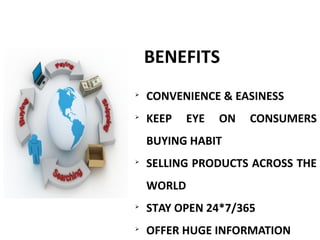
BENEFITS

CONVENIENCE & EASINESS

KEEP EYE ON CONSUMERS
BUYING HABIT

SELLING PRODUCTS ACROSS THE
WORLD

STAY OPEN 24*7/365

OFFER HUGE INFORMATION
IMPACT ON MARKETS
AND RETAILERS

Resistance to safeguard the interest of
offline retailers: As online players are using
disruptive pricing strategy, there is high
resistance from the offline resistance of the
same.

Challenges for offline retailers: Offline
retailers have to work much on customer
experience. For this, there should be
seamless flow of information.
CONCLUSION

In future, more entrepreneurs
will gain access to the Internet
at lower cost, but if concerns
such as security are not
addressed ecommerce may be
slow to grow.
Thank You

Ecommerce

  • 1.
    E- COMMERCE PRESENTED BY:Tnang Loaen KachariPRESENTED BY: Tnang Loaen Kachari Department of Business ManagementDepartment of Business Management 11stst SemesterSemester Roll No: MBA/02Roll No: MBA/02
  • 2.
    CONTENTS MEANING AND DEFINITION HISTORY TYPESOF E- COMMERCE EXAMPLES OF E-COMMERCE BENEFITS IMPACT ON MARKETS AND RETAILERS CONCLUSION
  • 3.
    MEANING AND DEFINITION MEANING: E-Commerce or electronic commerce simply means commercial transactions conducted electronically on the Internet. DEFINITION : E-Commerce is the buying and selling of goods and services, or the transmitting of funds or data, over an electronic network, primarily the Internet.
  • 4.
    HISTORY E-Commerce started inthe 1960s, when technological developments meant that data could be exchanged electronically for the 1st time. But became possible in 1991 when the Internet was opened to commercial use. The development of the Electronic Data Interchange (EDI) paved the way for ecommerce. In the 1990s the rise of eBay and Amazon revolutionarized the ecommerce industry and were amongst the first well known ecommerce brands.
  • 5.
    TYPES OF E-COMMERCE BUSINESSTO BUSINESS (B2B): B2B ecommerce transactions are those where both the transacting parties are businesses, e.g., manufacturers traders, retailers etc. BUSINESS TO CONSUMER (B2C): When businesses sell electronically to end-customers, it is called B2C ecommerce. CONSUMER TO CONSUMER (C2C): Business model that facilitates transaction of products or services between customers.
  • 6.
    EXAMPLES OF ECOMMERCE Shopping :Buying and selling goods on Internet. Ex: Flipkart, Amazon, Myntra. Electronic Payments: Paying online while buying goods online. Internet Banking: Banking transactions without visiting a physical bank. Online Ticketing: It does away with the need to queue up at the ticket . .
  • 7.
    BENEFITS  CONVENIENCE & EASINESS  KEEPEYE ON CONSUMERS BUYING HABIT  SELLING PRODUCTS ACROSS THE WORLD  STAY OPEN 24*7/365  OFFER HUGE INFORMATION
  • 8.
    IMPACT ON MARKETS ANDRETAILERS  Resistance to safeguard the interest of offline retailers: As online players are using disruptive pricing strategy, there is high resistance from the offline resistance of the same.  Challenges for offline retailers: Offline retailers have to work much on customer experience. For this, there should be seamless flow of information.
  • 9.
    CONCLUSION  In future, moreentrepreneurs will gain access to the Internet at lower cost, but if concerns such as security are not addressed ecommerce may be slow to grow.
  • 10.