Prepared by
Dayang
Finey
Erna
The Acquisition-Learning
Hypothesis
Krashen‟s First Hypothesis :
Acquisition-Learning Hypothesis
 Adults have two distinctive ways of developing
competences in second languages.
 First is acquisition, that is by using language for
real communication, and the second way is
learning,"knowing about" language (Krashen &
Terrell 1983)
 Krashen differentiates language learning from
language acquisition, emphasizing that while
learning is a formalized process, such as that
which occurs in a classroom, acquisition
happens informally, when a person is relaxed.
Language Acquisition
 Language Acquisition is a subconscious
process. It occurs very naturally in a non-
threatening environment. The research
strongly supports the view that both children
and adults can subconsciously acquire
languages.
 Language acquirers are not usually aware of
the fact that they are acquiring language, but
are only aware of the fact that they are using
the language for communication.
 The process is very similar to the process
children undergo when they acquire their first
language.
 It requires meaningful interaction in the target
language - natural communication - in which
speakers are concentrated not in the form of
their utterances, but in the communicative
act.
Language Learning
 Language Learning is what occurs at school in
an academic setting. It is a conscious process.
When we talk about rules and grammar of
language, we are usually talking about learning.
 Language learning comprises of a conscious
process which results in conscious knowledge
'about' the language, for example knowledge of
grammar rules.
 It involves error correction and explicit
instruction.
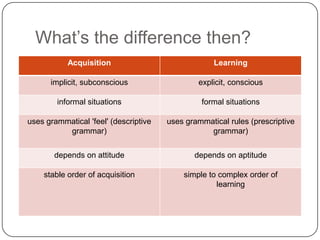
What‟s the difference then?
Acquisition Learning
implicit, subconscious explicit, conscious
informal situations formal situations
uses grammatical 'feel' (descriptive
grammar)
uses grammatical rules (prescriptive
grammar)
depends on attitude depends on aptitude
stable order of acquisition simple to complex order of
learning
Comprehensible Input – The Key
Variable
 Essentially, comprehensible input is what the teacher
gives the students; in order for the input to be
considered comprehensible, the student needs to
understand what is being said and/or given.
 By making input comprehensible or understandable
to students teachers use a maximum amount of the
target language without feeling they have to revert to
the mother tongue.
 Krashen‟s Acquisition-Learning hypothesis revolves
around the concept of “comprehensible input,” a term
which essentially means “messages that can be
understood.”
 Comprehensible input is best received when the learner
is hearing something that he or she wants or needs to
know.
 For example, when people are immersed in a culture in
which they do not know the language, they have an
intense need and desire to speak that language.
 Such students are not interested in grammar lessons
from a book but, instead, want to hear “comprehensible
input” about that culture that teaches them what they
need to know to survive.
 The Acquisition-Learning hypothesis acknowledges
that students learn faster as they are given more
comprehensible input.
 Inversely, a lack of comprehensible input delays
language acquisition.
 Krashen‟s acquisition-learning theory has much in
common with both the communicative approach to
language study and Noam Chomsky‟s theory of
generative grammar.
 The idea of “comprehensible input” is simply another
way of saying that students learn languages best
when they are learning about things that interest
them.
Application In Teaching
 According to this theory, the optimal way a
language is learned is through natural
communication.
 As a second language teacher, the ideal is to
create a situation wherein language is used in order
to fulfil authentic purposes.
 This is turn, will help students to „acquire‟ the
language instead of just „learning‟ it.
Reference
 http://www.unr.edu/cla/fll/people/facultyPages/isa
belli/FLL703/Chapter%202.pdf
 http://blog.innovativelanguage.com/2009/10/25/st
ephen-krashen%E2%80%99s-acquisition-
learning-hypothesis/

The acquisition learning hypothesis ours

  • 1.
  • 2.
    Krashen‟s First Hypothesis: Acquisition-Learning Hypothesis  Adults have two distinctive ways of developing competences in second languages.  First is acquisition, that is by using language for real communication, and the second way is learning,"knowing about" language (Krashen & Terrell 1983)  Krashen differentiates language learning from language acquisition, emphasizing that while learning is a formalized process, such as that which occurs in a classroom, acquisition happens informally, when a person is relaxed.
  • 3.
    Language Acquisition  LanguageAcquisition is a subconscious process. It occurs very naturally in a non- threatening environment. The research strongly supports the view that both children and adults can subconsciously acquire languages.  Language acquirers are not usually aware of the fact that they are acquiring language, but are only aware of the fact that they are using the language for communication.
  • 4.
     The processis very similar to the process children undergo when they acquire their first language.  It requires meaningful interaction in the target language - natural communication - in which speakers are concentrated not in the form of their utterances, but in the communicative act.
  • 5.
    Language Learning  LanguageLearning is what occurs at school in an academic setting. It is a conscious process. When we talk about rules and grammar of language, we are usually talking about learning.  Language learning comprises of a conscious process which results in conscious knowledge 'about' the language, for example knowledge of grammar rules.  It involves error correction and explicit instruction.
  • 6.
    What‟s the differencethen? Acquisition Learning implicit, subconscious explicit, conscious informal situations formal situations uses grammatical 'feel' (descriptive grammar) uses grammatical rules (prescriptive grammar) depends on attitude depends on aptitude stable order of acquisition simple to complex order of learning
  • 7.
    Comprehensible Input –The Key Variable  Essentially, comprehensible input is what the teacher gives the students; in order for the input to be considered comprehensible, the student needs to understand what is being said and/or given.  By making input comprehensible or understandable to students teachers use a maximum amount of the target language without feeling they have to revert to the mother tongue.
  • 8.
     Krashen‟s Acquisition-Learninghypothesis revolves around the concept of “comprehensible input,” a term which essentially means “messages that can be understood.”  Comprehensible input is best received when the learner is hearing something that he or she wants or needs to know.  For example, when people are immersed in a culture in which they do not know the language, they have an intense need and desire to speak that language.  Such students are not interested in grammar lessons from a book but, instead, want to hear “comprehensible input” about that culture that teaches them what they need to know to survive.
  • 9.
     The Acquisition-Learninghypothesis acknowledges that students learn faster as they are given more comprehensible input.  Inversely, a lack of comprehensible input delays language acquisition.  Krashen‟s acquisition-learning theory has much in common with both the communicative approach to language study and Noam Chomsky‟s theory of generative grammar.  The idea of “comprehensible input” is simply another way of saying that students learn languages best when they are learning about things that interest them.
  • 10.
    Application In Teaching According to this theory, the optimal way a language is learned is through natural communication.  As a second language teacher, the ideal is to create a situation wherein language is used in order to fulfil authentic purposes.  This is turn, will help students to „acquire‟ the language instead of just „learning‟ it.
  • 11.