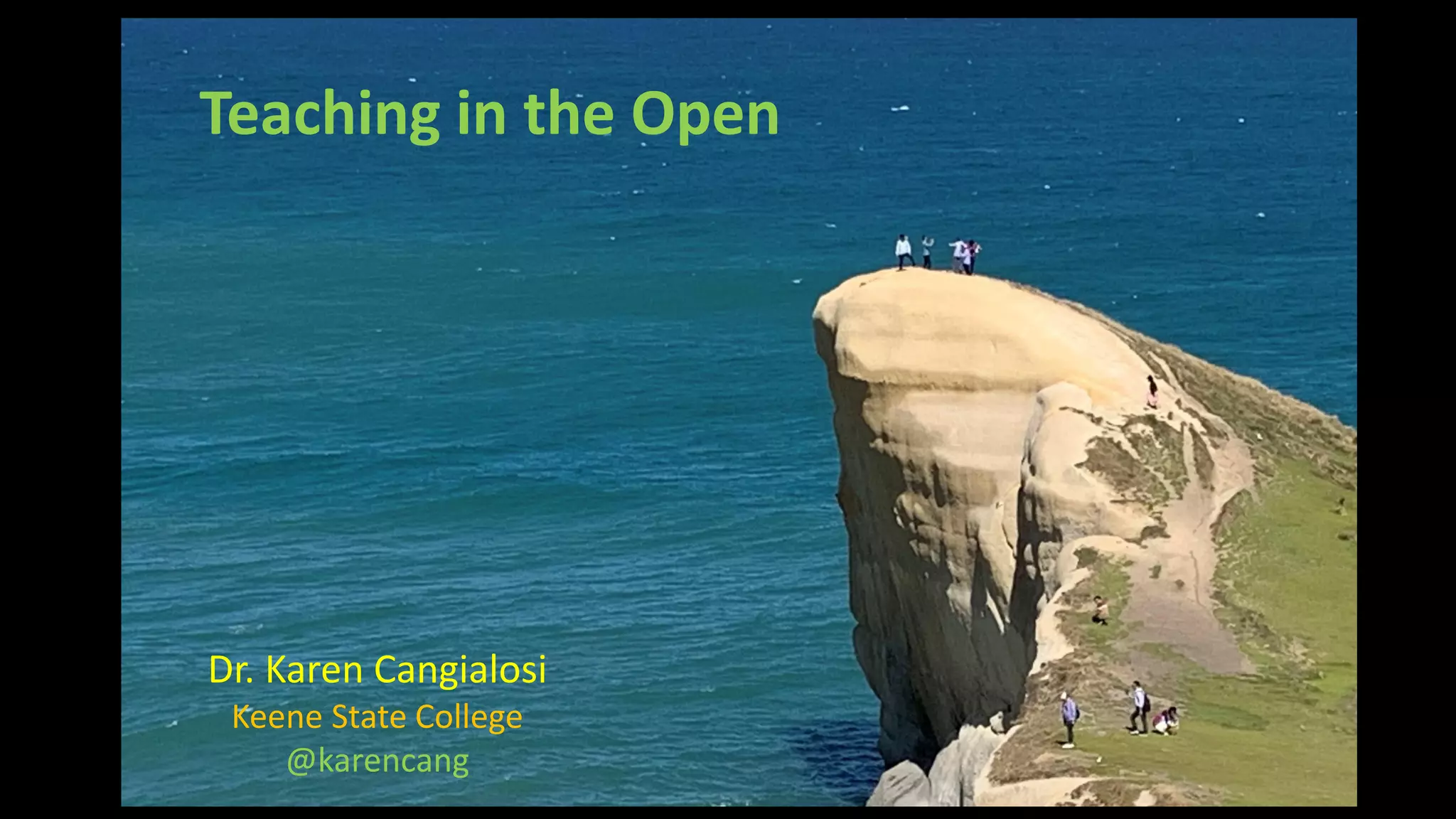
Teaching in the Open
Dr. Karen Cangialosi
Keene State College
@karencang
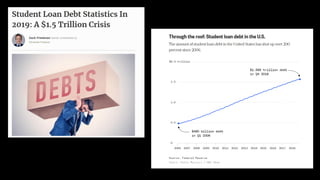
• In a study of 3,000 public college/university
students, HALF of the students left without a
degree, but with crippling debt.
• 23% of low-income sophomores worked a job
between the hours of 10:00pm and 8:00am.
• The average net price for a year at community
college equals 40% of a low income family’s
annual income.
• A year at a public university ranges from 16-
25% of a middle-class family’s annual income.
Modified from Slide by Robin DeRosa [CC BY 4.0]
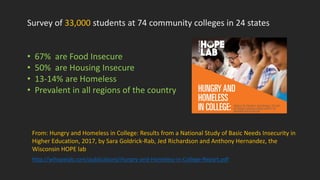
From: Hungry and Homeless in College: Results from a National Study of Basic Needs Insecurity in
Higher Education, 2017, by Sara Goldrick-Rab, Jed Richardson and Anthony Hernandez, the
Wisconsin HOPE lab
http://wihopelab.com/publications/Hungry-and-Homeless-in-College-Report.pdf
Survey of 33,000 students at 74 community colleges in 24 states
• 67% are Food Insecure
• 50% are Housing Insecure
• 13-14% are Homeless
• Prevalent in all regions of the country
https://hope4college.com/
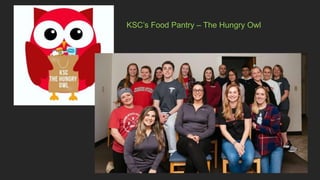
KSC’s Food Pantry – The Hungry Owl
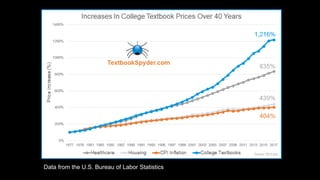
Data from the U.S. Bureau of Labor Statistics
Slide by Robin DeRosa [CC BY 4.0]
22,000 students in the study
Open Educational Resources by Ron Mader [CC BY 2.0]
• Free
OER
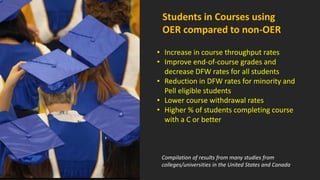
• Increase in course throughput rates
• Improve end-of-course grades and
decrease DFW rates for all students
• Reduction in DFW rates for minority and
Pell eligible students
• Lower course withdrawal rates
• Higher % of students completing course
with a C or better
Compilation of results from many studies from
colleges/universities in the United States and Canada
Students in Courses using
OER compared to non-OER
• The Keene State College Biology dept has collectively
saved our students over $250,000 over the last 4
years.
• Many Colleges and Universities in the U.S. and Canada
have already saved students MILLIONS of dollars in
textbooks costs.
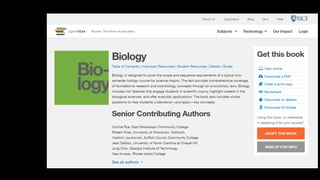
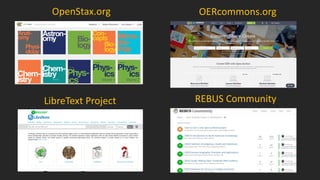
OpenStax.org OERcommons.org
LibreText Project REBUS Community
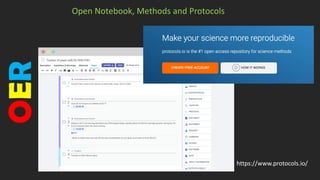
Open Notebook, Methods and Protocols
https://www.protocols.io/
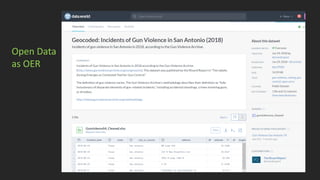
Open Data
as OER
Free as in “Free Beer”
Photo by Elliot Bledsoe [CC BY 2.0]
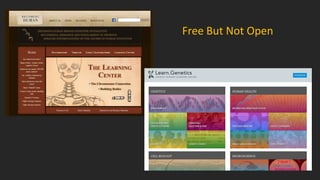
Free But Not Open
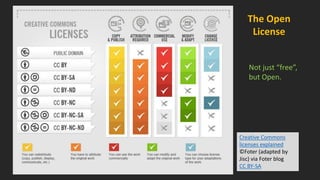
Creative Commons
licenses explained
©Foter (adapted by
Jisc) via Foter blog
CC BY-SA
The Open
License
Not just “free”,
but Open.
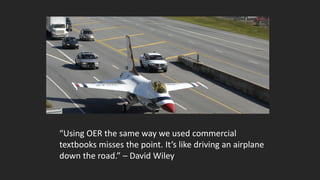
“Using OER the same way we used commercial
textbooks misses the point. It’s like driving an airplane
down the road.” – David Wiley
• Reuse
• Revise
• Remix
• Redistribute
• Retain
FREE as in Freedom (the 5 R’s)
Open Educational Resources by Ron Mader [CC BY 2.0]
• Digital
• Multimedia
• Downloadable
• Adaptable
• Current
• Public
• Openly Licensed
• Free
OER
• “Traditional” OER as textbook (e.g.
pressbooks)
• Ancillary materials: test banks,
study guides, lesson plans, etc
• Curated links on websites
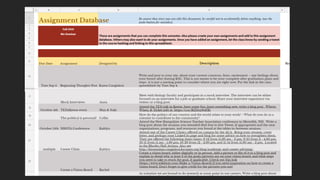
• Open Google Docs
• Open Access published articles
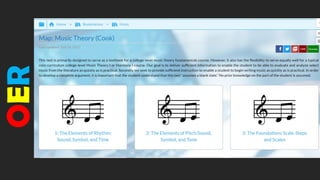
• Open Datasets
• Open Lab notebooks and Methods
repositories
• Open Videos
• Open Lab Simulations
• Open Source software/tools
• and more…
Popsicles by Colored Pencil Magazine [CC BY 2.0]
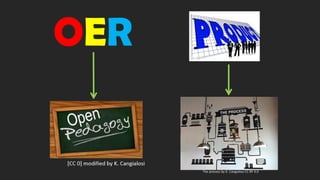
OER
Open Pedagogy
• Community and collaboration, sharing
resources, ideas and power
• Connection to the wider public
• Learners contribute to, not just
consume knowledge
• Student Agency, Learner-driven
• Critical approach to the use of tools
and technology
‘Floor at domains17’ by Karen Cangialosi [CC BY 4.0]
Modified from content by Robin DeRosa
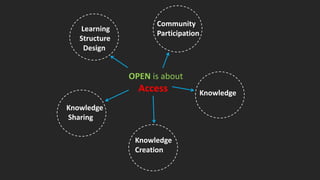
OPEN is about
Access
Learning
Structure
Design
Knowledge
Knowledge
Creation
Knowledge
Sharing
Community
Participation
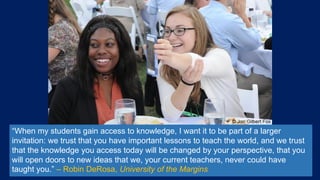
“When my students gain access to knowledge, I want it to be part of a larger
invitation: we trust that you have important lessons to teach the world, and we trust
that the knowledge you access today will be changed by your perspective, that you
will open doors to new ideas that we, your current teachers, never could have
taught you.” – Robin DeRosa, University of the Margins
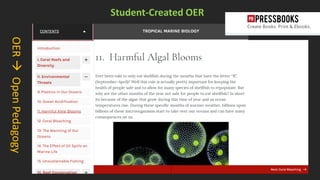
Student-Created OEROEROpenPedagogy
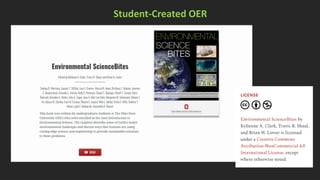
Student-Created OER
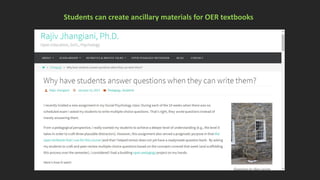
Students can create ancillary materials for OER textbooks
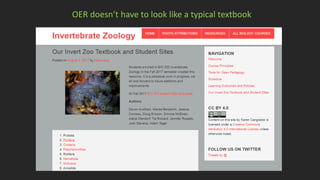
OER doesn’t have to look like a typical textbook
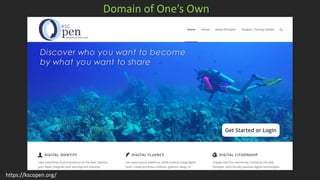
Domain of One’s Own
https://kscopen.org/
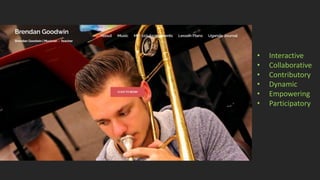
• Interactive
• Collaborative
• Contributory
• Dynamic
• Empowering
• Participatory
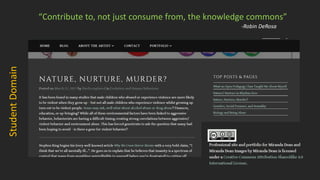
“Contribute to, not just consume from, the knowledge commons”
-Robin DeRosa
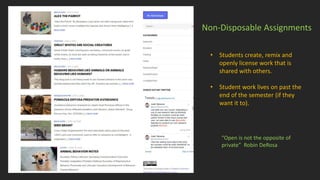
• Students create, remix and
openly license work that is
shared with others.
• Student work lives on past the
end of the semester (if they
want it to).
Non-Disposable Assignments
“Open is not the opposite of
private” Robin DeRosa
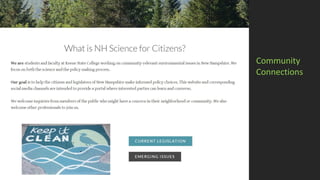
Community
Connections
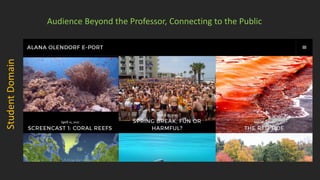
Audience Beyond the Professor, Connecting to the Public
“It was a drastic and honestly scary change going from a
traditional learning course where I only have my instructor’s
opinion to worry about.” - Invertebrate Zoology student
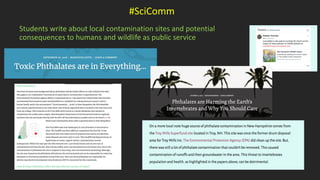
Students write about local contamination sites and potential
consequences to humans and wildlife as public service
#SciComm
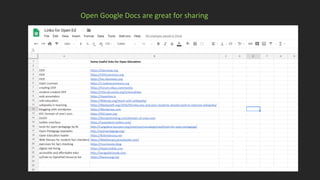
Open Google Docs are great for sharing
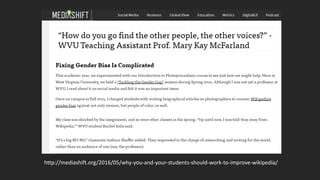
Wiki Education Foundation (wikiedu.org)
[CC BY SA]
Creating/Editing Wikipedia Articles
http://mediashift.org/2016/05/why-you-and-your-students-should-work-to-improve-wikipedia/
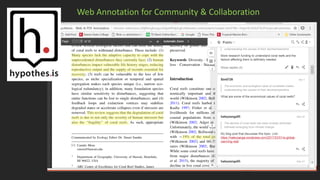
Web Annotation for Community & Collaboration
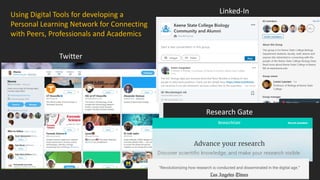
Using Digital Tools for developing a
Personal Learning Network for Connecting
with Peers, Professionals and Academics
Twitter
Research Gate
Linked-In
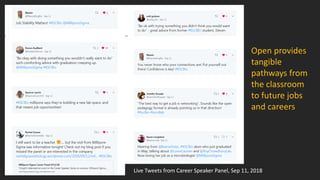
Live Tweets from Career Speaker Panel, Sep 11, 2018
Open provides
tangible
pathways from
the classroom
to future jobs
and careers
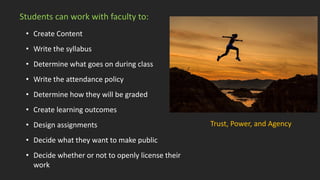
Students can work with faculty to:
• Create Content
• Write the syllabus
• Determine what goes on during class
• Write the attendance policy
• Determine how they will be graded
• Create learning outcomes
• Design assignments
• Decide what they want to make public
• Decide whether or not to openly license their
work
Trust, Power, and Agency
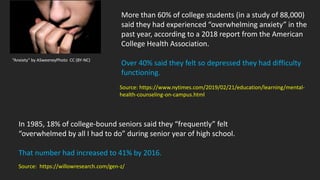
“Anxiety" by ASweeneyPhoto CC (BY-NC)
More than 60% of college students (in a study of 88,000)
said they had experienced “overwhelming anxiety” in the
past year, according to a 2018 report from the American
College Health Association.
Over 40% said they felt so depressed they had difficulty
functioning.
Source: https://www.nytimes.com/2019/02/21/education/learning/mental-
health-counseling-on-campus.html
In 1985, 18% of college-bound seniors said they “frequently” felt
“overwhelmed by all I had to do” during senior year of high school.
That number had increased to 41% by 2016.
Source: https://willowresearch.com/gen-z/
An atmosphere that places greater value on
“achievement” than on learning
Standardized tests and assessments that suck the
life out of learning
Surveillance systems that track, monitor, punish,
and insist on compliance
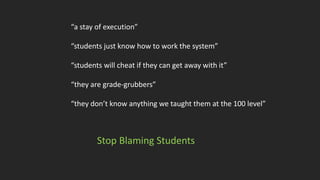
“a stay of execution”
“students just know how to work the system”
“students will cheat if they can get away with it”
“they are grade-grubbers”
“they don’t know anything we taught them at the 100 level”
Stop Blaming Students
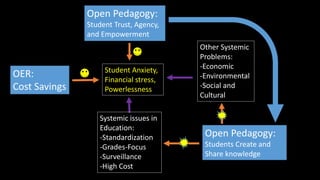
Student Anxiety,
Financial stress,
Powerlessness
Open Pedagogy:
Student Trust, Agency,
and Empowerment
Open Pedagogy:
Students Create and
Share knowledge
Other Systemic
Problems:
-Economic
-Environmental
-Social and
Cultural
Systemic issues in
Education:
-Standardization
-Grades-Focus
-Surveillance
-High Cost
OER:
Cost Savings
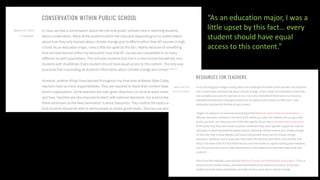
“As an education major, I was a
little upset by this fact… every
student should have equal
access to this content.”
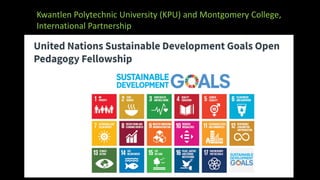
Kwantlen Polytechnic University (KPU) and Montgomery College,
International Partnership
“Open is a process, not a panacea”
-Robin DeRosa
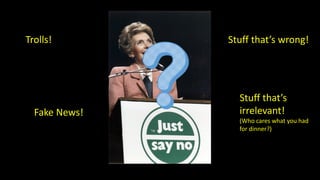
Trolls!
Fake News!
Stuff that’s wrong!
Stuff that’s
irrelevant!
(Who cares what you had
for dinner?)
Students will go online ANYWAY; they will have a digital
presence WITH or WITHOUT your guidance.
Is it responsible to “just say no” to:
• Smartphone use?
• Using social media?
• Reading, posting and interacting on the web?
If faculty and staff in higher education don’t guide students to think
about digital citizenship and their digital footprint – who will?
CC 0
Don’t start with
the tools
CC 0
• What are some ways to make education more accessible and
equitable for all students? (Open for whom?)
• How do we authentically give our students voice and power in
the design of learning structures?
• How do we help the public see the value in what our students
are achieving?
• How can we provide transformational (not just transactional)
experiences for our students?
• How might we inspire students to become agents of social
change?
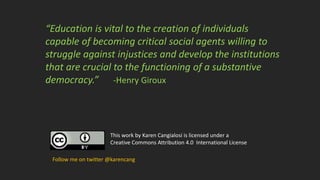
This work by Karen Cangialosi is licensed under a
Creative Commons Attribution 4.0 International License
Follow me on twitter @karencang
“Education is vital to the creation of individuals
capable of becoming critical social agents willing to
struggle against injustices and develop the institutions
that are crucial to the functioning of a substantive
democracy.” -Henry Giroux

Teaching in the Open - Bates College

  • 1.
    Teaching in theOpen Dr. Karen Cangialosi Keene State College @karencang
  • 5.
    • In astudy of 3,000 public college/university students, HALF of the students left without a degree, but with crippling debt. • 23% of low-income sophomores worked a job between the hours of 10:00pm and 8:00am. • The average net price for a year at community college equals 40% of a low income family’s annual income. • A year at a public university ranges from 16- 25% of a middle-class family’s annual income. Modified from Slide by Robin DeRosa [CC BY 4.0]
  • 6.
    From: Hungry andHomeless in College: Results from a National Study of Basic Needs Insecurity in Higher Education, 2017, by Sara Goldrick-Rab, Jed Richardson and Anthony Hernandez, the Wisconsin HOPE lab http://wihopelab.com/publications/Hungry-and-Homeless-in-College-Report.pdf Survey of 33,000 students at 74 community colleges in 24 states • 67% are Food Insecure • 50% are Housing Insecure • 13-14% are Homeless • Prevalent in all regions of the country
  • 7.
  • 8.
    KSC’s Food Pantry– The Hungry Owl
  • 9.
    Data from theU.S. Bureau of Labor Statistics
  • 10.
    Slide by RobinDeRosa [CC BY 4.0] 22,000 students in the study
  • 11.
    Open Educational Resourcesby Ron Mader [CC BY 2.0] • Free OER
  • 12.
    • Increase incourse throughput rates • Improve end-of-course grades and decrease DFW rates for all students • Reduction in DFW rates for minority and Pell eligible students • Lower course withdrawal rates • Higher % of students completing course with a C or better Compilation of results from many studies from colleges/universities in the United States and Canada Students in Courses using OER compared to non-OER
  • 13.
    • The KeeneState College Biology dept has collectively saved our students over $250,000 over the last 4 years. • Many Colleges and Universities in the U.S. and Canada have already saved students MILLIONS of dollars in textbooks costs.
  • 14.
  • 16.
    Open Notebook, Methodsand Protocols https://www.protocols.io/
  • 17.
  • 18.
    Free as in“Free Beer” Photo by Elliot Bledsoe [CC BY 2.0]
  • 19.
  • 20.
    Creative Commons licenses explained ©Foter(adapted by Jisc) via Foter blog CC BY-SA The Open License Not just “free”, but Open.
  • 21.
    “Using OER thesame way we used commercial textbooks misses the point. It’s like driving an airplane down the road.” – David Wiley
  • 22.
    • Reuse • Revise •Remix • Redistribute • Retain FREE as in Freedom (the 5 R’s)
  • 23.
    Open Educational Resourcesby Ron Mader [CC BY 2.0] • Digital • Multimedia • Downloadable • Adaptable • Current • Public • Openly Licensed • Free OER
  • 25.
    • “Traditional” OERas textbook (e.g. pressbooks) • Ancillary materials: test banks, study guides, lesson plans, etc • Curated links on websites • Open Google Docs • Open Access published articles • Open Datasets • Open Lab notebooks and Methods repositories • Open Videos • Open Lab Simulations • Open Source software/tools • and more… Popsicles by Colored Pencil Magazine [CC BY 2.0] OER
  • 26.
    Open Pedagogy • Communityand collaboration, sharing resources, ideas and power • Connection to the wider public • Learners contribute to, not just consume knowledge • Student Agency, Learner-driven • Critical approach to the use of tools and technology ‘Floor at domains17’ by Karen Cangialosi [CC BY 4.0] Modified from content by Robin DeRosa
  • 27.
  • 28.
    “When my studentsgain access to knowledge, I want it to be part of a larger invitation: we trust that you have important lessons to teach the world, and we trust that the knowledge you access today will be changed by your perspective, that you will open doors to new ideas that we, your current teachers, never could have taught you.” – Robin DeRosa, University of the Margins
  • 29.
  • 30.
  • 31.
    Students can createancillary materials for OER textbooks
  • 32.
    OER doesn’t haveto look like a typical textbook
  • 33.
    Domain of One’sOwn https://kscopen.org/
  • 34.
    • Interactive • Collaborative •Contributory • Dynamic • Empowering • Participatory
  • 35.
    “Contribute to, notjust consume from, the knowledge commons” -Robin DeRosa
  • 37.
    • Students create,remix and openly license work that is shared with others. • Student work lives on past the end of the semester (if they want it to). Non-Disposable Assignments “Open is not the opposite of private” Robin DeRosa
  • 38.
  • 39.
    Audience Beyond theProfessor, Connecting to the Public
  • 40.
    “It was adrastic and honestly scary change going from a traditional learning course where I only have my instructor’s opinion to worry about.” - Invertebrate Zoology student
  • 41.
    Students write aboutlocal contamination sites and potential consequences to humans and wildlife as public service #SciComm
  • 42.
    Open Google Docsare great for sharing
  • 44.
    Wiki Education Foundation(wikiedu.org) [CC BY SA] Creating/Editing Wikipedia Articles
  • 45.
  • 46.
    Web Annotation forCommunity & Collaboration
  • 47.
    Using Digital Toolsfor developing a Personal Learning Network for Connecting with Peers, Professionals and Academics Twitter Research Gate Linked-In
  • 48.
    Live Tweets fromCareer Speaker Panel, Sep 11, 2018 Open provides tangible pathways from the classroom to future jobs and careers
  • 49.
    Students can workwith faculty to: • Create Content • Write the syllabus • Determine what goes on during class • Write the attendance policy • Determine how they will be graded • Create learning outcomes • Design assignments • Decide what they want to make public • Decide whether or not to openly license their work Trust, Power, and Agency
  • 50.
    “Anxiety" by ASweeneyPhotoCC (BY-NC) More than 60% of college students (in a study of 88,000) said they had experienced “overwhelming anxiety” in the past year, according to a 2018 report from the American College Health Association. Over 40% said they felt so depressed they had difficulty functioning. Source: https://www.nytimes.com/2019/02/21/education/learning/mental- health-counseling-on-campus.html In 1985, 18% of college-bound seniors said they “frequently” felt “overwhelmed by all I had to do” during senior year of high school. That number had increased to 41% by 2016. Source: https://willowresearch.com/gen-z/
  • 51.
    An atmosphere thatplaces greater value on “achievement” than on learning Standardized tests and assessments that suck the life out of learning Surveillance systems that track, monitor, punish, and insist on compliance
  • 52.
    “a stay ofexecution” “students just know how to work the system” “students will cheat if they can get away with it” “they are grade-grubbers” “they don’t know anything we taught them at the 100 level” Stop Blaming Students
  • 53.
    Student Anxiety, Financial stress, Powerlessness OpenPedagogy: Student Trust, Agency, and Empowerment Open Pedagogy: Students Create and Share knowledge Other Systemic Problems: -Economic -Environmental -Social and Cultural Systemic issues in Education: -Standardization -Grades-Focus -Surveillance -High Cost OER: Cost Savings
  • 54.
    “As an educationmajor, I was a little upset by this fact… every student should have equal access to this content.”
  • 55.
    Kwantlen Polytechnic University(KPU) and Montgomery College, International Partnership
  • 56.
    “Open is aprocess, not a panacea” -Robin DeRosa
  • 57.
    Trolls! Fake News! Stuff that’swrong! Stuff that’s irrelevant! (Who cares what you had for dinner?)
  • 58.
    Students will goonline ANYWAY; they will have a digital presence WITH or WITHOUT your guidance. Is it responsible to “just say no” to: • Smartphone use? • Using social media? • Reading, posting and interacting on the web? If faculty and staff in higher education don’t guide students to think about digital citizenship and their digital footprint – who will?
  • 59.
    CC 0 Don’t startwith the tools CC 0
  • 60.
    • What aresome ways to make education more accessible and equitable for all students? (Open for whom?) • How do we authentically give our students voice and power in the design of learning structures? • How do we help the public see the value in what our students are achieving? • How can we provide transformational (not just transactional) experiences for our students? • How might we inspire students to become agents of social change?
  • 61.
    This work byKaren Cangialosi is licensed under a Creative Commons Attribution 4.0 International License Follow me on twitter @karencang “Education is vital to the creation of individuals capable of becoming critical social agents willing to struggle against injustices and develop the institutions that are crucial to the functioning of a substantive democracy.” -Henry Giroux