Open Education:
Serving Social Justice &
Transforming Pedagogy
License: CC Attribution License
Adapted by Nidia Cerna for
McMaster University - CCE
Nidia’s
Notes
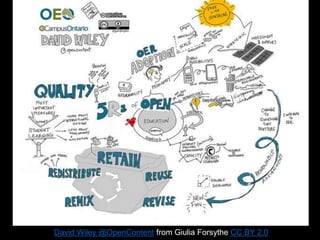
The 5 Rs of Open Education
Open doesn't just mean free. Open means free grant of permissions to
engage in:
• Retain: make and own a copy
• Reuse: use in a wide range of ways
• Revise: adapt, modify, and improve
• Remix: combine two or more
• Redistribute: share with others
OER examples:
•Full courses
•Textbooks
•Simulation
•Videos
•Assessments
Notes from keynote presentation David Wiley for the OEOSummit in Ontario, 2017.
OER Adoption
Replacing course required materials with OER. Benefits:
• Improves affordability
Disappearing strategies: buyback, rental, e-books, online subscriptions
(limited access and with expiration date)
Buying or leasing a textbook costs more than accessing thousands of movies (Netflix) or music (spotify)
• Invigorates pedagogy
copyrights restricts what we can do with the material
Disposable assignment are a missed opportunity: students want to do something that is meaningful. In
contrast to an open assignment, which will be tailored to creating something that will be shared openly
later. Example of Blogs vs. Wikis video.
• Improves student success
Studies are showing that OER might be improving completion & success (pass) student's rates on F2F
and online settings
• Does it at scale
A strategy: Faculty and students working together in creating open assignments
• Scale vertically. Ex. OER Degree (selecting only OER courses & materials to get a degree)
• Scale horizontally. Ex. open education pathway
Successful scaling requires strategic support
Quality of instructional material is defined by the extend to which it supports students learning.
Notes from keynote presentation David Wiley for the OEOSummit in Ontario, 2017.
Benefits for Institutions
• Cost savings
• Access
• Outcomes
• Adapt, update and remix
• Enrolment
• Persistence
• Completion
Notes from keynote presentation David Wiley for the OEOSummit in Ontario, 2017.
David Wiley @OpenContent from Giulia Forsythe CC BY 2.0
Open Education:
Serving Social Justice &
Transforming Pedagogy
Dr. Robin DeRosa
Plymouth State University
@actualham
Dr. Rajiv Jhangiani
Kwantlen Polytechnic University
@thatpsychprof
Selection of slides from the collaborative keynote for the OEOSummit in Ontario, 2017.
“higher education
shall be equally
accessible to all”
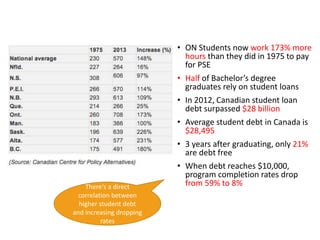
• ON Students now work 173% more
hours than they did in 1975 to pay
for PSE
• Half of Bachelor’s degree
graduates rely on student loans
• In 2012, Canadian student loan
debt surpassed $28 billion
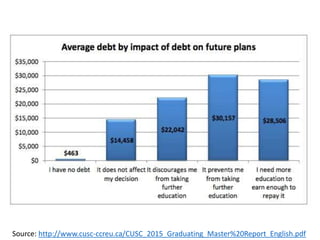
• Average student debt in Canada is
$28,495The
• 3 years after graduating, only 21%
are debt free
• When debt reaches $10,000,
program completion rates drop
from 59% to 8%
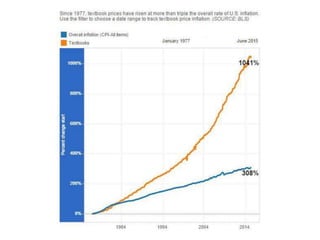
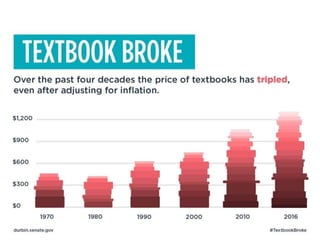
• The cost of textbooks
There's a direct
correlation between
higher student debt
and increasing dropping
rates
Source: http://www.cusc-ccreu.ca/CUSC_2015_Graduating_Master%20Report_English.pdf
What can YOU do?
• Survey your student body
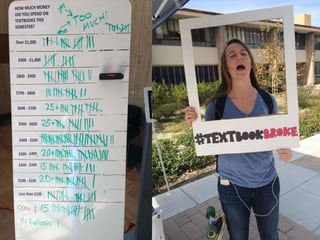
• #textbookbroke campaign
• Presentations
• Utilize visuals, create displays
• Speak directly to faculty & admin
• Suggest that faculty review a textbook
• Showcase examples
• Form a student-led OER group
• Connect. Collaborate.
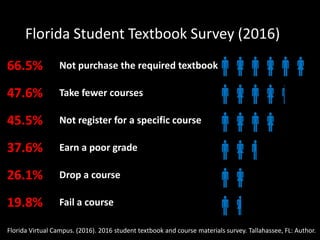
66.5% Not purchase the required textbook
47.6% Take fewer courses
45.5% Not register for a specific course
37.6% Earn a poor grade
26.1% Drop a course
19.8% Fail a course






Florida Virtual Campus. (2016). 2016 student textbook and course materials survey. Tallahassee, FL: Author.
Florida Student Textbook Survey (2016)
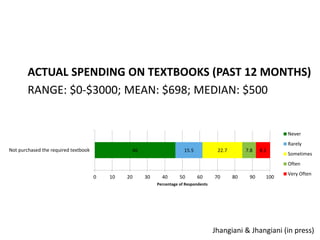
46 15.5 22.7 7.8 8.1
0 10 20 30 40 50 60 70 80 90 100
Not purchased the required textbook
Percentage of Respondents
Never
Rarely
Sometimes
Often
Very Often
ACTUAL SPENDING ON TEXTBOOKS (PAST 12 MONTHS)
RANGE: $0-$3000; MEAN: $698; MEDIAN: $500
Jhangiani & Jhangiani (in press)
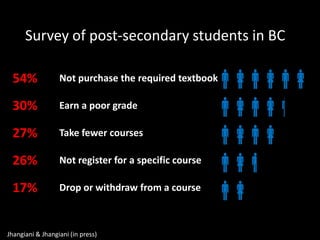
54% Not purchase the required textbook
30% Earn a poor grade
27% Take fewer courses
26% Not register for a specific course
17% Drop or withdraw from a course





Jhangiani & Jhangiani (in press)
Survey of post-secondary students in BC
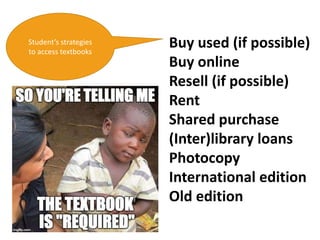
Buy used (if possible)
Buy online
Resell (if possible)
Rent
Shared purchase
(Inter)library loans
Photocopy
International edition
Old edition
Student’s strategies
to access textbooks
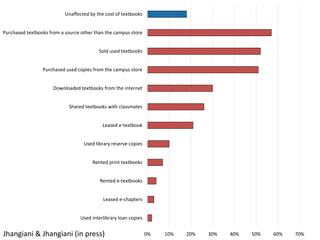
0% 10% 20% 30% 40% 50% 60% 70%
Used interlibrary loan copies
Leased e-chapters
Rented e-textbooks
Rented print textbooks
Used library reserve copies
Leased e-textbook
Shared textbooks with classmates
Downloaded textbooks from the internet
Purchased used copies from the campus store
Sold used textbooks
Purchased textbooks from a source other than the campus store
Unaffected by the cost of textbooks
Jhangiani & Jhangiani (in press)
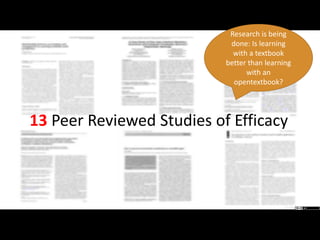
13 Peer Reviewed Studies of Efficacy
http://openedgroup.org/
Research is being
done: Is learning
with a textbook
better than learning
with an
opentextbook?
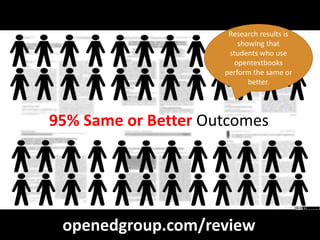
95% Same or Better Outcomes
http://openedgroup.org/
openedgroup.com/review
Research results is
showing that
students who use
opentextbooks
perform the same or
better.
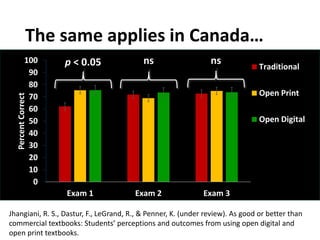
The same applies in Canada…
Jhangiani, R. S., Dastur, F., LeGrand, R., & Penner, K. (under review). As good or better than
commercial textbooks: Students’ perceptions and outcomes from using open digital and
open print textbooks.
0
10
20
30
40
50
60
70
80
90
100
Exam 1 Exam 2 Exam 3
PercentCorrect
Traditional
Open Print
Open Digital
p < 0.05 ns ns
What is
Open Pedagogy?
ACCESSIBLE
LEARNER-DRIVEN
CONNECTED
CC0 Alan Levine
Open education
movement is not only
about low or no cost
textbook, but access to
learning materials.
Student-Centered  Learner-Driven
Learning Outcomes; Policies (Attendance, Late Work);
Procedures (Assessments, Grading);
Schedule of Work (Curated Reading); Assignments
COURSE LEVEL, PROGRAM LEVEL
CC0 Alan Levine
Content
↓
Community
Connected
CC0 Alan Levine
Communities evolve our
understanding. Content is always
changing and moving.
Content curation - top digital skill -
enable students to create lifelong
learning, to stay connected and
learn from the field
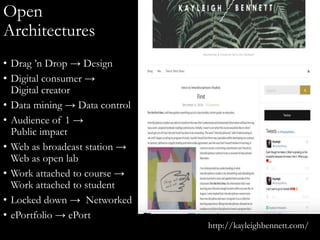
Open
Architectures
• Drag ’n Drop → Design
• Digital consumer →
Digital creator
• Data mining → Data control
• Audience of 1 →
Public impact
• Web as broadcast station →
Web as open lab
• Work attached to course →
Work attached to student
• Locked down → Networked
• ePortfolio → ePort
http://kayleighbennett.com/
Open Pedagogy:
HOW
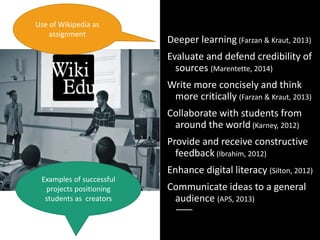
Deeper learning (Farzan & Kraut, 2013)
Evaluate and defend credibility of
sources (Marentette, 2014)
Write more concisely and think
more critically (Farzan & Kraut, 2013)
Collaborate with students from
around the world (Karney, 2012)
Provide and receive constructive
feedback (Ibrahim, 2012)
Enhance digital literacy (Silton, 2012)
Communicate ideas to a general
audience (APS, 2013)
Use of Wikipedia as
assignment
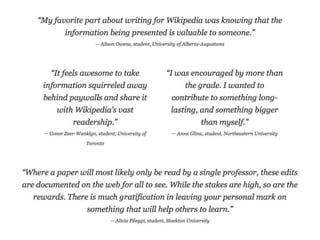
Examples of successful
projects positioning
students as creators
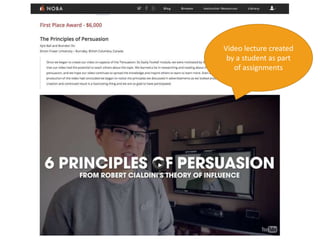
Video lecture created
by a student as part
of assignments
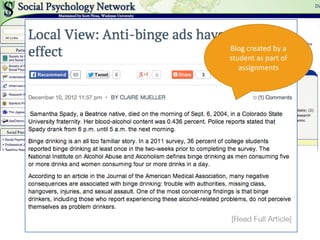
Blog created by a
student as part of
assignments
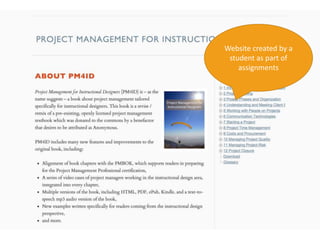
PM4ID
Website created by a
student as part of
assignments
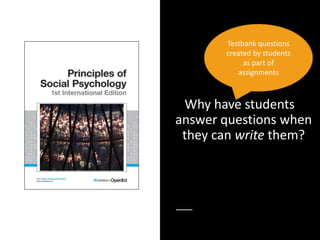
Why have students
answer questions when
they can write them?
Testbank questions
created by students
as part of
assignments
Constantly
Evolving:
Students &
Teachers
Add,
Improve,
Share
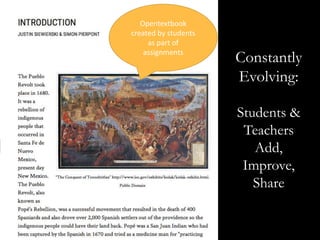
Opentextbook
created by students
as part of
assignments
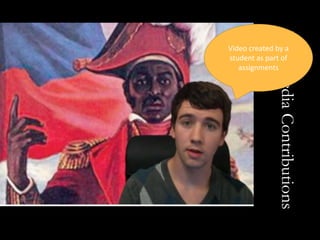
MultimediaContributions
Video created by a
student as part of
assignments
An Open
“Textbook”
Can Be:
• Interactive
• Collaborative
• Dialogic
• Dynamic
• Empowering
• Contributory
• Current
• Accessible
• Multimedia
• Public
• (Free)
CC0 Alan
For example:
involve students in
the conversation
about what needs
to be learned in the
course and the best
ways in which to
meet them
Open Ed: Growing Institutional Initiatives
• Grow Faculty Champions
• Compensate for Academic Labor
• Contextualize as an
Access Movement
• Team Approach:
• Academic Technology
(Connected Learning)
• Teaching & Learning Centers
(Learner-Driven Pedagogies)
• Librarians (OER Search)
#OEOSummit
@thatpsychprof
@actualham
Mission is access
Method is agency
Impact is immense
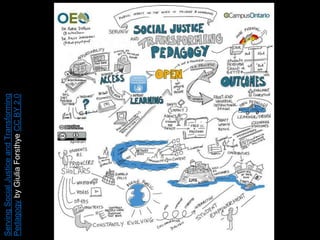
ServingSocialJusticeandTransforming
PedagogybyGiuliaForsthyeCCBY2.0

Open Education Ontario Summit 2017 - Summary

  • 1.
    Open Education: Serving SocialJustice & Transforming Pedagogy License: CC Attribution License Adapted by Nidia Cerna for McMaster University - CCE Nidia’s Notes
  • 2.
    The 5 Rsof Open Education Open doesn't just mean free. Open means free grant of permissions to engage in: • Retain: make and own a copy • Reuse: use in a wide range of ways • Revise: adapt, modify, and improve • Remix: combine two or more • Redistribute: share with others OER examples: •Full courses •Textbooks •Simulation •Videos •Assessments Notes from keynote presentation David Wiley for the OEOSummit in Ontario, 2017.
  • 3.
    OER Adoption Replacing courserequired materials with OER. Benefits: • Improves affordability Disappearing strategies: buyback, rental, e-books, online subscriptions (limited access and with expiration date) Buying or leasing a textbook costs more than accessing thousands of movies (Netflix) or music (spotify) • Invigorates pedagogy copyrights restricts what we can do with the material Disposable assignment are a missed opportunity: students want to do something that is meaningful. In contrast to an open assignment, which will be tailored to creating something that will be shared openly later. Example of Blogs vs. Wikis video. • Improves student success Studies are showing that OER might be improving completion & success (pass) student's rates on F2F and online settings • Does it at scale A strategy: Faculty and students working together in creating open assignments • Scale vertically. Ex. OER Degree (selecting only OER courses & materials to get a degree) • Scale horizontally. Ex. open education pathway Successful scaling requires strategic support Quality of instructional material is defined by the extend to which it supports students learning. Notes from keynote presentation David Wiley for the OEOSummit in Ontario, 2017.
  • 4.
    Benefits for Institutions •Cost savings • Access • Outcomes • Adapt, update and remix • Enrolment • Persistence • Completion Notes from keynote presentation David Wiley for the OEOSummit in Ontario, 2017.
  • 5.
    David Wiley @OpenContentfrom Giulia Forsythe CC BY 2.0
  • 6.
    Open Education: Serving SocialJustice & Transforming Pedagogy Dr. Robin DeRosa Plymouth State University @actualham Dr. Rajiv Jhangiani Kwantlen Polytechnic University @thatpsychprof Selection of slides from the collaborative keynote for the OEOSummit in Ontario, 2017.
  • 7.
    “higher education shall beequally accessible to all”
  • 8.
    • ON Studentsnow work 173% more hours than they did in 1975 to pay for PSE • Half of Bachelor’s degree graduates rely on student loans • In 2012, Canadian student loan debt surpassed $28 billion • Average student debt in Canada is $28,495The • 3 years after graduating, only 21% are debt free • When debt reaches $10,000, program completion rates drop from 59% to 8% • The cost of textbooks There's a direct correlation between higher student debt and increasing dropping rates
  • 9.
  • 12.
    What can YOUdo? • Survey your student body • #textbookbroke campaign • Presentations • Utilize visuals, create displays • Speak directly to faculty & admin • Suggest that faculty review a textbook • Showcase examples • Form a student-led OER group • Connect. Collaborate.
  • 13.
    66.5% Not purchasethe required textbook 47.6% Take fewer courses 45.5% Not register for a specific course 37.6% Earn a poor grade 26.1% Drop a course 19.8% Fail a course       Florida Virtual Campus. (2016). 2016 student textbook and course materials survey. Tallahassee, FL: Author. Florida Student Textbook Survey (2016)
  • 14.
    46 15.5 22.77.8 8.1 0 10 20 30 40 50 60 70 80 90 100 Not purchased the required textbook Percentage of Respondents Never Rarely Sometimes Often Very Often ACTUAL SPENDING ON TEXTBOOKS (PAST 12 MONTHS) RANGE: $0-$3000; MEAN: $698; MEDIAN: $500 Jhangiani & Jhangiani (in press)
  • 15.
    54% Not purchasethe required textbook 30% Earn a poor grade 27% Take fewer courses 26% Not register for a specific course 17% Drop or withdraw from a course      Jhangiani & Jhangiani (in press) Survey of post-secondary students in BC
  • 16.
    Buy used (ifpossible) Buy online Resell (if possible) Rent Shared purchase (Inter)library loans Photocopy International edition Old edition Student’s strategies to access textbooks
  • 17.
    0% 10% 20%30% 40% 50% 60% 70% Used interlibrary loan copies Leased e-chapters Rented e-textbooks Rented print textbooks Used library reserve copies Leased e-textbook Shared textbooks with classmates Downloaded textbooks from the internet Purchased used copies from the campus store Sold used textbooks Purchased textbooks from a source other than the campus store Unaffected by the cost of textbooks Jhangiani & Jhangiani (in press)
  • 18.
    13 Peer ReviewedStudies of Efficacy http://openedgroup.org/ Research is being done: Is learning with a textbook better than learning with an opentextbook?
  • 19.
    95% Same orBetter Outcomes http://openedgroup.org/ openedgroup.com/review Research results is showing that students who use opentextbooks perform the same or better.
  • 20.
    The same appliesin Canada… Jhangiani, R. S., Dastur, F., LeGrand, R., & Penner, K. (under review). As good or better than commercial textbooks: Students’ perceptions and outcomes from using open digital and open print textbooks. 0 10 20 30 40 50 60 70 80 90 100 Exam 1 Exam 2 Exam 3 PercentCorrect Traditional Open Print Open Digital p < 0.05 ns ns
  • 21.
    What is Open Pedagogy? ACCESSIBLE LEARNER-DRIVEN CONNECTED CC0Alan Levine Open education movement is not only about low or no cost textbook, but access to learning materials.
  • 22.
    Student-Centered  Learner-Driven LearningOutcomes; Policies (Attendance, Late Work); Procedures (Assessments, Grading); Schedule of Work (Curated Reading); Assignments COURSE LEVEL, PROGRAM LEVEL CC0 Alan Levine
  • 23.
    Content ↓ Community Connected CC0 Alan Levine Communitiesevolve our understanding. Content is always changing and moving. Content curation - top digital skill - enable students to create lifelong learning, to stay connected and learn from the field
  • 24.
    Open Architectures • Drag ’nDrop → Design • Digital consumer → Digital creator • Data mining → Data control • Audience of 1 → Public impact • Web as broadcast station → Web as open lab • Work attached to course → Work attached to student • Locked down → Networked • ePortfolio → ePort http://kayleighbennett.com/
  • 25.
    Open Pedagogy: HOW Deeper learning(Farzan & Kraut, 2013) Evaluate and defend credibility of sources (Marentette, 2014) Write more concisely and think more critically (Farzan & Kraut, 2013) Collaborate with students from around the world (Karney, 2012) Provide and receive constructive feedback (Ibrahim, 2012) Enhance digital literacy (Silton, 2012) Communicate ideas to a general audience (APS, 2013) Use of Wikipedia as assignment Examples of successful projects positioning students as creators
  • 27.
    Video lecture created bya student as part of assignments
  • 28.
    Blog created bya student as part of assignments
  • 29.
    PM4ID Website created bya student as part of assignments
  • 30.
    Why have students answerquestions when they can write them? Testbank questions created by students as part of assignments
  • 31.
  • 32.
    MultimediaContributions Video created bya student as part of assignments
  • 33.
    An Open “Textbook” Can Be: •Interactive • Collaborative • Dialogic • Dynamic • Empowering • Contributory • Current • Accessible • Multimedia • Public • (Free) CC0 Alan For example: involve students in the conversation about what needs to be learned in the course and the best ways in which to meet them
  • 34.
    Open Ed: GrowingInstitutional Initiatives • Grow Faculty Champions • Compensate for Academic Labor • Contextualize as an Access Movement • Team Approach: • Academic Technology (Connected Learning) • Teaching & Learning Centers (Learner-Driven Pedagogies) • Librarians (OER Search)
  • 35.
  • 36.

Editor's Notes

  • #8  http://www.un.org/en/universal-declaration-human-rights/
  • #9 Tuition fees began rising faster than the rate of inflation in the mid-1990s. Undergraduate students in Ontario ($8,114) paid the highest average tuition fees in 2016/2017.
  • #10 The 2015 survey involved 36 universities and over 18,000 graduating university students from across Canada. The Canada Student Loan Program says most students take about 10 years to pay off their federal debt. Delays life milestones; Takes a toll on mental health
  • #12 The cost of textbooks in Canada is often higher due to a 10-15% tariff that is imposed on imported books, a piece of legislation that costs students an estimated $130 million per year. Even the financial consumer agency of Canada advises post-secondary students to “share some resources with roommates and friends in the same program” if doing so is practical! https://pbs.twimg.com/media/CrxI3tDWYAEEqzF.jpg Why the focus on textbook costs (versus tuition)? Parallels between what students and faculty have more and less control over 23% do not have sole control (NACS Faculty Watch, 2015) Principal-agent dilemma 28% do not know the prices of assigned books (NY PIRG, 2008)
  • #13 This is why students across the country have joined the social media campaign #textbookbroke Disproportionately borne by 1st gen students, students of colour. Just as we as faculty cannot control tuition but can control textbook costs, students cannot easily choose not to pay tuition, but they can choose not to buy textbooks. Or groceries.
  • #17 Meme generated on https://imgflip.com/memegenerator
  • #19 Allen, G., Guzman-Alvarez, A., Molinaro, M., Larsen, D. (2015). Assessing the Impact and Efficacy of the Open-Access ChemWiki Textbook Project. Educause Learning Initiative Brief, January 2015. See also this newsletter. Bowen, W. G., Chingos, M. M., Lack, K. A., & Nygren, T. I. (2012). Interactive Learning Online at Public Universities: Evidence from Randomized Trials. Ithaka S+R. Bowen, W. G., Chingos, M. M., Lack, K. A., & Nygren, T. I. (2014). Interactive Learning Online at Public Universities: Evidence from a Six‐Campus Randomized Trial. Journal of Policy Analysis and Management, 33(1), 94-111. Feldstein, A., Martin, M., Hudson, A., Warren, K., Hilton, J., & Wiley, D. (2012). Open textbooks and increased student access and outcomes. European Journal of Open, Distance and E-Learning. Retrieved from http://www.eurodl.org/index.php?p=archives&year=2012&halfyear=2&article=533. Gil, P., Candelas, F., Jara, C., Garcia, G., Torres, F (2013). Web-based OERs in Computer Networks. International Journal of Engineering Education, 29(6), 1537-1550. (OA preprint) Hilton, J., Gaudet, D., Clark, P., Robinson, J., & Wiley, D. (2013). The adoption of open educational resources by one community college math department. The International Review of Research in Open and Distance Learning, 14(4), 37–50. Hilton, J., & Laman, C. (2012). One college’s use of an open psychology textbook. Open Learning: The Journal of Open and Distance Learning, 27(3), 201–217. Retrieved from http://www.tandfonline.com/doi/abs/10.1080/02680513.2012.716657. (Open Repository Preprint). Lovett, M., Meyer, O., & Thille, C. (2008). The open learning initiative: Measuring the effectiveness of the OLI statistics course in accelerating student learning. Journal of Interactive Media in Education, 2008 (1). Pawlyshyn, Braddlee, Casper and Miller (2013). Adopting OER: A Case Study of Cross-Institutional Collaboration and Innovation. Educause Review. Robinson, T.J. (2015). Open Textbooks: The Effects of Open Educational Resource Adoption on Measures of Post-secondary Student Success (Doctoral dissertation). Robinson T. J., Fischer, L., Wiley, D. A., & Hilton, J. (2014). The impact of open textbooks on secondary science learning outcomes. Educational Researcher, 43(7): 341-351. Wiley, D., Hilton, J. Ellington, S., and Hall, T. (2012). “A preliminary examination of the cost savings and learning impacts of using open textbooks in middle and high school science classes.” International Review of Research in Open and Distance Learning. 13 (3), pp. 261-276. This also includes Fischer et al (2015), Wiley et al. (EPAA) (2016), and Hilton et al. (IRRODL) (in press)
  • #24 ccbyCogdog imge
  • #26 Screenshot of https://wikiedu.org/blog/2016/10/20/wikipedia-career-skills/ (CC-BY-SA)
  • #27 Source: http://wikiedu.org/changing/students/
  • #28 Screenshot of http://nobaproject.com/student-video-award/winners
  • #29 Screenshot of https://www.socialpsychology.org/action/2014winner.htm
  • #30 Screenshot of https://pm4id.pressbooks.com/front-matter/about-this-book/
  • #31 Screenshot of http://opentextbc.ca/socialpsychology (CC-BY-NC-SA)