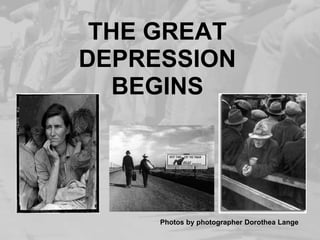
THE GREAT DEPRESSION BEGINSPhotos by photographer Dorothea Lange
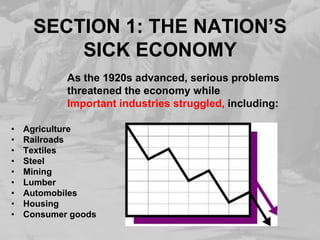
SECTION 1: THE NATION’S SICK ECONOMYAs the 1920s advanced, serious problems threatened the economy whileImportant industries struggled, including:AgricultureRailroadsTextilesSteelMiningLumberAutomobilesHousingConsumer goods
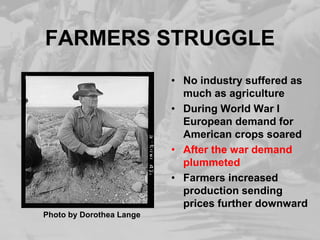
FARMERS STRUGGLENo industry suffered as much as agricultureDuring World War I European demand for American crops soaredAfter the war demand plummetedFarmers increased production sending prices further downwardPhoto by Dorothea Lange
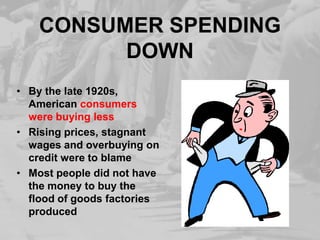
CONSUMER SPENDING DOWNBy the late 1920s, American consumers were buying lessRising prices, stagnant wages and overbuying on credit were to blameMost people did not have the money to buy the flood of goods factories produced
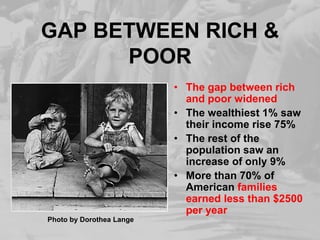
GAP BETWEEN RICH & POORThe gap between rich and poor widenedThe wealthiest 1% saw their income rise 75%The rest of the population saw an increase of only 9%More than 70% of American families earned less than $2500 per yearPhoto by Dorothea Lange
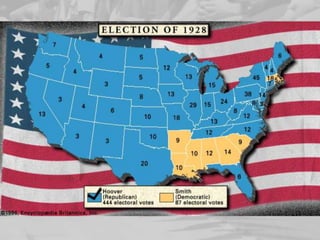
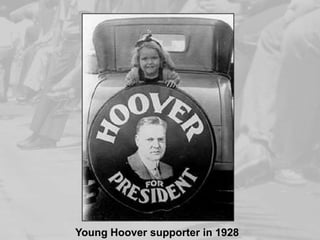
HOOVER WINS 1928 ELECTIONRepublican Herbert Hoover ran against Democrat Alfred E. Smith in the 1928 electionHoover emphasized years of prosperity under Republican administrations Hoover won an overwhelming victory
Young Hoover supporter in 1928
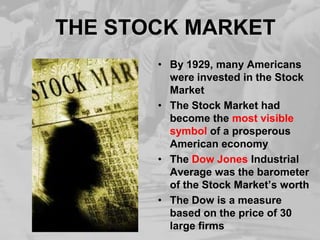
THE STOCK MARKET By 1929, many Americans were invested in the Stock MarketThe Stock Market had become the most visible symbol of a prosperous American economyThe Dow Jones Industrial Average was the barometer of the Stock Market’s worth The Dow is a measure based on the price of 30 large firms
STOCK PRICES RISE THROUGH THE 1920sThrough most of the 1920s, stock prices rose steadilyThe Dow reached a  high in 1929 of 381 points (300 points higher than 1924)By 1929, 4 million Americans owned stocks New York Stock Exchange
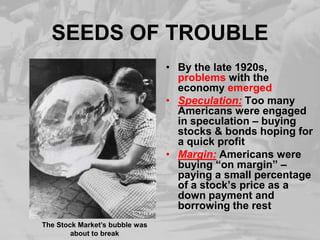
SEEDS OF TROUBLEBy the late 1920s, problems with the economy emergedSpeculation:Too many Americans were engaged in speculation – buying stocks & bonds hoping for a quick profitMargin:Americans were buying “on margin” – paying a small percentage of a stock’s price as a downpayment and borrowing the restThe Stock Market’s bubble was about to break
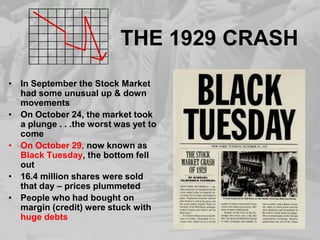
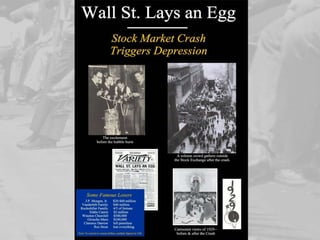
THE 1929 CRASHIn September the Stock Market had some unusual up & down movementsOn October 24, the market took a plunge . . .the worst was yet to comeOn October 29, now known as Black Tuesday, the bottom fell out16.4 million shares were sold that day – prices plummetedPeople who had bought on margin (credit) were stuck with huge debts
By mid-November, investors had lost about $30 billion
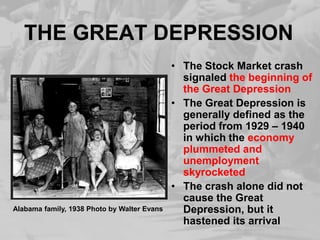
THE GREAT DEPRESSIONThe Stock Market crash signaled the beginning of the Great DepressionThe Great Depression is generally defined as the period from 1929 – 1940 in which the economy plummeted and unemployment skyrocketedThe crash alone did not cause the Great Depression, but it hastened its arrivalAlabama family, 1938 Photo by Walter Evans
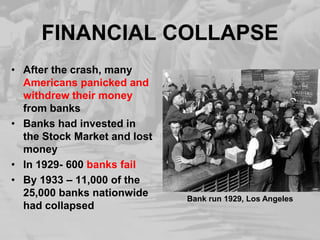
FINANCIAL COLLAPSEAfter the crash, many Americans panicked and withdrew their money from banksBanks had invested in the Stock Market and lost moneyIn 1929- 600 banks failBy 1933 – 11,000 of the 25,000 banks nationwide had collapsedBank run 1929, Los Angeles
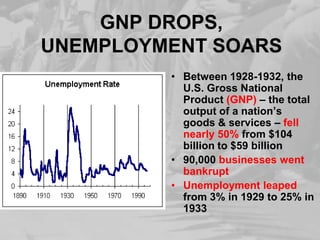
GNP DROPS, UNEMPLOYMENT SOARSBetween 1928-1932, the U.S. Gross National Product (GNP) – the total output of a nation’s goods & services – fell nearly 50% from $104 billion to $59 billion90,000 businesses went bankruptUnemployment leaped from 3% in 1929 to 25% in 1933
HAWLEY-SMOOT TARIFFThe U.S. was not the only country gripped by the Great DepressionMuch of Europe suffered throughout the 1920sIn 1930, Congress passed the toughest tariff in U.S. history called the Hawley- Smoot TariffIt was meant to protect U.S. industry yet had the opposite effectOther countries enacted their own tariffs and soon world trade fell 40%
CAUSES OF THE GREAT DEPRESSIONTariffs & war debt policiesU.S. demand low, despite factories producing moreFarm sector crisisEasy creditUnequal distribution of income
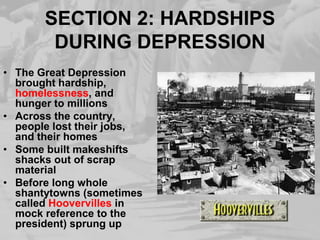
SECTION 2: HARDSHIPS DURING DEPRESSIONThe Great Depression brought hardship, homelessness, and hunger to millionsAcross the country, people lost their jobs, and their homesSome built makeshifts shacks out of scrap materialBefore long whole shantytowns (sometimes called Hoovervilles in mock reference to the president) sprung up
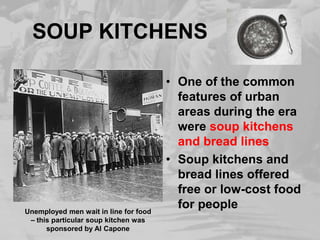
SOUP KITCHENSOne of the common features of urban areas during the era were soup kitchens and bread linesSoup kitchens and bread lines offered free or low-cost food for peopleUnemployed men wait in line for food – this particular soup kitchen was sponsored by Al Capone
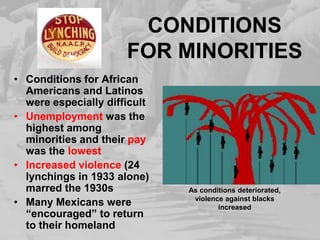
CONDITIONS FOR MINORITIESConditions for African Americans and Latinos were especially difficultUnemployment was the highest among minorities and their pay was the lowestIncreased violence (24 lynchings in 1933 alone)marred the 1930sMany Mexicans were “encouraged” to return to their homelandAs conditions deteriorated, violence against blacks increased
RURAL LIFE DURING THE DEPRESSIONWhile the Depression was difficult for everyone, farmers did have one advantage; they could grow food for their familiesThousands of farmers, however, lost their landMany turned to tenant farming and barely scraped out a livingBetween 1929-1932 almost ½ million farmers lost their land
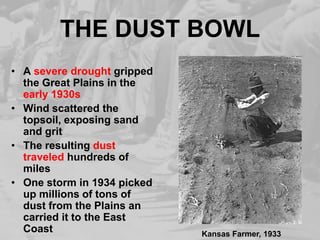
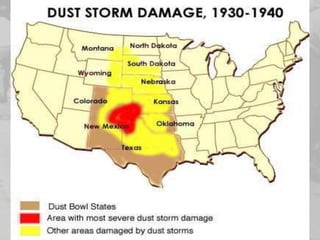
THE DUST BOWLA severe drought gripped the Great Plains in the early 1930sWind scattered the topsoil, exposing sand and gritThe resulting dust traveled hundreds of milesOne storm in 1934 picked up millions of tons of dust from the Plains an carried it to the East CoastKansas Farmer, 1933
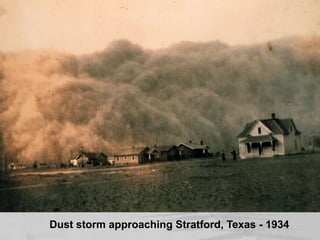
Dust storm approaching Stratford, Texas - 1934
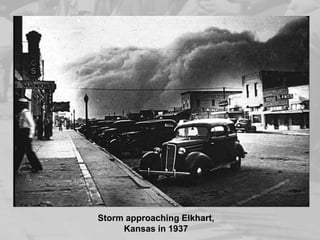
Storm approaching Elkhart, Kansas in 1937
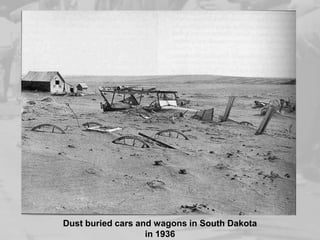
Dust buried cars and wagons in South Dakota in 1936
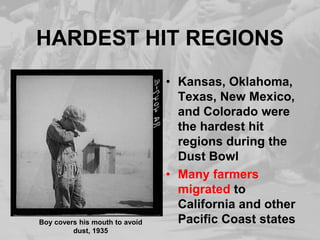
HARDEST HIT REGIONSKansas, Oklahoma, Texas, New Mexico, and Colorado were the hardest hit regions during the Dust BowlMany farmers migrated to California and other Pacific Coast statesBoy covers his mouth to avoid dust, 1935
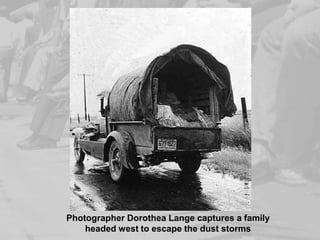
Photographer Dorothea Lange captures a family headed west to escape the dust storms
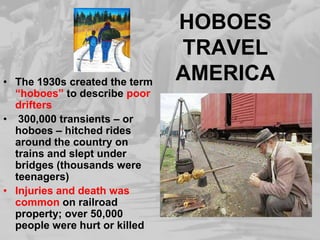
HOBOES TRAVEL AMERICAThe 1930s created the term “hoboes” to describe poor drifters 300,000 transients – or hoboes – hitched rides around the country on trains and slept under bridges (thousands were teenagers)Injuries and death was common on railroad property; over 50,000 people were hurt or killed
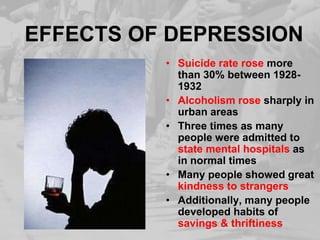
EFFECTS OF DEPRESSIONSuicide rate rose more than 30% between 1928-1932Alcoholism rose sharply in urban areasThree times as many people were admitted to state mental hospitals as in normal timesMany people showed great kindness to strangersAdditionally, many people developed habits of savings & thriftiness
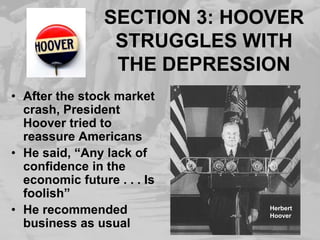
SECTION 3: HOOVER STRUGGLES WITH THE DEPRESSIONAfter the stock market crash, President Hoover tried to reassure AmericansHe said, “Any lack of confidence in the economic future . . . Is foolish”He recommended business as usualHerbert Hoover
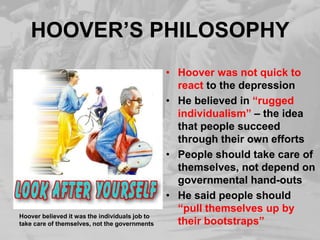
HOOVER’S PHILOSOPHYHoover was not quick to react to the depressionHe believed in “rugged individualism” – the idea that people succeed through their own effortsPeople should take care of themselves, not depend on governmental hand-outsHe said people should “pull themselves up by their bootstraps”Hoover believed it was the individuals job to take care of themselves, not the governments
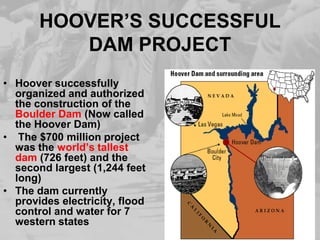
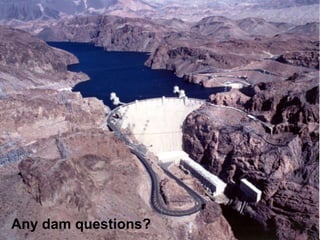
HOOVER’S SUCCESSFUL DAM PROJECTHoover successfully organized and authorized the construction of the Boulder Dam (Now called the Hoover Dam) The $700 million project was the world’s tallest dam (726 feet) and the second largest (1,244 feet long)The dam currently provides electricity, flood control and water for 7 western states
Any dam questions?
HOOVER TAKES ACTION: TOO LITTLE TOO LATEHoover gradually softened his position on government intervention in the economyHe created the Federal Farm Board to help farmers He also created the National Credit Organization that helped smaller banks His Federal Home Loan Bank Act and Reconstruction Finance Corp were two measures enacted to protect people’s homes and businessesHoover’s flurry of activity came too late to save the economy or his job
BONUS ARMYA 1932 incident further damaged Hoover’s imageThat spring about 15,000 World War I vets arrived in Washington to support a proposed billThe Patman Bill would have authorized Congress to pay a bonus to WWI vets immediatelyThe bonus was scheduled to be paid in 1945 --- The Army vets wanted it NOW
BONUS ARMY TURNED DOWNHoover called the Bonus marchers, “Communists and criminals”On June 17, 1932 the Senate voted down the Putnam BillThousands of Bonus Army soldiers protest – Spring 1932
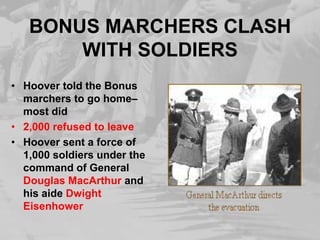
BONUS MARCHERS CLASH WITH SOLDIERSHoover told the Bonus marchers to go home– most did2,000 refused to leaveHoover sent a force of 1,000 soldiers under the command of General Douglas MacArthur and his aide Dwight Eisenhower
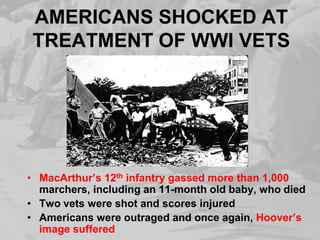
AMERICANS SHOCKED AT TREATMENT OF WWI VETSMacArthur’s 12th infantry gassed more than 1,000 marchers, including an 11-month old baby, who diedTwo vets were shot and scores injuredAmericans were outraged and once again, Hoover’s image suffered
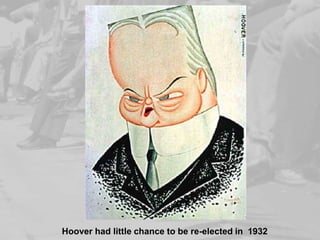
Hoover had little chance to be re-elected in  1932

Great Depression

  • 1.
    THE GREAT DEPRESSIONBEGINSPhotos by photographer Dorothea Lange
  • 2.
    SECTION 1: THENATION’S SICK ECONOMYAs the 1920s advanced, serious problems threatened the economy whileImportant industries struggled, including:AgricultureRailroadsTextilesSteelMiningLumberAutomobilesHousingConsumer goods
  • 3.
    FARMERS STRUGGLENo industrysuffered as much as agricultureDuring World War I European demand for American crops soaredAfter the war demand plummetedFarmers increased production sending prices further downwardPhoto by Dorothea Lange
  • 4.
    CONSUMER SPENDING DOWNBythe late 1920s, American consumers were buying lessRising prices, stagnant wages and overbuying on credit were to blameMost people did not have the money to buy the flood of goods factories produced
  • 5.
    GAP BETWEEN RICH& POORThe gap between rich and poor widenedThe wealthiest 1% saw their income rise 75%The rest of the population saw an increase of only 9%More than 70% of American families earned less than $2500 per yearPhoto by Dorothea Lange
  • 6.
    HOOVER WINS 1928ELECTIONRepublican Herbert Hoover ran against Democrat Alfred E. Smith in the 1928 electionHoover emphasized years of prosperity under Republican administrations Hoover won an overwhelming victory
  • 8.
  • 9.
    THE STOCK MARKETBy 1929, many Americans were invested in the Stock MarketThe Stock Market had become the most visible symbol of a prosperous American economyThe Dow Jones Industrial Average was the barometer of the Stock Market’s worth The Dow is a measure based on the price of 30 large firms
  • 10.
    STOCK PRICES RISETHROUGH THE 1920sThrough most of the 1920s, stock prices rose steadilyThe Dow reached a high in 1929 of 381 points (300 points higher than 1924)By 1929, 4 million Americans owned stocks New York Stock Exchange
  • 11.
    SEEDS OF TROUBLEBythe late 1920s, problems with the economy emergedSpeculation:Too many Americans were engaged in speculation – buying stocks & bonds hoping for a quick profitMargin:Americans were buying “on margin” – paying a small percentage of a stock’s price as a downpayment and borrowing the restThe Stock Market’s bubble was about to break
  • 12.
    THE 1929 CRASHInSeptember the Stock Market had some unusual up & down movementsOn October 24, the market took a plunge . . .the worst was yet to comeOn October 29, now known as Black Tuesday, the bottom fell out16.4 million shares were sold that day – prices plummetedPeople who had bought on margin (credit) were stuck with huge debts
  • 13.
    By mid-November, investorshad lost about $30 billion
  • 15.
    THE GREAT DEPRESSIONTheStock Market crash signaled the beginning of the Great DepressionThe Great Depression is generally defined as the period from 1929 – 1940 in which the economy plummeted and unemployment skyrocketedThe crash alone did not cause the Great Depression, but it hastened its arrivalAlabama family, 1938 Photo by Walter Evans
  • 16.
    FINANCIAL COLLAPSEAfter thecrash, many Americans panicked and withdrew their money from banksBanks had invested in the Stock Market and lost moneyIn 1929- 600 banks failBy 1933 – 11,000 of the 25,000 banks nationwide had collapsedBank run 1929, Los Angeles
  • 17.
    GNP DROPS, UNEMPLOYMENTSOARSBetween 1928-1932, the U.S. Gross National Product (GNP) – the total output of a nation’s goods & services – fell nearly 50% from $104 billion to $59 billion90,000 businesses went bankruptUnemployment leaped from 3% in 1929 to 25% in 1933
  • 18.
    HAWLEY-SMOOT TARIFFThe U.S.was not the only country gripped by the Great DepressionMuch of Europe suffered throughout the 1920sIn 1930, Congress passed the toughest tariff in U.S. history called the Hawley- Smoot TariffIt was meant to protect U.S. industry yet had the opposite effectOther countries enacted their own tariffs and soon world trade fell 40%
  • 19.
    CAUSES OF THEGREAT DEPRESSIONTariffs & war debt policiesU.S. demand low, despite factories producing moreFarm sector crisisEasy creditUnequal distribution of income
  • 20.
    SECTION 2: HARDSHIPSDURING DEPRESSIONThe Great Depression brought hardship, homelessness, and hunger to millionsAcross the country, people lost their jobs, and their homesSome built makeshifts shacks out of scrap materialBefore long whole shantytowns (sometimes called Hoovervilles in mock reference to the president) sprung up
  • 21.
    SOUP KITCHENSOne ofthe common features of urban areas during the era were soup kitchens and bread linesSoup kitchens and bread lines offered free or low-cost food for peopleUnemployed men wait in line for food – this particular soup kitchen was sponsored by Al Capone
  • 22.
    CONDITIONS FOR MINORITIESConditionsfor African Americans and Latinos were especially difficultUnemployment was the highest among minorities and their pay was the lowestIncreased violence (24 lynchings in 1933 alone)marred the 1930sMany Mexicans were “encouraged” to return to their homelandAs conditions deteriorated, violence against blacks increased
  • 23.
    RURAL LIFE DURINGTHE DEPRESSIONWhile the Depression was difficult for everyone, farmers did have one advantage; they could grow food for their familiesThousands of farmers, however, lost their landMany turned to tenant farming and barely scraped out a livingBetween 1929-1932 almost ½ million farmers lost their land
  • 24.
    THE DUST BOWLAsevere drought gripped the Great Plains in the early 1930sWind scattered the topsoil, exposing sand and gritThe resulting dust traveled hundreds of milesOne storm in 1934 picked up millions of tons of dust from the Plains an carried it to the East CoastKansas Farmer, 1933
  • 25.
    Dust storm approachingStratford, Texas - 1934
  • 26.
  • 27.
    Dust buried carsand wagons in South Dakota in 1936
  • 28.
    HARDEST HIT REGIONSKansas,Oklahoma, Texas, New Mexico, and Colorado were the hardest hit regions during the Dust BowlMany farmers migrated to California and other Pacific Coast statesBoy covers his mouth to avoid dust, 1935
  • 29.
    Photographer Dorothea Langecaptures a family headed west to escape the dust storms
  • 31.
    HOBOES TRAVEL AMERICAThe1930s created the term “hoboes” to describe poor drifters 300,000 transients – or hoboes – hitched rides around the country on trains and slept under bridges (thousands were teenagers)Injuries and death was common on railroad property; over 50,000 people were hurt or killed
  • 32.
    EFFECTS OF DEPRESSIONSuiciderate rose more than 30% between 1928-1932Alcoholism rose sharply in urban areasThree times as many people were admitted to state mental hospitals as in normal timesMany people showed great kindness to strangersAdditionally, many people developed habits of savings & thriftiness
  • 33.
    SECTION 3: HOOVERSTRUGGLES WITH THE DEPRESSIONAfter the stock market crash, President Hoover tried to reassure AmericansHe said, “Any lack of confidence in the economic future . . . Is foolish”He recommended business as usualHerbert Hoover
  • 34.
    HOOVER’S PHILOSOPHYHoover wasnot quick to react to the depressionHe believed in “rugged individualism” – the idea that people succeed through their own effortsPeople should take care of themselves, not depend on governmental hand-outsHe said people should “pull themselves up by their bootstraps”Hoover believed it was the individuals job to take care of themselves, not the governments
  • 35.
    HOOVER’S SUCCESSFUL DAMPROJECTHoover successfully organized and authorized the construction of the Boulder Dam (Now called the Hoover Dam) The $700 million project was the world’s tallest dam (726 feet) and the second largest (1,244 feet long)The dam currently provides electricity, flood control and water for 7 western states
  • 36.
  • 37.
    HOOVER TAKES ACTION:TOO LITTLE TOO LATEHoover gradually softened his position on government intervention in the economyHe created the Federal Farm Board to help farmers He also created the National Credit Organization that helped smaller banks His Federal Home Loan Bank Act and Reconstruction Finance Corp were two measures enacted to protect people’s homes and businessesHoover’s flurry of activity came too late to save the economy or his job
  • 38.
    BONUS ARMYA 1932incident further damaged Hoover’s imageThat spring about 15,000 World War I vets arrived in Washington to support a proposed billThe Patman Bill would have authorized Congress to pay a bonus to WWI vets immediatelyThe bonus was scheduled to be paid in 1945 --- The Army vets wanted it NOW
  • 39.
    BONUS ARMY TURNEDDOWNHoover called the Bonus marchers, “Communists and criminals”On June 17, 1932 the Senate voted down the Putnam BillThousands of Bonus Army soldiers protest – Spring 1932
  • 40.
    BONUS MARCHERS CLASHWITH SOLDIERSHoover told the Bonus marchers to go home– most did2,000 refused to leaveHoover sent a force of 1,000 soldiers under the command of General Douglas MacArthur and his aide Dwight Eisenhower
  • 41.
    AMERICANS SHOCKED ATTREATMENT OF WWI VETSMacArthur’s 12th infantry gassed more than 1,000 marchers, including an 11-month old baby, who diedTwo vets were shot and scores injuredAmericans were outraged and once again, Hoover’s image suffered
  • 42.
    Hoover had littlechance to be re-elected in 1932