STEERING GEOMETRY
STEERING GEOMETRY
 The term "steering geometry" (also known as "front-end geometry")
refers to the angular Relationship between suspension and steering
parts, front wheels, and the road surface. Because alignment deals
with angles and affects steering, the method of describing alignment
measurements is called steering geometry.
There are five steering geometry angles :
 Camber
 Caster
 king pin inclination
 Toe in & Toe-out on turns
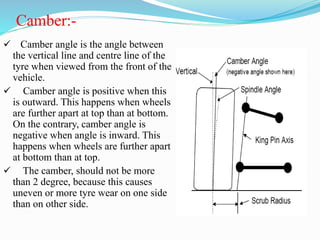
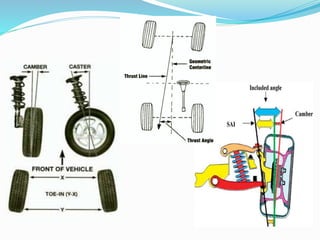
Camber:-
 Camber angle is the angle between
the vertical line and centre line of the
tyre when viewed from the front of the
vehicle.
 Camber angle is positive when this
is outward. This happens when wheels
are further apart at top than at bottom.
On the contrary, camber angle is
negative when angle is inward. This
happens when wheels are further apart
at bottom than at top.
 The camber, should not be more
than 2 degree, because this causes
uneven or more tyre wear on one side
than on other side.
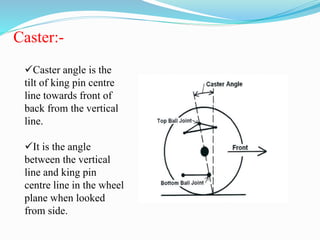
Caster:-
Caster angle is the
tilt of king pin centre
line towards front of
back from the vertical
line.
It is the angle
between the vertical
line and king pin
centre line in the wheel
plane when looked
from side.
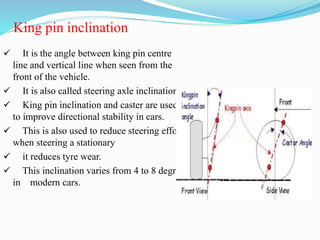
King pin inclination
 It is the angle between king pin centre
line and vertical line when seen from the
front of the vehicle.
 It is also called steering axle inclination.
 King pin inclination and caster are used
to improve directional stability in cars.
 This is also used to reduce steering effort
when steering a stationary
 it reduces tyre wear.
 This inclination varies from 4 to 8 degree
in modern cars.
TOE IN & TOE OUT
 In automotive engineering, toe also known as tracking.
 This can be contrasted with steer, which is the anti
symmetric angle, i.e. both wheels point to the left or right,
in parallel (roughly).
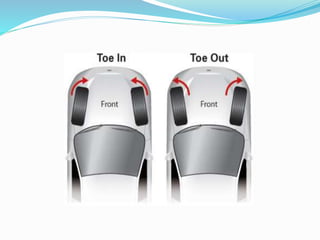
 Positive toe, or toe in, is the front of the wheel pointing in
towards the centerline of the vehicle
 Negative toe, or toe out, is the front of the wheel pointing
away from the centerline of the vehicle.
ACKERMANN STEERING GEOMETRY
 Ackermann steering geometry is a geometric arrangement of linkages in the
steering of a car or other vehicle designed to solve the problem of wheels on
the inside and outside of a turn needing to trace out circles of different radii.
 Modern cars do not use pure Ackermann steering partly because it ignores
important dynamic and compliant effects.
 The use of such geometry helps reduce tyre temperatures during high-speed
cornering but compromises performance in low speed maneuvers.
 The intention of Ackermann geometry is to avoid the need for tyre to slip
sideways when following the path around a curve.
 As the rear wheels are fixed, this centre point must be on a line extended from
the rear axle.
 Intersecting the axes of the front wheels on this line as well requires that the
inside front wheel is turned, when steering, through a greater angle than the
outside wheel .
Ackerman – Truck Steering System
Straight ahead
Right turn
Left turn
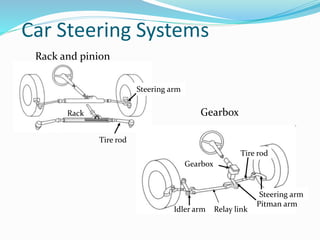
Car Steering Systems
Rack and pinion
GearboxRack
Tire rod
Steering arm
Gearbox
Steering arm
Tire rod
Relay linkIdler arm
Pitman arm
Truck Steering Systems
Tire rod
Steering arm
Drag link
Pitman arm
Gearbox

Steering geometry 8

  • 1.
  • 2.
    STEERING GEOMETRY  Theterm "steering geometry" (also known as "front-end geometry") refers to the angular Relationship between suspension and steering parts, front wheels, and the road surface. Because alignment deals with angles and affects steering, the method of describing alignment measurements is called steering geometry. There are five steering geometry angles :  Camber  Caster  king pin inclination  Toe in & Toe-out on turns
  • 3.
    Camber:-  Camber angleis the angle between the vertical line and centre line of the tyre when viewed from the front of the vehicle.  Camber angle is positive when this is outward. This happens when wheels are further apart at top than at bottom. On the contrary, camber angle is negative when angle is inward. This happens when wheels are further apart at bottom than at top.  The camber, should not be more than 2 degree, because this causes uneven or more tyre wear on one side than on other side.
  • 4.
    Caster:- Caster angle isthe tilt of king pin centre line towards front of back from the vertical line. It is the angle between the vertical line and king pin centre line in the wheel plane when looked from side.
  • 5.
    King pin inclination It is the angle between king pin centre line and vertical line when seen from the front of the vehicle.  It is also called steering axle inclination.  King pin inclination and caster are used to improve directional stability in cars.  This is also used to reduce steering effort when steering a stationary  it reduces tyre wear.  This inclination varies from 4 to 8 degree in modern cars.
  • 7.
    TOE IN &TOE OUT  In automotive engineering, toe also known as tracking.  This can be contrasted with steer, which is the anti symmetric angle, i.e. both wheels point to the left or right, in parallel (roughly).  Positive toe, or toe in, is the front of the wheel pointing in towards the centerline of the vehicle  Negative toe, or toe out, is the front of the wheel pointing away from the centerline of the vehicle.
  • 9.
    ACKERMANN STEERING GEOMETRY Ackermann steering geometry is a geometric arrangement of linkages in the steering of a car or other vehicle designed to solve the problem of wheels on the inside and outside of a turn needing to trace out circles of different radii.  Modern cars do not use pure Ackermann steering partly because it ignores important dynamic and compliant effects.  The use of such geometry helps reduce tyre temperatures during high-speed cornering but compromises performance in low speed maneuvers.  The intention of Ackermann geometry is to avoid the need for tyre to slip sideways when following the path around a curve.  As the rear wheels are fixed, this centre point must be on a line extended from the rear axle.  Intersecting the axes of the front wheels on this line as well requires that the inside front wheel is turned, when steering, through a greater angle than the outside wheel .
  • 11.
    Ackerman – TruckSteering System Straight ahead Right turn Left turn
  • 12.
    Car Steering Systems Rackand pinion GearboxRack Tire rod Steering arm Gearbox Steering arm Tire rod Relay linkIdler arm Pitman arm
  • 13.
    Truck Steering Systems Tirerod Steering arm Drag link Pitman arm Gearbox