Guess the Gibberish
Math Tow Doe Lurgy
Guess the gibberish
Methodology
hone lany duke at shown
Guess the gibberish
Online Education
Trade did shun all tech wing
Guess the gibberish
Traditional Teaching
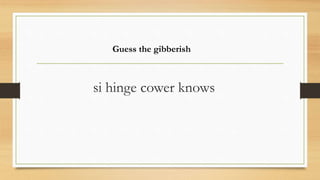
si hinge cower knows
Guess the gibberish
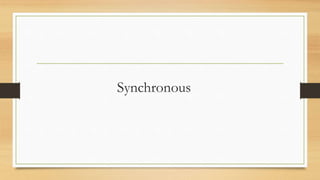
Synchronous
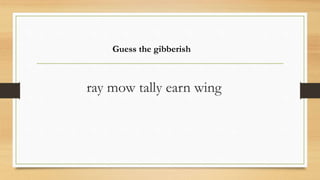
ray mow tally earn wing
Guess the gibberish
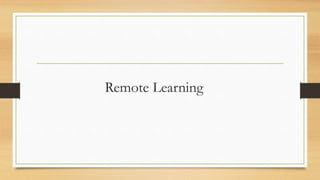
Remote Learning
Blend did lee earn wing
Guess the gibberish
Blended Learning
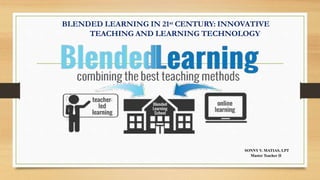
BLENDED LEARNING IN 21st CENTURY: INNOVATIVE
TEACHING AND LEARNING TECHNOLOGY
SONNY V. MATIAS, LPT
Master Teacher II
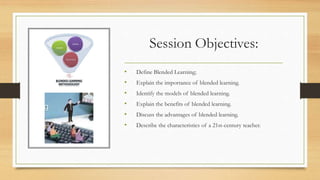
Session Objectives:
• Define Blended Learning;
• Explain the importance of blended learning.
• Identify the models of blended learning.
• Explain the benefits of blended learning.
• Discuss the advantages of blended learning.
• Describe the characteristics of a 21st-century teacher.
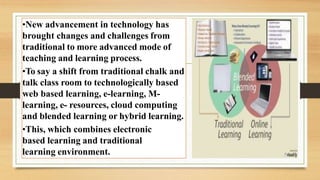
•New advancement in technology has
brought changes and challenges from
traditional to more advanced mode of
teaching and learning process.
•To say a shift from traditional chalk and
talk class room to technologically based
web based learning, e-learning, M-
learning, e- resources, cloud computing
and blended learning or hybrid learning.
•This, which combines electronic
based learning and traditional
learning environment.
•Blending learning is about finding better ways of supporting
students in achieving the learning objectives and providing them
with the best possible learning and teaching experiences, as well
as supporting teachers in their profession.
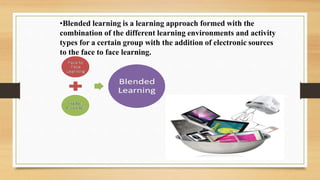
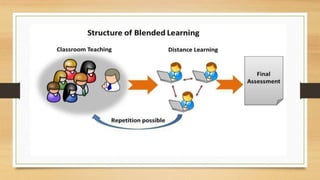
•Blended learning is a learning approach formed with the
combination of the different learning environments and activity
types for a certain group with the addition of electronic sources
to the face to face learning.
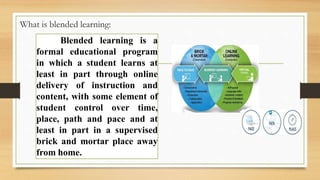
What is blended learning:
Blended learning is a
formal educational program
in which a student learns at
least in part through online
delivery of instruction and
content, with some element of
student control over time,
place, path and pace and at
least in part in a supervised
brick and mortar place away
from home.
BLENDED LEARNING
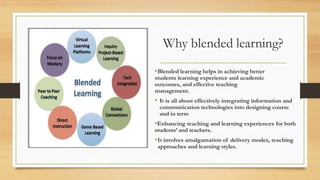
Why blended learning?
•Blended learning helps in achieving better
students learning experience and academic
outcomes, and effective teaching
management.
• It is all about effectively integrating information and
communication technologies into designing course
and in term
•Enhancing teaching and learning experiences for both
students’ and teachers.
•It involves amalgamation of delivery modes, teaching
approaches and learning styles.
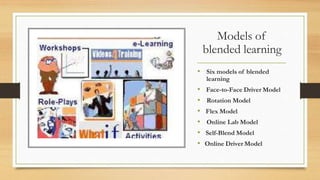
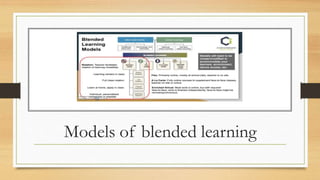
Models of
blended learning
• Six models of blended
learning
• Face-to-Face Driver Model
• Rotation Model
• Flex Model
• Online Lab Model
• Self-Blend Model
• Online Driver Model
Models of blended learning
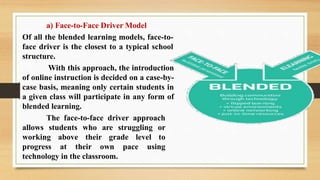
a) Face-to-Face Driver Model
Of all the blended learning models, face-to-
face driver is the closest to a typical school
structure.
With this approach, the introduction
of online instruction is decided on a case-by-
case basis, meaning only certain students in
a given class will participate in any form of
blended learning.
The face-to-face driver approach
allows students who are struggling or
working above their grade level to
progress at their own pace using
technology in the classroom.
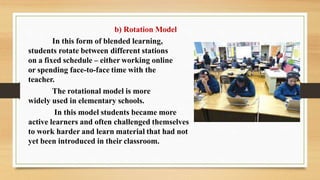
b) Rotation Model
In this form of blended learning,
students rotate between different stations
on a fixed schedule – either working online
or spending face-to-face time with the
teacher.
The rotational model is more
widely used in elementary schools.
In this model students became more
active learners and often challenged themselves
to work harder and learn material that had not
yet been introduced in their classroom.
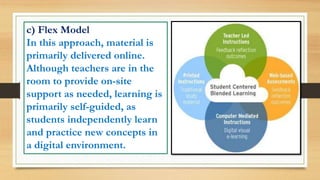
c) Flex Model
In this approach, material is
primarily delivered online.
Although teachers are in the
room to provide on-site
support as needed, learning is
primarily self-guided, as
students independently learn
and practice new concepts in
a digital environment.
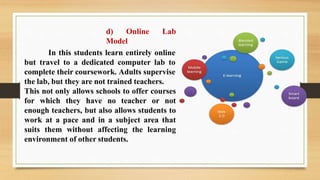
d) Online Lab
Model
In this students learn entirely online
but travel to a dedicated computer lab to
complete their coursework. Adults supervise
the lab, but they are not trained teachers.
This not only allows schools to offer courses
for which they have no teacher or not
enough teachers, but also allows students to
work at a pace and in a subject area that
suits them without affecting the learning
environment of other students.
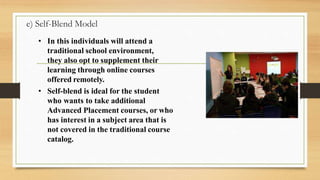
e) Self-Blend Model
• In this individuals will attend a
traditional school environment,
they also opt to supplement their
learning through online courses
offered remotely.
• Self-blend is ideal for the student
who wants to take additional
Advanced Placement courses, or who
has interest in a subject area that is
not covered in the traditional course
catalog.
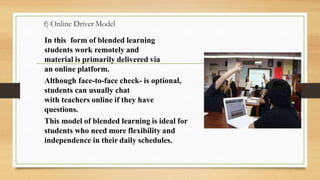
f) Online Driver Model
In this form of blended learning
students work remotely and
material is primarily delivered via
an online platform.
Although face-to-face check- is optional,
students can usually chat
with teachers online if they have
questions.
This model of blended learning is ideal for
students who need more flexibility and
independence in their daily schedules.
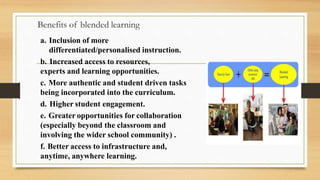
Benefits of blended learning
a. Inclusion of more
differentiated/personalised instruction.
b. Increased access to resources,
experts and learning opportunities.
c. More authentic and student driven tasks
being incorporated into the curriculum.
d. Higher student engagement.
e. Greater opportunities for collaboration
(especially beyond the classroom and
involving the wider school community) .
f. Better access to infrastructure and,
anytime, anywhere learning.
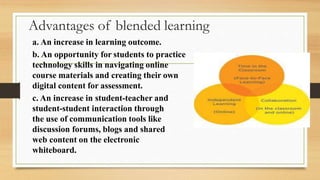
Advantages of blended learning
a. An increase in learning outcome.
b. An opportunity for students to practice
technology skills in navigating online
course materials and creating their own
digital content for assessment.
c. An increase in student-teacher and
student-student interaction through
the use of communication tools like
discussion forums, blogs and shared
web content on the electronic
whiteboard.
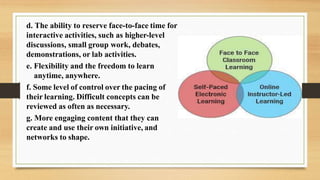
d. The ability to reserve face-to-face time for
interactive activities, such as higher-level
discussions, small group work, debates,
demonstrations, or lab activities.
e. Flexibility and the freedom to learn
anytime, anywhere.
f. Some level of control over the pacing of
their learning. Difficult concepts can be
reviewed as often as necessary.
g. More engaging content that they can
create and use their own initiative, and
networks to shape.
h. The opportunity to engage and draw on expertise that would otherwise not be available to
them without costly travel, such as virtual conferencing with zoo/museum/gallery or virtual
excursions to overseas historical or culturally significant landmarks.
i. Broaden the spaces and opportunities available for learning.
j. Support course management activities (e.g., communication, assessment submission,
marking and feedback).
k. Support the provision of information and resources to students.
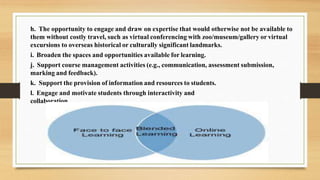
l. Engage and motivate students through interactivity and
collaboration.
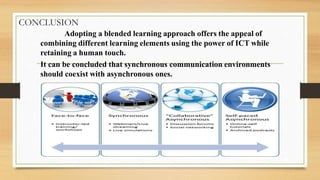
CONCLUSION
Adopting a blended learning approach offers the appeal of
combining different learning elements using the power of ICT while
retaining a human touch.
It can be concluded that synchronous communication environments
should coexist with asynchronous ones.
CHARACTERISTICS OF A 21ST-
CENTURY TEACHER
1. Learner-centered classroom and personalized
instruction: As students have access to any
information possible, there certainly is no need to
spoon-feed them knowledge or teach one-size-fits-
all content. Students have different personalities,
goals, and needs, and offering personalized
instruction is not just possible but desirable. When
students are allowed to make their own choices,
they own their learning, increase intrinsic
motivation, and put in more effort—an ideal recipe
for better learning outcomes.
2. Learners as producers: Today’s learners have the
latest and greatest tools, yet the usage in many cases
barely goes beyond communicating with family and
friends via chat, text, or calls. Even though students
are now viewed as digital natives, many are far from
producing any digital content. They own expensive
devices with capabilities to produce blogs,
infographics, books, how-to videos, and tutorials, just
to name a few, but in many classes, they are still asked
to turn those devices off and work with handouts and
worksheets.
Sadly, often these papers are simply thrown away once
graded. Many students don’t even want to do them, let
alone keep or return to them later. When given a
chance, students can produce beautiful and creative
blogs, movies, or digital stories that they feel proud of
and share with others.
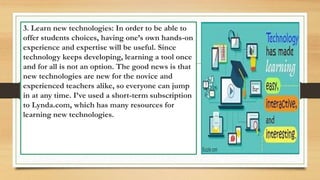
3. Learn new technologies: In order to be able to
offer students choices, having one’s own hands-on
experience and expertise will be useful. Since
technology keeps developing, learning a tool once
and for all is not an option. The good news is that
new technologies are new for the novice and
experienced teachers alike, so everyone can jump
in at any time. I’ve used a short-term subscription
to Lynda.com, which has many resources for
learning new technologies.
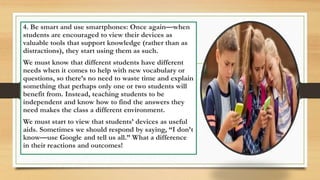
4. Be smart and use smartphones: Once again—when
students are encouraged to view their devices as
valuable tools that support knowledge (rather than as
distractions), they start using them as such.
We must know that different students have different
needs when it comes to help with new vocabulary or
questions, so there’s no need to waste time and explain
something that perhaps only one or two students will
benefit from. Instead, teaching students to be
independent and know how to find the answers they
need makes the class a different environment.
We must start to view that students’ devices as useful
aids. Sometimes we should respond by saying, “I don’t
know—use Google and tell us all.” What a difference
in their reactions and outcomes!
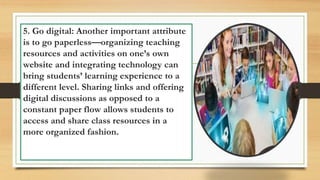
5. Go digital: Another important attribute
is to go paperless—organizing teaching
resources and activities on one’s own
website and integrating technology can
bring students’ learning experience to a
different level. Sharing links and offering
digital discussions as opposed to a
constant paper flow allows students to
access and share class resources in a
more organized fashion.
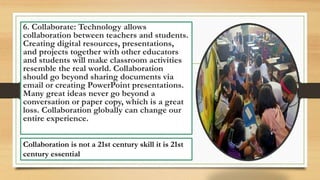
6. Collaborate: Technology allows
collaboration between teachers and students.
Creating digital resources, presentations,
and projects together with other educators
and students will make classroom activities
resemble the real world. Collaboration
should go beyond sharing documents via
email or creating PowerPoint presentations.
Many great ideas never go beyond a
conversation or paper copy, which is a great
loss. Collaboration globally can change our
entire experience.
Collaboration is not a 21st century skill it is 21st
century essential
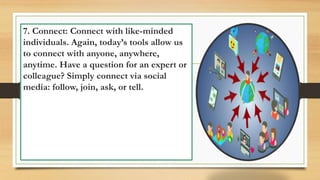
7. Connect: Connect with like-minded
individuals. Again, today’s tools allow us
to connect with anyone, anywhere,
anytime. Have a question for an expert or
colleague? Simply connect via social
media: follow, join, ask, or tell.
8. Innovate: I invite you to expand your
teaching toolbox and try new ways you
have not tried before, such as teaching
with social media or replacing textbooks
with web resources. Not for the sake of
tools but for the sake of students.
9. Blog: I have written on the importance
of both student and teacher blogging.
Even my beginners of English could see
the value of writing for real audience and
establishing their digital presence. To
blog or not to blog should not be a
question anymore.
9. Blog: I have written on the importance
of both student and teacher blogging.
Even my beginners of English could see
the value of writing for real audience and
establishing their digital presence. To
blog or not to blog should not be a
question anymore.
10. Keep learning: As new tools and new
technology keep emerging, learning, and
adapting is essential. The good news is:
It’s fun, and even 20 minutes a day will
take you a long way.
blendedlearningin21stcentury.pptx

blendedlearningin21stcentury.pptx

  • 1.
  • 2.
    Math Tow DoeLurgy Guess the gibberish
  • 3.
  • 4.
    hone lany dukeat shown Guess the gibberish
  • 5.
  • 6.
    Trade did shunall tech wing Guess the gibberish
  • 7.
  • 8.
    si hinge cowerknows Guess the gibberish
  • 9.
  • 10.
    ray mow tallyearn wing Guess the gibberish
  • 11.
  • 12.
    Blend did leeearn wing Guess the gibberish
  • 13.
  • 14.
    BLENDED LEARNING IN21st CENTURY: INNOVATIVE TEACHING AND LEARNING TECHNOLOGY SONNY V. MATIAS, LPT Master Teacher II
  • 15.
    Session Objectives: • DefineBlended Learning; • Explain the importance of blended learning. • Identify the models of blended learning. • Explain the benefits of blended learning. • Discuss the advantages of blended learning. • Describe the characteristics of a 21st-century teacher.
  • 16.
    •New advancement intechnology has brought changes and challenges from traditional to more advanced mode of teaching and learning process. •To say a shift from traditional chalk and talk class room to technologically based web based learning, e-learning, M- learning, e- resources, cloud computing and blended learning or hybrid learning. •This, which combines electronic based learning and traditional learning environment.
  • 17.
    •Blending learning isabout finding better ways of supporting students in achieving the learning objectives and providing them with the best possible learning and teaching experiences, as well as supporting teachers in their profession.
  • 18.
    •Blended learning isa learning approach formed with the combination of the different learning environments and activity types for a certain group with the addition of electronic sources to the face to face learning.
  • 19.
    What is blendedlearning: Blended learning is a formal educational program in which a student learns at least in part through online delivery of instruction and content, with some element of student control over time, place, path and pace and at least in part in a supervised brick and mortar place away from home.
  • 20.
  • 21.
    Why blended learning? •Blendedlearning helps in achieving better students learning experience and academic outcomes, and effective teaching management. • It is all about effectively integrating information and communication technologies into designing course and in term •Enhancing teaching and learning experiences for both students’ and teachers. •It involves amalgamation of delivery modes, teaching approaches and learning styles.
  • 23.
    Models of blended learning •Six models of blended learning • Face-to-Face Driver Model • Rotation Model • Flex Model • Online Lab Model • Self-Blend Model • Online Driver Model
  • 24.
  • 25.
    a) Face-to-Face DriverModel Of all the blended learning models, face-to- face driver is the closest to a typical school structure. With this approach, the introduction of online instruction is decided on a case-by- case basis, meaning only certain students in a given class will participate in any form of blended learning. The face-to-face driver approach allows students who are struggling or working above their grade level to progress at their own pace using technology in the classroom.
  • 26.
    b) Rotation Model Inthis form of blended learning, students rotate between different stations on a fixed schedule – either working online or spending face-to-face time with the teacher. The rotational model is more widely used in elementary schools. In this model students became more active learners and often challenged themselves to work harder and learn material that had not yet been introduced in their classroom.
  • 27.
    c) Flex Model Inthis approach, material is primarily delivered online. Although teachers are in the room to provide on-site support as needed, learning is primarily self-guided, as students independently learn and practice new concepts in a digital environment.
  • 28.
    d) Online Lab Model Inthis students learn entirely online but travel to a dedicated computer lab to complete their coursework. Adults supervise the lab, but they are not trained teachers. This not only allows schools to offer courses for which they have no teacher or not enough teachers, but also allows students to work at a pace and in a subject area that suits them without affecting the learning environment of other students.
  • 29.
    e) Self-Blend Model •In this individuals will attend a traditional school environment, they also opt to supplement their learning through online courses offered remotely. • Self-blend is ideal for the student who wants to take additional Advanced Placement courses, or who has interest in a subject area that is not covered in the traditional course catalog.
  • 30.
    f) Online DriverModel In this form of blended learning students work remotely and material is primarily delivered via an online platform. Although face-to-face check- is optional, students can usually chat with teachers online if they have questions. This model of blended learning is ideal for students who need more flexibility and independence in their daily schedules.
  • 31.
    Benefits of blendedlearning a. Inclusion of more differentiated/personalised instruction. b. Increased access to resources, experts and learning opportunities. c. More authentic and student driven tasks being incorporated into the curriculum. d. Higher student engagement. e. Greater opportunities for collaboration (especially beyond the classroom and involving the wider school community) . f. Better access to infrastructure and, anytime, anywhere learning.
  • 32.
    Advantages of blendedlearning a. An increase in learning outcome. b. An opportunity for students to practice technology skills in navigating online course materials and creating their own digital content for assessment. c. An increase in student-teacher and student-student interaction through the use of communication tools like discussion forums, blogs and shared web content on the electronic whiteboard.
  • 33.
    d. The abilityto reserve face-to-face time for interactive activities, such as higher-level discussions, small group work, debates, demonstrations, or lab activities. e. Flexibility and the freedom to learn anytime, anywhere. f. Some level of control over the pacing of their learning. Difficult concepts can be reviewed as often as necessary. g. More engaging content that they can create and use their own initiative, and networks to shape.
  • 34.
    h. The opportunityto engage and draw on expertise that would otherwise not be available to them without costly travel, such as virtual conferencing with zoo/museum/gallery or virtual excursions to overseas historical or culturally significant landmarks. i. Broaden the spaces and opportunities available for learning. j. Support course management activities (e.g., communication, assessment submission, marking and feedback). k. Support the provision of information and resources to students. l. Engage and motivate students through interactivity and collaboration.
  • 35.
    CONCLUSION Adopting a blendedlearning approach offers the appeal of combining different learning elements using the power of ICT while retaining a human touch. It can be concluded that synchronous communication environments should coexist with asynchronous ones.
  • 36.
    CHARACTERISTICS OF A21ST- CENTURY TEACHER 1. Learner-centered classroom and personalized instruction: As students have access to any information possible, there certainly is no need to spoon-feed them knowledge or teach one-size-fits- all content. Students have different personalities, goals, and needs, and offering personalized instruction is not just possible but desirable. When students are allowed to make their own choices, they own their learning, increase intrinsic motivation, and put in more effort—an ideal recipe for better learning outcomes.
  • 37.
    2. Learners asproducers: Today’s learners have the latest and greatest tools, yet the usage in many cases barely goes beyond communicating with family and friends via chat, text, or calls. Even though students are now viewed as digital natives, many are far from producing any digital content. They own expensive devices with capabilities to produce blogs, infographics, books, how-to videos, and tutorials, just to name a few, but in many classes, they are still asked to turn those devices off and work with handouts and worksheets. Sadly, often these papers are simply thrown away once graded. Many students don’t even want to do them, let alone keep or return to them later. When given a chance, students can produce beautiful and creative blogs, movies, or digital stories that they feel proud of and share with others.
  • 38.
    3. Learn newtechnologies: In order to be able to offer students choices, having one’s own hands-on experience and expertise will be useful. Since technology keeps developing, learning a tool once and for all is not an option. The good news is that new technologies are new for the novice and experienced teachers alike, so everyone can jump in at any time. I’ve used a short-term subscription to Lynda.com, which has many resources for learning new technologies.
  • 39.
    4. Be smartand use smartphones: Once again—when students are encouraged to view their devices as valuable tools that support knowledge (rather than as distractions), they start using them as such. We must know that different students have different needs when it comes to help with new vocabulary or questions, so there’s no need to waste time and explain something that perhaps only one or two students will benefit from. Instead, teaching students to be independent and know how to find the answers they need makes the class a different environment. We must start to view that students’ devices as useful aids. Sometimes we should respond by saying, “I don’t know—use Google and tell us all.” What a difference in their reactions and outcomes!
  • 40.
    5. Go digital:Another important attribute is to go paperless—organizing teaching resources and activities on one’s own website and integrating technology can bring students’ learning experience to a different level. Sharing links and offering digital discussions as opposed to a constant paper flow allows students to access and share class resources in a more organized fashion.
  • 41.
    6. Collaborate: Technologyallows collaboration between teachers and students. Creating digital resources, presentations, and projects together with other educators and students will make classroom activities resemble the real world. Collaboration should go beyond sharing documents via email or creating PowerPoint presentations. Many great ideas never go beyond a conversation or paper copy, which is a great loss. Collaboration globally can change our entire experience. Collaboration is not a 21st century skill it is 21st century essential
  • 42.
    7. Connect: Connectwith like-minded individuals. Again, today’s tools allow us to connect with anyone, anywhere, anytime. Have a question for an expert or colleague? Simply connect via social media: follow, join, ask, or tell.
  • 43.
    8. Innovate: Iinvite you to expand your teaching toolbox and try new ways you have not tried before, such as teaching with social media or replacing textbooks with web resources. Not for the sake of tools but for the sake of students.
  • 44.
    9. Blog: Ihave written on the importance of both student and teacher blogging. Even my beginners of English could see the value of writing for real audience and establishing their digital presence. To blog or not to blog should not be a question anymore.
  • 45.
    9. Blog: Ihave written on the importance of both student and teacher blogging. Even my beginners of English could see the value of writing for real audience and establishing their digital presence. To blog or not to blog should not be a question anymore.
  • 46.
    10. Keep learning:As new tools and new technology keep emerging, learning, and adapting is essential. The good news is: It’s fun, and even 20 minutes a day will take you a long way.