July 24, 2023
Hotel de Fides
By: JULIENNE ROSE P. SABALLA, RGC
Department of Education
Leyte National High School
Tacloban City
CAREER
GUIDANCE
At the end of this session, it is expected that
participants will be able to:
1. Learn about DepEd’s Career Guidance
programs and activities
2. Know more about basic career
concepts and steps on how to plan
their careers;
3. Identify their skills, interests, and
preferences, thus enabling them to
appreciate their own uniqueness and
individuality; and
4. Be guided, inspired and motivated in
making wise decisions for their future.
Department of Education
Schools Division of Tacloban City
 CAREER GUIDANCE
PROGRAM (DM-OUCI-2021-
347)
 HOMEROOM GUIDANCE
PROGRAM (DM-OUCI-346)
(KINDERGARTEN – GRADE 12)
 NATIONAL CAREER
ASSESSMENT EXAMINATION
(NCAE) – GRADE 9
 CAREER GUIDANCE MODULES
(GRADE 11 & 12)
 The Career Guidance Program
of DepED starts with the
implementation of the
HOMEROOM GUIDANCE
PROGRAM (DM-OUCI-346)
 One of the domains in the HG
is CAREER DOMAIN.
 It aims to help the learners
identify their future career
by getting to know
themselves deeper through
recognizing their interests,
abilities and potentials.
 NATIONAL CAREER
ASSESSMENT EXAMINATION
(NCAE) – GRADE 9
 For Grade 9 learners you will
be given the NCAE or the
National Career Assessment
Examination which will help
you determine your interests,
skills, abilities and potentials.
 It will also aid you in knowing
what track/strand will be
more suitable to you based on
your results.
 CAREER GUIDANCE MODULES
FOR (GRADE 10, 11 & 12)
 Starting the 2nd Quarter, the
Grade 10 will be given the
Multiple Career Development
Pathways (MCDP Toolkit)
module to know more about
their future career
 The Grade 11 & 12 then will
be given the Career Learning
Activity Plan or the Career
Guidance module to help you
with your future career.
 What do you want to be when
you grow up?
 It is never too early to start
thinking about the future!..
 What you are doing in school
now will have an impact in what
you do in the future.
Homeroom Guidance - is a comprehensive, developmental
and proactive program designed to equip K to 12 learners with
life skills on three domains: Academic Development, Personal
and Social Development and Career Development (based on
DM 155 s. 2020).
10/1/2021
Professionalism Integri
ty
Excellen
ce
Service
Career Guidance Program - is designed to help learners
explore their choices and make responsible decisions
relevant to career pathing. These include planning for their
track and strand for Senior High School, choosing their
curriculum exits (Higher Education, Employment,
Entrepreneurship, and Middle Level Skills Development) and
planning for their future.
10/1/2021
Professionalism Integri
ty
Excellen
ce
Service
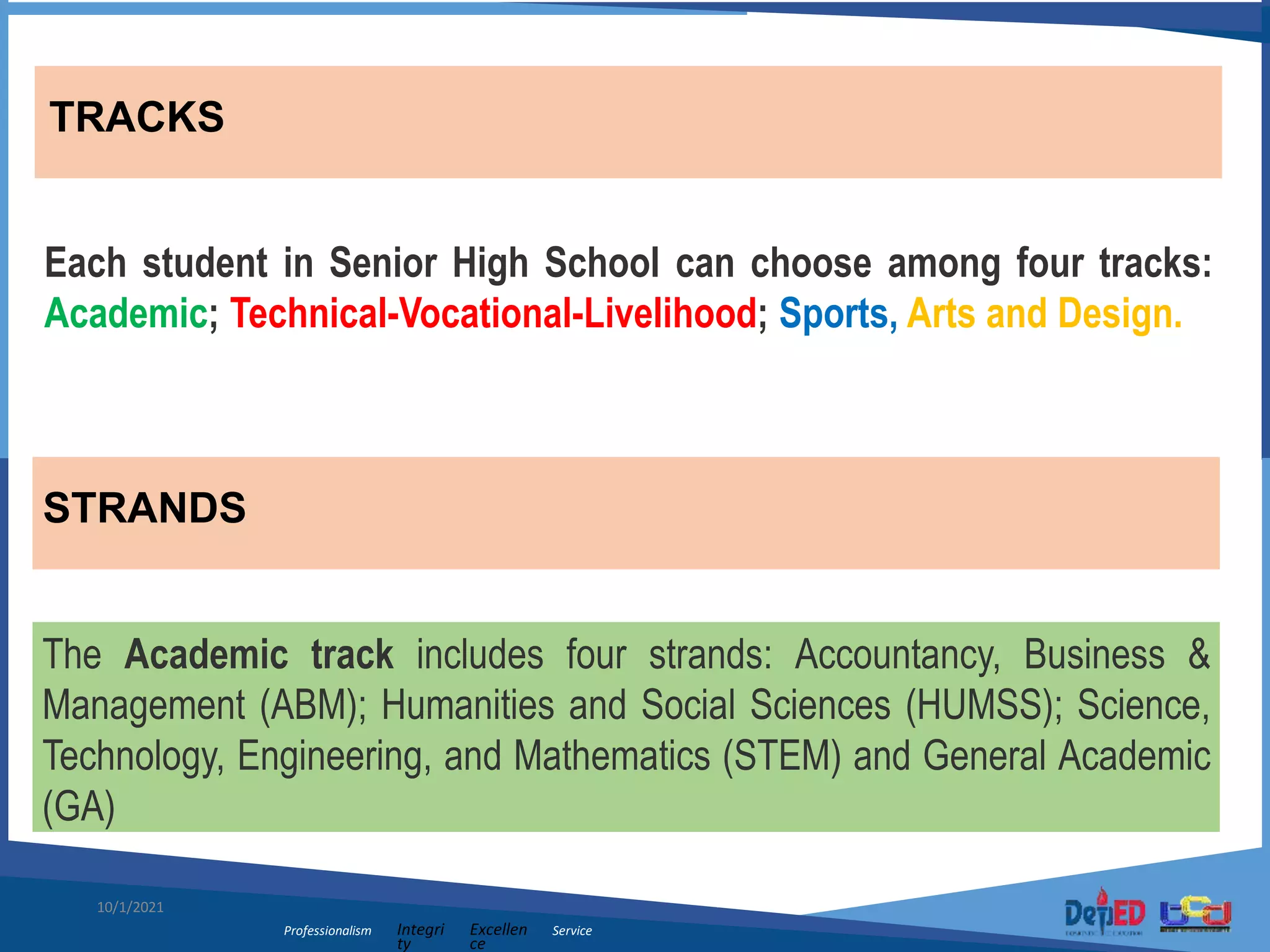
TRACKS
Each student in Senior High School can choose among four tracks:
Academic; Technical-Vocational-Livelihood; Sports, Arts and Design.
STRANDS
The Academic track includes four strands: Accountancy, Business &
Management (ABM); Humanities and Social Sciences (HUMSS); Science,
Technology, Engineering, and Mathematics (STEM) and General Academic
(GA)
10/1/2021
Professionalism Integri
ty
Excellen
ce
Service
TECHNICAL – VOCATIONAL – LIVELIHOOD TRACK
STRANDS
The Technical-Vocational-Livelihood track includes four strands: Home
Economics (HE), Agri-Fishery Arts; Information and Communication
Technology (ICT); and Industrial Arts.
EMPLOYMENT HIGHER EDUCATION ENTREPRENEURSHIP MIDDLE SKILLS
DEVELOPMENT
- refers to higher education, employment,
entrepreneurship, and middle level skills
development.
10/1/2021
Professionalism Integri
ty
Excellen
ce
Service
Curriculum
Exits
Higher Education
is one of the curriculum exits which SHS learners may opt to
pursue after graduation leading to an associate or bachelor’s
degree. This is also referred to as tertiary education, college
degree, or post-secondary education.
10/1/2021
Professionalism Integri
ty
Excellen
ce
Service
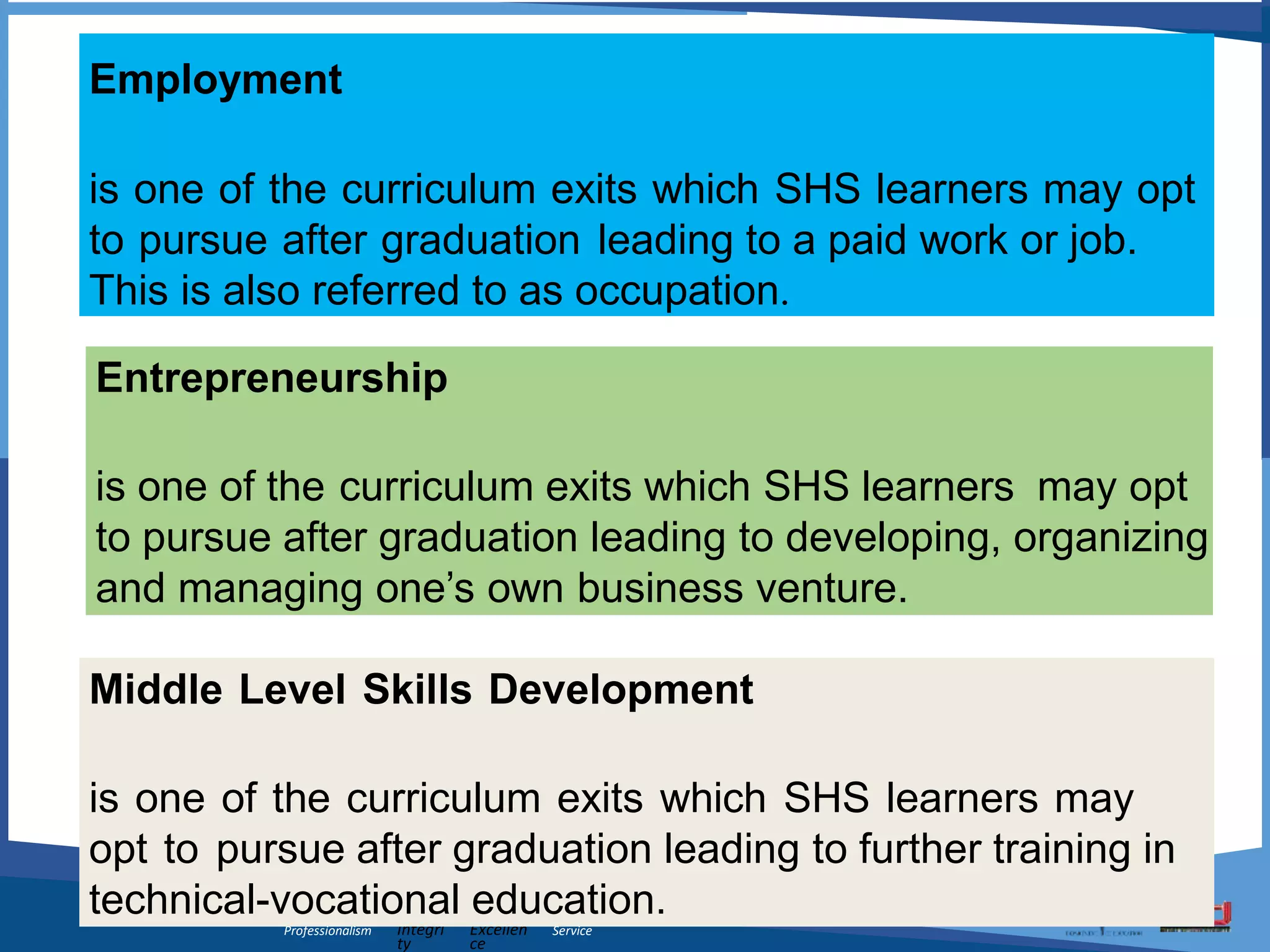
Employment
is one of the curriculum exits which SHS learners may opt
to pursue after graduation leading to a paid work or job.
This is also referred to as occupation.
Entrepreneurship
is one of the curriculum exits which SHS learners may opt
to pursue after graduation leading to developing, organizing
and managing one’s own business venture.
Middle Level Skills Development
is one of the curriculum exits which SHS learners may
opt to pursue after graduation leading to further training in
technical-vocational education.
HARD QUESTIONS TO
ASK YOURSELF!
Questions Like:
• W h e r e will this r o a d lead m e ?
• Will it br ing m e s u c c e s s , w e a l t h , a n d
joy?
• Will it br ing hardships, st r uggle s,
u n h a p p i n e s s ?
• W h a t c a n I d o t o e n s u r e a g r e a t f u t u r e ?
THE SLOW
LANE
• It's possible to quickly
choose a career. But to find a
career that's right for you, it's
helpful to slow down, give it
some thought, and take the
time to get it right.
• This is useful whetheryou’re
choosing a career for the first
time or changing careers for
the thirty-first time.
THE
ANSWER
• By taking a careful look atyour
personal values, interests, personal
attributes, and skills you can obtain
valuable information thatwill help you in
making your decision.
 Talents
 Abilities
 Likes
 Dislikes
 Capabilities
 Preferences
 Values
 Attitudes
John Holland’s
Theory
John Holland's Theory of
Career Choice (RIASEC)
maintains that
in choosing a career, people
prefer jobs where they can be
around others who are
like them.
They search for environments
that will let them use their skills
and abilities, and express their
attitudes and values, while taking
on enjoyable problems and
roles.
The
R I A S E C
 You appreciate and value who you are.
 You become more capable of actualizing your
potentials to the fullest.
 You respect others and relate with them more
meaningfully.
 You are empowered to cope well with the
demands in school, at home, and of your
relationships with others.
Ex. You want to cook –
Cooking contest – TVL
HE/Cooking
You create your own individuality and
develop wiser decision-making when
confronted with critical issues in life
such as setting goals, making career
choices, and relating with significant
others.
 Writing/Speaking clearly and concisely
 Listening and responding to what others say
 Reading and understanding manuals
Identifying
the problem
Understanding
the problem
Analyzing
information
Solving the
problem
Applying the
solution
Asking questions
Reading
information
Using the library
Reaching
information
Joining activities
and clubs
 Being reliable
 Honest
 Avoids blaming others for one’s mistakes
Getting along
with others
Meeting new
people
Working on a
team
Respecting the
ideas of others
 Learning how others have been creative
 Using your imagination
 Trying new ways of doing things
 Looking at issues from a different point of
view
Making ethical
choices
Motivated and
enthusiastic
Reliable and
dependable
Pride in
appearance
Courteous and
respectful
Positive mental
attitude
 Scheduling your day
 Setting priorities and goals
 Being flexible
 Positive attitude toward change
 Decision making ability
Using keyboard Using word
processing program
Using email Developing
powerpoint
Using the internet
to research
 Able to accept and give criticism in a
professional manner
 Understanding numerical data, statistics and
graphs
 Openness to new ideas and concepts
 Flexible
 Adapt to changing conditions
 Multi-tasking
 Ability to take charge and manage your co-
workers
 Ability to provide motivation to a team
towards a common goal
 Ability to take risks
TOP 5 BEHAVIORAL SKILLS
WILLINGNESS
TO LEARN
SELF-
MOTIVATED/
SELF-
STARTER
HONESTY &
INTEGRITY
INITIATIVE
SELF-
CONFIDENCE
BEHAVIORAL & FUNCTIONAL SKILLS
LIFE SKILLS
World Health Organization
The abilities for adaptive and
positive behavior that
enable individuals to deal
effectively with the demands
and challenges of everyday life
Mastery of competencies for
productive adults life
Not done to youth but with
youth
Skills that promote well-
being and competence in
youth to face life’s
challenges.
The Ten core Life Skills
• Self-awareness
• Empathy
• Critical thinking
• Creative thinking
• Decision making
• Problem Solving
• Effective communication
• Interpersonal relationship
• Coping with stress
• Coping with emotion
Importance of Life Skills
Exploring
alternatives
Weighing pros
and cons
Making rational
decisions
Effective
communication
Assertiveness:
saying NO.
Educationisnotthefillingofa
pail,butthelightingofafire.
— W.B. Yeats
https://www.slideshare.net/kesiamargot/career-
planning-presentation
https://www.slideshare.net/waqasdilasa/career-
planning-10520579
Cayaco, Mico May R. slide presentation of Career Planning
for Incoming Senior High School
Sison, Kristine Cyrelle V. slide presentation on Career
Guidance Program, 2021
Tenebro, Arabelle slide presentation on Career Planning,
May 26, 2022

CAREER-TALK-FOR-SAGKHAN-NATIONAL-HIGH-SCHOOL-09162022.pptx

  • 1.
    July 24, 2023 Hotelde Fides By: JULIENNE ROSE P. SABALLA, RGC Department of Education Leyte National High School Tacloban City
  • 2.
  • 3.
    At the endof this session, it is expected that participants will be able to: 1. Learn about DepEd’s Career Guidance programs and activities 2. Know more about basic career concepts and steps on how to plan their careers; 3. Identify their skills, interests, and preferences, thus enabling them to appreciate their own uniqueness and individuality; and 4. Be guided, inspired and motivated in making wise decisions for their future.
  • 5.
    Department of Education SchoolsDivision of Tacloban City
  • 6.
     CAREER GUIDANCE PROGRAM(DM-OUCI-2021- 347)  HOMEROOM GUIDANCE PROGRAM (DM-OUCI-346) (KINDERGARTEN – GRADE 12)  NATIONAL CAREER ASSESSMENT EXAMINATION (NCAE) – GRADE 9  CAREER GUIDANCE MODULES (GRADE 11 & 12)
  • 7.
     The CareerGuidance Program of DepED starts with the implementation of the HOMEROOM GUIDANCE PROGRAM (DM-OUCI-346)  One of the domains in the HG is CAREER DOMAIN.  It aims to help the learners identify their future career by getting to know themselves deeper through recognizing their interests, abilities and potentials.
  • 8.
     NATIONAL CAREER ASSESSMENTEXAMINATION (NCAE) – GRADE 9  For Grade 9 learners you will be given the NCAE or the National Career Assessment Examination which will help you determine your interests, skills, abilities and potentials.  It will also aid you in knowing what track/strand will be more suitable to you based on your results.
  • 9.
     CAREER GUIDANCEMODULES FOR (GRADE 10, 11 & 12)  Starting the 2nd Quarter, the Grade 10 will be given the Multiple Career Development Pathways (MCDP Toolkit) module to know more about their future career  The Grade 11 & 12 then will be given the Career Learning Activity Plan or the Career Guidance module to help you with your future career.
  • 11.
     What doyou want to be when you grow up?  It is never too early to start thinking about the future!..  What you are doing in school now will have an impact in what you do in the future.
  • 13.
    Homeroom Guidance -is a comprehensive, developmental and proactive program designed to equip K to 12 learners with life skills on three domains: Academic Development, Personal and Social Development and Career Development (based on DM 155 s. 2020). 10/1/2021 Professionalism Integri ty Excellen ce Service Career Guidance Program - is designed to help learners explore their choices and make responsible decisions relevant to career pathing. These include planning for their track and strand for Senior High School, choosing their curriculum exits (Higher Education, Employment, Entrepreneurship, and Middle Level Skills Development) and planning for their future.
  • 14.
    10/1/2021 Professionalism Integri ty Excellen ce Service TRACKS Each studentin Senior High School can choose among four tracks: Academic; Technical-Vocational-Livelihood; Sports, Arts and Design. STRANDS The Academic track includes four strands: Accountancy, Business & Management (ABM); Humanities and Social Sciences (HUMSS); Science, Technology, Engineering, and Mathematics (STEM) and General Academic (GA)
  • 15.
    10/1/2021 Professionalism Integri ty Excellen ce Service TECHNICAL –VOCATIONAL – LIVELIHOOD TRACK STRANDS The Technical-Vocational-Livelihood track includes four strands: Home Economics (HE), Agri-Fishery Arts; Information and Communication Technology (ICT); and Industrial Arts.
  • 16.
    EMPLOYMENT HIGHER EDUCATIONENTREPRENEURSHIP MIDDLE SKILLS DEVELOPMENT
  • 17.
    - refers tohigher education, employment, entrepreneurship, and middle level skills development. 10/1/2021 Professionalism Integri ty Excellen ce Service Curriculum Exits Higher Education is one of the curriculum exits which SHS learners may opt to pursue after graduation leading to an associate or bachelor’s degree. This is also referred to as tertiary education, college degree, or post-secondary education.
  • 18.
    10/1/2021 Professionalism Integri ty Excellen ce Service Employment is oneof the curriculum exits which SHS learners may opt to pursue after graduation leading to a paid work or job. This is also referred to as occupation. Entrepreneurship is one of the curriculum exits which SHS learners may opt to pursue after graduation leading to developing, organizing and managing one’s own business venture. Middle Level Skills Development is one of the curriculum exits which SHS learners may opt to pursue after graduation leading to further training in technical-vocational education.
  • 22.
    HARD QUESTIONS TO ASKYOURSELF! Questions Like: • W h e r e will this r o a d lead m e ? • Will it br ing m e s u c c e s s , w e a l t h , a n d joy? • Will it br ing hardships, st r uggle s, u n h a p p i n e s s ? • W h a t c a n I d o t o e n s u r e a g r e a t f u t u r e ?
  • 23.
    THE SLOW LANE • It'spossible to quickly choose a career. But to find a career that's right for you, it's helpful to slow down, give it some thought, and take the time to get it right. • This is useful whetheryou’re choosing a career for the first time or changing careers for the thirty-first time.
  • 24.
    THE ANSWER • By takinga careful look atyour personal values, interests, personal attributes, and skills you can obtain valuable information thatwill help you in making your decision.
  • 27.
     Talents  Abilities Likes  Dislikes  Capabilities  Preferences  Values  Attitudes
  • 28.
    John Holland’s Theory John Holland'sTheory of Career Choice (RIASEC) maintains that in choosing a career, people prefer jobs where they can be around others who are like them. They search for environments that will let them use their skills and abilities, and express their attitudes and values, while taking on enjoyable problems and roles.
  • 29.
    The R I AS E C
  • 38.
     You appreciateand value who you are.  You become more capable of actualizing your potentials to the fullest.  You respect others and relate with them more meaningfully.  You are empowered to cope well with the demands in school, at home, and of your relationships with others.
  • 40.
    Ex. You wantto cook – Cooking contest – TVL HE/Cooking
  • 43.
    You create yourown individuality and develop wiser decision-making when confronted with critical issues in life such as setting goals, making career choices, and relating with significant others.
  • 48.
     Writing/Speaking clearlyand concisely  Listening and responding to what others say  Reading and understanding manuals Identifying the problem Understanding the problem Analyzing information Solving the problem Applying the solution
  • 49.
    Asking questions Reading information Using thelibrary Reaching information Joining activities and clubs  Being reliable  Honest  Avoids blaming others for one’s mistakes
  • 50.
    Getting along with others Meetingnew people Working on a team Respecting the ideas of others  Learning how others have been creative  Using your imagination  Trying new ways of doing things  Looking at issues from a different point of view
  • 51.
    Making ethical choices Motivated and enthusiastic Reliableand dependable Pride in appearance Courteous and respectful Positive mental attitude  Scheduling your day  Setting priorities and goals  Being flexible  Positive attitude toward change  Decision making ability
  • 52.
    Using keyboard Usingword processing program Using email Developing powerpoint Using the internet to research  Able to accept and give criticism in a professional manner  Understanding numerical data, statistics and graphs
  • 53.
     Openness tonew ideas and concepts  Flexible  Adapt to changing conditions  Multi-tasking  Ability to take charge and manage your co- workers  Ability to provide motivation to a team towards a common goal  Ability to take risks
  • 54.
    TOP 5 BEHAVIORALSKILLS WILLINGNESS TO LEARN SELF- MOTIVATED/ SELF- STARTER HONESTY & INTEGRITY INITIATIVE SELF- CONFIDENCE BEHAVIORAL & FUNCTIONAL SKILLS
  • 55.
    LIFE SKILLS World HealthOrganization The abilities for adaptive and positive behavior that enable individuals to deal effectively with the demands and challenges of everyday life Mastery of competencies for productive adults life Not done to youth but with youth Skills that promote well- being and competence in youth to face life’s challenges.
  • 56.
    The Ten coreLife Skills • Self-awareness • Empathy • Critical thinking • Creative thinking • Decision making • Problem Solving • Effective communication • Interpersonal relationship • Coping with stress • Coping with emotion
  • 57.
    Importance of LifeSkills Exploring alternatives Weighing pros and cons Making rational decisions Effective communication Assertiveness: saying NO.
  • 61.
  • 63.
    https://www.slideshare.net/kesiamargot/career- planning-presentation https://www.slideshare.net/waqasdilasa/career- planning-10520579 Cayaco, Mico MayR. slide presentation of Career Planning for Incoming Senior High School Sison, Kristine Cyrelle V. slide presentation on Career Guidance Program, 2021 Tenebro, Arabelle slide presentation on Career Planning, May 26, 2022

Editor's Notes

  • #30 Before you start the seminar administer/give the RIASEC test to your learners.