Transformation of Energy
Lesson 9
You learned about the forms of
energy and their uses in the previous
modules. You knew that every kind of
matter possess some kind of energy.
However, energy may remain unused.
Do you think energy is useful when it is
not used to do work? Some forms of
energy must be changed into other
forms before they can do work. This
module will help you understand how
energy is changed into other forms.
TRANSFORMATION OF ENERGY
Lesson 9
What I need to Know
In this new lesson, you are expected to:
1. Demonstrate how sound, heat, light and electricity
can be transformed; (S6FEIIIa-c-2)
2. trace energy transformation;
3. realize the importance of the different forms of
energy in daily living;
4. infer that heat is always produced during energy
transformation and is transferred to the environment.
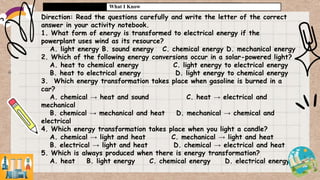
What I Know
Direction: Read the questions carefully and write the letter of the correct
answer in your activity notebook.
1. What form of energy is transformed to electrical energy if the
powerplant uses wind as its resource?
A. light energy B. sound energy C. chemical energy D. mechanical energy
2. Which of the following energy conversions occur in a solar-powered light?
A. heat to chemical energy C. light energy to electrical energy
B. heat to electrical energy D. light energy to chemical energy
3. Which energy transformation takes place when gasoline is burned in a
car?
A. chemical → heat and sound C. heat → electrical and
mechanical
B. chemical → mechanical and heat D. mechanical → chemical and
electrical
4. Which energy transformation takes place when you light a candle?
A. chemical → light and heat C. mechanical → light and heat
B. electrical → light and heat D. chemical → electrical and heat
5. Which is always produced when there is energy transformation?
A. heat B. light energy C. chemical energy D. electrical energy
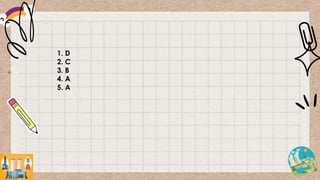
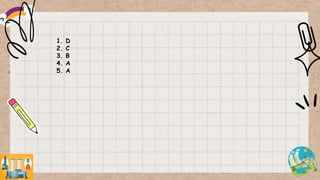
1. D
2. C
3. B
4. A
5. A
What’s In
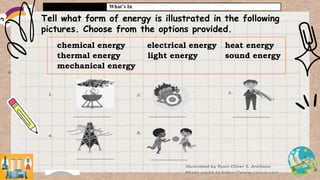
Tell what form of energy is illustrated in the following
pictures. Choose from the options provided.
chemical energy electrical energy heat energy
thermal energy light energy sound energy
mechanical energy
What’s New
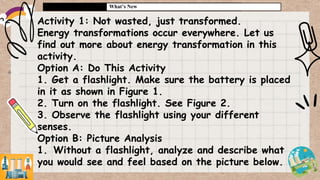
Activity 1: Not wasted, just transformed.
Energy transformations occur everywhere. Let us
find out more about energy transformation in this
activity.
Option A: Do This Activity
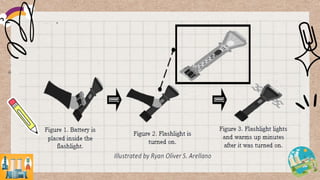
1. Get a flashlight. Make sure the battery is placed
in it as shown in Figure 1.
2. Turn on the flashlight. See Figure 2.
3. Observe the flashlight using your different
senses.
Option B: Picture Analysis
1. Without a flashlight, analyze and describe what
you would see and feel based on the picture below.
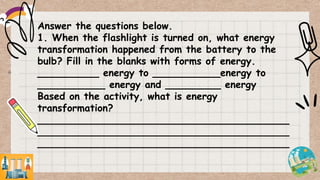
Answer the questions below.
1. When the flashlight is turned on, what energy
transformation happened from the battery to the
bulb? Fill in the blanks with forms of energy.
__________ energy to ___________energy to
___________ energy and _________ energy
Based on the activity, what is energy
transformation?
_________________________________________
_________________________________________
_________________________________________
What is it
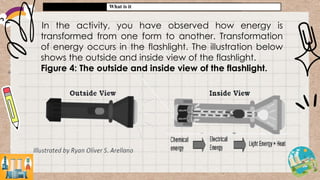
In the activity, you have observed how energy is
transformed from one form to another. Transformation
of energy occurs in the flashlight. The illustration below
shows the outside and inside view of the flashlight.
Figure 4: The outside and inside view of the flashlight.
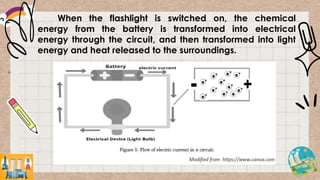
When the flashlight is switched on, the chemical
energy from the battery is transformed into electrical
energy through the circuit, and then transformed into light
energy and heat released to the surroundings.
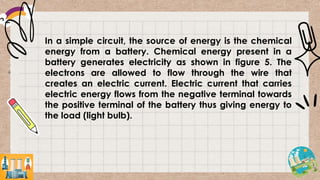
In a simple circuit, the source of energy is the chemical
energy from a battery. Chemical energy present in a
battery generates electricity as shown in figure 5. The
electrons are allowed to flow through the wire that
creates an electric current. Electric current that carries
electric energy flows from the negative terminal towards
the positive terminal of the battery thus giving energy to
the load (light bulb).
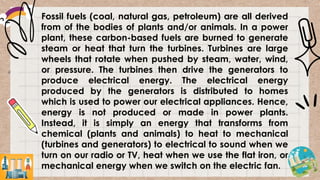
Fossil fuels (coal, natural gas, petroleum) are all derived
from of the bodies of plants and/or animals. In a power
plant, these carbon-based fuels are burned to generate
steam or heat that turn the turbines. Turbines are large
wheels that rotate when pushed by steam, water, wind,
or pressure. The turbines then drive the generators to
produce electrical energy. The electrical energy
produced by the generators is distributed to homes
which is used to power our electrical appliances. Hence,
energy is not produced or made in power plants.
Instead, it is simply an energy that transforms from
chemical (plants and animals) to heat to mechanical
(turbines and generators) to electrical to sound when we
turn on our radio or TV, heat when we use the flat iron, or
mechanical energy when we switch on the electric fan.
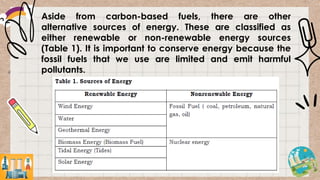
Aside from carbon-based fuels, there are other
alternative sources of energy. These are classified as
either renewable or non-renewable energy sources
(Table 1). It is important to conserve energy because the
fossil fuels that we use are limited and emit harmful
pollutants.
Transformation of energy may also be observed by simply
doing household chores. When hammering the nail,
mechanical energy is turned into sound energy and heat
energy as you continue hitting the nail. When ironing
clothes, the electrical energy from the source or outlet is
transformed into heat that makes the iron hot. In a boiling
water, the chemical energy from the LPG tank is
transformed into light energy and heat that makes the
water boil. At home, we use different appliances like TV,
electric fan, air condition, refrigerator, electric lamp, etc.
All these devices transform one energy to another form
and release heat to the surroundings. The end product of
energy transformations is heat wasted. Heat is collected
in the surroundings and results in the warming of the
environment.
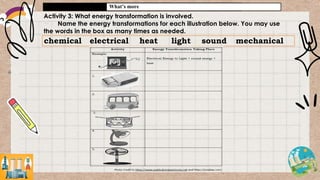
What’s more
Activity 3: What energy transformation is involved.
Name the energy transformations for each illustration below. You may use
the words in the box as many times as needed.
chemical electrical heat light sound mechanical
Discussion
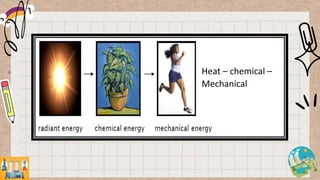
Energy transformation, also known as energy conversion,
is the process of changing energy from one form to
another.[1] In physics, energy is a quantity that provides the
capacity to perform work or moving, (e.g., Lifting an object)
or provides heat. In addition to being converted, according
to the law of conservation of energy, energy is transferable
to a different location or object, but it cannot be created or
destroyed.
The energy in many of its forms may be used in natural
processes, or to provide some service to society such as
heating, refrigeration, lighting or performing mechanical
work to operate machines. For example, to heat a home,
the furnace burns fuel, whose chemical potential energy is
converted into thermal energy, which is then transferred to
the home's air to raise its temperature.
Heat – chemical –
Mechanical
What’s more:
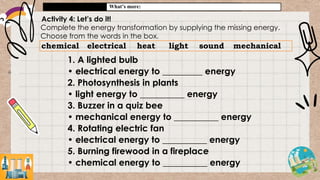
Activity 4: Let’s do it!
Complete the energy transformation by supplying the missing energy.
Choose from the words in the box.
chemical electrical heat light sound mechanical
1. A lighted bulb
• electrical energy to _________ energy
2. Photosynthesis in plants
• light energy to __________ energy
3. Buzzer in a quiz bee
• mechanical energy to __________ energy
4. Rotating electric fan
• electrical energy to __________ energy
5. Burning firewood in a fireplace
• chemical energy to __________ energy
What I can do
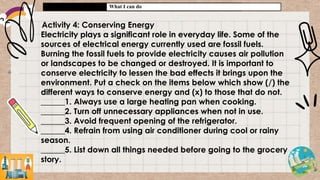
Activity 4: Conserving Energy
Electricity plays a significant role in everyday life. Some of the
sources of electrical energy currently used are fossil fuels.
Burning the fossil fuels to provide electricity causes air pollution
or landscapes to be changed or destroyed. It is important to
conserve electricity to lessen the bad effects it brings upon the
environment. Put a check on the items below which show (/) the
different ways to conserve energy and (x) to those that do not.
______1. Always use a large heating pan when cooking.
______2. Turn off unnecessary appliances when not in use.
______3. Avoid frequent opening of the refrigerator.
______4. Refrain from using air conditioner during cool or rainy
season.
______5. List down all things needed before going to the grocery
story.
What I have learned
What is energy transformation?
When does a form of energy
become useful to us?
Is transformation of energy
important? Why?
What I have learned
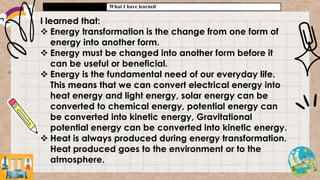
I learned that:
 Energy transformation is the change from one form of
energy into another form.
 Energy must be changed into another form before it
can be useful or beneficial.
 Energy is the fundamental need of our everyday life.
This means that we can convert electrical energy into
heat energy and light energy, solar energy can be
converted to chemical energy, potential energy can
be converted into kinetic energy, Gravitational
potential energy can be converted into kinetic energy.
 Heat is always produced during energy transformation.
Heat produced goes to the environment or to the
atmosphere.
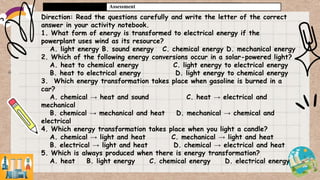
Assessment
Direction: Read the questions carefully and write the letter of the correct
answer in your activity notebook.
1. What form of energy is transformed to electrical energy if the
powerplant uses wind as its resource?
A. light energy B. sound energy C. chemical energy D. mechanical energy
2. Which of the following energy conversions occur in a solar-powered light?
A. heat to chemical energy C. light energy to electrical energy
B. heat to electrical energy D. light energy to chemical energy
3. Which energy transformation takes place when gasoline is burned in a
car?
A. chemical → heat and sound C. heat → electrical and
mechanical
B. chemical → mechanical and heat D. mechanical → chemical and
electrical
4. Which energy transformation takes place when you light a candle?
A. chemical → light and heat C. mechanical → light and heat
B. electrical → light and heat D. chemical → electrical and heat
5. Which is always produced when there is energy transformation?
A. heat B. light energy C. chemical energy D. electrical energy
1. D
2. C
3. B
4. A
5. A
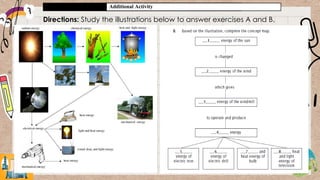
Additional Activity
Directions: Study the illustrations below to answer exercises A and B.
Q3 Lesson 9_Energy Transformation.pptx

Q3 Lesson 9_Energy Transformation.pptx

  • 1.
  • 3.
    You learned aboutthe forms of energy and their uses in the previous modules. You knew that every kind of matter possess some kind of energy. However, energy may remain unused. Do you think energy is useful when it is not used to do work? Some forms of energy must be changed into other forms before they can do work. This module will help you understand how energy is changed into other forms. TRANSFORMATION OF ENERGY Lesson 9
  • 5.
    What I needto Know In this new lesson, you are expected to: 1. Demonstrate how sound, heat, light and electricity can be transformed; (S6FEIIIa-c-2) 2. trace energy transformation; 3. realize the importance of the different forms of energy in daily living; 4. infer that heat is always produced during energy transformation and is transferred to the environment.
  • 6.
    What I Know Direction:Read the questions carefully and write the letter of the correct answer in your activity notebook. 1. What form of energy is transformed to electrical energy if the powerplant uses wind as its resource? A. light energy B. sound energy C. chemical energy D. mechanical energy 2. Which of the following energy conversions occur in a solar-powered light? A. heat to chemical energy C. light energy to electrical energy B. heat to electrical energy D. light energy to chemical energy 3. Which energy transformation takes place when gasoline is burned in a car? A. chemical → heat and sound C. heat → electrical and mechanical B. chemical → mechanical and heat D. mechanical → chemical and electrical 4. Which energy transformation takes place when you light a candle? A. chemical → light and heat C. mechanical → light and heat B. electrical → light and heat D. chemical → electrical and heat 5. Which is always produced when there is energy transformation? A. heat B. light energy C. chemical energy D. electrical energy
  • 7.
    1. D 2. C 3.B 4. A 5. A
  • 8.
    What’s In Tell whatform of energy is illustrated in the following pictures. Choose from the options provided. chemical energy electrical energy heat energy thermal energy light energy sound energy mechanical energy
  • 9.
    What’s New Activity 1:Not wasted, just transformed. Energy transformations occur everywhere. Let us find out more about energy transformation in this activity. Option A: Do This Activity 1. Get a flashlight. Make sure the battery is placed in it as shown in Figure 1. 2. Turn on the flashlight. See Figure 2. 3. Observe the flashlight using your different senses. Option B: Picture Analysis 1. Without a flashlight, analyze and describe what you would see and feel based on the picture below.
  • 11.
    Answer the questionsbelow. 1. When the flashlight is turned on, what energy transformation happened from the battery to the bulb? Fill in the blanks with forms of energy. __________ energy to ___________energy to ___________ energy and _________ energy Based on the activity, what is energy transformation? _________________________________________ _________________________________________ _________________________________________
  • 12.
    What is it Inthe activity, you have observed how energy is transformed from one form to another. Transformation of energy occurs in the flashlight. The illustration below shows the outside and inside view of the flashlight. Figure 4: The outside and inside view of the flashlight.
  • 13.
    When the flashlightis switched on, the chemical energy from the battery is transformed into electrical energy through the circuit, and then transformed into light energy and heat released to the surroundings.
  • 14.
    In a simplecircuit, the source of energy is the chemical energy from a battery. Chemical energy present in a battery generates electricity as shown in figure 5. The electrons are allowed to flow through the wire that creates an electric current. Electric current that carries electric energy flows from the negative terminal towards the positive terminal of the battery thus giving energy to the load (light bulb).
  • 15.
    Fossil fuels (coal,natural gas, petroleum) are all derived from of the bodies of plants and/or animals. In a power plant, these carbon-based fuels are burned to generate steam or heat that turn the turbines. Turbines are large wheels that rotate when pushed by steam, water, wind, or pressure. The turbines then drive the generators to produce electrical energy. The electrical energy produced by the generators is distributed to homes which is used to power our electrical appliances. Hence, energy is not produced or made in power plants. Instead, it is simply an energy that transforms from chemical (plants and animals) to heat to mechanical (turbines and generators) to electrical to sound when we turn on our radio or TV, heat when we use the flat iron, or mechanical energy when we switch on the electric fan.
  • 16.
    Aside from carbon-basedfuels, there are other alternative sources of energy. These are classified as either renewable or non-renewable energy sources (Table 1). It is important to conserve energy because the fossil fuels that we use are limited and emit harmful pollutants.
  • 17.
    Transformation of energymay also be observed by simply doing household chores. When hammering the nail, mechanical energy is turned into sound energy and heat energy as you continue hitting the nail. When ironing clothes, the electrical energy from the source or outlet is transformed into heat that makes the iron hot. In a boiling water, the chemical energy from the LPG tank is transformed into light energy and heat that makes the water boil. At home, we use different appliances like TV, electric fan, air condition, refrigerator, electric lamp, etc. All these devices transform one energy to another form and release heat to the surroundings. The end product of energy transformations is heat wasted. Heat is collected in the surroundings and results in the warming of the environment.
  • 18.
    What’s more Activity 3:What energy transformation is involved. Name the energy transformations for each illustration below. You may use the words in the box as many times as needed. chemical electrical heat light sound mechanical
  • 19.
    Discussion Energy transformation, alsoknown as energy conversion, is the process of changing energy from one form to another.[1] In physics, energy is a quantity that provides the capacity to perform work or moving, (e.g., Lifting an object) or provides heat. In addition to being converted, according to the law of conservation of energy, energy is transferable to a different location or object, but it cannot be created or destroyed. The energy in many of its forms may be used in natural processes, or to provide some service to society such as heating, refrigeration, lighting or performing mechanical work to operate machines. For example, to heat a home, the furnace burns fuel, whose chemical potential energy is converted into thermal energy, which is then transferred to the home's air to raise its temperature.
  • 20.
    Heat – chemical– Mechanical
  • 21.
    What’s more: Activity 4:Let’s do it! Complete the energy transformation by supplying the missing energy. Choose from the words in the box. chemical electrical heat light sound mechanical 1. A lighted bulb • electrical energy to _________ energy 2. Photosynthesis in plants • light energy to __________ energy 3. Buzzer in a quiz bee • mechanical energy to __________ energy 4. Rotating electric fan • electrical energy to __________ energy 5. Burning firewood in a fireplace • chemical energy to __________ energy
  • 22.
    What I cando Activity 4: Conserving Energy Electricity plays a significant role in everyday life. Some of the sources of electrical energy currently used are fossil fuels. Burning the fossil fuels to provide electricity causes air pollution or landscapes to be changed or destroyed. It is important to conserve electricity to lessen the bad effects it brings upon the environment. Put a check on the items below which show (/) the different ways to conserve energy and (x) to those that do not. ______1. Always use a large heating pan when cooking. ______2. Turn off unnecessary appliances when not in use. ______3. Avoid frequent opening of the refrigerator. ______4. Refrain from using air conditioner during cool or rainy season. ______5. List down all things needed before going to the grocery story.
  • 23.
    What I havelearned What is energy transformation? When does a form of energy become useful to us? Is transformation of energy important? Why?
  • 24.
    What I havelearned I learned that:  Energy transformation is the change from one form of energy into another form.  Energy must be changed into another form before it can be useful or beneficial.  Energy is the fundamental need of our everyday life. This means that we can convert electrical energy into heat energy and light energy, solar energy can be converted to chemical energy, potential energy can be converted into kinetic energy, Gravitational potential energy can be converted into kinetic energy.  Heat is always produced during energy transformation. Heat produced goes to the environment or to the atmosphere.
  • 25.
    Assessment Direction: Read thequestions carefully and write the letter of the correct answer in your activity notebook. 1. What form of energy is transformed to electrical energy if the powerplant uses wind as its resource? A. light energy B. sound energy C. chemical energy D. mechanical energy 2. Which of the following energy conversions occur in a solar-powered light? A. heat to chemical energy C. light energy to electrical energy B. heat to electrical energy D. light energy to chemical energy 3. Which energy transformation takes place when gasoline is burned in a car? A. chemical → heat and sound C. heat → electrical and mechanical B. chemical → mechanical and heat D. mechanical → chemical and electrical 4. Which energy transformation takes place when you light a candle? A. chemical → light and heat C. mechanical → light and heat B. electrical → light and heat D. chemical → electrical and heat 5. Which is always produced when there is energy transformation? A. heat B. light energy C. chemical energy D. electrical energy
  • 26.
    1. D 2. C 3.B 4. A 5. A
  • 27.
    Additional Activity Directions: Studythe illustrations below to answer exercises A and B.