
Blended Learning: How Do You
   Know It When You See It?


Dr. Allison Powell
Vice President, State and District Services

Dr. Rob Darrow
Director of Member Services
www.inacol.org
International Association for K-
       12 Online Learning (iNACOL)
•   iNACOL is the premier K-12 nonprofit in online learning
•   Provides leadership, advocacy, research, training, and networking with experts in K-12 online learning.
      – 4400+ members in K-12 online and blended learning in over 50 countries
      – Annual conference – iNACOL Blended and Online Learning Symposium: Orlando, FL in October
         28-30, 2013
•   “Ensure every student has access a world class education” regardless of geography, income or
    background.
•   Next Generation Learning Challenges – Gates Foundation
•   CompetencyWorks – Nellie Mae Education Foundation
•   Our strategic areas of focus in online and blended learning:
      1. Policy
      2. Quality
      3. New Learning Models
http://youtu.be/_LyuLJSByvI
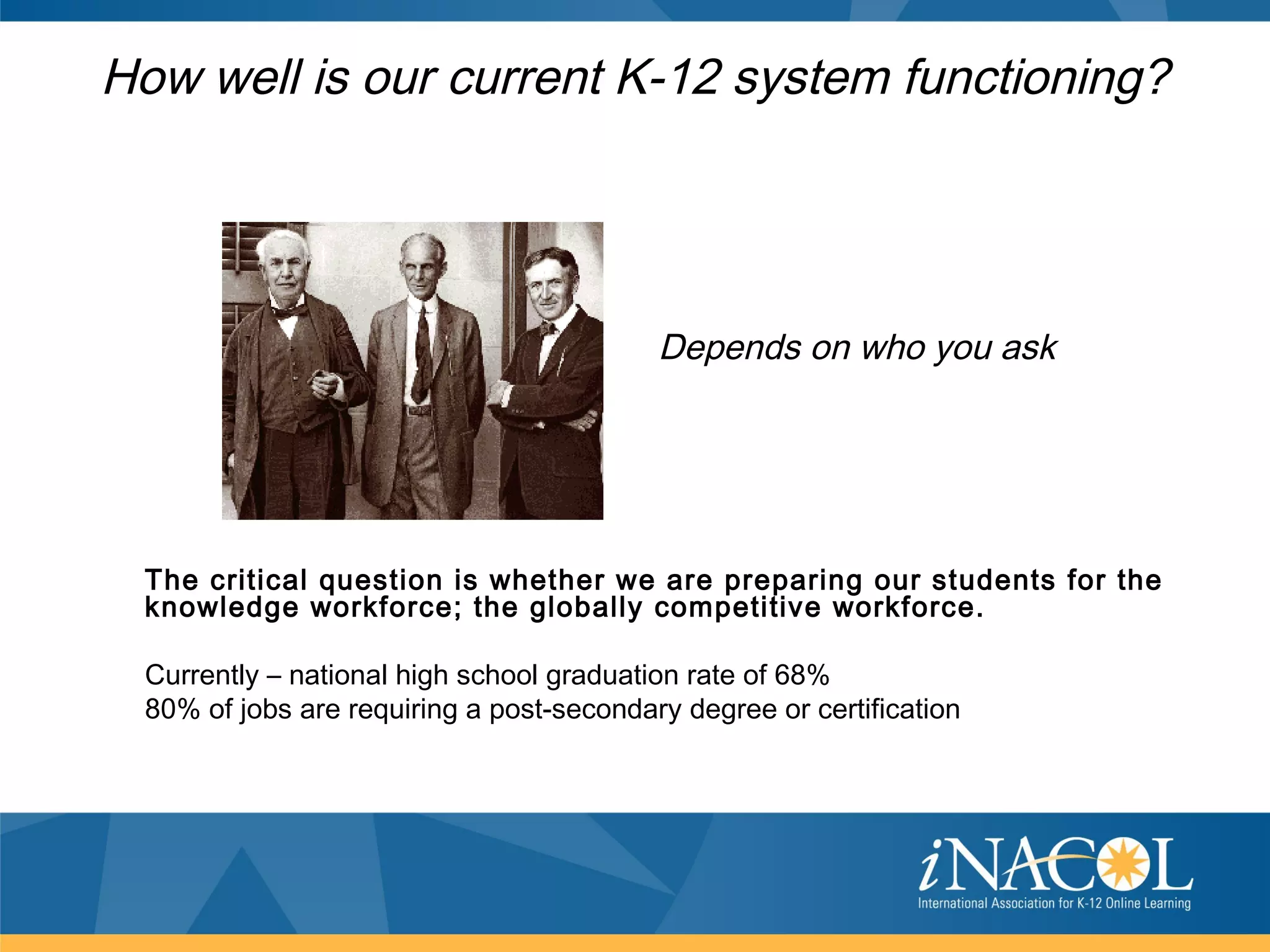
How well is our current K-12 system functioning?


                                          Depends on who you ask


 The critical question is whether we are preparing our students for the
 knowledge workforce; the globally competitive workforce.

 Currently – national high school graduation rate of 68%
 80% of jobs are requiring a post-secondary degree or certification
Online and Blended Learning as a
       catalyst for change
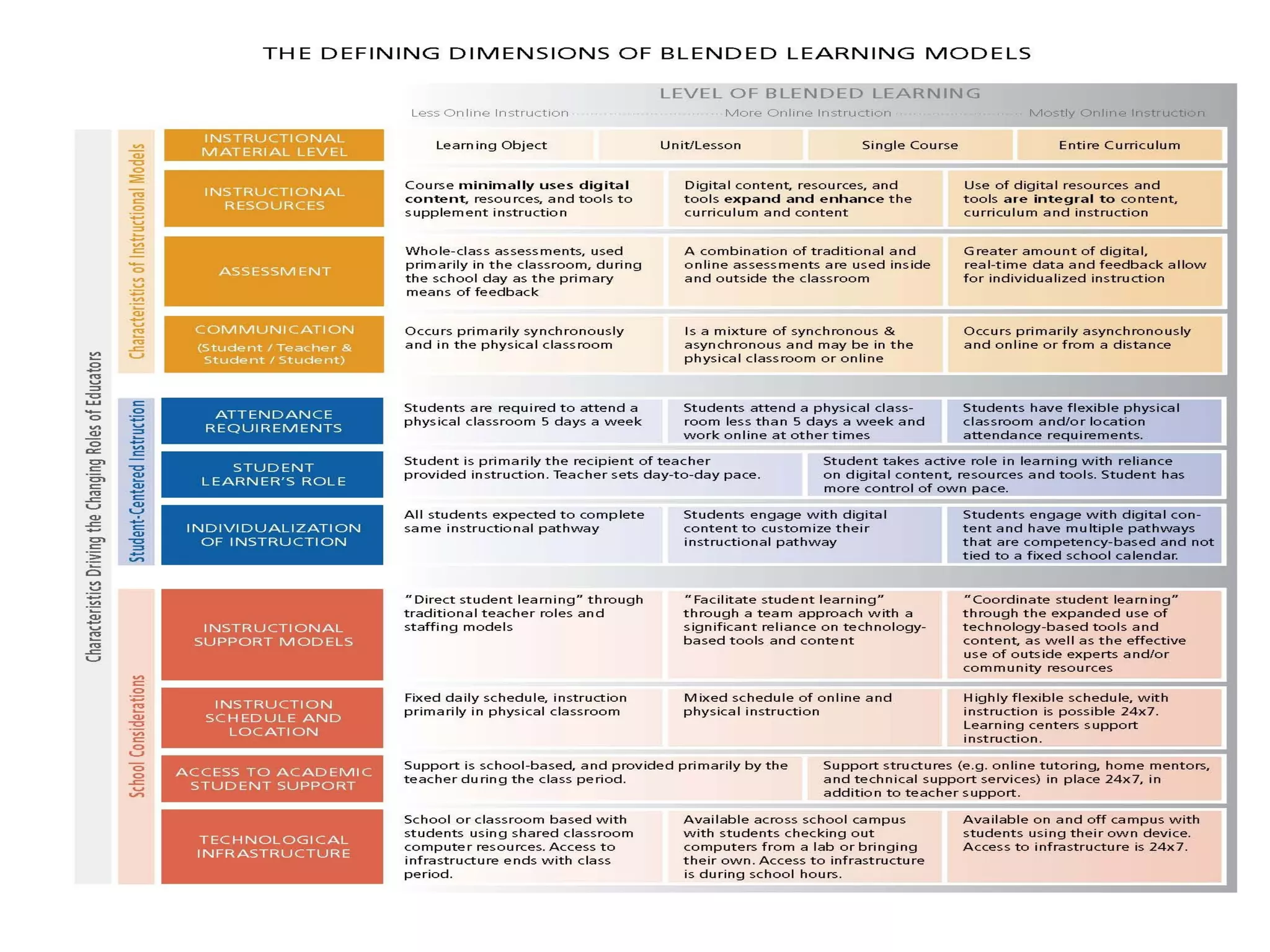
Defining blended learning?
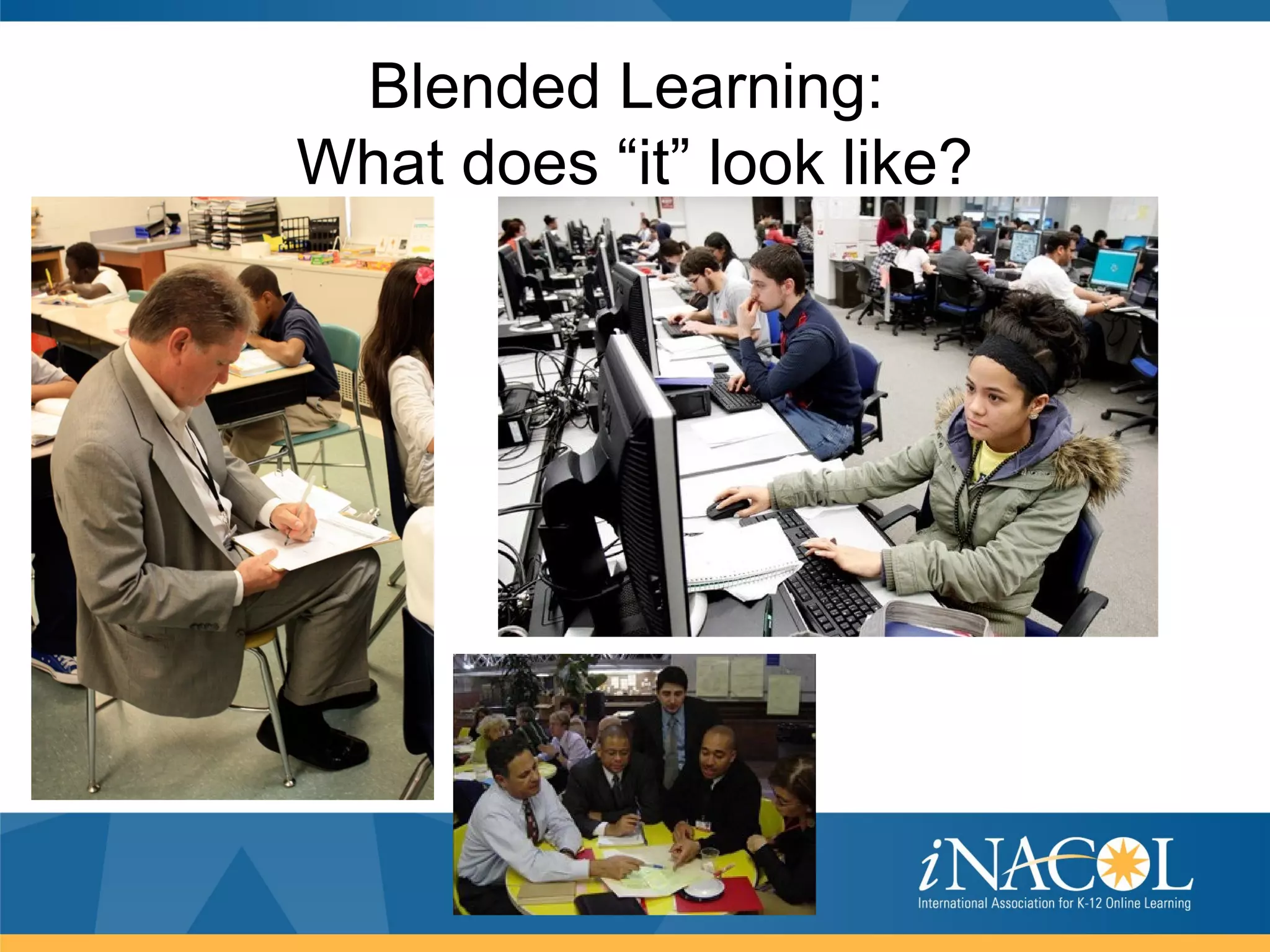
Blended Learning:
What does “it” look like?
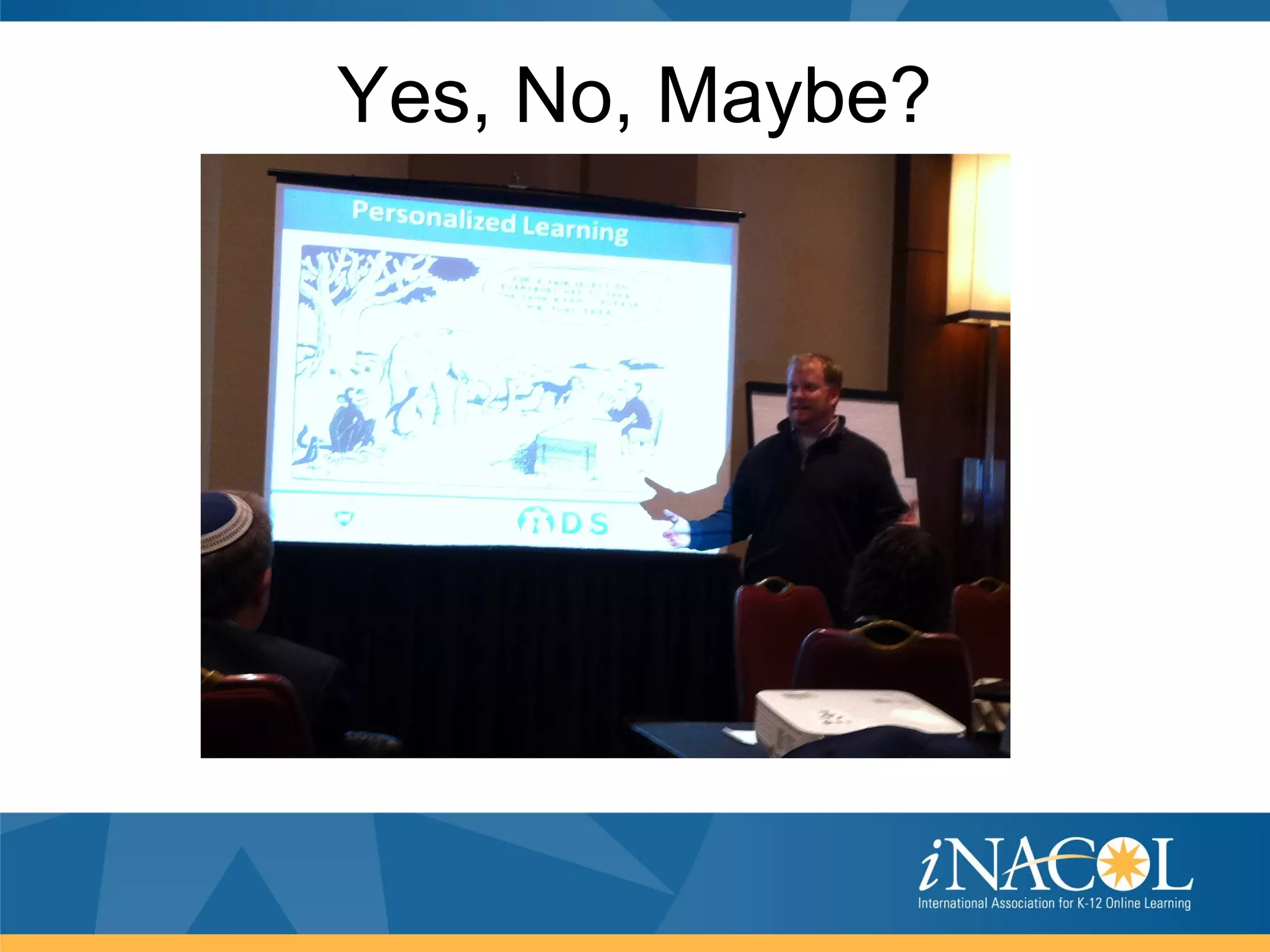
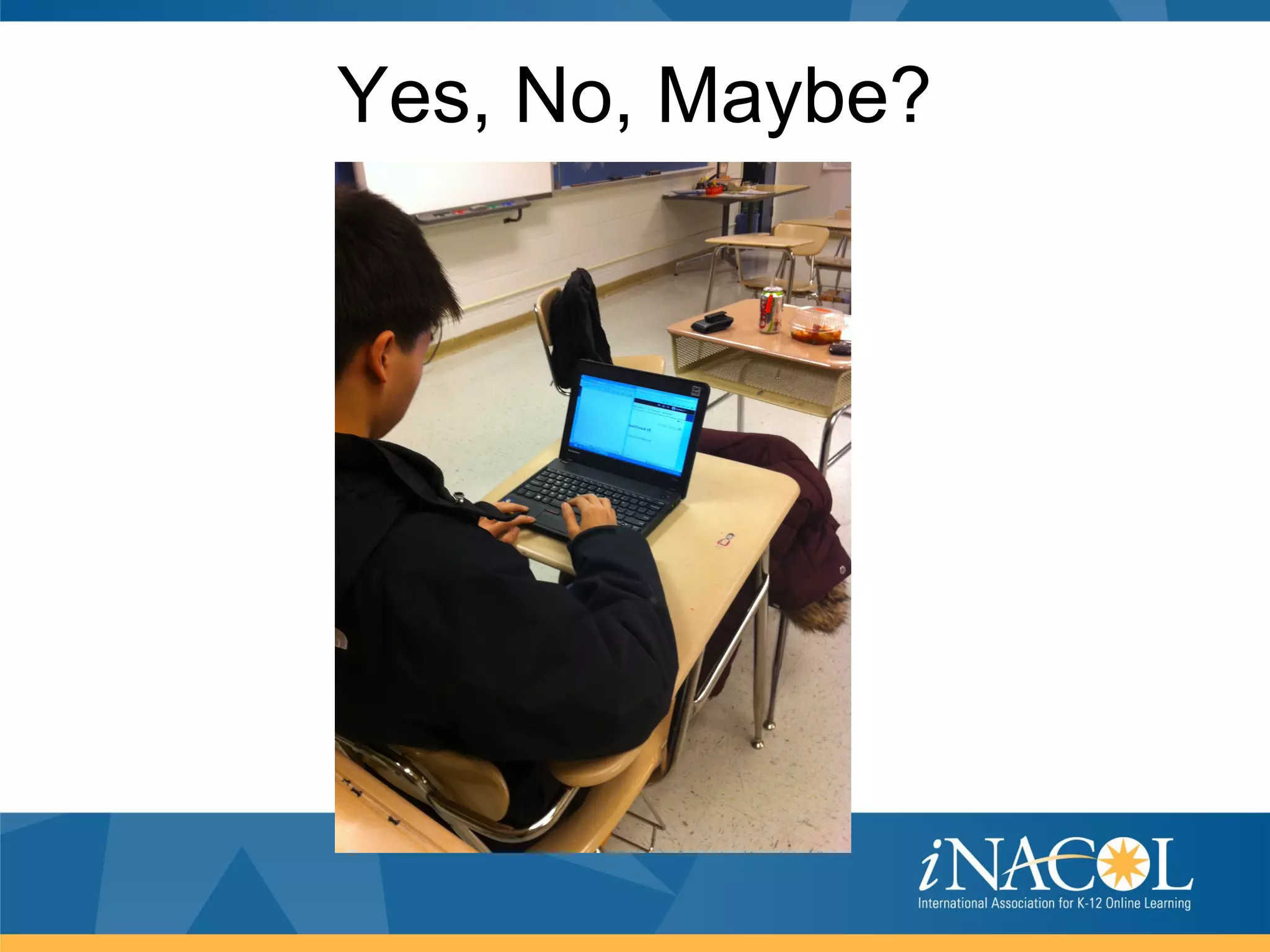
Yes, No, Maybe?
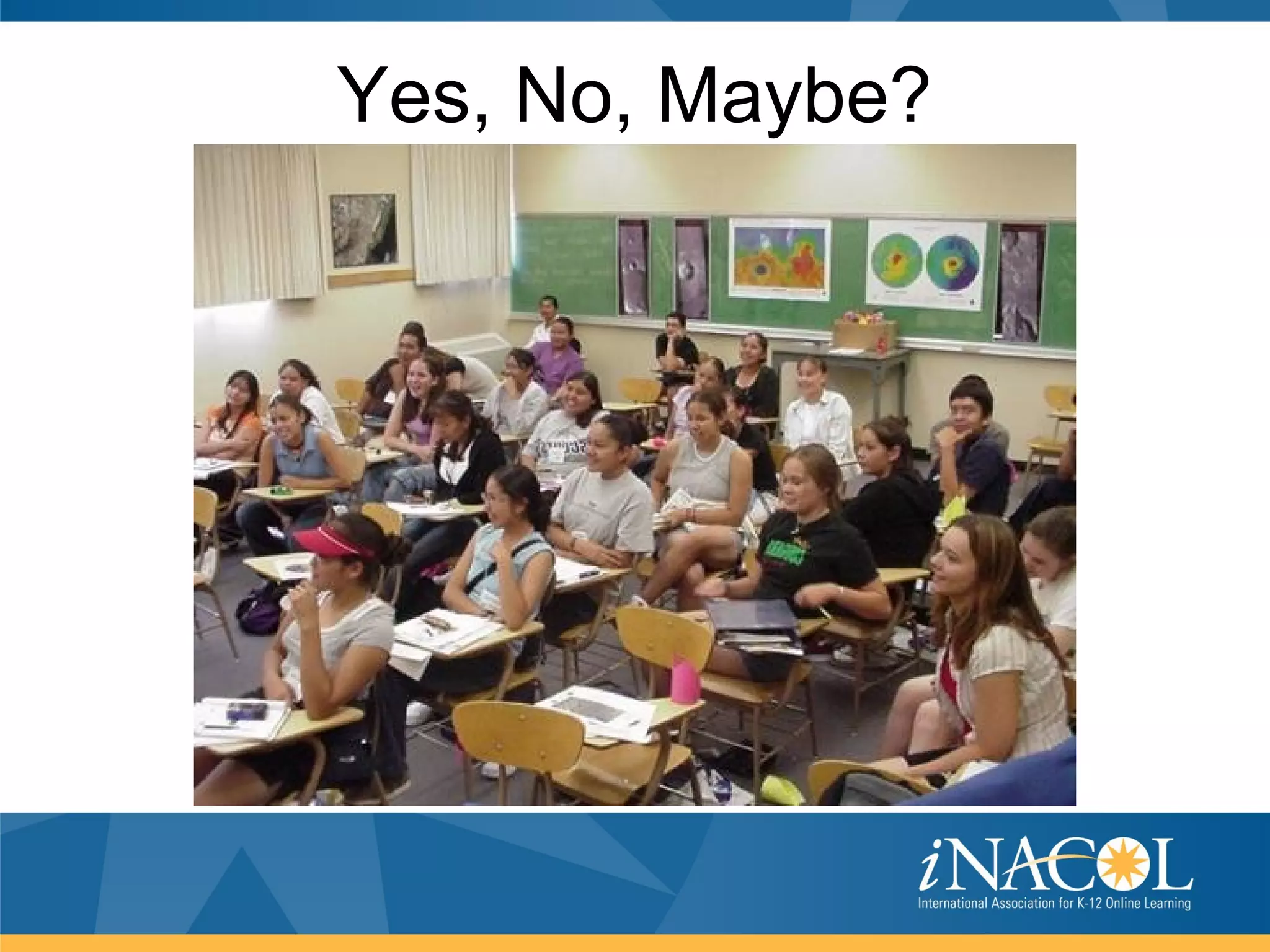
Yes, No, Maybe?
Yes, No, Maybe?
Yes, No, Maybe?
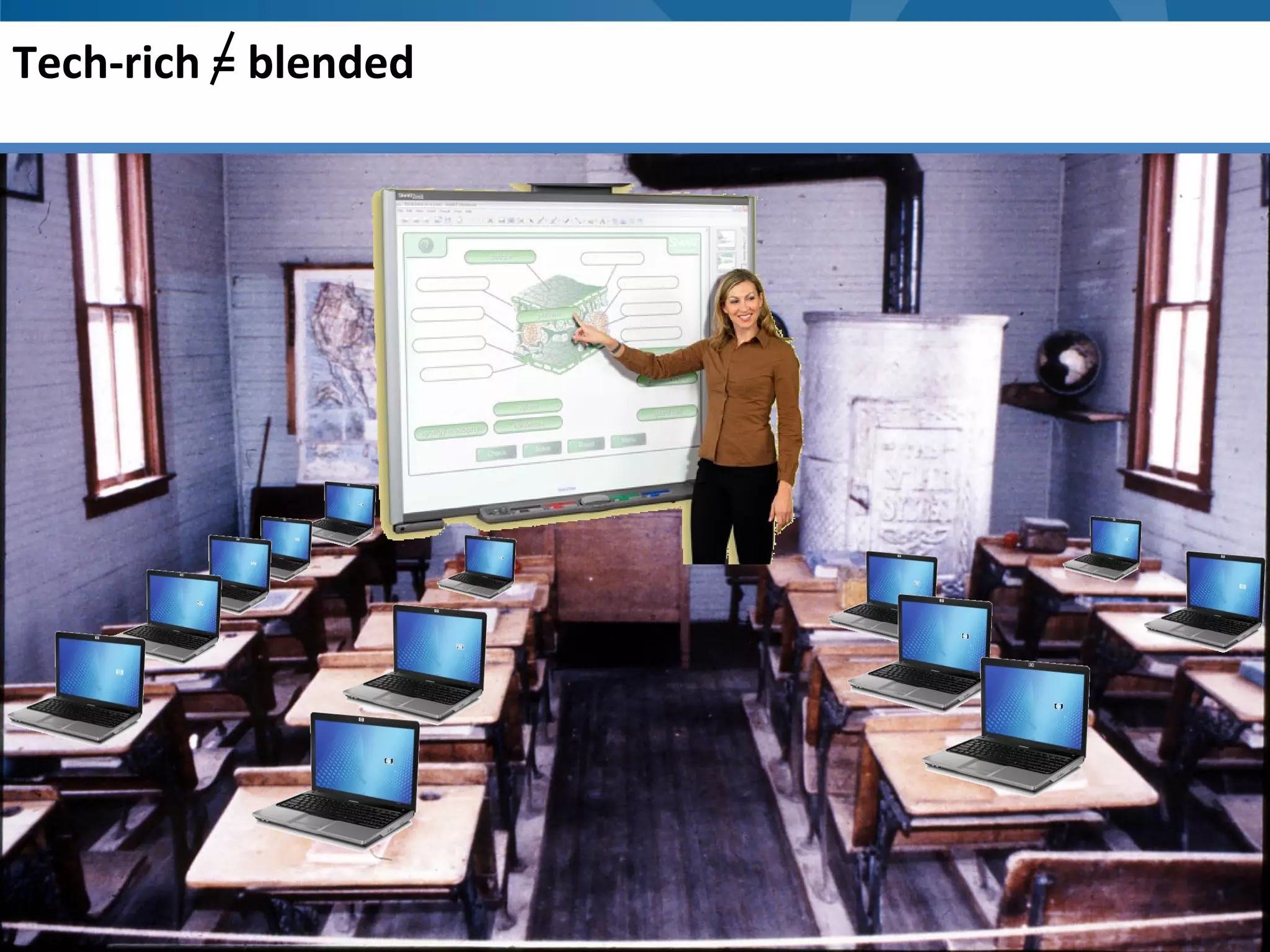
Tech-rich = blended
There are many blended
  learning Definitions
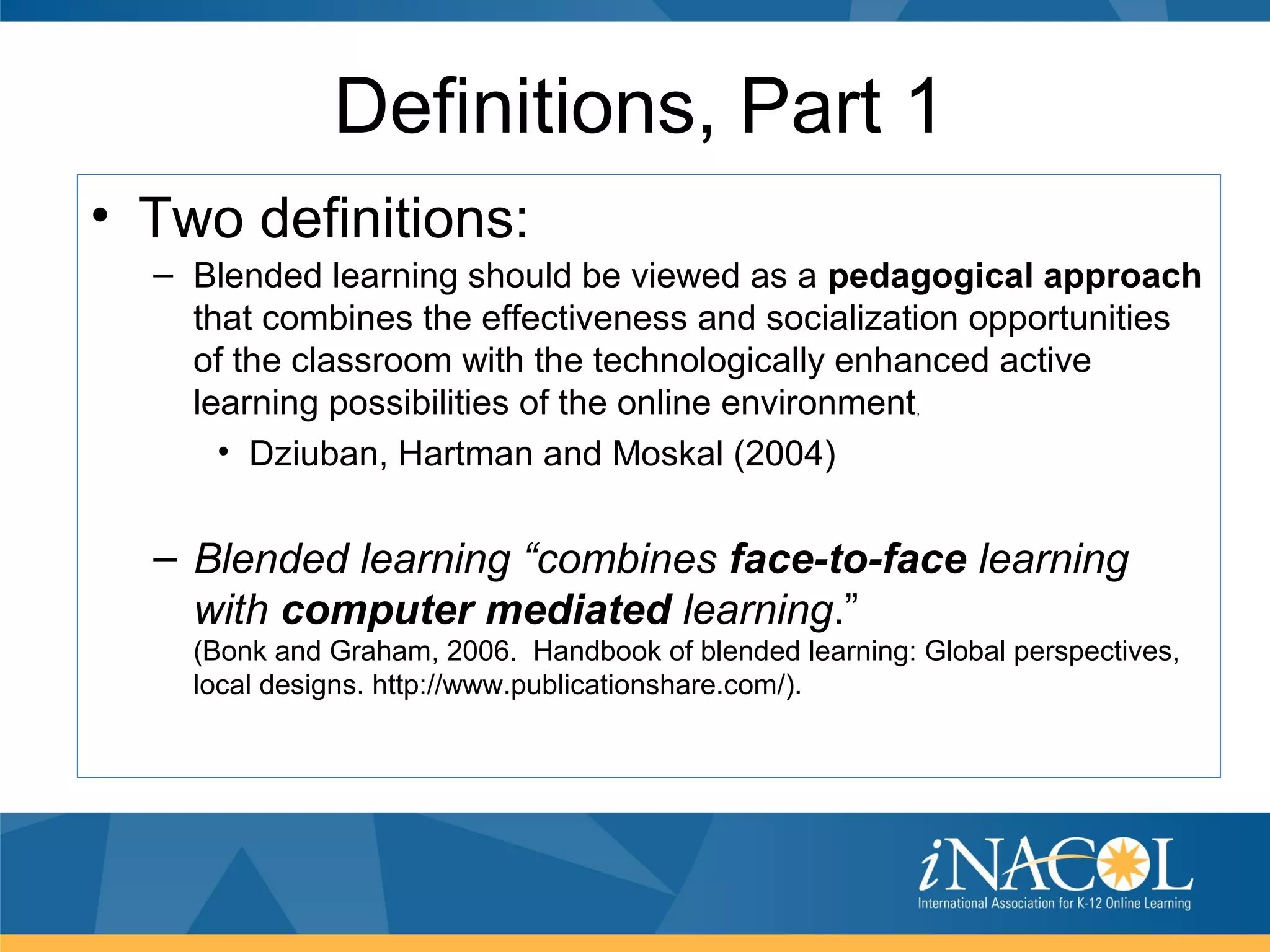
Definitions, Part 1
• Two definitions:
  – Blended learning should be viewed as a pedagogical approach
    that combines the effectiveness and socialization opportunities
    of the classroom with the technologically enhanced active
    learning possibilities of the online environment      ,


      • Dziuban, Hartman and Moskal (2004)


  – Blended learning “combines face-to-face learning
    with computer mediated learning.”
    (Bonk and Graham, 2006. Handbook of blended learning: Global perspectives,
    local designs. http://www.publicationshare.com/).
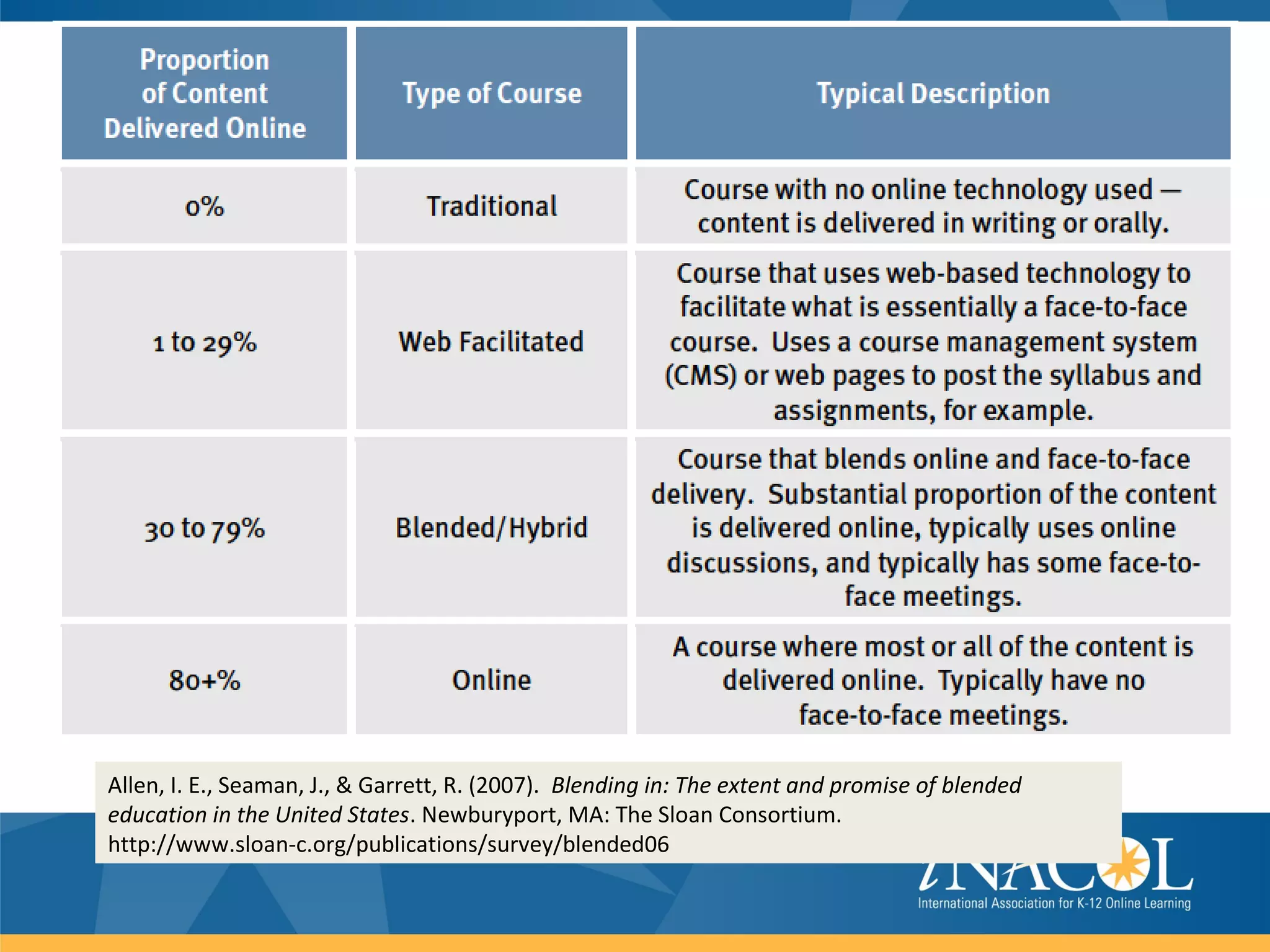
Allen, I. E., Seaman, J., & Garrett, R. (2007). Blending in: The extent and promise of blended
education in the United States. Newburyport, MA: The Sloan Consortium.
http://www.sloan-c.org/publications/survey/blended06
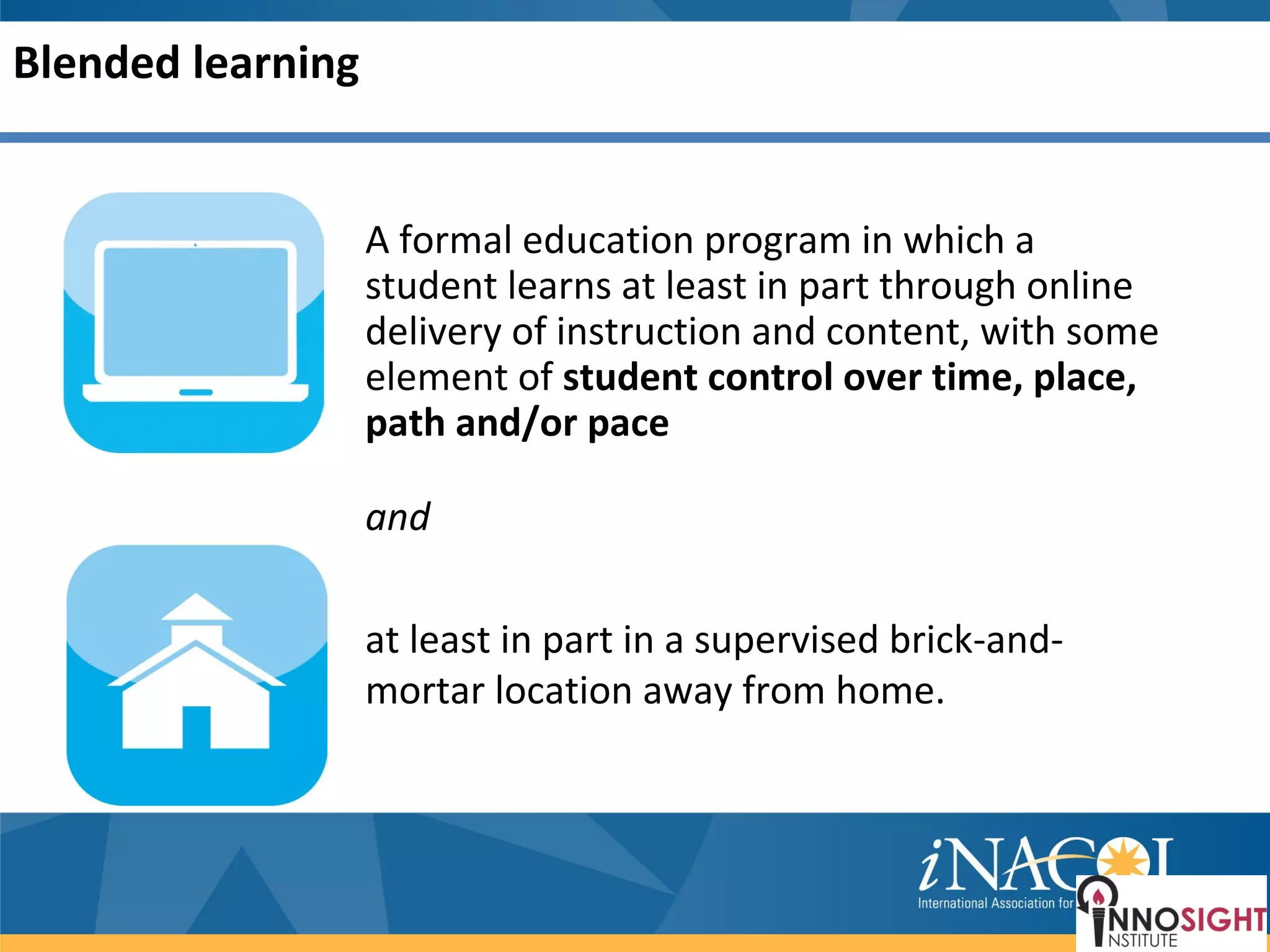
Blended learning


                   A formal education program in which a
                   student learns at least in part through online
                   delivery of instruction and content, with some
                   element of student control over time, place,
                   path and/or pace

                   and

                   at least in part in a supervised brick-and-
                   mortar location away from home.
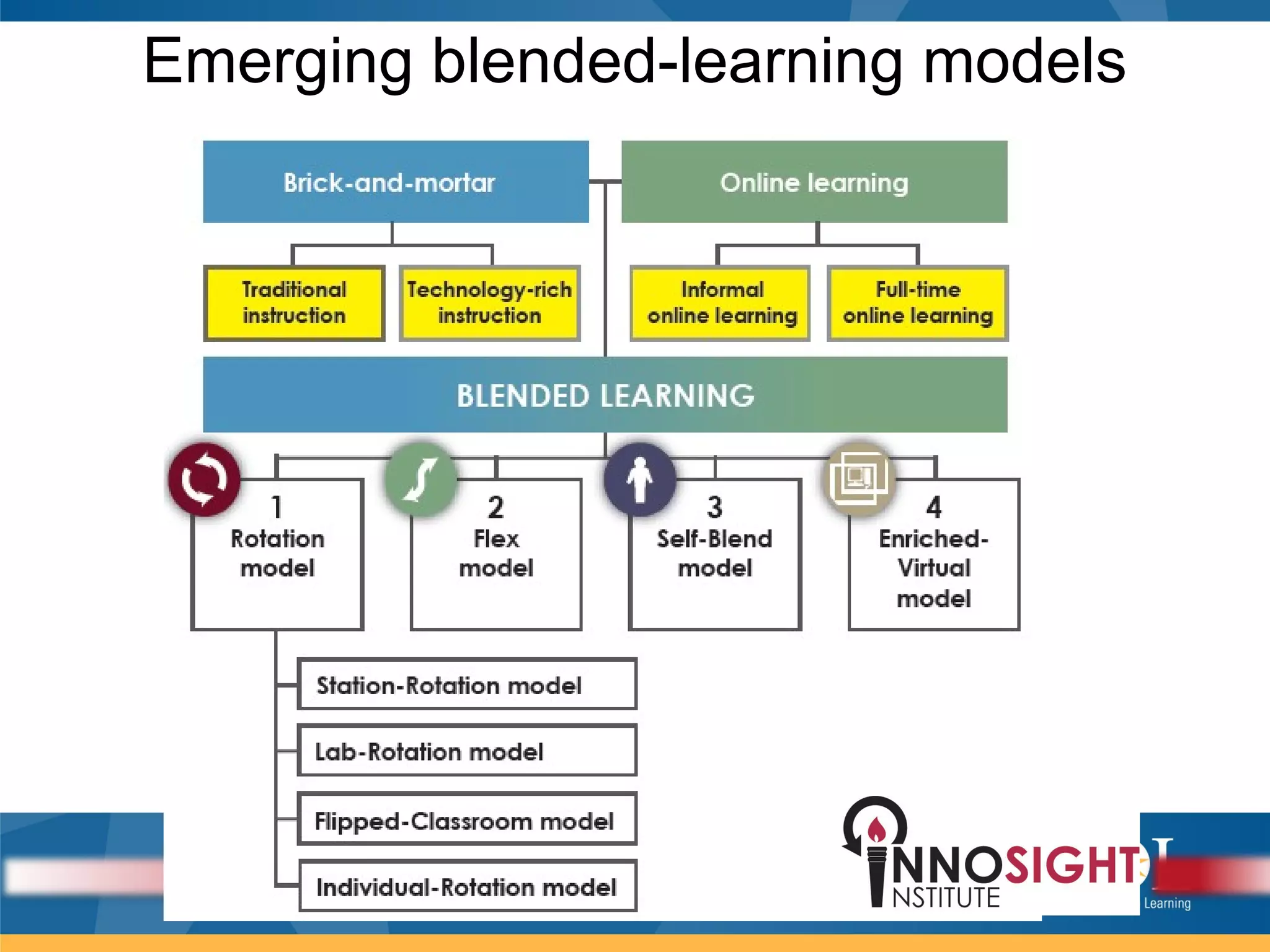
There are many blended
   learning Models
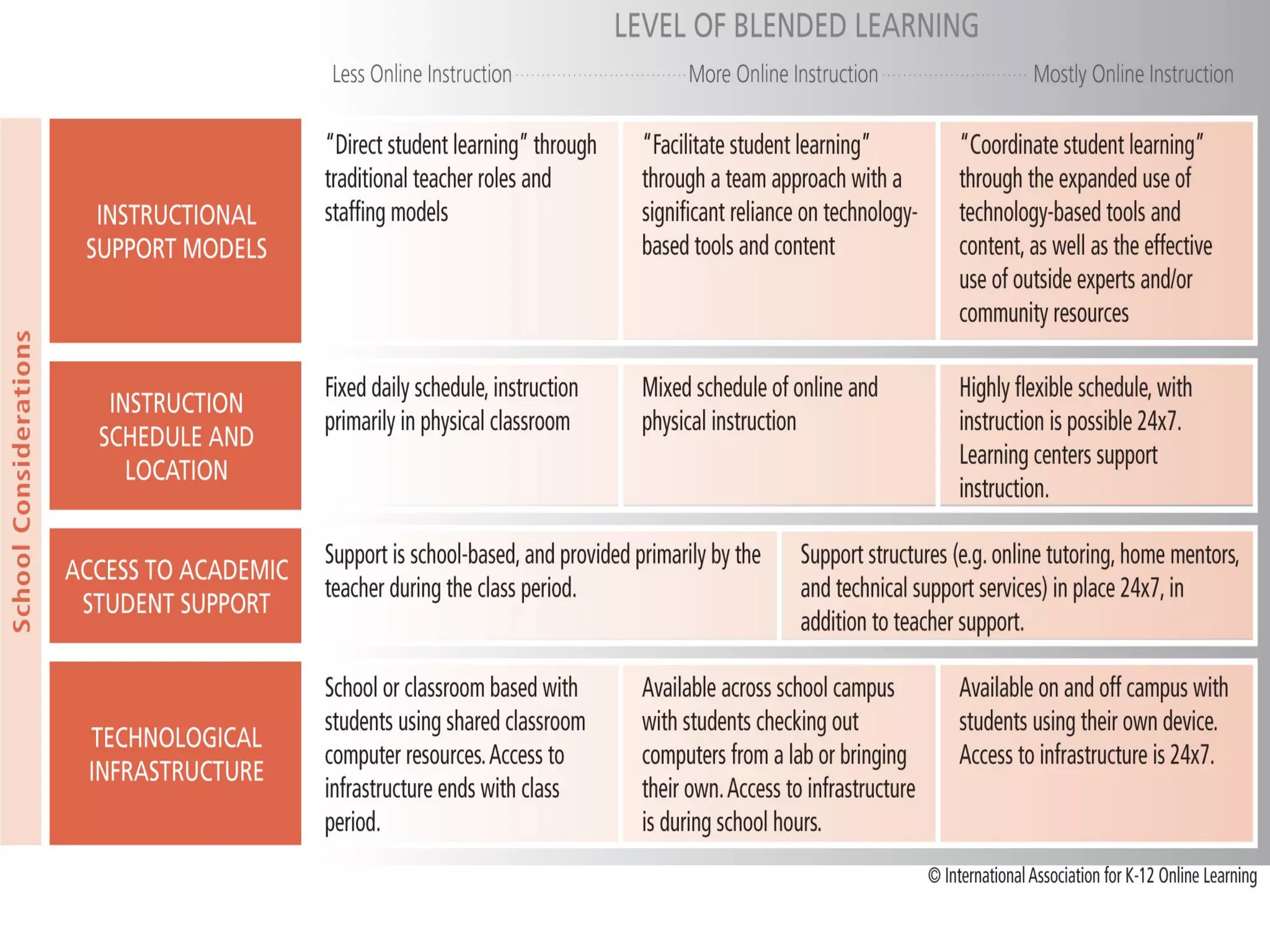
Emerging blended-learning models
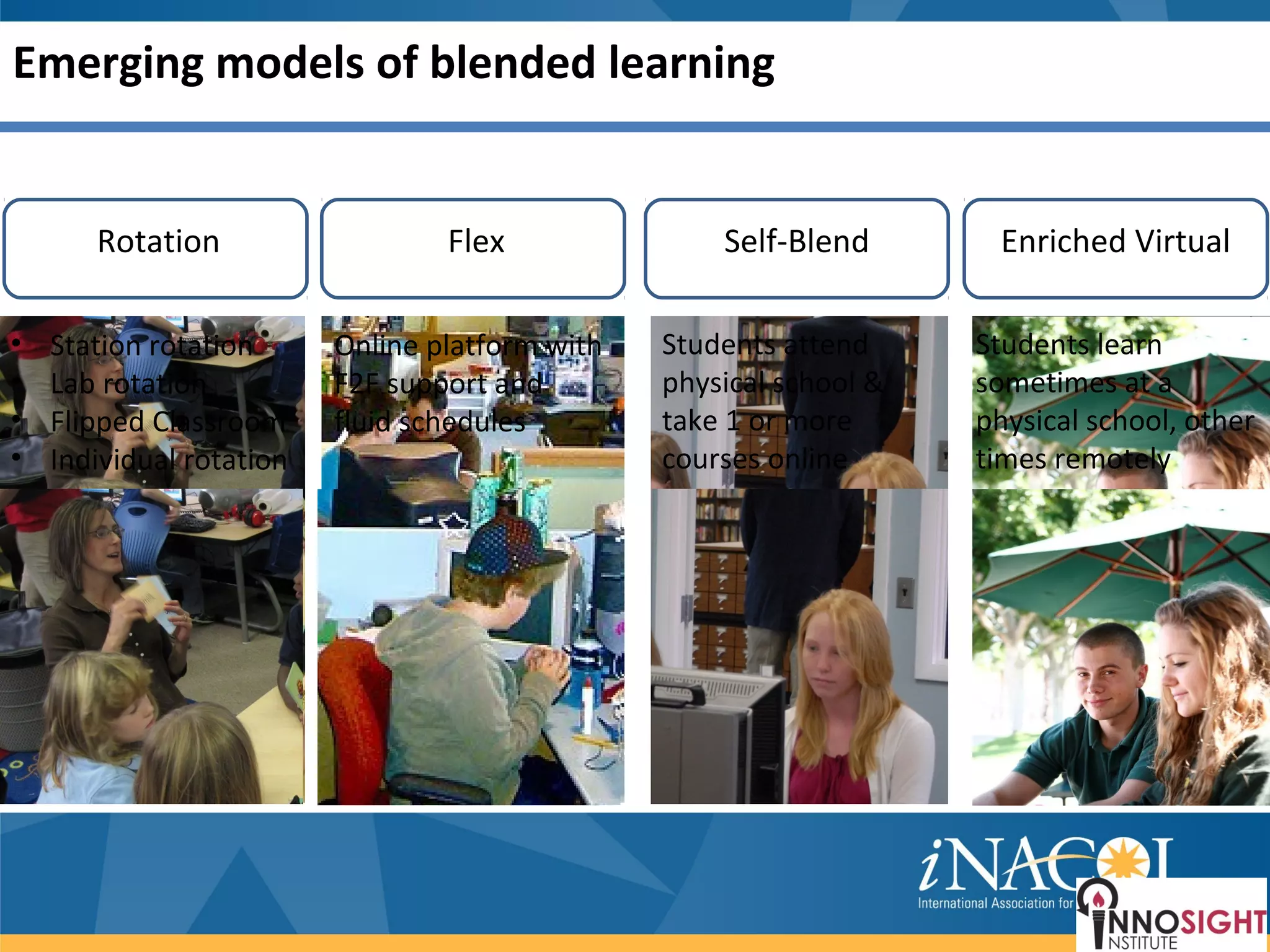
Emerging models of blended learning


       Rotation                   Flex               Self-Blend       Enriched Virtual

•   Station rotation      Online platform with   Students attend     Students learn
•   Lab rotation          F2F support and        physical school &   sometimes at a
•   Flipped Classroom     fluid schedules        take 1 or more      physical school, other
•   Individual rotation                          courses online      times remotely
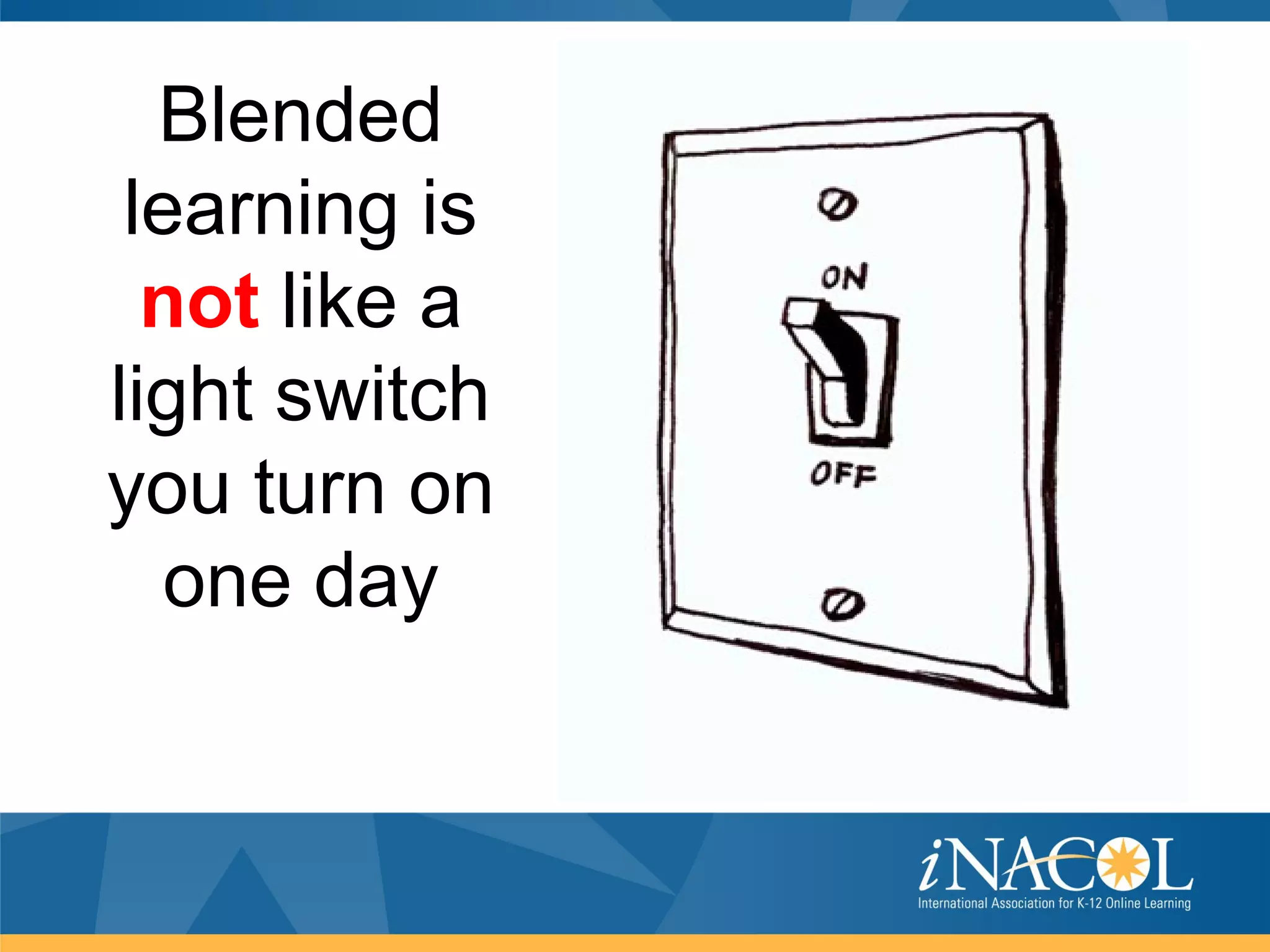
Blended
 learning is
  not like a
light switch
you turn on
   one day
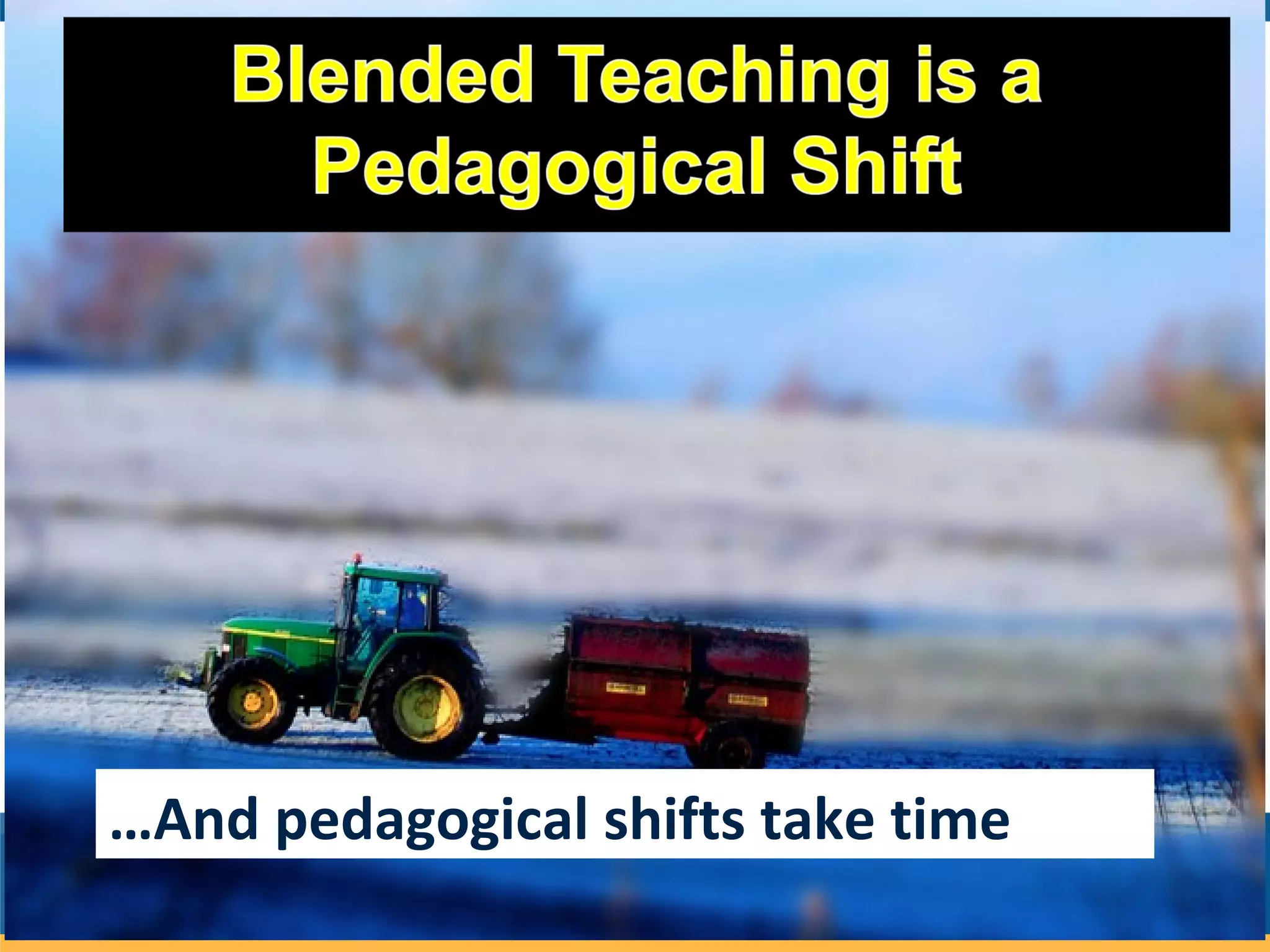
…And pedagogical shifts take time
Think in terms of 3-5 years
 from now (not just today).

Think about what can be,
       not what is.

    This is a journey,
    not a destination.
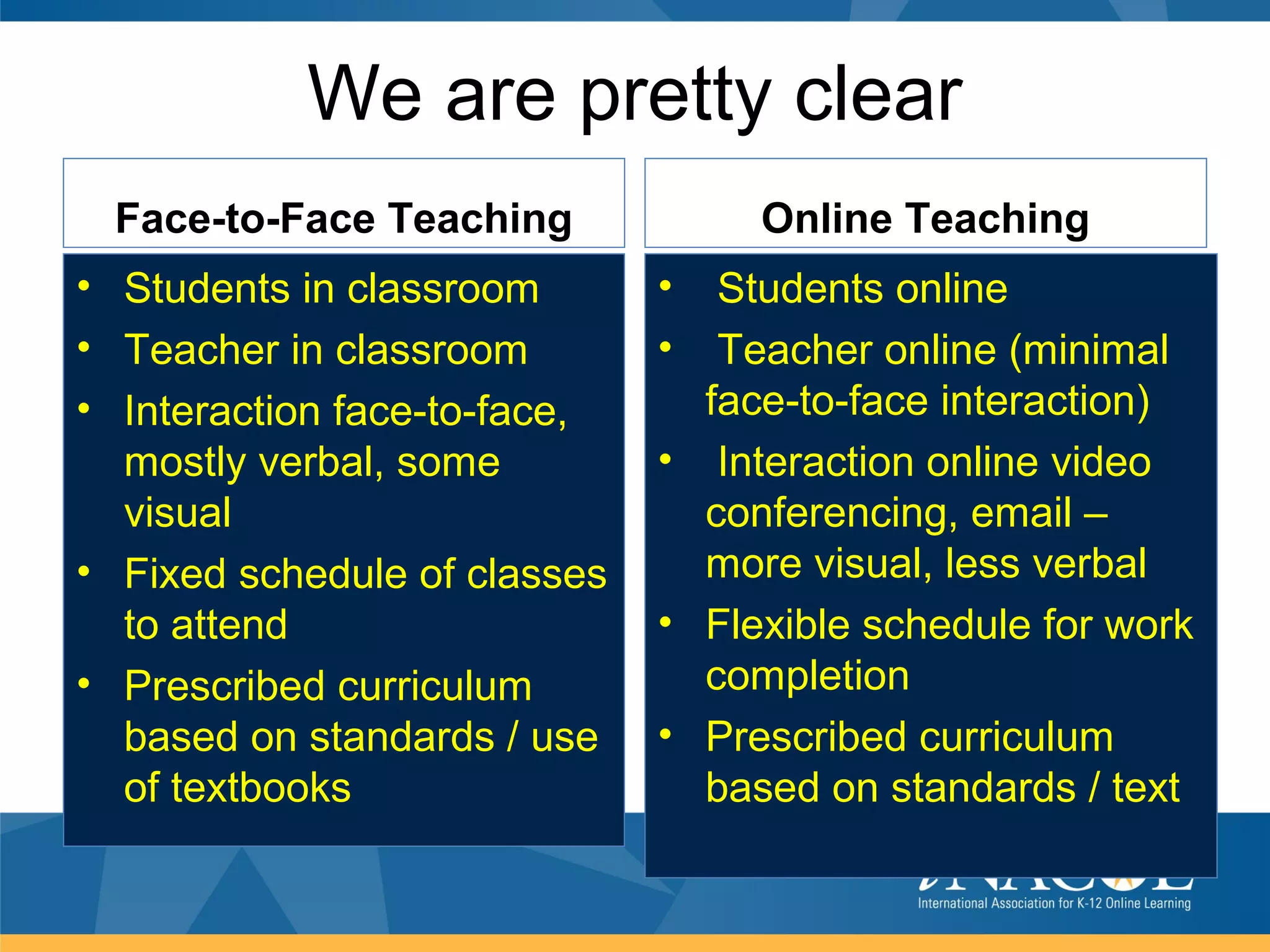
We are pretty clear
 Face-to-Face Teaching             Online Teaching
• Students in classroom       •  Students online
• Teacher in classroom        •  Teacher online (minimal
• Interaction face-to-face,     face-to-face interaction)
  mostly verbal, some         • Interaction online video
  visual                        conferencing, email –
• Fixed schedule of classes     more visual, less verbal
  to attend                   • Flexible schedule for work
• Prescribed curriculum         completion
  based on standards / use    • Prescribed curriculum
  of textbooks                  based on standards / text
But what does
Blended Learning
   really look like
    for a teacher?
Or an administrator?
www.inacol.org
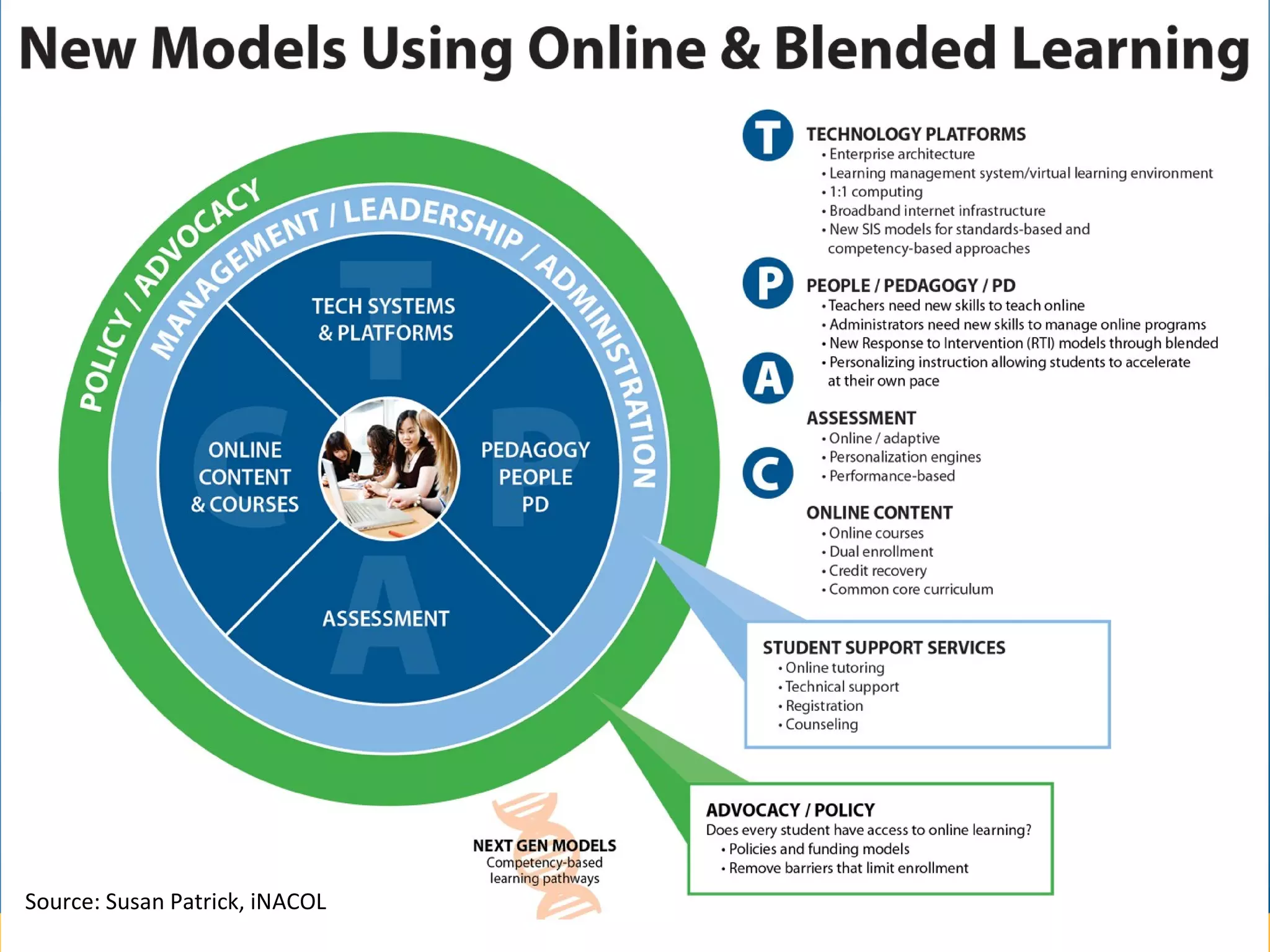
Source: Susan Patrick, iNACOL
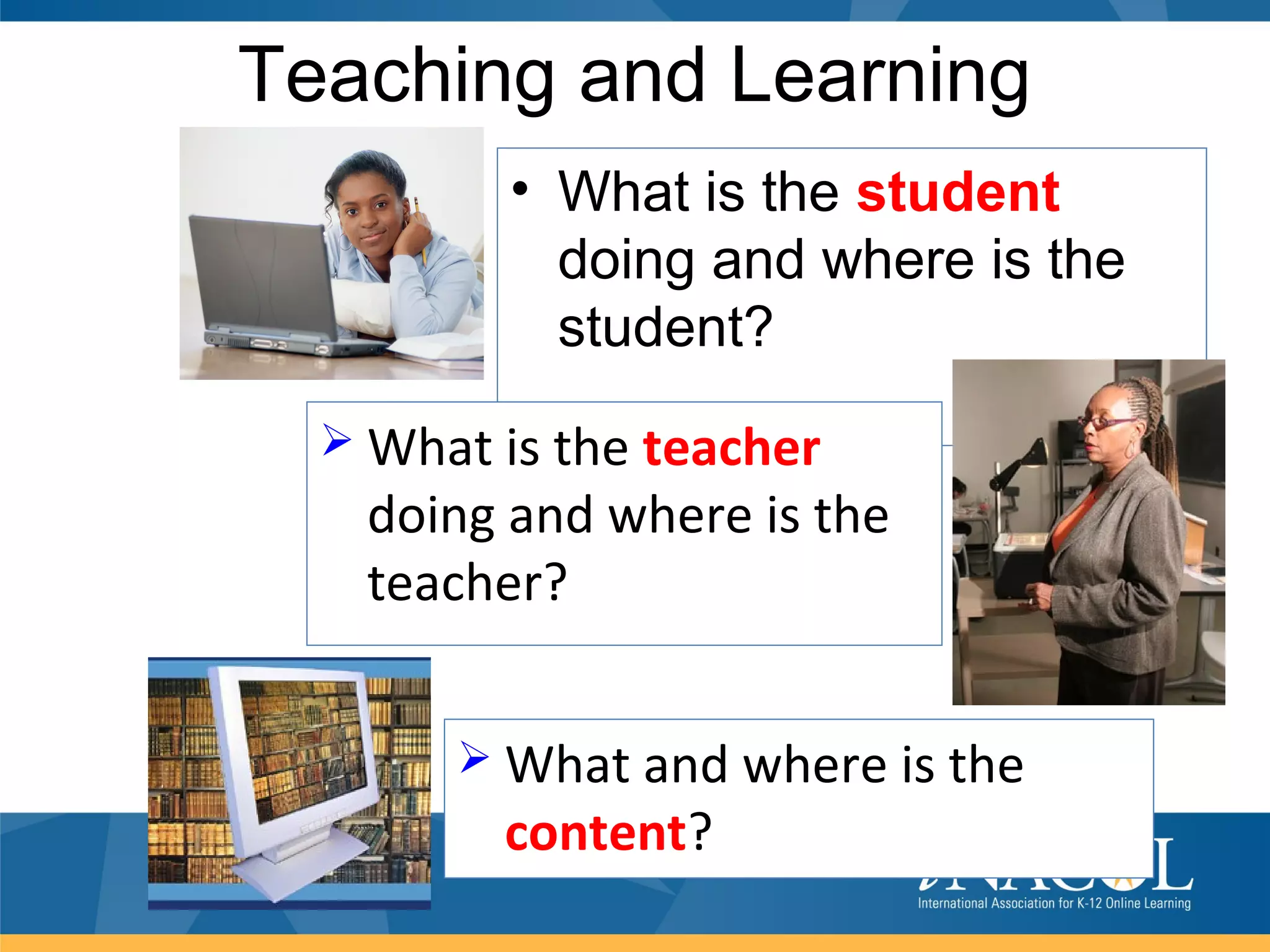
Teaching and Learning
         • What is the student
           doing and where is the
           student?
   What is the teacher
   doing and where is the
   teacher?


        What and where is the
         content?
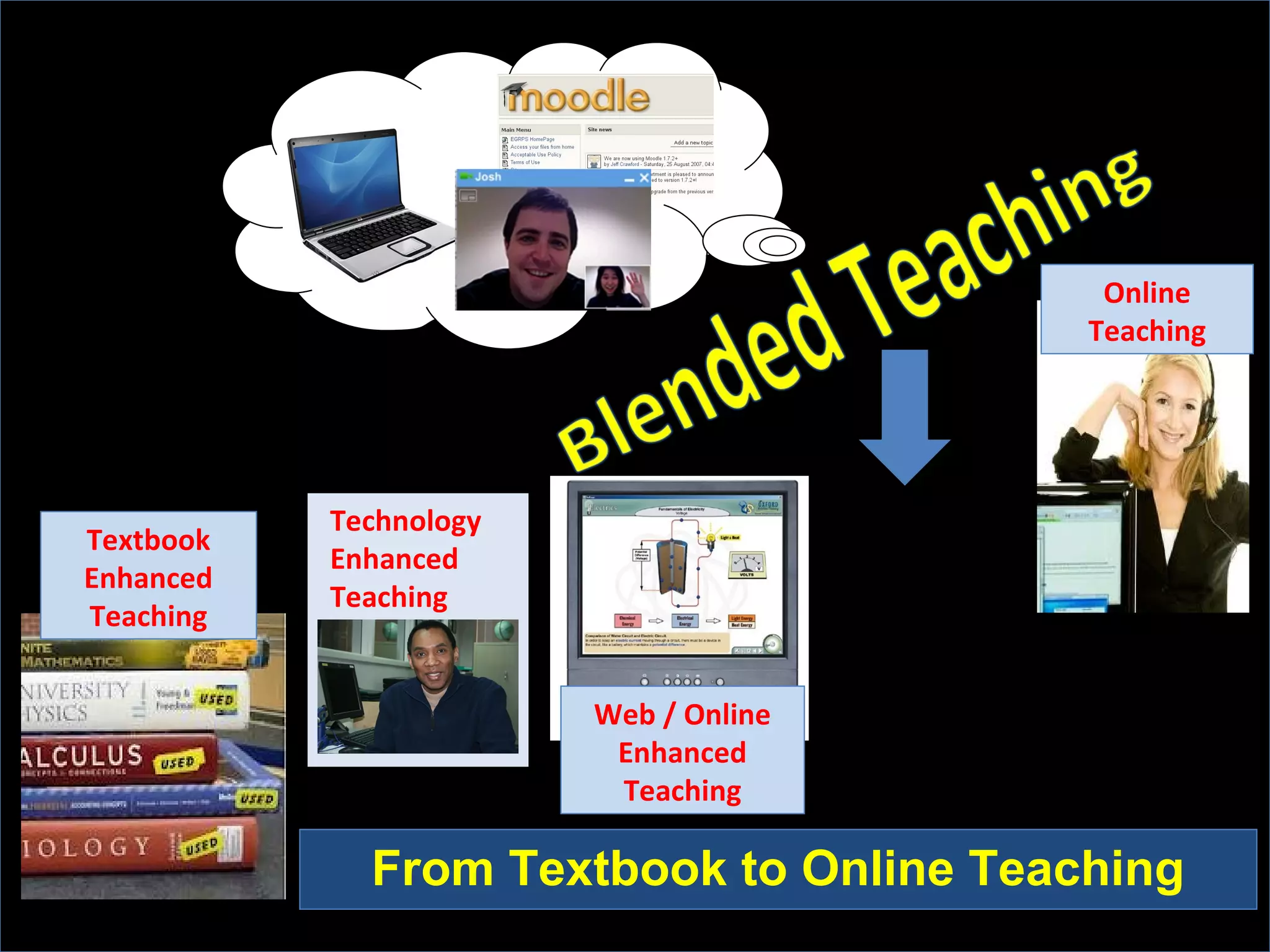
Online
                                         Teaching


           Technology
Textbook
           Enhanced
Enhanced
           Teaching
Teaching


                        Web / Online
                         Enhanced
                         Teaching

             From Textbook to Online Teaching
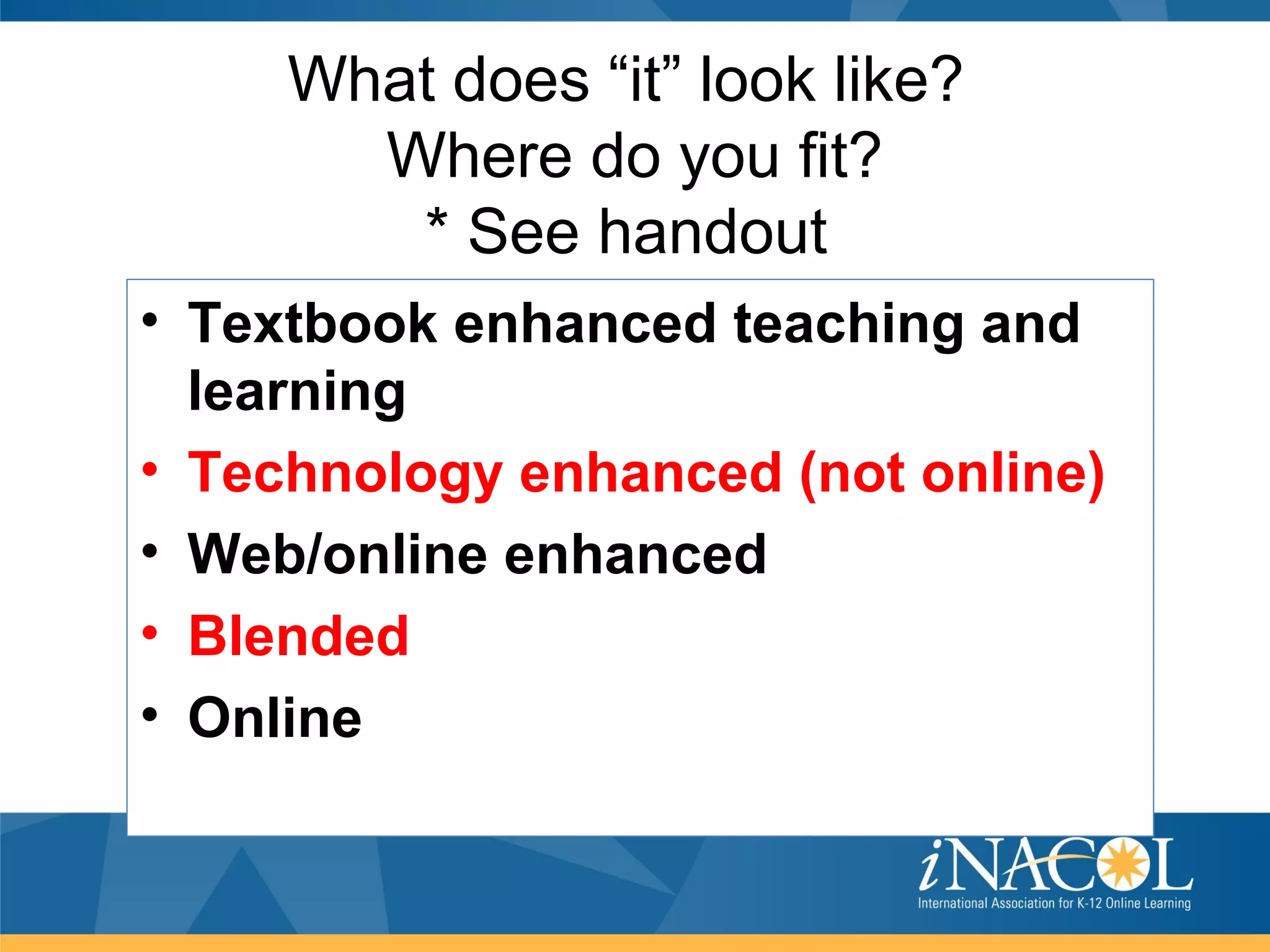
What does “it” look like?
       Where do you fit?
        * See handout
• Textbook enhanced teaching and
  learning
• Technology enhanced (not online)
• Web/online enhanced
• Blended
• Online
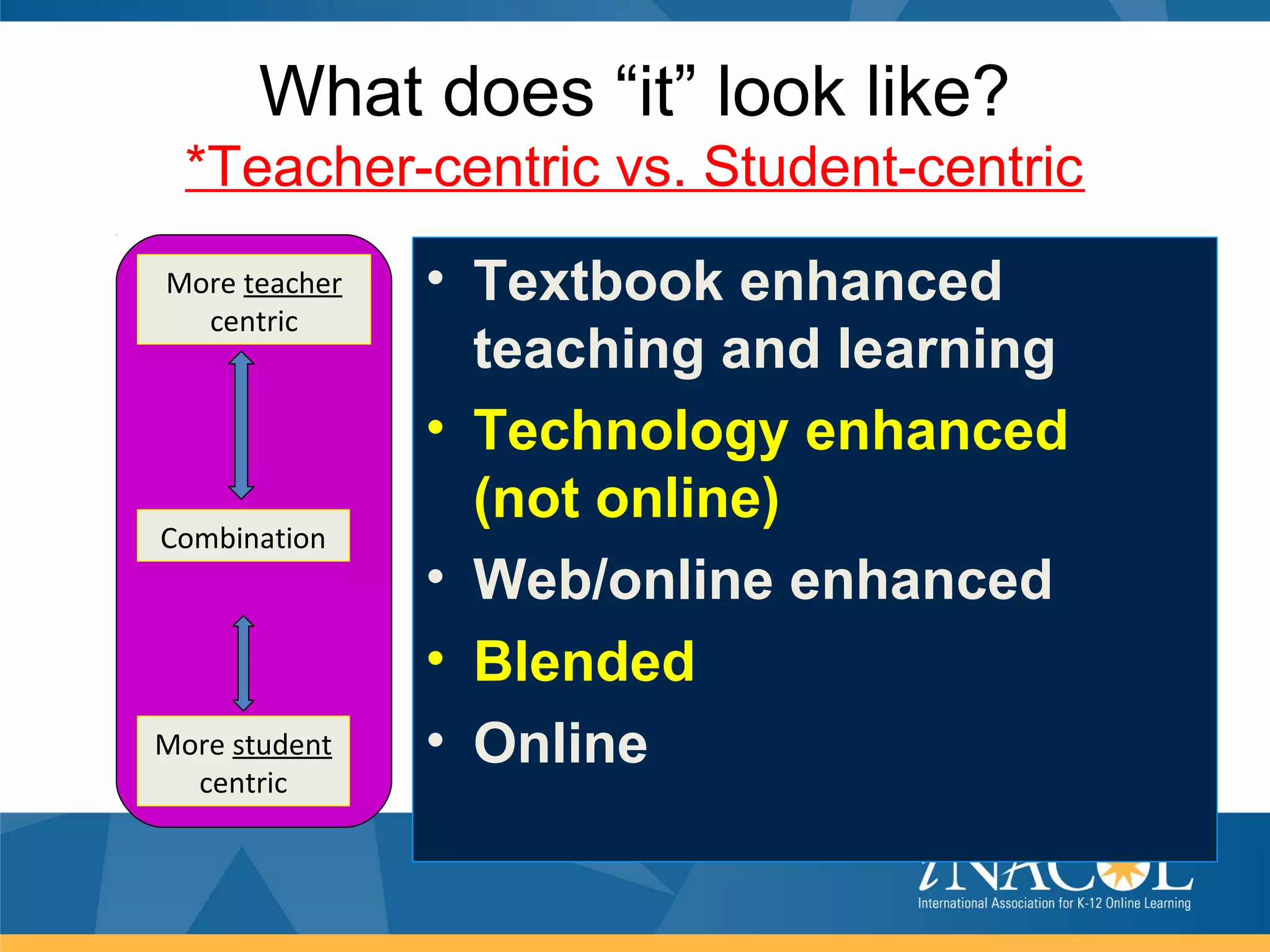
What does “it” look like?
  *Teacher-centric vs. Student-centric
More teacher   • Textbook enhanced
  centric
                 teaching and learning
               • Technology enhanced
                 (not online)
Combination
               • Web/online enhanced
               • Blended
More student   • Online
  centric
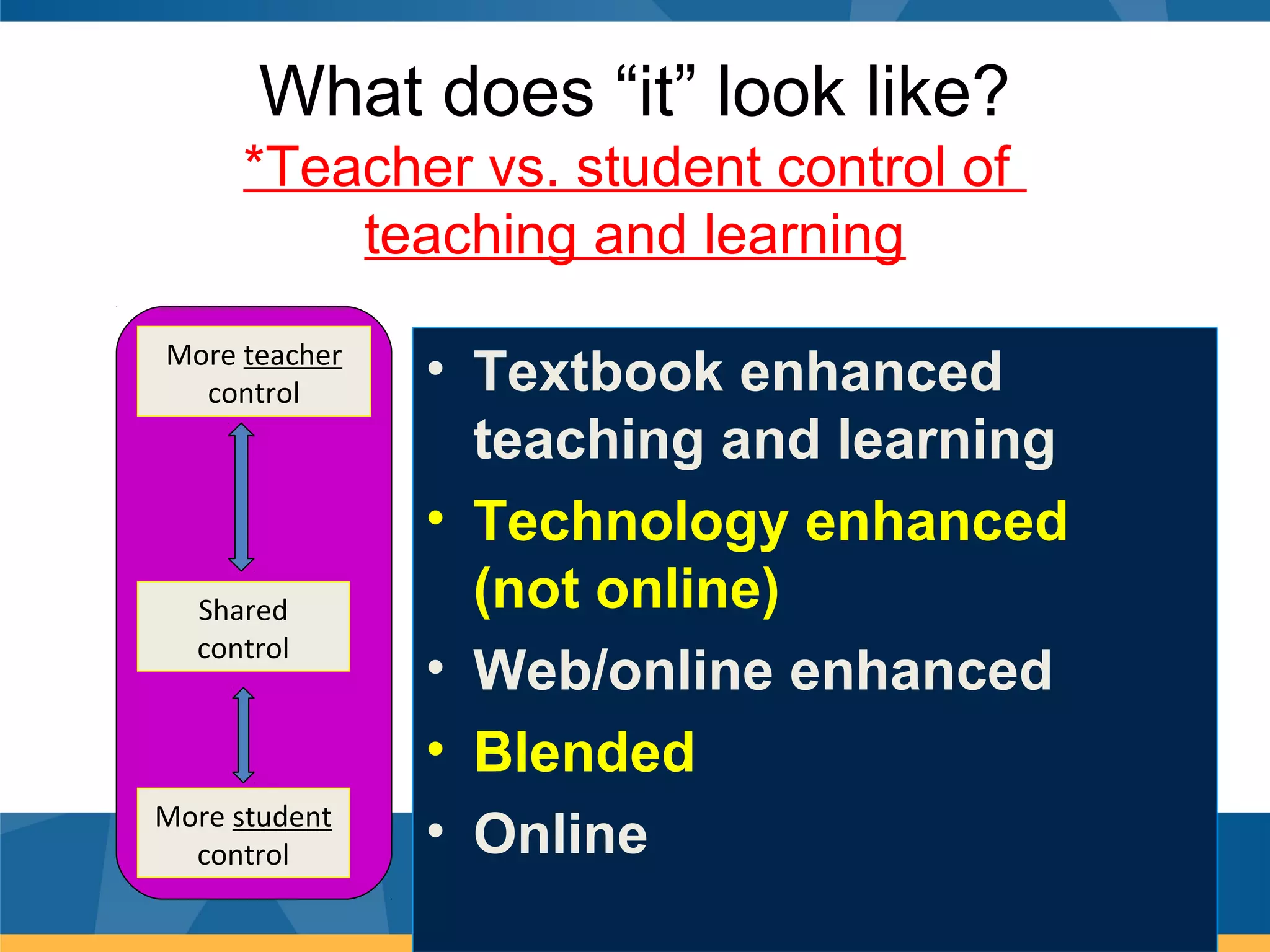
What does “it” look like?
     *Teacher vs. student control of
         teaching and learning
More teacher
  control      • Textbook enhanced
                 teaching and learning
               • Technology enhanced
  Shared         (not online)
  control
               • Web/online enhanced
               • Blended
More student
  control      • Online
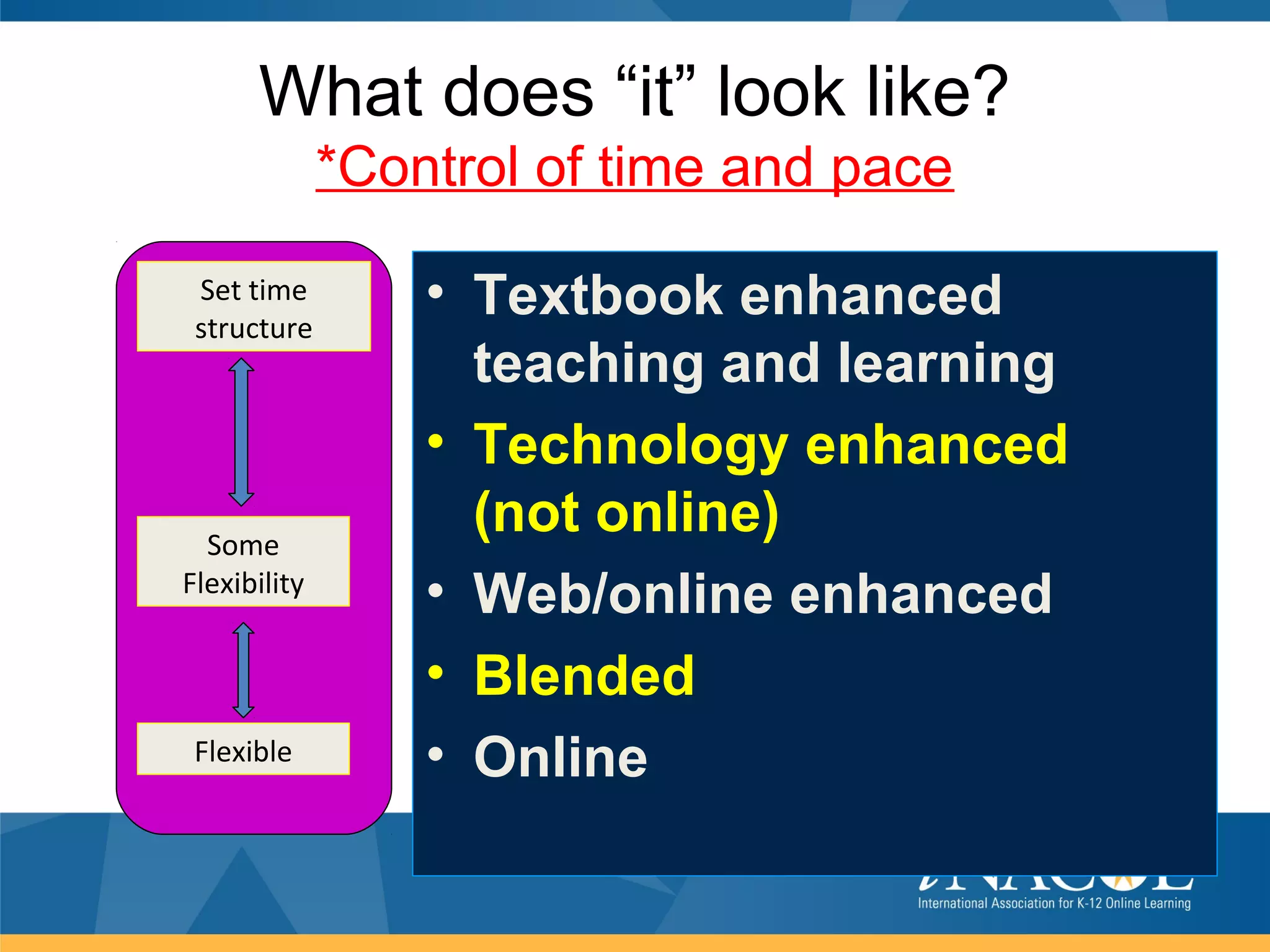
What does “it” look like?
              *Control of time and pace

 Set time
 structure
                  • Textbook enhanced
                    teaching and learning
                  • Technology enhanced
  Some
                    (not online)
Flexibility
                  • Web/online enhanced
                  • Blended
 Flexible         • Online
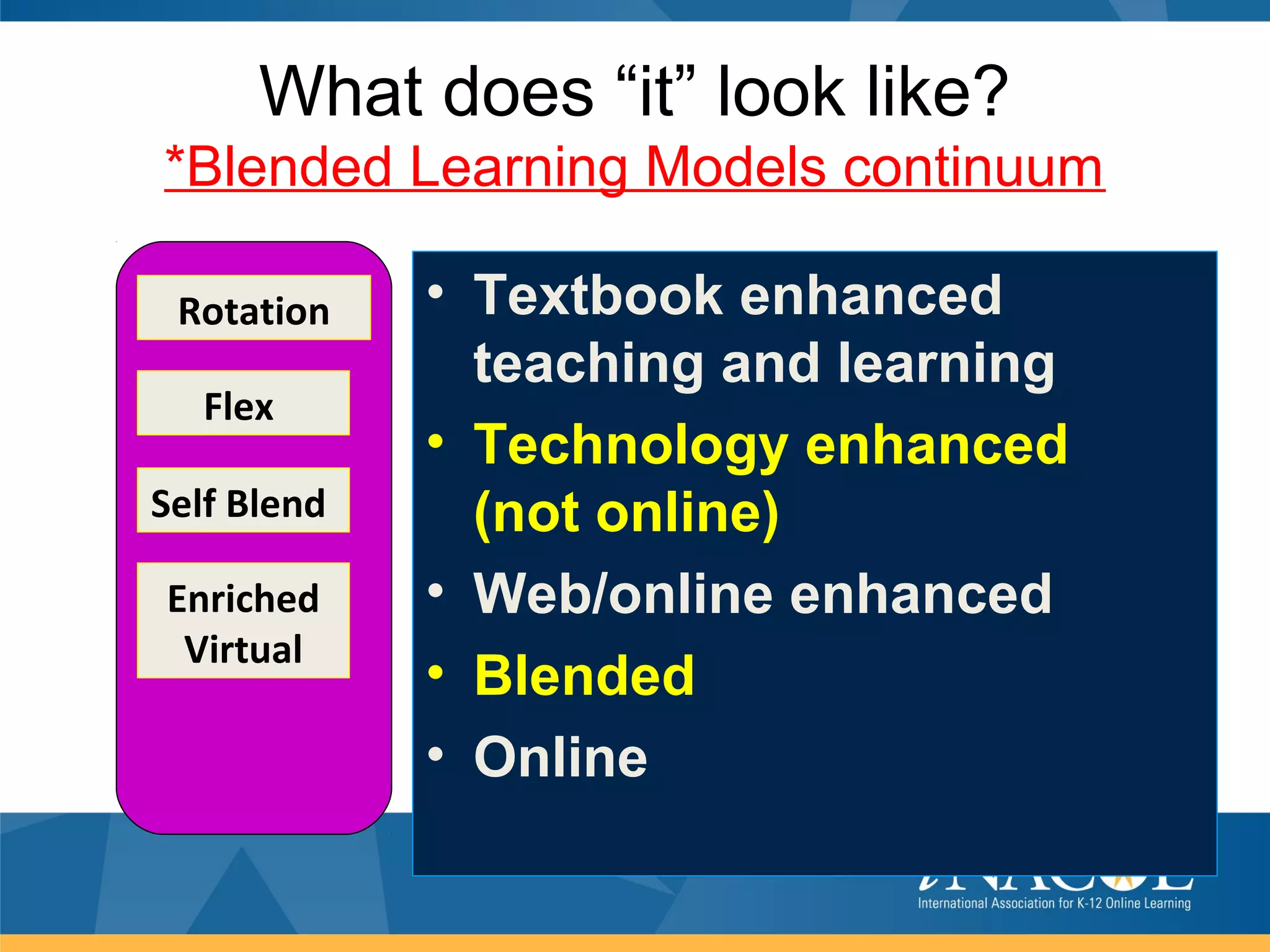
What does “it” look like?
*Blended Learning Models continuum

 Rotation    • Textbook enhanced
               teaching and learning
  Flex
             • Technology enhanced
Self Blend     (not online)
Enriched     • Web/online enhanced
 Virtual
             • Blended
             • Online
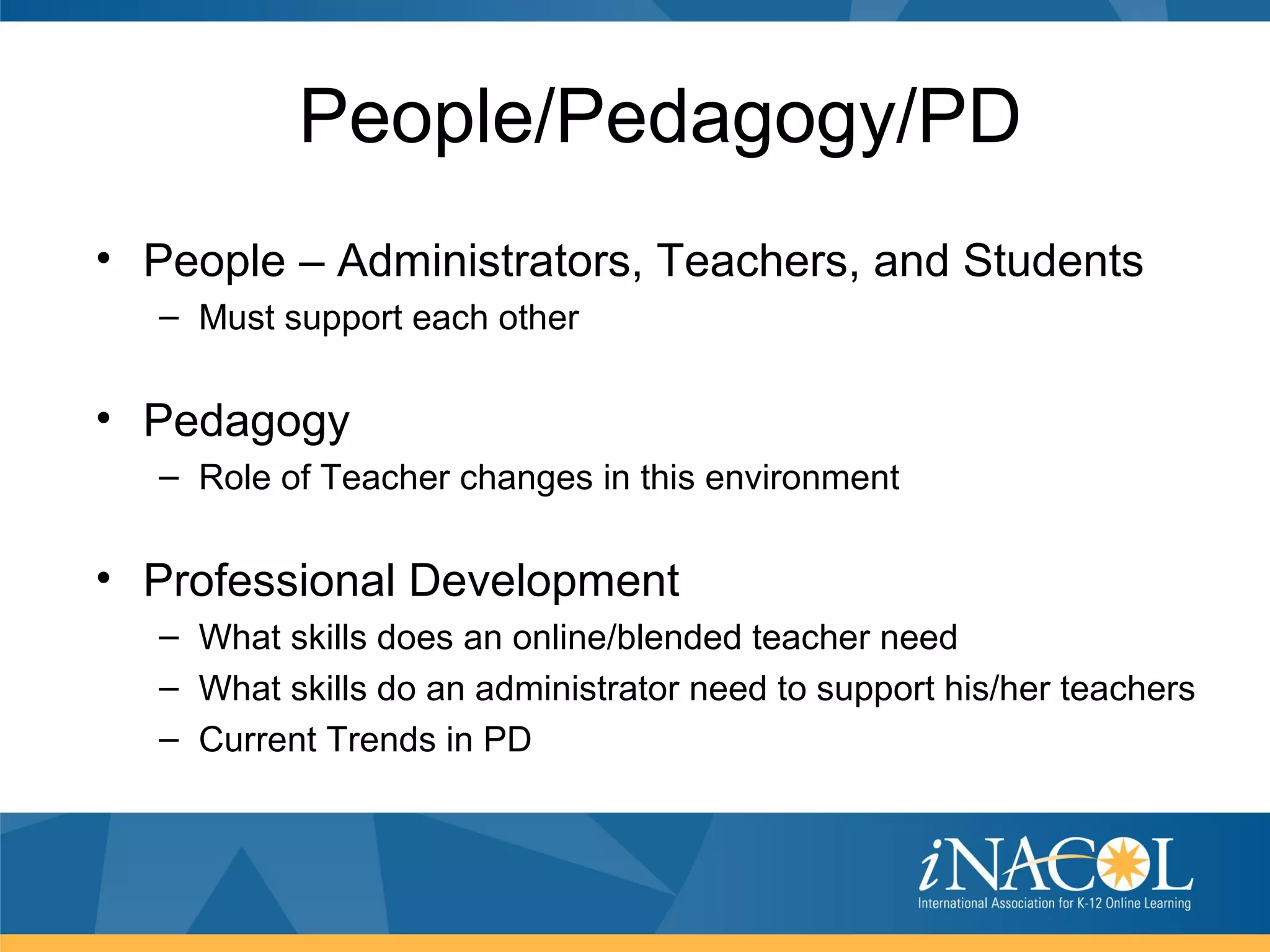
People/Pedagogy/PD
• People – Administrators, Teachers, and Students
  – Must support each other


• Pedagogy
  – Role of Teacher changes in this environment


• Professional Development
  – What skills does an online/blended teacher need
  – What skills do an administrator need to support his/her teachers
  – Current Trends in PD
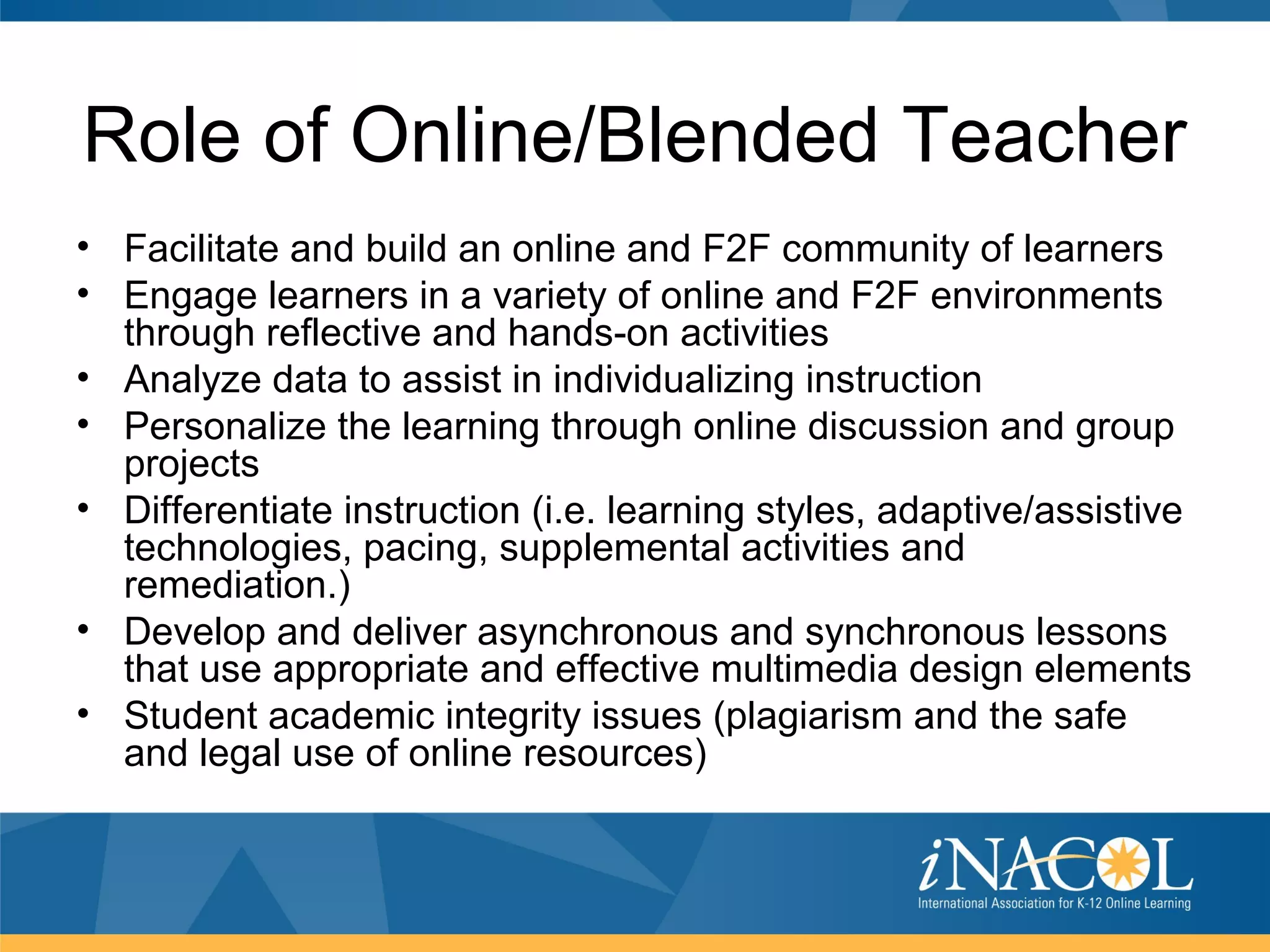
Role of Online/Blended Teacher
• Facilitate and build an online and F2F community of learners
• Engage learners in a variety of online and F2F environments
  through reflective and hands-on activities
• Analyze data to assist in individualizing instruction
• Personalize the learning through online discussion and group
  projects
• Differentiate instruction (i.e. learning styles, adaptive/assistive
  technologies, pacing, supplemental activities and
  remediation.)
• Develop and deliver asynchronous and synchronous lessons
  that use appropriate and effective multimedia design elements
• Student academic integrity issues (plagiarism and the safe
  and legal use of online resources)
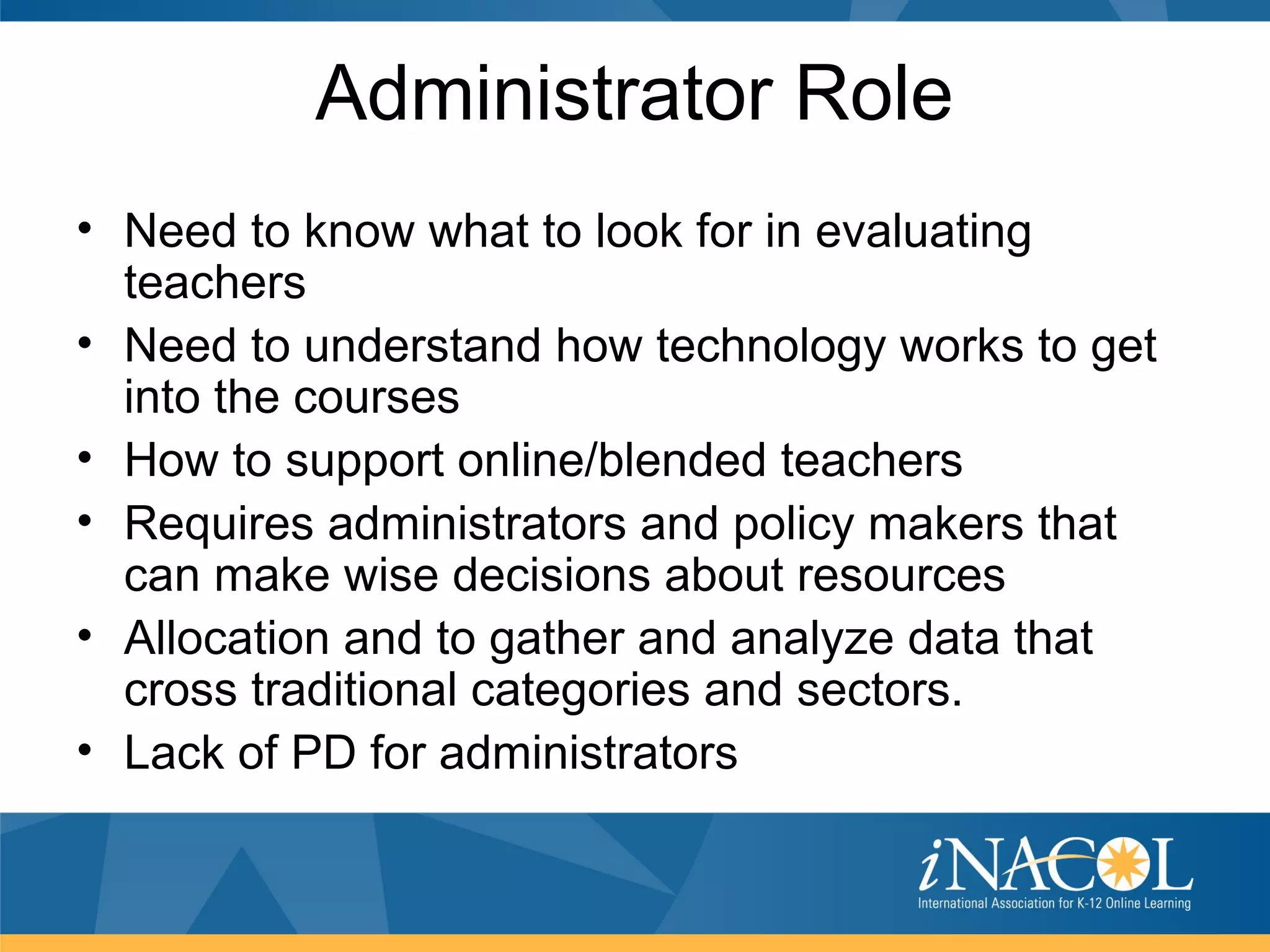
Administrator Role
• Need to know what to look for in evaluating
  teachers
• Need to understand how technology works to get
  into the courses
• How to support online/blended teachers
• Requires administrators and policy makers that
  can make wise decisions about resources
• Allocation and to gather and analyze data that
  cross traditional categories and sectors.
• Lack of PD for administrators
What should an administrator
   look for while observing a
blended learning environment?
         (see handout)
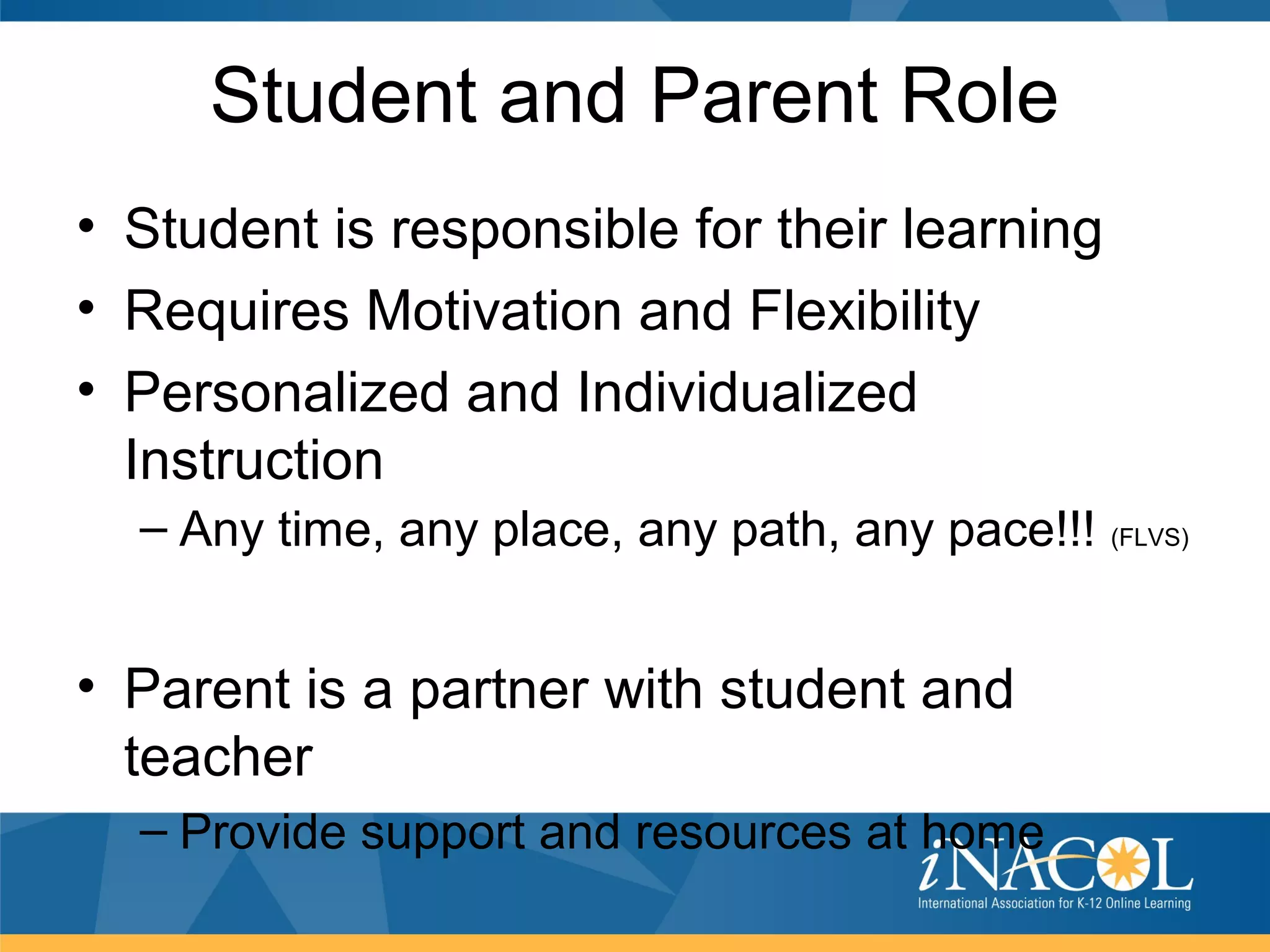
Student and Parent Role
• Student is responsible for their learning
• Requires Motivation and Flexibility
• Personalized and Individualized
  Instruction
  – Any time, any place, any path, any pace!!!   (FLVS)


• Parent is a partner with student and
  teacher
  – Provide support and resources at home
What does blended learning
        look like?
Rocketship
• http://vimeo.com/30557533
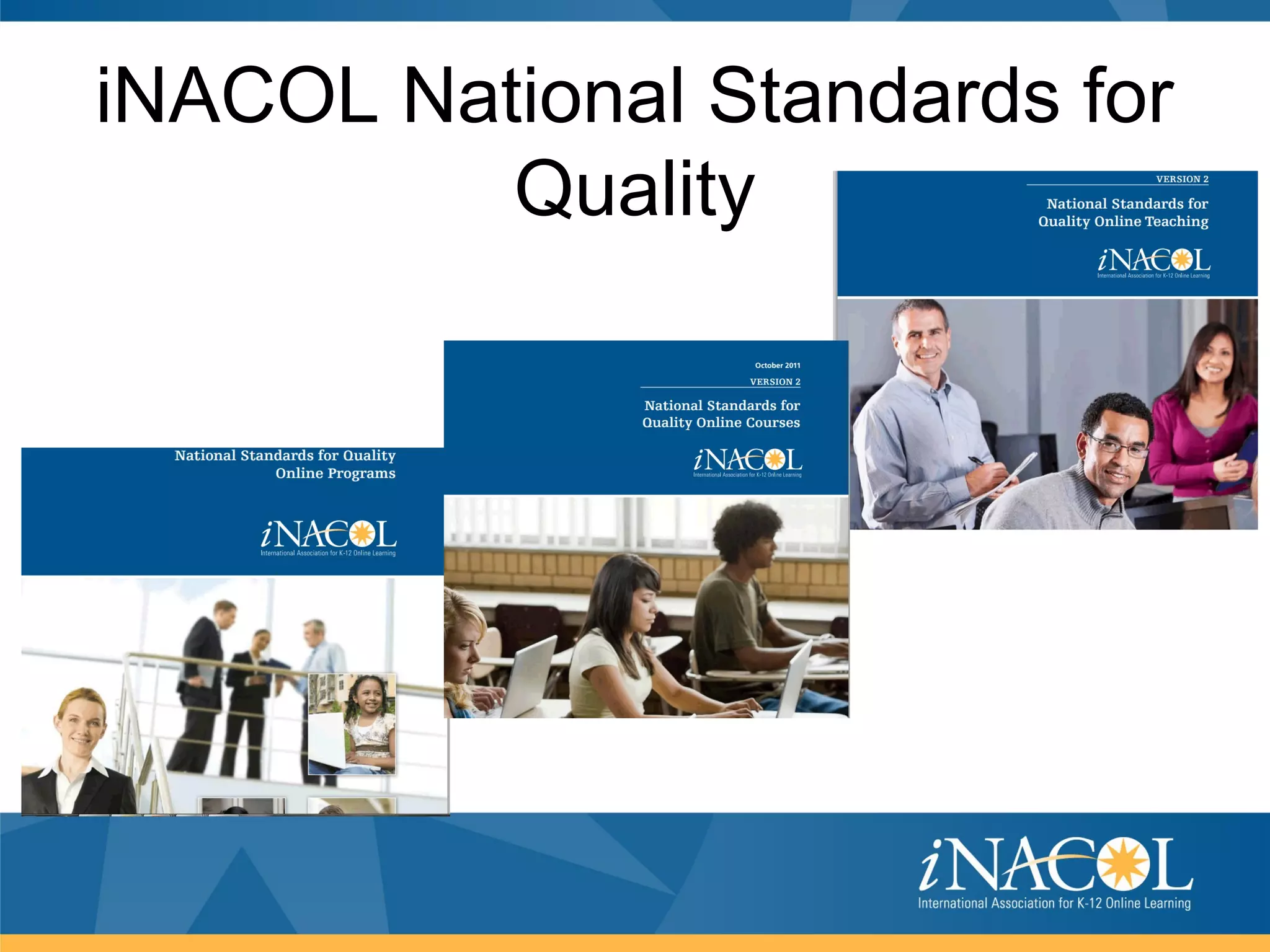
iNACOL National Standards for
          Quality
School of One

• http://schoolofone.org/concept_introvideos
  .html?playVideo
• (more in depth video) -
  http://vimeo.com/7964251
Carpe Diem Collegiate High
           School
• http://www.youtube.com/watch?v=-
  s_O65rWV10
New Line Learning Models
• http://www.youtube.com/watch?v=nnPLrK1USMA
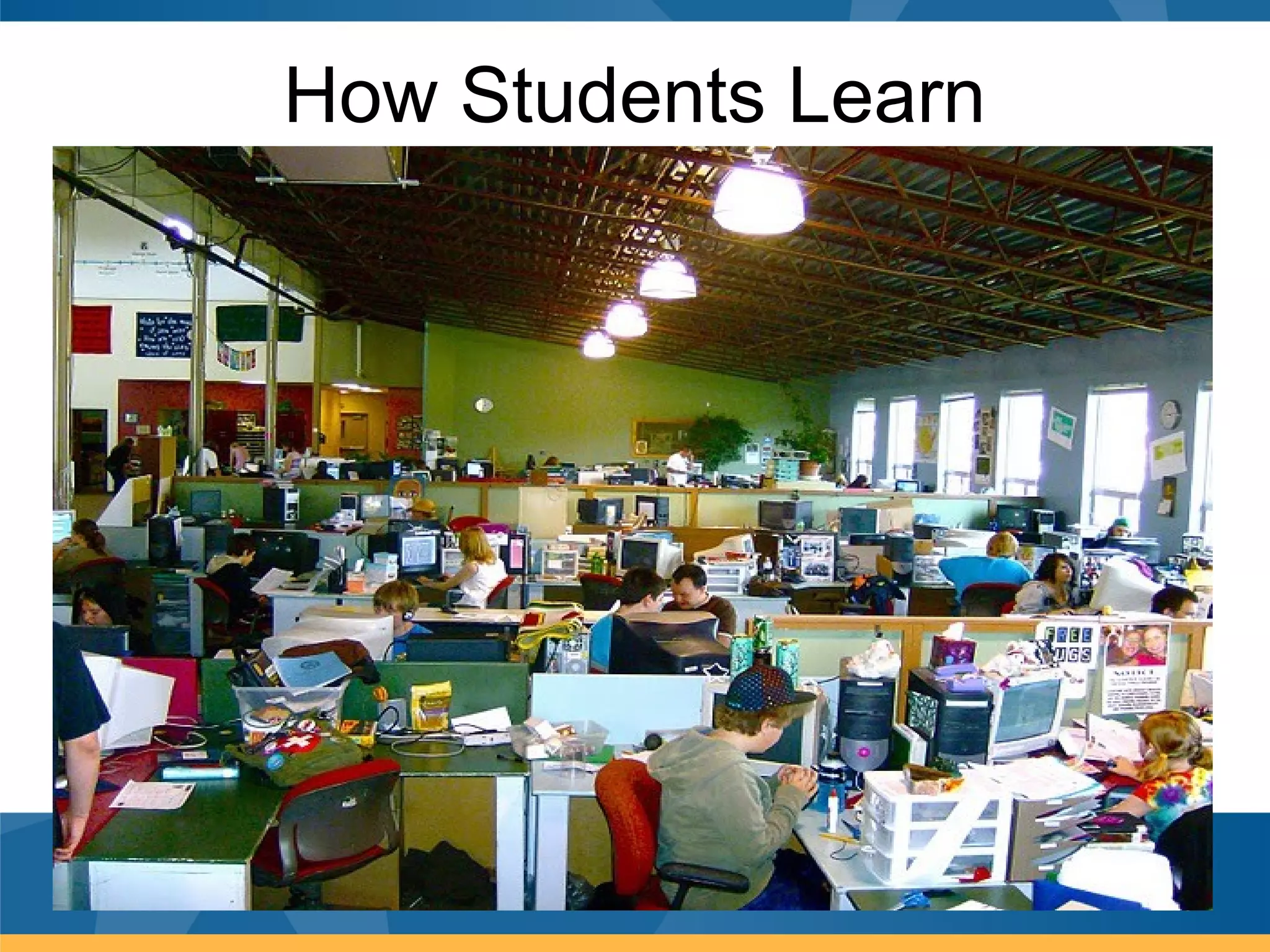
How Students Learn
Questions
• Dr. Allison Powell, VP State and District
  Services, apowell@inacol.org

• Dr. Rob Darrow, Director of Member Services –
  rdarrow@inacol.org
• (Presentation: http://robdarrow.wikispaces.com

               http://www.inacol.org
          http://onlineprogramhowto.org
Why join iNACOL? www.inacol.org
• Passion for online and blended learning
• Receive daily news and research updates
  about online and blended learning
• Contribute to the online and blended
  learning voice and conversation
• Participate in regional and standing
  committees
Why join iNACOL? www.inacol.org
• Participate in webinars and related
  activities (access to Archives)
• Reduced cost for attending yearly iNACOL
  Symposium (Oct. 27-30, 2013, Orlando,
  FL)
• Membership: $60 for educators
  – Other memberships: School, institution,
    companies, etc.

Blended Learning: How do you know it when you see it?

  • 1.
    Blended Learning: HowDo You Know It When You See It? Dr. Allison Powell Vice President, State and District Services Dr. Rob Darrow Director of Member Services www.inacol.org
  • 2.
    International Association forK- 12 Online Learning (iNACOL) • iNACOL is the premier K-12 nonprofit in online learning • Provides leadership, advocacy, research, training, and networking with experts in K-12 online learning. – 4400+ members in K-12 online and blended learning in over 50 countries – Annual conference – iNACOL Blended and Online Learning Symposium: Orlando, FL in October 28-30, 2013 • “Ensure every student has access a world class education” regardless of geography, income or background. • Next Generation Learning Challenges – Gates Foundation • CompetencyWorks – Nellie Mae Education Foundation • Our strategic areas of focus in online and blended learning: 1. Policy 2. Quality 3. New Learning Models
  • 3.
  • 4.
    How well isour current K-12 system functioning? Depends on who you ask The critical question is whether we are preparing our students for the knowledge workforce; the globally competitive workforce. Currently – national high school graduation rate of 68% 80% of jobs are requiring a post-secondary degree or certification
  • 5.
    Online and BlendedLearning as a catalyst for change
  • 6.
  • 7.
    Blended Learning: What does“it” look like?
  • 8.
  • 9.
  • 10.
  • 11.
  • 12.
  • 13.
    There are manyblended learning Definitions
  • 14.
    Definitions, Part 1 •Two definitions: – Blended learning should be viewed as a pedagogical approach that combines the effectiveness and socialization opportunities of the classroom with the technologically enhanced active learning possibilities of the online environment , • Dziuban, Hartman and Moskal (2004) – Blended learning “combines face-to-face learning with computer mediated learning.” (Bonk and Graham, 2006. Handbook of blended learning: Global perspectives, local designs. http://www.publicationshare.com/).
  • 15.
    Allen, I. E.,Seaman, J., & Garrett, R. (2007). Blending in: The extent and promise of blended education in the United States. Newburyport, MA: The Sloan Consortium. http://www.sloan-c.org/publications/survey/blended06
  • 16.
    Blended learning A formal education program in which a student learns at least in part through online delivery of instruction and content, with some element of student control over time, place, path and/or pace and at least in part in a supervised brick-and- mortar location away from home.
  • 17.
    There are manyblended learning Models
  • 18.
  • 19.
    Emerging models ofblended learning Rotation Flex Self-Blend Enriched Virtual • Station rotation Online platform with Students attend Students learn • Lab rotation F2F support and physical school & sometimes at a • Flipped Classroom fluid schedules take 1 or more physical school, other • Individual rotation courses online times remotely
  • 20.
    Blended learning is not like a light switch you turn on one day
  • 21.
  • 22.
    Think in termsof 3-5 years from now (not just today). Think about what can be, not what is. This is a journey, not a destination.
  • 23.
    We are prettyclear Face-to-Face Teaching Online Teaching • Students in classroom • Students online • Teacher in classroom • Teacher online (minimal • Interaction face-to-face, face-to-face interaction) mostly verbal, some • Interaction online video visual conferencing, email – • Fixed schedule of classes more visual, less verbal to attend • Flexible schedule for work • Prescribed curriculum completion based on standards / use • Prescribed curriculum of textbooks based on standards / text
  • 24.
    But what does BlendedLearning really look like for a teacher? Or an administrator?
  • 25.
  • 26.
    Teaching and Learning • What is the student doing and where is the student?  What is the teacher doing and where is the teacher?  What and where is the content?
  • 27.
    Online Teaching Technology Textbook Enhanced Enhanced Teaching Teaching Web / Online Enhanced Teaching From Textbook to Online Teaching
  • 28.
    What does “it”look like? Where do you fit? * See handout • Textbook enhanced teaching and learning • Technology enhanced (not online) • Web/online enhanced • Blended • Online
  • 29.
    What does “it”look like? *Teacher-centric vs. Student-centric More teacher • Textbook enhanced centric teaching and learning • Technology enhanced (not online) Combination • Web/online enhanced • Blended More student • Online centric
  • 30.
    What does “it”look like? *Teacher vs. student control of teaching and learning More teacher control • Textbook enhanced teaching and learning • Technology enhanced Shared (not online) control • Web/online enhanced • Blended More student control • Online
  • 31.
    What does “it”look like? *Control of time and pace Set time structure • Textbook enhanced teaching and learning • Technology enhanced Some (not online) Flexibility • Web/online enhanced • Blended Flexible • Online
  • 32.
    What does “it”look like? *Blended Learning Models continuum Rotation • Textbook enhanced teaching and learning Flex • Technology enhanced Self Blend (not online) Enriched • Web/online enhanced Virtual • Blended • Online
  • 33.
    People/Pedagogy/PD • People –Administrators, Teachers, and Students – Must support each other • Pedagogy – Role of Teacher changes in this environment • Professional Development – What skills does an online/blended teacher need – What skills do an administrator need to support his/her teachers – Current Trends in PD
  • 34.
    Role of Online/BlendedTeacher • Facilitate and build an online and F2F community of learners • Engage learners in a variety of online and F2F environments through reflective and hands-on activities • Analyze data to assist in individualizing instruction • Personalize the learning through online discussion and group projects • Differentiate instruction (i.e. learning styles, adaptive/assistive technologies, pacing, supplemental activities and remediation.) • Develop and deliver asynchronous and synchronous lessons that use appropriate and effective multimedia design elements • Student academic integrity issues (plagiarism and the safe and legal use of online resources)
  • 35.
    Administrator Role • Needto know what to look for in evaluating teachers • Need to understand how technology works to get into the courses • How to support online/blended teachers • Requires administrators and policy makers that can make wise decisions about resources • Allocation and to gather and analyze data that cross traditional categories and sectors. • Lack of PD for administrators
  • 36.
    What should anadministrator look for while observing a blended learning environment? (see handout)
  • 37.
    Student and ParentRole • Student is responsible for their learning • Requires Motivation and Flexibility • Personalized and Individualized Instruction – Any time, any place, any path, any pace!!! (FLVS) • Parent is a partner with student and teacher – Provide support and resources at home
  • 38.
    What does blendedlearning look like?
  • 39.
  • 40.
  • 43.
    School of One •http://schoolofone.org/concept_introvideos .html?playVideo • (more in depth video) - http://vimeo.com/7964251
  • 45.
    Carpe Diem CollegiateHigh School • http://www.youtube.com/watch?v=- s_O65rWV10
  • 47.
    New Line LearningModels • http://www.youtube.com/watch?v=nnPLrK1USMA
  • 48.
  • 49.
    Questions • Dr. AllisonPowell, VP State and District Services, apowell@inacol.org • Dr. Rob Darrow, Director of Member Services – rdarrow@inacol.org • (Presentation: http://robdarrow.wikispaces.com http://www.inacol.org http://onlineprogramhowto.org
  • 50.
    Why join iNACOL?www.inacol.org • Passion for online and blended learning • Receive daily news and research updates about online and blended learning • Contribute to the online and blended learning voice and conversation • Participate in regional and standing committees
  • 51.
    Why join iNACOL?www.inacol.org • Participate in webinars and related activities (access to Archives) • Reduced cost for attending yearly iNACOL Symposium (Oct. 27-30, 2013, Orlando, FL) • Membership: $60 for educators – Other memberships: School, institution, companies, etc.

Editor's Notes