STATIC & DYNAMIC
CHARACTERISTICS
Submitted by
Kaavya B
Holy Cross College, Trichy
PERFORMANCE
CHARACTERISTIC
STATIC DYNAMIC
STATIC CHARACTERISTICS ?
Static characteristics refer to the
characteristics of the system when the input is
either hold constant or varying very slowly
with time.
STATIC CHARACTERISTICS
 Accuracy & Precision
 Repeatability & Reproducibility
 Resolution
 Threshold
 Range or Span
 Linearity
 Sensitivity
 Drift
 Static error
 Dead zone
 Stability
 Bais
 Tolerance
 Hysteresis k
DYNAMIC CHARACTERISTICS ?
• Dynamic characteristics refer to the
performance of the instrument when the
input variable is changing rapidly with time.
• The dynamic performance of human eye
cannot be said to be very satisfactory.
DYNAMIC CHARACTERISTICS
Speed of response
Fidelity
Dynamic error
Lag
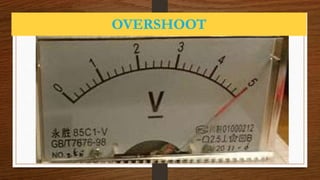
Overshoot
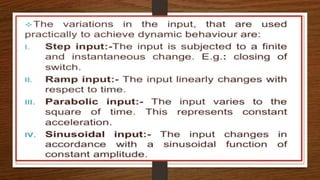
Step response
Ramp response
STATIC
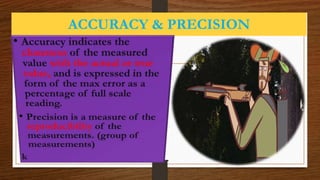
ACCURACY & PRECISION
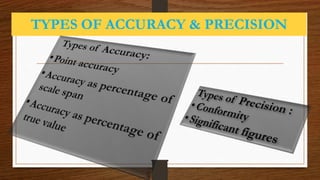
TYPES OF ACCURACY & PRECISION
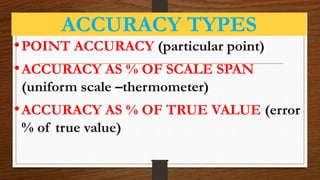
ACCURACY TYPES
•POINT ACCURACY (particular point)
•ACCURACY AS % OF SCALE SPAN
(uniform scale –thermometer)
•ACCURACY AS % OF TRUE VALUE (error
% of true value)
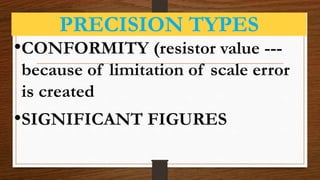
PRECISION TYPES
•CONFORMITY (resistor value ---
because of limitation of scale error
is created
•SIGNIFICANT FIGURES
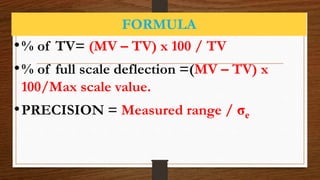
FORMULA
•% of TV= (MV – TV) x 100 / TV
•% of full scale deflection =(MV – TV) x
100/Max scale value.
•PRECISION = Measured range / σe
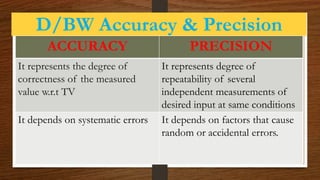
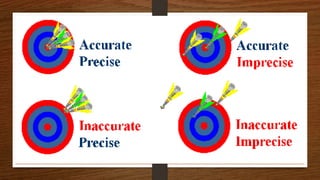
D/BW Accuracy & Precision
ACCURACY PRECISION
It represents the degree of
correctness of the measured
value w.r.t TV
It represents degree of
repeatability of several
independent measurements of
desired input at same conditions
It depends on systematic errors It depends on factors that cause
random or accidental errors.
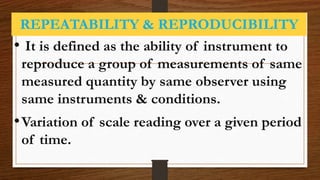
REPEATABILITY & REPRODUCIBILITY
• It is defined as the ability of instrument to
reproduce a group of measurements of same
measured quantity by same observer using
same instruments & conditions.
•Variation of scale reading over a given period
of time.
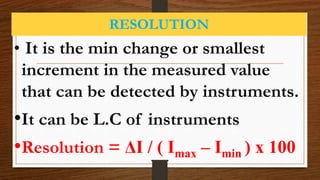
RESOLUTION
• It is the min change or smallest
increment in the measured value
that can be detected by instruments.
•It can be L.C of instruments
•Resolution = ΔI / ( Imax – Imin ) x 100
THRESHOLD
• It is defined as the
range of different
input values over
which there is a
constant output
value.
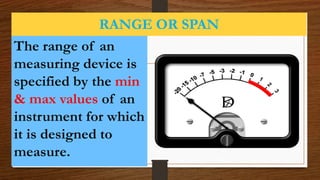
RANGE OR SPAN
The range of an
measuring device is
specified by the min
& max values of an
instrument for which
it is designed to
measure.
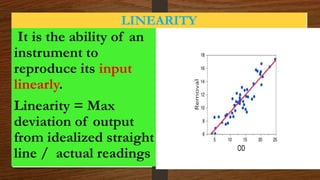
LINEARITY
It is the ability of an
instrument to
reproduce its input
linearly.
Linearity = Max
deviation of output
from idealized straight
line / actual readings
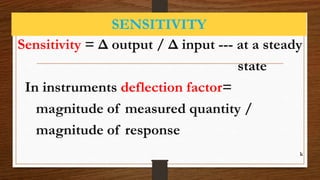
SENSITIVITY
Sensitivity = Δ output / Δ input --- at a steady
state
In instruments deflection factor=
magnitude of measured quantity /
magnitude of response
k
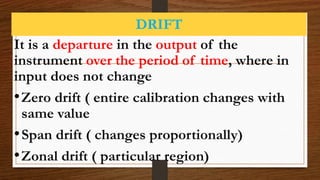
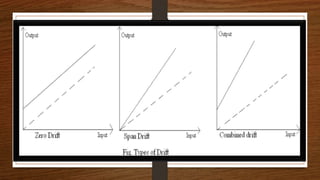
DRIFT
It is a departure in the output of the
instrument over the period of time, where in
input does not change
•Zero drift ( entire calibration changes with
same value
•Span drift ( changes proportionally)
•Zonal drift ( particular region)
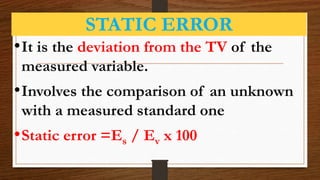
STATIC ERROR
•It is the deviation from the TV of the
measured variable.
•Involves the comparison of an unknown
with a measured standard one
•Static error =Es / Ev x 100
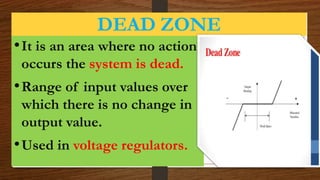
DEAD ZONE
•It is an area where no action
occurs the system is dead.
•Range of input values over
which there is no change in
output value.
•Used in voltage regulators.
STABILITY
•The ability of an
instrument to retain its
performance throughout its
specified storage life and
operating life.
•5ml of fuel sample is
enough
OXIDATION STABILITY
CHECKER
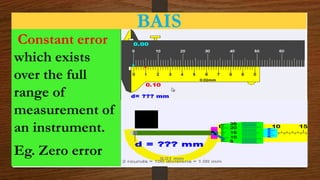
BAIS
Constant error
which exists
over the full
range of
measurement of
an instrument.
Eg. Zero error
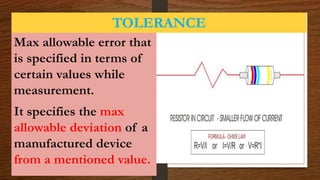
TOLERANCE
Max allowable error that
is specified in terms of
certain values while
measurement.
It specifies the max
allowable deviation of a
manufactured device
from a mentioned value.
HYSTERESIS
It is a phenomenon under which measuring instrument
shows different output effects during loading &
unloading.
It can be eliminated by taking readings in both
direction & then taking mean.
When input of an instrument is varied from zero to its
full scale & then if the input is decreased from its full
scale to zero, the output varies. The output at the
particular input while increasing & decreasing varies
because of internal friction.
DYNAMIC
(input changes with time)
2 INPUTS
•Transient response: part of the response
which goes to zero as the time becomes
large.
•Steady state response: It has a definite
periodic cycle
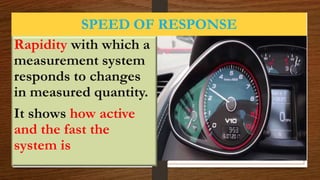
SPEED OF RESPONSE
Rapidity with which a
measurement system
responds to changes
in measured quantity.
It shows how active
and the fast the
system is
FIDELITY
•It is the ability of the system to reproduce
the output the same as the input without
dynamic error.
•If output varies linearly with input then the
system is 100% fidelity
•It does not depend on time and phase of
input
DYNAMIC ERROR
The difference between the TV
quatity changing with respect to time
and the measured quantity with
respect to time
k
LAG
Every system requires its own time to respond to
changes in input. This time is called as lag.
•RETARDATION LAG: As soon as there is a
change in the measured quantity, the system
begins to respond faster.
•TIME DELAY: The change occurs after some
time, begins after a dead time , after the
application of the input.
OVERSHOOT
STEP & RAMP RESPONSE
•The measuring instrument measuring the
one steady step value to another steady step
value, the in B/W these 2 values is called step
response. (ice to hot)
•The value of response time in B/W 2
response changes very slowly with time.
(Only ice) k
Static & dynamic characteristics of instruments

Static & dynamic characteristics of instruments

  • 1.
    STATIC & DYNAMIC CHARACTERISTICS Submittedby Kaavya B Holy Cross College, Trichy
  • 2.
  • 3.
    STATIC CHARACTERISTICS ? Staticcharacteristics refer to the characteristics of the system when the input is either hold constant or varying very slowly with time.
  • 4.
    STATIC CHARACTERISTICS  Accuracy& Precision  Repeatability & Reproducibility  Resolution  Threshold  Range or Span  Linearity  Sensitivity  Drift  Static error  Dead zone  Stability  Bais  Tolerance  Hysteresis k
  • 5.
    DYNAMIC CHARACTERISTICS ? •Dynamic characteristics refer to the performance of the instrument when the input variable is changing rapidly with time. • The dynamic performance of human eye cannot be said to be very satisfactory.
  • 6.
    DYNAMIC CHARACTERISTICS Speed ofresponse Fidelity Dynamic error Lag Overshoot Step response Ramp response
  • 7.
  • 8.
  • 9.
    TYPES OF ACCURACY& PRECISION
  • 10.
    ACCURACY TYPES •POINT ACCURACY(particular point) •ACCURACY AS % OF SCALE SPAN (uniform scale –thermometer) •ACCURACY AS % OF TRUE VALUE (error % of true value)
  • 11.
    PRECISION TYPES •CONFORMITY (resistorvalue --- because of limitation of scale error is created •SIGNIFICANT FIGURES
  • 12.
    FORMULA •% of TV=(MV – TV) x 100 / TV •% of full scale deflection =(MV – TV) x 100/Max scale value. •PRECISION = Measured range / σe
  • 13.
    D/BW Accuracy &Precision ACCURACY PRECISION It represents the degree of correctness of the measured value w.r.t TV It represents degree of repeatability of several independent measurements of desired input at same conditions It depends on systematic errors It depends on factors that cause random or accidental errors.
  • 15.
    REPEATABILITY & REPRODUCIBILITY •It is defined as the ability of instrument to reproduce a group of measurements of same measured quantity by same observer using same instruments & conditions. •Variation of scale reading over a given period of time.
  • 16.
    RESOLUTION • It isthe min change or smallest increment in the measured value that can be detected by instruments. •It can be L.C of instruments •Resolution = ΔI / ( Imax – Imin ) x 100
  • 18.
    THRESHOLD • It isdefined as the range of different input values over which there is a constant output value.
  • 19.
    RANGE OR SPAN Therange of an measuring device is specified by the min & max values of an instrument for which it is designed to measure.
  • 20.
    LINEARITY It is theability of an instrument to reproduce its input linearly. Linearity = Max deviation of output from idealized straight line / actual readings
  • 22.
    SENSITIVITY Sensitivity = Δoutput / Δ input --- at a steady state In instruments deflection factor= magnitude of measured quantity / magnitude of response k
  • 24.
    DRIFT It is adeparture in the output of the instrument over the period of time, where in input does not change •Zero drift ( entire calibration changes with same value •Span drift ( changes proportionally) •Zonal drift ( particular region)
  • 26.
    STATIC ERROR •It isthe deviation from the TV of the measured variable. •Involves the comparison of an unknown with a measured standard one •Static error =Es / Ev x 100
  • 27.
    DEAD ZONE •It isan area where no action occurs the system is dead. •Range of input values over which there is no change in output value. •Used in voltage regulators.
  • 28.
    STABILITY •The ability ofan instrument to retain its performance throughout its specified storage life and operating life. •5ml of fuel sample is enough OXIDATION STABILITY CHECKER
  • 29.
    BAIS Constant error which exists overthe full range of measurement of an instrument. Eg. Zero error
  • 30.
    TOLERANCE Max allowable errorthat is specified in terms of certain values while measurement. It specifies the max allowable deviation of a manufactured device from a mentioned value.
  • 31.
    HYSTERESIS It is aphenomenon under which measuring instrument shows different output effects during loading & unloading. It can be eliminated by taking readings in both direction & then taking mean. When input of an instrument is varied from zero to its full scale & then if the input is decreased from its full scale to zero, the output varies. The output at the particular input while increasing & decreasing varies because of internal friction.
  • 33.
  • 34.
    2 INPUTS •Transient response:part of the response which goes to zero as the time becomes large. •Steady state response: It has a definite periodic cycle
  • 36.
    SPEED OF RESPONSE Rapiditywith which a measurement system responds to changes in measured quantity. It shows how active and the fast the system is
  • 37.
    FIDELITY •It is theability of the system to reproduce the output the same as the input without dynamic error. •If output varies linearly with input then the system is 100% fidelity •It does not depend on time and phase of input
  • 38.
    DYNAMIC ERROR The differencebetween the TV quatity changing with respect to time and the measured quantity with respect to time k
  • 39.
    LAG Every system requiresits own time to respond to changes in input. This time is called as lag. •RETARDATION LAG: As soon as there is a change in the measured quantity, the system begins to respond faster. •TIME DELAY: The change occurs after some time, begins after a dead time , after the application of the input.
  • 41.
  • 42.
    STEP & RAMPRESPONSE •The measuring instrument measuring the one steady step value to another steady step value, the in B/W these 2 values is called step response. (ice to hot) •The value of response time in B/W 2 response changes very slowly with time. (Only ice) k