CHAPTER-2
Performance characteristics
&
Measurement error
1
2.1. PERFORMANCE CHARACTERISTICS
OF MEASURING INSTRUMENTS
 The measurement system characteristics are to be known, to choose an
instrument that most suited to a particular measurement application.
 The performance characteristics broadly classified into two groups,
namely static and dynamic characteristics.
 If the instrument is required to measure a condition not varying with
time, the characteristics are called static while for time-varying process-
variable measurement , the dynamic characteristics are more important.
2
2.1.1 Static characteristics of instruments
oRefers to the comparison between steady output and
ideal output when the input is constant.
oThe performance criteria for the measurement of quantities
that remain constant, or vary only quite slowly.
oThe main static characteristics are :-
1. Accuracy
2. Precision
3. Reproducibility
4. Drift
5. Sensitivity
6. Threshold
7 Static error
8. Dead zone
9. Stability
10. Range or Span
11. Bais
12. Hysteresis
3
2.1.1 STATIC CHARACTERISTICS…
Accuracy
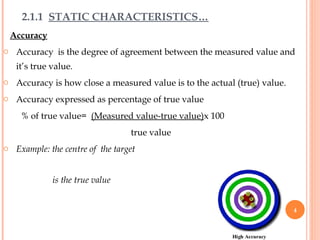
o Accuracy is the degree of agreement between the measured value and
it’s true value.
o Accuracy is how close a measured value is to the actual (true) value.
o Accuracy expressed as percentage of true value
% of true value= (Measured value-true value)x 100
true value
o Example: the centre of the target
is the true value
4
Precision
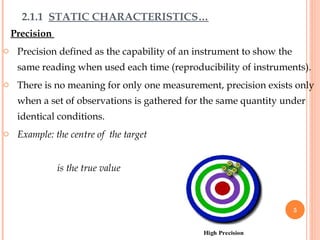
o Precision defined as the capability of an instrument to show the
same reading when used each time (reproducibility of instruments).
o There is no meaning for only one measurement, precision exists only
when a set of observations is gathered for the same quantity under
identical conditions.
o Example: the centre of the target
is the true value
2.1.1 STATIC CHARACTERISTICS…
5
ACCURACY VS PRECISION
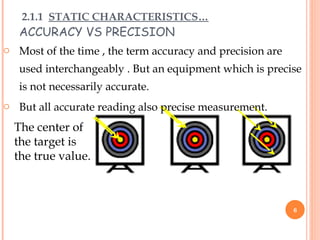
The center of
the target is
the true value.
2.1.1 STATIC CHARACTERISTICS…
o Most of the time , the term accuracy and precision are
used interchangeably . But an equipment which is precise
is not necessarily accurate.
o But all accurate reading also precise measurement.
6
ACCURACY VS PRECISION
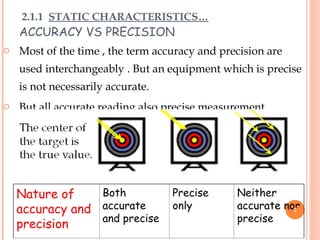
o Most of the time , the term accuracy and precision are
used interchangeably . But an equipment which is precise
is not necessarily accurate.
o But all accurate reading also precise measurement.
Nature of
accuracy and
precision
Both
accurate
and precise
Precise
only
Neither
accurate nor
precise
2.1.1 STATIC CHARACTERISTICS…
7
Example1:
o If one makes a mistake by 5 centimeters in measuring
two object that are actually 100 and 1,000 cm,
respectively, which one will be
o (a) More accurate measurements, and
(b) More precise measurements?
2.1.1 STATIC CHARACTERISTICS…
8
Example 2:
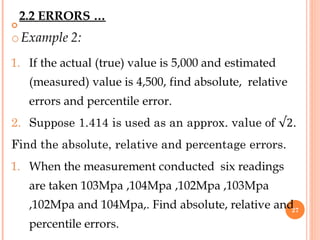
o Consider the measurement of a known pressure of
100Mpa with a pressure gauge. six readings are
taken 103Mpa ,104Mpa ,102Mpa ,103Mpa ,102Mpa
and 104Mpa
o Is it accurate or precise, how do we decide?
2.1.1 STATIC CHARACTERISTICS…
9
Repeatability
o The closeness of agreement among a number of consecutive measurements of
the output for the same value of input under the same operating condition.
Reproducibility
o The closeness of agreement among the repeated measurements of the output
for the same value of input under the same operating conditions over a
period of time.
Drift
o The variation of change in output for a given input over a period of
time known as drift
2.1.1 STATIC CHARACTERISTICS…
10
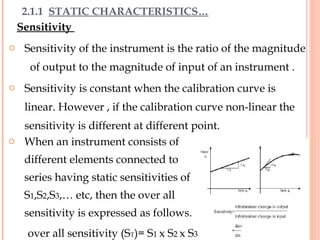
Sensitivity
o Sensitivity of the instrument is the ratio of the magnitude
of output to the magnitude of input of an instrument .
o Sensitivity is constant when the calibration curve is
linear. However , if the calibration curve non-linear the
sensitivity is different at different point.
2.1.1 STATIC CHARACTERISTICS…
o When an instrument consists of
different elements connected to
series having static sensitivities of
S1,S2,S3,… etc, then the over all
sensitivity is expressed as follows.
over all sensitivity (ST)= S1 x S2 x S3
11
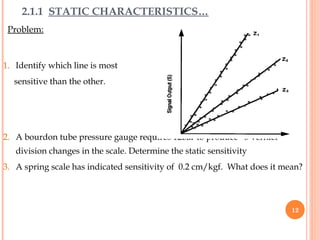
Problem:
1. Identify which line is most
sensitive than the other.
2. A bourdon tube pressure gauge requires 12bar to produce 3 vernier
division changes in the scale. Determine the static sensitivity
3. A spring scale has indicated sensitivity of 0.2 cm/kgf. What does it mean?
2.1.1 STATIC CHARACTERISTICS…
12
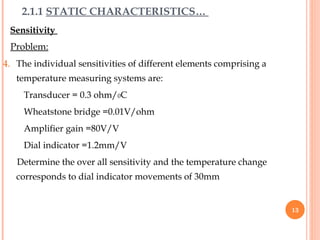
Sensitivity
Problem:
4. The individual sensitivities of different elements comprising a
temperature measuring systems are:
Transducer = 0.3 ohm/0C
Wheatstone bridge =0.01V/ohm
Amplifier gain =80V/V
Dial indicator =1.2mm/V
Determine the over all sensitivity and the temperature change
corresponds to dial indicator movements of 30mm
2.1.1 STATIC CHARACTERISTICS…
13
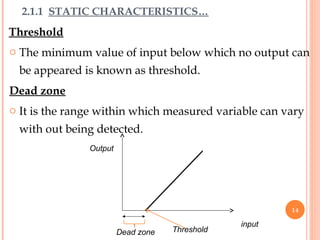
Threshold
o The minimum value of input below which no output can
be appeared is known as threshold.
Dead zone
o It is the range within which measured variable can vary
with out being detected.
input
Output
Dead zone Threshold
2.1.1 STATIC CHARACTERISTICS…
14
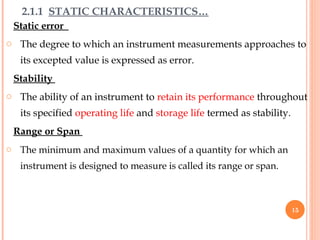
Static error
o The degree to which an instrument measurements approaches to
its excepted value is expressed as error.
Stability
o The ability of an instrument to retain its performance throughout
its specified operating life and storage life termed as stability.
Range or Span
o The minimum and maximum values of a quantity for which an
instrument is designed to measure is called its range or span.
2.1.1 STATIC CHARACTERISTICS…
15
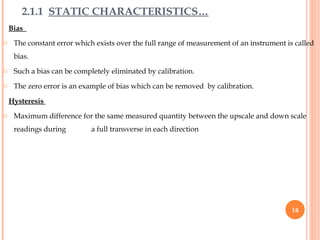
Bias
o The constant error which exists over the full range of measurement of an instrument is called
bias.
o Such a bias can be completely eliminated by calibration.
o The zero error is an example of bias which can be removed by calibration.
Hysteresis
o Maximum difference for the same measured quantity between the upscale and down scale
readings during a full transverse in each direction
2.1.1 STATIC CHARACTERISTICS…
16
2.1.2 Dynamic characteristics of instruments
oThese type of instruments are normally used for the
measurement of quantities that fluctuate with time.
oIn many practical cases, the parameter to be measured are
time-varying. Thus, the output of an instrument is also time
varying. The characteristics of an instrument under such time
varying input-output conditions is called dynamic
characteristics of an instruments.
oDynamic characteristics of a measurement system are:
4. Dynamic error
5. Overshoot
1. Speed of response
2. Measuring lag
3. Fidelity
17
2.1.2 DYNAMIC CHARACTERISTICS
1.Speed of response:
o It is defined as the rapidity with which an instrument responds
to a change in the value of the quantity being measured. It
shows how active and fast the system is.
2. Measuring lag:
o It is defined as the retardation or delay, in the response of a
system to the changes in the input. The lags are of two types:
 Retardation lag: As soon as there is a changes in the measured
quantity, the measurement system begins to respond.
 Time delay: The response of the measurement system starts
after a dead time, once the input is applied.
18
3. Fidelity:
o It is defined as the degree to which a measurement system
indicates changes in the measured quantity without any
dynamic error..
o It refers to the ability of the system to reproduce the output in
the same form as the input.
4. Dynamic error:
o It is the difference between the true value of the quantity
changing with time and the value indicated by the
measurement system if no static error is assumed.
2.1.2 DYNAMIC CHARACTERISTICS
19
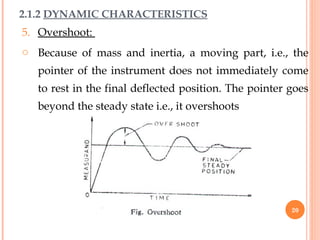
5. Overshoot:
o Because of mass and inertia, a moving part, i.e., the
pointer of the instrument does not immediately come
to rest in the final deflected position. The pointer goes
beyond the steady state i.e., it overshoots
2.1.2 DYNAMIC CHARACTERISTICS
20
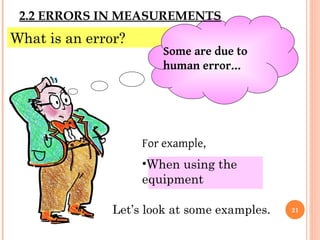
What is an error?
Some are due to
human error…
For example,
•When using the
equipment
Let’s look at some examples.
2.2 ERRORS IN MEASUREMENTS
21
2.2 ERRORS …
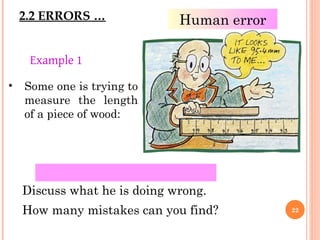
Example 1
• Some one is trying to
measure the length
of a piece of wood:
Discuss what he is doing wrong.
How many mistakes can you find? 22
Human error
2.2 ERRORS …
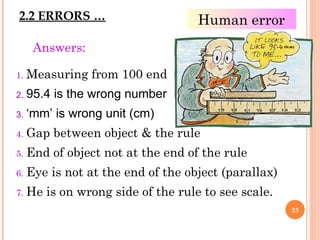
1. Measuring from 100 end
2. 95.4 is the wrong number
3. ‘mm’ is wrong unit (cm)
4. Gap between object & the rule
5. End of object not at the end of the rule
6. Eye is not at the end of the object (parallax)
7. He is on wrong side of the rule to see scale.
Answers:
23
Human error
 If we are making physical measurements, there may be error involved.
 Error in measurement is the difference between the true value of the size
being measured and the value found by measurement.
 Error in measurement = Measured value- True value
 The actual value or true value is a theoretical size of a dimension free
from any error of measurement which helps to examine the errors in a
measurement system that lead to uncertainties.
 Error may be expressed by absolute, relative or percentile
24
2.2 ERRORS …
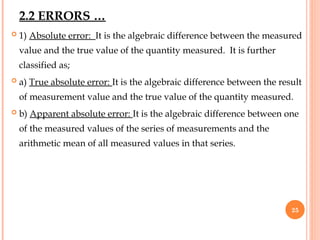
 1) Absolute error: It is the algebraic difference between the measured
value and the true value of the quantity measured. It is further
classified as;
 a) True absolute error: It is the algebraic difference between the result
of measurement value and the true value of the quantity measured.
 b) Apparent absolute error: It is the algebraic difference between one
of the measured values of the series of measurements and the
arithmetic mean of all measured values in that series.
25
2.2 ERRORS …
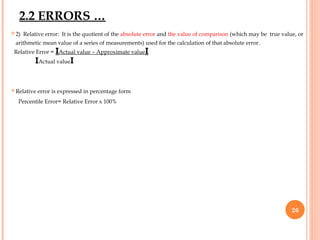
 2) Relative error: It is the quotient of the absolute error and the value of comparison (which may be true value, or
arithmetic mean value of a series of measurements) used for the calculation of that absolute error.
Relative Error = IActual value – Approximate valueI
IActual valueI
 Relative error is expressed in percentage form
Percentile Error= Relative Error x 100%
26
2.2 ERRORS …
27
2.2 ERRORS …
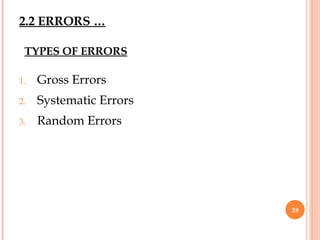
TYPES OF ERRORS
1. Gross Errors
2. Systematic Errors
3. Random Errors
28
2.2 ERRORS …
1.GROSS ERRORS
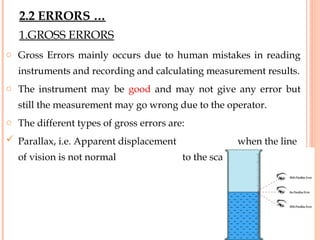
o Gross Errors mainly occurs due to human mistakes in reading
instruments and recording and calculating measurement results.
o The instrument may be good and may not give any error but
still the measurement may go wrong due to the operator.
o The different types of gross errors are:
 Parallax, i.e. Apparent displacement when the line
of vision is not normal to the scale.
29
2.2 ERRORS …
Inaccurate estimate of average reading.
Wrong scale reading and wrong recording the data.
Incorrect conversion of units between consecutive reading.
Gross Errors may be of any amount and these are avoided
by adopting two means:-
1. Great care is must in reading and recording the data.
2. Two , Three or even more reading should be taken for
the quantity under measurement.
30
2.2 ERRORS …
1.GROSS …
2. SYSTEMATIC ERRORS
o Systematic error is caused by any factors that
systematically affect measurement of the variable
across the sample.
o Systematic errors tend to be consistently either
positive or negative -- because of this,
systematic error is sometimes considered to be
bias in measurement.
o Sometimes systematic error is called zero
errors. 31
2.2 ERRORS …
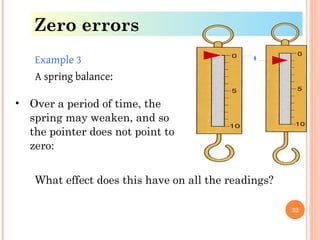
Example 3
A spring balance:
Zero errors
• Over a period of time, the
spring may weaken, and so
the pointer does not point to
zero:
What effect does this have on all the readings?
32
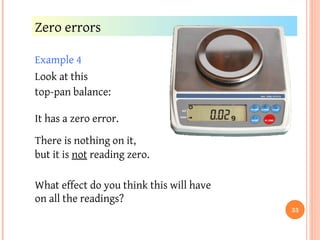
Example 4
Look at this
top-pan balance:
Zero errors
There is nothing on it,
but it is not reading zero.
What effect do you think this will have
on all the readings?
It has a zero error.
33
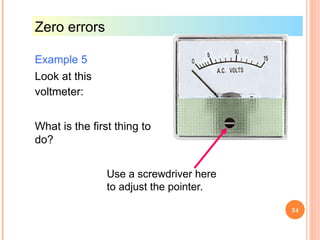
Example 5
Look at this
voltmeter:
Zero errors
What is the first thing to
do?
Use a screwdriver here
to adjust the pointer.
34
2. SYSTEMATIC ERRORS
These are divided into three categories:
I. Instrumental Errors
II. Environmental Errors
III.Observational error
35
2.2 ERRORS …
I. Instrumental Errors
o Inherent while measuring instrument because of their
mechanical structure ( eg: friction in the bearings of
various moving component, irregular spring tension,
stretching of spring, etc. )
Error can be avoid by:
• Selecting a suitable instrument for the particular
measurement application.
• Apply correction factor by determining instrumental
error.
• Calibrate the instrument against standard.
36
2. SYSTEMATIC …
2.2 ERRORS …
II. Environmental Errors
o Every instrument is manufactured and calibrated at
one place and used in some other place where the
environmental conditions such as temperature,
pressure, humidity, dust , and other such external
parameters can affect the performance of the
instrument.
Error can be avoid by:
• Air-conditioning to monitor the atmospheric condition.
• Cleaning the instruments
• Calibration of instrument at the place of use. etc
37
2. SYSTEMATIC …
2.2 ERRORS …
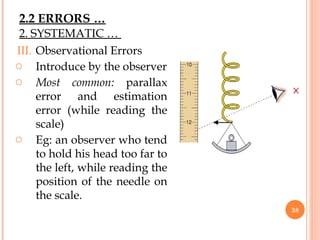
III. Observational Errors
o Introduce by the observer
o Most common: parallax
error and estimation
error (while reading the
scale)
o Eg: an observer who tend
to hold his head too far to
the left, while reading the
position of the needle on
the scale.
38
2. SYSTEMATIC …
2.2 ERRORS …
3. RANDOM ERRORS
o Random errors are due to unknown causes and
occur even when all systematic errors have been
accounted.
o These errors are not determinable in ordinary
processes of making measurements.
It is difficult to eliminate such error that vary in
unpredictable manner .
39
2.2 ERRORS …
THANK YOU!!
40

Instrumentation and Measurement Chapter - 2.ppt

  • 1.
  • 2.
    2.1. PERFORMANCE CHARACTERISTICS OFMEASURING INSTRUMENTS  The measurement system characteristics are to be known, to choose an instrument that most suited to a particular measurement application.  The performance characteristics broadly classified into two groups, namely static and dynamic characteristics.  If the instrument is required to measure a condition not varying with time, the characteristics are called static while for time-varying process- variable measurement , the dynamic characteristics are more important. 2
  • 3.
    2.1.1 Static characteristicsof instruments oRefers to the comparison between steady output and ideal output when the input is constant. oThe performance criteria for the measurement of quantities that remain constant, or vary only quite slowly. oThe main static characteristics are :- 1. Accuracy 2. Precision 3. Reproducibility 4. Drift 5. Sensitivity 6. Threshold 7 Static error 8. Dead zone 9. Stability 10. Range or Span 11. Bais 12. Hysteresis 3
  • 4.
    2.1.1 STATIC CHARACTERISTICS… Accuracy oAccuracy is the degree of agreement between the measured value and it’s true value. o Accuracy is how close a measured value is to the actual (true) value. o Accuracy expressed as percentage of true value % of true value= (Measured value-true value)x 100 true value o Example: the centre of the target is the true value 4
  • 5.
    Precision o Precision definedas the capability of an instrument to show the same reading when used each time (reproducibility of instruments). o There is no meaning for only one measurement, precision exists only when a set of observations is gathered for the same quantity under identical conditions. o Example: the centre of the target is the true value 2.1.1 STATIC CHARACTERISTICS… 5
  • 6.
    ACCURACY VS PRECISION Thecenter of the target is the true value. 2.1.1 STATIC CHARACTERISTICS… o Most of the time , the term accuracy and precision are used interchangeably . But an equipment which is precise is not necessarily accurate. o But all accurate reading also precise measurement. 6
  • 7.
    ACCURACY VS PRECISION oMost of the time , the term accuracy and precision are used interchangeably . But an equipment which is precise is not necessarily accurate. o But all accurate reading also precise measurement. Nature of accuracy and precision Both accurate and precise Precise only Neither accurate nor precise 2.1.1 STATIC CHARACTERISTICS… 7
  • 8.
    Example1: o If onemakes a mistake by 5 centimeters in measuring two object that are actually 100 and 1,000 cm, respectively, which one will be o (a) More accurate measurements, and (b) More precise measurements? 2.1.1 STATIC CHARACTERISTICS… 8
  • 9.
    Example 2: o Considerthe measurement of a known pressure of 100Mpa with a pressure gauge. six readings are taken 103Mpa ,104Mpa ,102Mpa ,103Mpa ,102Mpa and 104Mpa o Is it accurate or precise, how do we decide? 2.1.1 STATIC CHARACTERISTICS… 9
  • 10.
    Repeatability o The closenessof agreement among a number of consecutive measurements of the output for the same value of input under the same operating condition. Reproducibility o The closeness of agreement among the repeated measurements of the output for the same value of input under the same operating conditions over a period of time. Drift o The variation of change in output for a given input over a period of time known as drift 2.1.1 STATIC CHARACTERISTICS… 10
  • 11.
    Sensitivity o Sensitivity ofthe instrument is the ratio of the magnitude of output to the magnitude of input of an instrument . o Sensitivity is constant when the calibration curve is linear. However , if the calibration curve non-linear the sensitivity is different at different point. 2.1.1 STATIC CHARACTERISTICS… o When an instrument consists of different elements connected to series having static sensitivities of S1,S2,S3,… etc, then the over all sensitivity is expressed as follows. over all sensitivity (ST)= S1 x S2 x S3 11
  • 12.
    Problem: 1. Identify whichline is most sensitive than the other. 2. A bourdon tube pressure gauge requires 12bar to produce 3 vernier division changes in the scale. Determine the static sensitivity 3. A spring scale has indicated sensitivity of 0.2 cm/kgf. What does it mean? 2.1.1 STATIC CHARACTERISTICS… 12
  • 13.
    Sensitivity Problem: 4. The individualsensitivities of different elements comprising a temperature measuring systems are: Transducer = 0.3 ohm/0C Wheatstone bridge =0.01V/ohm Amplifier gain =80V/V Dial indicator =1.2mm/V Determine the over all sensitivity and the temperature change corresponds to dial indicator movements of 30mm 2.1.1 STATIC CHARACTERISTICS… 13
  • 14.
    Threshold o The minimumvalue of input below which no output can be appeared is known as threshold. Dead zone o It is the range within which measured variable can vary with out being detected. input Output Dead zone Threshold 2.1.1 STATIC CHARACTERISTICS… 14
  • 15.
    Static error o Thedegree to which an instrument measurements approaches to its excepted value is expressed as error. Stability o The ability of an instrument to retain its performance throughout its specified operating life and storage life termed as stability. Range or Span o The minimum and maximum values of a quantity for which an instrument is designed to measure is called its range or span. 2.1.1 STATIC CHARACTERISTICS… 15
  • 16.
    Bias o The constanterror which exists over the full range of measurement of an instrument is called bias. o Such a bias can be completely eliminated by calibration. o The zero error is an example of bias which can be removed by calibration. Hysteresis o Maximum difference for the same measured quantity between the upscale and down scale readings during a full transverse in each direction 2.1.1 STATIC CHARACTERISTICS… 16
  • 17.
    2.1.2 Dynamic characteristicsof instruments oThese type of instruments are normally used for the measurement of quantities that fluctuate with time. oIn many practical cases, the parameter to be measured are time-varying. Thus, the output of an instrument is also time varying. The characteristics of an instrument under such time varying input-output conditions is called dynamic characteristics of an instruments. oDynamic characteristics of a measurement system are: 4. Dynamic error 5. Overshoot 1. Speed of response 2. Measuring lag 3. Fidelity 17
  • 18.
    2.1.2 DYNAMIC CHARACTERISTICS 1.Speedof response: o It is defined as the rapidity with which an instrument responds to a change in the value of the quantity being measured. It shows how active and fast the system is. 2. Measuring lag: o It is defined as the retardation or delay, in the response of a system to the changes in the input. The lags are of two types:  Retardation lag: As soon as there is a changes in the measured quantity, the measurement system begins to respond.  Time delay: The response of the measurement system starts after a dead time, once the input is applied. 18
  • 19.
    3. Fidelity: o Itis defined as the degree to which a measurement system indicates changes in the measured quantity without any dynamic error.. o It refers to the ability of the system to reproduce the output in the same form as the input. 4. Dynamic error: o It is the difference between the true value of the quantity changing with time and the value indicated by the measurement system if no static error is assumed. 2.1.2 DYNAMIC CHARACTERISTICS 19
  • 20.
    5. Overshoot: o Becauseof mass and inertia, a moving part, i.e., the pointer of the instrument does not immediately come to rest in the final deflected position. The pointer goes beyond the steady state i.e., it overshoots 2.1.2 DYNAMIC CHARACTERISTICS 20
  • 21.
    What is anerror? Some are due to human error… For example, •When using the equipment Let’s look at some examples. 2.2 ERRORS IN MEASUREMENTS 21
  • 22.
    2.2 ERRORS … Example1 • Some one is trying to measure the length of a piece of wood: Discuss what he is doing wrong. How many mistakes can you find? 22 Human error
  • 23.
    2.2 ERRORS … 1.Measuring from 100 end 2. 95.4 is the wrong number 3. ‘mm’ is wrong unit (cm) 4. Gap between object & the rule 5. End of object not at the end of the rule 6. Eye is not at the end of the object (parallax) 7. He is on wrong side of the rule to see scale. Answers: 23 Human error
  • 24.
     If weare making physical measurements, there may be error involved.  Error in measurement is the difference between the true value of the size being measured and the value found by measurement.  Error in measurement = Measured value- True value  The actual value or true value is a theoretical size of a dimension free from any error of measurement which helps to examine the errors in a measurement system that lead to uncertainties.  Error may be expressed by absolute, relative or percentile 24 2.2 ERRORS …
  • 25.
     1) Absoluteerror: It is the algebraic difference between the measured value and the true value of the quantity measured. It is further classified as;  a) True absolute error: It is the algebraic difference between the result of measurement value and the true value of the quantity measured.  b) Apparent absolute error: It is the algebraic difference between one of the measured values of the series of measurements and the arithmetic mean of all measured values in that series. 25 2.2 ERRORS …
  • 26.
     2) Relativeerror: It is the quotient of the absolute error and the value of comparison (which may be true value, or arithmetic mean value of a series of measurements) used for the calculation of that absolute error. Relative Error = IActual value – Approximate valueI IActual valueI  Relative error is expressed in percentage form Percentile Error= Relative Error x 100% 26 2.2 ERRORS …
  • 27.
  • 28.
    TYPES OF ERRORS 1.Gross Errors 2. Systematic Errors 3. Random Errors 28 2.2 ERRORS …
  • 29.
    1.GROSS ERRORS o GrossErrors mainly occurs due to human mistakes in reading instruments and recording and calculating measurement results. o The instrument may be good and may not give any error but still the measurement may go wrong due to the operator. o The different types of gross errors are:  Parallax, i.e. Apparent displacement when the line of vision is not normal to the scale. 29 2.2 ERRORS …
  • 30.
    Inaccurate estimate ofaverage reading. Wrong scale reading and wrong recording the data. Incorrect conversion of units between consecutive reading. Gross Errors may be of any amount and these are avoided by adopting two means:- 1. Great care is must in reading and recording the data. 2. Two , Three or even more reading should be taken for the quantity under measurement. 30 2.2 ERRORS … 1.GROSS …
  • 31.
    2. SYSTEMATIC ERRORS oSystematic error is caused by any factors that systematically affect measurement of the variable across the sample. o Systematic errors tend to be consistently either positive or negative -- because of this, systematic error is sometimes considered to be bias in measurement. o Sometimes systematic error is called zero errors. 31 2.2 ERRORS …
  • 32.
    Example 3 A springbalance: Zero errors • Over a period of time, the spring may weaken, and so the pointer does not point to zero: What effect does this have on all the readings? 32
  • 33.
    Example 4 Look atthis top-pan balance: Zero errors There is nothing on it, but it is not reading zero. What effect do you think this will have on all the readings? It has a zero error. 33
  • 34.
    Example 5 Look atthis voltmeter: Zero errors What is the first thing to do? Use a screwdriver here to adjust the pointer. 34
  • 35.
    2. SYSTEMATIC ERRORS Theseare divided into three categories: I. Instrumental Errors II. Environmental Errors III.Observational error 35 2.2 ERRORS …
  • 36.
    I. Instrumental Errors oInherent while measuring instrument because of their mechanical structure ( eg: friction in the bearings of various moving component, irregular spring tension, stretching of spring, etc. ) Error can be avoid by: • Selecting a suitable instrument for the particular measurement application. • Apply correction factor by determining instrumental error. • Calibrate the instrument against standard. 36 2. SYSTEMATIC … 2.2 ERRORS …
  • 37.
    II. Environmental Errors oEvery instrument is manufactured and calibrated at one place and used in some other place where the environmental conditions such as temperature, pressure, humidity, dust , and other such external parameters can affect the performance of the instrument. Error can be avoid by: • Air-conditioning to monitor the atmospheric condition. • Cleaning the instruments • Calibration of instrument at the place of use. etc 37 2. SYSTEMATIC … 2.2 ERRORS …
  • 38.
    III. Observational Errors oIntroduce by the observer o Most common: parallax error and estimation error (while reading the scale) o Eg: an observer who tend to hold his head too far to the left, while reading the position of the needle on the scale. 38 2. SYSTEMATIC … 2.2 ERRORS …
  • 39.
    3. RANDOM ERRORS oRandom errors are due to unknown causes and occur even when all systematic errors have been accounted. o These errors are not determinable in ordinary processes of making measurements. It is difficult to eliminate such error that vary in unpredictable manner . 39 2.2 ERRORS …
  • 40.