Stabilizing the National
Economy
Chapter 17
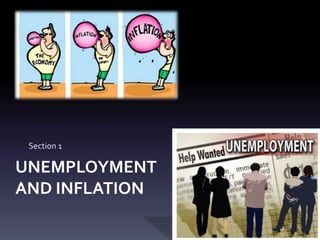
UNEMPLOYMENT
AND INFLATION
Section 1
Learning Goals
• Identify the two problems the government
faces in measuring unemployment
• Describe the 4 kinds of unemployment.
• Explain how demand-pull inflation differs
from cost-push inflation
Stabilization Policies
• Unemployment leads to uncertainty
– For people on it
– For the American economy
• Stabilization policies are used to keep the
economy healthy and the future predictable for
planning, saving and investing through monetary
& fiscal policies
Measuring Unemployment
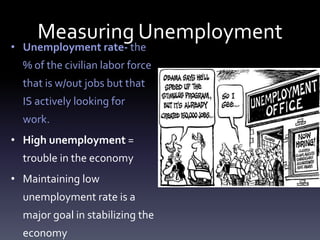
• Unemployment rate- the
% of the civilian labor force
that is w/out jobs but that
IS actively looking for
work.
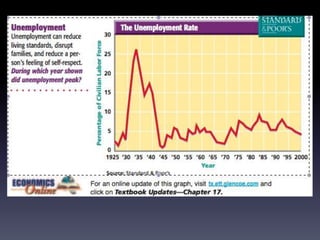
• High unemployment =
trouble in the economy
• Maintaining low
unemployment rate is a
major goal in stabilizing the
economy
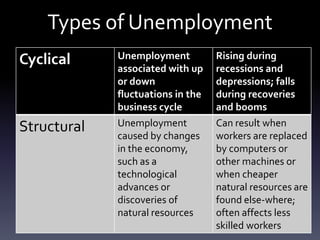
Types of Unemployment
Cyclical Unemployment
associated with up
or down
fluctuations in the
business cycle
Rising during
recessions and
depressions; falls
during recoveries
and booms
Structural Unemployment
caused by changes
in the economy,
such as a
technological
advances or
discoveries of
natural resources
Can result when
workers are replaced
by computers or
other machines or
when cheaper
natural resources are
found else-where;
often affects less
skilled workers
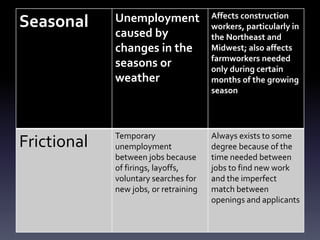
Seasonal Unemployment
caused by
changes in the
seasons or
weather
Affects construction
workers, particularly in
the Northeast and
Midwest; also affects
farmworkers needed
only during certain
months of the growing
season
Frictional Temporary
unemployment
between jobs because
of firings, layoffs,
voluntary searches for
new jobs, or retraining
Always exists to some
degree because of the
time needed between
jobs to find new work
and the imperfect
match between
openings and applicants
Full Employment vs
Unemployment
• Full employment- condition of the
economy when the unemployment rate
is lower than a certain perfecntage
established by economists’ studies
• **unemployment rate is ONLY an
estimate
• It does not include people who work in
family businesses without receiving pay
or people who are unemployed and do
not look for work
Unemployment Difficulties
• government staticians can’t interview ever
person in/out of the labor force
• Underground economy- transactions by
people who do not follow federal and state
law with respect to reporting earnings
Review
• Q:What are two problems the government
faces in measuring unemployment?
• A: Staticians can’t interview every person in
and out of the labor force; existence of an
underground economy
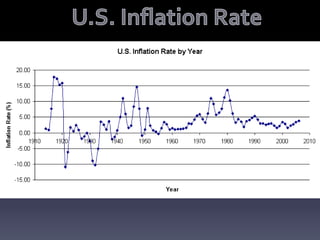
Inflation
• Economy can usually adapt to gradually rising prices
[avg- 3%/yr]
• High inflation=
– Creditors raising interest rates to maintain level of profits
– Slows economic growth
– Effects standard of living-
– EX.- 5% raise during 8% inflation
– Especially bad for those on fixed incomes
Why Does Inflation Occur?
• Two theories:
• Demand-PullTheory [prices are pulled up by
high demand]
• Cost-PushTheory [prices are pushed up by
high production costs and wages]
Demand-Pull
• Prices rise as the result of
excessive business and
consumer demand;
demand increases faster
than total supply resulting
in shortages that lead to
higher prices
• if the FED causes the $ supply
to grow to rapidly [people
spend additional funds on
limited supply]
• Increases in government
spending and in business
investment
• Aggregate demand can
increase if taxes are reduced
or consumers save less
Assumption of Demand-Pull
• Increased demand will increase output and
reduce unemployment
• EXPERIENCE has shown that rising prices +
unemployment may occur @ the same time
• Stagflation- the combination of inflation and
low economic activity
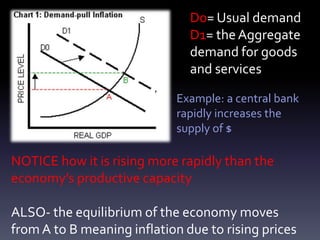
NOTICE how it is rising more rapidly than the
economy’s productive capacity
ALSO- the equilibrium of the economy moves
from A to B meaning inflation due to rising prices
D0= Usual demand
D1= theAggregate
demand for goods
and services
Example: a central bank
rapidly increases the
supply of $
Cost-Push
• Theory that
higher wages
and profits
push up prices
• Stagflation may
be the result of
cost-push
inflation
• When businesses have to pay
higher wages, their costs increase
to maintain profits
• During cost-push period,
unemployment remains high
• Prices are adjusted due to higher
wages/profits not aggregate
demand so there is no reason to
increase output or hire new
workers
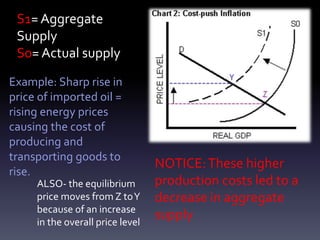
S1= Aggregate
Supply
S0= Actual supply
Example: Sharp rise in
price of imported oil =
rising energy prices
causing the cost of
producing and
transporting goods to
rise.
NOTICE:These higher
production costs led to a
decrease in aggregate
supply
ALSO- the equilibrium
price moves from Z toY
because of an increase
in the overall price level
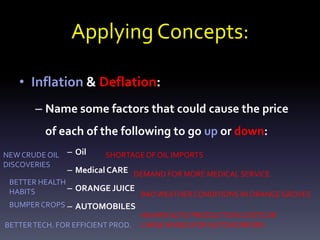
Applying Concepts:
• Inflation & Deflation:
– Name some factors that could cause the price
of each of the following to go up or down:
– Oil
– Medical CARE
– ORANGE JUICE
– AUTOMOBILES
SHORTAGEOF OIL IMPORTS
DEMAND FOR MORE MEDICAL SERVICE
BADWEATHERCONDITIONS IN ORANGEGROVES
HIGHERAUTO PRODUCTION COSTS OR
LARGE RAISES FORAUTOWORKERS
NEW CRUDE OIL
DISCOVERIES
BETTER HEALTH
HABITS
BUMPERCROPS
BETTERTECH. FOR EFFICIENT PROD.
CRITICALTHINKING
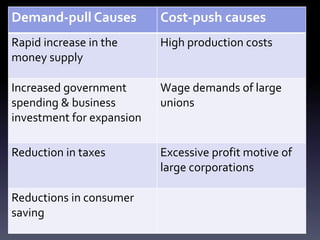
• CAUSE & EFFECT- Construct a table that
identifies the causes of inflation. List 4 causes
under demand-pull inflation in column 1 & 3
causes under cost-push inflation in column 2.
Demand-pull Causes Cost-push causes
Rapid increase in the
money supply
High production costs
Increased government
spending & business
investment for expansion
Wage demands of large
unions
Reduction in taxes Excessive profit motive of
large corporations
Reductions in consumer
saving
THE FISCAL POLICY APPROACH
TO STABILIZATION
Section 2
Learning Goals
• Identify how income flows between
businesses and consumer
• Describe how the federal government uses
fiscal policy to combat unemployment
2 Groups of Stabilization
• 1- Emphasizes the role of the Federal Reserve
• 2- the use of: fiscal policy- federal
government’s use of taxation and spending
policies to affect overall business activity
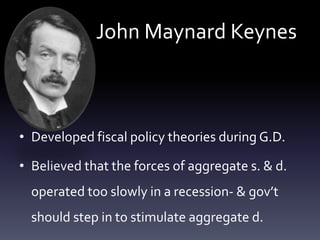
John Maynard Keynes
• Developed fiscal policy theories during G.D.
• Believed that the forces of aggregate s. & d.
operated too slowly in a recession- & gov’t
should step in to stimulate aggregate d.
Circular Flow of Income
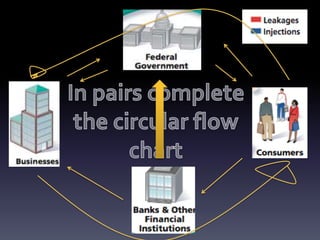
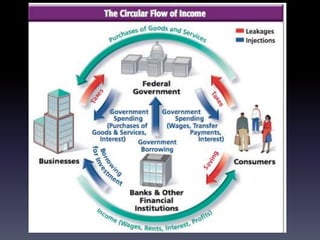
• CFoI- economic model that pictures income as
flowing continuously b/w businesses &
consumers [remember Ch. 2?]
• Flows from businesses to households as wages,
rents, interests and profits.
• Income flows from households to businesses as
payments for consumer goods & services
Exceptions to every Rule
• Not all income follows this flow:
– Some are removed from the economy through
consumer saving and government taxation
• Leakage-This removal of money income
– Offsetting leakages of income are injections of income into
the economy
– Injections occur through business investment & government
spending
Ideally
• Leakages & Injections balance each other
• W/ this equilibrium, the income that
households save is reinjected through
business investments
• Income taken out through taxes is returned
through government spending
Review
• How does income flow
between businesses and
consumer?
Fiscal Policy & Unemployment
• The creation of job programs to reduce unemployment &
stimulate the economy
• Cuts in federal taxes used in an attempt to speed up
economic activity & fight unemployment
• Giving businesses tax credits on investments allows them
to deduct from their taxes some of the costs of new capital
equipment
– Encouraging businesses to expand production and hire more
workers
Fiscal Policy & Inflation
• Reduce inflation by
increasing taxes and/or
reducing government
spending
– Will reduce the aggregate
demand for goods/services
– People paying higher taxes will
have less spendable income
– What will businesses do?
However…
• As inflation fails, unemployment rises slightly
b/c of less business activity
• THEREFORE, fiscal policy as a means of
reducing inflation has NOT been used
frequently…
Review
• How can federal government use fiscal policy
to combat unemployment? [½ of the class]
• Explain how the government policy of
increasing federal, state, or local taxes could
eventually lower inflation [other ½]
Applying the Concept
• Keynesian economists believe the Great
Depression resulted from a serious imbalance of
leakages and injections. In the months following
the stock market crash of 1929, the desire and
ability of businesses to invest collapsed, reducing
output and causing a high rate of
unemployment. What should the government
have done?
Increased injections of government spending or cutting
taxes- giving businesses & consumers more disposable
income
MONETARISM ANDTHE
ECONOMY
Section 3
Learning Goals
• Analyze the monetarists’ theory on what the
government and the Fed should do to
stabilize the economy.
• Explain the monestarists criticisms of fiscal
policy.
Vocabulary
• Monetarism- theory that deals with the
relationship between the amount of money the
Fed places in circulation and the level of activity
in the economy
• Monetarists- siupporters of the theory of
monetarism, often linked with Milton Friedman
TheTheory
• [Chapter 15],The FED can change the growth
rate of the money supply.
• Friedman and others believe money supply
should be increased by a given % ea.Yr.
• When the amount of $ in circulation expands
too rapidly, people spend more
Case Studies
• If the economy is operating below capacity, this
extra demand will lead to a rise in output
• To produce more, businesses will have to hire
more workers and unemployment will decrease
• BUT if there is full employment, the increased
aggregate demand will lead to a rise in the
prices- inflation
Government Policy According to
Monetarists
• Friedman believed the government does more harm
than good in trying to 2nd guess businesspeople &
consumers.
• Government should not operate with budget deficits
ea.Yr. in an attempt to stimulate the economy
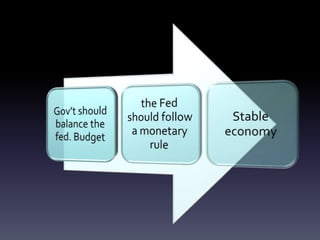
• Instead the gov’t should should balance the federal
budget
A Balanced Budget
• Would keep government from competiting with
private business to borrow money in the credit
market
• Reduce the amoung of interest the government
must pay ea.Yr.
• Monetarists oppose fiscal policy for
stimulating/slowing an economy
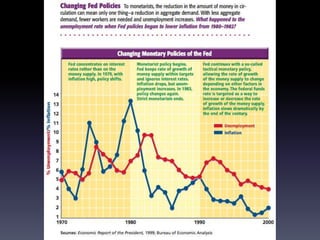
Monetarists view of the Fed
• The Fed should stop trying to smooth the
economy
• Should follow a monetary rule- monetarists’
belief that the Fed should allow the money
supply to grow at a smooth, consistent rate per
year and not use monetary policy to stimulate or
slow the economy.
The ideal
• According to monetarism- this would result in
a controlled expansion of the economy
without rapid inflation or high unemployment
MonetaristTheory and the
Federal Reserve
• Theory had a major influence on Federal
Reserve policies in the 1980s
Monetarists’ Criticism of Fiscal
Policy
• Fiscal policy never matches the reality for 2
reasons:
– Political process of fiscal policy- no single gov’t body
designs & implements fiscal policy
– Implementation of fiscal policy- time lags- periods
b/w the time fiscal policy is enacted and the time it
becomes effective
Case Study
Fiscal Policy
• President with direcor of the
Office of Management and
Budhet, the secretary of the
Treasury, and the Council of
Economic Advisers- design yet
only recommends the desired
mix of taxes & gov’t
expenditures.
Congress
• w/ the aid of many committees,
enacts fiscal policy
• Power to enact policy does not
rest with a single entity- thus
disagreements occur b/w
Congress & the President
• PLUS politicians have incentives
to take actions that will get them
reelected but may hurt the
economy in the long run
Time Goes by so Slowly
• Due to time lags it can take months, or years for fiscal
policy stimuli to cause employment to rise in the
economy
• Consequently, fiscal policy designed to combat a
recession might not produce results until the economy
is already experiencing inflation
• This means fiscal policy could worsen the situation
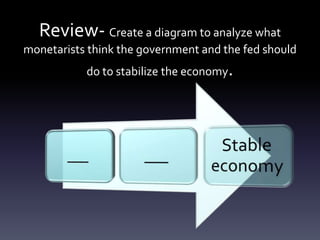
Review- Create a diagram to analyze what
monetarists think the government and the fed should
do to stabilize the economy.
Think-Pair-Share
• Describe in your own words the difference
between monetarism and monetary policy.
Share your description with a classmate until
they understand the difference.
Answer
• Monetarism is the theory that deals w/ the
relationship b/w the amount of $ in circulation
& economic activity; whereas monetary policy
is the action taken by the Ged to increase or
decrease the money supply.

17 stabilizing the economy

  • 1.
  • 2.
  • 3.
    Learning Goals • Identifythe two problems the government faces in measuring unemployment • Describe the 4 kinds of unemployment. • Explain how demand-pull inflation differs from cost-push inflation
  • 4.
    Stabilization Policies • Unemploymentleads to uncertainty – For people on it – For the American economy • Stabilization policies are used to keep the economy healthy and the future predictable for planning, saving and investing through monetary & fiscal policies
  • 5.
    Measuring Unemployment • Unemploymentrate- the % of the civilian labor force that is w/out jobs but that IS actively looking for work. • High unemployment = trouble in the economy • Maintaining low unemployment rate is a major goal in stabilizing the economy
  • 7.
    Types of Unemployment CyclicalUnemployment associated with up or down fluctuations in the business cycle Rising during recessions and depressions; falls during recoveries and booms Structural Unemployment caused by changes in the economy, such as a technological advances or discoveries of natural resources Can result when workers are replaced by computers or other machines or when cheaper natural resources are found else-where; often affects less skilled workers
  • 8.
    Seasonal Unemployment caused by changesin the seasons or weather Affects construction workers, particularly in the Northeast and Midwest; also affects farmworkers needed only during certain months of the growing season Frictional Temporary unemployment between jobs because of firings, layoffs, voluntary searches for new jobs, or retraining Always exists to some degree because of the time needed between jobs to find new work and the imperfect match between openings and applicants
  • 9.
    Full Employment vs Unemployment •Full employment- condition of the economy when the unemployment rate is lower than a certain perfecntage established by economists’ studies • **unemployment rate is ONLY an estimate • It does not include people who work in family businesses without receiving pay or people who are unemployed and do not look for work
  • 10.
    Unemployment Difficulties • governmentstaticians can’t interview ever person in/out of the labor force • Underground economy- transactions by people who do not follow federal and state law with respect to reporting earnings
  • 12.
    Review • Q:What aretwo problems the government faces in measuring unemployment? • A: Staticians can’t interview every person in and out of the labor force; existence of an underground economy
  • 13.
    Inflation • Economy canusually adapt to gradually rising prices [avg- 3%/yr] • High inflation= – Creditors raising interest rates to maintain level of profits – Slows economic growth – Effects standard of living- – EX.- 5% raise during 8% inflation – Especially bad for those on fixed incomes
  • 16.
    Why Does InflationOccur? • Two theories: • Demand-PullTheory [prices are pulled up by high demand] • Cost-PushTheory [prices are pushed up by high production costs and wages]
  • 17.
    Demand-Pull • Prices riseas the result of excessive business and consumer demand; demand increases faster than total supply resulting in shortages that lead to higher prices • if the FED causes the $ supply to grow to rapidly [people spend additional funds on limited supply] • Increases in government spending and in business investment • Aggregate demand can increase if taxes are reduced or consumers save less
  • 18.
    Assumption of Demand-Pull •Increased demand will increase output and reduce unemployment • EXPERIENCE has shown that rising prices + unemployment may occur @ the same time • Stagflation- the combination of inflation and low economic activity
  • 19.
    NOTICE how itis rising more rapidly than the economy’s productive capacity ALSO- the equilibrium of the economy moves from A to B meaning inflation due to rising prices D0= Usual demand D1= theAggregate demand for goods and services Example: a central bank rapidly increases the supply of $
  • 20.
    Cost-Push • Theory that higherwages and profits push up prices • Stagflation may be the result of cost-push inflation • When businesses have to pay higher wages, their costs increase to maintain profits • During cost-push period, unemployment remains high • Prices are adjusted due to higher wages/profits not aggregate demand so there is no reason to increase output or hire new workers
  • 21.
    S1= Aggregate Supply S0= Actualsupply Example: Sharp rise in price of imported oil = rising energy prices causing the cost of producing and transporting goods to rise. NOTICE:These higher production costs led to a decrease in aggregate supply ALSO- the equilibrium price moves from Z toY because of an increase in the overall price level
  • 23.
    Applying Concepts: • Inflation& Deflation: – Name some factors that could cause the price of each of the following to go up or down: – Oil – Medical CARE – ORANGE JUICE – AUTOMOBILES SHORTAGEOF OIL IMPORTS DEMAND FOR MORE MEDICAL SERVICE BADWEATHERCONDITIONS IN ORANGEGROVES HIGHERAUTO PRODUCTION COSTS OR LARGE RAISES FORAUTOWORKERS NEW CRUDE OIL DISCOVERIES BETTER HEALTH HABITS BUMPERCROPS BETTERTECH. FOR EFFICIENT PROD.
  • 24.
    CRITICALTHINKING • CAUSE &EFFECT- Construct a table that identifies the causes of inflation. List 4 causes under demand-pull inflation in column 1 & 3 causes under cost-push inflation in column 2.
  • 25.
    Demand-pull Causes Cost-pushcauses Rapid increase in the money supply High production costs Increased government spending & business investment for expansion Wage demands of large unions Reduction in taxes Excessive profit motive of large corporations Reductions in consumer saving
  • 26.
    THE FISCAL POLICYAPPROACH TO STABILIZATION Section 2
  • 27.
    Learning Goals • Identifyhow income flows between businesses and consumer • Describe how the federal government uses fiscal policy to combat unemployment
  • 28.
    2 Groups ofStabilization • 1- Emphasizes the role of the Federal Reserve • 2- the use of: fiscal policy- federal government’s use of taxation and spending policies to affect overall business activity
  • 29.
    John Maynard Keynes •Developed fiscal policy theories during G.D. • Believed that the forces of aggregate s. & d. operated too slowly in a recession- & gov’t should step in to stimulate aggregate d.
  • 30.
    Circular Flow ofIncome • CFoI- economic model that pictures income as flowing continuously b/w businesses & consumers [remember Ch. 2?] • Flows from businesses to households as wages, rents, interests and profits. • Income flows from households to businesses as payments for consumer goods & services
  • 31.
    Exceptions to everyRule • Not all income follows this flow: – Some are removed from the economy through consumer saving and government taxation • Leakage-This removal of money income – Offsetting leakages of income are injections of income into the economy – Injections occur through business investment & government spending
  • 34.
    Ideally • Leakages &Injections balance each other • W/ this equilibrium, the income that households save is reinjected through business investments • Income taken out through taxes is returned through government spending
  • 35.
    Review • How doesincome flow between businesses and consumer?
  • 36.
    Fiscal Policy &Unemployment • The creation of job programs to reduce unemployment & stimulate the economy • Cuts in federal taxes used in an attempt to speed up economic activity & fight unemployment • Giving businesses tax credits on investments allows them to deduct from their taxes some of the costs of new capital equipment – Encouraging businesses to expand production and hire more workers
  • 37.
    Fiscal Policy &Inflation • Reduce inflation by increasing taxes and/or reducing government spending – Will reduce the aggregate demand for goods/services – People paying higher taxes will have less spendable income – What will businesses do?
  • 38.
    However… • As inflationfails, unemployment rises slightly b/c of less business activity • THEREFORE, fiscal policy as a means of reducing inflation has NOT been used frequently…
  • 39.
    Review • How canfederal government use fiscal policy to combat unemployment? [½ of the class] • Explain how the government policy of increasing federal, state, or local taxes could eventually lower inflation [other ½]
  • 40.
    Applying the Concept •Keynesian economists believe the Great Depression resulted from a serious imbalance of leakages and injections. In the months following the stock market crash of 1929, the desire and ability of businesses to invest collapsed, reducing output and causing a high rate of unemployment. What should the government have done? Increased injections of government spending or cutting taxes- giving businesses & consumers more disposable income
  • 41.
  • 42.
    Learning Goals • Analyzethe monetarists’ theory on what the government and the Fed should do to stabilize the economy. • Explain the monestarists criticisms of fiscal policy.
  • 43.
    Vocabulary • Monetarism- theorythat deals with the relationship between the amount of money the Fed places in circulation and the level of activity in the economy • Monetarists- siupporters of the theory of monetarism, often linked with Milton Friedman
  • 44.
    TheTheory • [Chapter 15],TheFED can change the growth rate of the money supply. • Friedman and others believe money supply should be increased by a given % ea.Yr. • When the amount of $ in circulation expands too rapidly, people spend more
  • 45.
    Case Studies • Ifthe economy is operating below capacity, this extra demand will lead to a rise in output • To produce more, businesses will have to hire more workers and unemployment will decrease • BUT if there is full employment, the increased aggregate demand will lead to a rise in the prices- inflation
  • 46.
    Government Policy Accordingto Monetarists • Friedman believed the government does more harm than good in trying to 2nd guess businesspeople & consumers. • Government should not operate with budget deficits ea.Yr. in an attempt to stimulate the economy • Instead the gov’t should should balance the federal budget
  • 47.
    A Balanced Budget •Would keep government from competiting with private business to borrow money in the credit market • Reduce the amoung of interest the government must pay ea.Yr. • Monetarists oppose fiscal policy for stimulating/slowing an economy
  • 48.
    Monetarists view ofthe Fed • The Fed should stop trying to smooth the economy • Should follow a monetary rule- monetarists’ belief that the Fed should allow the money supply to grow at a smooth, consistent rate per year and not use monetary policy to stimulate or slow the economy.
  • 49.
    The ideal • Accordingto monetarism- this would result in a controlled expansion of the economy without rapid inflation or high unemployment
  • 50.
    MonetaristTheory and the FederalReserve • Theory had a major influence on Federal Reserve policies in the 1980s
  • 52.
    Monetarists’ Criticism ofFiscal Policy • Fiscal policy never matches the reality for 2 reasons: – Political process of fiscal policy- no single gov’t body designs & implements fiscal policy – Implementation of fiscal policy- time lags- periods b/w the time fiscal policy is enacted and the time it becomes effective
  • 53.
    Case Study Fiscal Policy •President with direcor of the Office of Management and Budhet, the secretary of the Treasury, and the Council of Economic Advisers- design yet only recommends the desired mix of taxes & gov’t expenditures. Congress • w/ the aid of many committees, enacts fiscal policy • Power to enact policy does not rest with a single entity- thus disagreements occur b/w Congress & the President • PLUS politicians have incentives to take actions that will get them reelected but may hurt the economy in the long run
  • 54.
    Time Goes byso Slowly • Due to time lags it can take months, or years for fiscal policy stimuli to cause employment to rise in the economy • Consequently, fiscal policy designed to combat a recession might not produce results until the economy is already experiencing inflation • This means fiscal policy could worsen the situation
  • 55.
    Review- Create adiagram to analyze what monetarists think the government and the fed should do to stabilize the economy.
  • 57.
    Think-Pair-Share • Describe inyour own words the difference between monetarism and monetary policy. Share your description with a classmate until they understand the difference.
  • 58.
    Answer • Monetarism isthe theory that deals w/ the relationship b/w the amount of $ in circulation & economic activity; whereas monetary policy is the action taken by the Ged to increase or decrease the money supply.