Introduction to
Macroeconomics
Presented by :
MUHAMMAD ZISHAN
HYDER RAJPUT
Introduction to Macroeconomics
 Microeconomics examines the behavior of
individual decision-making
 Macroeconomics deals with the economy as
a whole
Aggregate behavior refers to the behavior of all
households and firms together.
2 of 31
Introduction to Macroeconomics
 Sticky prices are prices that do not
always adjust rapidly to maintain the
equality between quantity supplied and
quantity demanded.
3 of 31
Introduction to Macroeconomics
 Macroeconomists often reflect on the
microeconomic principles underlying
macroeconomic analysis, or the
microeconomic foundations of
macroeconomics.
4 of 31
The Roots of Macroeconomics
 The Great Depression was
a period of severe economic
contraction and high
unemployment that began
in 1929 and continued
throughout the 1930s.
5 of 31
Macroeconomic Concerns
 Three of the major concerns of
macroeconomics are:
 Inflation
 Output growth
 Unemployment
6 of 31
Inflation and Deflation
 Inflation is an increase in the overall price
level.
 Hyperinflation is a period of very rapid
increases in the overall price level.
 Deflation is a decrease in the overall price
level.
7 of 31
Output Growth:
Short Run and Long Run
 The business cycle is the cycle of short-
term ups and downs in the economy.
 The main measure of how an economy is
doing is aggregate output:
 Aggregate output is the total quantity of
goods and services produced in an
economy in a given period.
8 of 31
Output Growth:
Short Run and Long Run
 A recession is a period during which
aggregate output declines.
 A prolonged and deep recession becomes a
depression.
 Policy makers attempt not only to smooth
fluctuations….
9 of 31
Unemployment
 The unemployment rate is the percentage of the
labor force that is unemployed.
 The unemployment rate is a key indicator of the
economy’s health.
 The existence of unemployment seems to imply that
the aggregate labor market is not in equilibrium. Why
do labor markets not clear when other markets do?
10 of 31
Government in the Macroeconomy
 There are three kinds of policy
that the government has used to
influence the macroeconomy:
1. Fiscal policy
2. Monetary policy
3. Growth or supply-side policies
11 of 31
Government in the Macroeconomy
 Fiscal policy refers to government policies
concerning taxes and spending.
 Monetary policy consists of tools used by
the Federal Reserve to control the quantity of
money in the economy.
 Growth policies are government policies
that focus on stimulating aggregate supply
instead of aggregate demand.
12 of 31
The Components of
the Macroeconomy
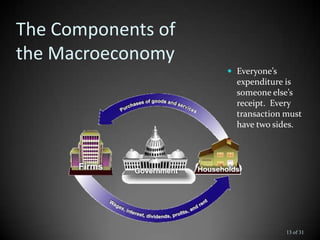
 Everyone’s
expenditure is
someone else’s
receipt. Every
transaction must
have two sides.
13 of 31
The Components of
the Macroeconomy
 Transfer payments are payments
made by the government to people
who do not supply goods, services, or
labor in exchange for these payments.
14 of 31
Financial Instruments
 Treasury bonds, notes, and bills are
promissory notes issued by the federal
government when it borrows money.
 Corporate bonds are promissory notes
issued by corporations when they borrow
money.
15 of 31
Financial Instruments
 Shares of stock are financial
instruments that give to the holder a
share in the firm’s ownership and
therefore the right to share in the firm’s
profits.
 Dividends are the portion of a
corporation’s profits that the firm pays out
each period to its shareholders.
16 of 31
CHAPTER17:IntroductiontoMacroeconomics
© 2004 Prentice Hall Business Publishing Principles of Economics, 7/e Karl Case, Ray Fair
CONCLUSION
 The macroeconomics pertains to the overall external
and internal economic behavior and pattern of any
economic state which includes large scale of public
and private sector growth as well as the impact of
recession and inflation on overall growth and
development of any economy.
17 of 31
CHAPTER17:IntroductiontoMacroeconomics
© 2004 Prentice Hall Business Publishing Principles of Economics, 7/e Karl Case, Ray Fair
18 of 31

Introduction to macro economics

  • 1.
    Introduction to Macroeconomics Presented by: MUHAMMAD ZISHAN HYDER RAJPUT
  • 2.
    Introduction to Macroeconomics Microeconomics examines the behavior of individual decision-making  Macroeconomics deals with the economy as a whole Aggregate behavior refers to the behavior of all households and firms together. 2 of 31
  • 3.
    Introduction to Macroeconomics Sticky prices are prices that do not always adjust rapidly to maintain the equality between quantity supplied and quantity demanded. 3 of 31
  • 4.
    Introduction to Macroeconomics Macroeconomists often reflect on the microeconomic principles underlying macroeconomic analysis, or the microeconomic foundations of macroeconomics. 4 of 31
  • 5.
    The Roots ofMacroeconomics  The Great Depression was a period of severe economic contraction and high unemployment that began in 1929 and continued throughout the 1930s. 5 of 31
  • 6.
    Macroeconomic Concerns  Threeof the major concerns of macroeconomics are:  Inflation  Output growth  Unemployment 6 of 31
  • 7.
    Inflation and Deflation Inflation is an increase in the overall price level.  Hyperinflation is a period of very rapid increases in the overall price level.  Deflation is a decrease in the overall price level. 7 of 31
  • 8.
    Output Growth: Short Runand Long Run  The business cycle is the cycle of short- term ups and downs in the economy.  The main measure of how an economy is doing is aggregate output:  Aggregate output is the total quantity of goods and services produced in an economy in a given period. 8 of 31
  • 9.
    Output Growth: Short Runand Long Run  A recession is a period during which aggregate output declines.  A prolonged and deep recession becomes a depression.  Policy makers attempt not only to smooth fluctuations…. 9 of 31
  • 10.
    Unemployment  The unemploymentrate is the percentage of the labor force that is unemployed.  The unemployment rate is a key indicator of the economy’s health.  The existence of unemployment seems to imply that the aggregate labor market is not in equilibrium. Why do labor markets not clear when other markets do? 10 of 31
  • 11.
    Government in theMacroeconomy  There are three kinds of policy that the government has used to influence the macroeconomy: 1. Fiscal policy 2. Monetary policy 3. Growth or supply-side policies 11 of 31
  • 12.
    Government in theMacroeconomy  Fiscal policy refers to government policies concerning taxes and spending.  Monetary policy consists of tools used by the Federal Reserve to control the quantity of money in the economy.  Growth policies are government policies that focus on stimulating aggregate supply instead of aggregate demand. 12 of 31
  • 13.
    The Components of theMacroeconomy  Everyone’s expenditure is someone else’s receipt. Every transaction must have two sides. 13 of 31
  • 14.
    The Components of theMacroeconomy  Transfer payments are payments made by the government to people who do not supply goods, services, or labor in exchange for these payments. 14 of 31
  • 15.
    Financial Instruments  Treasurybonds, notes, and bills are promissory notes issued by the federal government when it borrows money.  Corporate bonds are promissory notes issued by corporations when they borrow money. 15 of 31
  • 16.
    Financial Instruments  Sharesof stock are financial instruments that give to the holder a share in the firm’s ownership and therefore the right to share in the firm’s profits.  Dividends are the portion of a corporation’s profits that the firm pays out each period to its shareholders. 16 of 31
  • 17.
    CHAPTER17:IntroductiontoMacroeconomics © 2004 PrenticeHall Business Publishing Principles of Economics, 7/e Karl Case, Ray Fair CONCLUSION  The macroeconomics pertains to the overall external and internal economic behavior and pattern of any economic state which includes large scale of public and private sector growth as well as the impact of recession and inflation on overall growth and development of any economy. 17 of 31
  • 18.
    CHAPTER17:IntroductiontoMacroeconomics © 2004 PrenticeHall Business Publishing Principles of Economics, 7/e Karl Case, Ray Fair 18 of 31