RUNNING HEAD: Design Plan for Materials Design 1
Prof. Jonathan Acuña Solano
Design Plan for Materials Design:
Creating an EFL Reading Exercise for A1+ Learners
By Prof. Jonathan Acuña Solano
Sunday, May 3, 2015
Twitter: @jonacuso
Post 161
Antecedents
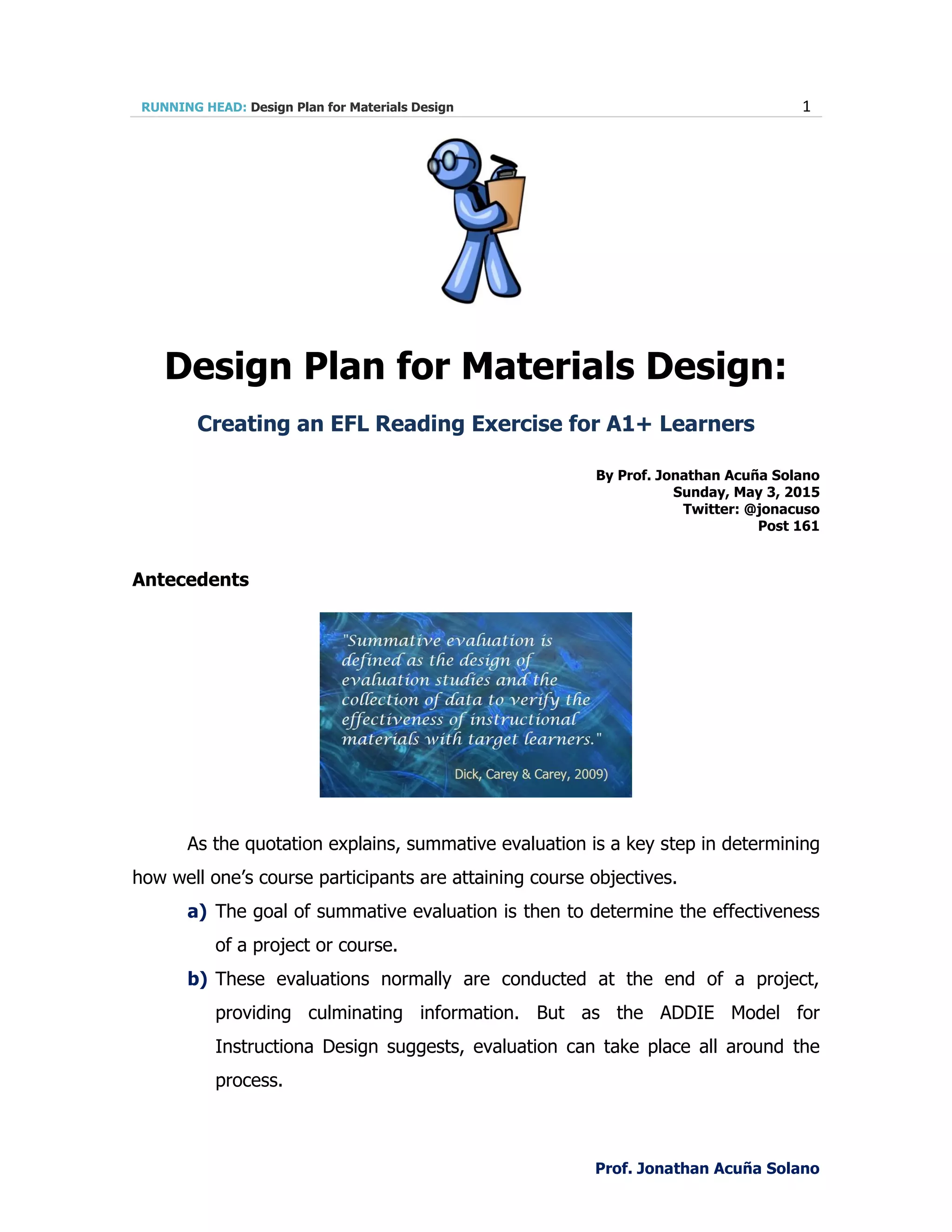
As the quotation explains, summative evaluation is a key step in determining
how well one’s course participants are attaining course objectives.
a) The goal of summative evaluation is then to determine the effectiveness
of a project or course.
b) These evaluations normally are conducted at the end of a project,
providing culminating information. But as the ADDIE Model for
Instructiona Design suggests, evaluation can take place all around the
process.
Design Plan for Materials Design 2
Prof. Jonathan Acuña Solano
c) Combined with regular formative evaluation (ongoing smaller
evaluations), the evaluation process can provide valuable information for
maintaining and improving online courses or hybrid/blended teaching
learning scenarios.
When instructional designers need to conduct an evaluation, they often create
Evaluation Plans. An Evaluation Plan examines learning objectives and teaching
goals, evaluation methods whether they are summative or formative, and available
assessment data either coming from learners as well from teachers’ memoranda. It
can indeed be used as a tool not only to plan effective course evaluation procedures
that help learners build their knowledge, but also to make sure that the assessments
in a course are aligned to learning objectives and pupils are not being graded in
areas that were not fully or at all covered during the course.
In this post, it is my intention to complete an Evaluation Plan for one week of
the online course I was developing some time ago. In this blog entry, I intend to
analyze my learning objectives, evaluation methods, and assessment data for you –
the reader- to have a better understanding of what this entails.
Evaluation Plan
As previously explained, my Materials Design students at Universidad Latina
are asked to develop all sorts of learning materials, e.g. reading tasks, for their
current or even future language learners. As part of their training, learners must
demonstrate how a reading activity is created by taking into account how to choose
the right text for a specific target group and the steps they consider the most
appropriate to use the text as much as possible as an instructional resource to help
A1 students develop their language proficiency.
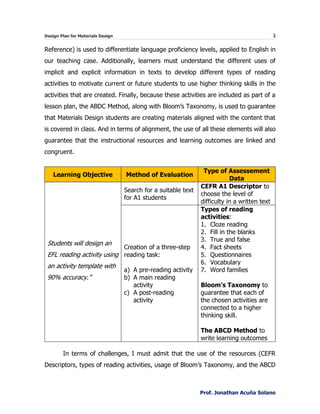
To create the right kind of reading activity, as indicated below [see chart],
students must be certain of how the CEFR (Common European Framework of
Design Plan for Materials Design 3
Prof. Jonathan Acuña Solano
Reference) is used to differentiate language proficiency levels, applied to English in
our teaching case. Additionally, learners must understand the different uses of
implicit and explicit information in texts to develop different types of reading
activities to motivate current or future students to use higher thinking skills in the
activities that are created. Finally, because these activities are included as part of a
lesson plan, the ABDC Method, along with Bloom’s Taxonomy, is used to guarantee
that Materials Design students are creating materials aligned with the content that
is covered in class. And in terms of alignment, the use of all these elements will also
guarantee that the instructional resources and learning outcomes are linked and
congruent.
Learning Objective Method of Evaluation
Type of Assessement
Data
Students will design an
EFL reading activity using
an activity template with
90% accuracy.”
Search for a suitable text
for A1 students
CEFR A1 Descriptor to
choose the level of
difficulty in a written text
Creation of a three-step
reading task:
a) A pre-reading activity
b) A main reading
activity
c) A post-reading
activity
Types of reading
activities:
1. Cloze reading
2. Fill in the blanks
3. True and false
4. Fact sheets
5. Questionnaires
6. Vocabulary
7. Word families
Bloom’s Taxonomy to
guarantee that each of
the chosen activities are
connected to a higher
thinking skill.
The ABCD Method to
write learning outcomes
In terms of challenges, I must admit that the use of the resources (CEFR
Descriptors, types of reading activities, usage of Bloom’s Taxonomy, and the ABCD
Design Plan for Materials Design 4
Prof. Jonathan Acuña Solano
Method) is crucial in materials design. If students do not really understand how all
these elements interact among them, learners will miss the whole point in designing
and creating a language activity for reading skills.
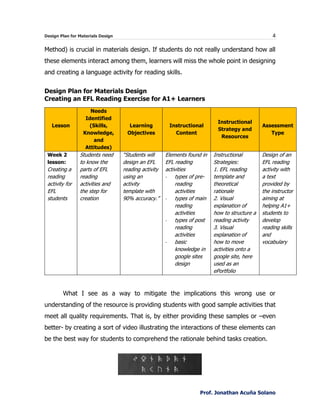
Design Plan for Materials Design
Creating an EFL Reading Exercise for A1+ Learners
Lesson
Needs
Identified
(Skills,
Knowledge,
and
Attitudes)
Learning
Objectives
Instructional
Content
Instructional
Strategy and
Resources
Assessment
Type
Week 2
lesson:
Creating a
reading
activity for
EFL
students
Students need
to know the
parts of EFL
reading
activities and
the step for
creation
“Students will
design an EFL
reading activity
using an
activity
template with
90% accuracy.”
Elements found in
EFL reading
activities
- types of pre-
reading
activities
- types of main
reading
activities
- types of post
reading
activities
- basic
knowledge in
google sites
design
Instructional
Strategies:
1. EFL reading
template and
theoretical
rationale
2. Visual
explanation of
how to structure a
reading activity
3. Visual
explanation of
how to move
activities onto a
google site, here
used as an
ePortfolio
Design of an
EFL reading
activity with
a text
provided by
the instructor
aiming at
helping A1+
students to
develop
reading skills
and
vocabulary
What I see as a way to mitigate the implications this wrong use or
understanding of the resource is providing students with good sample activities that
meet all quality requirements. That is, by either providing these samples or –even
better- by creating a sort of video illustrating the interactions of these elements can
be the best way for students to comprehend the rationale behind tasks creation.

Design Plan for Materials Design

  • 1.
    RUNNING HEAD: DesignPlan for Materials Design 1 Prof. Jonathan Acuña Solano Design Plan for Materials Design: Creating an EFL Reading Exercise for A1+ Learners By Prof. Jonathan Acuña Solano Sunday, May 3, 2015 Twitter: @jonacuso Post 161 Antecedents As the quotation explains, summative evaluation is a key step in determining how well one’s course participants are attaining course objectives. a) The goal of summative evaluation is then to determine the effectiveness of a project or course. b) These evaluations normally are conducted at the end of a project, providing culminating information. But as the ADDIE Model for Instructiona Design suggests, evaluation can take place all around the process.
  • 2.
    Design Plan forMaterials Design 2 Prof. Jonathan Acuña Solano c) Combined with regular formative evaluation (ongoing smaller evaluations), the evaluation process can provide valuable information for maintaining and improving online courses or hybrid/blended teaching learning scenarios. When instructional designers need to conduct an evaluation, they often create Evaluation Plans. An Evaluation Plan examines learning objectives and teaching goals, evaluation methods whether they are summative or formative, and available assessment data either coming from learners as well from teachers’ memoranda. It can indeed be used as a tool not only to plan effective course evaluation procedures that help learners build their knowledge, but also to make sure that the assessments in a course are aligned to learning objectives and pupils are not being graded in areas that were not fully or at all covered during the course. In this post, it is my intention to complete an Evaluation Plan for one week of the online course I was developing some time ago. In this blog entry, I intend to analyze my learning objectives, evaluation methods, and assessment data for you – the reader- to have a better understanding of what this entails. Evaluation Plan As previously explained, my Materials Design students at Universidad Latina are asked to develop all sorts of learning materials, e.g. reading tasks, for their current or even future language learners. As part of their training, learners must demonstrate how a reading activity is created by taking into account how to choose the right text for a specific target group and the steps they consider the most appropriate to use the text as much as possible as an instructional resource to help A1 students develop their language proficiency. To create the right kind of reading activity, as indicated below [see chart], students must be certain of how the CEFR (Common European Framework of
  • 3.
    Design Plan forMaterials Design 3 Prof. Jonathan Acuña Solano Reference) is used to differentiate language proficiency levels, applied to English in our teaching case. Additionally, learners must understand the different uses of implicit and explicit information in texts to develop different types of reading activities to motivate current or future students to use higher thinking skills in the activities that are created. Finally, because these activities are included as part of a lesson plan, the ABDC Method, along with Bloom’s Taxonomy, is used to guarantee that Materials Design students are creating materials aligned with the content that is covered in class. And in terms of alignment, the use of all these elements will also guarantee that the instructional resources and learning outcomes are linked and congruent. Learning Objective Method of Evaluation Type of Assessement Data Students will design an EFL reading activity using an activity template with 90% accuracy.” Search for a suitable text for A1 students CEFR A1 Descriptor to choose the level of difficulty in a written text Creation of a three-step reading task: a) A pre-reading activity b) A main reading activity c) A post-reading activity Types of reading activities: 1. Cloze reading 2. Fill in the blanks 3. True and false 4. Fact sheets 5. Questionnaires 6. Vocabulary 7. Word families Bloom’s Taxonomy to guarantee that each of the chosen activities are connected to a higher thinking skill. The ABCD Method to write learning outcomes In terms of challenges, I must admit that the use of the resources (CEFR Descriptors, types of reading activities, usage of Bloom’s Taxonomy, and the ABCD
  • 4.
    Design Plan forMaterials Design 4 Prof. Jonathan Acuña Solano Method) is crucial in materials design. If students do not really understand how all these elements interact among them, learners will miss the whole point in designing and creating a language activity for reading skills. Design Plan for Materials Design Creating an EFL Reading Exercise for A1+ Learners Lesson Needs Identified (Skills, Knowledge, and Attitudes) Learning Objectives Instructional Content Instructional Strategy and Resources Assessment Type Week 2 lesson: Creating a reading activity for EFL students Students need to know the parts of EFL reading activities and the step for creation “Students will design an EFL reading activity using an activity template with 90% accuracy.” Elements found in EFL reading activities - types of pre- reading activities - types of main reading activities - types of post reading activities - basic knowledge in google sites design Instructional Strategies: 1. EFL reading template and theoretical rationale 2. Visual explanation of how to structure a reading activity 3. Visual explanation of how to move activities onto a google site, here used as an ePortfolio Design of an EFL reading activity with a text provided by the instructor aiming at helping A1+ students to develop reading skills and vocabulary What I see as a way to mitigate the implications this wrong use or understanding of the resource is providing students with good sample activities that meet all quality requirements. That is, by either providing these samples or –even better- by creating a sort of video illustrating the interactions of these elements can be the best way for students to comprehend the rationale behind tasks creation.