In Search for Comprehending Learning Attitudes
Embrace Differences and Help College Learners Succeed
Attitudes
WASs Traditional Students
Differences Similarities Differences
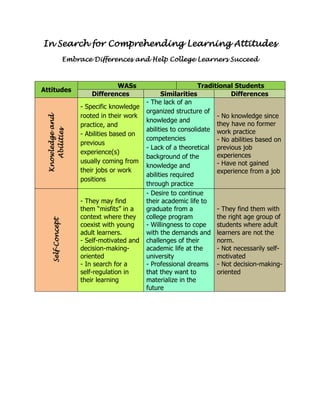
Knowledgeand
Abilities
- Specific knowledge
rooted in their work
practice, and
- Abilities based on
previous
experience(s)
usually coming from
their jobs or work
positions
- The lack of an
organized structure of
knowledge and
abilities to consolidate
competencies
- Lack of a theoretical
background of the
knowledge and
abilities required
through practice
- No knowledge since
they have no former
work practice
- No abilities based on
previous job
experiences
- Have not gained
experience from a job
Self-Concept
- They may find
them “misfits” in a
context where they
coexist with young
adult learners.
- Self-motivated and
decision-making-
oriented
- In search for a
self-regulation in
their learning
- Desire to continue
their academic life to
graduate from a
college program
- Willingness to cope
with the demands and
challenges of their
academic life at the
university
- Professional dreams
that they want to
materialize in the
future
- They find them with
the right age group of
students where adult
learners are not the
norm.
- Not necessarily self-
motivated
- Not decision-making-
oriented
Attitudes
WASs Traditional Students
Differences Similarities Differences
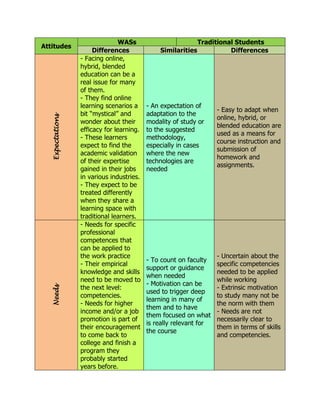
Expectations - Facing online,
hybrid, blended
education can be a
real issue for many
of them.
- They find online
learning scenarios a
bit “mystical” and
wonder about their
efficacy for learning.
- These learners
expect to find the
academic validation
of their expertise
gained in their jobs
in various industries.
- They expect to be
treated differently
when they share a
learning space with
traditional learners.
- An expectation of
adaptation to the
modality of study or
to the suggested
methodology,
especially in cases
where the new
technologies are
needed
- Easy to adapt when
online, hybrid, or
blended education are
used as a means for
course instruction and
submission of
homework and
assignments.
Needs
- Needs for specific
professional
competences that
can be applied to
the work practice
- Their empirical
knowledge and skills
need to be moved to
the next level:
competencies.
- Needs for higher
income and/or a job
promotion is part of
their encouragement
to come back to
college and finish a
program they
probably started
years before.
- To count on faculty
support or guidance
when needed
- Motivation can be
used to trigger deep
learning in many of
them and to have
them focused on what
is really relevant for
the course
- Uncertain about the
specific competencies
needed to be applied
while working
- Extrinsic motivation
to study many not be
the norm with them
- Needs are not
necessarily clear to
them in terms of skills
and competencies.
Attitudes
WASs Traditional Students
Differences Similarities Differences
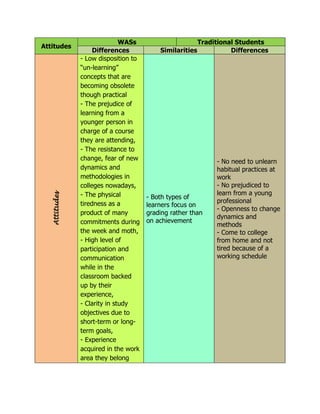
Attitudes - Low disposition to
“un-learning”
concepts that are
becoming obsolete
though practical
- The prejudice of
learning from a
younger person in
charge of a course
they are attending,
- The resistance to
change, fear of new
dynamics and
methodologies in
colleges nowadays,
- The physical
tiredness as a
product of many
commitments during
the week and moth,
- High level of
participation and
communication
while in the
classroom backed
up by their
experience,
- Clarity in study
objectives due to
short-term or long-
term goals,
- Experience
acquired in the work
area they belong
- Both types of
learners focus on
grading rather than
on achievement
- No need to unlearn
habitual practices at
work
- No prejudiced to
learn from a young
professional
- Openness to change
dynamics and
methods
- Come to college
from home and not
tired because of a
working schedule

in search for comprehending learning attitudes chart

  • 1.
    In Search forComprehending Learning Attitudes Embrace Differences and Help College Learners Succeed Attitudes WASs Traditional Students Differences Similarities Differences Knowledgeand Abilities - Specific knowledge rooted in their work practice, and - Abilities based on previous experience(s) usually coming from their jobs or work positions - The lack of an organized structure of knowledge and abilities to consolidate competencies - Lack of a theoretical background of the knowledge and abilities required through practice - No knowledge since they have no former work practice - No abilities based on previous job experiences - Have not gained experience from a job Self-Concept - They may find them “misfits” in a context where they coexist with young adult learners. - Self-motivated and decision-making- oriented - In search for a self-regulation in their learning - Desire to continue their academic life to graduate from a college program - Willingness to cope with the demands and challenges of their academic life at the university - Professional dreams that they want to materialize in the future - They find them with the right age group of students where adult learners are not the norm. - Not necessarily self- motivated - Not decision-making- oriented
  • 2.
    Attitudes WASs Traditional Students DifferencesSimilarities Differences Expectations - Facing online, hybrid, blended education can be a real issue for many of them. - They find online learning scenarios a bit “mystical” and wonder about their efficacy for learning. - These learners expect to find the academic validation of their expertise gained in their jobs in various industries. - They expect to be treated differently when they share a learning space with traditional learners. - An expectation of adaptation to the modality of study or to the suggested methodology, especially in cases where the new technologies are needed - Easy to adapt when online, hybrid, or blended education are used as a means for course instruction and submission of homework and assignments. Needs - Needs for specific professional competences that can be applied to the work practice - Their empirical knowledge and skills need to be moved to the next level: competencies. - Needs for higher income and/or a job promotion is part of their encouragement to come back to college and finish a program they probably started years before. - To count on faculty support or guidance when needed - Motivation can be used to trigger deep learning in many of them and to have them focused on what is really relevant for the course - Uncertain about the specific competencies needed to be applied while working - Extrinsic motivation to study many not be the norm with them - Needs are not necessarily clear to them in terms of skills and competencies.
  • 3.
    Attitudes WASs Traditional Students DifferencesSimilarities Differences Attitudes - Low disposition to “un-learning” concepts that are becoming obsolete though practical - The prejudice of learning from a younger person in charge of a course they are attending, - The resistance to change, fear of new dynamics and methodologies in colleges nowadays, - The physical tiredness as a product of many commitments during the week and moth, - High level of participation and communication while in the classroom backed up by their experience, - Clarity in study objectives due to short-term or long- term goals, - Experience acquired in the work area they belong - Both types of learners focus on grading rather than on achievement - No need to unlearn habitual practices at work - No prejudiced to learn from a young professional - Openness to change dynamics and methods - Come to college from home and not tired because of a working schedule