Automated Packaging
   Understanding ISO 9001 /
   Documentation Requirements
GAP ANALYSIS Of ISO-
                  9001
1. Minimum knowledge (ISO Requirements)

2. Current quality manual repeats the standard
   (Not used)

3. QPM procedures missing that show compliance
   to key processes and interaction with ISO
GAP ANALYSIS Of ISO-
                  9001
4. Too many work instructions to control

5. Internal audits not auditing to a process
   approach system.

6. Process approach not mentioned

7. SGS
Internal
 Standard
Organization

ISO-9001:2008
 Piece Of The
    Puzzle
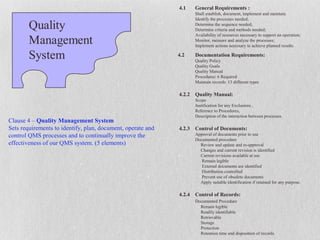
4.1     General Requirements :
                                                                     Shall establish, document, implement and maintain.
                                                                     Identify the processes needed;
                                                                     Determine the sequence needed;
                                                                     Determine criteria and methods needed;
                                                                     Availability of resources necessary to support an operation;
                                                                     Monitor, measure and analyze the processes;
                                                                     Implement actions necessary to achieve planned results.
                                                             4.2     Documentation Requirements:
                                                                     Quality Policy
                                                                     Quality Goals
                                                                     Quality Manual
                                                                     Procedures: 6 Required
                                                                     Maintain records: 13 different types

                                                             4.2.2   Quality Manual:
                                                                     Scope
                                                                     Justification for any Exclusions ,
                                                                     Reference to Procedures,
                                                                     Description of the interaction between processes.
Clause 4 – Quality Management System
Sets requirements to identify, plan, document, operate and   4.2.3   Control of Documents:
control QMS processes and to continually improve the                 Approval of documents prior to use
                                                                     Documented procedure
effectiveness of our QMS system. (5 elements)                          Review and update and re-approval
                                                                       Changes and current revision is identified
                                                                       Current revisions available at use
                                                                        Remain legible
                                                                        External documents are identified
                                                                        Distribution controlled
                                                                        Prevent use of obsolete documents
                                                                       Apply suitable identification if retained for any purpose.

                                                             4.2.4   Control of Records:
                                                                     Documented Procedure
                                                                       Remain legible
                                                                       Readily identifiable
                                                                       Retrievable
                                                                       Storage
                                                                       Protection
                                                                       Retention time and disposition of records.
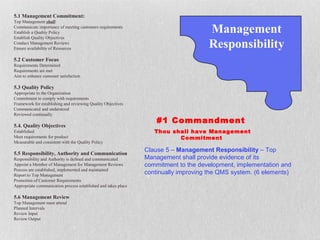
5.1 Management Commitment:
Top Management shall:
Communicate importance of meeting customers requirements
Establish a Quality Policy                                                           Management
Establish Quality Objectives
Conduct Management Reviews
Ensure availability of Resources                                                     Responsibility
5.2 Customer Focus
Requirements Determined
Requirements are met
Aim to enhance customer satisfaction

5.3 Quality Policy
Appropriate to the Organization
Commitment to comply with requirements
Framework for establishing and reviewing Quality Objectives
Communicated and understood
Reviewed continually
                                                                    #1 Commandment
5.4. Quality Objectives
Established                                                        Thou shall have Management
Meet requirements for product                                             Commitment
Measurable and consistent with the Quality Policy
                                                                Clause 5 – Management Responsibility – Top
5.5 Responsibility, Authority and Communication
Responsibility and Authority is defined and communicated        Management shall provide evidence of its
Appoint a Member of Management for Management Reviews           commitment to the development, implementation and
Process are established, implemented and maintained
Report to Top Management
                                                                continually improving the QMS system. (6 elements)
Promotion of Customer Requirements
Appropriate communication process established and takes place

5.6 Management Review
Top Management must attend
Planned Intervals
Review Input
Review Output
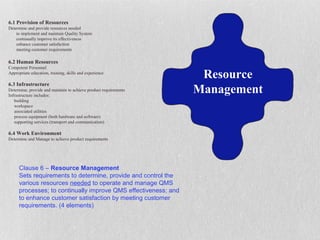
6.1 Provision of Resources
Determine and provide resources needed
    to implement and maintain Quality System
    continually improve its effectiveness
    enhance customer satisfaction
    meeting customer requirements

6.2 Human Resources
Competent Personnel
Appropriate education, training, skills and experience
                                                                   Resource
6.3 Infrastructure
Determine, provide and maintain to achieve product requirements
Infrastructure includes:
                                                                  Management
   building
   workspace
   associated utilities
   process equipment (both hardware and software)
   supporting services (transport and communication)

6.4 Work Environment
Determine and Manage to achieve product requirements


      Clause 6 – Resource Management
      Sets requirements to determine, provide and control the
      various resources needed to operate and manage QMS
      processes; to continually improve QMS effectiveness; and
      to enhance customer satisfaction by meeting customer
      requirements. (4 elements)
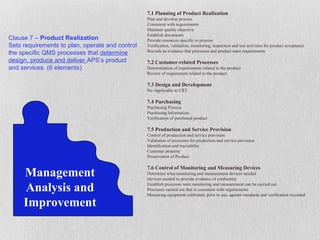
7.1 Planning of Product Realization
                                                 Plan and develop process
                                                 Consistent with requirements
                                                 Maintain quality objective
                                                 Establish documents
Clause 7 – Product Realization                   Provide resources specific to process
Sets requirements to plan, operate and control   Verification, validation, monitoring, inspection and test activities for product acceptance
                                                 Records as evidence that processes and product meet requirements
the specific QMS processes that determine
design, produce and deliver APS’s product        7.2 Customer-related Processes
and services. (6 elements)                       Determination of requirements related to the product
                                                 Review of requirement related to the product

                                                 7.3 Design and Development
                                                 No Applicable to CRT

                                                 7.4 Purchasing
                                                 Purchasing Process
                                                 Purchasing Information
                                                 Verification of purchased product

                                                 7.5 Production and Service Provision
                                                 Control of production and service provision
                                                 Validation of processes for production and service provision
                                                 Identification and traceability
                                                 Customer property
                                                 Preservation of Product

                                                 7.6 Control of Monitoring and Measuring Devices
     Management                                  Determine what monitoring and measurement devices needed
                                                 Devices needed to provide evidence of conformity

     Analysis and                                Establish processes were monitoring and measurement can be carried out
                                                 Processes carried out that is consistent with requirements
                                                 Measuring equipment calibrated, prior to use, against standards and verification recorded

     Improvement
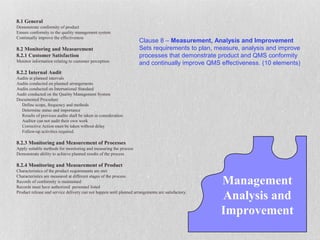
8.1 General
Demonstrate conformity of product
Ensure conformity to the quality management system
Continually improve the effectiveness
                                                                     Clause 8 – Measurement, Analysis and Improvement
8.2 Monitoring and Measurement                                       Sets requirements to plan, measure, analysis and improve
8.2.1 Customer Satisfaction                                          processes that demonstrate product and QMS conformity
Monitor information relating to customer perception
                                                                     and continually improve QMS effectiveness. (10 elements)
8.2.2 Internal Audit
Audits at planned intervals
Audits conducted on planned arrangements
Audits conducted on International Standard
Audit conducted on the Quality Management System
Documented Procedure
  Define scope, frequency and methods
  Determine status and importance
  Results of previous audits shall be taken in consideration
  Auditor can not audit their own work
  Corrective Action must be taken without delay
  Follow-up activities required.

8.2.3 Monitoring and Measurement of Processes
Apply suitable methods for monitoring and measuring the process
Demonstrate ability to achieve planned results of the process

8.2.4 Monitoring and Measurement of Product
Characteristics of the product requirements are met

                                                                                                   Management
Characteristics are measured at different stages of the process
Records of conformity is maintained
Records must have authorized personnel listed
Product release and service delivery can not happen until planned arrangements are satisfactory.
                                                                                                   Analysis and
                                                                                                   Improvement
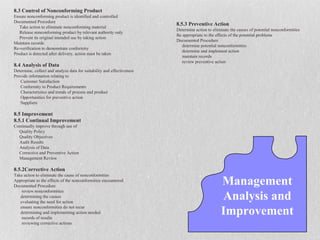
8.3 Control of Nonconforming Product
Ensure nonconforming product is identified and controlled
Documented Procedure
                                                                        8.5.3 Preventive Action
   Take action to eliminate nonconforming material
                                                                        Determine action to eliminate the causes of potential nonconformities
   Release nonconforming product by relevant authority only
                                                                        Be appropriate to the effects of the potential problems
   Prevent its original intended use by taking action
                                                                        Documented Procedure
Maintain records
                                                                           determine potential nonconformities
Re-verification to demonstrate conformity
                                                                           determine and implement action
Product is detected after delivery, action must be taken
                                                                           maintain records
                                                                           review preventive action
8.4 Analysis of Data
Determine, collect and analyze data for suitability and effectiveness
Provide information relating to
   Customer Satisfaction
   Conformity to Product Requirements
   Characteristics and trends of process and product
   Opportunities for preventive action
   Suppliers

8.5 Improvement
8.5.1 Continual Improvement
Continually improve through use of
  Quality Policy
  Quality Objectives
  Audit Results
  Analysis of Data
  Corrective and Preventive Action
  Management Review

8.5.2Corrective Action
Take action to eliminate the cause of nonconformities
Appropriate to the effects of the nonconformities encountered
Documented Procedure
                                                                                                Management
                                                                                                Analysis and
    review nonconformities
   determining the causes
   evaluating the need for action
   ensure nonconformities do not recur
   determining and implementing action needed
    records of results
                                                                                                Improvement
    reviewing corrective actions
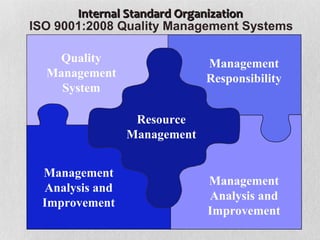
Internal Standard Organization
ISO 9001:2008 Quality Management Systems

   Quality                   Management
  Management                 Responsibility
    System

                 Resource
                Management


 Management
                             Management
 Analysis and
                             Analysis and
 Improvement
                             Improvement
ISO DOCUMENTATION
To some companies, the point of ISO 9001 registration
is to get a certificate.

While important to convince customers that certain
procedures are in place, a certificate can be a very
expensive piece of paper if that is the only benefit
realized by an organization.

 The QMS Quality Management System must be
 planned and implemented by Top Management.
In most cases the understanding of the requirements is that
a lot of procedures and documents are needed. So the myth
of ISO 9001 being a documentation nightmare is still a
common misconception at many levels of management.
To some organization, the point of ISO 9001 registration
is to get a certificate to convince customers that
procedures are in place and they comply to the
standard. A certificate can be a very expensive piece of
paper if that is the only benefit realized by an
organization.


The (QMS) Quality Management System must be planned
and implemented by Top Management.
One of the major issues of the previous revision of the
standard was that it required extensive documentation. The
new revised standard has significantly reduced mandatory
documented procedures. It has given greater flexibility to
determine the documented procedures and instructions
based on the nature of activities and processes.
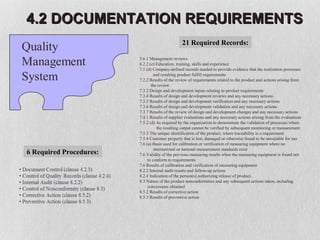
4.2 DOCUMENTATION REQUIREMENTS
                                                 21 Required Records:

                         5.6.1 Management reviews
                         6.2.2 (e) Education, training, skills and experience
                         7.1 (d) Company-defined records needed to provide evidence that the realization processes
                                  and resulting product fulfill requirements
                         7.2.2 Results of the review of requirements related to the product and actions arising from
                                the review
                         7.3.2 Design and development inputs relating to product requirements
                         7.3.4 Results of design and development reviews and any necessary actions
                         7.3.5 Results of design and development verification and any necessary actions
                         7.3.6 Results of design and development validation and any necessary actions
                         7.3.7 Results of the review of design and development changes and any necessary actions
                         7.4.1 Results of supplier evaluations and any necessary actions arising from the evaluations
                         7.5.2 (d) As required by the organization to demonstrate the validation of processes where
                                    the resulting output cannot be verified by subsequent monitoring or measurement
                         7.5.3 The unique identification of the product, where traceability is a requirement
                         7.5.4 Customer property that is lost, damaged or otherwise found to be unsuitable for use
                         7.6 (a) Basis used for calibration or verification of measuring equipment where no
                                  international or national measurement standards exist
6 Required Procedures:   7.6 Validity of the previous measuring results when the measuring equipment is found not
                              to conform to requirements
                         7.6 Results of calibration and verification of measuring equipment
                         8.2.2 Internal audit results and follow-up actions
                         8.2.4 Indication of the person(s) authorizing release of product.
                         8.3 Nature of the product nonconformities and any subsequent actions taken, including
                              concessions obtained
                         8.5.2 Results of corrective action
                         8.5.3 Results of preventive action
So does our Quality Management System have to be
complicated and cumbersome?

Complying with ISO 9001:2008 does not have to be a
“document nightmare.” Understanding the requirements of
the standard and developing ways to meet them is what we
need, “A review of the standard”.

ISO 9001 can only be a documentation nightmare if we
choose to make it so.


  We Need To Avoid Drowning
  in Detail…..
The old adage frequently applied to ISO 9001 is “Say what
you do and do what you say.” Some of us seem to take this
to mean “Write down everything you do,” but that is not
required by the standard. The actual requirement is that
processes are well-defined and responsibilities clearly
communicated. This can be accomplished through a lot of
methods that require little documentation, such as training.

The key concept is that the goal is to use the ISO 9001
standard to improve our business, and if it becomes a
burdensome paper bureaucracy, then that is probably not
happening. Using a Leaner (meaning not wasteful) approach
to ISO 9001 is one way to ensure saving time in our
documentation and cost in revising / reviewing documents.
ISO 9001 Quality Management
                System
There is nothing in the ISO requirements that says a Quality Manual /
QMS Quality Management System procedures needs to be 50 pages
or more. However, most Quality Manual seem to follow the pattern of
addressing each and every ISO 9001 “shall” statement by essentially
repeating the standard’s requirements as we have in our APS Quality
Manual. This is an incredible waste of time and cost! (see examples)
        •Waste is hidden in all processes
        •Identifying and eliminating waste
        •When waste is identified, it becomes clear that it
            adds no value to the customer and increases our
            operating cost.
ISO 9001 Quality Management
                System

Clause 4.2.2 of ISO 9001:2008 states the following:
The organization shall establish and maintain a quality
manual that includes;
a)the scope of the quality management system, including
details of and justification for any exclusions.
b)the documented procedures established for the (QMS)
Quality Management System, or reference to them.
c)and a description of the interaction between the
processes of the (QMS) Quality Management System.
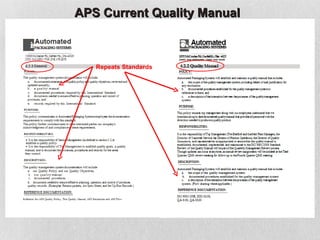
APS Current Quality Manual


   Repeats Standards
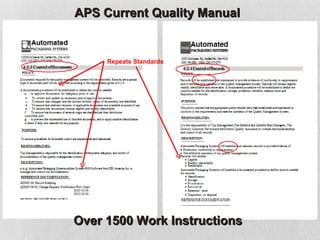
APS Current Quality Manual


     Repeats Standards


Over 1500 Work Instructions
Leaner ISO 9001
   QMS – Quality Management System
     Purposing a revised Quality Manual

  Core Quality Manual for all of Plastic
Operations with basic statements showing
Top Managements commitment to comply
           with ISO-9001:2008

   See attached Quality Manual examples

If approved my management to move forward.
   This quality manual will replace the current
           APS manual in lotus notes
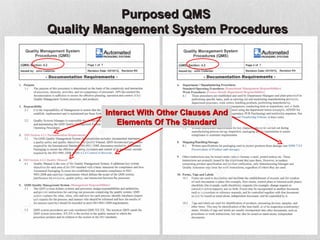
Purposed QMS
Quality Management System Procedures


        Interact With Other Clauses And
           Elements Of The Standard
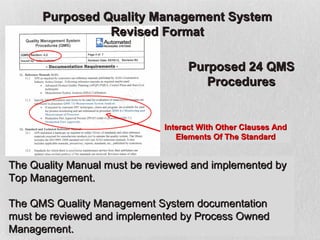
Purposed Quality Management System
                Revised Format

                                    Purposed 24 QMS
                                       Procedures


                              Interact With Other Clauses And
                                 Elements Of The Standard


The Quality Manual must be reviewed and implemented by
Top Management.

The QMS Quality Management System documentation
must be reviewed and implemented by Process Owned
Management.
Lean ISO 9001
 Quality Management Systems


The goal of our QMS Quality Management System procedures
is to document key processes. The ISO 9001 Standard does
not specify any format for writing procedures, nor does it
specify a length. Since no one wants to read long-winded,
boring procedures – why write them? Why not write one, two
or three page procedures using brief and easy to understand?
I am proposing using a LEAN approach which makes
procedures more useful so they can benefit us instead of being
a paper burden.
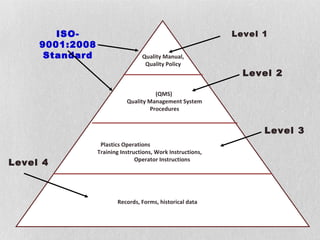
ISO-                                                 Level 1
     9001:2008
      Standard                    Quality Manual,
                                   Quality Policy
                                                               Level 2

                                       (QMS)
                            Quality Management System
                                     Procedures


                                                                   Level 3
                  Plastics Operations
                 Training Instructions, Work Instructions,
                                Operator Instructions
Level 4


                        Records, Forms, historical data
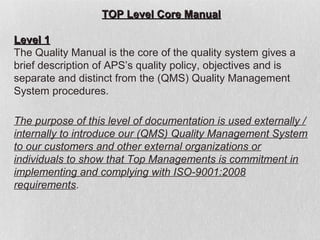
TOP Level Core Manual

Level 1
The Quality Manual is the core of the quality system gives a
brief description of APS’s quality policy, objectives and is
separate and distinct from the (QMS) Quality Management
System procedures.

The purpose of this level of documentation is used externally /
internally to introduce our (QMS) Quality Management System
to our customers and other external organizations or
individuals to show that Top Managements is commitment in
implementing and complying with ISO-9001:2008
requirements.
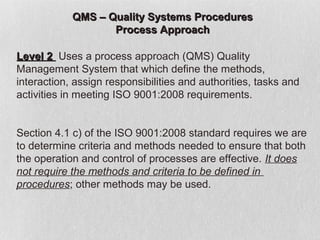
QMS – Quality Systems Procedures
                   Process Approach

Level 2 Uses a process approach (QMS) Quality
Management System that which define the methods,
interaction, assign responsibilities and authorities, tasks and
activities in meeting ISO 9001:2008 requirements.


Section 4.1 c) of the ISO 9001:2008 standard requires we are
to determine criteria and methods needed to ensure that both
the operation and control of processes are effective. It does
not require the methods and criteria to be defined in
procedures; other methods may be used.
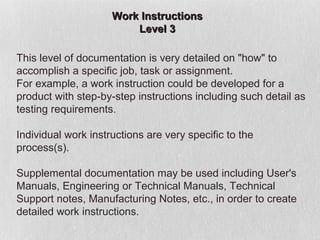
Work Instructions
                         Level 3

This level of documentation is very detailed on "how" to
accomplish a specific job, task or assignment.
For example, a work instruction could be developed for a
product with step-by-step instructions including such detail as
testing requirements.

Individual work instructions are very specific to the
process(s).

Supplemental documentation may be used including User's
Manuals, Engineering or Technical Manuals, Technical
Support notes, Manufacturing Notes, etc., in order to create
detailed work instructions.
Level 4 - Forms and other
            Documents


The last level of documentation can include forms, records,
checklists, surveys, and other documents used in the
production or delivery of a product or service.
ISO-9001:2008 Clause .2
    Process Approach


What Is Process Approach?
Promote Clause .2 Process Approach

The ISO-9001:2008 Standard promotes the adoption of a
process approach when developing, implementing and
improving the effectiveness of a QMS System.
Clause .2 Process Approach

 (COP’s)

"Core" processes (also known as Customer-Oriented-
Processes) are product realization processes that determine
customer requirements. These processes have a direct
impact on the customer.

Examples of core processes include:
•Design & Development
•Production (manufacturing, outsourcing, testing, etc.)
•Invoicing
Clause .2 Process Approach

(SOP’s)

  “These processes ('SOPs') (also known as Support-
  Oriented-Processes) provide the necessary resources to
  COP’s to facilitate product realization.

  Some support functions are:
  Purchasing - Supplier management processes,
  Requisitions, Request for Quote
  Others – Quality, HR, IT, Engineering, Training
Clause .2 Process Approach

(MOP’s)
 “These processes ('MOPs') (also known as Management-
 Oriented Processes) provide the commitment, leadership,
 resources, review and decision-making by Top
 Management.
 Examples of management processes include:
 •Quality policy and objectives
 •Planning (Strategic, Operational)
 •Resource management
 •Customer focus
 •Management reviews
 •Corrective Action
 •Control of documents and records
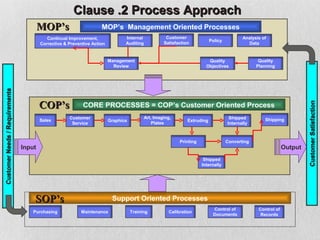
Clause .2 Process Approach
                                        MOP’s                       MOP’s Management Oriented Processes
                                           Continual Improvement,               Internal             Customer                              Analysis of
                                                                                                                           Policy
                                        Corrective & Preventive Action          Auditing            Satisfaction                             Data


                                                                         Management                                      Quality                  Quality
                                                                           Review                                       Objectives               Planning
Customer Needs / Requirements


                                        COP’s


                                                                                                                                                                        Customer Satisfaction
                                                           CORE PROCESSES = COP’s Customer Oriented Process
                                                     Customer                              Art, Imaging,                             Shipped         Shipping
                                        Sales                            Graphics                              Extruding
                                                      Service                                  Plates                               Internally


                                                                                                           Printing                 Converting
                                Input                                                                                                                          Output
                                                                                                                       Shipped
                                                                                                                      Internally


                                    SOP’s                                 Support Oriented Processes
                                                                                                                            Control of            Control of
                                    Purchasing             Maintenance              Training          Calibration
                                                                                                                            Documents              Records
Promoting The Use Of Process
Approach During Internal Auditing
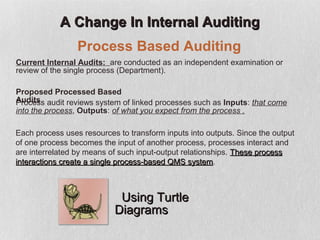
A Change In Internal Auditing
                 Process Based Auditing
Current Internal Audits: are conducted as an independent examination or
review of the single process (Department).

Proposed Processed Based
Audits audit reviews system of linked processes such as Inputs: that come
Process
into the process, Outputs: of what you expect from the process .

Each process uses resources to transform inputs into outputs. Since the output
of one process becomes the input of another process, processes interact and
are interrelated by means of such input-output relationships. These process
interactions create a single process-based QMS system.
                                                 system


                            Using Turtle
                           Diagrams
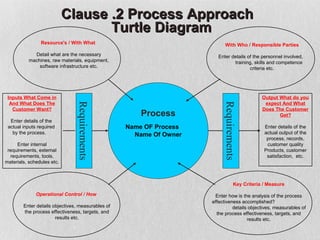
Clause .2 Process Approach
                                   Turtle Diagram
                Resource's / With What                                     With Who / Responsible Parties
             Detail what are the necessary                             Enter details of the personnel involved,
           machines, raw materials, equipment,                                training, skills and competence
               software infrastructure etc.                                           criteria etc.


 Inputs What Come in                                                                          Output What do you
  And What Does The                                                                            expect And What
                                Requirements


                                                                          Requirements
   Customer Want?                                                                             Does The Customer
                                                       Process                                       Get?
  Enter details of the
 actual inputs required                            Name OF Process                             Enter details of the
   by the process.                                   Name Of Owner                             actual output of the
                                                                                                process, records,
     Enter internal                                                                             customer quality
 requirements, external                                                                        Products, customer
  requirements, tools,                                                                          satisfaction, etc.
materials, schedules etc.


                                                                                  Key Criteria / Measure

              Operational Control / How                               Enter how is the analysis of the process
                                                                     effectiveness accomplished?
        Enter details objectives, measurables of                               details objectives, measurables of
        the process effectiveness, targets, and                        the process effectiveness, targets, and
                       results etc.                                                   results etc.
Clause .2 Process Approach
                               Turtle Diagram
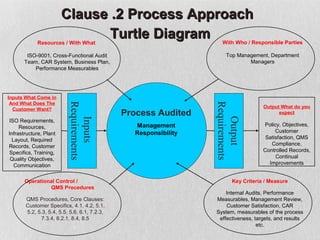
            Resources / With What                                   With Who / Responsible Parties

        ISO-9001, Cross-Functional Audit                             Top Management, Department
       Team, CAR System, Business Plan,                                      Managers
           Performance Measurables


Inputs What Come in
 And What Does The
                          Requirements


                                                                 Requirements
                                                                                    Output What do you
  Customer Want?
                                              Process Audited                             expect


                                                                    Output
                             Inputs


ISO Requirements,
     Resources,                                 Management                          Policy, Objectives,
Infrastructure, Plant                           Responsibility                           Customer
  Layout, Required                                                                   Satisfaction, QMS
Records, Customer                                                                      Compliance,
 Specifics, Training,                                                               Controlled Records,
 Quality Objectives,                                                                     Continual
   Communication                                                                      Improvements


       Operational Control /                                            Key Criteria / Measure
                QMS Procedures
                                                                     Internal Audits, Performance
       QMS Procedures, Core Clauses:                             Measurables, Management Review,
       Customer Specifics, 4.1, 4.2, 5.1,                            Customer Satisfaction, CAR
       5.2, 5.3, 5.4, 5.5, 5.6, 6.1, 7.2.3,                      System, measurables of the process
              7.3.4, 8.2.1, 8.4, 8.5                              effectiveness, targets, and results
                                                                                  etc.
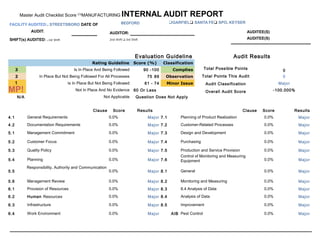
Master Audit Checklist Score 0730MANUFACTURING               INTERNAL AUDIT REPORT
                                                                       BEDFORD                      GARFIEL ❑ SANTA FE ❑ SPO KEYSER
FACILITY AUDITED: STREETSBORO DATE OF
                                                                                                                                  ❑
                        ❑


               AUDIT:                                          AUDITOR:                                                                        AUDITEE(S)
SHIFT(s) AUDITED:       ❑   1st Shift                          2nd Shift ❑ 3rd Shift                                                           AUDITEE(S)


                                                                                 Evaluation Guideline                                 Audit Results
                                                     Rating Guideline           Score (%)        Classification
      3                                    Is In Place And Being Followed              90 -100       Complies          Total Possible Points                    0
      2             In Place But Not Being Followed For All Processes                   75 89-    Observation         Total Points This Audit                   0
      1                                 Is In Place But Not Being Followed             61 - 74    Minor Issue          Audit Classification                   Major
MP!                                         Not In Place And No Evidence        60 Or Less                             Overall Audit Score                  -100.000%
      N/A                                                  Not Applicable         Question Does Not Apply


                                                     Clause      Score             Results                                                 Clause    Score            Results
4.1          General Requirements                             0.0%                      Major 7.1        Planning of Product Realization              0.0%              Major
4.2          Documentation Requirements                       0.0%                      Major 7.2        Customer-Related Processes                   0.0%              Major

5.1          Management Commitment                            0.0%                      Major 7.3        Design and Development                       0.0%              Major

5.2          Customer Focus                                   0.0%                      Major 7.4        Purchasing                                   0.0%              Major

5.3          Quality Policy                                   0.0%                      Major 7.5        Production and Service Provision             0.0%              Major
                                                                                                         Control of Monitoring and Measuring
5.4          Planning                                         0.0%                      Major 7.6        Equipment                                    0.0%              Major
             Responsibility, Authority and Communication
5.5                                                           0.0%                      Major 8.1        General                                      0.0%              Major

5.6          Management Review                                0.0%                      Major 8.2        Monitoring and Measuring                     0.0%              Major
6.1          Provision of Resources                           0.0%                      Major 8.3        8.4 Analysis of Data                         0.0%              Major
6.2          Human Resources                                  0.0%                      Major 8.4        Analysis of Data                             0.0%              Major

6.3          Infrastructure                                   0.0%                      Major 8.5        Improvement                                  0.0%              Major

6.4          Work Environment                                 0.0%                      Major       AIB Pest Control                                  0.0%              Major
SGS Registrar
FICCI
                          CE


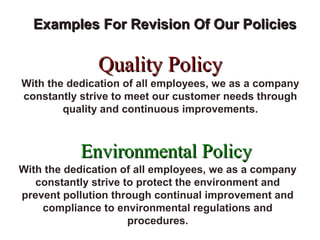
  Examples For Revision Of Our Policies

               Quality Policy
With the dedication of all employees, we as a company
constantly strive to meet our customer needs through
        quality and continuous improvements.


           Environmental Policy
With the dedication of all employees, we as a company
   constantly strive to protect the environment and
prevent pollution through continual improvement and
    compliance to environmental regulations and
                      procedures.
That’s a wrap!
 Thank you!

Iso 9001 understanding rev3

  • 1.
    Automated Packaging Understanding ISO 9001 / Documentation Requirements
  • 2.
    GAP ANALYSIS OfISO- 9001 1. Minimum knowledge (ISO Requirements) 2. Current quality manual repeats the standard (Not used) 3. QPM procedures missing that show compliance to key processes and interaction with ISO
  • 3.
    GAP ANALYSIS OfISO- 9001 4. Too many work instructions to control 5. Internal audits not auditing to a process approach system. 6. Process approach not mentioned 7. SGS
  • 5.
  • 6.
    4.1 General Requirements : Shall establish, document, implement and maintain. Identify the processes needed; Determine the sequence needed; Determine criteria and methods needed; Availability of resources necessary to support an operation; Monitor, measure and analyze the processes; Implement actions necessary to achieve planned results. 4.2 Documentation Requirements: Quality Policy Quality Goals Quality Manual Procedures: 6 Required Maintain records: 13 different types 4.2.2 Quality Manual: Scope Justification for any Exclusions , Reference to Procedures, Description of the interaction between processes. Clause 4 – Quality Management System Sets requirements to identify, plan, document, operate and 4.2.3 Control of Documents: control QMS processes and to continually improve the Approval of documents prior to use Documented procedure effectiveness of our QMS system. (5 elements) Review and update and re-approval Changes and current revision is identified Current revisions available at use Remain legible External documents are identified Distribution controlled Prevent use of obsolete documents Apply suitable identification if retained for any purpose. 4.2.4 Control of Records: Documented Procedure Remain legible Readily identifiable Retrievable Storage Protection Retention time and disposition of records.
  • 7.
    5.1 Management Commitment: TopManagement shall: Communicate importance of meeting customers requirements Establish a Quality Policy Management Establish Quality Objectives Conduct Management Reviews Ensure availability of Resources Responsibility 5.2 Customer Focus Requirements Determined Requirements are met Aim to enhance customer satisfaction 5.3 Quality Policy Appropriate to the Organization Commitment to comply with requirements Framework for establishing and reviewing Quality Objectives Communicated and understood Reviewed continually #1 Commandment 5.4. Quality Objectives Established Thou shall have Management Meet requirements for product Commitment Measurable and consistent with the Quality Policy Clause 5 – Management Responsibility – Top 5.5 Responsibility, Authority and Communication Responsibility and Authority is defined and communicated Management shall provide evidence of its Appoint a Member of Management for Management Reviews commitment to the development, implementation and Process are established, implemented and maintained Report to Top Management continually improving the QMS system. (6 elements) Promotion of Customer Requirements Appropriate communication process established and takes place 5.6 Management Review Top Management must attend Planned Intervals Review Input Review Output
  • 8.
    6.1 Provision ofResources Determine and provide resources needed to implement and maintain Quality System continually improve its effectiveness enhance customer satisfaction meeting customer requirements 6.2 Human Resources Competent Personnel Appropriate education, training, skills and experience Resource 6.3 Infrastructure Determine, provide and maintain to achieve product requirements Infrastructure includes: Management building workspace associated utilities process equipment (both hardware and software) supporting services (transport and communication) 6.4 Work Environment Determine and Manage to achieve product requirements Clause 6 – Resource Management Sets requirements to determine, provide and control the various resources needed to operate and manage QMS processes; to continually improve QMS effectiveness; and to enhance customer satisfaction by meeting customer requirements. (4 elements)
  • 9.
    7.1 Planning ofProduct Realization Plan and develop process Consistent with requirements Maintain quality objective Establish documents Clause 7 – Product Realization Provide resources specific to process Sets requirements to plan, operate and control Verification, validation, monitoring, inspection and test activities for product acceptance Records as evidence that processes and product meet requirements the specific QMS processes that determine design, produce and deliver APS’s product 7.2 Customer-related Processes and services. (6 elements) Determination of requirements related to the product Review of requirement related to the product 7.3 Design and Development No Applicable to CRT 7.4 Purchasing Purchasing Process Purchasing Information Verification of purchased product 7.5 Production and Service Provision Control of production and service provision Validation of processes for production and service provision Identification and traceability Customer property Preservation of Product 7.6 Control of Monitoring and Measuring Devices Management Determine what monitoring and measurement devices needed Devices needed to provide evidence of conformity Analysis and Establish processes were monitoring and measurement can be carried out Processes carried out that is consistent with requirements Measuring equipment calibrated, prior to use, against standards and verification recorded Improvement
  • 10.
    8.1 General Demonstrate conformityof product Ensure conformity to the quality management system Continually improve the effectiveness Clause 8 – Measurement, Analysis and Improvement 8.2 Monitoring and Measurement Sets requirements to plan, measure, analysis and improve 8.2.1 Customer Satisfaction processes that demonstrate product and QMS conformity Monitor information relating to customer perception and continually improve QMS effectiveness. (10 elements) 8.2.2 Internal Audit Audits at planned intervals Audits conducted on planned arrangements Audits conducted on International Standard Audit conducted on the Quality Management System Documented Procedure Define scope, frequency and methods Determine status and importance Results of previous audits shall be taken in consideration Auditor can not audit their own work Corrective Action must be taken without delay Follow-up activities required. 8.2.3 Monitoring and Measurement of Processes Apply suitable methods for monitoring and measuring the process Demonstrate ability to achieve planned results of the process 8.2.4 Monitoring and Measurement of Product Characteristics of the product requirements are met Management Characteristics are measured at different stages of the process Records of conformity is maintained Records must have authorized personnel listed Product release and service delivery can not happen until planned arrangements are satisfactory. Analysis and Improvement
  • 11.
    8.3 Control ofNonconforming Product Ensure nonconforming product is identified and controlled Documented Procedure 8.5.3 Preventive Action Take action to eliminate nonconforming material Determine action to eliminate the causes of potential nonconformities Release nonconforming product by relevant authority only Be appropriate to the effects of the potential problems Prevent its original intended use by taking action Documented Procedure Maintain records determine potential nonconformities Re-verification to demonstrate conformity determine and implement action Product is detected after delivery, action must be taken maintain records review preventive action 8.4 Analysis of Data Determine, collect and analyze data for suitability and effectiveness Provide information relating to Customer Satisfaction Conformity to Product Requirements Characteristics and trends of process and product Opportunities for preventive action Suppliers 8.5 Improvement 8.5.1 Continual Improvement Continually improve through use of Quality Policy Quality Objectives Audit Results Analysis of Data Corrective and Preventive Action Management Review 8.5.2Corrective Action Take action to eliminate the cause of nonconformities Appropriate to the effects of the nonconformities encountered Documented Procedure Management Analysis and review nonconformities determining the causes evaluating the need for action ensure nonconformities do not recur determining and implementing action needed records of results Improvement reviewing corrective actions
  • 12.
    Internal Standard Organization ISO9001:2008 Quality Management Systems Quality Management Management Responsibility System Resource Management Management Management Analysis and Analysis and Improvement Improvement
  • 13.
  • 14.
    To some companies,the point of ISO 9001 registration is to get a certificate. While important to convince customers that certain procedures are in place, a certificate can be a very expensive piece of paper if that is the only benefit realized by an organization. The QMS Quality Management System must be planned and implemented by Top Management. In most cases the understanding of the requirements is that a lot of procedures and documents are needed. So the myth of ISO 9001 being a documentation nightmare is still a common misconception at many levels of management.
  • 15.
    To some organization,the point of ISO 9001 registration is to get a certificate to convince customers that procedures are in place and they comply to the standard. A certificate can be a very expensive piece of paper if that is the only benefit realized by an organization. The (QMS) Quality Management System must be planned and implemented by Top Management.
  • 16.
    One of themajor issues of the previous revision of the standard was that it required extensive documentation. The new revised standard has significantly reduced mandatory documented procedures. It has given greater flexibility to determine the documented procedures and instructions based on the nature of activities and processes.
  • 17.
    4.2 DOCUMENTATION REQUIREMENTS 21 Required Records: 5.6.1 Management reviews 6.2.2 (e) Education, training, skills and experience 7.1 (d) Company-defined records needed to provide evidence that the realization processes and resulting product fulfill requirements 7.2.2 Results of the review of requirements related to the product and actions arising from the review 7.3.2 Design and development inputs relating to product requirements 7.3.4 Results of design and development reviews and any necessary actions 7.3.5 Results of design and development verification and any necessary actions 7.3.6 Results of design and development validation and any necessary actions 7.3.7 Results of the review of design and development changes and any necessary actions 7.4.1 Results of supplier evaluations and any necessary actions arising from the evaluations 7.5.2 (d) As required by the organization to demonstrate the validation of processes where the resulting output cannot be verified by subsequent monitoring or measurement 7.5.3 The unique identification of the product, where traceability is a requirement 7.5.4 Customer property that is lost, damaged or otherwise found to be unsuitable for use 7.6 (a) Basis used for calibration or verification of measuring equipment where no international or national measurement standards exist 6 Required Procedures: 7.6 Validity of the previous measuring results when the measuring equipment is found not to conform to requirements 7.6 Results of calibration and verification of measuring equipment 8.2.2 Internal audit results and follow-up actions 8.2.4 Indication of the person(s) authorizing release of product. 8.3 Nature of the product nonconformities and any subsequent actions taken, including concessions obtained 8.5.2 Results of corrective action 8.5.3 Results of preventive action
  • 18.
    So does ourQuality Management System have to be complicated and cumbersome? Complying with ISO 9001:2008 does not have to be a “document nightmare.” Understanding the requirements of the standard and developing ways to meet them is what we need, “A review of the standard”. ISO 9001 can only be a documentation nightmare if we choose to make it so. We Need To Avoid Drowning in Detail…..
  • 19.
    The old adagefrequently applied to ISO 9001 is “Say what you do and do what you say.” Some of us seem to take this to mean “Write down everything you do,” but that is not required by the standard. The actual requirement is that processes are well-defined and responsibilities clearly communicated. This can be accomplished through a lot of methods that require little documentation, such as training. The key concept is that the goal is to use the ISO 9001 standard to improve our business, and if it becomes a burdensome paper bureaucracy, then that is probably not happening. Using a Leaner (meaning not wasteful) approach to ISO 9001 is one way to ensure saving time in our documentation and cost in revising / reviewing documents.
  • 20.
    ISO 9001 QualityManagement System There is nothing in the ISO requirements that says a Quality Manual / QMS Quality Management System procedures needs to be 50 pages or more. However, most Quality Manual seem to follow the pattern of addressing each and every ISO 9001 “shall” statement by essentially repeating the standard’s requirements as we have in our APS Quality Manual. This is an incredible waste of time and cost! (see examples) •Waste is hidden in all processes •Identifying and eliminating waste •When waste is identified, it becomes clear that it adds no value to the customer and increases our operating cost.
  • 21.
    ISO 9001 QualityManagement System Clause 4.2.2 of ISO 9001:2008 states the following: The organization shall establish and maintain a quality manual that includes; a)the scope of the quality management system, including details of and justification for any exclusions. b)the documented procedures established for the (QMS) Quality Management System, or reference to them. c)and a description of the interaction between the processes of the (QMS) Quality Management System.
  • 22.
    APS Current QualityManual Repeats Standards
  • 23.
    APS Current QualityManual Repeats Standards Over 1500 Work Instructions
  • 24.
    Leaner ISO 9001 QMS – Quality Management System Purposing a revised Quality Manual Core Quality Manual for all of Plastic Operations with basic statements showing Top Managements commitment to comply with ISO-9001:2008 See attached Quality Manual examples If approved my management to move forward. This quality manual will replace the current APS manual in lotus notes
  • 25.
    Purposed QMS Quality ManagementSystem Procedures Interact With Other Clauses And Elements Of The Standard
  • 26.
    Purposed Quality ManagementSystem Revised Format Purposed 24 QMS Procedures Interact With Other Clauses And Elements Of The Standard The Quality Manual must be reviewed and implemented by Top Management. The QMS Quality Management System documentation must be reviewed and implemented by Process Owned Management.
  • 27.
    Lean ISO 9001 Quality Management Systems The goal of our QMS Quality Management System procedures is to document key processes. The ISO 9001 Standard does not specify any format for writing procedures, nor does it specify a length. Since no one wants to read long-winded, boring procedures – why write them? Why not write one, two or three page procedures using brief and easy to understand? I am proposing using a LEAN approach which makes procedures more useful so they can benefit us instead of being a paper burden.
  • 28.
    ISO- Level 1 9001:2008 Standard Quality Manual, Quality Policy Level 2 (QMS) Quality Management System Procedures Level 3 Plastics Operations Training Instructions, Work Instructions, Operator Instructions Level 4 Records, Forms, historical data
  • 29.
    TOP Level CoreManual Level 1 The Quality Manual is the core of the quality system gives a brief description of APS’s quality policy, objectives and is separate and distinct from the (QMS) Quality Management System procedures. The purpose of this level of documentation is used externally / internally to introduce our (QMS) Quality Management System to our customers and other external organizations or individuals to show that Top Managements is commitment in implementing and complying with ISO-9001:2008 requirements.
  • 30.
    QMS – QualitySystems Procedures Process Approach Level 2 Uses a process approach (QMS) Quality Management System that which define the methods, interaction, assign responsibilities and authorities, tasks and activities in meeting ISO 9001:2008 requirements. Section 4.1 c) of the ISO 9001:2008 standard requires we are to determine criteria and methods needed to ensure that both the operation and control of processes are effective. It does not require the methods and criteria to be defined in procedures; other methods may be used.
  • 31.
    Work Instructions Level 3 This level of documentation is very detailed on "how" to accomplish a specific job, task or assignment. For example, a work instruction could be developed for a product with step-by-step instructions including such detail as testing requirements. Individual work instructions are very specific to the process(s). Supplemental documentation may be used including User's Manuals, Engineering or Technical Manuals, Technical Support notes, Manufacturing Notes, etc., in order to create detailed work instructions.
  • 32.
    Level 4 -Forms and other Documents The last level of documentation can include forms, records, checklists, surveys, and other documents used in the production or delivery of a product or service.
  • 33.
    ISO-9001:2008 Clause .2 Process Approach What Is Process Approach?
  • 34.
    Promote Clause .2Process Approach The ISO-9001:2008 Standard promotes the adoption of a process approach when developing, implementing and improving the effectiveness of a QMS System.
  • 35.
    Clause .2 ProcessApproach (COP’s) "Core" processes (also known as Customer-Oriented- Processes) are product realization processes that determine customer requirements. These processes have a direct impact on the customer. Examples of core processes include: •Design & Development •Production (manufacturing, outsourcing, testing, etc.) •Invoicing
  • 36.
    Clause .2 ProcessApproach (SOP’s) “These processes ('SOPs') (also known as Support- Oriented-Processes) provide the necessary resources to COP’s to facilitate product realization. Some support functions are: Purchasing - Supplier management processes, Requisitions, Request for Quote Others – Quality, HR, IT, Engineering, Training
  • 37.
    Clause .2 ProcessApproach (MOP’s) “These processes ('MOPs') (also known as Management- Oriented Processes) provide the commitment, leadership, resources, review and decision-making by Top Management. Examples of management processes include: •Quality policy and objectives •Planning (Strategic, Operational) •Resource management •Customer focus •Management reviews •Corrective Action •Control of documents and records
  • 38.
    Clause .2 ProcessApproach MOP’s MOP’s Management Oriented Processes Continual Improvement, Internal Customer Analysis of Policy Corrective & Preventive Action Auditing Satisfaction Data Management Quality Quality Review Objectives Planning Customer Needs / Requirements COP’s Customer Satisfaction CORE PROCESSES = COP’s Customer Oriented Process Customer Art, Imaging, Shipped Shipping Sales Graphics Extruding Service Plates Internally Printing Converting Input Output Shipped Internally SOP’s Support Oriented Processes Control of Control of Purchasing Maintenance Training Calibration Documents Records
  • 39.
    Promoting The UseOf Process Approach During Internal Auditing
  • 40.
    A Change InInternal Auditing Process Based Auditing Current Internal Audits: are conducted as an independent examination or review of the single process (Department). Proposed Processed Based Audits audit reviews system of linked processes such as Inputs: that come Process into the process, Outputs: of what you expect from the process . Each process uses resources to transform inputs into outputs. Since the output of one process becomes the input of another process, processes interact and are interrelated by means of such input-output relationships. These process interactions create a single process-based QMS system. system Using Turtle Diagrams
  • 41.
    Clause .2 ProcessApproach Turtle Diagram Resource's / With What With Who / Responsible Parties Detail what are the necessary Enter details of the personnel involved, machines, raw materials, equipment, training, skills and competence software infrastructure etc. criteria etc. Inputs What Come in Output What do you And What Does The expect And What Requirements Requirements Customer Want? Does The Customer Process Get? Enter details of the actual inputs required Name OF Process Enter details of the by the process. Name Of Owner actual output of the process, records, Enter internal customer quality requirements, external Products, customer requirements, tools, satisfaction, etc. materials, schedules etc. Key Criteria / Measure Operational Control / How Enter how is the analysis of the process effectiveness accomplished? Enter details objectives, measurables of details objectives, measurables of the process effectiveness, targets, and the process effectiveness, targets, and results etc. results etc.
  • 42.
    Clause .2 ProcessApproach Turtle Diagram Resources / With What With Who / Responsible Parties ISO-9001, Cross-Functional Audit Top Management, Department Team, CAR System, Business Plan, Managers Performance Measurables Inputs What Come in And What Does The Requirements Requirements Output What do you Customer Want? Process Audited expect Output Inputs ISO Requirements, Resources, Management Policy, Objectives, Infrastructure, Plant Responsibility Customer Layout, Required Satisfaction, QMS Records, Customer Compliance, Specifics, Training, Controlled Records, Quality Objectives, Continual Communication Improvements Operational Control / Key Criteria / Measure QMS Procedures Internal Audits, Performance QMS Procedures, Core Clauses: Measurables, Management Review, Customer Specifics, 4.1, 4.2, 5.1, Customer Satisfaction, CAR 5.2, 5.3, 5.4, 5.5, 5.6, 6.1, 7.2.3, System, measurables of the process 7.3.4, 8.2.1, 8.4, 8.5 effectiveness, targets, and results etc.
  • 43.
    Master Audit ChecklistScore 0730MANUFACTURING INTERNAL AUDIT REPORT BEDFORD GARFIEL ❑ SANTA FE ❑ SPO KEYSER FACILITY AUDITED: STREETSBORO DATE OF ❑ ❑ AUDIT: AUDITOR: AUDITEE(S) SHIFT(s) AUDITED: ❑ 1st Shift 2nd Shift ❑ 3rd Shift AUDITEE(S) Evaluation Guideline Audit Results Rating Guideline Score (%) Classification 3 Is In Place And Being Followed 90 -100 Complies Total Possible Points 0 2 In Place But Not Being Followed For All Processes 75 89- Observation Total Points This Audit 0 1 Is In Place But Not Being Followed 61 - 74 Minor Issue Audit Classification Major MP! Not In Place And No Evidence 60 Or Less Overall Audit Score -100.000% N/A Not Applicable Question Does Not Apply Clause Score Results Clause Score Results 4.1 General Requirements 0.0% Major 7.1 Planning of Product Realization 0.0% Major 4.2 Documentation Requirements 0.0% Major 7.2 Customer-Related Processes 0.0% Major 5.1 Management Commitment 0.0% Major 7.3 Design and Development 0.0% Major 5.2 Customer Focus 0.0% Major 7.4 Purchasing 0.0% Major 5.3 Quality Policy 0.0% Major 7.5 Production and Service Provision 0.0% Major Control of Monitoring and Measuring 5.4 Planning 0.0% Major 7.6 Equipment 0.0% Major Responsibility, Authority and Communication 5.5 0.0% Major 8.1 General 0.0% Major 5.6 Management Review 0.0% Major 8.2 Monitoring and Measuring 0.0% Major 6.1 Provision of Resources 0.0% Major 8.3 8.4 Analysis of Data 0.0% Major 6.2 Human Resources 0.0% Major 8.4 Analysis of Data 0.0% Major 6.3 Infrastructure 0.0% Major 8.5 Improvement 0.0% Major 6.4 Work Environment 0.0% Major AIB Pest Control 0.0% Major
  • 45.
  • 46.
    FICCI CE Examples For Revision Of Our Policies Quality Policy With the dedication of all employees, we as a company constantly strive to meet our customer needs through quality and continuous improvements. Environmental Policy With the dedication of all employees, we as a company constantly strive to protect the environment and prevent pollution through continual improvement and compliance to environmental regulations and procedures.
  • 47.

Editor's Notes

  • #2 Use this presentation to introduce the project plan to the ISO Steering Team and to the Task teams. The first team meeting is a good place to present this program.