Ankle-Brachial Pressure Index (ABPI)
Jibran Mohsin
Resident, Surgical Unit I
SIMS/Services Hospital, Lahore
Outline
• Terminology
• Units
• Definition
• Concept
• Indications
• Contraindications
• Merits
• Limitations/Drawbacks/Demerits
• Why ABI?
• Why range?
• Pre-requisites
• Equipment
• How to perform?
• Calculations
• Results/Interpretations
• (Post-)Exercise (treadmill) AB(P)I
(testing)
• Besides PAD what else ABPI
indicates?
• Accuracy
• What to do next?
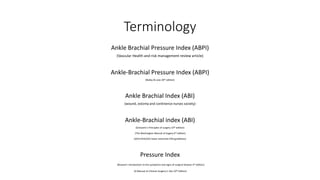
Terminology
Ankle Brachial Pressure Index (ABPI)
(Vascular Health and risk management review article)
Ankle-Brachial Pressure Index (ABPI)
(Bailey & Love 26th edition)
Ankle Brachial Index (ABI)
(wound, ostomy and continence nurses society)
Ankle-Brachial index (ABI)
(Schwartz’s Principles of surgery 10th edition)
(The Washington Manual of Sugary 6th edition)
(2016 AHA/ACC lower extremity PAD guidelines)
Pressure Index
(Browse’s introduction to the symptoms and signs of surgical disease 4th edition)
(A Manual on Clinical Surgery S. Das 10th Edition)
Terminology
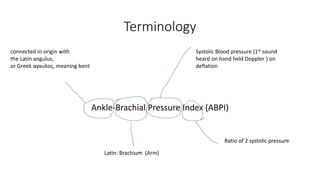
Ankle-Brachial Pressure Index (ABPI)
connected in origin with
the Latin angulus,
or Greek αγκυλος, meaning bent
Latin: Brachium (Arm)
Systolic Blood pressure (1st sound
heard on hand held Doppler ) on
deflation
Ratio of 2 systolic pressure
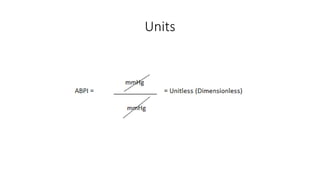
Units
Definition
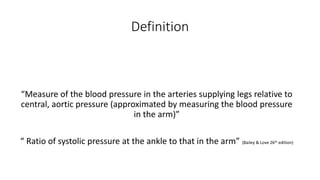
“Measure of the blood pressure in the arteries supplying legs relative to
central, aortic pressure (approximated by measuring the blood pressure
in the arm)”
“ Ratio of systolic pressure at the ankle to that in the arm” (Bailey & Love 26th edition)
Definition
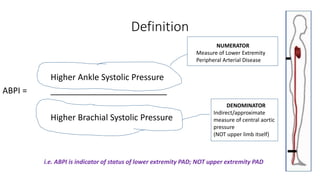
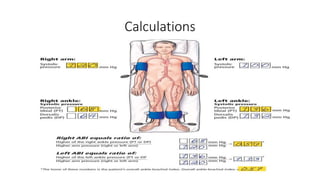
Higher Ankle Systolic Pressure
ABPI = _________________________
Higher Brachial Systolic Pressure
NUMERATOR
Measure of Lower Extremity
Peripheral Arterial Disease
DENOMINATOR
Indirect/approximate
measure of central aortic
pressure
(NOT upper limb itself)
i.e. ABPI is indicator of status of lower extremity PAD; NOT upper extremity PAD
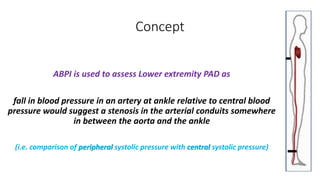
Concept
ABPI is used to assess Lower extremity PAD as
fall in blood pressure in an artery at ankle relative to central blood
pressure would suggest a stenosis in the arterial conduits somewhere
in between the aorta and the ankle
(i.e. comparison of peripheral systolic pressure with central systolic pressure)
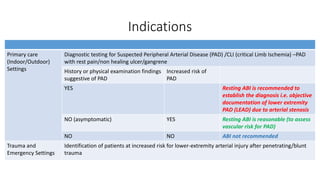
Indications
Primary care
(Indoor/Outdoor)
Settings
Diagnostic testing for Suspected Peripheral Arterial Disease (PAD) /CLI (critical Limb Ischemia) –PAD
with rest pain/non healing ulcer/gangrene
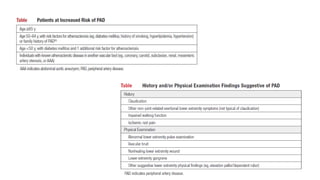
History or physical examination findings
suggestive of PAD
Increased risk of
PAD
YES Resting ABI is recommended to
establish the diagnosis i.e. objective
documentation of lower extremity
PAD (LEAD) due to arterial stenosis
NO (asymptomatic) YES Resting ABI is reasonable (to assess
vascular risk for PAD)
NO NO ABI not recommended
Trauma and
Emergency Settings
Identification of patients at increased risk for lower-extremity arterial injury after penetrating/blunt
trauma
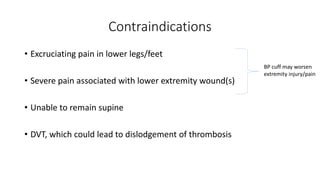
Contraindications
• Excruciating pain in lower legs/feet
• Severe pain associated with lower extremity wound(s)
• Unable to remain supine
• DVT, which could lead to dislodgement of thrombosis
BP cuff may worsen
extremity injury/pain
Merits
• Simple to perform
• Non-invasive
• Reproducible
• Cost effective
• Minimal risks
Limitations/Drawbacks/Demerits
Indirect examination that
infers the anatomical location
of an occlusion or stenosis.
Exact location of stenosis/occlusion can’t be determined by ABI alone
False negative • ABI might be elevated due to calcification of medial arteries at the ankle in certain patients
(DM/renal failure/elderly age/RA)
• Other vascular tests should be performed
• Resting ABI normal with arterial stenosis (< 50 %) having claudication i.e. ABI is biased toward the
detection of severe disease and is more consistent with duplex US when most symptomatic limbs are
compared.
• Prevalence (ABI elevated in 8.4 % with LEAD 62.2 %)
• Exercise treadmill ABI testing recommended
Lack of standardization • Position of patient during measurement
• Width and level of sphygmometer cuffs
• Use of Korotkoff method vs Dinamap vs Doppler probe to define systolic pressures
• Whether to use both brachial pressures or not in calculation of ABPI
• Whether to use all 3 crural vessels, 2. just 1 in calculation of ABPI
• Whether to use highest or mean or lowest values of pressure in calculation of ABPI
• Normal ranges for ABPI ratios
Limitations/Drawbacks/Demerits
Inter observer variability 7.3 % to 12 %
(non expert vs expert)
Dismiss changes of < 0.15 (i.e. insignificant)
Intra observer variability 8 %
Age, sex, leg, ankle vessel, respiratory phase, sequence and blood pressure (baseline hypotension/hypertension) dependent
Beat-to-beat physiological variation in SBP
Over-rapid/slow deflation rate
High-grade aorto-iliac stenosis or occlusion clinical masked by rich collateral network; ABI fails to unmask underlying lesion
No consensus that how central pressure should be approximated from arm pressure
Patient-white coat phenomena
Resting period (severe multilevel arterial disease need longer period of rest
Doppler probe selection (frequency and level of quality)
Environmental factors that can affect vasomotor tone (e.g. temperature)
Limitations/Drawbacks/Demerits
Validity of noninvasive blood pressure measurement in the context of ABI has never been assessed (e.g.
compared in real time against invasive blood pressure reading in controlled settings)
Occlusive cuff method is liable to underestimate true resting pressure drop across lesion i.e. presence of PAD
(due to reduction in blood flow through any proximal lesion at moment of SBP measurement); more marked
when lesion immediately proximal to ankle cuff
No agreement on precise normal value (or normal range)
Insensitive to detecting progression of atherosclerosis (Screening and diagnostic test but NOT prognostic test)
i.e. imaging studies are superior to ABI for monitoring progression of PAD.
Diseased vs non diseased patients groups –difference of accuracy
Cuff size/placement
Why ABI?
• Relying on clinical history has very low sensitivity for determining PAD
• Majority of PAD patients are asymptomatic and underdiagnosed.
• Intermittent claudication (primary and most often only symptom) absent in
90 % of high-risk patients (Rose criteria).
• Can’t solely rely on absent pulse palpation or other physical
examination findings to diagnose PAD
• ABI  confirmation as well as quantification.
Why Range?
• Accepted methodology of ABPI does not make any corrections for
physiological variation over time in baseline brachial SBP or other
confounders for blood pressure measurement like respiratory phase
necessitating a range to be used, rather than a point figure
Why Range?
• Why upper limit >1.0 ?
• Ankle SBP slightly higher than brachial SBP in normal supine individual due to
difference in magnitude of pressure pulse reflections from vascular beds
immediately downstream of ankle and elbow.
• Also due to difference in distance between point of measurement at ankle
and elbow from peripheral bed i.e. ankle immediately proximal to pressure
antinode (the peripheral bed represented by foot), whereas elbow is one
segment upstream from analogous peripheral bed of hand.
Why Range?
• Why lower limit < 1.0?
• Respiratory phase changes not controlled during measurement of ABPI
• i.e. ankle pressure at peak expiration with brachial pressure at peak
inspiration (3 % fall in SBP during inspiration)
• Beat-to-beat physiological variation controlled by synchronous measurements
at arm and ankle (cumbersome, NOT recommended)
• Over-rapid deflation can gives false low ankle pressure.
Pre-requisites
• No caffeine/ alcohol/tobacco/heavy activity for 1-2 hours prior to test
• Quiet, warm environment to prevent vasoconstriction of arteries (21- 23 ±
1 o C).
• Relaxed, comfortable, and empty bladder.
• Explain procedure to the patient.
• Remove socks, shoes, and tight clothing to permit placement of pressure
cuffs and access to pulse sites by Doppler.
Pre-requisites
• Place patient in a flat, supine position (i.e. arm and leg at same level as heart;
sitting position overestimate ABI by 0.30).
• Place 1 small pillow behind patient’s head for comfort.
• Apply protective barrier (e.g. plastic wrap) on extremities if any wounds or
alteration in skin integrity are present.
• Place pressure cuffs with bottom of cuff approximately 2-3 cm above the cubital
fossa on the arms and malleolus at the ankle. (via straight wrapping method)
• Cuffs should be wrapped without wrinkles and placed securely to prevent slipping and
movement during the test.
Pre-requisites
• Cover the trunk and extremities to prevent cooling.
• Ensure the patient is comfortable and have the patient rest for
minimum of 10 minutes (5 mins to 20 mins) prior to the test to allow
pressures to normalize.
Equipment
• Portable (hand-held) Doppler with 8-10 MHz probe. (Use 5 MHz probe if ankle edema) in working position
• Aneroid sphygmomanometer. (Properly calibrated) (Not pulse palpation or automated BP devices).
• Appropriate pressure cuff i.e. cuff bladder width should be 40 % of limb circumference and long enough to
cover 80 % of arm circumference
• Typically, 12 cm wide cuffs are used for arms and 10 cm wide cuffs at the ankles.
• Extra large adult cuffs might be needed (14 cm).
• Cuffs should not cover distal bypass or ulcer
• Ultrasound transmission gel.
• Alcohol pads to clean the Doppler.
• Gauze, tissue or pads to remove transmission gel from patient’s skin.
• Towels, sheets, or blankets to cover trunk and extremities.
• Paper and Pen for recording test results; calculator.
• Examination table
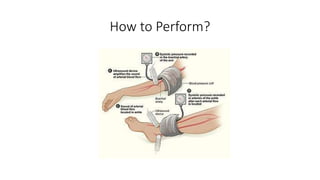
How to Perform?
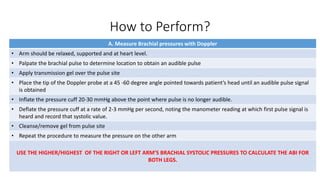
A. Measure Brachial pressures with Doppler
• Arm should be relaxed, supported and at heart level.
• Palpate the brachial pulse to determine location to obtain an audible pulse
• Apply transmission gel over the pulse site
• Place the tip of the Doppler probe at a 45 -60 degree angle pointed towards patient’s head until an audible pulse signal
is obtained
• Inflate the pressure cuff 20-30 mmHg above the point where pulse is no longer audible.
• Deflate the pressure cuff at a rate of 2-3 mmHg per second, noting the manometer reading at which first pulse signal is
heard and record that systolic value.
• Cleanse/remove gel from pulse site
• Repeat the procedure to measure the pressure on the other arm
USE THE HIGHER/HIGHEST OF THE RIGHT OR LEFT ARM’S BRACHIAL SYSTOLIC PRESSURES TO CALCULATE THE ABI FOR
BOTH LEGS.
How to Perform?
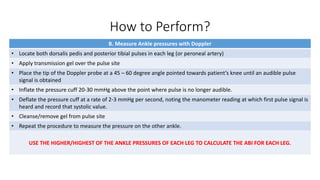
B. Measure Ankle pressures with Doppler
• Locate both dorsalis pedis and posterior tibial pulses in each leg (or peroneal artery)
• Apply transmission gel over the pulse site
• Place the tip of the Doppler probe at a 45 – 60 degree angle pointed towards patient’s knee until an audible pulse
signal is obtained
• Inflate the pressure cuff 20-30 mmHg above the point where pulse is no longer audible.
• Deflate the pressure cuff at a rate of 2-3 mmHg per second, noting the manometer reading at which first pulse signal is
heard and record that systolic value.
• Cleanse/remove gel from pulse site
• Repeat the procedure to measure the pressure on the other ankle.
USE THE HIGHER/HIGHEST OF THE ANKLE PRESSURES OF EACH LEG TO CALCULATE THE ABI FOR EACH LEG.
How to Perform?
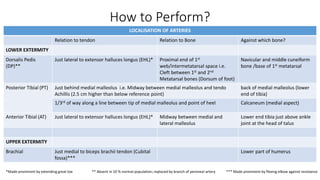
LOCALISATION OF ARTERIES
Relation to tendon Relation to Bone Against which bone?
LOWER EXTERMITY
Dorsalis Pedis
(DP)**
Just lateral to extensor halluces longus (EHL)* Proximal end of 1st
web/intermetatarsal space i.e.
Cleft between 1st and 2nd
Metatarsal bones (Dorsum of foot)
Navicular and middle cuneiform
bone /base of 1st metatarsal
Posterior Tibial (PT) Just behind medial malleolus i.e. Midway between medial malleolus and tendo
Achillis (2.5 cm higher than below reference point)
back of medial malleolus (lower
end of tibia)
1/3rd of way along a line between tip of medial malleolus and point of heel Calcaneum (medial aspect)
Anterior Tibial (AT) Just lateral to extensor halluces longus (EHL)* Midway between medial and
lateral malleolus
Lower end tibia just above ankle
joint at the head of talus
UPPER EXTERMITY
Brachial Just medial to biceps brachii tendon (Cubital
fossa)***
Lower part of humerus
*Made prominent by extending great toe ** Absent in 10 % normal population; replaced by branch of peroneal artery *** Made prominent by flexing elbow against resistance
How to Perform?
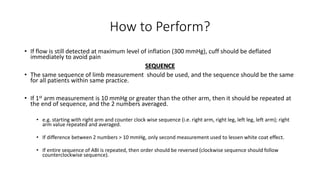
• If flow is still detected at maximum level of inflation (300 mmHg), cuff should be deflated
immediately to avoid pain
SEQUENCE
• The same sequence of limb measurement should be used, and the sequence should be the same
for all patients within same practice.
• If 1st arm measurement is 10 mmHg or greater than the other arm, then it should be repeated at
the end of sequence, and the 2 numbers averaged.
• e.g. starting with right arm and counter clock wise sequence (i.e. right arm, right leg, left leg, left arm); right
arm value repeated and averaged.
• If difference between 2 numbers > 10 mmHg, only second measurement used to lessen white coat effect.
• If entire sequence of ABI is repeated, then order should be reversed (clockwise sequence should follow
counterclockwise sequence).
How to Perform?
Calculations
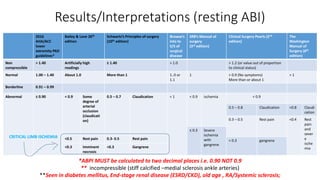
Results/Interpretations (resting ABI)
*ABPI MUST be calculated to two decimal places i.e. 0.90 NOT 0.9
** incompressible (stiff calcified –medial sclerosis ankle arteries)
**Seen in diabetes mellitus, End-stage renal disease (ESRD/CKD), old age , RA/Systemic sclerosis;
2016
AHA/ACC
lower
extremity PAD
guidelines*
Bailey & Love 26th
edition
Schwartz’s Principles of surgery
(10th edition)
Browse’s
Into to
S/S of
surgical
disease
SRB’s Manual of
surgery
(3rd edition)
Clinical Surgery Pearls (2nd
edition)
The
Washington
Manual of
Surgery (6th
edition)
Non
compressible
> 1.40 Artificially high
readings
≥ 1.40 > 1.0 > 1.2 (or value out of proportion
to clinical status)
Normal 1.00 – 1.40 About 1.0 More than 1 1..0 or
1.1
1 > 0.9 (No symptoms)
More than or about 1
> 1
Borderline 0.91 – 0.99
Abnormal ≤ 0.90 < 0.9 Some
degree of
arterial
occlusion
(claudicati
on)
0.5 – 0.7 Claudication < 1 < 0.9 ischemia < 0.9
0.5 – 0.8 Claudication <0.8 Claudi
cation
0.3 – 0.5 Rest pain <0.4 Rest
pain
and
sever
e
ische
mia
≤ 0.3 Severe
ischemia
with
gangrene
<0.5 Rest pain 0.3- 0.5 Rest pain < 0.3 gangrene
<0.3 Imminent
necrosis
<0.3 Gangrene
CRITICAL LIMB ISCHEMIA
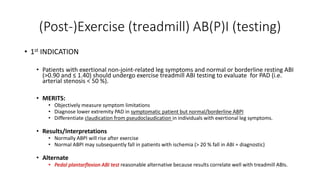
(Post-)Exercise (treadmill) AB(P)I (testing)
• 1st INDICATION
• Patients with exertional non-joint-related leg symptoms and normal or borderline resting ABI
(>0.90 and ≤ 1.40) should undergo exercise treadmill ABI testing to evaluate for PAD (i.e.
arterial stenosis < 50 %).
• MERITS:
• Objectively measure symptom limitations
• Diagnose lower extremity PAD in symptomatic patient but normal/borderline ABPI
• Differentiate claudication from pseudoclaudication in individuals with exertional leg symptoms.
• Results/Interpretations
• Normally ABPI will rise after exercise
• Normal ABPI may subsequently fall in patients with ischemia (> 20 % fall in ABI = diagnostic)
• Alternate
• Pedal plantarflexion ABI test reasonable alternative because results correlate well with treadmill ABIs.
(Post-)Exercise (treadmill) AB(P)I (testing)
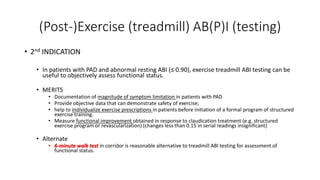
• 2nd INDICATION
• In patients with PAD and abnormal resting ABI (≤ 0.90), exercise treadmill ABI testing can be
useful to objectively assess functional status.
• MERITS
• Documentation of magnitude of symptom limitation in patients with PAD
• Provide objective data that can demonstrate safety of exercise;
• help to individualize exercise prescriptions in patients before initiation of a formal program of structured
exercise training.
• Measure functional improvement obtained in response to claudication treatment (e.g. structured
exercise program or revascularization) (changes less than 0.15 in serial readings insignificant)
• Alternate
• 6-minute walk test in corridor is reasonable alternative to treadmill ABI testing for assessment of
functional status.
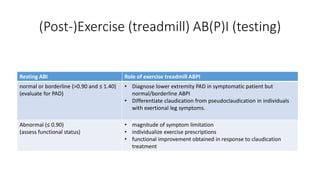
(Post-)Exercise (treadmill) AB(P)I (testing)
Resting ABI Role of exercise treadmill ABPI
normal or borderline (>0.90 and ≤ 1.40)
(evaluate for PAD)
• Diagnose lower extremity PAD in symptomatic patient but
normal/borderline ABPI
• Differentiate claudication from pseudoclaudication in individuals
with exertional leg symptoms.
Abnormal (≤ 0.90)
(assess functional status)
• magnitude of symptom limitation
• individualize exercise prescriptions
• functional improvement obtained in response to claudication
treatment
(Post-)Exercise (treadmill) AB(P)I (testing)
• LIMITATION
• Patients with poor mobility due to co morbidity e.g. cardiac disease,
respiratory disease, or disability
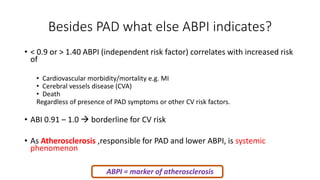
Besides PAD what else ABPI indicates?
• < 0.9 or > 1.40 ABPI (independent risk factor) correlates with increased risk
of
• Cardiovascular morbidity/mortality e.g. MI
• Cerebral vessels disease (CVA)
• Death
Regardless of presence of PAD symptoms or other CV risk factors.
• ABI 0.91 – 1.0  borderline for CV risk
• As Atherosclerosis ,responsible for PAD and lower ABPI, is systemic
phenomenon
ABPI = marker of atherosclerosis
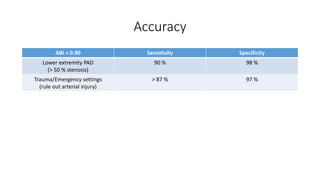
Accuracy
ABI < 0.90 Sensitivity Specificity
Lower extremity PAD
(> 50 % stenosis)
90 % 98 %
Trauma/Emergency settings
(rule out arterial injury)
> 87 % 97 %
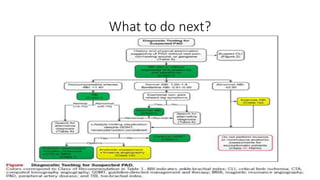
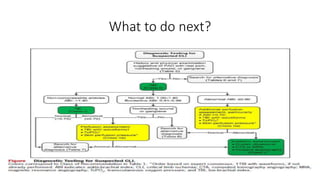
What to do next?
What to do next?
What to do next?
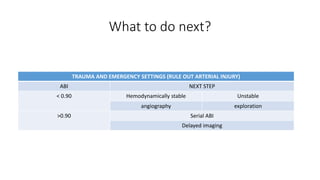
TRAUMA AND EMERGENCY SETTINGS (RULE OUT ARTERIAL INJURY)
ABI NEXT STEP
< 0.90 Hemodynamically stable Unstable
angiography exploration
>0.90 Serial ABI
Delayed imaging
Documentation
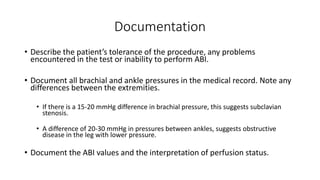
• Describe the patient’s tolerance of the procedure, any problems
encountered in the test or inability to perform ABI.
• Document all brachial and ankle pressures in the medical record. Note any
differences between the extremities.
• If there is a 15-20 mmHg difference in brachial pressure, this suggests subclavian
stenosis.
• A difference of 20-30 mmHg in pressures between ankles, suggests obstructive
disease in the leg with lower pressure.
• Document the ABI values and the interpretation of perfusion status.
Documentation
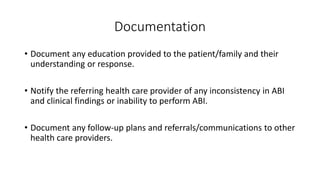
• Document any education provided to the patient/family and their
understanding or response.
• Notify the referring health care provider of any inconsistency in ABI
and clinical findings or inability to perform ABI.
• Document any follow-up plans and referrals/communications to other
health care providers.
Ankle brachial pressure index (ABPI)

Ankle brachial pressure index (ABPI)

  • 1.
    Ankle-Brachial Pressure Index(ABPI) Jibran Mohsin Resident, Surgical Unit I SIMS/Services Hospital, Lahore
  • 2.
    Outline • Terminology • Units •Definition • Concept • Indications • Contraindications • Merits • Limitations/Drawbacks/Demerits • Why ABI? • Why range? • Pre-requisites • Equipment • How to perform? • Calculations • Results/Interpretations • (Post-)Exercise (treadmill) AB(P)I (testing) • Besides PAD what else ABPI indicates? • Accuracy • What to do next?
  • 3.
    Terminology Ankle Brachial PressureIndex (ABPI) (Vascular Health and risk management review article) Ankle-Brachial Pressure Index (ABPI) (Bailey & Love 26th edition) Ankle Brachial Index (ABI) (wound, ostomy and continence nurses society) Ankle-Brachial index (ABI) (Schwartz’s Principles of surgery 10th edition) (The Washington Manual of Sugary 6th edition) (2016 AHA/ACC lower extremity PAD guidelines) Pressure Index (Browse’s introduction to the symptoms and signs of surgical disease 4th edition) (A Manual on Clinical Surgery S. Das 10th Edition)
  • 4.
    Terminology Ankle-Brachial Pressure Index(ABPI) connected in origin with the Latin angulus, or Greek αγκυλος, meaning bent Latin: Brachium (Arm) Systolic Blood pressure (1st sound heard on hand held Doppler ) on deflation Ratio of 2 systolic pressure
  • 5.
  • 6.
    Definition “Measure of theblood pressure in the arteries supplying legs relative to central, aortic pressure (approximated by measuring the blood pressure in the arm)” “ Ratio of systolic pressure at the ankle to that in the arm” (Bailey & Love 26th edition)
  • 7.
    Definition Higher Ankle SystolicPressure ABPI = _________________________ Higher Brachial Systolic Pressure NUMERATOR Measure of Lower Extremity Peripheral Arterial Disease DENOMINATOR Indirect/approximate measure of central aortic pressure (NOT upper limb itself) i.e. ABPI is indicator of status of lower extremity PAD; NOT upper extremity PAD
  • 8.
    Concept ABPI is usedto assess Lower extremity PAD as fall in blood pressure in an artery at ankle relative to central blood pressure would suggest a stenosis in the arterial conduits somewhere in between the aorta and the ankle (i.e. comparison of peripheral systolic pressure with central systolic pressure)
  • 9.
    Indications Primary care (Indoor/Outdoor) Settings Diagnostic testingfor Suspected Peripheral Arterial Disease (PAD) /CLI (critical Limb Ischemia) –PAD with rest pain/non healing ulcer/gangrene History or physical examination findings suggestive of PAD Increased risk of PAD YES Resting ABI is recommended to establish the diagnosis i.e. objective documentation of lower extremity PAD (LEAD) due to arterial stenosis NO (asymptomatic) YES Resting ABI is reasonable (to assess vascular risk for PAD) NO NO ABI not recommended Trauma and Emergency Settings Identification of patients at increased risk for lower-extremity arterial injury after penetrating/blunt trauma
  • 11.
    Contraindications • Excruciating painin lower legs/feet • Severe pain associated with lower extremity wound(s) • Unable to remain supine • DVT, which could lead to dislodgement of thrombosis BP cuff may worsen extremity injury/pain
  • 12.
    Merits • Simple toperform • Non-invasive • Reproducible • Cost effective • Minimal risks
  • 13.
    Limitations/Drawbacks/Demerits Indirect examination that infersthe anatomical location of an occlusion or stenosis. Exact location of stenosis/occlusion can’t be determined by ABI alone False negative • ABI might be elevated due to calcification of medial arteries at the ankle in certain patients (DM/renal failure/elderly age/RA) • Other vascular tests should be performed • Resting ABI normal with arterial stenosis (< 50 %) having claudication i.e. ABI is biased toward the detection of severe disease and is more consistent with duplex US when most symptomatic limbs are compared. • Prevalence (ABI elevated in 8.4 % with LEAD 62.2 %) • Exercise treadmill ABI testing recommended Lack of standardization • Position of patient during measurement • Width and level of sphygmometer cuffs • Use of Korotkoff method vs Dinamap vs Doppler probe to define systolic pressures • Whether to use both brachial pressures or not in calculation of ABPI • Whether to use all 3 crural vessels, 2. just 1 in calculation of ABPI • Whether to use highest or mean or lowest values of pressure in calculation of ABPI • Normal ranges for ABPI ratios
  • 14.
    Limitations/Drawbacks/Demerits Inter observer variability7.3 % to 12 % (non expert vs expert) Dismiss changes of < 0.15 (i.e. insignificant) Intra observer variability 8 % Age, sex, leg, ankle vessel, respiratory phase, sequence and blood pressure (baseline hypotension/hypertension) dependent Beat-to-beat physiological variation in SBP Over-rapid/slow deflation rate High-grade aorto-iliac stenosis or occlusion clinical masked by rich collateral network; ABI fails to unmask underlying lesion No consensus that how central pressure should be approximated from arm pressure Patient-white coat phenomena Resting period (severe multilevel arterial disease need longer period of rest Doppler probe selection (frequency and level of quality) Environmental factors that can affect vasomotor tone (e.g. temperature)
  • 15.
    Limitations/Drawbacks/Demerits Validity of noninvasiveblood pressure measurement in the context of ABI has never been assessed (e.g. compared in real time against invasive blood pressure reading in controlled settings) Occlusive cuff method is liable to underestimate true resting pressure drop across lesion i.e. presence of PAD (due to reduction in blood flow through any proximal lesion at moment of SBP measurement); more marked when lesion immediately proximal to ankle cuff No agreement on precise normal value (or normal range) Insensitive to detecting progression of atherosclerosis (Screening and diagnostic test but NOT prognostic test) i.e. imaging studies are superior to ABI for monitoring progression of PAD. Diseased vs non diseased patients groups –difference of accuracy Cuff size/placement
  • 16.
    Why ABI? • Relyingon clinical history has very low sensitivity for determining PAD • Majority of PAD patients are asymptomatic and underdiagnosed. • Intermittent claudication (primary and most often only symptom) absent in 90 % of high-risk patients (Rose criteria). • Can’t solely rely on absent pulse palpation or other physical examination findings to diagnose PAD • ABI  confirmation as well as quantification.
  • 17.
    Why Range? • Acceptedmethodology of ABPI does not make any corrections for physiological variation over time in baseline brachial SBP or other confounders for blood pressure measurement like respiratory phase necessitating a range to be used, rather than a point figure
  • 18.
    Why Range? • Whyupper limit >1.0 ? • Ankle SBP slightly higher than brachial SBP in normal supine individual due to difference in magnitude of pressure pulse reflections from vascular beds immediately downstream of ankle and elbow. • Also due to difference in distance between point of measurement at ankle and elbow from peripheral bed i.e. ankle immediately proximal to pressure antinode (the peripheral bed represented by foot), whereas elbow is one segment upstream from analogous peripheral bed of hand.
  • 19.
    Why Range? • Whylower limit < 1.0? • Respiratory phase changes not controlled during measurement of ABPI • i.e. ankle pressure at peak expiration with brachial pressure at peak inspiration (3 % fall in SBP during inspiration) • Beat-to-beat physiological variation controlled by synchronous measurements at arm and ankle (cumbersome, NOT recommended) • Over-rapid deflation can gives false low ankle pressure.
  • 20.
    Pre-requisites • No caffeine/alcohol/tobacco/heavy activity for 1-2 hours prior to test • Quiet, warm environment to prevent vasoconstriction of arteries (21- 23 ± 1 o C). • Relaxed, comfortable, and empty bladder. • Explain procedure to the patient. • Remove socks, shoes, and tight clothing to permit placement of pressure cuffs and access to pulse sites by Doppler.
  • 21.
    Pre-requisites • Place patientin a flat, supine position (i.e. arm and leg at same level as heart; sitting position overestimate ABI by 0.30). • Place 1 small pillow behind patient’s head for comfort. • Apply protective barrier (e.g. plastic wrap) on extremities if any wounds or alteration in skin integrity are present. • Place pressure cuffs with bottom of cuff approximately 2-3 cm above the cubital fossa on the arms and malleolus at the ankle. (via straight wrapping method) • Cuffs should be wrapped without wrinkles and placed securely to prevent slipping and movement during the test.
  • 22.
    Pre-requisites • Cover thetrunk and extremities to prevent cooling. • Ensure the patient is comfortable and have the patient rest for minimum of 10 minutes (5 mins to 20 mins) prior to the test to allow pressures to normalize.
  • 23.
    Equipment • Portable (hand-held)Doppler with 8-10 MHz probe. (Use 5 MHz probe if ankle edema) in working position • Aneroid sphygmomanometer. (Properly calibrated) (Not pulse palpation or automated BP devices). • Appropriate pressure cuff i.e. cuff bladder width should be 40 % of limb circumference and long enough to cover 80 % of arm circumference • Typically, 12 cm wide cuffs are used for arms and 10 cm wide cuffs at the ankles. • Extra large adult cuffs might be needed (14 cm). • Cuffs should not cover distal bypass or ulcer • Ultrasound transmission gel. • Alcohol pads to clean the Doppler. • Gauze, tissue or pads to remove transmission gel from patient’s skin. • Towels, sheets, or blankets to cover trunk and extremities. • Paper and Pen for recording test results; calculator. • Examination table
  • 24.
    How to Perform? A.Measure Brachial pressures with Doppler • Arm should be relaxed, supported and at heart level. • Palpate the brachial pulse to determine location to obtain an audible pulse • Apply transmission gel over the pulse site • Place the tip of the Doppler probe at a 45 -60 degree angle pointed towards patient’s head until an audible pulse signal is obtained • Inflate the pressure cuff 20-30 mmHg above the point where pulse is no longer audible. • Deflate the pressure cuff at a rate of 2-3 mmHg per second, noting the manometer reading at which first pulse signal is heard and record that systolic value. • Cleanse/remove gel from pulse site • Repeat the procedure to measure the pressure on the other arm USE THE HIGHER/HIGHEST OF THE RIGHT OR LEFT ARM’S BRACHIAL SYSTOLIC PRESSURES TO CALCULATE THE ABI FOR BOTH LEGS.
  • 25.
    How to Perform? B.Measure Ankle pressures with Doppler • Locate both dorsalis pedis and posterior tibial pulses in each leg (or peroneal artery) • Apply transmission gel over the pulse site • Place the tip of the Doppler probe at a 45 – 60 degree angle pointed towards patient’s knee until an audible pulse signal is obtained • Inflate the pressure cuff 20-30 mmHg above the point where pulse is no longer audible. • Deflate the pressure cuff at a rate of 2-3 mmHg per second, noting the manometer reading at which first pulse signal is heard and record that systolic value. • Cleanse/remove gel from pulse site • Repeat the procedure to measure the pressure on the other ankle. USE THE HIGHER/HIGHEST OF THE ANKLE PRESSURES OF EACH LEG TO CALCULATE THE ABI FOR EACH LEG.
  • 26.
    How to Perform? LOCALISATIONOF ARTERIES Relation to tendon Relation to Bone Against which bone? LOWER EXTERMITY Dorsalis Pedis (DP)** Just lateral to extensor halluces longus (EHL)* Proximal end of 1st web/intermetatarsal space i.e. Cleft between 1st and 2nd Metatarsal bones (Dorsum of foot) Navicular and middle cuneiform bone /base of 1st metatarsal Posterior Tibial (PT) Just behind medial malleolus i.e. Midway between medial malleolus and tendo Achillis (2.5 cm higher than below reference point) back of medial malleolus (lower end of tibia) 1/3rd of way along a line between tip of medial malleolus and point of heel Calcaneum (medial aspect) Anterior Tibial (AT) Just lateral to extensor halluces longus (EHL)* Midway between medial and lateral malleolus Lower end tibia just above ankle joint at the head of talus UPPER EXTERMITY Brachial Just medial to biceps brachii tendon (Cubital fossa)*** Lower part of humerus *Made prominent by extending great toe ** Absent in 10 % normal population; replaced by branch of peroneal artery *** Made prominent by flexing elbow against resistance
  • 27.
    How to Perform? •If flow is still detected at maximum level of inflation (300 mmHg), cuff should be deflated immediately to avoid pain SEQUENCE • The same sequence of limb measurement should be used, and the sequence should be the same for all patients within same practice. • If 1st arm measurement is 10 mmHg or greater than the other arm, then it should be repeated at the end of sequence, and the 2 numbers averaged. • e.g. starting with right arm and counter clock wise sequence (i.e. right arm, right leg, left leg, left arm); right arm value repeated and averaged. • If difference between 2 numbers > 10 mmHg, only second measurement used to lessen white coat effect. • If entire sequence of ABI is repeated, then order should be reversed (clockwise sequence should follow counterclockwise sequence).
  • 28.
  • 29.
  • 30.
    Results/Interpretations (resting ABI) *ABPIMUST be calculated to two decimal places i.e. 0.90 NOT 0.9 ** incompressible (stiff calcified –medial sclerosis ankle arteries) **Seen in diabetes mellitus, End-stage renal disease (ESRD/CKD), old age , RA/Systemic sclerosis; 2016 AHA/ACC lower extremity PAD guidelines* Bailey & Love 26th edition Schwartz’s Principles of surgery (10th edition) Browse’s Into to S/S of surgical disease SRB’s Manual of surgery (3rd edition) Clinical Surgery Pearls (2nd edition) The Washington Manual of Surgery (6th edition) Non compressible > 1.40 Artificially high readings ≥ 1.40 > 1.0 > 1.2 (or value out of proportion to clinical status) Normal 1.00 – 1.40 About 1.0 More than 1 1..0 or 1.1 1 > 0.9 (No symptoms) More than or about 1 > 1 Borderline 0.91 – 0.99 Abnormal ≤ 0.90 < 0.9 Some degree of arterial occlusion (claudicati on) 0.5 – 0.7 Claudication < 1 < 0.9 ischemia < 0.9 0.5 – 0.8 Claudication <0.8 Claudi cation 0.3 – 0.5 Rest pain <0.4 Rest pain and sever e ische mia ≤ 0.3 Severe ischemia with gangrene <0.5 Rest pain 0.3- 0.5 Rest pain < 0.3 gangrene <0.3 Imminent necrosis <0.3 Gangrene CRITICAL LIMB ISCHEMIA
  • 31.
    (Post-)Exercise (treadmill) AB(P)I(testing) • 1st INDICATION • Patients with exertional non-joint-related leg symptoms and normal or borderline resting ABI (>0.90 and ≤ 1.40) should undergo exercise treadmill ABI testing to evaluate for PAD (i.e. arterial stenosis < 50 %). • MERITS: • Objectively measure symptom limitations • Diagnose lower extremity PAD in symptomatic patient but normal/borderline ABPI • Differentiate claudication from pseudoclaudication in individuals with exertional leg symptoms. • Results/Interpretations • Normally ABPI will rise after exercise • Normal ABPI may subsequently fall in patients with ischemia (> 20 % fall in ABI = diagnostic) • Alternate • Pedal plantarflexion ABI test reasonable alternative because results correlate well with treadmill ABIs.
  • 32.
    (Post-)Exercise (treadmill) AB(P)I(testing) • 2nd INDICATION • In patients with PAD and abnormal resting ABI (≤ 0.90), exercise treadmill ABI testing can be useful to objectively assess functional status. • MERITS • Documentation of magnitude of symptom limitation in patients with PAD • Provide objective data that can demonstrate safety of exercise; • help to individualize exercise prescriptions in patients before initiation of a formal program of structured exercise training. • Measure functional improvement obtained in response to claudication treatment (e.g. structured exercise program or revascularization) (changes less than 0.15 in serial readings insignificant) • Alternate • 6-minute walk test in corridor is reasonable alternative to treadmill ABI testing for assessment of functional status.
  • 33.
    (Post-)Exercise (treadmill) AB(P)I(testing) Resting ABI Role of exercise treadmill ABPI normal or borderline (>0.90 and ≤ 1.40) (evaluate for PAD) • Diagnose lower extremity PAD in symptomatic patient but normal/borderline ABPI • Differentiate claudication from pseudoclaudication in individuals with exertional leg symptoms. Abnormal (≤ 0.90) (assess functional status) • magnitude of symptom limitation • individualize exercise prescriptions • functional improvement obtained in response to claudication treatment
  • 34.
    (Post-)Exercise (treadmill) AB(P)I(testing) • LIMITATION • Patients with poor mobility due to co morbidity e.g. cardiac disease, respiratory disease, or disability
  • 35.
    Besides PAD whatelse ABPI indicates? • < 0.9 or > 1.40 ABPI (independent risk factor) correlates with increased risk of • Cardiovascular morbidity/mortality e.g. MI • Cerebral vessels disease (CVA) • Death Regardless of presence of PAD symptoms or other CV risk factors. • ABI 0.91 – 1.0  borderline for CV risk • As Atherosclerosis ,responsible for PAD and lower ABPI, is systemic phenomenon ABPI = marker of atherosclerosis
  • 36.
    Accuracy ABI < 0.90Sensitivity Specificity Lower extremity PAD (> 50 % stenosis) 90 % 98 % Trauma/Emergency settings (rule out arterial injury) > 87 % 97 %
  • 37.
  • 38.
  • 39.
    What to donext? TRAUMA AND EMERGENCY SETTINGS (RULE OUT ARTERIAL INJURY) ABI NEXT STEP < 0.90 Hemodynamically stable Unstable angiography exploration >0.90 Serial ABI Delayed imaging
  • 40.
    Documentation • Describe thepatient’s tolerance of the procedure, any problems encountered in the test or inability to perform ABI. • Document all brachial and ankle pressures in the medical record. Note any differences between the extremities. • If there is a 15-20 mmHg difference in brachial pressure, this suggests subclavian stenosis. • A difference of 20-30 mmHg in pressures between ankles, suggests obstructive disease in the leg with lower pressure. • Document the ABI values and the interpretation of perfusion status.
  • 41.
    Documentation • Document anyeducation provided to the patient/family and their understanding or response. • Notify the referring health care provider of any inconsistency in ABI and clinical findings or inability to perform ABI. • Document any follow-up plans and referrals/communications to other health care providers.