

Software Project Management
 What is Artifact?
 Artifact Sets.
    › Management Sets.
       Specific Artifacts in the Management Set.
    › Engineering Sets.
       Requirement Sets.
       Design Sets.
       Implementation Sets.
       Deployment Sets.
   Life Cycle Focus on artifact Sets.
   The term artifact in connection with
    software development is largely
    associated with specific development
    methods or processes(such as project
    plans, business cases, and risk
    assessments.)

   To make the development of a
    complete software system manageable,
    distinct collection of information are
    organized into artifact set.
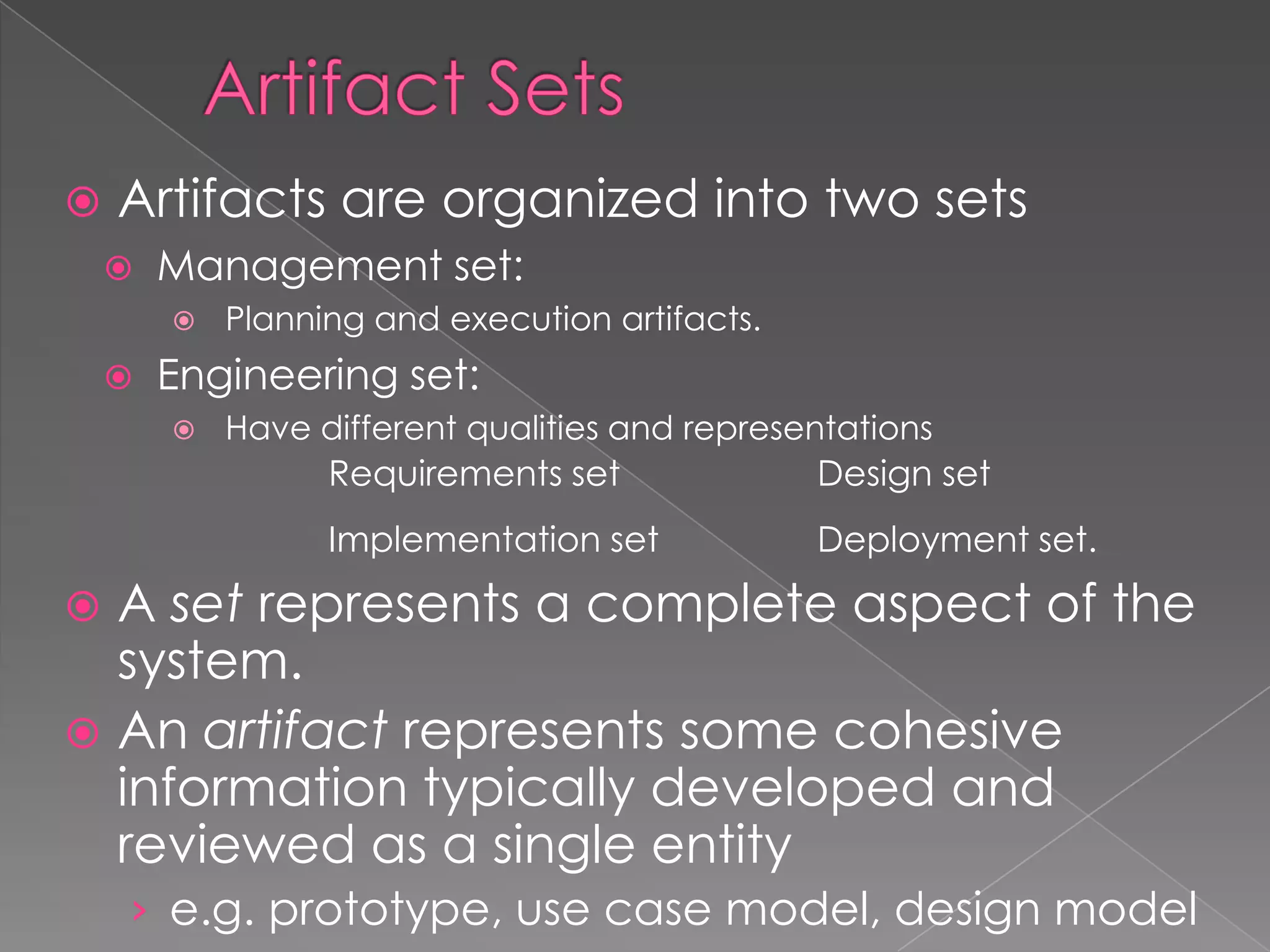
   Artifacts are organized into two sets
       Management set:
           Planning and execution artifacts.
       Engineering set:
           Have different qualities and representations
                  Requirements set              Design set
                  Implementation set            Deployment set.
 A set represents a complete aspect of the
  system.
 An artifact represents some cohesive
  information typically developed and
  reviewed as a single entity
    › e.g. prototype, use case model, design model
 These artifacts are mainly designed to
  capture data associated with process
  planning and execution.
 Text and graphics will include whatever is
  necessary to capture the contracts among
  the project personnel (project
  management,architects,developers,testers), among
  stakeholders(funding authority,user,software project
  manager,oraganization manager), and between
  project personnel and stakeholders.
 The management set includes several
 artifacts :
  › Work Breakdown Structure:
     Vehicle for budgeting and collecting costs.
     The software project manager must have insight
      into project costs and how they are expended.
     If the WBS is structured improperly, it can drive
      the evolving design in the wrong direction.
  › Business Case:
     Provides all the information necessary to determine
      whether the project is worth investing in.
     It details the expected revenue, expected cost,
      technical and management plans.
› Software Development Plan:
   The defining document for the project’s
    process.
   It must comply with the contract, comply with
    the organization standards, evolve along with
    the design and requirements.
› Deployment:
   It include several document subsets for
    transitioning the product into operational
    status.
   It could also include computer system
    operations manuals, software installation
    manuals, plans and procedures for cutover
› Environment:
  A robust(strong) development environment
   must support automation of the development
   process.
  It should include :
     requirements management
     visual modeling
     document automation
     automated regression testing .
 In the Engineering Set, the primary
  mechanism for evaluating the
  evolving quality of these artifact sets is
  in the transitioning of information from
  set to set.
 It consist of:
  ›    requirement set
  ›    design set
  ›    implementation set
  ›    deployment set
   The requirements set is the primary
    engineering context for evaluating the
    other three engineering artifact sets and is
    the basis for test cases.
   Vision Statement:
    › Notation: text structure is used.
    › Documents project scope that supports the
      contract between the funding authority and the
      project team.
   Supplementary Specifications:
    ›   Notation: Variety of formats
    › Can come from regulatory agencies, other
        prototypes indicating proof of concept.
   Requirements models:
    › Notation: Usually captured in UML
    › Use Case modeling and domain modeling;
        activity diagrams.
   Tools used: Visually modeling tools.

   UML notation is used to engineer the design
    model.

   Design set contains levels of abstraction.

   The design model include structural and
    behavioral information to ascertain bill of
    material(quantity and specifications of material, labor
    and other cost).


   Design set artifacts normally include: design
    model, test model, software architecture
   Tools used: Debuggers, compilers, code
    analyzers, test management tools.

   Implementation set artifacts includes
    source code (as implementation of
    components) their form, interfaces and
    executables necessary for stand-alone
    testing of components.
    › These executables are the primitive parts needed
     to construct the end products including custom
     components, application programming
     interface(APIs), other reusable or legacy
     components in some programming languages.
   Tools used: Test coverage and test
    automation tools, network management
    tools, commercial components (OS, GUI,
    DBMSs, middleware, installation tools, etc.)

   Deployment set artifacts normally include
    the machine language notations,
    executable software, build scripts,
    installation scripts, and executable target
    specific data necessary to use the
    product in its target environment.
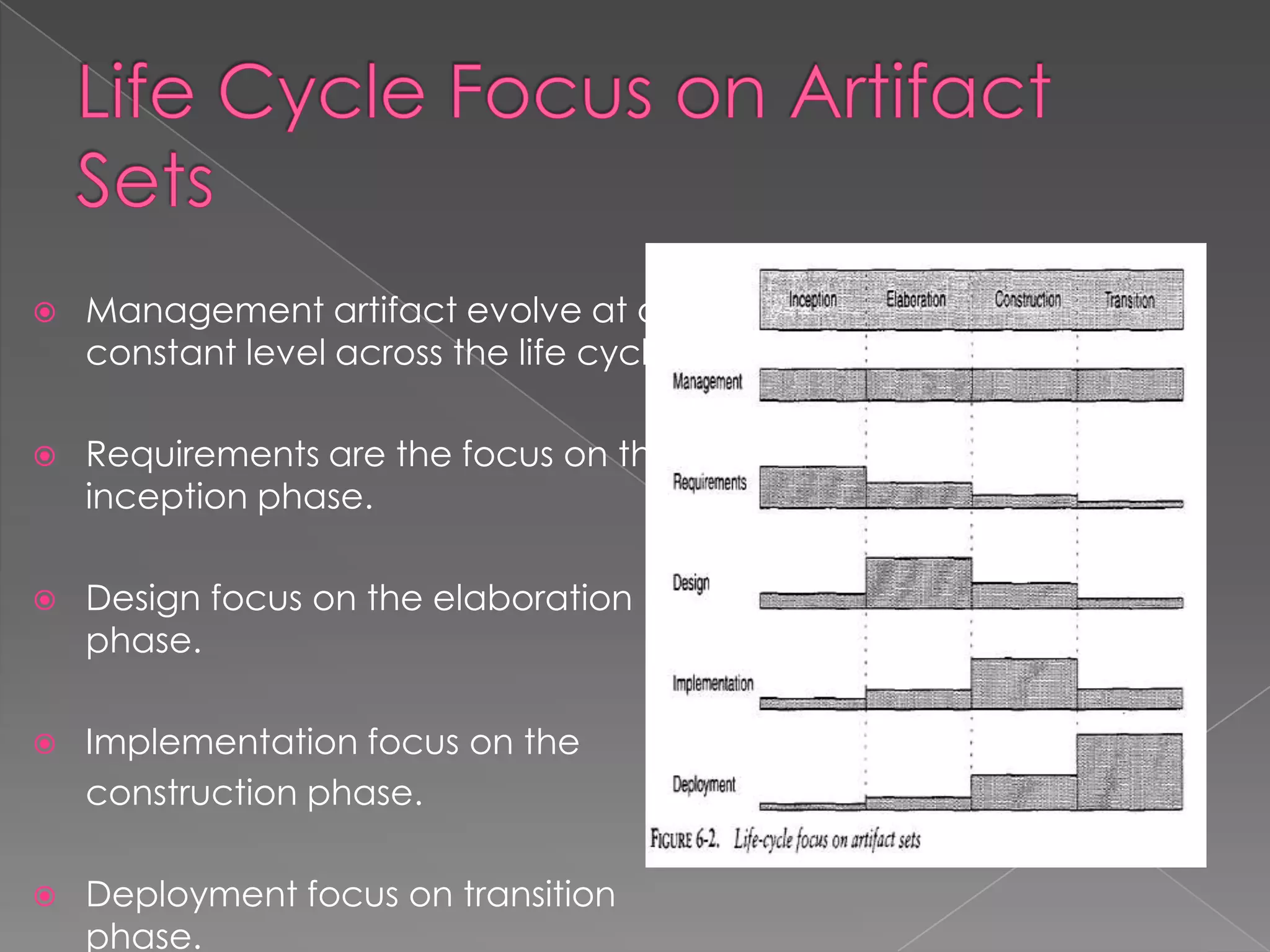
   Management artifact evolve at a
    constant level across the life cycle.

   Requirements are the focus on the
    inception phase.

   Design focus on the elaboration
    phase.

   Implementation focus on the
    construction phase.

   Deployment focus on transition
    phase.
Software Project Management.
A Unified Framework
By: Walker Royce
software project management Artifact set(spm)

software project management Artifact set(spm)

  • 1.
  • 2.
     What isArtifact?  Artifact Sets. › Management Sets.  Specific Artifacts in the Management Set. › Engineering Sets.  Requirement Sets.  Design Sets.  Implementation Sets.  Deployment Sets.  Life Cycle Focus on artifact Sets.
  • 3.
    The term artifact in connection with software development is largely associated with specific development methods or processes(such as project plans, business cases, and risk assessments.)  To make the development of a complete software system manageable, distinct collection of information are organized into artifact set.
  • 4.
    Artifacts are organized into two sets  Management set:  Planning and execution artifacts.  Engineering set:  Have different qualities and representations Requirements set Design set Implementation set Deployment set.  A set represents a complete aspect of the system.  An artifact represents some cohesive information typically developed and reviewed as a single entity › e.g. prototype, use case model, design model
  • 5.
     These artifactsare mainly designed to capture data associated with process planning and execution.  Text and graphics will include whatever is necessary to capture the contracts among the project personnel (project management,architects,developers,testers), among stakeholders(funding authority,user,software project manager,oraganization manager), and between project personnel and stakeholders.
  • 6.
     The managementset includes several artifacts : › Work Breakdown Structure:  Vehicle for budgeting and collecting costs.  The software project manager must have insight into project costs and how they are expended.  If the WBS is structured improperly, it can drive the evolving design in the wrong direction. › Business Case:  Provides all the information necessary to determine whether the project is worth investing in.  It details the expected revenue, expected cost, technical and management plans.
  • 7.
    › Software DevelopmentPlan:  The defining document for the project’s process.  It must comply with the contract, comply with the organization standards, evolve along with the design and requirements. › Deployment:  It include several document subsets for transitioning the product into operational status.  It could also include computer system operations manuals, software installation manuals, plans and procedures for cutover
  • 8.
    › Environment: A robust(strong) development environment must support automation of the development process.  It should include :  requirements management  visual modeling  document automation  automated regression testing .
  • 9.
     In theEngineering Set, the primary mechanism for evaluating the evolving quality of these artifact sets is in the transitioning of information from set to set.  It consist of: › requirement set › design set › implementation set › deployment set
  • 10.
    The requirements set is the primary engineering context for evaluating the other three engineering artifact sets and is the basis for test cases.  Vision Statement: › Notation: text structure is used. › Documents project scope that supports the contract between the funding authority and the project team.
  • 11.
    Supplementary Specifications: › Notation: Variety of formats › Can come from regulatory agencies, other prototypes indicating proof of concept.  Requirements models: › Notation: Usually captured in UML › Use Case modeling and domain modeling; activity diagrams.
  • 12.
    Tools used: Visually modeling tools.  UML notation is used to engineer the design model.  Design set contains levels of abstraction.  The design model include structural and behavioral information to ascertain bill of material(quantity and specifications of material, labor and other cost).  Design set artifacts normally include: design model, test model, software architecture
  • 13.
    Tools used: Debuggers, compilers, code analyzers, test management tools.  Implementation set artifacts includes source code (as implementation of components) their form, interfaces and executables necessary for stand-alone testing of components. › These executables are the primitive parts needed to construct the end products including custom components, application programming interface(APIs), other reusable or legacy components in some programming languages.
  • 14.
    Tools used: Test coverage and test automation tools, network management tools, commercial components (OS, GUI, DBMSs, middleware, installation tools, etc.)  Deployment set artifacts normally include the machine language notations, executable software, build scripts, installation scripts, and executable target specific data necessary to use the product in its target environment.
  • 15.
    Management artifact evolve at a constant level across the life cycle.  Requirements are the focus on the inception phase.  Design focus on the elaboration phase.  Implementation focus on the construction phase.  Deployment focus on transition phase.
  • 16.
    Software Project Management. AUnified Framework By: Walker Royce

Editor's Notes

  • #5 Aspect: A particular part or feature.Cohesive: Characterize by.
  • #8 Comply: Act in accordance with a wish.
  • #9 Regression: A return to a former state.
  • #14 Stand alone: testing in which we test only single feature(module/component)Test management tools: are used to structure automated tests and manual test processes
  • #15 Middleware: It is computer software that provides services to software applications.