210253 -Software Engineering
Theory :3 hrs/week
In-Sem: 30 marks
End-Sem:70 marks
Credit: 3
Introduction to Software Engineering
and Software Process Model
Unit -1
Nature of a software [pg no.3 book R.P,7th edition]
• Software takes dual role.It is a product and at
the same time ,the vehicle for delivering a
product.
• Software is an information transformer,
producing, managing , acquiring , modifying ,
displaying or transmitting into that Can be as
simple as single bit or complex as a multimedia
presentation derived from data acquired from
dozens of independents sources.
Defining software
• Software is-
1.Instruction that when executed provide
desired features, functions and performance.
2.Data structure that enable the program to
adequately manipulate information.
3.Descriptive information in both hard copy and
virtual forms that describes the operation and
use of the program.
• Software is uses logical rather than physical
system elements.
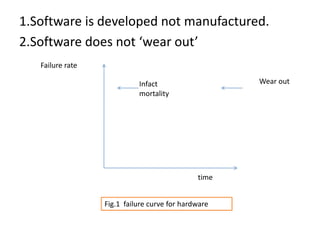
1.Software is developed not manufactured.
2.Software does not ‘wear out’
Failure rate
Wear out
time
Infact
mortality
Fig.1 failure curve for hardware
• It indicates that hardware exhibits relatively
high failure rate early in its life.
• Defects are corrected and failures are drops to a
steady state level for some period of time.
• Software does not wear out but
deteriorate(corrupt/spoil).
Software
• Software is nothing but a collection of computer
programs and related documents that are intended
to provide desired features, functionalities and
better performance.
• Software products may be-
I. Generic : that means developed to be sold to a
range of different customers.
Eg.PC s/w such as Excel or word.
II. Custom: that means developed for a single customer
according to their specification.
Eg. Air traffic monitoring
Software Engineering
• s/w engineering is a discipline in which
theories, methods and tools are applied to
develop professional s/w product .
• In software engineering the systematic and
organized approach is adapted.
• The definition of s/w engineering is based on
two terms-
1.Discipline: for finding the solution to the
problem an engg. applies appropriate theories,
methods and tools.
2.Product: the s/w products get developed after
following systematic theories, methods and
tools along with the appropriate
management activities.
Nature of software: [pg no 3 book R.P ]
• Software can be applied in a situation for
which a predefined set of procedural steps
(algorithms) exist.
• Based on a complex growth of s/w it can be
classified into following-
1.System software: It is collection of programs
written to service other program.
2.Application software: It consist of standalone
program that are developed for specific
business head.
3.Embedded software: this category consist of
program that can reside within a product or
system.
4.Web Applications: this s/w consist of various
web pages that can be retrieved by a browser.
5.Engineering/scientific s/w: this category of s/w
has wide range of programs from astronomy to
volcano logy ,from automotive stress analysis
to space shuttle orbital dynamics and from
molecular energy to automated manufacturing.
This s/w is based on complex numeric
computation.
6.Artificial Intelligence s/w: this type of s/w are
based on knowledge based expert system.
Typically this s/w is useful in robotics, expert
system, image and voice recognition, artificial
neural n/w and game playing.
Layered Technology [pg no-14]
a “quality” management
process model
methods
tools
Automatic support for s/w
Provide technical details
Foundation of s/w
Backbone of s/w
Figure 2. software engineering layers
• It is a layered technology.
• Any s/w can be developed using these layered
approaches.
• So software engg is a combination of process,
method and tools for development of quality
s/w.
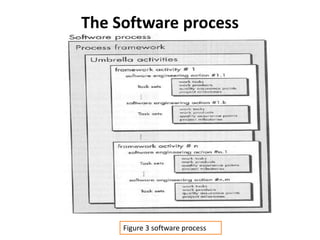
The Software process
Figure 3 software process
• Software process can be defined as the
structured set of activities.
• Common process framework is established by
dividing overall framework activities into small
number of framework activities.
• These small number of activities are applicable
to the entire project irrespective of its size and
complexity.
• A framework is a collection of task sets and
these task sets consist of -
1.Collection of small work tasks.
2.Project milestones, deliverables.
3.s/w quality assurance point
• There are various activities called umbrella
activities and these activities are associated
throughout the development process.
• Umbrella Activities :
 Software project management
 Formal technical reviews
 Software quality assurance
 Software configuration management
 Work product preparation and production
 Reusability management
 Measurement
 Risk management
The umbrella activities include-
I. Software project tracking & control:
Developing team has to access project plan and
compared with predefined schedule.
II. Risk management: risk management is an
event that may or may not occur. assesses risks
that may affect outcome of project.
III. Software quality assurance: It is nothing but
planned and systematic pattern of activities
those are required to give guarantee of s/w
quality.
IV. Formal technical review: IT is a meeting
conducted by technical staff.
• The purpose of meeting is to detect quality
problems and suggest quality improvement.
V. Measurement: It includes the effort required
to measure the software (cost,line of code
,size).
vI. Software configuration management: It
manages effect of change through out the s/w
process.
VII. Reusability management: It defines criteria
for product reuse.
VIII. Work product preparation and production:
It includes activities required to create
documents, logs. Forms, lists and user manual
for development software.
Framework Activities
Communication
Planning
Modeling
Analysis of requirements
Design
Construction
Code generation
Testing
Deployment
Software Vs. Hardware
• Software is developed or engineered, it is not
manufactured in the classical sense.
• Software doesn’t wear out.
• Although the industry is moving towards
component based construction, most
software continues to be custom built.
Software Myths [pg.no-21 to 24 book R.P.7th edition]
• Dictionary meaning of myth is fable stories.
• It is fiction, imagination or it is a thing or story
whose existence is not verifiable.
• In relation with computer software myth is
nothing but misinformation, misunderstanding
or confusions propagate in software
development field.
• In software development the myths can be
considered as three level myths.
1.Management level myths
2.Customer level myths
3.Practitioner/developer level myths
• Software crisis :
Most of the s/w engg refers the problem associate with s/w
development as “software crisis”.
The cause of s/w crisis are linked to all the problems and
complexities associated with development process.
• Following are some most encountered problems associated
with development process-
1.Running out of time i.e. deadline crosses.
2.Over budget
3.s/w inefficient
4.Low quality
5.Not upto expectations of customers
6.No enough development team.
Core Software Engineering Principles
• The reason it all exists
• keep it simple!
• Maintain the product and project “vision”
• What you produce, others will consume
• Be open to the future
• Plan ahead for reuse
• Think!
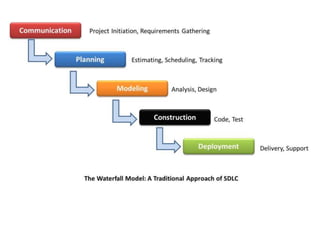
A generic process model
• Software process is collection of various activities.
• There are 5 generic process framework activities.
1.Communication: The software development process
starts with communication between customer and
developer.
2.Planning: It includes complete estimation and
scheduling and tracking.
Need of process model
Each team member will understand what is the next
activity and how to do it.
Thus process model will bring the definiteness and
discipline in overall development process.
3.Modeling:it includes detail requirement
analysis and project design (flowchart,
algorithm).
4.Construction: it includes coding and testing
steps.
5.Deployment: it includes software delivery,
support and feedback from customer.
Legacy software
• The term legacy software refers to older s/w
development that were poorly designed and
documented.
• It had supported for many years.
• The legacy system may or may not remain in
use.
• Even if it is no longer used, it may continue to
impact the organization due to its historical role
Process Flow
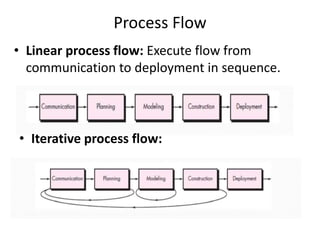
• Linear process flow: Execute flow from
communication to deployment in sequence.
• Iterative process flow:
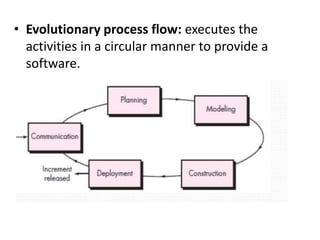
• Evolutionary process flow: executes the
activities in a circular manner to provide a
software.
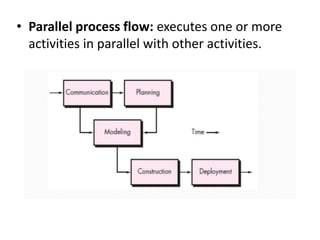
• Parallel process flow: executes one or more
activities in parallel with other activities.
Types of process models
• Generic process model
• Prescriptive process model
• Evolutionary process model
Generic process model
• A generic process model has-
1.Defining a framework activity:
 Work tasks for a simple software projects are-
• Make contacts with stakeholder via telephone.
• Discuss requirements and take notes.
• Organize notes in brief written statements of
requirements.
• E-mail to stakeholder for review and approval.
 If project is complex, then go for :inception,
elaboration, negotiation, specification and
validation.
2.Identifying a task set:
• Task sets are actual list of work to be done to
accomplish the objective of s/w engineering
action.
• Select suitable task set based on problem and
project.
3.Process patterns: proven solutions for the
similar problem
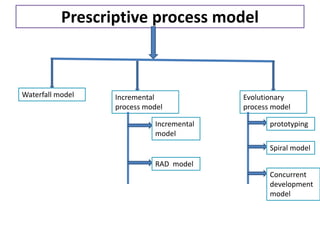
Prescriptive process model
• This process model define prescribed set of
process elements and a predictable process
workflow.
• Organize framework activities in a certain order
• Process framework activity with set of software
engineering actions.
• Each actions in terms of a task set that identifies
the work to be accomplished to meet the goals.
• The resultant process model should be adapted to
accommodate the nature of the specific project ,
people doing the work , and the work
environment.
Prescriptive process model
Waterfall model Incremental
process model
Incremental
model
RAD model
Evolutionary
process model
prototyping
Spiral model
Concurrent
development
model
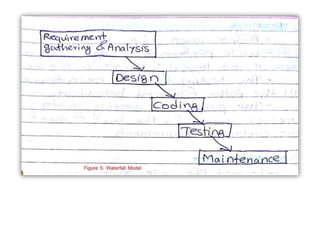
Waterfall model [pg no.39-40 book R.P]
• Waterfall model is also called as “linear
sequential model” or “classic life cycle model”.
• The software development will start with
requirement gathering phase.
• then progresses through analysis, design,
coding, testing and maintenance.
1. Requirement gathering and analysis:
• In this phase basic requirements of the system must be
understood by software engineer who is also called as
analyst.
• The information domain function behavioral requirements
of the system are understood.
• All the requirements are then well documented and
discussed with customer.
2. Design:
Focuses on program attributes such as-
• Data structure
• Software architecture
• Interface representation
• Algorithmic details
3. Coding:
In this phase actual coding will start according to design.
4. Testing:
• Begins when coding will done.
• While performing testing more focus is on logical
internals of the software.
• Testing ensures execution of all the paths, functional
behaviors
• The purpose of testing is to uncover errors, fix the
bugs and meet the customer requirements.
5. Maintenance:
• Longest life cycle phase.
• When the system is installed and put in practical use
then error may get introduced.
• Correcting such errors and putting it in is the major
purpose of maintenance activity.
Benefits:
• The waterfall model is simple to implement.
• For implementation of small systems waterfall model
is useful.
Drawbacks:
• Difficult to follow sequential flow.
• Requirement analysis is done initially and
sometimes it is not possible to state all the
requirements explicitly in the beginning .
• The customer can see working model only at
the end.
• Linear nature of waterfall model induced
blocking state because certain tasks may be
dependent on some previous task
Incremental process model(eg RAD model)
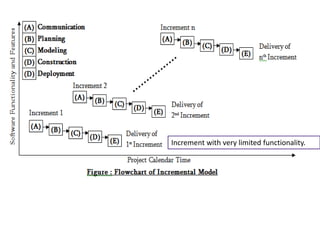
• In this model the initial model with limited
functionality is created for users understanding
about s/w product and then this model is
refined and expanded in later releases.
• Phases in incremental model:
1.Analysis
2.Design
3.Code
4.Test
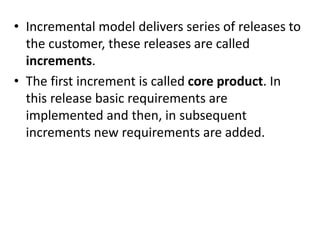
• Incremental model delivers series of releases to
the customer, these releases are called
increments.
• The first increment is called core product. In
this release basic requirements are
implemented and then, in subsequent
increments new requirements are added.
Increment with very limited functionality.
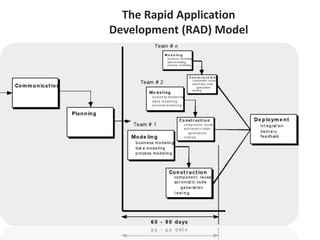
The Rapid Application
Development (RAD) Model
RAD Model
• It is type of incremental process model in which
there is extremely short development cycle.
• When the requirements are fully understood and the
component based construction approach is adopted
then the RAD model is used.
• Using RAD model fully functional system can be
developed within 60 to 90 days.
• Multiple teams work on developing the s/w system
using RAD model parallely .
• During design phase various models are created.
Those models are Business model ,data model and
process model.
Drawbacks of RAD model:
• It requires multiple teams or large number of people
to work on the project.
• This model requires heavily committed developer
and customers. If commitment is lacking then RAD
projects will fail.
• Project using RAD models requires heavy resources.
When to choose incremental model?
• When requirements are reasonably well_defined.
• When overall scope of development effort suggest a
purely linear effort.
• When limited set of s/w functionality needed.
Merits of Incremental model:
• The incremental model can be adopted when there
are less number of people involved in the project.
• Technical risk can be managed with each increment.
• For a very small time span at least core product Can
be delivered to client.
Evolutionary process model
[pg no 42-46 PR]
• While developing the s/w system it is often needed to
make modification in earlier development phases or
task sets.
• IF development process is linear or in a straight line
then the end product will be unrealistic.
• In such cases the iterative approach needs to be
adapted.
• Evolutionary model is iterative model.
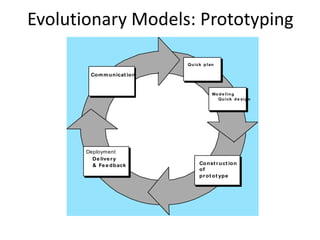
Prototyping:
• Software prototyping refers to building s/w
application prototypes which displays the
functionality of the product under
development, but may not actually hold the
exact logic of the original s/w.
• From a quick design a prototype is prepared.
• Customer or user evaluates the prototype in
order to refine requirement .Iteratively
prototype is tuned for satisfying customer
requirements.
Communicat ion
Quick plan
Const ruct ion
of
prot ot ype
Mode ling
Quick de sign
De live ry
& Fe e dback
Deployment
Evolutionary Models: Prototyping
When to choose it?
• General objective of s/w is defined but not
detailed input, processing or o/p requirement.
• When the developer is unsure about the
efficiency of an algorithm then prototype serves
as a better choice.
Drawback of prototyping:
• In the first version itself customer often want
“few fixes” rather than rebuilding of the system.
• The first version may have some compromises.
• Sometimes developer may make implementation
compromises to get prototype working quickly.
Evolutionary process model
(Spiral Model) [pg no 45-47]
• This model gives efficient development of incremental
versions of s/w.
• In this model the s/w is developed in series of
increments.
• Spiral model is divided into number of framework
activities.
• These framework activities are denoted by task
regions.
• Usually there are 6 task regions.
• Spiral model is realistic approach for development of
large scale systems and software.
• Customer and developer identify risk in each level.
Advantages:
• Requirement changes can be made at every
stage.
• Risk can be identified and rectified before they
get problematic.
Drawbacks:
• If communication is not proper then s/w
development will not be upto the mark.
• IF risk assessment is not done properly then
product will not be obtained successfully.
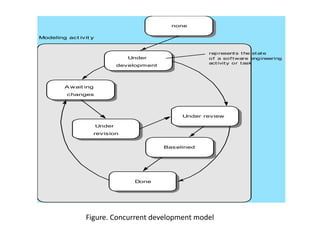
Concurrent Development model
[pg.no.48 PR. 7th edition]
• It is also called as concurrent Engineering.
• In this model framework activities or software
development tasks are represented as states.
• The modeling or designing phase of s/w
development can be one of the states like under
development, waiting for modification under revision
or under review and so on
• All the s/w development activities exist concurrently
in this model but framework activities can be in
various states.
• These states make transitions.
• i.e. during modeling the transition from under
development states to waiting for
modification state occurs.
• This model basically defines the series of
events due to transition from one state to
another state occurs
Under review
Baselined
Done
Under
revision
A wait ing
changes
Under
development
none
Modeling act ivit y
represent s t he st at e
of a sof t ware engineering
act ivit y or t ask
Figure. Concurrent development model
Advantages:
• All types of s/w development can be done
using concurrent development model.
• This model provide accurate picture of current
state of project.
• Each activity or tasks can be carried out
concurrently.
• Hence this model is an efficient process model.
Specialized Process Models
• Specialized process models are used when
only collection of specialized technique or
methods are expected for developing specific
s/w.
• Various types of specialized models are:
1. Component Based Development
2. Formal Methods Model
3. Aspect-Oriented Software Development
1.Component Based Development:
• These components have specialized targeted
functionalities and well defined interface.
• It uses various characteristics of spiral models.
• This model is evolutionary in nature.
• The component must be searched and analyzed
before beginning of modeling and construction
activity of s/w development.
• Components can be simple functions or object
oriented methods or classes.
• Steps:
1.Identify component based product.
2.Analyse component integration issues.
3.Design s/w architecture(SA) to accommodate
the component.
4.Integrate components into the SA.
5.Conduct comprehensive testing for the s/w.
• s/w reusability is the major advantage .
• Reusability reduces the development cycle
time and overall cost.
2.Formal method model:[pg.no 51-53]
• This model consist of set of activities in which the
formal mathematical specification is used.
• The s/w engg. Specify, develop and test the computer
based systems using mathematical notation.
• The notations are specified within the formal method.
• Clean room s/w engineering makes use of the formal
method approach.
Advantages:
• Ambiguity
• Incompleteness
• Inconsistency
• Offers defect free s/w
Drawbacks:
• It is time consuming and expensive.
• For using this model developer must have strong
mathematical background or some extensive
training.
• If this model is chosen for development then
communication with customer become very difficult.
3.Aspect-Oriented Software Development:
• This focuses on identification,specification and
representation of cross cutting concern and
their modularization into separate functional
unit.
• Aspectual requirements defines these cross
cutting concerns that have impact on s/w
architecture.
• It is relatively new s/w engg. Paradigm and is
not matured enough.
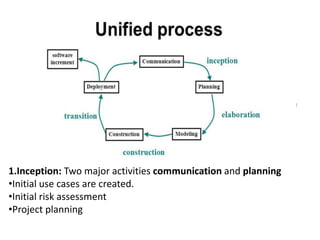
The Unified process
• IT is a framework for object oriented model.
• This model is also called as rational unified
process model(RUP).
• This model is iterative and incremental by
nature.
• There are phases:
1.Inception
2.Elaboration
3.Construction
4.Transition
5.Production
1.Inception: Two major activities communication and planning
•Initial use cases are created.
•Initial risk assessment
•Project planning
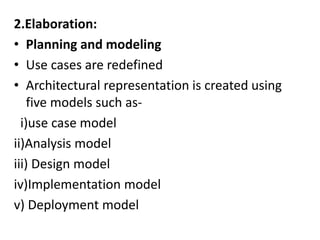
2.Elaboration:
• Planning and modeling
• Use cases are redefined
• Architectural representation is created using
five models such as-
i)use case model
ii)Analysis model
iii) Design model
iv)Implementation model
v) Deployment model
3.Construction :
• Main activity is to make use cases operational.
• Analysis and design activities of previous phases
are completed and source code is developed.
• Then testing and user and installation manual is
created.
4.Transition:
• Activities required for deployment of s/w product
are carried out.
• Beta testing conducted.
• User feedback report is used to remove defects
from created system.
5.Production:
• Mainly maintenance activities are conducted
in order to support the user in user friendly
environment.
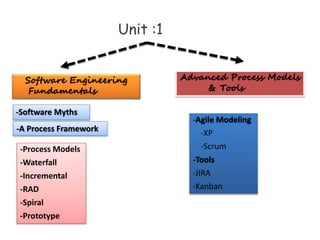
Unit :1
Software Engineering
Fundamentals
Advanced Process Models
& Tools
-Software Myths
-A Process Framework
-Process Models
-Waterfall
-Incremental
-RAD
-Spiral
-Prototype
-Agile Modeling
-XP
-Scrum
-Tools
-JIRA
-Kanban
What Is Agile
Meaning: able to move quickly and easily.
• Readiness for motion of activity.
• Effective response to change.
• Effective communication among all
stakeholder.
• Organizing a team so that it is in control of the
work performed.
• Rapid, Incremental delivery of s/w.
Agility
• The ability to both create and respond to change in order to
profit in a business environment.
• Agile engineers believe:
 Current s/w process are heavyweight.
 Too many things are done that are not directly related to s/w
product being produced.
 Current s/w development is too rigid.
 Difficulty with incomplete or changing requirements.
 Short development cycles.(internet applications)
 More active costumer involvement needed.
• Agile methods are considered:
Lightweight
People based rather than plan based.
Set of principles
Developed by agile alliance -
• A non profit organization promotes agile
development.
• agile is dynamic, content specific, aggressively,
change embracing and growth oriented.
• An Agile process -
Is Driven by customer descriptions of what is
required (scenarios)
Recognizes that plan are short lived.
Develops s/w iteratively with a heavy emphasis
on construction activities.
Delivers multiple s/w increment.
Adapts as changes occurs.
1.Highest priority is to satisfy the customer through early and
continuous delivery of valuable s/w.
2.Welcome changes from customer at anything in the process.
3.Deliver working s/w frequently.
4.Business people and developer must work together daily
throughout the project.
5.Build project around motivated individual.
6.Have face to face conversation.
7.Working s/w is primary measure of progress.
8.The sponsors, developers and user should be able to maintain a
constant pace indefinitely.
9.Continuous attention to technical excellence and good designs
enhances agility.
10.simplicity.
Agile principles
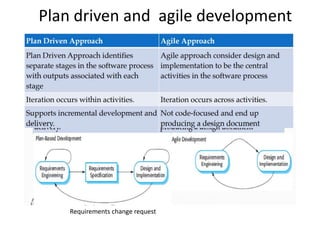
Plan driven and agile development
Requirements change request
Success in industry
The success of project, which follow extreme
programming practices, is due to -
• Rapid development
• Immediate responsiveness to the customer’s changing
requirements.
• Focus on low defect rates
• System returning constant and consistent value to the
customer.
• High customer satisfaction.
• Reduced cost.
• Team cohesion and employee satisfaction.
Agile methods
• Kanban
• Extreme Programming
• Scrum
• Feature-Driven Development (FDD)
• Dynamic system development method(DSDM)
• Adaptive software development (ASD)etc.
Agile methodologies
• Kanban - Kanban is a simple, visual means of
managing projects that emphasizes visibility.
• Extreme Programming(XP) - It focuses on
continuous development and customer delivery
and uses intervals or sprints similar to a scrum
methodology
Scrum:
• SCRUM is an agile process model which is used for
developing the complex s/w system.
• It is lightweight process framework that can be used to
manage and control the s/w development using iterative
and incremental approach.
Principles:
Various principles using SCRUM works are as-
• There are small working teams on the s/w development
projects. Due to this there is maximum communication
and minimum overhead.
• The task of peoples must be partitioned into small
partitions.
• The process must accommodate the technical or business
changes if they occur.
• The process should produce s/w increments. These
increments must be tested , documented and built on.
• During the product building the constant testing and
documentation must be conducted.
• The SCRUM process must produce the working
model of the product whenever demanded or
required.
• Various development activities (requirements
analysis, design , evolution and delivery ) are guided
by SCRUM principles.
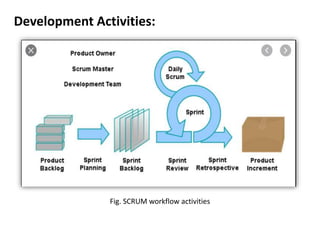
Development Activities:
Fig. SCRUM workflow activities
Various development activities in SCRUM are-
• Backlog:
 It is basically a list of project requirements or features
that must be provided to the customer.
 The item can be included in list at anytime.
 Project manager analyses this list and updates the
priorities as per the requirements.
• Sprint:
 These are the work units that are needed to achieve the
requirements mentioned in the backlogs.
 Typically Sprints have fixed duration or time-box (2-4
weeks)
 Thus Sprint allows the team members to work in short
term environment.
• Roles:
1.Scrum master: he leads the meeting and
analyses the response of each team member.
The potential problems are discussed and
solved in the meeting with the help of master.
2.Team Member: These are the person working
in a team to develop the s/w solution.
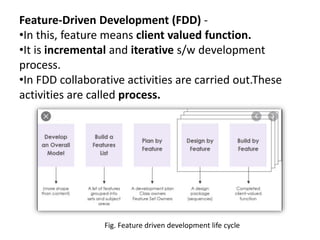
Feature-Driven Development (FDD) -
•In this, feature means client valued function.
•It is incremental and iterative s/w development
process.
•In FDD collaborative activities are carried out.These
activities are called process.
Fig. Feature driven development life cycle
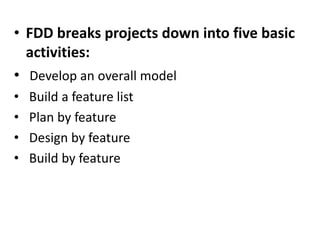
• FDD breaks projects down into five basic
activities:
• Develop an overall model
• Build a feature list
• Plan by feature
• Design by feature
• Build by feature
Dynamic Systems Development Method (DSDM) -
• This is an iterative process model.
• Part of DSDM is the mandate that rework is to be expected,
and any development changes that occur must be reversible.
This framework is based on eight key principles:
• Focus on the business need
• Deliver on time
• Collaborate
• Never compromise quality
• Build incrementally from firm foundations
• Develop iteratively
• Communicate continuously and clearly
• Demonstrate control
Adaptive s/w development(ASD):
• This s/w development approach is useful in
building the complex s/w systems using
iterative approach.
• Focus of this method is on working in
collaboration and team self organization.
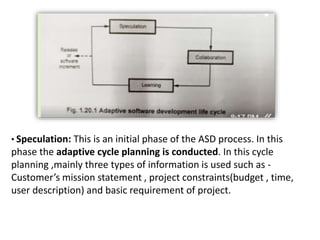
• The life cycle of ASD consist of three phases of
s/w development and those are -
1.Speculation 2. Collaboration 3.Learning
• Speculation: This is an initial phase of the ASD process. In this
phase the adaptive cycle planning is conducted. In this cycle
planning ,mainly three types of information is used such as -
Customer’s mission statement , project constraints(budget , time,
user description) and basic requirement of project.
• Collaboration:
The motivated people can work in collaboration to
develop the desired s/w product.In this phase
collaboration among the members of development
team is a key factor.For successful collaboration and
coordination it is necessary to have following
qualities in every individuals-
Assist each other
Work hard
Posses the required skill sets
Criticize without any hate
• Learning: as team members go on developing the
components , the emphasize is on learning new skills
and techniques.there are three ways by which team
members can learn-
 Focus groups: the feedback from the end users can
be obtained about the s/w components being
developed.
 Formal technical review: this review for s/w
component is conducted for better quality.
 Postmortems: the team analyses its own
performance and make appropriate improvements.
Introduction to agile tool
• The Objective is to help in one or more
activities in agile development.
• Automated support for project planning, use
case development, requirement gathering,
code generation and testing.
• Project management tools focus on preparing
―Earned Value Charts‖ instead of preparing the
Gantt Charts.
• Purpose is to enhance the environment
JIRA
• Developed by Atlassian in 2002.
• Used for bug tracking, issue tracking and project
management.
• Inherited from Japanese word ―Gojira meaning
Godzilla
• JIRA is a competitor for Bugzilla.
• Written in Java and used for Project Management
activities.
Features:
• Plan development iterations
• Iteration reports
• Bug tracking
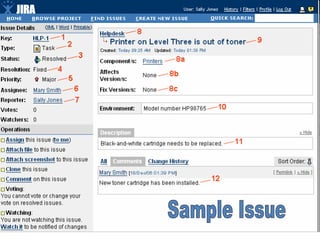
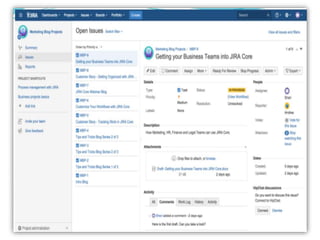
JIRA Issues:
• It is a part of JIRA tool which is used to track
bugs in the project.
JIRA Components :
• Sub-sections of project
• Used to group issues into smaller parts.
• Projects can be broken down into features,
teams, modules, sub-projects, etc.
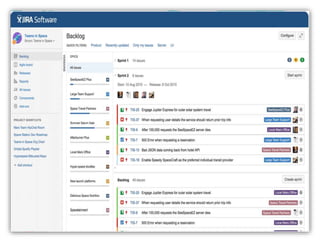
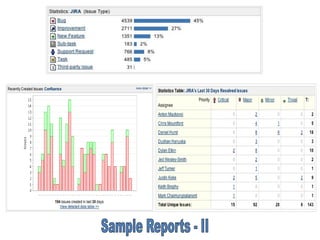
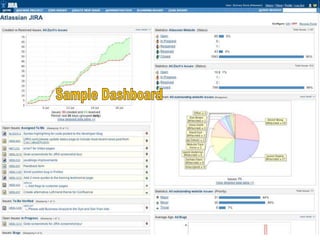
• We can generate reports, collect statistics and
display it on dashboards.
JIRA
• Reports in JIRA
• Progress of the project can be represented
using BurndownChart.
• Different reports like Sprint Report, Version
Report, Control Chart, Cumulative flow
diagram, etc. are also available.
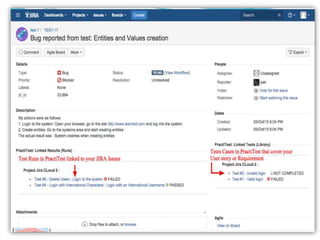
Dashboard
1.Enlist and explain characteristics of software which describe the nature of
software.
2.Explain the layered approach of software engineering
3.What are the Seven engineering principles ?Explain each in detail
4.What is software process? Explain process framework.
5.What are various umbrella activities associated in development process.
6.What do you mean by software myth
explain a.Managment b.Customers d. Practitioner Myths
7.Explain with advantages and disadvantage of
a.Waterfall b. Incremental c.RAD d.Prototype d.Spiral Model
8.Compare the agile with evolutionary process models .
9.Explain Agile development, what are the key factors that are considered for
agile development.
10.List the principle of agility
11.Explain extreme programming process.
12.Explain Scrum Process Flow.
13.Explain features of
a.JIRA Tool
b.Kanban Tool
Thank You

UNIT-I.pptx

  • 1.
    210253 -Software Engineering Theory:3 hrs/week In-Sem: 30 marks End-Sem:70 marks Credit: 3
  • 2.
    Introduction to SoftwareEngineering and Software Process Model Unit -1
  • 4.
    Nature of asoftware [pg no.3 book R.P,7th edition] • Software takes dual role.It is a product and at the same time ,the vehicle for delivering a product. • Software is an information transformer, producing, managing , acquiring , modifying , displaying or transmitting into that Can be as simple as single bit or complex as a multimedia presentation derived from data acquired from dozens of independents sources.
  • 5.
    Defining software • Softwareis- 1.Instruction that when executed provide desired features, functions and performance. 2.Data structure that enable the program to adequately manipulate information. 3.Descriptive information in both hard copy and virtual forms that describes the operation and use of the program. • Software is uses logical rather than physical system elements.
  • 6.
    1.Software is developednot manufactured. 2.Software does not ‘wear out’ Failure rate Wear out time Infact mortality Fig.1 failure curve for hardware
  • 7.
    • It indicatesthat hardware exhibits relatively high failure rate early in its life. • Defects are corrected and failures are drops to a steady state level for some period of time. • Software does not wear out but deteriorate(corrupt/spoil).
  • 8.
    Software • Software isnothing but a collection of computer programs and related documents that are intended to provide desired features, functionalities and better performance. • Software products may be- I. Generic : that means developed to be sold to a range of different customers. Eg.PC s/w such as Excel or word. II. Custom: that means developed for a single customer according to their specification. Eg. Air traffic monitoring
  • 9.
    Software Engineering • s/wengineering is a discipline in which theories, methods and tools are applied to develop professional s/w product . • In software engineering the systematic and organized approach is adapted. • The definition of s/w engineering is based on two terms- 1.Discipline: for finding the solution to the problem an engg. applies appropriate theories, methods and tools.
  • 10.
    2.Product: the s/wproducts get developed after following systematic theories, methods and tools along with the appropriate management activities. Nature of software: [pg no 3 book R.P ] • Software can be applied in a situation for which a predefined set of procedural steps (algorithms) exist.
  • 11.
    • Based ona complex growth of s/w it can be classified into following- 1.System software: It is collection of programs written to service other program. 2.Application software: It consist of standalone program that are developed for specific business head. 3.Embedded software: this category consist of program that can reside within a product or system. 4.Web Applications: this s/w consist of various web pages that can be retrieved by a browser.
  • 12.
    5.Engineering/scientific s/w: thiscategory of s/w has wide range of programs from astronomy to volcano logy ,from automotive stress analysis to space shuttle orbital dynamics and from molecular energy to automated manufacturing. This s/w is based on complex numeric computation. 6.Artificial Intelligence s/w: this type of s/w are based on knowledge based expert system. Typically this s/w is useful in robotics, expert system, image and voice recognition, artificial neural n/w and game playing.
  • 13.
    Layered Technology [pgno-14] a “quality” management process model methods tools Automatic support for s/w Provide technical details Foundation of s/w Backbone of s/w Figure 2. software engineering layers
  • 14.
    • It isa layered technology. • Any s/w can be developed using these layered approaches. • So software engg is a combination of process, method and tools for development of quality s/w.
  • 15.
    The Software process Figure3 software process
  • 16.
    • Software processcan be defined as the structured set of activities. • Common process framework is established by dividing overall framework activities into small number of framework activities. • These small number of activities are applicable to the entire project irrespective of its size and complexity. • A framework is a collection of task sets and these task sets consist of - 1.Collection of small work tasks. 2.Project milestones, deliverables. 3.s/w quality assurance point
  • 17.
    • There arevarious activities called umbrella activities and these activities are associated throughout the development process. • Umbrella Activities :  Software project management  Formal technical reviews  Software quality assurance  Software configuration management  Work product preparation and production  Reusability management  Measurement  Risk management
  • 18.
    The umbrella activitiesinclude- I. Software project tracking & control: Developing team has to access project plan and compared with predefined schedule. II. Risk management: risk management is an event that may or may not occur. assesses risks that may affect outcome of project. III. Software quality assurance: It is nothing but planned and systematic pattern of activities those are required to give guarantee of s/w quality.
  • 19.
    IV. Formal technicalreview: IT is a meeting conducted by technical staff. • The purpose of meeting is to detect quality problems and suggest quality improvement. V. Measurement: It includes the effort required to measure the software (cost,line of code ,size). vI. Software configuration management: It manages effect of change through out the s/w process. VII. Reusability management: It defines criteria for product reuse.
  • 20.
    VIII. Work productpreparation and production: It includes activities required to create documents, logs. Forms, lists and user manual for development software.
  • 21.
    Framework Activities Communication Planning Modeling Analysis ofrequirements Design Construction Code generation Testing Deployment
  • 22.
    Software Vs. Hardware •Software is developed or engineered, it is not manufactured in the classical sense. • Software doesn’t wear out. • Although the industry is moving towards component based construction, most software continues to be custom built.
  • 23.
    Software Myths [pg.no-21to 24 book R.P.7th edition] • Dictionary meaning of myth is fable stories. • It is fiction, imagination or it is a thing or story whose existence is not verifiable. • In relation with computer software myth is nothing but misinformation, misunderstanding or confusions propagate in software development field. • In software development the myths can be considered as three level myths.
  • 24.
    1.Management level myths 2.Customerlevel myths 3.Practitioner/developer level myths • Software crisis : Most of the s/w engg refers the problem associate with s/w development as “software crisis”. The cause of s/w crisis are linked to all the problems and complexities associated with development process. • Following are some most encountered problems associated with development process- 1.Running out of time i.e. deadline crosses. 2.Over budget 3.s/w inefficient 4.Low quality 5.Not upto expectations of customers 6.No enough development team.
  • 25.
    Core Software EngineeringPrinciples • The reason it all exists • keep it simple! • Maintain the product and project “vision” • What you produce, others will consume • Be open to the future • Plan ahead for reuse • Think!
  • 26.
    A generic processmodel • Software process is collection of various activities. • There are 5 generic process framework activities. 1.Communication: The software development process starts with communication between customer and developer. 2.Planning: It includes complete estimation and scheduling and tracking. Need of process model Each team member will understand what is the next activity and how to do it. Thus process model will bring the definiteness and discipline in overall development process.
  • 27.
    3.Modeling:it includes detailrequirement analysis and project design (flowchart, algorithm). 4.Construction: it includes coding and testing steps. 5.Deployment: it includes software delivery, support and feedback from customer.
  • 28.
    Legacy software • Theterm legacy software refers to older s/w development that were poorly designed and documented. • It had supported for many years. • The legacy system may or may not remain in use. • Even if it is no longer used, it may continue to impact the organization due to its historical role
  • 29.
    Process Flow • Linearprocess flow: Execute flow from communication to deployment in sequence. • Iterative process flow:
  • 30.
    • Evolutionary processflow: executes the activities in a circular manner to provide a software.
  • 31.
    • Parallel processflow: executes one or more activities in parallel with other activities.
  • 32.
    Types of processmodels • Generic process model • Prescriptive process model • Evolutionary process model
  • 33.
    Generic process model •A generic process model has- 1.Defining a framework activity:  Work tasks for a simple software projects are- • Make contacts with stakeholder via telephone. • Discuss requirements and take notes. • Organize notes in brief written statements of requirements. • E-mail to stakeholder for review and approval.  If project is complex, then go for :inception, elaboration, negotiation, specification and validation.
  • 34.
    2.Identifying a taskset: • Task sets are actual list of work to be done to accomplish the objective of s/w engineering action. • Select suitable task set based on problem and project. 3.Process patterns: proven solutions for the similar problem
  • 35.
    Prescriptive process model •This process model define prescribed set of process elements and a predictable process workflow. • Organize framework activities in a certain order • Process framework activity with set of software engineering actions. • Each actions in terms of a task set that identifies the work to be accomplished to meet the goals. • The resultant process model should be adapted to accommodate the nature of the specific project , people doing the work , and the work environment.
  • 36.
    Prescriptive process model Waterfallmodel Incremental process model Incremental model RAD model Evolutionary process model prototyping Spiral model Concurrent development model
  • 37.
    Waterfall model [pgno.39-40 book R.P] • Waterfall model is also called as “linear sequential model” or “classic life cycle model”. • The software development will start with requirement gathering phase. • then progresses through analysis, design, coding, testing and maintenance.
  • 40.
    1. Requirement gatheringand analysis: • In this phase basic requirements of the system must be understood by software engineer who is also called as analyst. • The information domain function behavioral requirements of the system are understood. • All the requirements are then well documented and discussed with customer. 2. Design: Focuses on program attributes such as- • Data structure • Software architecture • Interface representation • Algorithmic details
  • 41.
    3. Coding: In thisphase actual coding will start according to design. 4. Testing: • Begins when coding will done. • While performing testing more focus is on logical internals of the software. • Testing ensures execution of all the paths, functional behaviors • The purpose of testing is to uncover errors, fix the bugs and meet the customer requirements.
  • 42.
    5. Maintenance: • Longestlife cycle phase. • When the system is installed and put in practical use then error may get introduced. • Correcting such errors and putting it in is the major purpose of maintenance activity. Benefits: • The waterfall model is simple to implement. • For implementation of small systems waterfall model is useful.
  • 43.
    Drawbacks: • Difficult tofollow sequential flow. • Requirement analysis is done initially and sometimes it is not possible to state all the requirements explicitly in the beginning . • The customer can see working model only at the end. • Linear nature of waterfall model induced blocking state because certain tasks may be dependent on some previous task
  • 44.
    Incremental process model(egRAD model) • In this model the initial model with limited functionality is created for users understanding about s/w product and then this model is refined and expanded in later releases. • Phases in incremental model: 1.Analysis 2.Design 3.Code 4.Test
  • 45.
    • Incremental modeldelivers series of releases to the customer, these releases are called increments. • The first increment is called core product. In this release basic requirements are implemented and then, in subsequent increments new requirements are added.
  • 46.
    Increment with verylimited functionality.
  • 47.
  • 48.
    RAD Model • Itis type of incremental process model in which there is extremely short development cycle. • When the requirements are fully understood and the component based construction approach is adopted then the RAD model is used. • Using RAD model fully functional system can be developed within 60 to 90 days. • Multiple teams work on developing the s/w system using RAD model parallely . • During design phase various models are created. Those models are Business model ,data model and process model.
  • 49.
    Drawbacks of RADmodel: • It requires multiple teams or large number of people to work on the project. • This model requires heavily committed developer and customers. If commitment is lacking then RAD projects will fail. • Project using RAD models requires heavy resources.
  • 50.
    When to chooseincremental model? • When requirements are reasonably well_defined. • When overall scope of development effort suggest a purely linear effort. • When limited set of s/w functionality needed. Merits of Incremental model: • The incremental model can be adopted when there are less number of people involved in the project. • Technical risk can be managed with each increment. • For a very small time span at least core product Can be delivered to client.
  • 51.
    Evolutionary process model [pgno 42-46 PR] • While developing the s/w system it is often needed to make modification in earlier development phases or task sets. • IF development process is linear or in a straight line then the end product will be unrealistic. • In such cases the iterative approach needs to be adapted. • Evolutionary model is iterative model.
  • 52.
    Prototyping: • Software prototypingrefers to building s/w application prototypes which displays the functionality of the product under development, but may not actually hold the exact logic of the original s/w. • From a quick design a prototype is prepared. • Customer or user evaluates the prototype in order to refine requirement .Iteratively prototype is tuned for satisfying customer requirements.
  • 53.
    Communicat ion Quick plan Construct ion of prot ot ype Mode ling Quick de sign De live ry & Fe e dback Deployment Evolutionary Models: Prototyping
  • 54.
    When to chooseit? • General objective of s/w is defined but not detailed input, processing or o/p requirement. • When the developer is unsure about the efficiency of an algorithm then prototype serves as a better choice. Drawback of prototyping: • In the first version itself customer often want “few fixes” rather than rebuilding of the system. • The first version may have some compromises. • Sometimes developer may make implementation compromises to get prototype working quickly.
  • 55.
  • 56.
    • This modelgives efficient development of incremental versions of s/w. • In this model the s/w is developed in series of increments. • Spiral model is divided into number of framework activities. • These framework activities are denoted by task regions. • Usually there are 6 task regions. • Spiral model is realistic approach for development of large scale systems and software. • Customer and developer identify risk in each level.
  • 57.
    Advantages: • Requirement changescan be made at every stage. • Risk can be identified and rectified before they get problematic. Drawbacks: • If communication is not proper then s/w development will not be upto the mark. • IF risk assessment is not done properly then product will not be obtained successfully.
  • 58.
    Concurrent Development model [pg.no.48PR. 7th edition] • It is also called as concurrent Engineering. • In this model framework activities or software development tasks are represented as states. • The modeling or designing phase of s/w development can be one of the states like under development, waiting for modification under revision or under review and so on • All the s/w development activities exist concurrently in this model but framework activities can be in various states. • These states make transitions.
  • 59.
    • i.e. duringmodeling the transition from under development states to waiting for modification state occurs. • This model basically defines the series of events due to transition from one state to another state occurs
  • 60.
    Under review Baselined Done Under revision A waiting changes Under development none Modeling act ivit y represent s t he st at e of a sof t ware engineering act ivit y or t ask Figure. Concurrent development model
  • 61.
    Advantages: • All typesof s/w development can be done using concurrent development model. • This model provide accurate picture of current state of project. • Each activity or tasks can be carried out concurrently. • Hence this model is an efficient process model.
  • 62.
    Specialized Process Models •Specialized process models are used when only collection of specialized technique or methods are expected for developing specific s/w. • Various types of specialized models are: 1. Component Based Development 2. Formal Methods Model 3. Aspect-Oriented Software Development
  • 63.
    1.Component Based Development: •These components have specialized targeted functionalities and well defined interface. • It uses various characteristics of spiral models. • This model is evolutionary in nature. • The component must be searched and analyzed before beginning of modeling and construction activity of s/w development. • Components can be simple functions or object oriented methods or classes.
  • 64.
    • Steps: 1.Identify componentbased product. 2.Analyse component integration issues. 3.Design s/w architecture(SA) to accommodate the component. 4.Integrate components into the SA. 5.Conduct comprehensive testing for the s/w. • s/w reusability is the major advantage . • Reusability reduces the development cycle time and overall cost.
  • 65.
    2.Formal method model:[pg.no51-53] • This model consist of set of activities in which the formal mathematical specification is used. • The s/w engg. Specify, develop and test the computer based systems using mathematical notation. • The notations are specified within the formal method. • Clean room s/w engineering makes use of the formal method approach.
  • 66.
    Advantages: • Ambiguity • Incompleteness •Inconsistency • Offers defect free s/w Drawbacks: • It is time consuming and expensive. • For using this model developer must have strong mathematical background or some extensive training. • If this model is chosen for development then communication with customer become very difficult.
  • 67.
    3.Aspect-Oriented Software Development: •This focuses on identification,specification and representation of cross cutting concern and their modularization into separate functional unit. • Aspectual requirements defines these cross cutting concerns that have impact on s/w architecture. • It is relatively new s/w engg. Paradigm and is not matured enough.
  • 68.
    The Unified process •IT is a framework for object oriented model. • This model is also called as rational unified process model(RUP). • This model is iterative and incremental by nature. • There are phases: 1.Inception 2.Elaboration 3.Construction 4.Transition 5.Production
  • 69.
    1.Inception: Two majoractivities communication and planning •Initial use cases are created. •Initial risk assessment •Project planning
  • 70.
    2.Elaboration: • Planning andmodeling • Use cases are redefined • Architectural representation is created using five models such as- i)use case model ii)Analysis model iii) Design model iv)Implementation model v) Deployment model
  • 71.
    3.Construction : • Mainactivity is to make use cases operational. • Analysis and design activities of previous phases are completed and source code is developed. • Then testing and user and installation manual is created. 4.Transition: • Activities required for deployment of s/w product are carried out. • Beta testing conducted. • User feedback report is used to remove defects from created system.
  • 72.
    5.Production: • Mainly maintenanceactivities are conducted in order to support the user in user friendly environment.
  • 73.
    Unit :1 Software Engineering Fundamentals AdvancedProcess Models & Tools -Software Myths -A Process Framework -Process Models -Waterfall -Incremental -RAD -Spiral -Prototype -Agile Modeling -XP -Scrum -Tools -JIRA -Kanban
  • 75.
    What Is Agile Meaning:able to move quickly and easily. • Readiness for motion of activity. • Effective response to change. • Effective communication among all stakeholder. • Organizing a team so that it is in control of the work performed. • Rapid, Incremental delivery of s/w.
  • 76.
    Agility • The abilityto both create and respond to change in order to profit in a business environment. • Agile engineers believe:  Current s/w process are heavyweight.  Too many things are done that are not directly related to s/w product being produced.  Current s/w development is too rigid.  Difficulty with incomplete or changing requirements.  Short development cycles.(internet applications)  More active costumer involvement needed.
  • 77.
    • Agile methodsare considered: Lightweight People based rather than plan based. Set of principles Developed by agile alliance - • A non profit organization promotes agile development. • agile is dynamic, content specific, aggressively, change embracing and growth oriented.
  • 78.
    • An Agileprocess - Is Driven by customer descriptions of what is required (scenarios) Recognizes that plan are short lived. Develops s/w iteratively with a heavy emphasis on construction activities. Delivers multiple s/w increment. Adapts as changes occurs.
  • 79.
    1.Highest priority isto satisfy the customer through early and continuous delivery of valuable s/w. 2.Welcome changes from customer at anything in the process. 3.Deliver working s/w frequently. 4.Business people and developer must work together daily throughout the project. 5.Build project around motivated individual. 6.Have face to face conversation. 7.Working s/w is primary measure of progress. 8.The sponsors, developers and user should be able to maintain a constant pace indefinitely. 9.Continuous attention to technical excellence and good designs enhances agility. 10.simplicity. Agile principles
  • 80.
    Plan driven andagile development Requirements change request
  • 81.
    Success in industry Thesuccess of project, which follow extreme programming practices, is due to - • Rapid development • Immediate responsiveness to the customer’s changing requirements. • Focus on low defect rates • System returning constant and consistent value to the customer. • High customer satisfaction. • Reduced cost. • Team cohesion and employee satisfaction.
  • 82.
    Agile methods • Kanban •Extreme Programming • Scrum • Feature-Driven Development (FDD) • Dynamic system development method(DSDM) • Adaptive software development (ASD)etc.
  • 83.
    Agile methodologies • Kanban- Kanban is a simple, visual means of managing projects that emphasizes visibility. • Extreme Programming(XP) - It focuses on continuous development and customer delivery and uses intervals or sprints similar to a scrum methodology
  • 84.
    Scrum: • SCRUM isan agile process model which is used for developing the complex s/w system. • It is lightweight process framework that can be used to manage and control the s/w development using iterative and incremental approach. Principles: Various principles using SCRUM works are as- • There are small working teams on the s/w development projects. Due to this there is maximum communication and minimum overhead. • The task of peoples must be partitioned into small partitions. • The process must accommodate the technical or business changes if they occur.
  • 85.
    • The processshould produce s/w increments. These increments must be tested , documented and built on. • During the product building the constant testing and documentation must be conducted. • The SCRUM process must produce the working model of the product whenever demanded or required. • Various development activities (requirements analysis, design , evolution and delivery ) are guided by SCRUM principles.
  • 86.
  • 87.
    Various development activitiesin SCRUM are- • Backlog:  It is basically a list of project requirements or features that must be provided to the customer.  The item can be included in list at anytime.  Project manager analyses this list and updates the priorities as per the requirements. • Sprint:  These are the work units that are needed to achieve the requirements mentioned in the backlogs.  Typically Sprints have fixed duration or time-box (2-4 weeks)  Thus Sprint allows the team members to work in short term environment.
  • 88.
    • Roles: 1.Scrum master:he leads the meeting and analyses the response of each team member. The potential problems are discussed and solved in the meeting with the help of master. 2.Team Member: These are the person working in a team to develop the s/w solution.
  • 89.
    Feature-Driven Development (FDD)- •In this, feature means client valued function. •It is incremental and iterative s/w development process. •In FDD collaborative activities are carried out.These activities are called process. Fig. Feature driven development life cycle
  • 90.
    • FDD breaksprojects down into five basic activities: • Develop an overall model • Build a feature list • Plan by feature • Design by feature • Build by feature
  • 91.
    Dynamic Systems DevelopmentMethod (DSDM) - • This is an iterative process model. • Part of DSDM is the mandate that rework is to be expected, and any development changes that occur must be reversible. This framework is based on eight key principles: • Focus on the business need • Deliver on time • Collaborate • Never compromise quality • Build incrementally from firm foundations • Develop iteratively • Communicate continuously and clearly • Demonstrate control
  • 92.
    Adaptive s/w development(ASD): •This s/w development approach is useful in building the complex s/w systems using iterative approach. • Focus of this method is on working in collaboration and team self organization. • The life cycle of ASD consist of three phases of s/w development and those are - 1.Speculation 2. Collaboration 3.Learning
  • 93.
    • Speculation: Thisis an initial phase of the ASD process. In this phase the adaptive cycle planning is conducted. In this cycle planning ,mainly three types of information is used such as - Customer’s mission statement , project constraints(budget , time, user description) and basic requirement of project.
  • 94.
    • Collaboration: The motivatedpeople can work in collaboration to develop the desired s/w product.In this phase collaboration among the members of development team is a key factor.For successful collaboration and coordination it is necessary to have following qualities in every individuals- Assist each other Work hard Posses the required skill sets Criticize without any hate
  • 95.
    • Learning: asteam members go on developing the components , the emphasize is on learning new skills and techniques.there are three ways by which team members can learn-  Focus groups: the feedback from the end users can be obtained about the s/w components being developed.  Formal technical review: this review for s/w component is conducted for better quality.  Postmortems: the team analyses its own performance and make appropriate improvements.
  • 96.
    Introduction to agiletool • The Objective is to help in one or more activities in agile development. • Automated support for project planning, use case development, requirement gathering, code generation and testing. • Project management tools focus on preparing ―Earned Value Charts‖ instead of preparing the Gantt Charts. • Purpose is to enhance the environment
  • 97.
    JIRA • Developed byAtlassian in 2002. • Used for bug tracking, issue tracking and project management. • Inherited from Japanese word ―Gojira meaning Godzilla • JIRA is a competitor for Bugzilla. • Written in Java and used for Project Management activities. Features: • Plan development iterations • Iteration reports • Bug tracking
  • 98.
    JIRA Issues: • Itis a part of JIRA tool which is used to track bugs in the project. JIRA Components : • Sub-sections of project • Used to group issues into smaller parts. • Projects can be broken down into features, teams, modules, sub-projects, etc. • We can generate reports, collect statistics and display it on dashboards.
  • 99.
    JIRA • Reports inJIRA • Progress of the project can be represented using BurndownChart. • Different reports like Sprint Report, Version Report, Control Chart, Cumulative flow diagram, etc. are also available.
  • 104.
  • 106.
    1.Enlist and explaincharacteristics of software which describe the nature of software. 2.Explain the layered approach of software engineering 3.What are the Seven engineering principles ?Explain each in detail 4.What is software process? Explain process framework. 5.What are various umbrella activities associated in development process. 6.What do you mean by software myth explain a.Managment b.Customers d. Practitioner Myths 7.Explain with advantages and disadvantage of a.Waterfall b. Incremental c.RAD d.Prototype d.Spiral Model 8.Compare the agile with evolutionary process models . 9.Explain Agile development, what are the key factors that are considered for agile development. 10.List the principle of agility 11.Explain extreme programming process. 12.Explain Scrum Process Flow. 13.Explain features of a.JIRA Tool b.Kanban Tool
  • 107.