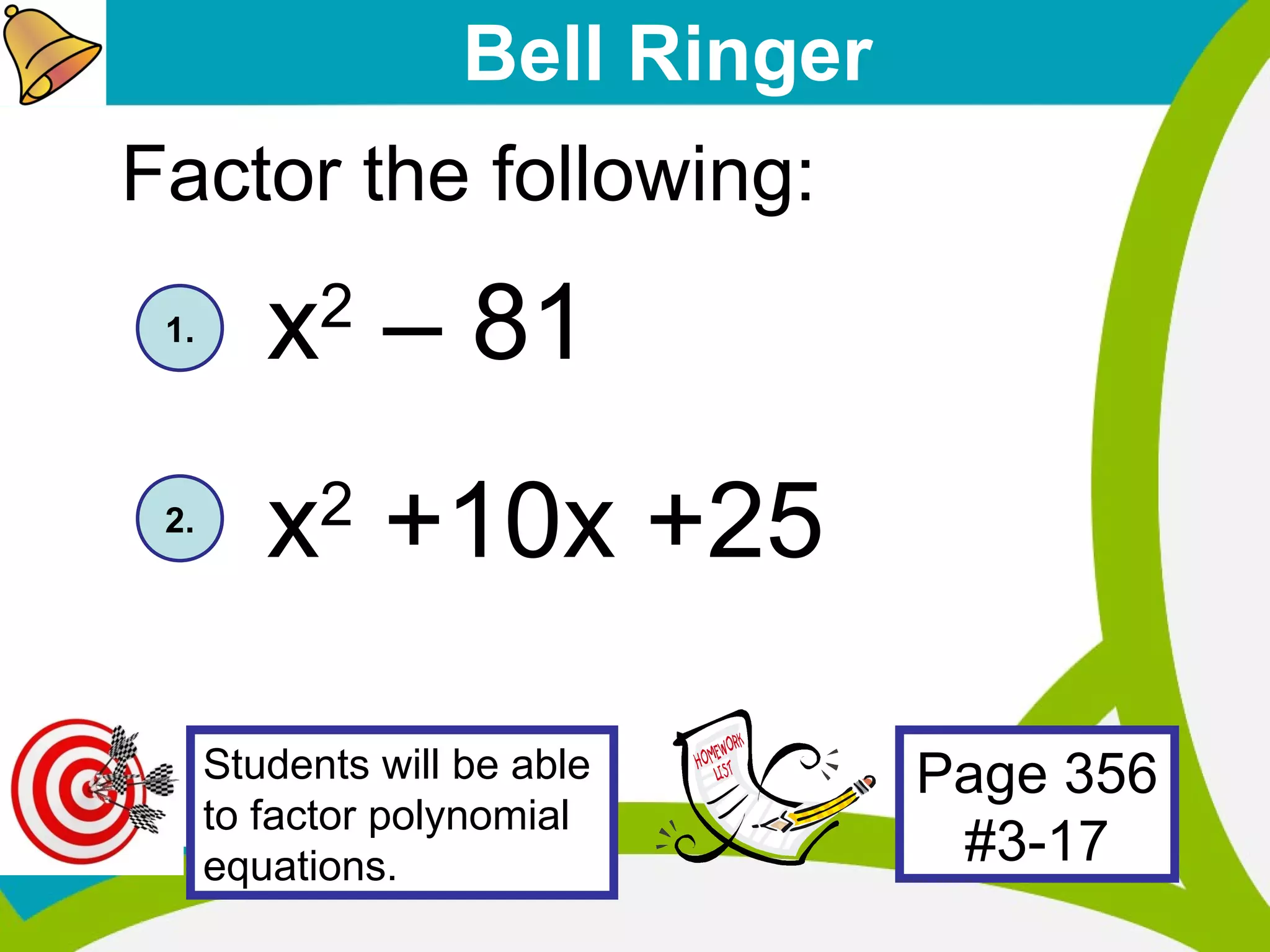
Bell Ringer Factor the following: x 2  – 81 x 2  +10x +25 1.  2.  Students will be able to factor polynomial equations. Page 356 #3-17
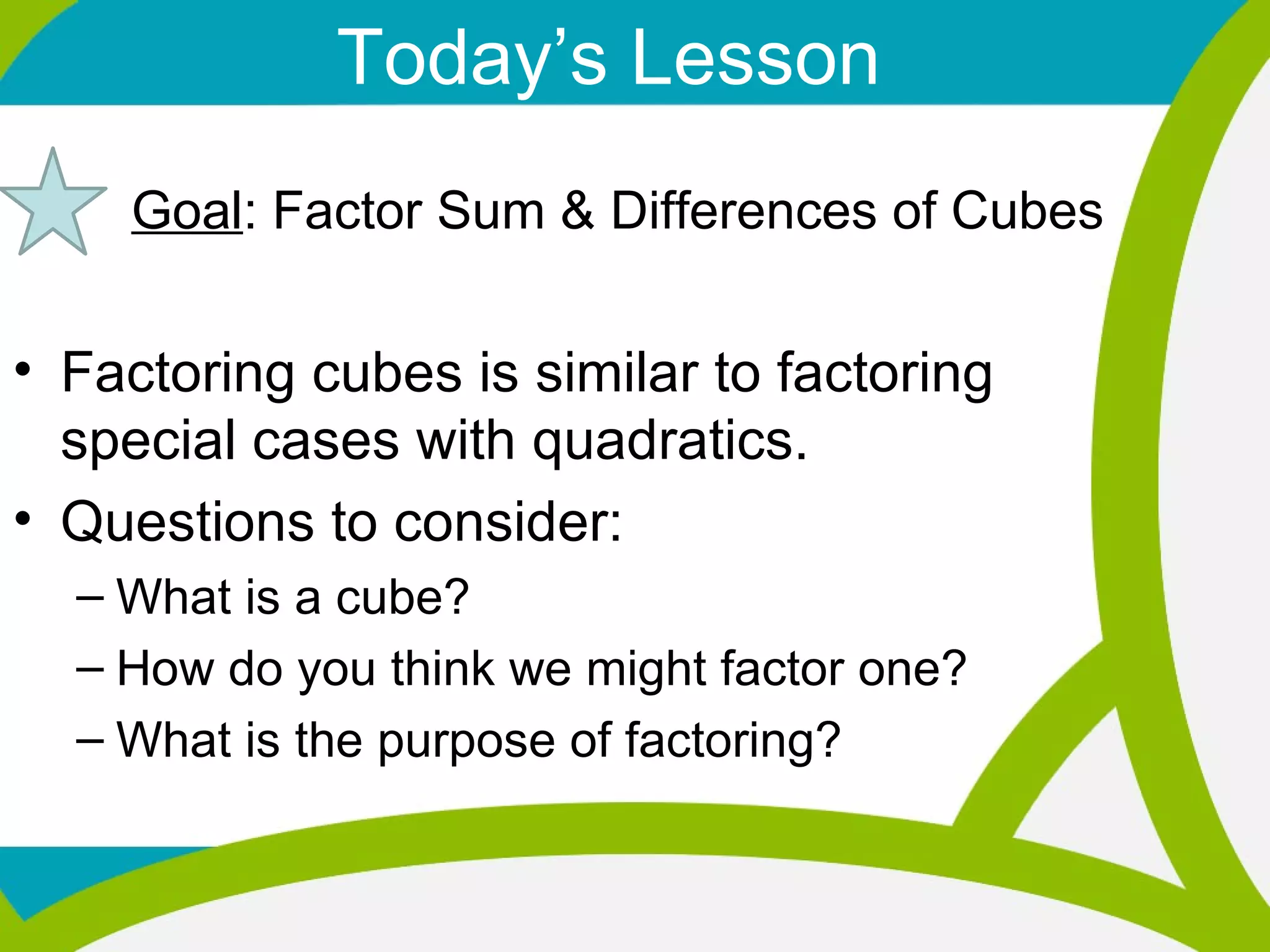
Today’s Lesson Goal : Factor Sum & Differences of Cubes Factoring cubes is similar to factoring special cases with quadratics. Questions to consider: What is a cube?  How do you think we might factor one? What is the purpose of factoring?
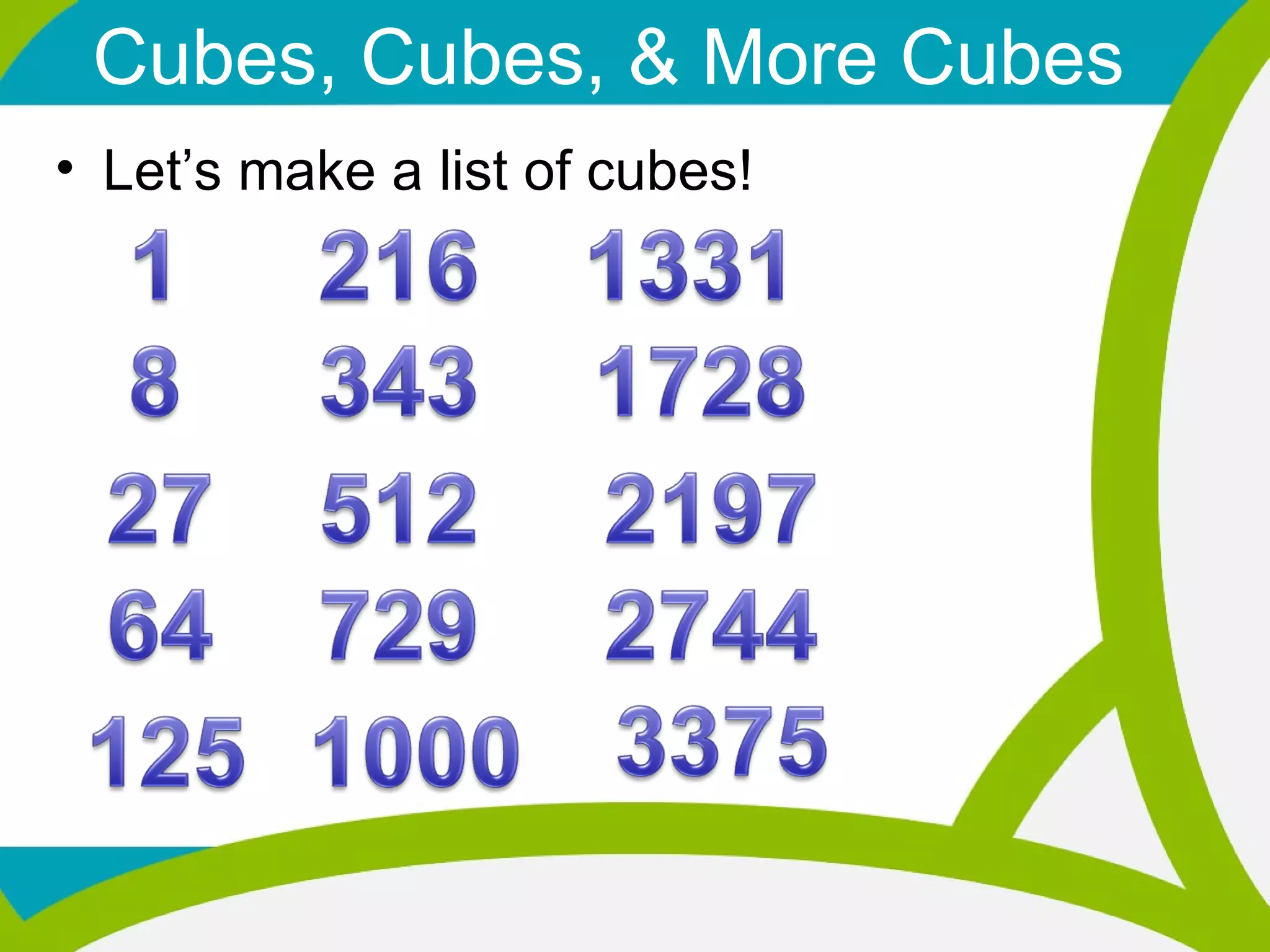
Cubes, Cubes, & More Cubes Let’s make a list of cubes!
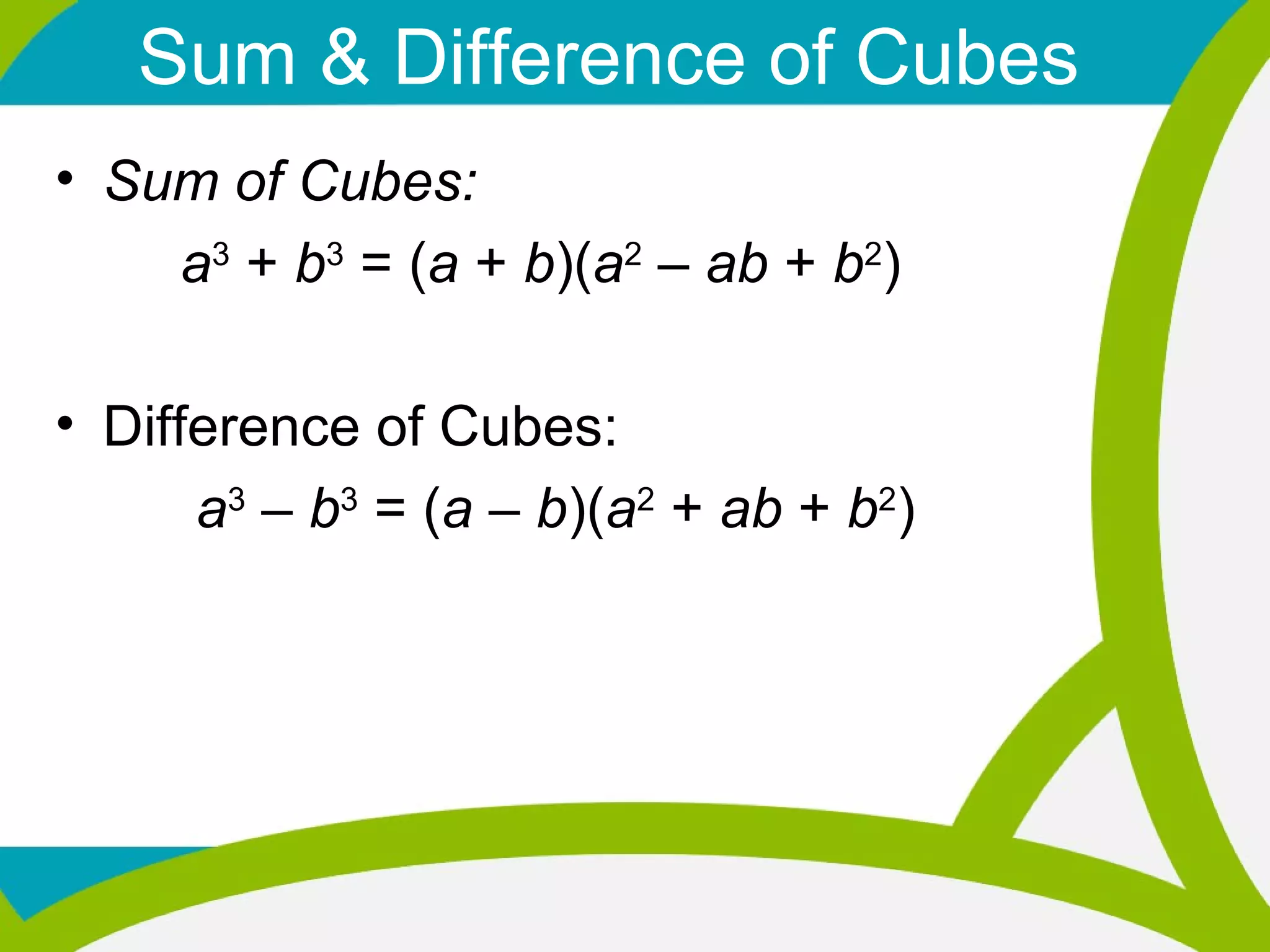
Sum & Difference of Cubes Sum of Cubes: a 3  +  b 3  = ( a  +  b )( a 2  –  ab  +  b 2 )  Difference of Cubes: a 3  –  b 3  = ( a  –  b )( a 2  +  ab  +  b 2 )
Sum of two Cubes Example Factor the following:  x 3  + 27  a 3  + b 3  = (a + b)(a 2  – ab + b 2 ) x 3  + 27 = (x) 3  + (3) 3 = (x + 3)[(x) 2  − (x)(3) + (3) 2 ] = (x + 3)(x 2  − 3x + 9) 1, 8, 27, 64, 125, 216, 343, 512, 729, 1000…
Difference of two Cubes Example Factor the following:  x 3  - 64    a 3  –  b 3  = ( a  –  b )( a 2  +  ab  +  b 2 ) x 3  - 64 = (x) 3  - (4) 3 = (x - 4)[(x) 2  + (x)(4) + (4) 2 ] = (x - 4)(x 2  +4x + 16) 1, 8, 27, 64, 125, 216, 343, 512, 729, 1000…
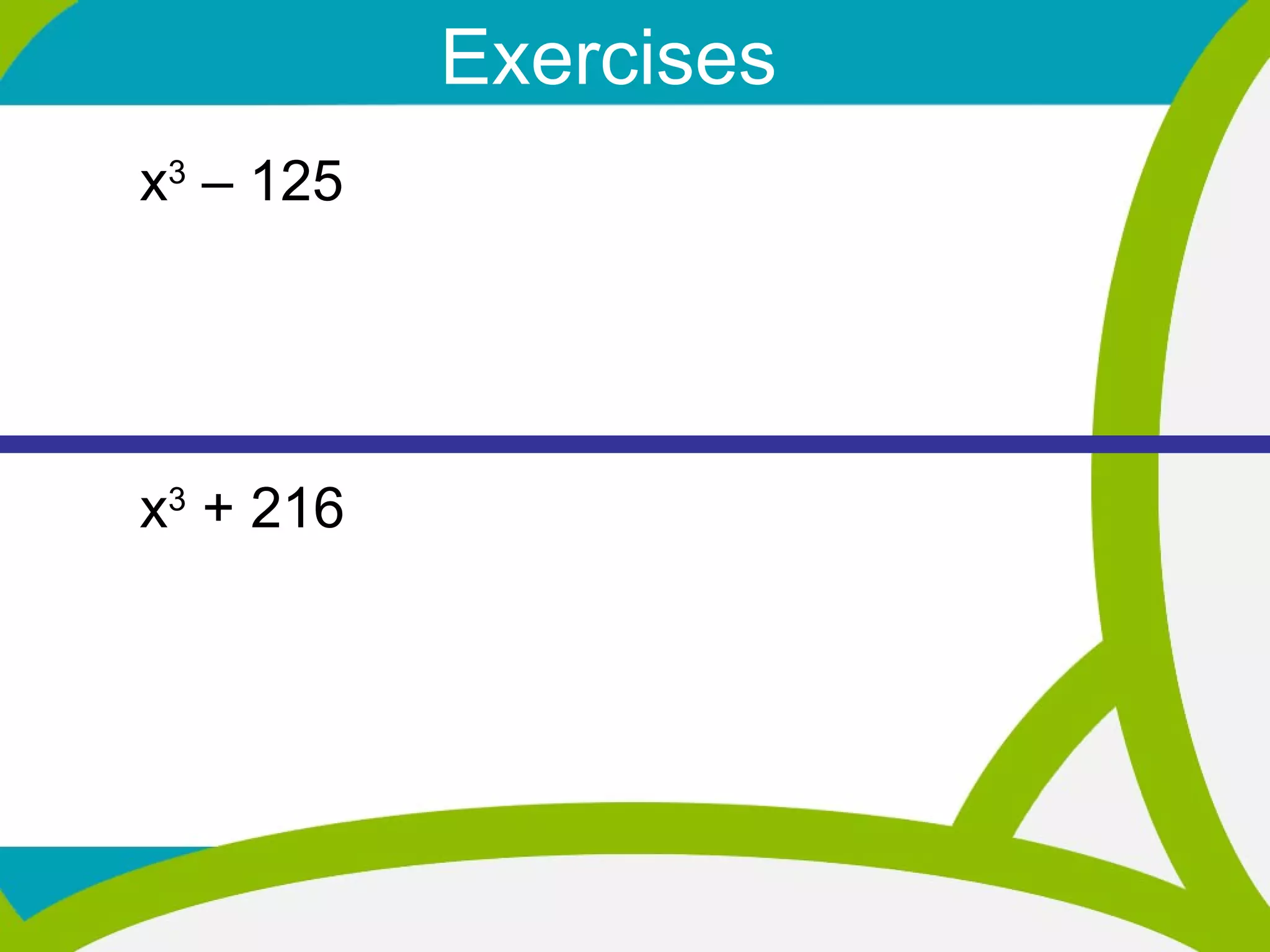
Exercises x 3  – 125   x 3  + 216
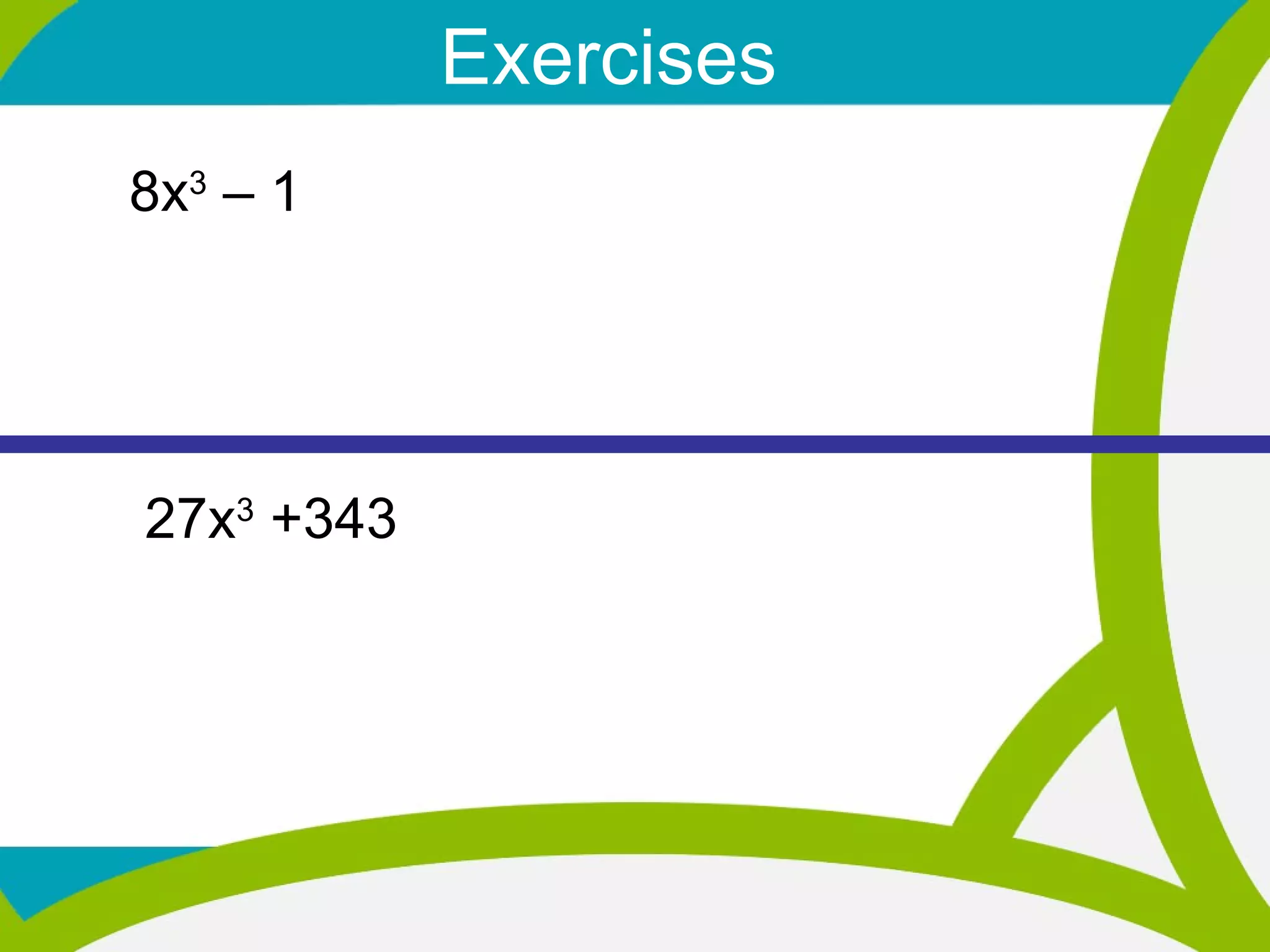
Exercises 8x 3  – 1   27x 3  +343
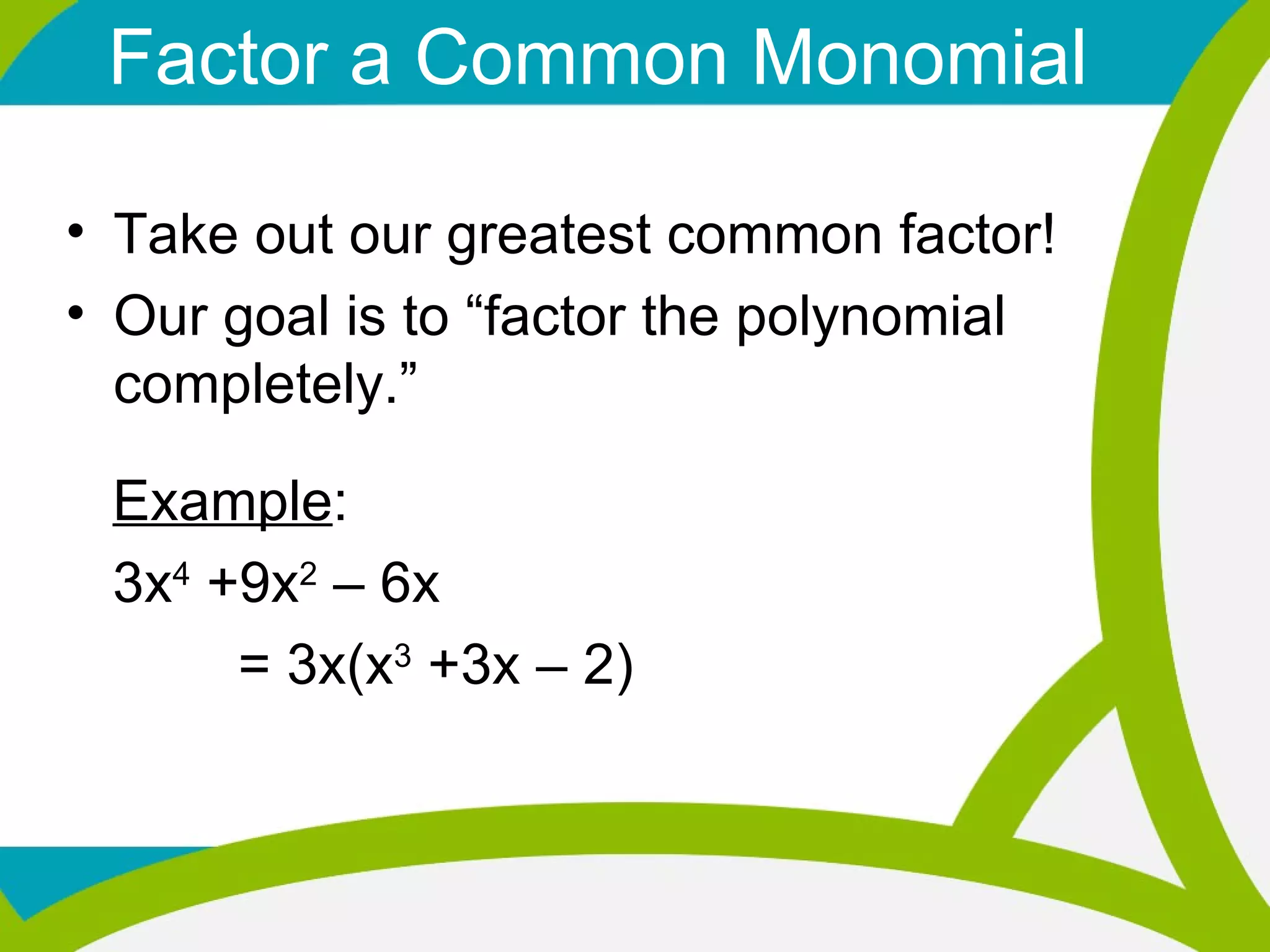
Factor a Common Monomial  Take out our greatest common factor! Our goal is to “factor the polynomial completely.” Example : 3x 4  +9x 2  – 6x = 3x(x 3  +3x – 2)
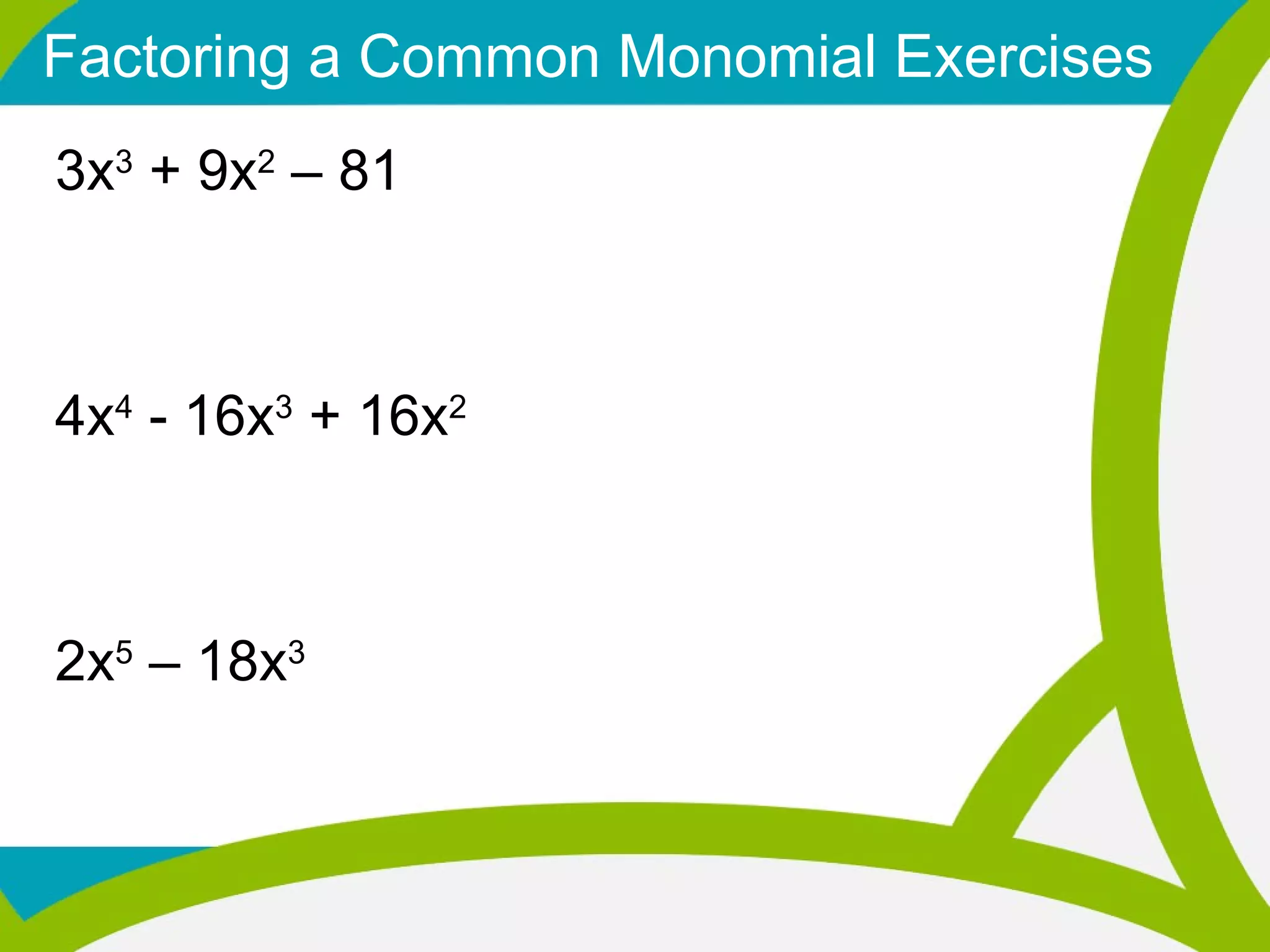
Factoring a Common Monomial Exercises 3x 3  + 9x 2  – 81 4x 4  - 16x 3  + 16x 2   2x 5  – 18x 3
Homework Page 356 #3-17 Sum or Difference of Cubes  Monomial Factors

2/27/12 Special Factoring - Sum & Difference of Two Cubes

  • 1.
    Bell Ringer Factorthe following: x 2 – 81 x 2 +10x +25 1. 2. Students will be able to factor polynomial equations. Page 356 #3-17
  • 2.
    Today’s Lesson Goal: Factor Sum & Differences of Cubes Factoring cubes is similar to factoring special cases with quadratics. Questions to consider: What is a cube? How do you think we might factor one? What is the purpose of factoring?
  • 3.
    Cubes, Cubes, &More Cubes Let’s make a list of cubes!
  • 4.
    Sum & Differenceof Cubes Sum of Cubes: a 3 + b 3 = ( a + b )( a 2 – ab + b 2 ) Difference of Cubes: a 3 – b 3 = ( a – b )( a 2 + ab + b 2 )
  • 5.
    Sum of twoCubes Example Factor the following: x 3 + 27 a 3 + b 3 = (a + b)(a 2 – ab + b 2 ) x 3 + 27 = (x) 3 + (3) 3 = (x + 3)[(x) 2 − (x)(3) + (3) 2 ] = (x + 3)(x 2 − 3x + 9) 1, 8, 27, 64, 125, 216, 343, 512, 729, 1000…
  • 6.
    Difference of twoCubes Example Factor the following: x 3 - 64 a 3 – b 3 = ( a – b )( a 2 + ab + b 2 ) x 3 - 64 = (x) 3 - (4) 3 = (x - 4)[(x) 2 + (x)(4) + (4) 2 ] = (x - 4)(x 2 +4x + 16) 1, 8, 27, 64, 125, 216, 343, 512, 729, 1000…
  • 7.
    Exercises x 3 – 125 x 3 + 216
  • 8.
    Exercises 8x 3 – 1 27x 3 +343
  • 9.
    Factor a CommonMonomial Take out our greatest common factor! Our goal is to “factor the polynomial completely.” Example : 3x 4 +9x 2 – 6x = 3x(x 3 +3x – 2)
  • 10.
    Factoring a CommonMonomial Exercises 3x 3 + 9x 2 – 81 4x 4 - 16x 3 + 16x 2 2x 5 – 18x 3
  • 11.
    Homework Page 356#3-17 Sum or Difference of Cubes Monomial Factors

Editor's Notes

  • #2 When factoring, look at what perfect squares you have and pay attention to your signs. x^2 -81 = (x-9)(x+9). When factoring this, we know that 81 is a perfect square. Since there is no middle term and 81 is negative, this can be factored into a difference of squares. x^2+10x+25 For this one, we once again have a perfect square, 25. 25 = 5^2. But, we have a middle term which is positive. This is why we can factor this quadratic into two perfect squares. For more practice, reference Sections 4.3 & 4.4 Specifically, page 253 for these special cases.
  • #3 A cube is any number or variable raised to the third power. So, 2^3 = 8, making 8 a cube. The same applies for variables, such as x^3. This would also be a cube. We’ll take a look at factoring in the next couple slides. Factoring is similar to when we factor a quadratic, except this time, we factor into a binomial and a trinomial. The purpose of factoring is to solve our equations and find our zeros.
  • #5 Do you notice a similarity between the two factorizations? What is similar? What is different?
  • #6 Example 1 How can we check that our factors are correct? You can always double-check your work by multiplying out the polynomial (which is what we did in the last section)!
  • #8 Exercise 1: Difference of cubes x^3 -125 = (x-3)(x^2 +5x+25) Exercise 2: Sum of cubes x^3 + 216 = (x+6)(x^2-6x+36)
  • #9 Now, consider what you would do when we have a coefficient in front of our first term. Well…what would you do if you were told to write that coefficient in terms of a cube? Let’s take a look. Exercise 3: 8x^3 -1 We know that 8 is a cube. 8 may be written as 2^3. So, we can write our polynomial as… (2x)^3 – (1)^3 In this case, our a =2x and b=1. Now, we can use our difference of cubes formula. 8x^3-1 = (2x-1)(4x^2+2x+1) * Common mistake - Be careful and make sure that you are squaring your a correctly…so that you square the two as well to get 4x^2. Exercise 4: Sum of cubes Once again, write your polynomial in terms of cubes! 27x^3 +343 = (3x)^3 + (7)^3 So, when we use our formula, we get (3x+7)(9x^2-21x+49)
  • #10 Also included in this section is factoring out a common monomial (aka the most common factor). This should be a review from prior, only you probably did not do this with as many terms, and some do require further factoring. Example: 3x^4 +9x^2 -6x Look at each term in our polynomial. First, I like to look at our numbers…3, 9, 6. What is in common between each of these? Since a three is in common, we can factor that out of each term. Now, look at our variables. We have x^4, x^2, x. Clearly, x is the common factor, so we will factor that out. Caution: When doing this, be very careful and pay attention to your powers and signs. It is really easy to drop a power or forget to factor out of each term. 3x^4+9x^2-6x = 3x(x^3+3x-2).
  • #11 Exercises: Note, some require further factorization, such as factoring for difference of two squares or perfect square trinomials, like we did in the bell ringer. Exercise 5: 3x^3+9x^2-81 = 3(x^3+9x^2-27) Exercise 6: 4x^4 – 16x^3 +16x^2 Careful, this polynomial can be factored further. = 4x^2 (x^2 -4x + 4) =4x^2 (x-2)(x-2) or 4x^2(x-2)^2 Exercise 7: 2x^5-18x^3 = 2x^3 (x^2 - 9)