6th July 2017
Sri
Renal failure
 What comes to mind?
Renal Failure
 Innocent bystanders – mostly T2DM/HTN/Obesity
 eGFR <60 = >50% loss
 Uraemic symptoms
 PD vs HD vs Conservative care
 Haemodialysis in theory
 Intermittent haemodialysis
Complications
 What are some complications?
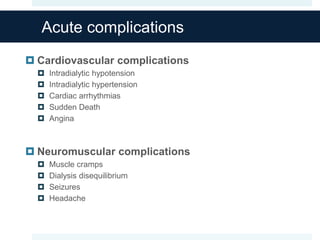
Acute complications
 Cardiovascular complications
 Intradialytic hypotension
 Intradialytic hypertension
 Cardiac arrhythmias
 Sudden Death
 Angina
 Neuromuscular complications
 Muscle cramps
 Dialysis disequilibrium
 Seizures
 Headache
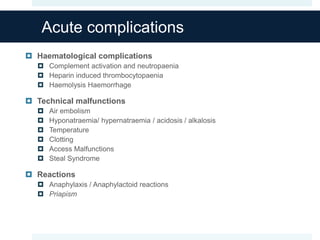
Acute complications
 Haematological complications
 Complement activation and neutropaenia
 Heparin induced thrombocytopaenia
 Haemolysis Haemorrhage
 Technical malfunctions
 Air embolism
 Hyponatraemia/ hypernatraemia / acidosis / alkalosis
 Temperature
 Clotting
 Access Malfunctions
 Steal Syndrome
 Reactions
 Anaphylaxis / Anaphylactoid reactions
 Priapism
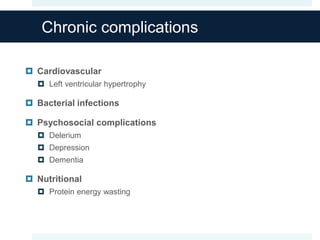
Chronic complications
 Cardiovascular
 Left ventricular hypertrophy
 Bacterial infections
 Psychosocial complications
 Delerium
 Depression
 Dementia
 Nutritional
 Protein energy wasting
Presentations to ED
Approximately (355 visits by 143 patients):
20% infection
20% SOB
15% vascular access
15% chest pain / arrythmia
15% GI complaints
(other)
60% admission rates
Average LOS 8 days
Mr RF, 30M Electrician
 Recent start on haemodialysis
 Comes in with shortness of breath
 VBG – K+ 7.9
 What do you do?
Hyperkalaemia
 Haemolysis isn’t usually the case
 Treatment in ED?
 Gluconate (repeat doses)
 Care with insulin
 Twice the care with sodium bicarbonate
 Care with resonium (onset?)
 Bowel prep – if youre particularly frustrated
 Other electrolyte abnormalities ( Ca / Mg / Phos / Na) – not
common cause of acute presentation, usually another cause
(medications / sepsis)
Cardiac complications
 T/F ESRD patients carry the same cardiovascular risk as
general population.
 T/F Troponins are commonly significantly elevated in patients
on regular dialysis and cannot be trusted as cardiac marker.
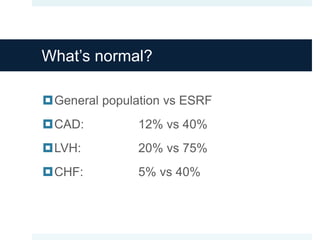
What’s normal?
General population vs ESRF
CAD: 12% vs 40%
LVH: 20% vs 75%
CHF: 5% vs 40%
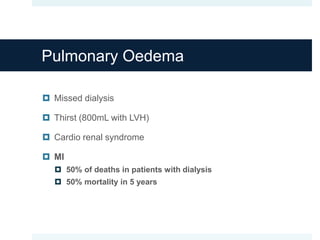
Pulmonary Oedema
 Missed dialysis
 Thirst (800mL with LVH)
 Cardio renal syndrome
 MI
 50% of deaths in patients with dialysis
 50% mortality in 5 years
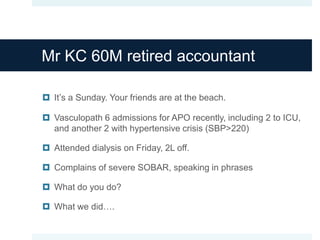
Mr KC 60M retired accountant
 It’s a Sunday. Your friends are at the beach.
 Vasculopath 6 admissions for APO recently, including 2 to ICU,
and another 2 with hypertensive crisis (SBP>220)
 Attended dialysis on Friday, 2L off.
 Complains of severe SOBAR, speaking in phrases
 What do you do?
 What we did….
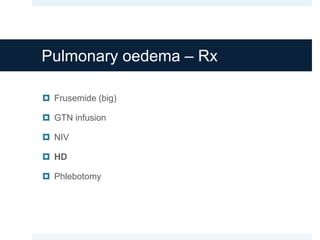
Pulmonary oedema – Rx
 Frusemide (big)
 GTN infusion
 NIV
 HD
 Phlebotomy
Mr RF, 68M
 History of renal amyloidosis. Presented with SOBOE 3/7 ago,
thought to be fluid overload, treated with frusemide
 Now presents again SOBAR.
 What’s the approach?
 Peri-arrest….
Pericarditis / tamponade
 Everyone has uraemic pericarditis
 Complicated by anti-platelet and anticoagulant use
 Poor cardiac reserve
 What had happened with Mr. RF (warfarin)
Mr. NM, 65M
 Nice guy, community HD for ESRF T2DM, stable
 Dizzy post dialysis
 What will be your approach?
 What had happened….
Anaemia
 Diagnosis of exclusion, especially in HD
 ( eGFR <30 )
 ESA, aim for ~100 (trials)
 Bleed during haemodialysis
 Malignancies / plasma cell dyscrasias
 Platelet dysfunction uraemic toxins
 Oesophagitis, gastristis, angiodysplasia, anticoagulation during
HD (~5000 units heparin)
Treatment of anaemia
 dDAVP (0.2 micrograms/kg, 15 min)
 Cryoprecipitate
 Withdrawal of medications (e.g. allopurinol)
 Transfusion on dialysis
 Consideration of future transplant and PRAs
Mrs PC, 78F , retired nurse
 OCD traits, looks after husband with lung cancer at home.
Sudden onset left knee pain 1/12 ago – managed with OTC
analgesics
 Now presents with right ankle pain, unable to weight bear
 What would your approach be?
 What had happened….
CKD Mineral Bone Disorders
 Bones
 ?fracture ?infection
 Low threshold for CT – microfractures
 Bony aches and pains
 Hip and lumbar fractures
 What’s the PTH – turnover
 Types
 Osteitis fibrosa cystica (lytic lesion, painful)
 Osteomalacia
 Adynamic bone disease (common, ?calcium treatment)
 Metastatic calcification (calciphylaxis / vascular – CAD)
Mr ST, 60M, casino addict
 Vasculopath, 130kg, with femoral Hickman line
 “I woke up in a pool of blood.”
 What’s your approach?
 What had happened…
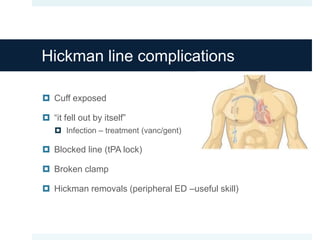
Hickman line complications
 Cuff exposed
 “it fell out by itself”
 Infection – treatment (vanc/gent)
 Blocked line (tPA lock)
 Broken clamp
 Hickman removals (peripheral ED –useful skill)
Hickman bleeds
 Hope its not a subclavian line….
 Pressure, gauze
 Xylocaine adrenaline
 Red-top tubes
 Head-up
 Sand-bag
 Box-suture
 Underlying cause
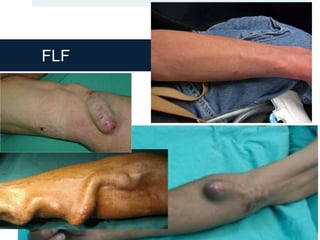
FLF
Fistula complications
 Types – RCF, BCF, Femoral, (PU/PTFE graft) <picture>
 Examination – infection, thrill, bruit, central stenosis,
aneurysm, thrombosis, bleeding
 Investigation: USS – flows, thrombus, cellulitis
 Swabs, Hickman (dialysis nurses or heparin lock) and
peripheral cultures
Bleeding fistula
 Careful pressure
 Torniquet
 Box suture
 Surgeons
Blocked fistula
 Urgent USS for flow
 Clexane (0.8mg/kg – MDRD)
 Interventional radiology / nephrology
 Surgeons (GS 5 or, vascular)
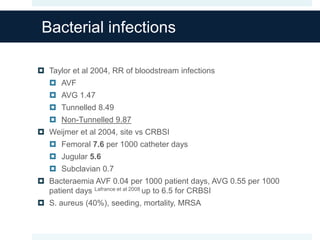
Bacterial infections
 Taylor et al 2004, RR of bloodstream infections
 AVF
 AVG 1.47
 Tunnelled 8.49
 Non-Tunnelled 9.87
 Weijmer et al 2004, site vs CRBSI
 Femoral 7.6 per 1000 catheter days
 Jugular 5.6
 Subclavian 0.7
 Bacteraemia AVF 0.04 per 1000 patient days, AVG 0.55 per 1000
patient days Lafrance et al 2008 up to 6.5 for CRBSI
 S. aureus (40%), seeding, mortality, MRSA
Other topics..
49M, Fijian
 Diabetic with industrial adiposity. Home haemodialysis. Recent
return from family holiday for 7 days.
 Presents to Kattaning ED with confusion
 What is your approach?
 What had happened…
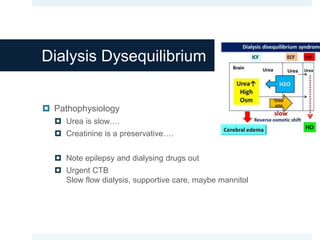
Dialysis Dysequilibrium
 Pathophysiology
 Urea is slow….
 Creatinine is a preservative….
 Note epilepsy and dialysing drugs out
 Urgent CTB
Slow flow dialysis, supportive care, maybe mannitol
The surprises from G65
 Apologies
 Hypotension
 Excessive fluid removal
 Sepsis
 Cardiac tamponage (heparin on HD)
 GI haemorrhage (and only the finger knows)
 MI / arrythmia (30% ventricular, ~50% AF)
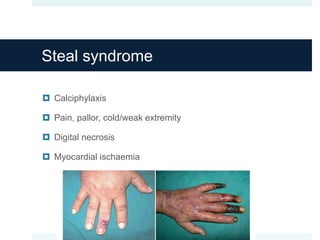
Steal syndrome
 Calciphylaxis
 Pain, pallor, cold/weak extremity
 Digital necrosis
 Myocardial ischaemia
Contrast in haemodialysis
 No proof to schedule dialysis
 Takes up to 3 sessions of dialysis to remove contrast,
depending on type
 Some evidence that questions the phenomenon of contrast
induced nephropathy in the first place (CJASN 2016)
 No reproducible protection in non-HD CKD patients who had
dialysis post contrast administration (Kid Int 20006) + risk of
dialysis
Pain management in HD
 Morphine – dirty, dialysed, use half of usual
 Codeine – not dialysed
 Fentanyl – not dialysed
 Buprenorphine – short acting, dialysed out
 Hydromorphone – who knows?
 This and other medications on – renal drug database
Things to know
 Months/years on dialysis, cause
 Access – creation, complications, function
 Symptoms of infection
 Last session, duration
 Weight and volume status, JVP, blood pressure(s)
 Usual intradialytic weight gains
 Usual trend of potassium / bicarbonate
 Residual urine output
 Cardiac history

Haemodialysis complications

  • 1.
  • 2.
    Renal failure  Whatcomes to mind?
  • 3.
    Renal Failure  Innocentbystanders – mostly T2DM/HTN/Obesity  eGFR <60 = >50% loss  Uraemic symptoms  PD vs HD vs Conservative care  Haemodialysis in theory  Intermittent haemodialysis
  • 4.
    Complications  What aresome complications?
  • 5.
    Acute complications  Cardiovascularcomplications  Intradialytic hypotension  Intradialytic hypertension  Cardiac arrhythmias  Sudden Death  Angina  Neuromuscular complications  Muscle cramps  Dialysis disequilibrium  Seizures  Headache
  • 6.
    Acute complications  Haematologicalcomplications  Complement activation and neutropaenia  Heparin induced thrombocytopaenia  Haemolysis Haemorrhage  Technical malfunctions  Air embolism  Hyponatraemia/ hypernatraemia / acidosis / alkalosis  Temperature  Clotting  Access Malfunctions  Steal Syndrome  Reactions  Anaphylaxis / Anaphylactoid reactions  Priapism
  • 7.
    Chronic complications  Cardiovascular Left ventricular hypertrophy  Bacterial infections  Psychosocial complications  Delerium  Depression  Dementia  Nutritional  Protein energy wasting
  • 8.
    Presentations to ED Approximately(355 visits by 143 patients): 20% infection 20% SOB 15% vascular access 15% chest pain / arrythmia 15% GI complaints (other) 60% admission rates Average LOS 8 days
  • 9.
    Mr RF, 30MElectrician  Recent start on haemodialysis  Comes in with shortness of breath  VBG – K+ 7.9  What do you do?
  • 10.
    Hyperkalaemia  Haemolysis isn’tusually the case  Treatment in ED?  Gluconate (repeat doses)  Care with insulin  Twice the care with sodium bicarbonate  Care with resonium (onset?)  Bowel prep – if youre particularly frustrated  Other electrolyte abnormalities ( Ca / Mg / Phos / Na) – not common cause of acute presentation, usually another cause (medications / sepsis)
  • 11.
    Cardiac complications  T/FESRD patients carry the same cardiovascular risk as general population.  T/F Troponins are commonly significantly elevated in patients on regular dialysis and cannot be trusted as cardiac marker.
  • 12.
    What’s normal? General populationvs ESRF CAD: 12% vs 40% LVH: 20% vs 75% CHF: 5% vs 40%
  • 13.
    Pulmonary Oedema  Misseddialysis  Thirst (800mL with LVH)  Cardio renal syndrome  MI  50% of deaths in patients with dialysis  50% mortality in 5 years
  • 14.
    Mr KC 60Mretired accountant  It’s a Sunday. Your friends are at the beach.  Vasculopath 6 admissions for APO recently, including 2 to ICU, and another 2 with hypertensive crisis (SBP>220)  Attended dialysis on Friday, 2L off.  Complains of severe SOBAR, speaking in phrases  What do you do?  What we did….
  • 15.
    Pulmonary oedema –Rx  Frusemide (big)  GTN infusion  NIV  HD  Phlebotomy
  • 16.
    Mr RF, 68M History of renal amyloidosis. Presented with SOBOE 3/7 ago, thought to be fluid overload, treated with frusemide  Now presents again SOBAR.  What’s the approach?  Peri-arrest….
  • 17.
    Pericarditis / tamponade Everyone has uraemic pericarditis  Complicated by anti-platelet and anticoagulant use  Poor cardiac reserve  What had happened with Mr. RF (warfarin)
  • 18.
    Mr. NM, 65M Nice guy, community HD for ESRF T2DM, stable  Dizzy post dialysis  What will be your approach?  What had happened….
  • 19.
    Anaemia  Diagnosis ofexclusion, especially in HD  ( eGFR <30 )  ESA, aim for ~100 (trials)  Bleed during haemodialysis  Malignancies / plasma cell dyscrasias  Platelet dysfunction uraemic toxins  Oesophagitis, gastristis, angiodysplasia, anticoagulation during HD (~5000 units heparin)
  • 20.
    Treatment of anaemia dDAVP (0.2 micrograms/kg, 15 min)  Cryoprecipitate  Withdrawal of medications (e.g. allopurinol)  Transfusion on dialysis  Consideration of future transplant and PRAs
  • 21.
    Mrs PC, 78F, retired nurse  OCD traits, looks after husband with lung cancer at home. Sudden onset left knee pain 1/12 ago – managed with OTC analgesics  Now presents with right ankle pain, unable to weight bear  What would your approach be?  What had happened….
  • 22.
    CKD Mineral BoneDisorders  Bones  ?fracture ?infection  Low threshold for CT – microfractures  Bony aches and pains  Hip and lumbar fractures  What’s the PTH – turnover  Types  Osteitis fibrosa cystica (lytic lesion, painful)  Osteomalacia  Adynamic bone disease (common, ?calcium treatment)  Metastatic calcification (calciphylaxis / vascular – CAD)
  • 23.
    Mr ST, 60M,casino addict  Vasculopath, 130kg, with femoral Hickman line  “I woke up in a pool of blood.”  What’s your approach?  What had happened…
  • 24.
    Hickman line complications Cuff exposed  “it fell out by itself”  Infection – treatment (vanc/gent)  Blocked line (tPA lock)  Broken clamp  Hickman removals (peripheral ED –useful skill)
  • 25.
    Hickman bleeds  Hopeits not a subclavian line….  Pressure, gauze  Xylocaine adrenaline  Red-top tubes  Head-up  Sand-bag  Box-suture  Underlying cause
  • 26.
  • 27.
    Fistula complications  Types– RCF, BCF, Femoral, (PU/PTFE graft) <picture>  Examination – infection, thrill, bruit, central stenosis, aneurysm, thrombosis, bleeding  Investigation: USS – flows, thrombus, cellulitis  Swabs, Hickman (dialysis nurses or heparin lock) and peripheral cultures
  • 28.
    Bleeding fistula  Carefulpressure  Torniquet  Box suture  Surgeons
  • 29.
    Blocked fistula  UrgentUSS for flow  Clexane (0.8mg/kg – MDRD)  Interventional radiology / nephrology  Surgeons (GS 5 or, vascular)
  • 30.
    Bacterial infections  Tayloret al 2004, RR of bloodstream infections  AVF  AVG 1.47  Tunnelled 8.49  Non-Tunnelled 9.87  Weijmer et al 2004, site vs CRBSI  Femoral 7.6 per 1000 catheter days  Jugular 5.6  Subclavian 0.7  Bacteraemia AVF 0.04 per 1000 patient days, AVG 0.55 per 1000 patient days Lafrance et al 2008 up to 6.5 for CRBSI  S. aureus (40%), seeding, mortality, MRSA
  • 31.
  • 32.
    49M, Fijian  Diabeticwith industrial adiposity. Home haemodialysis. Recent return from family holiday for 7 days.  Presents to Kattaning ED with confusion  What is your approach?  What had happened…
  • 33.
    Dialysis Dysequilibrium  Pathophysiology Urea is slow….  Creatinine is a preservative….  Note epilepsy and dialysing drugs out  Urgent CTB Slow flow dialysis, supportive care, maybe mannitol
  • 34.
    The surprises fromG65  Apologies  Hypotension  Excessive fluid removal  Sepsis  Cardiac tamponage (heparin on HD)  GI haemorrhage (and only the finger knows)  MI / arrythmia (30% ventricular, ~50% AF)
  • 35.
    Steal syndrome  Calciphylaxis Pain, pallor, cold/weak extremity  Digital necrosis  Myocardial ischaemia
  • 36.
    Contrast in haemodialysis No proof to schedule dialysis  Takes up to 3 sessions of dialysis to remove contrast, depending on type  Some evidence that questions the phenomenon of contrast induced nephropathy in the first place (CJASN 2016)  No reproducible protection in non-HD CKD patients who had dialysis post contrast administration (Kid Int 20006) + risk of dialysis
  • 37.
    Pain management inHD  Morphine – dirty, dialysed, use half of usual  Codeine – not dialysed  Fentanyl – not dialysed  Buprenorphine – short acting, dialysed out  Hydromorphone – who knows?  This and other medications on – renal drug database
  • 38.
    Things to know Months/years on dialysis, cause  Access – creation, complications, function  Symptoms of infection  Last session, duration  Weight and volume status, JVP, blood pressure(s)  Usual intradialytic weight gains  Usual trend of potassium / bicarbonate  Residual urine output  Cardiac history

Editor's Notes

  • #2 https://www.ahcmedia.com/articles/77642-emergencies-in-the-dialysis-patient
  • #9 Clin Nephrol. 2002 Jun;57(6):439-43. The emergency department care of hemodialysis patients. Loran MJ1, McErlean M, Eisele G, Raccio-Robak N, Verdile VP. Author information Abstract AIMS:  To describe the emergency department (ED) presentation, evaluation and disposition of maintenance hemodialysis (HD) patients. MATERIALS AND METHODS:  A retrospective review of adult HD patients seen 1/1-12/31/97. The following was collected: demographics, mode of arrival, chief complaint, etiology of renal failure, evaluation, treatment, disposition, length of stay and facility charges. During the study period, this tertiary care ED had an annual adult census of 45,000. No clinical pathways were in place. RESULTS:  143 patients made 355 visits: 351 charts were available. Mean patient age was 51 (range 20-86), 62% were male, 51% were white. 70% presented from home, 26% from dialysis. EMS transported 32%. Medicare insured 78%. Etiologies of renal failure included hypertension (33%), diabetes (27%), HIV (7%) and glomerulonephritis (8%). Complaints were related to infection (18%), dyspnea (17%), vascular access (16%). chest pain or dysrhythmia (15%) and gastrointestinal complaints (12%). ED evaluation included CBC (79%), electrolytes (75%), CXR (57%) and EKG (48%). Antibiotics were administered to 21%. HD was performed earlier than scheduled in 14%. Two hundred and eighteen patients (62%) were admitted (ICU 11%, telemetry 22%), 19 (5%) refused admission and 2 expired in the ED. The average hospital length of stay was 7.8 days (range 1-59), with 29% hospitalized more than 1 week, compared to 6.54 days for non-HD patients. The mean facility charge for admitted subjects was $14,758, while the average cost for non-HD admissions was $7,152. Of the 133 patients (38%) who were discharged directly from the ED, the mean length stay was 223 minutes (range 30 to 750) and the mean charge was $658. The mean length of stay for non-HD patients was 124 minutes. CONCLUSION:  The ED evaluation of adult HD patients involves multiple diagnostic modalities, and patients are usually admitted. The admit rate, ED length of stay for discharged patients and hospital charges for care were substantially higher in the HD patients than in the general population. Further research in the ED care of these complex patients should be undertaken.
  • #23 DOPPS COSMOS EVOLVE - cinacalcet