
Definition
 Dialysis access–associated hand ischemia, “steal syndrome,”
complicates 1%–20% of accesses
 Is stealing of (arterial) blood which would normally flow to the
palmar arch.
 Common in upper arm AVFs (~4%) compared with both AVGs
and forearm AVFs (~1%).
Risk factors
Upper arm access (AVFs)
Peripheral arterial disease
Diabetes
Symptoms
Hand numbness, pain, or weakness
Cold sensation and pale or cyanosis of the fingers
Diminished or absent pulses
Ulceration or dry gangrene of the finger tips  in severe
cases  infection.
Patient start to wear gloves in fistula hand
Diagnosis
 Examination requires comparison with the temperature,
pulse, and function of the opposite hand.
 Investigations
 Pulse oximetry
 Doppler flow
Angiography
Differential diagnosis
Carpal tunnel syndrome
Peripheral vascular disease
Neuropathy DM or Uremia
Ischemic monomelic neuropathy due to the loss of
blood supply to nerves.
 Treatment Options (Depending on Severity)
Symptomatic coldness or paresthesia but without sensory or
motor loss (e.g., gloves)
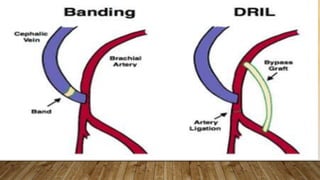
Surgical, with preservation of vascular access- banding to
reduce flow, distal revascularization–interval ligation (DRIL)
procedure
Surgical, with loss of vascular access- in motor loss: ligation
STEAL SYNDROME.pptx
STEAL SYNDROME.pptx

STEAL SYNDROME.pptx

  • 2.
    Definition  Dialysis access–associatedhand ischemia, “steal syndrome,” complicates 1%–20% of accesses  Is stealing of (arterial) blood which would normally flow to the palmar arch.  Common in upper arm AVFs (~4%) compared with both AVGs and forearm AVFs (~1%).
  • 3.
    Risk factors Upper armaccess (AVFs) Peripheral arterial disease Diabetes
  • 4.
    Symptoms Hand numbness, pain,or weakness Cold sensation and pale or cyanosis of the fingers Diminished or absent pulses Ulceration or dry gangrene of the finger tips  in severe cases  infection. Patient start to wear gloves in fistula hand
  • 5.
    Diagnosis  Examination requirescomparison with the temperature, pulse, and function of the opposite hand.  Investigations  Pulse oximetry  Doppler flow Angiography
  • 6.
    Differential diagnosis Carpal tunnelsyndrome Peripheral vascular disease Neuropathy DM or Uremia Ischemic monomelic neuropathy due to the loss of blood supply to nerves.
  • 7.
     Treatment Options(Depending on Severity) Symptomatic coldness or paresthesia but without sensory or motor loss (e.g., gloves) Surgical, with preservation of vascular access- banding to reduce flow, distal revascularization–interval ligation (DRIL) procedure Surgical, with loss of vascular access- in motor loss: ligation