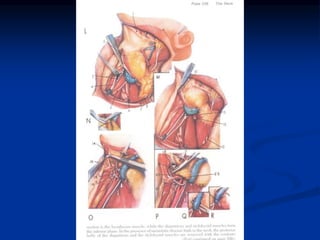
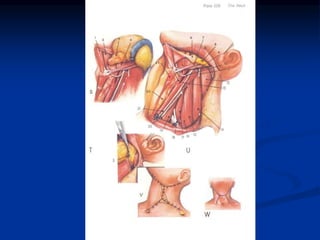
NECK
DISSECTION
By Prof. Muhammad Iqbal Butt
F.R.C.S. (Canada)
Chairman Department of E.N.T.
Lahore Medical & Dental College,
Dean Faculty of E.N.T.
College of Physicians and Surgeons, Pakistan
BENIGN AND MALIGNANT
LESIONS
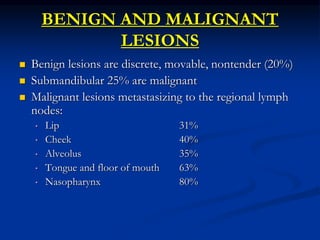
 Benign lesions are discrete, movable, nontender (20%)
 Submandibular 25% are malignant
 Malignant lesions metastasizing to the regional lymph
nodes:
• Lip 31%
• Cheek 40%
• Alveolus 35%
• Tongue and floor of mouth 63%
• Nasopharynx 80%
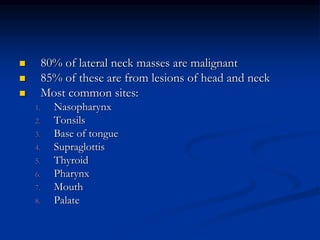
 80% of lateral neck masses are malignant
 85% of these are from lesions of head and neck
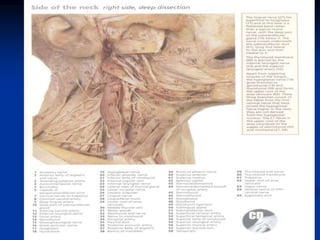
 Most common sites:
1. Nasopharynx
2. Tonsils
3. Base of tongue
4. Supraglottis
5. Thyroid
6. Pharynx
7. Mouth
8. Palate
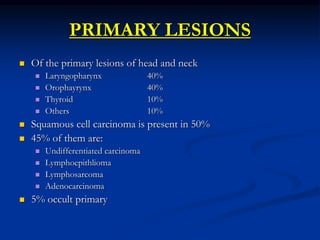
PRIMARY LESIONS
 Of the primary lesions of head and neck
 Laryngopharynx 40%
 Orophayrynx 40%
 Thyroid 10%
 Others 10%
 Squamous cell carcinoma is present in 50%
 45% of them are:
 Undifferentiated carcinoma
 Lymphoepithlioma
 Lymphosarcoma
 Adenocarcinoma
 5% occult primary
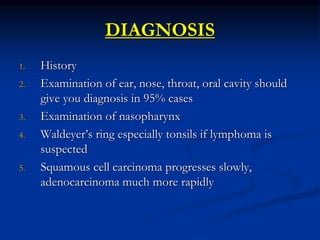
DIAGNOSIS
1. History
2. Examination of ear, nose, throat, oral cavity should
give you diagnosis in 95% cases
3. Examination of nasopharynx
4. Waldeyer’s ring especially tonsils if lymphoma is
suspected
5. Squamous cell carcinoma progresses slowly,
adenocarcinoma much more rapidly
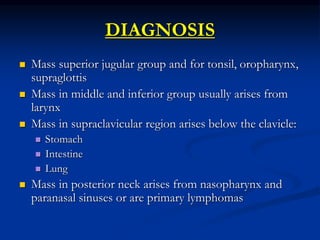
DIAGNOSIS
 Mass superior jugular group and for tonsil, oropharynx,
supraglottis
 Mass in middle and inferior group usually arises from
larynx
 Mass in supraclavicular region arises below the clavicle:
 Stomach
 Intestine
 Lung
 Mass in posterior neck arises from nasopharynx and
paranasal sinuses or are primary lymphomas
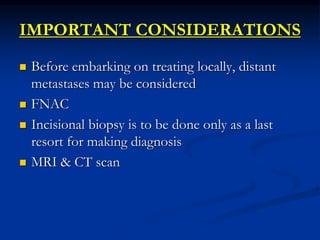
IMPORTANT CONSIDERATIONS
 Before embarking on treating locally, distant
metastases may be considered
 FNAC
 Incisional biopsy is to be done only as a last
resort for making diagnosis
 MRI & CT scan
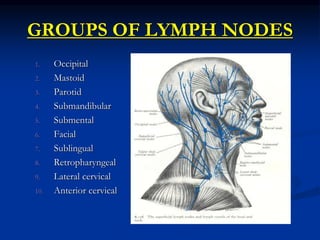
GROUPS OF LYMPH NODES
1. Occipital
2. Mastoid
3. Parotid
4. Submandibular
5. Submental
6. Facial
7. Sublingual
8. Retropharyngeal
9. Lateral cervical
10. Anterior cervical
PAROTID
a) Superficial part
b) Superficial subglandular lying beneath the parotid
sheath (Fascia parotidomasseter)
b1) Preauricular
b2) Intraauricular
c) Deep intraglandular
d) The lower pole of the parotid
These are removed in radical neck dissection
SUBMANDIBULAR
a) Preglandular
b) Prevascular: Usually one large prevascular
node is lying in front of the anterior facial vein
and on the external maxillary artery
c) Retrovascular: Usually two retrovascular
nodes are situated behind the anterior facial
vein
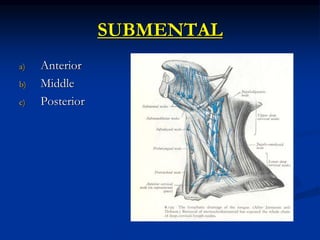
SUBMENTAL
a) Anterior
b) Middle
c) Posterior
RETROPHARYNGEAL
a) Medial: These are intercalated
b) Lateral: These are one to two lying between
prevertebral fascia and lateral pharyngeal wall
at the level of the atlas, near the carotid as it
enters the carotid canal
LATERAL CERVICAL
a) Superficial: There are one to four superficial nodes
over the upper half of sternocleidomastoid. These are
in close relation to the lower pole of the parotid.
b) Deep: The deep cervical nodes consist of three
chains:
i. Internal jugular
ii. Spinal accessory
iii. Transverse cervical
i. Internal jugular chain
 The internal jugular chain lies along the anterolateral aspect
of the internal jugular vein and spinal laterally to the
posterior aspect of the vein in the lower neck
 SUBDIGASTRIC: These are in relation to the posterior
belly of the digastric
 CAROTID NODES: These are in relation to the carotid
bifurcation
 OMHYOID: These are in relation to the superior belly of
the omhyoid
 SUPRACLAVICULAR: These are in relation to the
clavicle
 KUTTNER’S NODE: Also called the principle node of
Kuttner located anteriorly near the posterior belly of the
digastric
ii. Spinal accessory chain
 These are five to ten nodes that extend along the
accessory nerve
iii. Transverse cervical chain
 These are one to ten lymph nodes at the
jugulosubclavian junction. They accompany the
transverse cervical artery and vein. The most
medial of these is the Troissier’s node which may
be the site of metastasis of carcinoma of
stomach. These drain into the right lymphatic
duct.
ANTERIOR CERVICAL
NODES
 These lie between the two carotid sheaths
below the level of the hyoid bone
1. Superficial anterior jugular
2. Deep anterior cervical
Lymph nodes groups:
a) Prelaryngeal
b) Paratracheal
c) Recurrent nerve chain
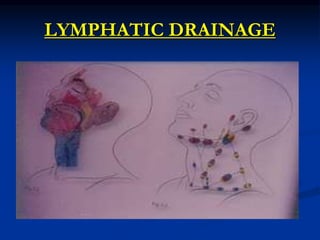
LYMPHATIC DRAINAGE
GENERAL
CONSIDERATIONS
 If adenocarcinoma occult primary is high in the neck,
block dissection is performed with inspection of the
parotid gland
 If biopsy shows undifferentiated carcinoma, radiate
especially for 4cm lymph nodes and then clean residual
disease
 As a general rule, incurable lesions of the neck should
be first treated with radiation
 Block dissection is used to relieve intractible pain
 If adenocarcinoma is present in a supraclavicular LN,
look for primary in the thyroid
 Functional neck dissection is indicated:
i. When bilateral neck dissection is indicated
ii. Preserves muscle function and protects the
carotids
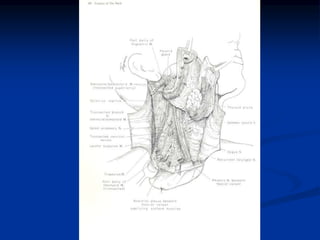
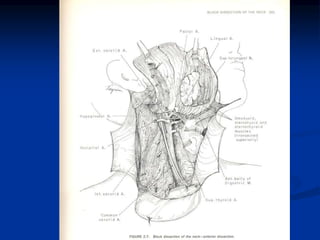
BLOCK DISSECTION
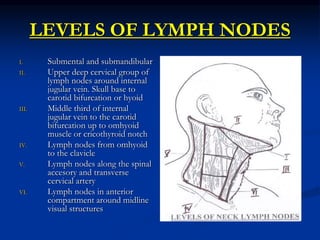
LEVELS OF LYMPH NODES
I. Submental and submandibular
II. Upper deep cervical group of
lymph nodes around internal
jugular vein. Skull base to
carotid bifurcation or hyoid
III. Middle third of internal
jugular vein to the carotid
bifurcation up to omhyoid
muscle or cricothyroid notch
IV. Lymph nodes from omhyoid
to the clavicle
V. Lymph nodes along the spinal
accesory and transverse
cervical artery
VI. Lymph nodes in anterior
compartment around midline
visual structures
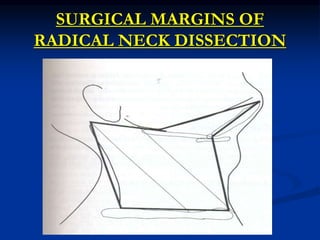
SURGICAL MARGINS OF
RADICAL NECK DISSECTION
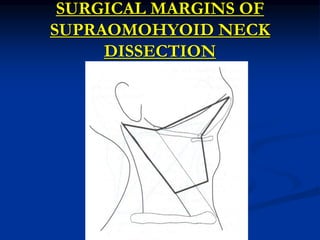
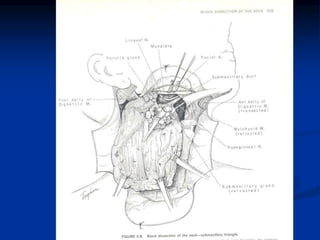
SURGICAL MARGINS OF
SUPRAOMOHYOID NECK
DISSECTION
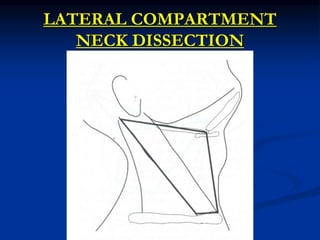
LATERAL COMPARTMENT
NECK DISSECTION
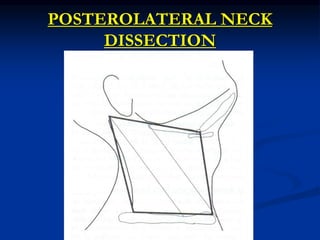
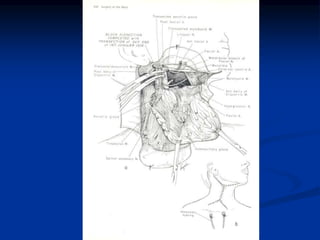
POSTEROLATERAL NECK
DISSECTION
ELECTIVE THERAPEUTICS
 No palpable nodes
 Out of seventy operated cases only eight require
surgery
THERAPEUTICS (also called definitive)
 If nodes are palpable surgery is definite
treatment
TYPES OF NECK DISSECTIONS
1. Radical neck dissection
2. Modified radical neck dissection
3. Selective neck dissection
4. Extended radical neck dissection
1- Radical Neck Dissection
Removal of:
a) Sternocleidomastoid muscle
b) All lymph node groups (level 1-5)
c) Spinal accessory nerve
d) Internal jugular vein
2- Modified Radical Neck Dissection
Remove all lymph nodes (level 1-5), preservation
of one or more non-lymphatic structures
i. Type I Modified Radical Neck Dissection preserves
the spinal accessory nerve
ii. Type II Modified Radical Neck Dissection saves
spinal accessory nerve, internal jugular vein
iii. Type III Modified Radical Neck Dissection
preserves spinal accessory nerve, internal jugular
vein, sternocleidomastoid muscle. Known as
Functional Neck Dissection (Berry picking)
3- Selective Neck Dissection
a) Preservation of one or more lymph node groups and
b) All non-lymphatic structures (accessory nerve,
internal jugular vein, sternocleidomastoid muscle)
i. Supra omhyoid LN removed (level 1-3)
ii. Posterolateral LN removed (level 2-5)
1. Post-auricular and
2. Suboccipital lymph node groups
iii. Lateral (level 2-4) removed
iv. Anterior (level 6) removed
4- Extended Radical Neck
Dissection
 All structures in radical neck dissection and one
or more additional lymph node groups or non-
lymphatic structures or both
CONTRA-INDICATIONS OF
NECK DISSECTION
1. Mass in subclavian triangle
2. A large fixed mass
3. Mass extending to the mastoid
4. Undifferentiated carcinoma
5. Primary lesion that cannot be controlled
6. Distant metastases
7. Uncontrollable tumour will remain in neck after surgery
8. Papillary carcinoma of thyroid without extracapsular
invasion
9. Occult primary adenocarcinoma – sample nodal excision
with inspection of neck
INDICATIONS OF NECK
DISSECTION
 The tumour has extended to lymph nodes
 There is reasonable expectation of controlling
the PRIMARY TUMOUR
 Emphasis is on preservation of function
 Radiation failure
 Lymph nodes larger than 3cm
IMPORTANT LANDMARKS
 Transverse process of atlas
 Internal jugular, Internal carotid artery.
 IX, X, XI & XII cranial nerve.
SRUCTURES AT TIP OF
HYOID BONE
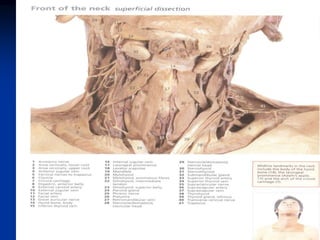
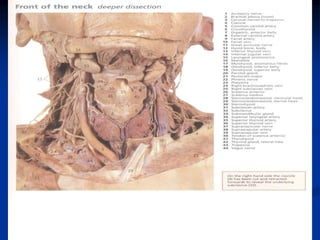
 Carotid bulb, External & Internal carotid artery
 Internal jugular vein
 Vagus nerve, Hypoglossal nerve passing lateral
to carotids
 Lingual vein, superior thyroid & facial vein
entering internal jugular vein
 Superior thyroid artery, Superior laryngeal nerve
& artery
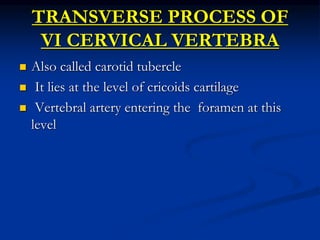
TRANSVERSE PROCESS OF
VI CERVICAL VERTEBRA
 Also called carotid tubercle
 It lies at the level of cricoids cartilage
 Vertebral artery entering the foramen at this
level
PREOPERATIVE
1. Type cross match 2-3
units of whole blood
2. Patient anaesthetized using
various tubes
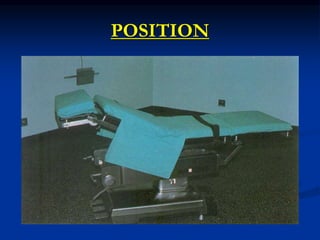
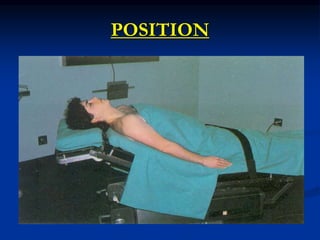
3. Pillow placed under the
shoulder, raise the head
30°
4. Scrub to prepare:
i. Lower face
ii. Ears
iii. Neck
iv. Shoulders
v. Upper chest
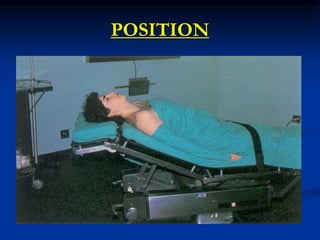
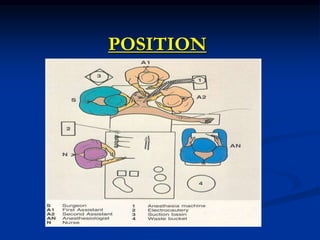
POSITION
POSITION
POSITION
POSITION
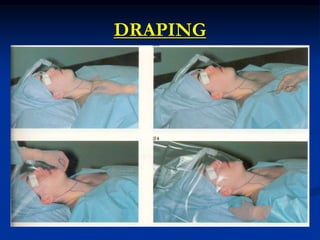
DRAPING
 Keep the ear outside
 First sheet from chin to ear
 Second sheet across upper chest
 Third sheet mastoid to shoulder
 Stitch the sheets
DRAPING
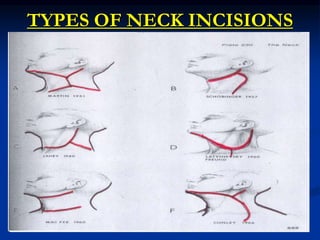
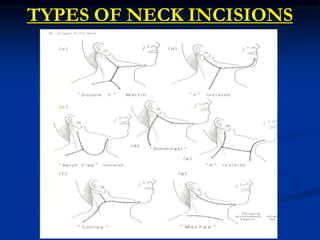
TYPES OF NECK INCISIONS
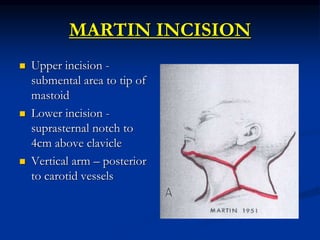
MARTIN INCISION
 Upper incision -
submental area to tip of
mastoid
 Lower incision -
suprasternal notch to
4cm above clavicle
 Vertical arm – posterior
to carotid vessels
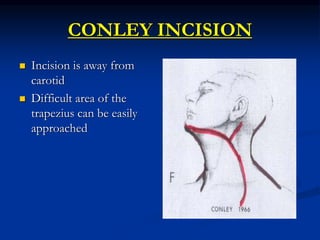
CONLEY INCISION
 Incision is away from
carotid
 Difficult area of the
trapezius can be easily
approached
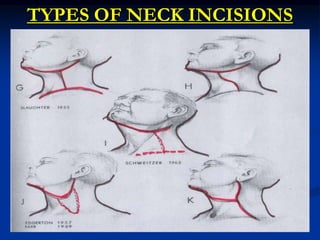
TYPES OF NECK INCISIONS
INCISION
 Protect the carotid with levator muscles, fascia
lata graft
 Incision should be carried out through
i. Skin
ii. Subcutaneus tissue
iii. Platysma muscle
 External jugular vein is not included with the
skin incision
INCISION
 Include the platysma muscle in skin flaps
 Use superior belly of omohyoid as medial guide
 Use scalenus fascia as guide for depth
 Critical areas and structures:
 Internal jugular vein superiorly and inferiorly
 Subclavian vein
 Posterior facial vein hidden in tail of parotid gland
 Superior laryngeal nerve deep to external and internal carotid arteries
 Thoracic duct on left side
 Apical pleura
 Place incision so that trifurcation does not overlie the carotid
vessels
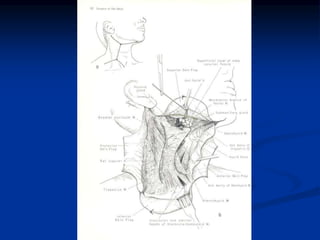
SURGERY 1
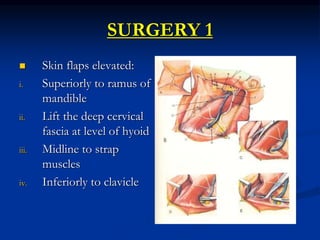
 Skin flaps elevated:
i. Superiorly to ramus of
mandible
ii. Lift the deep cervical
fascia at level of hyoid
iii. Midline to strap
muscles
iv. Inferiorly to clavicle
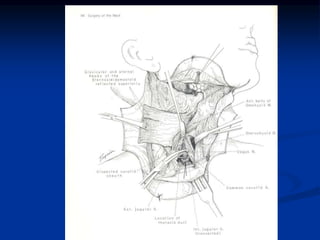
SURGERY 2
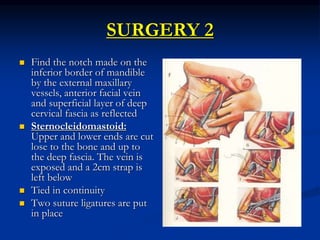
 Find the notch made on the
inferior border of mandible
by the external maxillary
vessels, anterior facial vein
and superficial layer of deep
cervical fascia as reflected
 Sternocleidomastoid:
Upper and lower ends are cut
lose to the bone and up to
the deep fascia. The vein is
exposed and a 2cm strap is
left below
 Tied in continuity
 Two suture ligatures are put
in place
PROBLEM
 The lower end slips or tears
DO NOT PANIC
Remedy!
 JUGULAR VEINS: Always tie the lower end first
 OTHER VEINS:
1. Transverse cervical vein
2. Transverse scapular vein
3. Anterior jugular vein
Fascia of carotid sheath is stripped and vagus nerve and internal
carotid artery saved
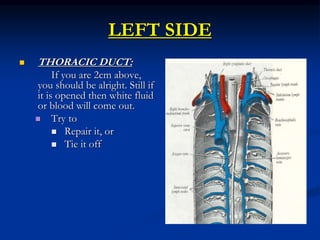
LEFT SIDE
 THORACIC DUCT:
If you are 2cm above,
you should be alright. Still if
it is opened then white fluid
or blood will come out.
 Try to
 Repair it, or
 Tie it off
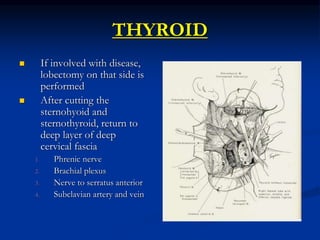
THYROID
 If involved with disease,
lobectomy on that side is
performed
 After cutting the
sternohyoid and
sternothyroid, return to
deep layer of deep
cervical fascia
1. Phrenic nerve
2. Brachial plexus
3. Nerve to serratus anterior
4. Subclavian artery and vein
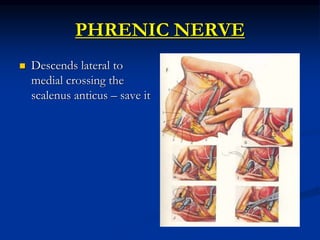
PHRENIC NERVE
 Descends lateral to
medial crossing the
scalenus anticus – save it
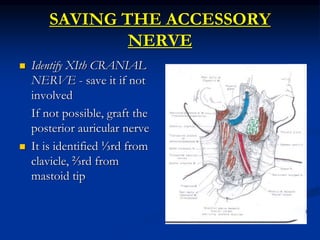
SAVING THE ACCESSORY
NERVE
 Identify XIth CRANIAL
NERVE - save it if not
involved
If not possible, graft the
posterior auricular nerve
 It is identified ⅓rd from
clavicle, ⅔rd from
mastoid tip
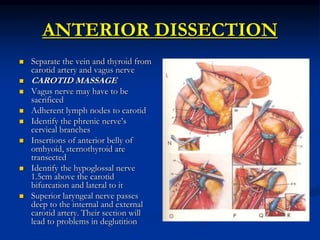
ANTERIOR DISSECTION
 Separate the vein and thyroid from
carotid artery and vagus nerve
 CAROTID MASSAGE
 Vagus nerve may have to be
sacrificed
 Adherent lymph nodes to carotid
 Identify the phrenic nerve’s
cervical branches
 Insertions of anterior belly of
omhyoid, sternothyroid are
transected
 Identify the hypoglossal nerve
1.5cm above the carotid
bifurcation and lateral to it
 Superior laryngeal nerve passes
deep to the internal and external
carotid artery. Their section will
lead to problems in deglutition
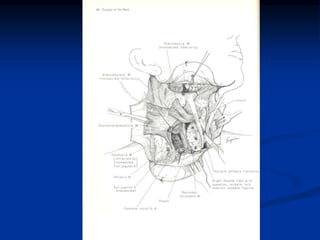
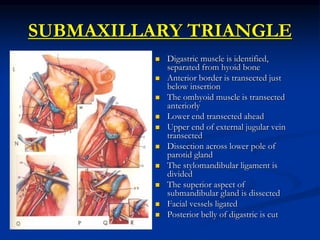
SUBMAXILLARY TRIANGLE
 Digastric muscle is identified,
separated from hyoid bone
 Anterior border is transected just
below insertion
 The omhyoid muscle is transected
anteriorly
 Lower end transected ahead
 Upper end of external jugular vein
transected
 Dissection across lower pole of
parotid gland
 The stylomandibular ligament is
divided
 The superior aspect of
submandibular gland is dissected
 Facial vessels ligated
 Posterior belly of digastric is cut
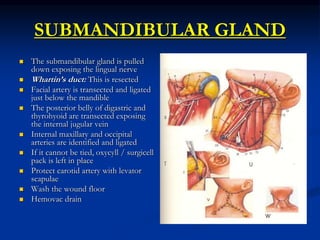
SUBMANDIBULAR GLAND
 The submandibular gland is pulled
down exposing the lingual nerve
 Whartin’s duct: This is resected
 Facial artery is transected and ligated
just below the mandible
 The posterior belly of digastric and
thyrohyoid are transected exposing
the internal jugular vein
 Internal maxillary and occipital
arteries are identified and ligated
 If it cannot be tied, oxycyll / surgicell
pack is left in place
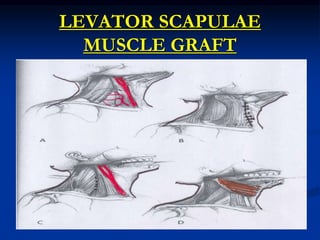
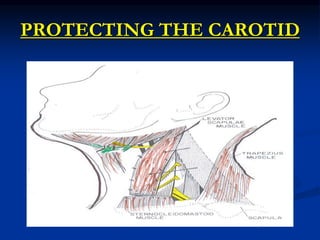
 Protect carotid artery with levator
scapulae
 Wash the wound floor
 Hemovac drain
CAUSES OF CAROTID
BLOWOUT
 Infection
 Incision line is on the carotid
 Flaps are lifted by blood or serum
 Injury during surgery
 Suction tip close to the carotid
 Radiated patient
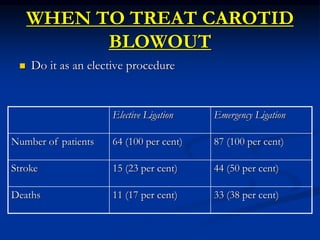
WHEN TO TREAT CAROTID
BLOWOUT
 Do it as an elective procedure
Elective Ligation Emergency Ligation
Number of patients 64 (100 per cent) 87 (100 per cent)
Stroke 15 (23 per cent) 44 (50 per cent)
Deaths 11 (17 per cent) 33 (38 per cent)
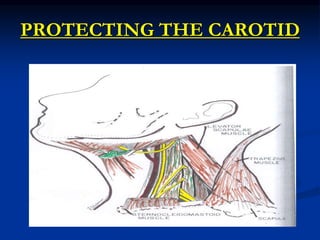
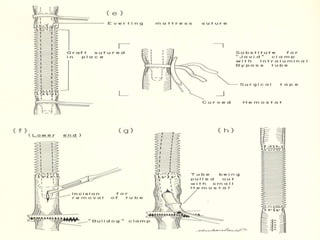
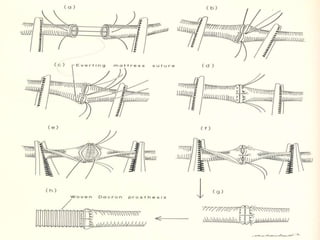
PROTECTING THE CAROTID
 Muscle graft
 Fascia lata graft
 Dermal graft
LEVATOR SCAPULAE
MUSCLE GRAFT
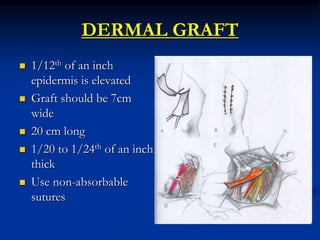
DERMAL GRAFT
 1/12th of an inch
epidermis is elevated
 Graft should be 7cm
wide
 20 cm long
 1/20 to 1/24th of an inch
thick
 Use non-absorbable
sutures
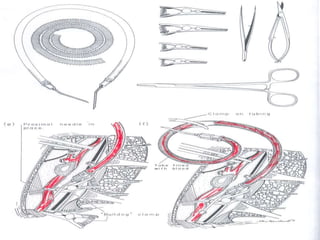
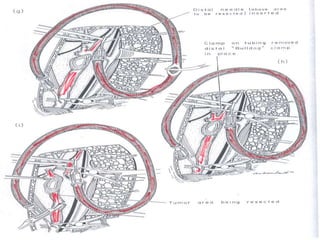
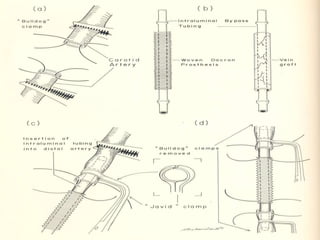
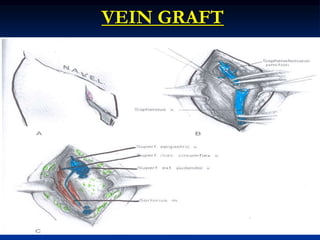
PROTECTING THE CAROTID
VEIN GRAFT
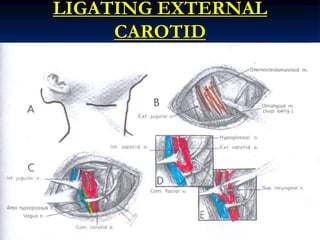
LIGATING EXTERNAL
CAROTID
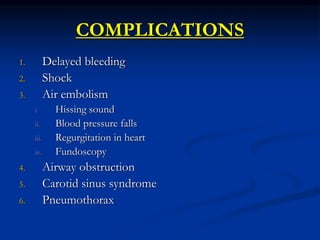
COMPLICATIONS
1. Delayed bleeding
2. Shock
3. Air embolism
i. Hissing sound
ii. Blood pressure falls
iii. Regurgitation in heart
iv. Fundoscopy
4. Airway obstruction
5. Carotid sinus syndrome
6. Pneumothorax
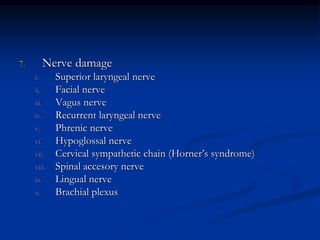
7. Nerve damage
i. Superior laryngeal nerve
ii. Facial nerve
iii. Vagus nerve
iv. Recurrent laryngeal nerve
v. Phrenic nerve
vi. Hypoglossal nerve
vii. Cervical sympathetic chain (Horner’s syndrome)
viii. Spinal accesory nerve
ix. Lingual nerve
x. Brachial plexus
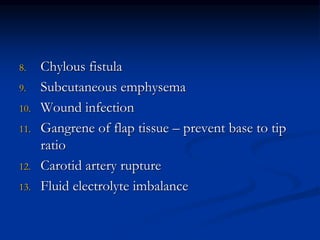
8. Chylous fistula
9. Subcutaneous emphysema
10. Wound infection
11. Gangrene of flap tissue – prevent base to tip
ratio
12. Carotid artery rupture
13. Fluid electrolyte imbalance
14. Increased central venous pressure – if CSF pressure rises
above 600 mmH2O, cerebral palsy
15. Injury to cervical vertebrae
16. Salivary fistula
17. Feeding tube syndrome:
1. Dehydration
2. Hypernatremia
3. Hyperchloridemia
4. Azotemia
5. Fever
6. Increased urinary output
7. Weight loss
8. Confusion
QUESTIONS?

Neck dissection

  • 1.
    NECK DISSECTION By Prof. MuhammadIqbal Butt F.R.C.S. (Canada) Chairman Department of E.N.T. Lahore Medical & Dental College, Dean Faculty of E.N.T. College of Physicians and Surgeons, Pakistan
  • 2.
    BENIGN AND MALIGNANT LESIONS Benign lesions are discrete, movable, nontender (20%)  Submandibular 25% are malignant  Malignant lesions metastasizing to the regional lymph nodes: • Lip 31% • Cheek 40% • Alveolus 35% • Tongue and floor of mouth 63% • Nasopharynx 80%
  • 3.
     80% oflateral neck masses are malignant  85% of these are from lesions of head and neck  Most common sites: 1. Nasopharynx 2. Tonsils 3. Base of tongue 4. Supraglottis 5. Thyroid 6. Pharynx 7. Mouth 8. Palate
  • 4.
    PRIMARY LESIONS  Ofthe primary lesions of head and neck  Laryngopharynx 40%  Orophayrynx 40%  Thyroid 10%  Others 10%  Squamous cell carcinoma is present in 50%  45% of them are:  Undifferentiated carcinoma  Lymphoepithlioma  Lymphosarcoma  Adenocarcinoma  5% occult primary
  • 5.
    DIAGNOSIS 1. History 2. Examinationof ear, nose, throat, oral cavity should give you diagnosis in 95% cases 3. Examination of nasopharynx 4. Waldeyer’s ring especially tonsils if lymphoma is suspected 5. Squamous cell carcinoma progresses slowly, adenocarcinoma much more rapidly
  • 6.
    DIAGNOSIS  Mass superiorjugular group and for tonsil, oropharynx, supraglottis  Mass in middle and inferior group usually arises from larynx  Mass in supraclavicular region arises below the clavicle:  Stomach  Intestine  Lung  Mass in posterior neck arises from nasopharynx and paranasal sinuses or are primary lymphomas
  • 7.
    IMPORTANT CONSIDERATIONS  Beforeembarking on treating locally, distant metastases may be considered  FNAC  Incisional biopsy is to be done only as a last resort for making diagnosis  MRI & CT scan
  • 8.
    GROUPS OF LYMPHNODES 1. Occipital 2. Mastoid 3. Parotid 4. Submandibular 5. Submental 6. Facial 7. Sublingual 8. Retropharyngeal 9. Lateral cervical 10. Anterior cervical
  • 9.
    PAROTID a) Superficial part b)Superficial subglandular lying beneath the parotid sheath (Fascia parotidomasseter) b1) Preauricular b2) Intraauricular c) Deep intraglandular d) The lower pole of the parotid These are removed in radical neck dissection
  • 10.
    SUBMANDIBULAR a) Preglandular b) Prevascular:Usually one large prevascular node is lying in front of the anterior facial vein and on the external maxillary artery c) Retrovascular: Usually two retrovascular nodes are situated behind the anterior facial vein
  • 11.
  • 12.
    RETROPHARYNGEAL a) Medial: Theseare intercalated b) Lateral: These are one to two lying between prevertebral fascia and lateral pharyngeal wall at the level of the atlas, near the carotid as it enters the carotid canal
  • 13.
    LATERAL CERVICAL a) Superficial:There are one to four superficial nodes over the upper half of sternocleidomastoid. These are in close relation to the lower pole of the parotid. b) Deep: The deep cervical nodes consist of three chains: i. Internal jugular ii. Spinal accessory iii. Transverse cervical
  • 14.
    i. Internal jugularchain  The internal jugular chain lies along the anterolateral aspect of the internal jugular vein and spinal laterally to the posterior aspect of the vein in the lower neck  SUBDIGASTRIC: These are in relation to the posterior belly of the digastric  CAROTID NODES: These are in relation to the carotid bifurcation  OMHYOID: These are in relation to the superior belly of the omhyoid  SUPRACLAVICULAR: These are in relation to the clavicle  KUTTNER’S NODE: Also called the principle node of Kuttner located anteriorly near the posterior belly of the digastric
  • 15.
    ii. Spinal accessorychain  These are five to ten nodes that extend along the accessory nerve
  • 16.
    iii. Transverse cervicalchain  These are one to ten lymph nodes at the jugulosubclavian junction. They accompany the transverse cervical artery and vein. The most medial of these is the Troissier’s node which may be the site of metastasis of carcinoma of stomach. These drain into the right lymphatic duct.
  • 17.
    ANTERIOR CERVICAL NODES  Theselie between the two carotid sheaths below the level of the hyoid bone 1. Superficial anterior jugular 2. Deep anterior cervical Lymph nodes groups: a) Prelaryngeal b) Paratracheal c) Recurrent nerve chain
  • 18.
  • 20.
    GENERAL CONSIDERATIONS  If adenocarcinomaoccult primary is high in the neck, block dissection is performed with inspection of the parotid gland  If biopsy shows undifferentiated carcinoma, radiate especially for 4cm lymph nodes and then clean residual disease  As a general rule, incurable lesions of the neck should be first treated with radiation  Block dissection is used to relieve intractible pain  If adenocarcinoma is present in a supraclavicular LN, look for primary in the thyroid
  • 21.
     Functional neckdissection is indicated: i. When bilateral neck dissection is indicated ii. Preserves muscle function and protects the carotids BLOCK DISSECTION
  • 22.
    LEVELS OF LYMPHNODES I. Submental and submandibular II. Upper deep cervical group of lymph nodes around internal jugular vein. Skull base to carotid bifurcation or hyoid III. Middle third of internal jugular vein to the carotid bifurcation up to omhyoid muscle or cricothyroid notch IV. Lymph nodes from omhyoid to the clavicle V. Lymph nodes along the spinal accesory and transverse cervical artery VI. Lymph nodes in anterior compartment around midline visual structures
  • 23.
  • 24.
  • 25.
  • 26.
  • 27.
    ELECTIVE THERAPEUTICS  Nopalpable nodes  Out of seventy operated cases only eight require surgery THERAPEUTICS (also called definitive)  If nodes are palpable surgery is definite treatment
  • 28.
    TYPES OF NECKDISSECTIONS 1. Radical neck dissection 2. Modified radical neck dissection 3. Selective neck dissection 4. Extended radical neck dissection
  • 29.
    1- Radical NeckDissection Removal of: a) Sternocleidomastoid muscle b) All lymph node groups (level 1-5) c) Spinal accessory nerve d) Internal jugular vein
  • 30.
    2- Modified RadicalNeck Dissection Remove all lymph nodes (level 1-5), preservation of one or more non-lymphatic structures i. Type I Modified Radical Neck Dissection preserves the spinal accessory nerve ii. Type II Modified Radical Neck Dissection saves spinal accessory nerve, internal jugular vein iii. Type III Modified Radical Neck Dissection preserves spinal accessory nerve, internal jugular vein, sternocleidomastoid muscle. Known as Functional Neck Dissection (Berry picking)
  • 31.
    3- Selective NeckDissection a) Preservation of one or more lymph node groups and b) All non-lymphatic structures (accessory nerve, internal jugular vein, sternocleidomastoid muscle) i. Supra omhyoid LN removed (level 1-3) ii. Posterolateral LN removed (level 2-5) 1. Post-auricular and 2. Suboccipital lymph node groups iii. Lateral (level 2-4) removed iv. Anterior (level 6) removed
  • 32.
    4- Extended RadicalNeck Dissection  All structures in radical neck dissection and one or more additional lymph node groups or non- lymphatic structures or both
  • 33.
    CONTRA-INDICATIONS OF NECK DISSECTION 1.Mass in subclavian triangle 2. A large fixed mass 3. Mass extending to the mastoid 4. Undifferentiated carcinoma 5. Primary lesion that cannot be controlled 6. Distant metastases 7. Uncontrollable tumour will remain in neck after surgery 8. Papillary carcinoma of thyroid without extracapsular invasion 9. Occult primary adenocarcinoma – sample nodal excision with inspection of neck
  • 34.
    INDICATIONS OF NECK DISSECTION The tumour has extended to lymph nodes  There is reasonable expectation of controlling the PRIMARY TUMOUR  Emphasis is on preservation of function  Radiation failure  Lymph nodes larger than 3cm
  • 35.
    IMPORTANT LANDMARKS  Transverseprocess of atlas  Internal jugular, Internal carotid artery.  IX, X, XI & XII cranial nerve.
  • 36.
    SRUCTURES AT TIPOF HYOID BONE  Carotid bulb, External & Internal carotid artery  Internal jugular vein  Vagus nerve, Hypoglossal nerve passing lateral to carotids  Lingual vein, superior thyroid & facial vein entering internal jugular vein  Superior thyroid artery, Superior laryngeal nerve & artery
  • 37.
    TRANSVERSE PROCESS OF VICERVICAL VERTEBRA  Also called carotid tubercle  It lies at the level of cricoids cartilage  Vertebral artery entering the foramen at this level
  • 47.
    PREOPERATIVE 1. Type crossmatch 2-3 units of whole blood 2. Patient anaesthetized using various tubes 3. Pillow placed under the shoulder, raise the head 30° 4. Scrub to prepare: i. Lower face ii. Ears iii. Neck iv. Shoulders v. Upper chest
  • 48.
  • 49.
  • 50.
  • 51.
  • 52.
    DRAPING  Keep theear outside  First sheet from chin to ear  Second sheet across upper chest  Third sheet mastoid to shoulder  Stitch the sheets
  • 53.
  • 54.
    TYPES OF NECKINCISIONS
  • 55.
    TYPES OF NECKINCISIONS
  • 56.
    MARTIN INCISION  Upperincision - submental area to tip of mastoid  Lower incision - suprasternal notch to 4cm above clavicle  Vertical arm – posterior to carotid vessels
  • 57.
    CONLEY INCISION  Incisionis away from carotid  Difficult area of the trapezius can be easily approached
  • 58.
    TYPES OF NECKINCISIONS
  • 66.
    INCISION  Protect thecarotid with levator muscles, fascia lata graft  Incision should be carried out through i. Skin ii. Subcutaneus tissue iii. Platysma muscle  External jugular vein is not included with the skin incision
  • 67.
    INCISION  Include theplatysma muscle in skin flaps  Use superior belly of omohyoid as medial guide  Use scalenus fascia as guide for depth  Critical areas and structures:  Internal jugular vein superiorly and inferiorly  Subclavian vein  Posterior facial vein hidden in tail of parotid gland  Superior laryngeal nerve deep to external and internal carotid arteries  Thoracic duct on left side  Apical pleura  Place incision so that trifurcation does not overlie the carotid vessels
  • 68.
    SURGERY 1  Skinflaps elevated: i. Superiorly to ramus of mandible ii. Lift the deep cervical fascia at level of hyoid iii. Midline to strap muscles iv. Inferiorly to clavicle
  • 69.
    SURGERY 2  Findthe notch made on the inferior border of mandible by the external maxillary vessels, anterior facial vein and superficial layer of deep cervical fascia as reflected  Sternocleidomastoid: Upper and lower ends are cut lose to the bone and up to the deep fascia. The vein is exposed and a 2cm strap is left below  Tied in continuity  Two suture ligatures are put in place
  • 72.
    PROBLEM  The lowerend slips or tears DO NOT PANIC Remedy!  JUGULAR VEINS: Always tie the lower end first  OTHER VEINS: 1. Transverse cervical vein 2. Transverse scapular vein 3. Anterior jugular vein Fascia of carotid sheath is stripped and vagus nerve and internal carotid artery saved
  • 73.
    LEFT SIDE  THORACICDUCT: If you are 2cm above, you should be alright. Still if it is opened then white fluid or blood will come out.  Try to  Repair it, or  Tie it off
  • 74.
    THYROID  If involvedwith disease, lobectomy on that side is performed  After cutting the sternohyoid and sternothyroid, return to deep layer of deep cervical fascia 1. Phrenic nerve 2. Brachial plexus 3. Nerve to serratus anterior 4. Subclavian artery and vein
  • 75.
    PHRENIC NERVE  Descendslateral to medial crossing the scalenus anticus – save it
  • 76.
    SAVING THE ACCESSORY NERVE Identify XIth CRANIAL NERVE - save it if not involved If not possible, graft the posterior auricular nerve  It is identified ⅓rd from clavicle, ⅔rd from mastoid tip
  • 77.
    ANTERIOR DISSECTION  Separatethe vein and thyroid from carotid artery and vagus nerve  CAROTID MASSAGE  Vagus nerve may have to be sacrificed  Adherent lymph nodes to carotid  Identify the phrenic nerve’s cervical branches  Insertions of anterior belly of omhyoid, sternothyroid are transected  Identify the hypoglossal nerve 1.5cm above the carotid bifurcation and lateral to it  Superior laryngeal nerve passes deep to the internal and external carotid artery. Their section will lead to problems in deglutition
  • 78.
    SUBMAXILLARY TRIANGLE  Digastricmuscle is identified, separated from hyoid bone  Anterior border is transected just below insertion  The omhyoid muscle is transected anteriorly  Lower end transected ahead  Upper end of external jugular vein transected  Dissection across lower pole of parotid gland  The stylomandibular ligament is divided  The superior aspect of submandibular gland is dissected  Facial vessels ligated  Posterior belly of digastric is cut
  • 79.
    SUBMANDIBULAR GLAND  Thesubmandibular gland is pulled down exposing the lingual nerve  Whartin’s duct: This is resected  Facial artery is transected and ligated just below the mandible  The posterior belly of digastric and thyrohyoid are transected exposing the internal jugular vein  Internal maxillary and occipital arteries are identified and ligated  If it cannot be tied, oxycyll / surgicell pack is left in place  Protect carotid artery with levator scapulae  Wash the wound floor  Hemovac drain
  • 80.
    CAUSES OF CAROTID BLOWOUT Infection  Incision line is on the carotid  Flaps are lifted by blood or serum  Injury during surgery  Suction tip close to the carotid  Radiated patient
  • 81.
    WHEN TO TREATCAROTID BLOWOUT  Do it as an elective procedure Elective Ligation Emergency Ligation Number of patients 64 (100 per cent) 87 (100 per cent) Stroke 15 (23 per cent) 44 (50 per cent) Deaths 11 (17 per cent) 33 (38 per cent)
  • 82.
    PROTECTING THE CAROTID Muscle graft  Fascia lata graft  Dermal graft
  • 83.
  • 84.
    DERMAL GRAFT  1/12thof an inch epidermis is elevated  Graft should be 7cm wide  20 cm long  1/20 to 1/24th of an inch thick  Use non-absorbable sutures
  • 85.
  • 86.
  • 91.
  • 93.
  • 94.
    COMPLICATIONS 1. Delayed bleeding 2.Shock 3. Air embolism i. Hissing sound ii. Blood pressure falls iii. Regurgitation in heart iv. Fundoscopy 4. Airway obstruction 5. Carotid sinus syndrome 6. Pneumothorax
  • 95.
    7. Nerve damage i.Superior laryngeal nerve ii. Facial nerve iii. Vagus nerve iv. Recurrent laryngeal nerve v. Phrenic nerve vi. Hypoglossal nerve vii. Cervical sympathetic chain (Horner’s syndrome) viii. Spinal accesory nerve ix. Lingual nerve x. Brachial plexus
  • 96.
    8. Chylous fistula 9.Subcutaneous emphysema 10. Wound infection 11. Gangrene of flap tissue – prevent base to tip ratio 12. Carotid artery rupture 13. Fluid electrolyte imbalance
  • 97.
    14. Increased centralvenous pressure – if CSF pressure rises above 600 mmH2O, cerebral palsy 15. Injury to cervical vertebrae 16. Salivary fistula 17. Feeding tube syndrome: 1. Dehydration 2. Hypernatremia 3. Hyperchloridemia 4. Azotemia 5. Fever 6. Increased urinary output 7. Weight loss 8. Confusion
  • 98.