
CHCCN2C Care for Children Element 4 Respond to the emotional needs of children
Stages of emotional development - Erickson Trust vs mistrust  – approximately 0 – 18 mths Developing sufficient trust in the world to explore it – needs warm, loving interaction Autonomy vs shame  and doubt – approx 2 – 3 yrs Developing feeling of control over behaviour; realising that intentions can be carried out – need support, encouragement, imitation Initiative vs guilt  – approx 3 - 6 yrs Developing a sense of self through identification with parents & a sense of responsibility for own actions Industry vs inferiority  – approx 6 – 11 yrs  Developing a sense of self –worth through interaction with peers – need support, identification with family, peers etc
Why emotional outbursts? video
How do we help children deal with their emotional feelings?
Responding to emotional outbursts At times, children experience intense emotions.  You may find all the children have extreme mood swings - angry and disruptive, withdrawn, upset and crying Need to respond with sensitivity and empathy while ensuring safety of others What to do? Remove the child from the group & find a quiet place where they can regain their composure If child is beyond reason then remove other children from the vicinity and wait for child to calm down
Emotion Post Trauma Video
Help children express emotions appropriately Provide children with opportunities to express emotions Encourage children to draw how they are feeling Help child to write a story about how they are feeling Act out emotions through music and movement Allow acting out of anger and other emotions during dramatic play Encourage the use of miniatures and models to act out stories containing anger Talk about different feelings – help children to label the feeling Read stories about other children in similar   circumstances
Talk about feelings Many researchers believe that helping children talk about their emotions helps children distance themselves from the feelings they are experiencing This gives them some space to think about how they re feeling, and why they are feeling that way and what will happen because they are feeling like this (Kuebli, 1994). The way we talk about feelings will influence how they organise their own emotions and responses to those emotions. But first – help children identify and label feelings
Labelling Feelings Play matching faces with faceless figures engaged in social interaction Play card games where children are asked to pair opposite feelings Play charades where children are asked to act out feelings for other children to guess
Labelling Feelings Find faces and figures that represent specific feelings to use in collage and paste activities
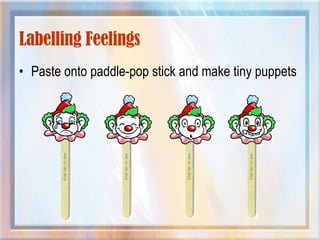
Labelling Feelings Paste onto paddle-pop stick and make tiny puppets
Labelling Feelings Don’t forget the most powerful of all activities to assist children label their emotions: MODELLING Video
Help  children talk about their feelings After children can label a broad range of feelings they can be encouraged to talk about their own feelings This may be difficult for children who have already learned that expressing their feelings is likely to result in in violence and abuse. It will take a lot of TRUST before children will be ready to talk about how they are feeling
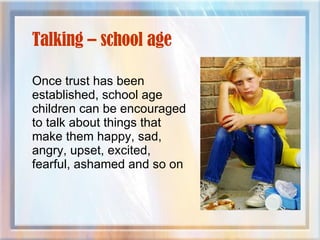
Talking – school age Once trust has been established, school age children can be encouraged to talk about things that make them happy, sad, angry, upset, excited, fearful, ashamed and so on
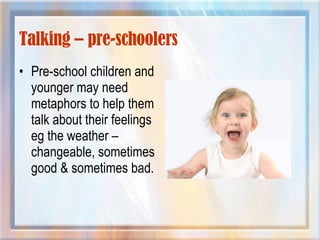
Talking – pre-schoolers Pre-school children and younger may need metaphors to help them talk about their feelings eg the weather – changeable, sometimes good & sometimes bad.
Children’s Style of Communication Be sensitive to children’s style of communication Remember – trust is the key to helping children overcome their difficulties Do not jeopardise the trust you have by being insensitive to their way of communicating.
Children’s style of communication Listen to the words children are using to express themselves Use these same words in your interactions with them Be sensitive to non-verbal cues Listen for children using storytelling as a form of communicating their feelings. Use storytelling in responses to children
Children’s communication style Use active listening Help children apply problem-solving processes to their situation Video
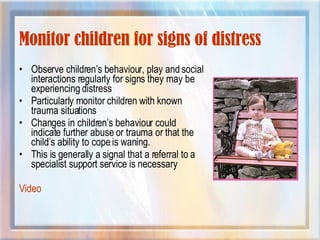
Monitor children for signs of distress Observe children’s behaviour, play and social interactions regularly for signs they may be experiencing distress Particularly monitor children with known trauma situations Changes in children’s behaviour could indicate further abuse or trauma or that the child’s ability to cope is waning.  This is generally a signal that a referral to a specialist support service is necessary Video
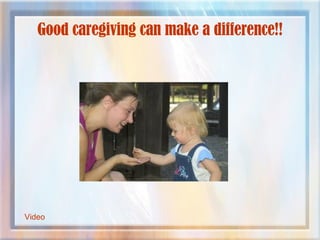
Good caregiving can make a difference!! Video
Inform children of change How do we cope with change? Do we like it to be introduced gradually? Children. Like most adults need time to adjust to change. They need time to process how it will effect then When change is external to the children’s service , it is not the role of the caregiver to inform the child. However, if it is internal change then it is the caregiver’s role to inform the children in plenty of time for them to become used to the idea.

Emotional

  • 1.
    CHCCN2C Care forChildren Element 4 Respond to the emotional needs of children
  • 2.
    Stages of emotionaldevelopment - Erickson Trust vs mistrust – approximately 0 – 18 mths Developing sufficient trust in the world to explore it – needs warm, loving interaction Autonomy vs shame and doubt – approx 2 – 3 yrs Developing feeling of control over behaviour; realising that intentions can be carried out – need support, encouragement, imitation Initiative vs guilt – approx 3 - 6 yrs Developing a sense of self through identification with parents & a sense of responsibility for own actions Industry vs inferiority – approx 6 – 11 yrs Developing a sense of self –worth through interaction with peers – need support, identification with family, peers etc
  • 3.
  • 4.
    How do wehelp children deal with their emotional feelings?
  • 5.
    Responding to emotionaloutbursts At times, children experience intense emotions. You may find all the children have extreme mood swings - angry and disruptive, withdrawn, upset and crying Need to respond with sensitivity and empathy while ensuring safety of others What to do? Remove the child from the group & find a quiet place where they can regain their composure If child is beyond reason then remove other children from the vicinity and wait for child to calm down
  • 6.
  • 7.
    Help children expressemotions appropriately Provide children with opportunities to express emotions Encourage children to draw how they are feeling Help child to write a story about how they are feeling Act out emotions through music and movement Allow acting out of anger and other emotions during dramatic play Encourage the use of miniatures and models to act out stories containing anger Talk about different feelings – help children to label the feeling Read stories about other children in similar circumstances
  • 8.
    Talk about feelingsMany researchers believe that helping children talk about their emotions helps children distance themselves from the feelings they are experiencing This gives them some space to think about how they re feeling, and why they are feeling that way and what will happen because they are feeling like this (Kuebli, 1994). The way we talk about feelings will influence how they organise their own emotions and responses to those emotions. But first – help children identify and label feelings
  • 9.
    Labelling Feelings Playmatching faces with faceless figures engaged in social interaction Play card games where children are asked to pair opposite feelings Play charades where children are asked to act out feelings for other children to guess
  • 10.
    Labelling Feelings Findfaces and figures that represent specific feelings to use in collage and paste activities
  • 11.
    Labelling Feelings Pasteonto paddle-pop stick and make tiny puppets
  • 12.
    Labelling Feelings Don’tforget the most powerful of all activities to assist children label their emotions: MODELLING Video
  • 13.
    Help childrentalk about their feelings After children can label a broad range of feelings they can be encouraged to talk about their own feelings This may be difficult for children who have already learned that expressing their feelings is likely to result in in violence and abuse. It will take a lot of TRUST before children will be ready to talk about how they are feeling
  • 14.
    Talking – schoolage Once trust has been established, school age children can be encouraged to talk about things that make them happy, sad, angry, upset, excited, fearful, ashamed and so on
  • 15.
    Talking – pre-schoolersPre-school children and younger may need metaphors to help them talk about their feelings eg the weather – changeable, sometimes good & sometimes bad.
  • 16.
    Children’s Style ofCommunication Be sensitive to children’s style of communication Remember – trust is the key to helping children overcome their difficulties Do not jeopardise the trust you have by being insensitive to their way of communicating.
  • 17.
    Children’s style ofcommunication Listen to the words children are using to express themselves Use these same words in your interactions with them Be sensitive to non-verbal cues Listen for children using storytelling as a form of communicating their feelings. Use storytelling in responses to children
  • 18.
    Children’s communication styleUse active listening Help children apply problem-solving processes to their situation Video
  • 19.
    Monitor children forsigns of distress Observe children’s behaviour, play and social interactions regularly for signs they may be experiencing distress Particularly monitor children with known trauma situations Changes in children’s behaviour could indicate further abuse or trauma or that the child’s ability to cope is waning. This is generally a signal that a referral to a specialist support service is necessary Video
  • 20.
    Good caregiving canmake a difference!! Video
  • 21.
    Inform children ofchange How do we cope with change? Do we like it to be introduced gradually? Children. Like most adults need time to adjust to change. They need time to process how it will effect then When change is external to the children’s service , it is not the role of the caregiver to inform the child. However, if it is internal change then it is the caregiver’s role to inform the children in plenty of time for them to become used to the idea.