ACE Learning Circles project Lynne Gibb
What is the project? Project is funded by ACFE as part of the ACFE Board's Research strategy and to support the implementation of the Ministerial Statement,  Future Directions for ACE in Victoria .  Cheryl Wilkinson (ACFE Board) commented on the aim:  "Ultimately what participants are doing in the Circle will/should translate in some concrete way into their actual practice and impact on learners and help the implementation of ACFE Board policy. We hope practitioners will become aware of how they might be able to carry out their  strategies in practice  through their ACE organisations" .
What is pedagogy? In relation to this project, pedagogy is seen to be about: The processes and dynamics of teaching and learning, including the purposes, relationships, environment, management & social context of learning
Principles of ACE Pedagogy Centred on learners and their needs Continuous learning for work and life Building on and within real life contexts Sharing power – empowering people & communities Many roads to learning
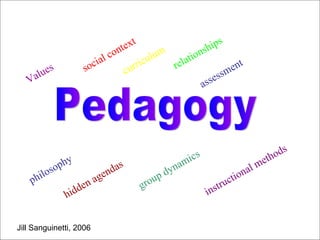
Jill Sanguinetti, 2006 Pedagogy group dynamics social context curriculum relationships assessment philosophy hidden agendas instructional methods Values
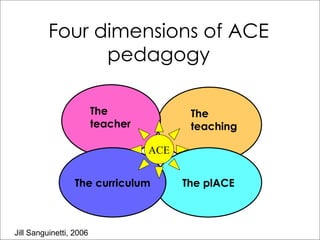
Four dimensions of ACE pedagogy Jill Sanguinetti, 2006 The plACE The teacher The teaching The curriculum ACE
The teacher Is engaged with learners and their learning on  a personal level Is reflexive and open about her/his own practice Is able to improvise and take risks Is aware of relations of power Is patient and puts trust in the learning process
The teaching developmental experiential fosters skills of critical literacy strategies to empower learners multi-layered and eclectic
The curriculum Prioritises learners’ needs in assessment methods Includes explicit teaching of employment and employability skills Contextualised (in the lives of learners) Curriculum negotiated where possible Mix of accredited, non-accredited and enrichment programs opens pathways
The place The plACE: Embodies collective values Has a strongly networked ‘community of practice’ Is community-owned and community building Is led by enabling management Is involved in local community issues
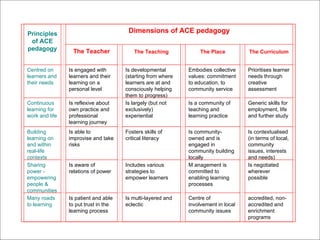
Principles of ACE pedagogy Dimensions of ACE pedagogy The Teacher The Teaching The Place The Curriculum Centred on learners and their needs Is engaged with learners and their learning on a personal level Is developmental (starting from where learners are at and consciously helping them to progress) Embodies collective values: commitment to education, to community service Prioritises learner needs through creative assessment C ontinuous learning for work and life  Is reflexive about own practice and professional learning journey Is largely (but not exclusively) experiential Is a community of teaching and learning practice G eneric skills for employment, life and further study Building learning on and within real-life contexts Is able to improvise and take risks Fosters skills of critical literacy Is community-owned and is engaged in community building locally Is contextualised (in terms of local, community issues, interests and needs) Sharing power - empowering people & communities  Is aware of relations of power Includes various strategies to empower learners  M  anagement  is  committed to enabling learning processes Is negotiated wherever possible Many roads to learning Is patient and able to put trust in the learning process Is multi-layered and eclectic C entre of involvement in local community issues accredited, non-accredited and enrichment programs
My project Involves Reflection Mutual support Technology Resources
What is blogging? A blog is basically a journal that is available on the web. The activity of updating a blog is "blogging" and someone who keeps a blog is a "blogger." Blogs are typically updated daily using software that allows people  with little or no technical background  to update and maintain the blog.
It is a requirement of the project that we keep a journal My blog is my journal of the project progress.  It is long, wordy and written on the fly Some people use pen and paper – I am trialing doing it online
What is a Wiki? A website or similar online resource which allows users to add and edit content collectively. “ Wiki wiki” means "rapidly" in the Hawaiian language.
How I am using the wiki To outline and keep track of the progress of the project To house resources for tutors To provide a discussion point for us to reflect on our work To use as chat forum if we wish – the facility is there To practise using a wiki to discover if we can use it with our students
Coonara Tutors wiki

ACE learning Circles Project Workshop presentation

  • 1.
    ACE Learning Circlesproject Lynne Gibb
  • 2.
    What is theproject? Project is funded by ACFE as part of the ACFE Board's Research strategy and to support the implementation of the Ministerial Statement, Future Directions for ACE in Victoria . Cheryl Wilkinson (ACFE Board) commented on the aim: "Ultimately what participants are doing in the Circle will/should translate in some concrete way into their actual practice and impact on learners and help the implementation of ACFE Board policy. We hope practitioners will become aware of how they might be able to carry out their strategies in practice through their ACE organisations" .
  • 3.
    What is pedagogy?In relation to this project, pedagogy is seen to be about: The processes and dynamics of teaching and learning, including the purposes, relationships, environment, management & social context of learning
  • 4.
    Principles of ACEPedagogy Centred on learners and their needs Continuous learning for work and life Building on and within real life contexts Sharing power – empowering people & communities Many roads to learning
  • 5.
    Jill Sanguinetti, 2006Pedagogy group dynamics social context curriculum relationships assessment philosophy hidden agendas instructional methods Values
  • 6.
    Four dimensions ofACE pedagogy Jill Sanguinetti, 2006 The plACE The teacher The teaching The curriculum ACE
  • 7.
    The teacher Isengaged with learners and their learning on a personal level Is reflexive and open about her/his own practice Is able to improvise and take risks Is aware of relations of power Is patient and puts trust in the learning process
  • 8.
    The teaching developmentalexperiential fosters skills of critical literacy strategies to empower learners multi-layered and eclectic
  • 9.
    The curriculum Prioritiseslearners’ needs in assessment methods Includes explicit teaching of employment and employability skills Contextualised (in the lives of learners) Curriculum negotiated where possible Mix of accredited, non-accredited and enrichment programs opens pathways
  • 10.
    The place TheplACE: Embodies collective values Has a strongly networked ‘community of practice’ Is community-owned and community building Is led by enabling management Is involved in local community issues
  • 11.
    Principles of ACEpedagogy Dimensions of ACE pedagogy The Teacher The Teaching The Place The Curriculum Centred on learners and their needs Is engaged with learners and their learning on a personal level Is developmental (starting from where learners are at and consciously helping them to progress) Embodies collective values: commitment to education, to community service Prioritises learner needs through creative assessment C ontinuous learning for work and life Is reflexive about own practice and professional learning journey Is largely (but not exclusively) experiential Is a community of teaching and learning practice G eneric skills for employment, life and further study Building learning on and within real-life contexts Is able to improvise and take risks Fosters skills of critical literacy Is community-owned and is engaged in community building locally Is contextualised (in terms of local, community issues, interests and needs) Sharing power - empowering people & communities Is aware of relations of power Includes various strategies to empower learners M anagement is committed to enabling learning processes Is negotiated wherever possible Many roads to learning Is patient and able to put trust in the learning process Is multi-layered and eclectic C entre of involvement in local community issues accredited, non-accredited and enrichment programs
  • 12.
    My project InvolvesReflection Mutual support Technology Resources
  • 13.
    What is blogging?A blog is basically a journal that is available on the web. The activity of updating a blog is "blogging" and someone who keeps a blog is a "blogger." Blogs are typically updated daily using software that allows people with little or no technical background to update and maintain the blog.
  • 14.
    It is arequirement of the project that we keep a journal My blog is my journal of the project progress. It is long, wordy and written on the fly Some people use pen and paper – I am trialing doing it online
  • 15.
    What is aWiki? A website or similar online resource which allows users to add and edit content collectively. “ Wiki wiki” means "rapidly" in the Hawaiian language.
  • 16.
    How I amusing the wiki To outline and keep track of the progress of the project To house resources for tutors To provide a discussion point for us to reflect on our work To use as chat forum if we wish – the facility is there To practise using a wiki to discover if we can use it with our students
  • 17.