International Research Journal of Engineering and Technology (IRJET) e-ISSN: 2395 -0056
Volume: 04 Issue: 03 | Mar -2017 www.irjet.net p-ISSN: 2395-0072
© 2017, IRJET | Impact Factor value: 5.181 | ISO 9001:2008 Certified Journal | Page 622
INTEGRATING MULTIMEDIA SERVICES OVER SOFTWARE DEFINED
NETWORKING
R.Thenmozhi1, T.Preethi2, S.Sadhana3 , V.Shruthi4, B.Yuvarani5
1Assistant Professor,Department of Information Technology, Valliammai Engineering, Tamil Nadu, India
[2][3][4][5]UG Students, Department of Information Technology, Valliammai Engineering College, Tamil Nadu ,India.
---------------------------------------------------------------------***---------------------------------------------------------------------
Abstract - This paper proposes a methodology, whichaims
to improve the reliability of multimedia streaming while
reducing the utilization of server resources. SoftwareDefined
Networking (SDN) posses a centralized SDN Controller
enabled with OpenFlow protocol that monitors every node in
the network. It optimizes video delivery using an algorithm
(Scalable Video Coding) that sends layers of differentbitrates
via discrete paths. The optimal path is determined using
LARAC algorithm. TheOpenQoScanguaranteeseamlessvideo
delivery with little or no video artifacts experienced by the
end-users. HTML5 browser display embeds videos into the
server. This allows everyone to access the media files
irrespective of their platform, device, or browser. A powerful
Amazon Web Server (AWS) and Adobe Media Server are
deployed. Also guarantees the viewer with an alternative
version of full functionality in case the less important
segments are lost or discarded. It implements a resilient
method for packet loss by utilizing independent paths. This
transmits the multimedia files from one system to another
connected over a distributed network.
Key Words: Software Defined Networking(SDN),Quality
of Service (QoS), OpenFlow, Open QoS, Scalable Video
Coding (SVC), Lagrange Relaxation based AggregateCost
(LARAC), Amazon Web Service (AWS), Streaming.
1.INTRODUCTION
The networking elements have been turn into a significant
element in almost all human activity. So, there is increase in
the number of devices as well as amountoftraffic innetwork
is exponentially growing. Thenewinventionsneedtochange
the inflexibility of traditional network. The key technique of
SDN is OpenFlow, which provides additional configuration
options in the data plane. The principle of communication
between data plane and control plane is allowed by the
OpenFlow design and also permits the complete network to
be controlled through Application Programming Interface
(API).The networking foundation
together with Open ONF is committed for promoting and
adopting OpenFlow specification.
This realization of OpenFlow eliminate the drawbacks of
severity of static protocols, open the possibility of fast
Improvement and led research community to extend new
paradigms. This paper presents an analysis of five policies
such as route management, route discovery, traffic analysis,
call admission and topology management.
The fast failure recovery mechanism is implemented in
OpenFlow which will competent of recovering from
connection failure using different path. The control plane in
SDN not only performs forwarding of packets but also link
alteration at a data level infringement the difficulty of
layering. So this leads to remuneration in Optimizing
network configurationandenhancing network performance.
It also provides network programmability and capability to
identify isolated virtual networks by means of control plane.
2. RELATED WORK
This section we discuss various proposed architectures,
frameworks and routing algorithms based on SDN. These
target various network aspects such as virtualization,
scalability, Quality of service network management,
programmability and service assurance.
Software Defined Networking (SDN) is a networking
paradigm where thecontrolandthedataplanearedecoupled
and is logically centralized and programmable through
interfaces.
QoS routing technique to optimize multimedia traffic
dynamically based on the user needs is done by the
implementation of LARAC algorithm.
An optimization framework for the OpenFlow controller
using scalable video coding algorithmprovidesQoSsupport
for scalable video streaming.
3. PROPOSED WORK
The key design goals for designingtheproposed work areas
follows:
International Research Journal of Engineering and Technology (IRJET) e-ISSN: 2395 -0056
Volume: 04 Issue: 03 | Mar -2017 www.irjet.net p-ISSN: 2395-0072
© 2017, IRJET | Impact Factor value: 5.181 | ISO 9001:2008 Certified Journal | Page 623
 To create an Open-flow enabled switches
(laptops) for streaming the multimedia file .
 To design an efficient routing algorithm to
guarantee route management and route calculation
and a method for optimizing video delivery over
SDN based on open flow.
In this section the method for encoding videos dynamically
from the server-side to stream them over a network is
performed. We have used HTML5 for encoding videos in the
server side and PHP script on the server-side can now
handle the HTTP range requests normally and the progress
controls no longer freezes. Thevideocapturedfromwebcam
or any video file chosen are multi-casted over internet using
HTTP. The video is fragmentedusingScalableVideoCoding
algorithm that sends layers of different quality via discrete
paths. Then, Setup a SDN network with four laptopswhichis
connected through open-flow enabled switches. Optimal
network connection is chosen to route fragments
dynamically using LARAC algorithm.Stream the video over
the HTTP response to the multiple devices by incorporating
route management and route calculation.The fragments are
then combined to form proper visual format and the clients
are provided with end-to-endQoSaddedtothecontroller for
better live streaming of multimedia.
4. ARCHITECTURE
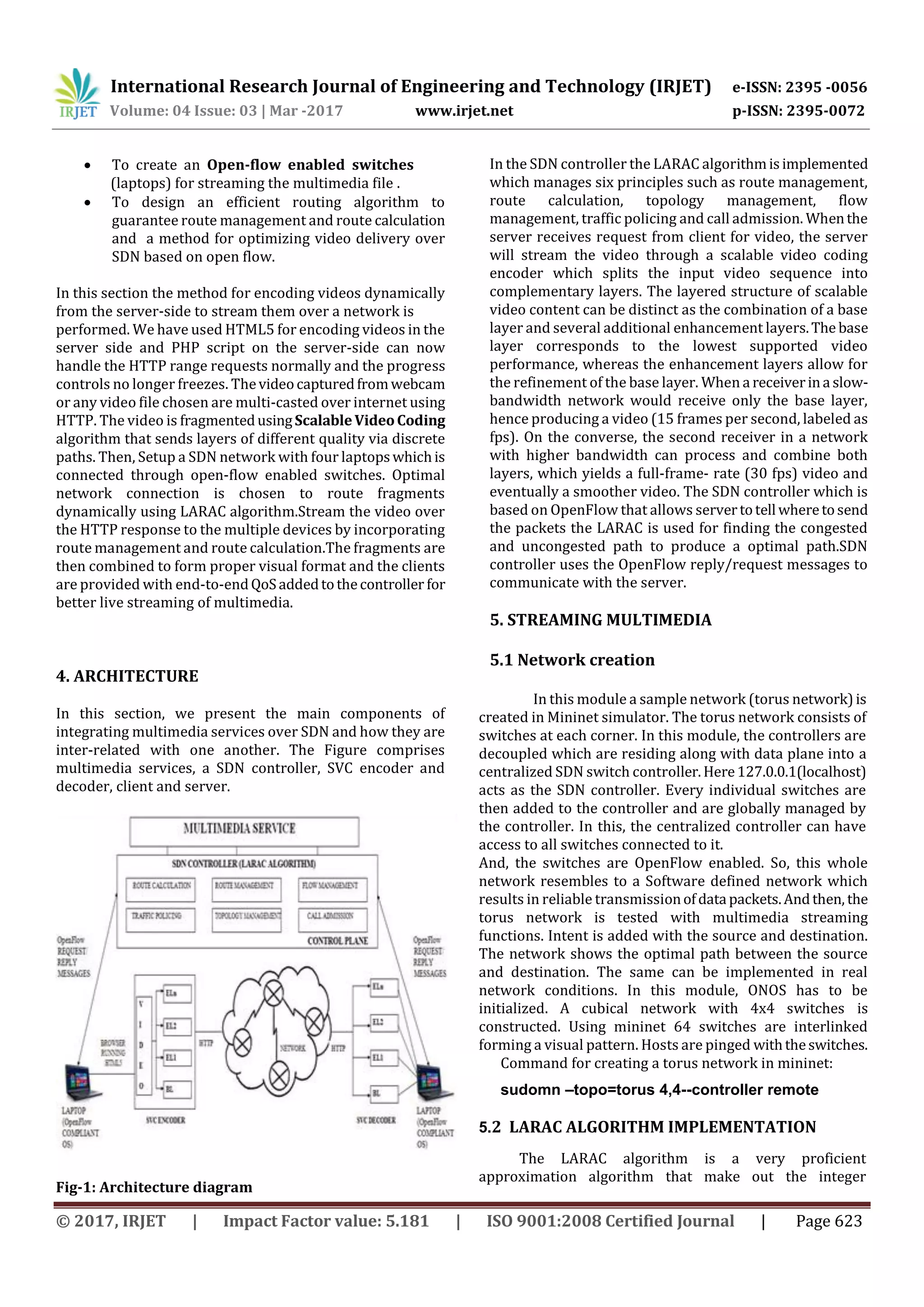
In this section, we present the main components of
integrating multimedia services over SDN and how they are
inter-related with one another. The Figure comprises
multimedia services, a SDN controller, SVC encoder and
decoder, client and server.
Fig-1: Architecture diagram
In the SDN controller the LARAC algorithmisimplemented
which manages six principles such as route management,
route calculation, topology management, flow
management, traffic policing and call admission. Whenthe
server receives request from client for video, the server
will stream the video through a scalable video coding
encoder which splits the input video sequence into
complementary layers. The layered structure of scalable
video content can be distinct as the combination of a base
layer and several additional enhancement layers.The base
layer corresponds to the lowest supported video
performance, whereas the enhancement layers allow for
the refinement of the base layer. When a receiverina slow-
bandwidth network would receive only the base layer,
hence producing a video (15 frames per second, labeled as
fps). On the converse, the second receiver in a network
with higher bandwidth can process and combine both
layers, which yields a full-frame- rate (30 fps) video and
eventually a smoother video. The SDN controller which is
based on OpenFlow that allows servertotell wheretosend
the packets the LARAC is used for finding the congested
and uncongested path to produce a optimal path.SDN
controller uses the OpenFlow reply/request messages to
communicate with the server.
5. STREAMING MULTIMEDIA
5.1 Network creation
In this module a sample network (torus network)is
created in Mininet simulator. The torus network consists of
switches at each corner. In this module, the controllers are
decoupled which are residing along with data plane into a
centralized SDN switch controller.Here127.0.0.1(localhost)
acts as the SDN controller. Every individual switches are
then added to the controller and are globally managed by
the controller. In this, the centralized controller can have
access to all switches connected to it.
And, the switches are OpenFlow enabled. So, this whole
network resembles to a Software defined network which
results in reliable transmissionofdata packets.Andthen, the
torus network is tested with multimedia streaming
functions. Intent is added with the source and destination.
The network shows the optimal path between the source
and destination. The same can be implemented in real
network conditions. In this module, ONOS has to be
initialized. A cubical network with 4x4 switches is
constructed. Using mininet 64 switches are interlinked
forming a visual pattern. Hosts are pinged withtheswitches.
Command for creating a torus network in mininet:
sudomn –topo=torus 4,4--controller remote
5.2 LARAC ALGORITHM IMPLEMENTATION
The LARAC algorithm is a very proficient
approximation algorithm that make out the integer
International Research Journal of Engineering and Technology (IRJET) e-ISSN: 2395 -0056
Volume: 04 Issue: 03 | Mar -2017 www.irjet.net p-ISSN: 2395-0072
© 2017, IRJET | Impact Factor value: 5.181 | ISO 9001:2008 Certified Journal | Page 624
relaxation of the CSP problem (RELAX-CSP) and is a
geometric approach. The purpose of a minimum cost path a
source node to a destination node of a network to the
condition that the total delay of the path be less than or
equal to a specified value. The shortest path is calculated
based on link costs. The optimal path is obtained if delay
constraint is met, or else algorithm provisions the path as
the latest infeasible path. Then the shortest path is
determined based on link delays. The SDN controller is a
logical entity that monitors the OpenFlow enabled switches
by sending OpenFlow FEATURE_REQUEST and
FEATURE_REPLY messages.Inthismodule,thefeasiblelinks
are analyzed. The LARAC algorithm is used to find the path
link where the shortest (minimum hops) is calculated. This
path is concluded as the most efficient link for transfer of
data packets between the switches. The flow table that
contains all the possible links (paths) between the switches
is maintained by a centralized controller. At the end of this
module, an intent (Connection)betweenthehostsiscreated.
The controller has a buffer that stores the link statistics.The
controller determines the optimal path specified in the flow
table. If the current path is congested, then it finds the next
optimal path. The congested path is in which 75% (ormore)
of the bandwidth is already utilized. Using this LARAC
algorithm, the optimal path is provided by the centralized
controller to the switches where there is no congestion. In
this optimal path there is no traffic and provides easy
transmission of data packets to the switches.
5.3 SET UP TO STREAM A VIDEO
Web server creation is performed by registering in
Amazon Web Service and log in into AWS to access Amazon
services. For creating EC2 instance choose EC2 under
compute service. When EC2 instance is launched from a
chosen (Amazon Machine Image), instance will be booted
with preferred OS. Configuring security groups are used to
add IP addresses which forms a network to access the
instance. The concept of a scalable video encoder is to split
the single-stream video in a multi-stream flow, often
referred to as layers. Scalable video coding (SVC) encoder
encodes the input video sequence into complementary
layers. So that receivers can choose and decode different
number of layers each related to discrete video
characteristics along with the processing constraintsofboth
the network and the device. Thelayeredstructureofscalable
video content can be distinct as the combination of a base
layer and several additional enhancement layers. The base
layer conforms to the lowest supported video performance,
while the enhancement layersallowfortherefinement of the
base layer. When a receiver in a slow-bandwidth network
would receive only the base layer, hence producing a video
(15 frames per second, labeled as fps). On the converse, the
second receiver in a network with higher bandwidth can
combine both layers and progress, which returns a full-
frame-rate (30 fps) video and finally a smoother video. The
addition of enhancement layers enhances the resolution of
the decoded video sample, so when the supplementary
layers are made accessible to the receiver, the high
resolution of the decoded video and user’s quality of
experience is achieved.
5.4 OPENQoS FOR DELAY ANG JITTER
REDUCTION
To optimize multimedia video deliverywithlittleornovideo
artifacts by adding route management and calculation and
traffic policing is done at earlier stages. The comparative
study is performed to address the reduction in jitter,
bandwidth and latency in SDN. The enhancement layer is
requested by client based on the quality of video by
performing SVC client implementation.Iftheclientdemands
one base and two enhancement layers, then clients send an
HTTP GET message to the corresponding ports of the server
at the same time. Hence, the client throughput is maximized
since it does not have to wait downloadingpacketsofa video
layer to request the next layer packets for a segment. In
order to calculate throughput, a new method is formulated.
Suppose the client request base and n enhancement layers.
Let tdt represents the total time to download base and these
n enhancement layers. The calculation of throughputand tdt
for the requested segment is performed according to the
formula given in (2) and (3), respectively. In theformulas, ei
represents the i th enhancement layer, b represents base
layer. x last t is the receiving time of the last packet of x th
layer, t request is the sending time of the request and br x is
the bit-rate of the x th layer. This mainly focused on
calculation of delay and jitter reduction. The comparison of
Software Defined Network and the traditional network
based on calculation of delay andjitter.Optimizemultimedia
video delivery with little or no video artifacts by adding
route management and calculation and traffic policing. The
client decides to request one base and two enhancement
layers and send an HTTP GET message to the corresponding
ports of the server at the same time. Hence, the client
throughput will be maximized while it need not have to wait
for downloading packets of a video layer to request the next
layer packets for a segment.
6. EXPERIMENTAL SETUP
To demonstrate the performance of our OpenFlow enabled
network devices,wehaveconstructedanexperimental setup
of a network as shown in Fig.6. Throughout the tests, we
streamed a video file of size 450 KB having a resolution of
1024 × 768. We embedded the video using HTML5 browser
view. The video is encoded at different bitrates using SVC
Encoder at the browser end.
The Base Layer (BL) is streamed at 1800 kbps. The
Enhancement Layer 1 (EL1) is
streamed at 900 kbps.
The Enhancement Layer 1 (EL2) is streamed at 150
kbps.These three streams are transmitted from the
controller to the receiver ends.
International Research Journal of Engineering and Technology (IRJET) e-ISSN: 2395 -0056
Volume: 04 Issue: 03 | Mar -2017 www.irjet.net p-ISSN: 2395-0072
© 2017, IRJET | Impact Factor value: 5.181 | ISO 9001:2008 Certified Journal | Page 625
6.1 NOVEL CONTROLLER DESIGN
We propose OpenQoS controller that enablessixservicesfor
multimedia delivery. The services include Route
Management, Route Calculation, Flow Management, Call
Admission, Traffic Policing, Topology Management.
The SDN controller is a logically centralized entity. It
monitors the link statistics of the network by sending
FEATURE_REQUEST messages to individual nodes. The
nodes in return send a FEATURE_REPLY message. These
messages are forwarded using OpenFlow Protocol. The
controller maintains two different flow tables to enhance
video streaming. The two Flow Tables are,
Best Effort Flow Table and QoS Flow Table.
The Best Effort Flow Table maintains the paths that are
shortest from the source. The shortest path is calculated by
considering the number of hops (Hop Count) from the
source to the intended destination. The Dijkstra’s algorithm
is used to calculate the minimum cost. This algorithm
calculates the distance between the source and all possible
destinations. It considers the source node cost as ‘Zero’ and
all other possible node cost as ‘Infinity’.
The QoS Flow Table determines the capacityofvariouslinks.
It selects a path only if it can satisfy all the services assured
by the QoS parameters. If the controller cannot satisfy the
QoS parameters for a requester,thenit rejects/block thecall.
The QoS paths have larger capacity but longer distance.
6.2 ADAPTIVE STREAMING OVER HTTP
The video file of size 450 KB is embedded into the Web
Server (AWS). The multimedia file is to be bit-streamed
adaptively at various bitrates. The streaming is done by
using a SVC Encoder that separates the video content into
multiple layers. Each layer corresponds to a video file of
particular bit-rate. The Base Layer (BL) is the mandatory
layer which is transferred first. The Enhancement Layers
(EL) adds quality to the video.
The BL is streamed via the path having the highest capacity
i,e 1800 kbps. This layer is transferred using the QoS Flow
Table. The next enhancement layers are transmitted via
paths having the next higher capacity i,e 900 kbps[17]. This
layer is forwarded using Best Effort Flow Table.
An Amazon Web Server (AWS) and Adobe Media Server are
hosted in the server end. The AWS server streams the video
over HTTP to the client end.
7. CONCLUSION
Hence, in this paper we proposed a methodology to
optimally stream video by restructuringSDN with enhanced
services such as route management and route calculation
etc. While comparing to the traditional network, we added
functionalities to the software defined network by
incorporating SVC and LARAC algorithm to minimize the
delay and jitter in the network.
REFERENCES
[1] Jose M. Jimenez, Oscar Romero, Albert Rego,
AvinashDilendra, Jaime Lloret Universidad Politécnica de
alencia , “Study of Multimedia Delivery over Software
Defined Networks” in Network Protocols and
Algorithms ISSN 19433581 2015, Vol. 7, No. 4 .
[2] Harold Owens ,ArjanDurresi, presented a paper
titled , “Video over SoftwareDefined Networking (VSDN)”
,Computer Networks 000 (2015) 1–16 Accepted 15
September 2015.
[3] Hilmi E. Egilmez, S. T. Dane, K. T. Bagci, A.M. Tekalp,
“OpenQoS:
An OpenFlow controller design for multimedia deliverywith
end-to-end Quality of Service over Software-Defined
Networks” Signal & Information Processing Association
Annual Summit and Conference (APSIPA ASC), 3 -6 Dec
2012, Asia-Pacific and Published by IEEE Explore.
[4] Hilmi E. Egilmez ,BurakGorkemli , A. Murat
Tekalp , Seyhan Civanlar presented a paper titled,
“Scalable video streaming over OpenFlow networks: An
optimization framework for QOS routing” in
18th IEEE International Conference, 2011.
[5]Adnan Shahid, Jinan Fiaidhi and Sabah Mohammed
presented a paper titled, “Implementing InnovativeRouting
Using Software Defined Networking (SDN) in International
journal of multimedia and ubiquitous engineering, 2016.
[6] Olivier Flauzac, Carlos Gonzalez, Florent Nolot
“Developing a distributed software defined networking
testbed for IoT” in The 7th International Conference on
Ambient Systems, Networks and Technologies (ANT 2016).
[7] L. Zuccaroa, F. Cimorellia, F. Delli Priscolia, C.Gori
Giorgia, S. Monacoa, V. Suracib* “Distributed control in
virtualized networks” in the 10th International
Conference on Future Networks and Communications
(FNC 2015).
[8] Sajjad Ali Mushtaqa, Naheed Sajjadb, Sohail Razzaqa,b
“Decision Making Framework with Stochastic Dynamicity:A
Step Forward Towards SDN” in the 9th International
Conference on Future Networks and Communications
(FNC2014) .
[9] Ognjen Dobrijevic, Matija Santl, and Maja
Matijasevic “Ant Colony Optimization for QoE-Centric
Flow Routing in Software-Defined Networks”.
[10] Andreas Kassler1, Lea Skorin-Kapov2, Ognjen
Dobrijevic2, Maja Matijasevic2, Peter Dely1 “Towards
QoE-driven Multimedia Service Negotiation and Path
Optimization with Software Defined Networking”.
International Research Journal of Engineering and Technology (IRJET) e-ISSN: 2395 -0056
Volume: 04 Issue: 03 | Mar -2017 www.irjet.net p-ISSN: 2395-0072
© 2017, IRJET | Impact Factor value: 5.181 | ISO 9001:2008 Certified Journal | Page 626
[11] Ehab Al-ShaerUniversity of North Carolina at
Charlotte, Charlotte, NC, USASaeed Al-HajUniversity of
North Carolina at Charlotte, Charlotte, NC, USA
“FlowChecker: configuration analysis and verification of
federated openflow infrastructures”.
[12] Chenhui Xu, Bing Chen, and Hongyan Qian “Quality
of Service Guaranteed Resource Management
Dynamically in Software Defined Network”.
[13]Grzegorz Wilczewski Faculty of Electronics and
Information Technology, Warsaw University of Technology,
Warsaw, Poland “Utilization of the Software-Defined
Networking Approach in a Model of a 3DTV Service”.
[14] Jose Saldana, David de Hoz, Julián Fernández-
Navajas, José Ruiz- Mas “SmallPacket Flows in Software
Defined Networks: Traffic Profile Optimization”
[15] Nick McKeown , Tom Anderson , Hari Balakrishnan,
Guru Parulkar , Larry Peterson , Jennifer Rexford, Scott
Shenker , JonathanTurne“OpenFlow:EnablingInnovationin
Campus Networks”.
[16] Curtis Yu1 , Cristian Lumezanu2 , Yueping Zhang2 ,
Vishal Singh2 , Guofei Jiang2 , and Harsha V. Madhyastha1
“FlowSense: Monitoring Network Utilization with Zero
Measurement Cost”.
[17] Srinivas Narayana, Jennifer Rexford, David Walker
“Compiling path queries in software-defined networks”.
[18] Syed Taha Ali, Member, IEEE, Vijay Sivaraman,
Member, IEEE, Adam Radford,Member, IEEE,andSanjay Jha,
Senior Member, IEEE
“A Survey of Securing Networks using Software Defined
Networking”.
[19]Minlan Yu, Lavanya Jose, Rui Miao “Software Defined
Traffic Measurement with OpenSketch”.
[20] Hesham MekkyUniversity of Minnesota, Minneapolis,
MN, USAFang HaoBell Labs Alcatel-Lucent, Holmdel, NJ,
USASarit MukherjeeBell Labs Alcatel-Lucent, Holmdel, NJ,
USAZhi -Li ZhangUniversity of Minnesota, Minneapolis,MN,
USAT.V. LakshmanBell Labs Alcatel-Lucent, Holmdel, NJ,
USA “Application-aware data plane processing in SDN”.

Integrating Multimedia Services Over Software Defined Networking

  • 1.
    International Research Journalof Engineering and Technology (IRJET) e-ISSN: 2395 -0056 Volume: 04 Issue: 03 | Mar -2017 www.irjet.net p-ISSN: 2395-0072 © 2017, IRJET | Impact Factor value: 5.181 | ISO 9001:2008 Certified Journal | Page 622 INTEGRATING MULTIMEDIA SERVICES OVER SOFTWARE DEFINED NETWORKING R.Thenmozhi1, T.Preethi2, S.Sadhana3 , V.Shruthi4, B.Yuvarani5 1Assistant Professor,Department of Information Technology, Valliammai Engineering, Tamil Nadu, India [2][3][4][5]UG Students, Department of Information Technology, Valliammai Engineering College, Tamil Nadu ,India. ---------------------------------------------------------------------***--------------------------------------------------------------------- Abstract - This paper proposes a methodology, whichaims to improve the reliability of multimedia streaming while reducing the utilization of server resources. SoftwareDefined Networking (SDN) posses a centralized SDN Controller enabled with OpenFlow protocol that monitors every node in the network. It optimizes video delivery using an algorithm (Scalable Video Coding) that sends layers of differentbitrates via discrete paths. The optimal path is determined using LARAC algorithm. TheOpenQoScanguaranteeseamlessvideo delivery with little or no video artifacts experienced by the end-users. HTML5 browser display embeds videos into the server. This allows everyone to access the media files irrespective of their platform, device, or browser. A powerful Amazon Web Server (AWS) and Adobe Media Server are deployed. Also guarantees the viewer with an alternative version of full functionality in case the less important segments are lost or discarded. It implements a resilient method for packet loss by utilizing independent paths. This transmits the multimedia files from one system to another connected over a distributed network. Key Words: Software Defined Networking(SDN),Quality of Service (QoS), OpenFlow, Open QoS, Scalable Video Coding (SVC), Lagrange Relaxation based AggregateCost (LARAC), Amazon Web Service (AWS), Streaming. 1.INTRODUCTION The networking elements have been turn into a significant element in almost all human activity. So, there is increase in the number of devices as well as amountoftraffic innetwork is exponentially growing. Thenewinventionsneedtochange the inflexibility of traditional network. The key technique of SDN is OpenFlow, which provides additional configuration options in the data plane. The principle of communication between data plane and control plane is allowed by the OpenFlow design and also permits the complete network to be controlled through Application Programming Interface (API).The networking foundation together with Open ONF is committed for promoting and adopting OpenFlow specification. This realization of OpenFlow eliminate the drawbacks of severity of static protocols, open the possibility of fast Improvement and led research community to extend new paradigms. This paper presents an analysis of five policies such as route management, route discovery, traffic analysis, call admission and topology management. The fast failure recovery mechanism is implemented in OpenFlow which will competent of recovering from connection failure using different path. The control plane in SDN not only performs forwarding of packets but also link alteration at a data level infringement the difficulty of layering. So this leads to remuneration in Optimizing network configurationandenhancing network performance. It also provides network programmability and capability to identify isolated virtual networks by means of control plane. 2. RELATED WORK This section we discuss various proposed architectures, frameworks and routing algorithms based on SDN. These target various network aspects such as virtualization, scalability, Quality of service network management, programmability and service assurance. Software Defined Networking (SDN) is a networking paradigm where thecontrolandthedataplanearedecoupled and is logically centralized and programmable through interfaces. QoS routing technique to optimize multimedia traffic dynamically based on the user needs is done by the implementation of LARAC algorithm. An optimization framework for the OpenFlow controller using scalable video coding algorithmprovidesQoSsupport for scalable video streaming. 3. PROPOSED WORK The key design goals for designingtheproposed work areas follows:
  • 2.
    International Research Journalof Engineering and Technology (IRJET) e-ISSN: 2395 -0056 Volume: 04 Issue: 03 | Mar -2017 www.irjet.net p-ISSN: 2395-0072 © 2017, IRJET | Impact Factor value: 5.181 | ISO 9001:2008 Certified Journal | Page 623  To create an Open-flow enabled switches (laptops) for streaming the multimedia file .  To design an efficient routing algorithm to guarantee route management and route calculation and a method for optimizing video delivery over SDN based on open flow. In this section the method for encoding videos dynamically from the server-side to stream them over a network is performed. We have used HTML5 for encoding videos in the server side and PHP script on the server-side can now handle the HTTP range requests normally and the progress controls no longer freezes. Thevideocapturedfromwebcam or any video file chosen are multi-casted over internet using HTTP. The video is fragmentedusingScalableVideoCoding algorithm that sends layers of different quality via discrete paths. Then, Setup a SDN network with four laptopswhichis connected through open-flow enabled switches. Optimal network connection is chosen to route fragments dynamically using LARAC algorithm.Stream the video over the HTTP response to the multiple devices by incorporating route management and route calculation.The fragments are then combined to form proper visual format and the clients are provided with end-to-endQoSaddedtothecontroller for better live streaming of multimedia. 4. ARCHITECTURE In this section, we present the main components of integrating multimedia services over SDN and how they are inter-related with one another. The Figure comprises multimedia services, a SDN controller, SVC encoder and decoder, client and server. Fig-1: Architecture diagram In the SDN controller the LARAC algorithmisimplemented which manages six principles such as route management, route calculation, topology management, flow management, traffic policing and call admission. Whenthe server receives request from client for video, the server will stream the video through a scalable video coding encoder which splits the input video sequence into complementary layers. The layered structure of scalable video content can be distinct as the combination of a base layer and several additional enhancement layers.The base layer corresponds to the lowest supported video performance, whereas the enhancement layers allow for the refinement of the base layer. When a receiverina slow- bandwidth network would receive only the base layer, hence producing a video (15 frames per second, labeled as fps). On the converse, the second receiver in a network with higher bandwidth can process and combine both layers, which yields a full-frame- rate (30 fps) video and eventually a smoother video. The SDN controller which is based on OpenFlow that allows servertotell wheretosend the packets the LARAC is used for finding the congested and uncongested path to produce a optimal path.SDN controller uses the OpenFlow reply/request messages to communicate with the server. 5. STREAMING MULTIMEDIA 5.1 Network creation In this module a sample network (torus network)is created in Mininet simulator. The torus network consists of switches at each corner. In this module, the controllers are decoupled which are residing along with data plane into a centralized SDN switch controller.Here127.0.0.1(localhost) acts as the SDN controller. Every individual switches are then added to the controller and are globally managed by the controller. In this, the centralized controller can have access to all switches connected to it. And, the switches are OpenFlow enabled. So, this whole network resembles to a Software defined network which results in reliable transmissionofdata packets.Andthen, the torus network is tested with multimedia streaming functions. Intent is added with the source and destination. The network shows the optimal path between the source and destination. The same can be implemented in real network conditions. In this module, ONOS has to be initialized. A cubical network with 4x4 switches is constructed. Using mininet 64 switches are interlinked forming a visual pattern. Hosts are pinged withtheswitches. Command for creating a torus network in mininet: sudomn –topo=torus 4,4--controller remote 5.2 LARAC ALGORITHM IMPLEMENTATION The LARAC algorithm is a very proficient approximation algorithm that make out the integer
  • 3.
    International Research Journalof Engineering and Technology (IRJET) e-ISSN: 2395 -0056 Volume: 04 Issue: 03 | Mar -2017 www.irjet.net p-ISSN: 2395-0072 © 2017, IRJET | Impact Factor value: 5.181 | ISO 9001:2008 Certified Journal | Page 624 relaxation of the CSP problem (RELAX-CSP) and is a geometric approach. The purpose of a minimum cost path a source node to a destination node of a network to the condition that the total delay of the path be less than or equal to a specified value. The shortest path is calculated based on link costs. The optimal path is obtained if delay constraint is met, or else algorithm provisions the path as the latest infeasible path. Then the shortest path is determined based on link delays. The SDN controller is a logical entity that monitors the OpenFlow enabled switches by sending OpenFlow FEATURE_REQUEST and FEATURE_REPLY messages.Inthismodule,thefeasiblelinks are analyzed. The LARAC algorithm is used to find the path link where the shortest (minimum hops) is calculated. This path is concluded as the most efficient link for transfer of data packets between the switches. The flow table that contains all the possible links (paths) between the switches is maintained by a centralized controller. At the end of this module, an intent (Connection)betweenthehostsiscreated. The controller has a buffer that stores the link statistics.The controller determines the optimal path specified in the flow table. If the current path is congested, then it finds the next optimal path. The congested path is in which 75% (ormore) of the bandwidth is already utilized. Using this LARAC algorithm, the optimal path is provided by the centralized controller to the switches where there is no congestion. In this optimal path there is no traffic and provides easy transmission of data packets to the switches. 5.3 SET UP TO STREAM A VIDEO Web server creation is performed by registering in Amazon Web Service and log in into AWS to access Amazon services. For creating EC2 instance choose EC2 under compute service. When EC2 instance is launched from a chosen (Amazon Machine Image), instance will be booted with preferred OS. Configuring security groups are used to add IP addresses which forms a network to access the instance. The concept of a scalable video encoder is to split the single-stream video in a multi-stream flow, often referred to as layers. Scalable video coding (SVC) encoder encodes the input video sequence into complementary layers. So that receivers can choose and decode different number of layers each related to discrete video characteristics along with the processing constraintsofboth the network and the device. Thelayeredstructureofscalable video content can be distinct as the combination of a base layer and several additional enhancement layers. The base layer conforms to the lowest supported video performance, while the enhancement layersallowfortherefinement of the base layer. When a receiver in a slow-bandwidth network would receive only the base layer, hence producing a video (15 frames per second, labeled as fps). On the converse, the second receiver in a network with higher bandwidth can combine both layers and progress, which returns a full- frame-rate (30 fps) video and finally a smoother video. The addition of enhancement layers enhances the resolution of the decoded video sample, so when the supplementary layers are made accessible to the receiver, the high resolution of the decoded video and user’s quality of experience is achieved. 5.4 OPENQoS FOR DELAY ANG JITTER REDUCTION To optimize multimedia video deliverywithlittleornovideo artifacts by adding route management and calculation and traffic policing is done at earlier stages. The comparative study is performed to address the reduction in jitter, bandwidth and latency in SDN. The enhancement layer is requested by client based on the quality of video by performing SVC client implementation.Iftheclientdemands one base and two enhancement layers, then clients send an HTTP GET message to the corresponding ports of the server at the same time. Hence, the client throughput is maximized since it does not have to wait downloadingpacketsofa video layer to request the next layer packets for a segment. In order to calculate throughput, a new method is formulated. Suppose the client request base and n enhancement layers. Let tdt represents the total time to download base and these n enhancement layers. The calculation of throughputand tdt for the requested segment is performed according to the formula given in (2) and (3), respectively. In theformulas, ei represents the i th enhancement layer, b represents base layer. x last t is the receiving time of the last packet of x th layer, t request is the sending time of the request and br x is the bit-rate of the x th layer. This mainly focused on calculation of delay and jitter reduction. The comparison of Software Defined Network and the traditional network based on calculation of delay andjitter.Optimizemultimedia video delivery with little or no video artifacts by adding route management and calculation and traffic policing. The client decides to request one base and two enhancement layers and send an HTTP GET message to the corresponding ports of the server at the same time. Hence, the client throughput will be maximized while it need not have to wait for downloading packets of a video layer to request the next layer packets for a segment. 6. EXPERIMENTAL SETUP To demonstrate the performance of our OpenFlow enabled network devices,wehaveconstructedanexperimental setup of a network as shown in Fig.6. Throughout the tests, we streamed a video file of size 450 KB having a resolution of 1024 × 768. We embedded the video using HTML5 browser view. The video is encoded at different bitrates using SVC Encoder at the browser end. The Base Layer (BL) is streamed at 1800 kbps. The Enhancement Layer 1 (EL1) is streamed at 900 kbps. The Enhancement Layer 1 (EL2) is streamed at 150 kbps.These three streams are transmitted from the controller to the receiver ends.
  • 4.
    International Research Journalof Engineering and Technology (IRJET) e-ISSN: 2395 -0056 Volume: 04 Issue: 03 | Mar -2017 www.irjet.net p-ISSN: 2395-0072 © 2017, IRJET | Impact Factor value: 5.181 | ISO 9001:2008 Certified Journal | Page 625 6.1 NOVEL CONTROLLER DESIGN We propose OpenQoS controller that enablessixservicesfor multimedia delivery. The services include Route Management, Route Calculation, Flow Management, Call Admission, Traffic Policing, Topology Management. The SDN controller is a logically centralized entity. It monitors the link statistics of the network by sending FEATURE_REQUEST messages to individual nodes. The nodes in return send a FEATURE_REPLY message. These messages are forwarded using OpenFlow Protocol. The controller maintains two different flow tables to enhance video streaming. The two Flow Tables are, Best Effort Flow Table and QoS Flow Table. The Best Effort Flow Table maintains the paths that are shortest from the source. The shortest path is calculated by considering the number of hops (Hop Count) from the source to the intended destination. The Dijkstra’s algorithm is used to calculate the minimum cost. This algorithm calculates the distance between the source and all possible destinations. It considers the source node cost as ‘Zero’ and all other possible node cost as ‘Infinity’. The QoS Flow Table determines the capacityofvariouslinks. It selects a path only if it can satisfy all the services assured by the QoS parameters. If the controller cannot satisfy the QoS parameters for a requester,thenit rejects/block thecall. The QoS paths have larger capacity but longer distance. 6.2 ADAPTIVE STREAMING OVER HTTP The video file of size 450 KB is embedded into the Web Server (AWS). The multimedia file is to be bit-streamed adaptively at various bitrates. The streaming is done by using a SVC Encoder that separates the video content into multiple layers. Each layer corresponds to a video file of particular bit-rate. The Base Layer (BL) is the mandatory layer which is transferred first. The Enhancement Layers (EL) adds quality to the video. The BL is streamed via the path having the highest capacity i,e 1800 kbps. This layer is transferred using the QoS Flow Table. The next enhancement layers are transmitted via paths having the next higher capacity i,e 900 kbps[17]. This layer is forwarded using Best Effort Flow Table. An Amazon Web Server (AWS) and Adobe Media Server are hosted in the server end. The AWS server streams the video over HTTP to the client end. 7. CONCLUSION Hence, in this paper we proposed a methodology to optimally stream video by restructuringSDN with enhanced services such as route management and route calculation etc. While comparing to the traditional network, we added functionalities to the software defined network by incorporating SVC and LARAC algorithm to minimize the delay and jitter in the network. REFERENCES [1] Jose M. Jimenez, Oscar Romero, Albert Rego, AvinashDilendra, Jaime Lloret Universidad Politécnica de alencia , “Study of Multimedia Delivery over Software Defined Networks” in Network Protocols and Algorithms ISSN 19433581 2015, Vol. 7, No. 4 . [2] Harold Owens ,ArjanDurresi, presented a paper titled , “Video over SoftwareDefined Networking (VSDN)” ,Computer Networks 000 (2015) 1–16 Accepted 15 September 2015. [3] Hilmi E. Egilmez, S. T. Dane, K. T. Bagci, A.M. Tekalp, “OpenQoS: An OpenFlow controller design for multimedia deliverywith end-to-end Quality of Service over Software-Defined Networks” Signal & Information Processing Association Annual Summit and Conference (APSIPA ASC), 3 -6 Dec 2012, Asia-Pacific and Published by IEEE Explore. [4] Hilmi E. Egilmez ,BurakGorkemli , A. Murat Tekalp , Seyhan Civanlar presented a paper titled, “Scalable video streaming over OpenFlow networks: An optimization framework for QOS routing” in 18th IEEE International Conference, 2011. [5]Adnan Shahid, Jinan Fiaidhi and Sabah Mohammed presented a paper titled, “Implementing InnovativeRouting Using Software Defined Networking (SDN) in International journal of multimedia and ubiquitous engineering, 2016. [6] Olivier Flauzac, Carlos Gonzalez, Florent Nolot “Developing a distributed software defined networking testbed for IoT” in The 7th International Conference on Ambient Systems, Networks and Technologies (ANT 2016). [7] L. Zuccaroa, F. Cimorellia, F. Delli Priscolia, C.Gori Giorgia, S. Monacoa, V. Suracib* “Distributed control in virtualized networks” in the 10th International Conference on Future Networks and Communications (FNC 2015). [8] Sajjad Ali Mushtaqa, Naheed Sajjadb, Sohail Razzaqa,b “Decision Making Framework with Stochastic Dynamicity:A Step Forward Towards SDN” in the 9th International Conference on Future Networks and Communications (FNC2014) . [9] Ognjen Dobrijevic, Matija Santl, and Maja Matijasevic “Ant Colony Optimization for QoE-Centric Flow Routing in Software-Defined Networks”. [10] Andreas Kassler1, Lea Skorin-Kapov2, Ognjen Dobrijevic2, Maja Matijasevic2, Peter Dely1 “Towards QoE-driven Multimedia Service Negotiation and Path Optimization with Software Defined Networking”.
  • 5.
    International Research Journalof Engineering and Technology (IRJET) e-ISSN: 2395 -0056 Volume: 04 Issue: 03 | Mar -2017 www.irjet.net p-ISSN: 2395-0072 © 2017, IRJET | Impact Factor value: 5.181 | ISO 9001:2008 Certified Journal | Page 626 [11] Ehab Al-ShaerUniversity of North Carolina at Charlotte, Charlotte, NC, USASaeed Al-HajUniversity of North Carolina at Charlotte, Charlotte, NC, USA “FlowChecker: configuration analysis and verification of federated openflow infrastructures”. [12] Chenhui Xu, Bing Chen, and Hongyan Qian “Quality of Service Guaranteed Resource Management Dynamically in Software Defined Network”. [13]Grzegorz Wilczewski Faculty of Electronics and Information Technology, Warsaw University of Technology, Warsaw, Poland “Utilization of the Software-Defined Networking Approach in a Model of a 3DTV Service”. [14] Jose Saldana, David de Hoz, Julián Fernández- Navajas, José Ruiz- Mas “SmallPacket Flows in Software Defined Networks: Traffic Profile Optimization” [15] Nick McKeown , Tom Anderson , Hari Balakrishnan, Guru Parulkar , Larry Peterson , Jennifer Rexford, Scott Shenker , JonathanTurne“OpenFlow:EnablingInnovationin Campus Networks”. [16] Curtis Yu1 , Cristian Lumezanu2 , Yueping Zhang2 , Vishal Singh2 , Guofei Jiang2 , and Harsha V. Madhyastha1 “FlowSense: Monitoring Network Utilization with Zero Measurement Cost”. [17] Srinivas Narayana, Jennifer Rexford, David Walker “Compiling path queries in software-defined networks”. [18] Syed Taha Ali, Member, IEEE, Vijay Sivaraman, Member, IEEE, Adam Radford,Member, IEEE,andSanjay Jha, Senior Member, IEEE “A Survey of Securing Networks using Software Defined Networking”. [19]Minlan Yu, Lavanya Jose, Rui Miao “Software Defined Traffic Measurement with OpenSketch”. [20] Hesham MekkyUniversity of Minnesota, Minneapolis, MN, USAFang HaoBell Labs Alcatel-Lucent, Holmdel, NJ, USASarit MukherjeeBell Labs Alcatel-Lucent, Holmdel, NJ, USAZhi -Li ZhangUniversity of Minnesota, Minneapolis,MN, USAT.V. LakshmanBell Labs Alcatel-Lucent, Holmdel, NJ, USA “Application-aware data plane processing in SDN”.