SARENA: SFC-Enabled Architecture for Adaptive Video
Streaming Applications
International Conference on Communications (ICC)
May 29th
, 2023
reza.farahani@aau.at | https://www.rezafarahani.me
Reza Farahani, Abdelhak Bentaleb , Christian Timmerer, Mohammad Shojafar, Radu Prodan, and Hermann Hellwagner
Agenda
● Introduction
● Proposed Solution
○ SARENA Architecture
○ Optimization Model
○ Heuristic Approach
● Performance Evaluation
○ Setup
○ Methods/Metrics
○ Results
● Conclusion and Future Work
Introduction
Motivation
Proposed Solution
HTTP Adaptive Streaming (HAS)
1
https://bitmovin.com/dynamic-adaptive-streaming-http-mpeg-dash/
● Video streaming traffic has become the primary type of traffic over the Internet.
○ It includes 53.72% of the total video traffic over the Internet [1]
○ HAS is one of the prominent technologies that delivers more than 51% of video streams [1]
○ Live video streaming has become significantly popular, i.e., 17% of the total video traffic by 2022 [1]
[1] Sandvine, “The Global Internet Phenamena Report,” White Paper, January 2023. [Online]. Available: https://www.sandvine.com/global-internet-phenomena-report-2023
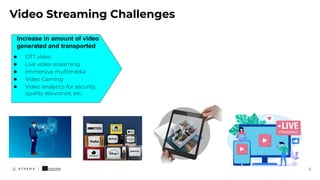
Video Streaming Challenges
2
● OTT video
● Live video streaming
● Immersive multimedia
● Video Gaming
● Video analytics for security,
quality assurance, etc.
Increase in amount of video
generated and transported
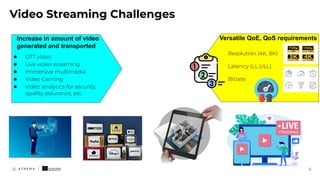
Video Streaming Challenges
2
● OTT video
● Live video streaming
● Immersive multimedia
● Video Gaming
● Video analytics for security,
quality assurance, etc.
Increase in amount of video
generated and transported
Versatile QoE, QoS requirements
Resolution (4K, 8K)
Latency (LL,ULL)
Bitrate
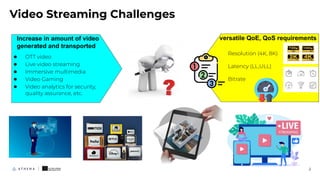
Video Streaming Challenges
2
● OTT video
● Live video streaming
● Immersive multimedia
● Video Gaming
● Video analytics for security,
quality assurance, etc.
Increase in amount of video
generated and transported
versatile QoE, QoS requirements
Resolution (4K, 8K)
Latency (LL,ULL)
Bitrate
3
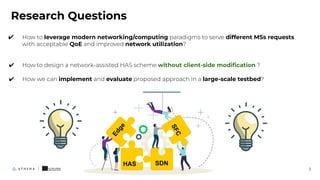
Research Questions
✔ How to leverage modern networking/computing paradigms to serve different MSs requests
with acceptable QoE and improved network utilization?
✔ How to design a network-assisted HAS scheme without client-side modification ?
✔ How we can implement and evaluate proposed approach in a large-scale testbed?
SDN
S
F
C
HAS
E
d
g
e
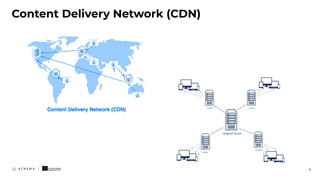
Content Delivery Network (CDN)
4
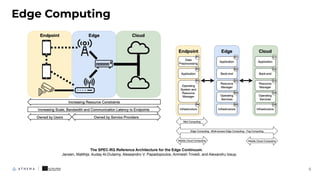
Edge Computing
5
The SPEC-RG Reference Architecture for the Edge Continuum.
Jansen, Matthijs, Auday Al-Dulaimy, Alessandro V. Papadopoulos, Animesh Trivedi, and Alexandru Iosup.
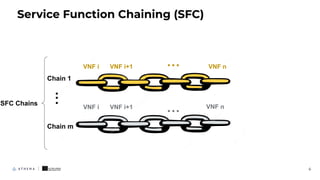
Service Function Chaining (SFC)
6
VNF i VNF i+1 VNF n
VNF i VNF i+1 VNF n
SFC Chains
Chain 1
Chain m
…
…
.
.
.
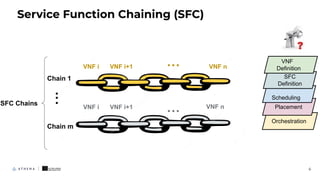
Service Function Chaining (SFC)
6
VNF i VNF i+1 VNF n
VNF i VNF i+1 VNF n
SFC Chains
Chain 1
Chain m
…
…
.
.
.
Orchestration
Placement
Scheduling
SFC
Definition
VNF
Definition
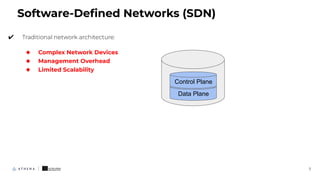
✔ Traditional network architecture:
◆ Complex Network Devices
◆ Management Overhead
◆ Limited Scalability
Software-Defined Networks (SDN)
7
Data Plane
Control Plane
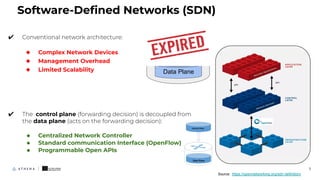
✔ Conventional network architecture:
◆ Complex Network Devices
◆ Management Overhead
◆ Limited Scalability
✔ The control plane (forwarding decision) is decoupled from
the data plane (acts on the forwarding decision):
◆ Centralized Network Controller
◆ Standard communication Interface (OpenFlow)
◆ Programmable Open APIs
7
Source: https://opennetworking.org/sdn-definition/
Data Plane
Control Plane
Software-Defined Networks (SDN)
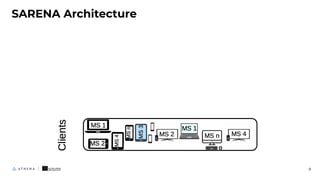
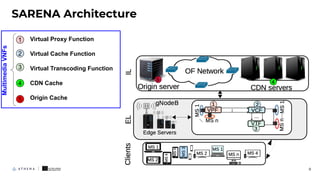
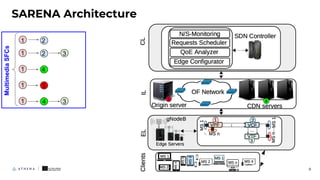
SARENA Architecture
8
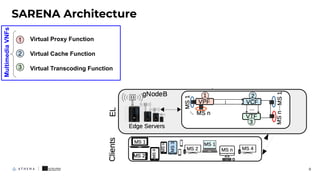
SARENA Architecture
8
Virtual Proxy Function
Virtual Cache Function
Virtual Transcoding Function
1
2
3
Multimedia
VNFs
SARENA Architecture
8
Virtual Proxy Function
Virtual Cache Function
Virtual Transcoding Function
CDN Cache
Origin Cache
1
2
3
4
5
Multimedia
VNFs
3
SARENA Architecture
8
1
2
5
Multimedia
SFCs
1
2
4
1
1
4
1 3
9
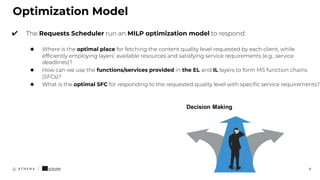
✔ The Requests Scheduler run an MILP optimization model to respond:
◆ Where is the optimal place for fetching the content quality level requested by each client, while
efficiently employing layers’ available resources and satisfying service requirements (e.g., service
deadlines)?
◆ How can we use the functions/services provided in the EL and IL layers to form MS function chains
(SFCs)?
◆ What is the optimal SFC for responding to the requested quality level with specific service requirements?
Optimization Model
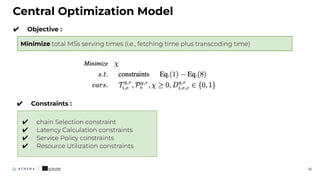
Minimize total MSs serving times (i.e., fetching time plus transcoding time)
✔ chain Selection constraint
✔ Latency Calculation constraints
✔ Service Policy constraints
✔ Resource Utilization constraints
10
✔ Constraints :
✔ Objective :
Central Optimization Model
11
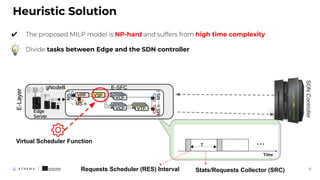
✔ The proposed MILP model is NP-hard and suffers from high time complexity
✔ Divide tasks between Edge and the SDN controller
Heuristic Solution
Virtual Scheduler Function
Stats/Requests Collector (SRC)
Requests Scheduler (RES) Interval
12
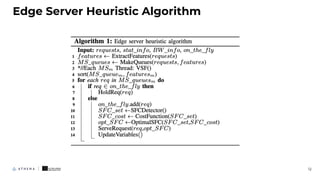
Edge Server Heuristic Algorithm
13
SDN Controller Heuristic Algorithm
Performance Evaluation
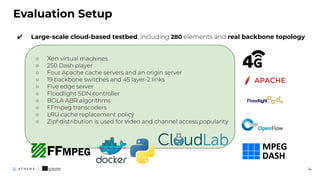
✔ Large-scale cloud-based testbed, including 280 elements and real backbone topology
○ Xen virtual machines
○ 250 Dash player
○ Four Apache cache servers and an origin server
○ 19 backbone switches and 45 layer-2 links
○ Five edge server
○ Floodlight SDN controller
○ BOLA ABR algorithms
○ FFmpeg transcoders
○ LRU cache replacement policy
○ Zipf distribution is used for video and channel access popularity
Evaluation Setup
14
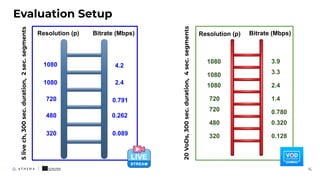
Evaluation Setup
15
0.089
320
480
720
1080
1080
0.262
0.791
2.4
4.2
Resolution (p) Bitrate (Mbps) Bitrate (Mbps)
Resolution (p)
20
VoDs,
300
sec.
duration,
4
sec.
segments
320
480
720
720
1080
1080
1080
0.128
0.320
0.780
1.4
2.4
3.3
3.9
5
live
ch,
300
sec.
duration,
2
sec.
segments
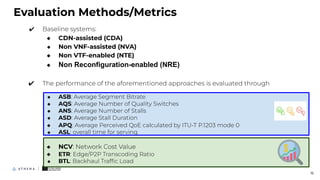
✔ Baseline systems:
◆ CDN-assisted (CDA)
◆ Non VNF-assisted (NVA)
◆ Non VTF-enabled (NTE)
◆ Non Reconfiguration-enabled (NRE)
✔ The performance of the aforementioned approaches is evaluated through
◆ ASB: Average Segment Bitrate
◆ AQS: Average Number of Quality Switches
◆ ANS: Average Number of Stalls
◆ ASD: Average Stall Duration
◆ APQ: Average Perceived QoE calculated by ITU-T P.1203 mode 0
◆ ASL: overall time for serving
◆ NCV: Network Cost Value
◆ ETR: Edge/P2P Transcoding Ratio
◆ BTL: Backhaul Traffic Load
Evaluation Methods/Metrics
16
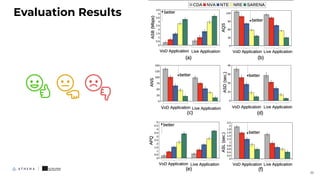
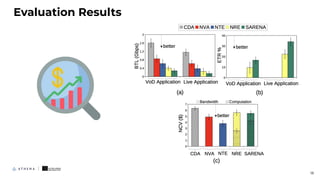
Evaluation Results
17
Evaluation Results
18
Conclusion and Future Work
✔ Use the cooperation of SDN, SFC, and edge computing to serve efficiently various
types of MSs with different QoE requirements.
✔ The experimental results over a large-scale testbed show:
○ users’ QoE by at least 39.6%,
○ latency by 29.3%
○ network utilization by 30%.
✔ Propose RL-based approaches and design FaaS-enabled solutions are our future
directions.
Conclusion and Future Work
19
Thank you for your attention
reza.farahani@aau.at | https://www.rezafarahani.me
All rights reserved. ©2020
34

IEEE_ICC'23_SARENA.pdf

  • 1.
    SARENA: SFC-Enabled Architecturefor Adaptive Video Streaming Applications International Conference on Communications (ICC) May 29th , 2023 reza.farahani@aau.at | https://www.rezafarahani.me Reza Farahani, Abdelhak Bentaleb , Christian Timmerer, Mohammad Shojafar, Radu Prodan, and Hermann Hellwagner
  • 2.
    Agenda ● Introduction ● ProposedSolution ○ SARENA Architecture ○ Optimization Model ○ Heuristic Approach ● Performance Evaluation ○ Setup ○ Methods/Metrics ○ Results ● Conclusion and Future Work
  • 3.
  • 4.
  • 5.
  • 6.
    HTTP Adaptive Streaming(HAS) 1 https://bitmovin.com/dynamic-adaptive-streaming-http-mpeg-dash/ ● Video streaming traffic has become the primary type of traffic over the Internet. ○ It includes 53.72% of the total video traffic over the Internet [1] ○ HAS is one of the prominent technologies that delivers more than 51% of video streams [1] ○ Live video streaming has become significantly popular, i.e., 17% of the total video traffic by 2022 [1] [1] Sandvine, “The Global Internet Phenamena Report,” White Paper, January 2023. [Online]. Available: https://www.sandvine.com/global-internet-phenomena-report-2023
  • 7.
    Video Streaming Challenges 2 ●OTT video ● Live video streaming ● Immersive multimedia ● Video Gaming ● Video analytics for security, quality assurance, etc. Increase in amount of video generated and transported
  • 8.
    Video Streaming Challenges 2 ●OTT video ● Live video streaming ● Immersive multimedia ● Video Gaming ● Video analytics for security, quality assurance, etc. Increase in amount of video generated and transported Versatile QoE, QoS requirements Resolution (4K, 8K) Latency (LL,ULL) Bitrate
  • 9.
    Video Streaming Challenges 2 ●OTT video ● Live video streaming ● Immersive multimedia ● Video Gaming ● Video analytics for security, quality assurance, etc. Increase in amount of video generated and transported versatile QoE, QoS requirements Resolution (4K, 8K) Latency (LL,ULL) Bitrate
  • 10.
    3 Research Questions ✔ Howto leverage modern networking/computing paradigms to serve different MSs requests with acceptable QoE and improved network utilization? ✔ How to design a network-assisted HAS scheme without client-side modification ? ✔ How we can implement and evaluate proposed approach in a large-scale testbed? SDN S F C HAS E d g e
  • 11.
  • 12.
    Edge Computing 5 The SPEC-RGReference Architecture for the Edge Continuum. Jansen, Matthijs, Auday Al-Dulaimy, Alessandro V. Papadopoulos, Animesh Trivedi, and Alexandru Iosup.
  • 13.
    Service Function Chaining(SFC) 6 VNF i VNF i+1 VNF n VNF i VNF i+1 VNF n SFC Chains Chain 1 Chain m … … . . .
  • 14.
    Service Function Chaining(SFC) 6 VNF i VNF i+1 VNF n VNF i VNF i+1 VNF n SFC Chains Chain 1 Chain m … … . . . Orchestration Placement Scheduling SFC Definition VNF Definition
  • 15.
    ✔ Traditional networkarchitecture: ◆ Complex Network Devices ◆ Management Overhead ◆ Limited Scalability Software-Defined Networks (SDN) 7 Data Plane Control Plane
  • 16.
    ✔ Conventional networkarchitecture: ◆ Complex Network Devices ◆ Management Overhead ◆ Limited Scalability ✔ The control plane (forwarding decision) is decoupled from the data plane (acts on the forwarding decision): ◆ Centralized Network Controller ◆ Standard communication Interface (OpenFlow) ◆ Programmable Open APIs 7 Source: https://opennetworking.org/sdn-definition/ Data Plane Control Plane Software-Defined Networks (SDN)
  • 17.
  • 18.
    SARENA Architecture 8 Virtual ProxyFunction Virtual Cache Function Virtual Transcoding Function 1 2 3 Multimedia VNFs
  • 19.
    SARENA Architecture 8 Virtual ProxyFunction Virtual Cache Function Virtual Transcoding Function CDN Cache Origin Cache 1 2 3 4 5 Multimedia VNFs
  • 20.
  • 21.
    9 ✔ The RequestsScheduler run an MILP optimization model to respond: ◆ Where is the optimal place for fetching the content quality level requested by each client, while efficiently employing layers’ available resources and satisfying service requirements (e.g., service deadlines)? ◆ How can we use the functions/services provided in the EL and IL layers to form MS function chains (SFCs)? ◆ What is the optimal SFC for responding to the requested quality level with specific service requirements? Optimization Model
  • 22.
    Minimize total MSsserving times (i.e., fetching time plus transcoding time) ✔ chain Selection constraint ✔ Latency Calculation constraints ✔ Service Policy constraints ✔ Resource Utilization constraints 10 ✔ Constraints : ✔ Objective : Central Optimization Model
  • 23.
    11 ✔ The proposedMILP model is NP-hard and suffers from high time complexity ✔ Divide tasks between Edge and the SDN controller Heuristic Solution Virtual Scheduler Function Stats/Requests Collector (SRC) Requests Scheduler (RES) Interval
  • 24.
  • 25.
  • 26.
  • 27.
    ✔ Large-scale cloud-basedtestbed, including 280 elements and real backbone topology ○ Xen virtual machines ○ 250 Dash player ○ Four Apache cache servers and an origin server ○ 19 backbone switches and 45 layer-2 links ○ Five edge server ○ Floodlight SDN controller ○ BOLA ABR algorithms ○ FFmpeg transcoders ○ LRU cache replacement policy ○ Zipf distribution is used for video and channel access popularity Evaluation Setup 14
  • 28.
    Evaluation Setup 15 0.089 320 480 720 1080 1080 0.262 0.791 2.4 4.2 Resolution (p)Bitrate (Mbps) Bitrate (Mbps) Resolution (p) 20 VoDs, 300 sec. duration, 4 sec. segments 320 480 720 720 1080 1080 1080 0.128 0.320 0.780 1.4 2.4 3.3 3.9 5 live ch, 300 sec. duration, 2 sec. segments
  • 29.
    ✔ Baseline systems: ◆CDN-assisted (CDA) ◆ Non VNF-assisted (NVA) ◆ Non VTF-enabled (NTE) ◆ Non Reconfiguration-enabled (NRE) ✔ The performance of the aforementioned approaches is evaluated through ◆ ASB: Average Segment Bitrate ◆ AQS: Average Number of Quality Switches ◆ ANS: Average Number of Stalls ◆ ASD: Average Stall Duration ◆ APQ: Average Perceived QoE calculated by ITU-T P.1203 mode 0 ◆ ASL: overall time for serving ◆ NCV: Network Cost Value ◆ ETR: Edge/P2P Transcoding Ratio ◆ BTL: Backhaul Traffic Load Evaluation Methods/Metrics 16
  • 30.
  • 31.
  • 32.
  • 33.
    ✔ Use thecooperation of SDN, SFC, and edge computing to serve efficiently various types of MSs with different QoE requirements. ✔ The experimental results over a large-scale testbed show: ○ users’ QoE by at least 39.6%, ○ latency by 29.3% ○ network utilization by 30%. ✔ Propose RL-based approaches and design FaaS-enabled solutions are our future directions. Conclusion and Future Work 19
  • 34.
    Thank you foryour attention reza.farahani@aau.at | https://www.rezafarahani.me All rights reserved. ©2020 34