Point-to-Point Protocol
           (PPP)


           Accessing the WAN – Chapter 2


ITE I Chapter 6   © 2006 Cisco Systems, Inc. All rights reserved.   Cisco Public   1
Objectives
                 Describe the fundamental concepts of point-to-point serial
                  communication including TDM, demarcation point, DTE-DCE
                  functions, HDLC encapsulation, and serial interface
                  troubleshooting.
                 Describe PPP concepts including PPP layered architecture, PPP
                  frame structure, PPP session establishment, multiprotocol
                  encapsulation support, link control protocol (LCP), network
                  control protocol (NCP), and Internet Protocol Control Protocol
                  (IPCP).
                 Configure PPP on a serial interface including enabling PPP
                  encapsulation, verifying the PPP connection and troubleshooting
                  encapsulation problems.
                 Configure PPP authentication including explaining PAP and
                  CHAP authentication protocols, configuring PPP authentication
                  using PAP and CHAP, and troubleshooting PPP authentication
                  problems.


ITE 1 Chapter 6   © 2006 Cisco Systems, Inc. All rights reserved.   Cisco Public    2
Fundamental Concepts of Point-to-Point
           Serial Communication

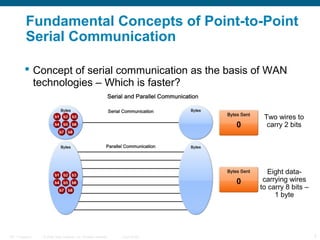
           Concept of serial communication as the basis of WAN
            technologies – Which is faster?


                                                                                    Two wires to
                                                                                     carry 2 bits


                                                                                      Eight data-
                                                                                    carrying wires
                                                                                   to carry 8 bits –
                                                                                        1 byte


ITE 1 Chapter 6   © 2006 Cisco Systems, Inc. All rights reserved.   Cisco Public                       3
Serial Communication Standards

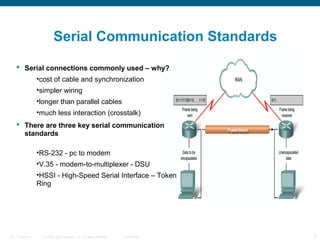
     Serial connections commonly used – why?
                  •cost of cable and synchronization
                  •simpler wiring
                  •longer than parallel cables
                  •much less interaction (crosstalk)
     There are three key serial communication
      standards

                  •RS-232 - pc to modem
                  •V.35 - modem-to-multiplexer - DSU
                  •HSSI - High-Speed Serial Interface – Token
                  Ring


ITE 1 Chapter 6     © 2006 Cisco Systems, Inc. All rights reserved.   Cisco Public   4
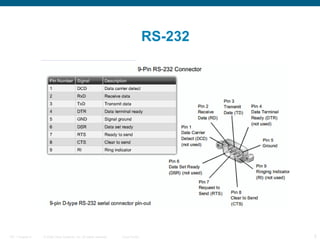
RS-232


ITE 1 Chapter 6   © 2006 Cisco Systems, Inc. All rights reserved.   Cisco Public            5
Fundamental Concepts of Point-to-Point
           Serial Communication
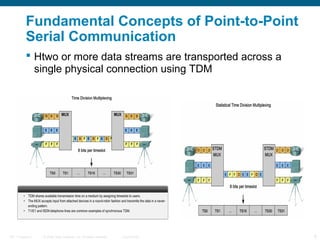
            Htwo or more data streams are transported across a
             single physical connection using TDM


ITE 1 Chapter 6   © 2006 Cisco Systems, Inc. All rights reserved.   Cisco Public   6
Fundamental Concepts of Point-to-Point
           Serial Communication
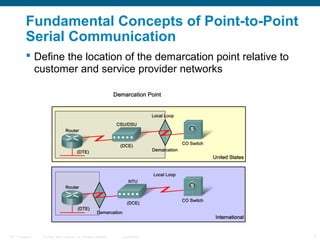
            Define the location of the demarcation point relative to
             customer and service provider networks


ITE 1 Chapter 6   © 2006 Cisco Systems, Inc. All rights reserved.   Cisco Public   7
Fundamental Concepts of Point-to-Point
           Serial Communication
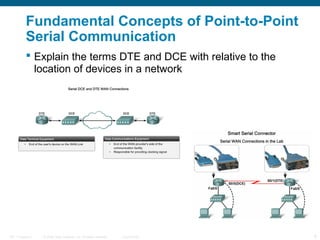
            Explain the terms DTE and DCE with relative to the
             location of devices in a network


ITE 1 Chapter 6   © 2006 Cisco Systems, Inc. All rights reserved.   Cisco Public   8
Fundamental Concepts of Point-to-Point
           Serial Communication
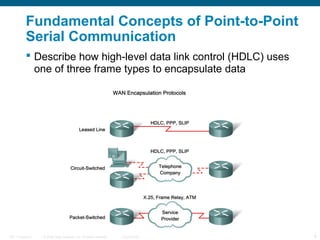
            Describe how high-level data link control (HDLC) uses
             one of three frame types to encapsulate data


ITE 1 Chapter 6   © 2006 Cisco Systems, Inc. All rights reserved.   Cisco Public   9
Fundamental Concepts of Point-to-Point
           Serial Communication
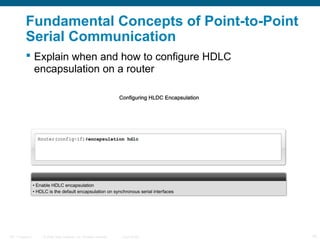
            Explain when and how to configure HDLC
             encapsulation on a router


ITE 1 Chapter 6   © 2006 Cisco Systems, Inc. All rights reserved.   Cisco Public   10
Describe the Fundamental Concepts of
           Point-to-Point Serial Communication
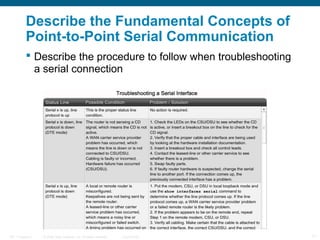
            Describe the procedure to follow when troubleshooting
             a serial connection


ITE 1 Chapter 6   © 2006 Cisco Systems, Inc. All rights reserved.   Cisco Public   11
Point-to-Point Concepts
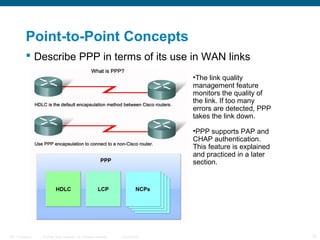
            Describe PPP in terms of its use in WAN links
                                                                                   •The link quality
                                                                                   management feature
                                                                                   monitors the quality of
                                                                                   the link. If too many
                                                                                   errors are detected, PPP
                                                                                   takes the link down.

                                                                                   •PPP supports PAP and
                                                                                   CHAP authentication.
                                                                                   This feature is explained
                                                                                   and practiced in a later
                                                                                   section.


ITE 1 Chapter 6   © 2006 Cisco Systems, Inc. All rights reserved.   Cisco Public                               12
Point-to-Point Concepts
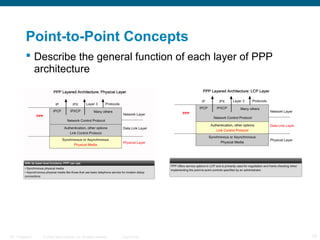
            Describe the general function of each layer of PPP
             architecture


ITE 1 Chapter 6   © 2006 Cisco Systems, Inc. All rights reserved.   Cisco Public   13
Point-to-Point Concepts
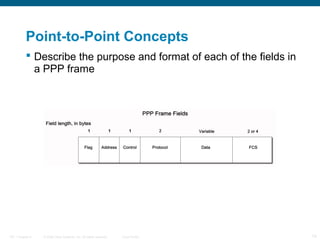
            Describe the purpose and format of each of the fields in
             a PPP frame


ITE 1 Chapter 6   © 2006 Cisco Systems, Inc. All rights reserved.   Cisco Public   14
Point-to-Point Concepts
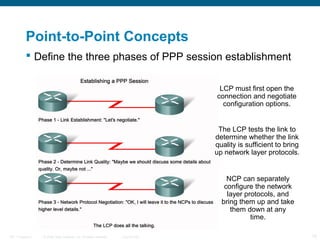
            Define the three phases of PPP session establishment

                                                                                    LCP must first open the
                                                                                   connection and negotiate
                                                                                     configuration options.


                                                                                    The LCP tests the link to
                                                                                   determine whether the link
                                                                                   quality is sufficient to bring
                                                                                   up network layer protocols.


                                                                                       NCP can separately
                                                                                      configure the network
                                                                                       layer protocols, and
                                                                                     bring them up and take
                                                                                        them down at any
                                                                                               time.

ITE 1 Chapter 6   © 2006 Cisco Systems, Inc. All rights reserved.   Cisco Public                                    15
Point-to-Point Concepts
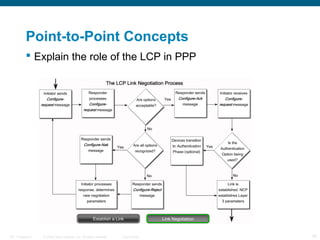
            Explain the role of the LCP in PPP


ITE 1 Chapter 6   © 2006 Cisco Systems, Inc. All rights reserved.   Cisco Public   16
Point-to-Point Concepts
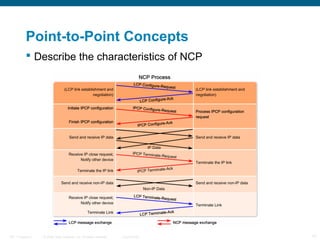
            Describe the characteristics of NCP


ITE 1 Chapter 6   © 2006 Cisco Systems, Inc. All rights reserved.   Cisco Public   17
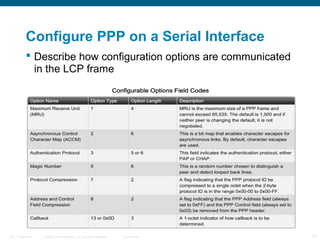
Configure PPP on a Serial Interface
            Describe how configuration options are communicated
             in the LCP frame


ITE 1 Chapter 6   © 2006 Cisco Systems, Inc. All rights reserved.   Cisco Public   18
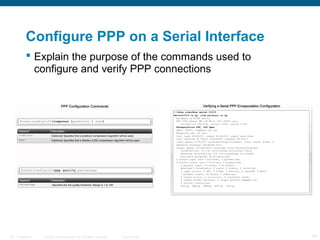
Configure PPP on a Serial Interface
            Explain the purpose of the commands used to
             configure and verify PPP connections


ITE 1 Chapter 6   © 2006 Cisco Systems, Inc. All rights reserved.   Cisco Public   19
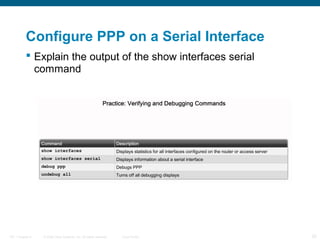
Configure PPP on a Serial Interface
            Explain the output of the show interfaces serial
             command


ITE 1 Chapter 6   © 2006 Cisco Systems, Inc. All rights reserved.   Cisco Public   20
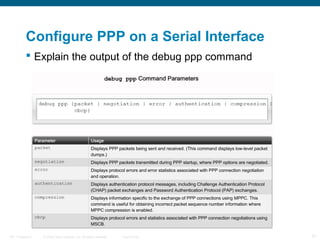
Configure PPP on a Serial Interface
            Explain the output of the debug ppp command


ITE 1 Chapter 6   © 2006 Cisco Systems, Inc. All rights reserved.   Cisco Public   21
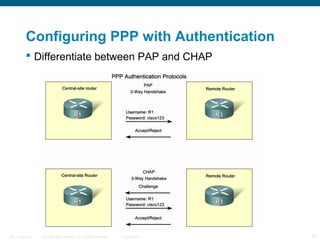
Configuring PPP with Authentication
            Differentiate between PAP and CHAP


ITE 1 Chapter 6   © 2006 Cisco Systems, Inc. All rights reserved.   Cisco Public   22
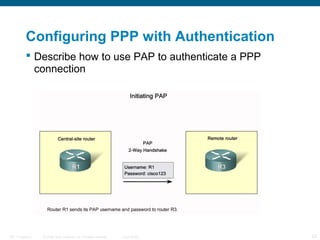
Configuring PPP with Authentication
            Describe how to use PAP to authenticate a PPP
             connection


ITE 1 Chapter 6   © 2006 Cisco Systems, Inc. All rights reserved.   Cisco Public   23
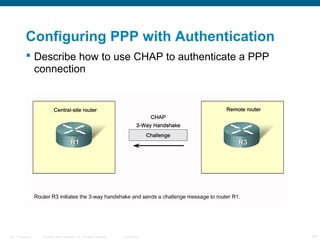
Configuring PPP with Authentication
            Describe how to use CHAP to authenticate a PPP
             connection


ITE 1 Chapter 6   © 2006 Cisco Systems, Inc. All rights reserved.   Cisco Public   24
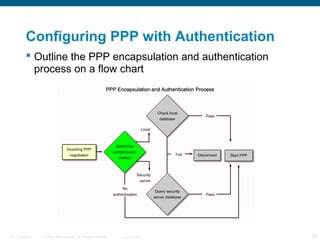
Configuring PPP with Authentication
            Outline the PPP encapsulation and authentication
             process on a flow chart


ITE 1 Chapter 6   © 2006 Cisco Systems, Inc. All rights reserved.   Cisco Public   25
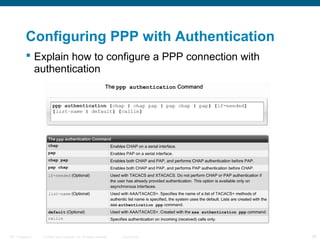
Configuring PPP with Authentication
            Explain how to configure a PPP connection with
             authentication


ITE 1 Chapter 6   © 2006 Cisco Systems, Inc. All rights reserved.   Cisco Public   26
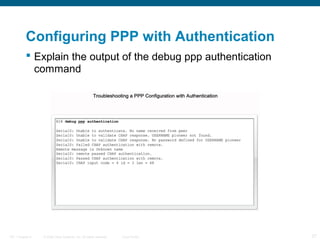
Configuring PPP with Authentication
            Explain the output of the debug ppp authentication
             command


ITE 1 Chapter 6   © 2006 Cisco Systems, Inc. All rights reserved.   Cisco Public   27
Summary

          PPP is a widely used WAN protocol
          PPP provides multi-protocol LAN to WAN connections
          PPP session establishment – 4 phases
                  Link establishment
                  Link quality determination
                  Network layer protocol configuration negotiation
                  Link termination
          WAN Encapsulation
                  –HDLC default encapsulation
                  –PPP


ITE 1 Chapter 6   © 2006 Cisco Systems, Inc. All rights reserved.   Cisco Public   28
Summary
          PPP authentication
                  –PAP
                           •2 way handshake
                  –CHAP
                           •3 way handshake
                  –Use debug ppp authentication to confirm authentication
                  configuration
          PPP configuration
                  –Done on a serial interface

          After PPP configuration, use show interfaces command
           to display:
                  –LCP state
                  –NCP state

ITE 1 Chapter 6   © 2006 Cisco Systems, Inc. All rights reserved.   Cisco Public   29
ITE 1 Chapter 6   © 2006 Cisco Systems, Inc. All rights reserved.   Cisco Public   30

Chapter 2 point-to-point protocol (ppp)

  • 1.
    Point-to-Point Protocol (PPP) Accessing the WAN – Chapter 2 ITE I Chapter 6 © 2006 Cisco Systems, Inc. All rights reserved. Cisco Public 1
  • 2.
    Objectives  Describe the fundamental concepts of point-to-point serial communication including TDM, demarcation point, DTE-DCE functions, HDLC encapsulation, and serial interface troubleshooting.  Describe PPP concepts including PPP layered architecture, PPP frame structure, PPP session establishment, multiprotocol encapsulation support, link control protocol (LCP), network control protocol (NCP), and Internet Protocol Control Protocol (IPCP).  Configure PPP on a serial interface including enabling PPP encapsulation, verifying the PPP connection and troubleshooting encapsulation problems.  Configure PPP authentication including explaining PAP and CHAP authentication protocols, configuring PPP authentication using PAP and CHAP, and troubleshooting PPP authentication problems. ITE 1 Chapter 6 © 2006 Cisco Systems, Inc. All rights reserved. Cisco Public 2
  • 3.
    Fundamental Concepts ofPoint-to-Point Serial Communication  Concept of serial communication as the basis of WAN technologies – Which is faster? Two wires to carry 2 bits Eight data- carrying wires to carry 8 bits – 1 byte ITE 1 Chapter 6 © 2006 Cisco Systems, Inc. All rights reserved. Cisco Public 3
  • 4.
    Serial Communication Standards  Serial connections commonly used – why? •cost of cable and synchronization •simpler wiring •longer than parallel cables •much less interaction (crosstalk)  There are three key serial communication standards •RS-232 - pc to modem •V.35 - modem-to-multiplexer - DSU •HSSI - High-Speed Serial Interface – Token Ring ITE 1 Chapter 6 © 2006 Cisco Systems, Inc. All rights reserved. Cisco Public 4
  • 5.
    RS-232 ITE 1 Chapter6 © 2006 Cisco Systems, Inc. All rights reserved. Cisco Public 5
  • 6.
    Fundamental Concepts ofPoint-to-Point Serial Communication  Htwo or more data streams are transported across a single physical connection using TDM ITE 1 Chapter 6 © 2006 Cisco Systems, Inc. All rights reserved. Cisco Public 6
  • 7.
    Fundamental Concepts ofPoint-to-Point Serial Communication  Define the location of the demarcation point relative to customer and service provider networks ITE 1 Chapter 6 © 2006 Cisco Systems, Inc. All rights reserved. Cisco Public 7
  • 8.
    Fundamental Concepts ofPoint-to-Point Serial Communication  Explain the terms DTE and DCE with relative to the location of devices in a network ITE 1 Chapter 6 © 2006 Cisco Systems, Inc. All rights reserved. Cisco Public 8
  • 9.
    Fundamental Concepts ofPoint-to-Point Serial Communication  Describe how high-level data link control (HDLC) uses one of three frame types to encapsulate data ITE 1 Chapter 6 © 2006 Cisco Systems, Inc. All rights reserved. Cisco Public 9
  • 10.
    Fundamental Concepts ofPoint-to-Point Serial Communication  Explain when and how to configure HDLC encapsulation on a router ITE 1 Chapter 6 © 2006 Cisco Systems, Inc. All rights reserved. Cisco Public 10
  • 11.
    Describe the FundamentalConcepts of Point-to-Point Serial Communication  Describe the procedure to follow when troubleshooting a serial connection ITE 1 Chapter 6 © 2006 Cisco Systems, Inc. All rights reserved. Cisco Public 11
  • 12.
    Point-to-Point Concepts  Describe PPP in terms of its use in WAN links •The link quality management feature monitors the quality of the link. If too many errors are detected, PPP takes the link down. •PPP supports PAP and CHAP authentication. This feature is explained and practiced in a later section. ITE 1 Chapter 6 © 2006 Cisco Systems, Inc. All rights reserved. Cisco Public 12
  • 13.
    Point-to-Point Concepts  Describe the general function of each layer of PPP architecture ITE 1 Chapter 6 © 2006 Cisco Systems, Inc. All rights reserved. Cisco Public 13
  • 14.
    Point-to-Point Concepts  Describe the purpose and format of each of the fields in a PPP frame ITE 1 Chapter 6 © 2006 Cisco Systems, Inc. All rights reserved. Cisco Public 14
  • 15.
    Point-to-Point Concepts  Define the three phases of PPP session establishment LCP must first open the connection and negotiate configuration options. The LCP tests the link to determine whether the link quality is sufficient to bring up network layer protocols. NCP can separately configure the network layer protocols, and bring them up and take them down at any time. ITE 1 Chapter 6 © 2006 Cisco Systems, Inc. All rights reserved. Cisco Public 15
  • 16.
    Point-to-Point Concepts  Explain the role of the LCP in PPP ITE 1 Chapter 6 © 2006 Cisco Systems, Inc. All rights reserved. Cisco Public 16
  • 17.
    Point-to-Point Concepts  Describe the characteristics of NCP ITE 1 Chapter 6 © 2006 Cisco Systems, Inc. All rights reserved. Cisco Public 17
  • 18.
    Configure PPP ona Serial Interface  Describe how configuration options are communicated in the LCP frame ITE 1 Chapter 6 © 2006 Cisco Systems, Inc. All rights reserved. Cisco Public 18
  • 19.
    Configure PPP ona Serial Interface  Explain the purpose of the commands used to configure and verify PPP connections ITE 1 Chapter 6 © 2006 Cisco Systems, Inc. All rights reserved. Cisco Public 19
  • 20.
    Configure PPP ona Serial Interface  Explain the output of the show interfaces serial command ITE 1 Chapter 6 © 2006 Cisco Systems, Inc. All rights reserved. Cisco Public 20
  • 21.
    Configure PPP ona Serial Interface  Explain the output of the debug ppp command ITE 1 Chapter 6 © 2006 Cisco Systems, Inc. All rights reserved. Cisco Public 21
  • 22.
    Configuring PPP withAuthentication  Differentiate between PAP and CHAP ITE 1 Chapter 6 © 2006 Cisco Systems, Inc. All rights reserved. Cisco Public 22
  • 23.
    Configuring PPP withAuthentication  Describe how to use PAP to authenticate a PPP connection ITE 1 Chapter 6 © 2006 Cisco Systems, Inc. All rights reserved. Cisco Public 23
  • 24.
    Configuring PPP withAuthentication  Describe how to use CHAP to authenticate a PPP connection ITE 1 Chapter 6 © 2006 Cisco Systems, Inc. All rights reserved. Cisco Public 24
  • 25.
    Configuring PPP withAuthentication  Outline the PPP encapsulation and authentication process on a flow chart ITE 1 Chapter 6 © 2006 Cisco Systems, Inc. All rights reserved. Cisco Public 25
  • 26.
    Configuring PPP withAuthentication  Explain how to configure a PPP connection with authentication ITE 1 Chapter 6 © 2006 Cisco Systems, Inc. All rights reserved. Cisco Public 26
  • 27.
    Configuring PPP withAuthentication  Explain the output of the debug ppp authentication command ITE 1 Chapter 6 © 2006 Cisco Systems, Inc. All rights reserved. Cisco Public 27
  • 28.
    Summary  PPP is a widely used WAN protocol  PPP provides multi-protocol LAN to WAN connections  PPP session establishment – 4 phases Link establishment Link quality determination Network layer protocol configuration negotiation Link termination  WAN Encapsulation –HDLC default encapsulation –PPP ITE 1 Chapter 6 © 2006 Cisco Systems, Inc. All rights reserved. Cisco Public 28
  • 29.
    Summary  PPP authentication –PAP •2 way handshake –CHAP •3 way handshake –Use debug ppp authentication to confirm authentication configuration  PPP configuration –Done on a serial interface  After PPP configuration, use show interfaces command to display: –LCP state –NCP state ITE 1 Chapter 6 © 2006 Cisco Systems, Inc. All rights reserved. Cisco Public 29
  • 30.
    ITE 1 Chapter6 © 2006 Cisco Systems, Inc. All rights reserved. Cisco Public 30

Editor's Notes

  • #4 Graphic 2.1.1.1
  • #7 Graphics 2.1.2.1, 2.1.2.2 & 2.1.2.3
  • #8 Graphic 2.1.3.1
  • #9 Graphics 2.1.4.1 & 2.1.4.2 (for the latter graphic modify it to use the serial and the router to router pictures)
  • #10 Graphic 2.1.5.1
  • #11 Graphic 2.1.6.1
  • #12 Graphic 2.1.7.1 (use status)
  • #13 Graphic 2.2.1.1 PPP contains three main components: HDLC protocol for encapsulating datagrams over point-to-point links. Extensible Link Control Protocol (LCP) to establish, configure, and test the data link connection. Family of Network Control Protocols (NCPs) for establishing and configuring different network layer protocols. PPP allows the simultaneous use of multiple network layer protocols. Some of the more common NCPs are Internet Protocol Control Protocol, Appletalk Control Protocol, Novell IPX Control Protocol, Cisco Systems Control Protocol, SNA Control Protocol, and Compression Control Protocol.
  • #14 Graphics 2.2.2.1 thru 2.2. PPP Architecture - Link Control Protocol Layer The LCP is the real working part of PPP. The LCP sits on top of the physical layer and has a role in establishing, configuring, and testing the data-link connection. The LCP establishes the point-to-point link. The LCP also negotiates and sets up control options on the WAN data link, which are handled by the NCPs. 2.3 PPP permits multiple network layer protocols to operate on the same communications link. For every network layer protocol used, PPP uses a separate NCP. For example, IP uses the IP Control Protocol (IPCP), and IPX uses the Novell IPX Control Protocol (IPXCP).
  • #15 Graphic 2.2.3.1
  • #16 Graphic 2.2.4.1
  • #17 Graphic 2.2.5.1 (link negotiation)
  • #18 Graphic 2.2.6.1
  • #19 Graphic 2.3.1.1
  • #20 Graphic 2.3.2.1 Graphic 2.3.3.1
  • #21 Graphic 2.3.3.1 (commands)
  • #22 Graphic 2.3.4.1
  • #23 Graphic 2.4.1.1
  • #24 Graphic 2.4.2.1
  • #25 Graphic 2.4.3.1
  • #26 Graphic 2.4.4.1
  • #27 Graphic 2.4.5.1
  • #28 Graphic 2.4.6.1