22IT508 - Full Stack Development with
Node and React
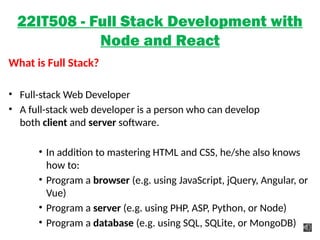
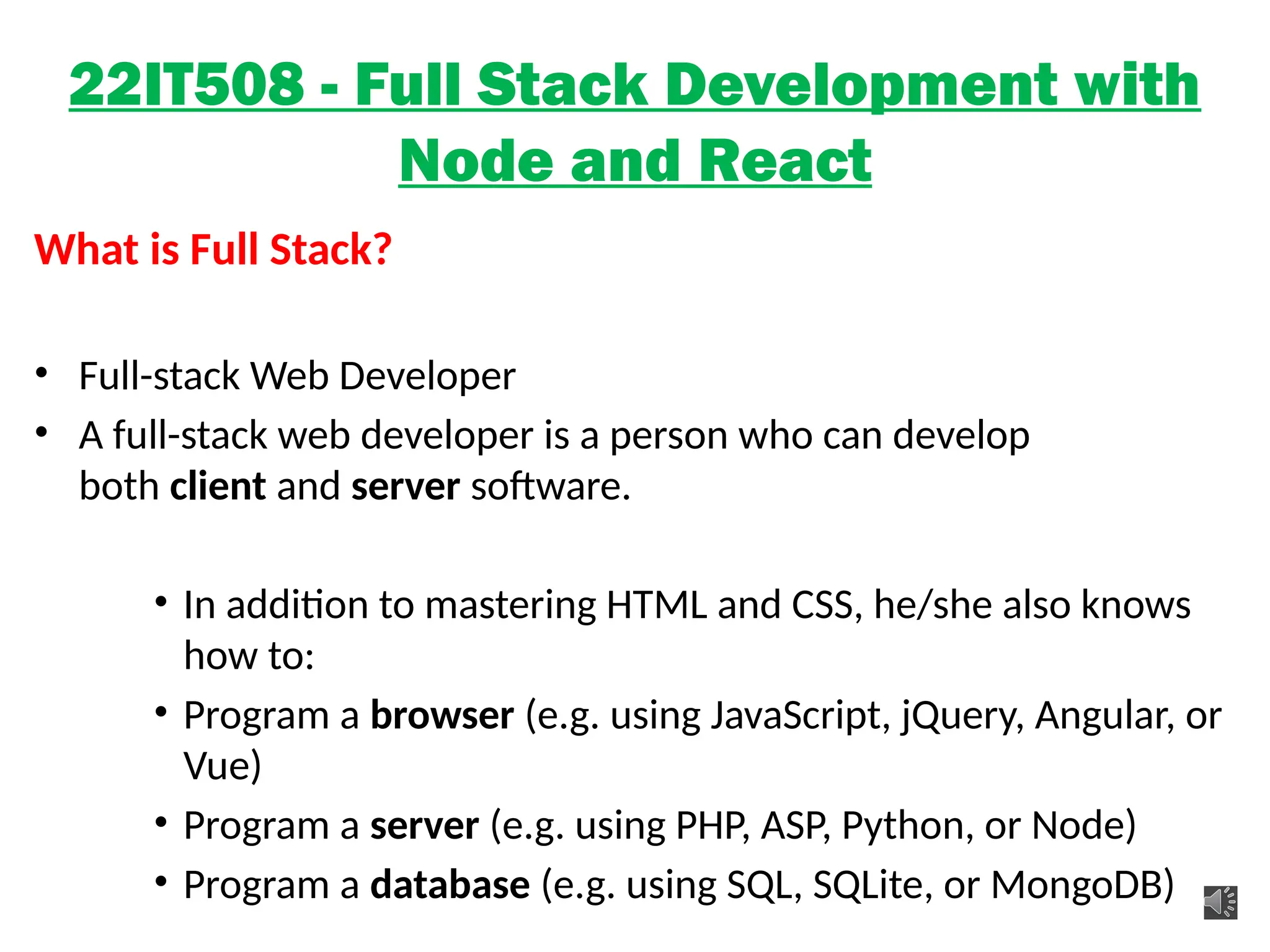
What is Full Stack?
• Full-stack Web Developer
• A full-stack web developer is a person who can develop
both client and server software.
• In addition to mastering HTML and CSS, he/she also knows
how to:
• Program a browser (e.g. using JavaScript, jQuery, Angular, or
Vue)
• Program a server (e.g. using PHP, ASP, Python, or Node)
• Program a database (e.g. using SQL, SQLite, or MongoDB)
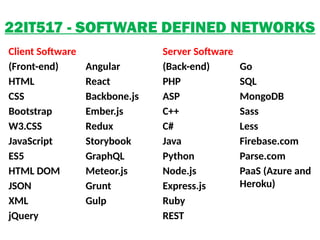
22IT517 - SOFTWARE DEFINED NETWORKS
Client Software
(Front-end)
HTML
CSS
Bootstrap
W3.CSS
JavaScript
ES5
HTML DOM
JSON
XML
jQuery
Angular
React
Backbone.js
Ember.js
Redux
Storybook
GraphQL
Meteor.js
Grunt
Gulp
Server Software
(Back-end)
PHP
ASP
C++
C#
Java
Python
Node.js
Express.js
Ruby
REST
Go
SQL
MongoDB
Sass
Less
Firebase.com
Parse.com
PaaS (Azure and
Heroku)
22IT517 - SOFTWARE DEFINED NETWORKS
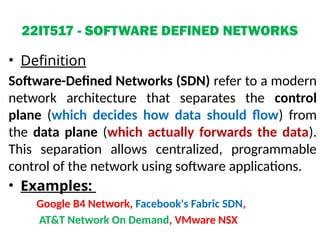
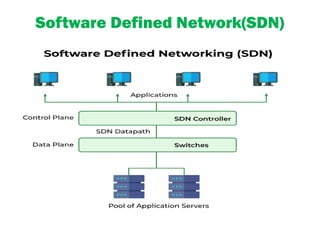
• Definition
Software-Defined Networks (SDN) refer to a modern
network architecture that separates the control
plane (which decides how data should flow) from
the data plane (which actually forwards the data).
This separation allows centralized, programmable
control of the network using software applications.
• Examples:
Google B4 Network, Facebook's Fabric SDN,
AT&T Network On Demand, VMware NSX
Software Defined Network(SDN)
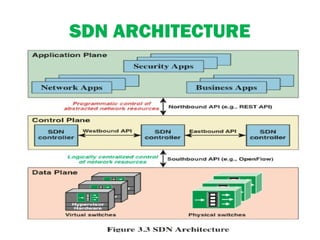
SDN ARCHITECTURE
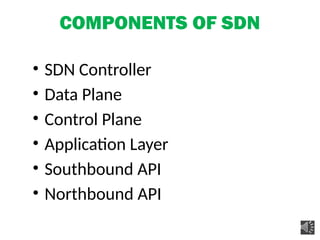
COMPONENTS OF SDN
• SDN Controller
• Data Plane
• Control Plane
• Application Layer
• Southbound API
• Northbound API
Advantages of SDN
• Centralized Control
• High Flexibility
• Automation
• Cost-Effective
• Scalable
Disadvantages of SDN
• Initial Setup Complexity
• Security Risks
• Integration Challenges
• Controller Dependency
SDN VS Traditional Networks
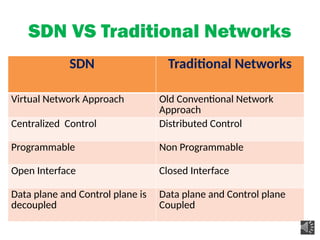
SDN Traditional Networks
Virtual Network Approach Old Conventional Network
Approach
Centralized Control Distributed Control
Programmable Non Programmable
Open Interface Closed Interface
Data plane and Control plane is
decoupled
Data plane and Control plane
Coupled
Data Plane in SDN
• Function: Handles actual packet forwarding.
• Components: OpenFlow-enabled switches,
routers.
• Characteristics:
- Simple forwarding logic.
- No decision-making ability.
- Follows flow rules from controller.
• Example:
- OpenFlow switch: Receives flow table from
controller and applies rules to packet flows.
Control Plane in SDN
• Control Plane:
- Role: Acts as the brain of the network.
• Functions:
- Maintains network-wide view.
- Makes routing decisions.
- Installs flow rules on data plane.
• Example Tools: OpenDaylight, Ryu, ONOS.
Application Plane in SDN
• Application Plane:
- Role: Hosts network applications.
• Examples: Network monitoring, security
apps, traffic engineering.
• Uses Northbound APIs to request services
from the controller.
Data Plane Functions and Protocols
Data Plane Functions
• Packet forwarding
• Packet switching
• Header inspection
• MAC address filtering
• Quality of Service (QoS) enforcement
• Traffic policing and shaping
Data Plane Functions and Protocols
Data Plane Protocols
• Ethernet – for frame-level forwarding
• IP (IPv4/IPv6) – for routing decisions
• MPLS – for label-based forwarding
• VLAN (802.1Q) – for virtual segmentation
• GRE/IPSec – for tunneling/encryption
• OpenFlow (in SDN) – to program flow tables
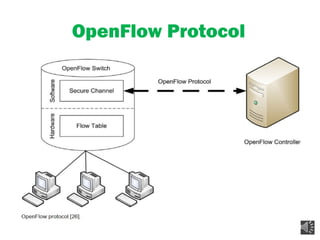
OpenFlow Protocol
Definition
OpenFlow is a standard protocol that allows an SDN
controller to directly interact with the forwarding
plane of network devices (like switches), enabling
programmable network management.
• OpenFlow consists of three components
OpenFlow controller
OpenFlow protocol
OpenFlow switch
OpenFlow Protocol
OpenFlow Protocol
OpenFlow Protocol
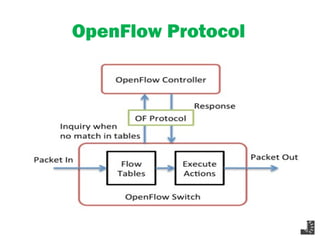
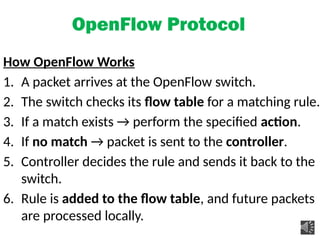
How OpenFlow Works
1. A packet arrives at the OpenFlow switch.
2. The switch checks its flow table for a matching rule.
3. If a match exists → perform the specified action.
4. If no match → packet is sent to the controller.
5. Controller decides the rule and sends it back to the
switch.
6. Rule is added to the flow table, and future packets
are processed locally.
OpenFlow Protocol
Benefits of OpenFlow
• Centralized Management
• Dynamic Network Adaptation
• Innovation and Flexibility
• Hardware Agnostic
Examples of Open Flow's Use
• Software-Defined Networking (SDN)
• Network Virtualization
• Traffic Engineering
Flow Table
Definition
• In SDN, a flow table is a core component of an
OpenFlow switch, used to store and manage flow
entries that dictate how packets are processed and
forwarded.
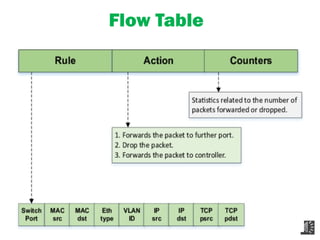
Flow Table
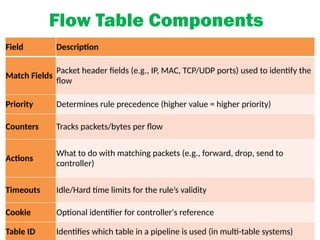
Flow Table Components
Field Description
Match Fields
Packet header fields (e.g., IP, MAC, TCP/UDP ports) used to identify the
flow
Priority Determines rule precedence (higher value = higher priority)
Counters Tracks packets/bytes per flow
Actions
What to do with matching packets (e.g., forward, drop, send to
controller)
Timeouts Idle/Hard time limits for the rule’s validity
Cookie Optional identifier for controller's reference
Table ID Identifies which table in a pipeline is used (in multi-table systems)
Flow Table Actions
• Forwarding to a port (or multiple ports)
• Dropping the packet
• Modifying the packet header (e.g., changing IP or
MAC)
• Sending the packet to the controller (for new or
unknown flows)
Flow Table Life Cycles
1. Packet arrives at the switch
2. Match packet headers with flow entries
3. If a match is found → perform specified
action
4. If no match → send packet to controller for
decision (default behavior)
Southbound API
In Software-Defined Networking (SDN), a
southbound API is the interface that allows the
SDN controller to communicate with and
configure the underlying network devices, such
as switches and routers
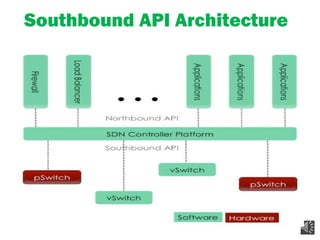
Southbound API Architecture
Southbound API
Function:
Southbound APIs are the communication channel
between the SDN controller and the network devices.
Purpose:
They allow the controller to instruct the network devices
on how to handle traffic, such as directing flows,
implementing policies, and managing network resources.
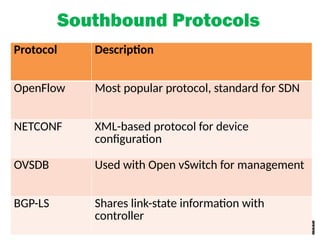
Southbound Protocols
Protocol Description
OpenFlow Most popular protocol, standard for SDN
NETCONF XML-based protocol for device
configuration
OVSDB Used with Open vSwitch for management
BGP-LS Shares link-state information with
controller
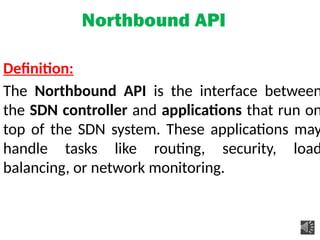
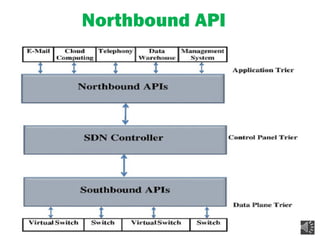
Northbound API
Definition:
The Northbound API is the interface between
the SDN controller and applications that run on
top of the SDN system. These applications may
handle tasks like routing, security, load
balancing, or network monitoring.
Northbound API
Northbound API
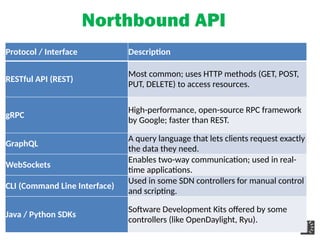
Protocol / Interface Description
RESTful API (REST)
Most common; uses HTTP methods (GET, POST,
PUT, DELETE) to access resources.
gRPC
High-performance, open-source RPC framework
by Google; faster than REST.
GraphQL
A query language that lets clients request exactly
the data they need.
WebSockets
Enables two-way communication; used in real-
time applications.
CLI (Command Line Interface)
Used in some SDN controllers for manual control
and scripting.
Java / Python SDKs
Software Development Kits offered by some
controllers (like OpenDaylight, Ryu).
SDN Controller
An SDN controller is the central brain of a
Software Defined Network. It acts as an
intermediary between the network devices
(data plane) and the applications
(application plane).
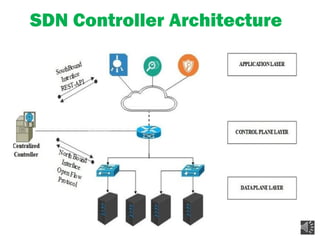
SDN Controller Architecture
SDN Controller Functions
Function Description
Network Control
Manages flow rules and configurations in
switches/routers
Decision Making
Decides how data should flow through the
network
Topology Discovery Learns and updates the network map
Statistics Gathering Collects usage data from devices
Northbound API Offers interfaces to external apps
Southbound API Communicates with physical/virtual devices
SDN Controller Functions
An SDN controller is the central brain of a
Software Defined Network. It acts as an
intermediary between the network devices
(data plane) and the applications
(application plane).
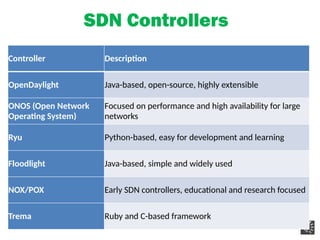
SDN Controllers
Controller Description
OpenDaylight Java-based, open-source, highly extensible
ONOS (Open Network
Operating System)
Focused on performance and high availability for large
networks
Ryu Python-based, easy for development and learning
Floodlight Java-based, simple and widely used
NOX/POX Early SDN controllers, educational and research focused
Trema Ruby and C-based framework
Measurement and Monitoring in SDN
Measurement and monitoring in SDN are essential
to ensure network performance, reliability, and
security. Since SDN separates the control plane
from the data plane, it offers centralized control
and better visibility into network behaviour, which
enhances monitoring capabilities.
Measurement in SDN
Measurement involves collecting quantitative data
about the network to understand its current state.
Examples:
• Packet loss rate
• Bandwidth usage
• Flow duration
• Latency and jitter
Monitoring in SDN
Monitoring refers to the continuous observation of
the network to detect anomalies, faults, or
performance issues in real time.
Measurement and Monitoring in SDN Goals:
 Ensure Quality of Service (QoS)
 Detect failures and security threats
 Enable traffic engineering
 Support dynamic network management
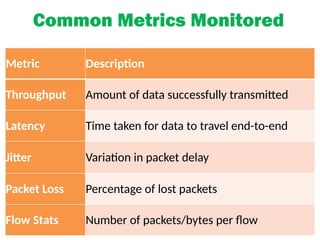
Common Metrics Monitored
Metric Description
Throughput Amount of data successfully transmitted
Latency Time taken for data to travel end-to-end
Jitter Variation in packet delay
Packet Loss Percentage of lost packets
Flow Stats Number of packets/bytes per flow
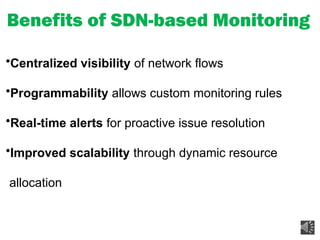
Benefits of SDN-based Monitoring
•Centralized visibility of network flows
•Programmability allows custom monitoring rules
•Real-time alerts for proactive issue resolution
•Improved scalability through dynamic resource
allocation
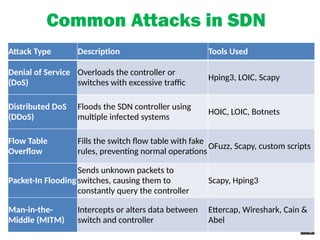
Common Attacks in SDN
Attack Type Description Tools Used
Denial of Service
(DoS)
Overloads the controller or
switches with excessive traffic
Hping3, LOIC, Scapy
Distributed DoS
(DDoS)
Floods the SDN controller using
multiple infected systems
HOIC, LOIC, Botnets
Flow Table
Overflow
Fills the switch flow table with fake
rules, preventing normal operations
OFuzz, Scapy, custom scripts
Packet-In Flooding
Sends unknown packets to
switches, causing them to
constantly query the controller
Scapy, Hping3
Man-in-the-
Middle (MITM)
Intercepts or alters data between
switch and controller
Ettercap, Wireshark, Cain &
Abel
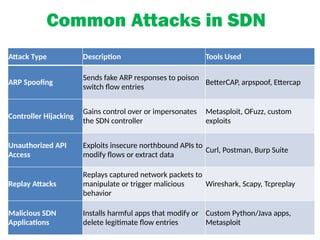
Common Attacks in SDN
Attack Type Description Tools Used
ARP Spoofing
Sends fake ARP responses to poison
switch flow entries
BetterCAP, arpspoof, Ettercap
Controller Hijacking
Gains control over or impersonates
the SDN controller
Metasploit, OFuzz, custom
exploits
Unauthorized API
Access
Exploits insecure northbound APIs to
modify flows or extract data
Curl, Postman, Burp Suite
Replay Attacks
Replays captured network packets to
manipulate or trigger malicious
behavior
Wireshark, Scapy, Tcpreplay
Malicious SDN
Applications
Installs harmful apps that modify or
delete legitimate flow entries
Custom Python/Java apps,
Metasploit
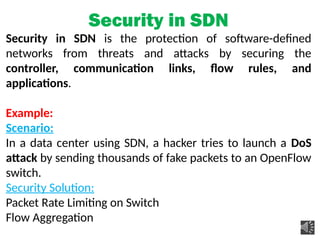
Security in SDN
Security in SDN is the protection of software-defined
networks from threats and attacks by securing the
controller, communication links, flow rules, and
applications.
Example:
Scenario:
In a data center using SDN, a hacker tries to launch a DoS
attack by sending thousands of fake packets to an OpenFlow
switch.
Security Solution:
Packet Rate Limiting on Switch
Flow Aggregation
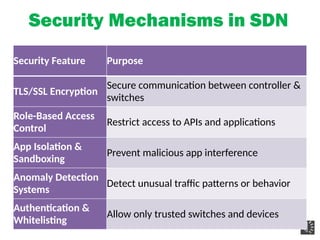
Security Mechanisms in SDN
Security Feature Purpose
TLS/SSL Encryption
Secure communication between controller &
switches
Role-Based Access
Control
Restrict access to APIs and applications
App Isolation &
Sandboxing
Prevent malicious app interference
Anomaly Detection
Systems
Detect unusual traffic patterns or behavior
Authentication &
Whitelisting
Allow only trusted switches and devices
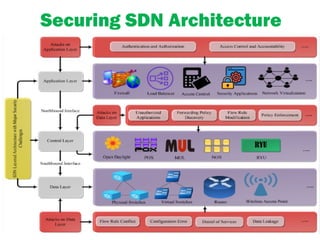
Securing SDN Architecture
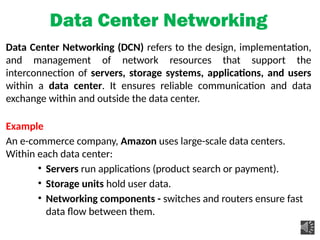
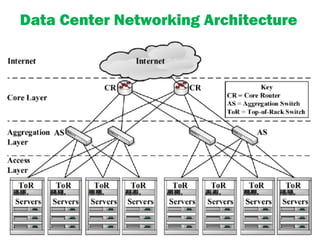
Data Center Networking
Data Center Networking (DCN) refers to the design, implementation,
and management of network resources that support the
interconnection of servers, storage systems, applications, and users
within a data center. It ensures reliable communication and data
exchange within and outside the data center.
Example
An e-commerce company, Amazon uses large-scale data centers.
Within each data center:
• Servers run applications (product search or payment).
• Storage units hold user data.
• Networking components - switches and routers ensure fast
data flow between them.
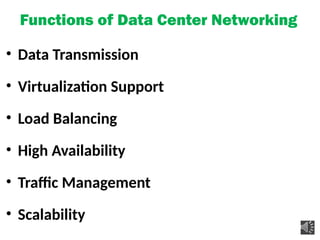
Functions of Data Center Networking
• Data Transmission
• Virtualization Support
• Load Balancing
• High Availability
• Traffic Management
• Scalability
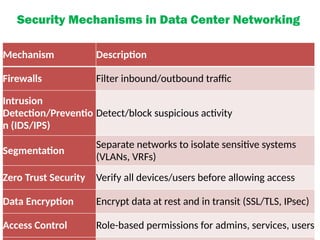
Security Mechanisms in Data Center Networking
Mechanism Description
Firewalls Filter inbound/outbound traffic
Intrusion
Detection/Preventio
n (IDS/IPS)
Detect/block suspicious activity
Segmentation
Separate networks to isolate sensitive systems
(VLANs, VRFs)
Zero Trust Security Verify all devices/users before allowing access
Data Encryption Encrypt data at rest and in transit (SSL/TLS, IPsec)
Access Control Role-based permissions for admins, services, users
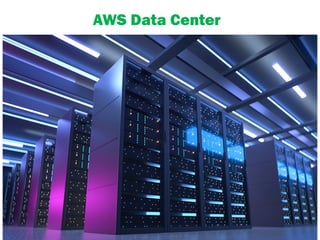
AWS Data Center
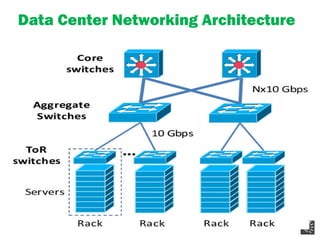
Data Center Networking Architecture
Software Tools in Data Center Networking
Tool Name Usage / Purpose
1. Nagios
Real-time monitoring of servers, switches, and
services
2. Ansible
Automating network device configuration and
updates
3. OpenDaylight SDN controller managing traffic flow via OpenFlow
4. VMware NSX-T
Network virtualization and micro-segmentation in
data centers
5. Wireshark
Packet capture and protocol analysis in live
networks
Software Tools in Data Center Networking
Tool Name Usage / Purpose
6. Zabbix
Performance monitoring and visualization for
devices and apps
7. Terraform
Infrastructure as Code for deploying network
components
8. Ryu
Python-based SDN controller for managing
OpenFlow switches
9. Snort Real-time Intrusion Detection System (IDS)
10. Open vSwitch
Virtual switch for building programmable,
scalable networks

22IT508 - Full Stack Development with Node and React.pptx

  • 1.
    22IT508 - FullStack Development with Node and React What is Full Stack? • Full-stack Web Developer • A full-stack web developer is a person who can develop both client and server software. • In addition to mastering HTML and CSS, he/she also knows how to: • Program a browser (e.g. using JavaScript, jQuery, Angular, or Vue) • Program a server (e.g. using PHP, ASP, Python, or Node) • Program a database (e.g. using SQL, SQLite, or MongoDB)
  • 2.
    22IT517 - SOFTWAREDEFINED NETWORKS Client Software (Front-end) HTML CSS Bootstrap W3.CSS JavaScript ES5 HTML DOM JSON XML jQuery Angular React Backbone.js Ember.js Redux Storybook GraphQL Meteor.js Grunt Gulp Server Software (Back-end) PHP ASP C++ C# Java Python Node.js Express.js Ruby REST Go SQL MongoDB Sass Less Firebase.com Parse.com PaaS (Azure and Heroku)
  • 3.
    22IT517 - SOFTWAREDEFINED NETWORKS • Definition Software-Defined Networks (SDN) refer to a modern network architecture that separates the control plane (which decides how data should flow) from the data plane (which actually forwards the data). This separation allows centralized, programmable control of the network using software applications. • Examples: Google B4 Network, Facebook's Fabric SDN, AT&T Network On Demand, VMware NSX
  • 4.
  • 5.
  • 6.
    COMPONENTS OF SDN •SDN Controller • Data Plane • Control Plane • Application Layer • Southbound API • Northbound API
  • 7.
    Advantages of SDN •Centralized Control • High Flexibility • Automation • Cost-Effective • Scalable
  • 8.
    Disadvantages of SDN •Initial Setup Complexity • Security Risks • Integration Challenges • Controller Dependency
  • 9.
    SDN VS TraditionalNetworks SDN Traditional Networks Virtual Network Approach Old Conventional Network Approach Centralized Control Distributed Control Programmable Non Programmable Open Interface Closed Interface Data plane and Control plane is decoupled Data plane and Control plane Coupled
  • 10.
    Data Plane inSDN • Function: Handles actual packet forwarding. • Components: OpenFlow-enabled switches, routers. • Characteristics: - Simple forwarding logic. - No decision-making ability. - Follows flow rules from controller. • Example: - OpenFlow switch: Receives flow table from controller and applies rules to packet flows.
  • 11.
    Control Plane inSDN • Control Plane: - Role: Acts as the brain of the network. • Functions: - Maintains network-wide view. - Makes routing decisions. - Installs flow rules on data plane. • Example Tools: OpenDaylight, Ryu, ONOS.
  • 12.
    Application Plane inSDN • Application Plane: - Role: Hosts network applications. • Examples: Network monitoring, security apps, traffic engineering. • Uses Northbound APIs to request services from the controller.
  • 13.
    Data Plane Functionsand Protocols Data Plane Functions • Packet forwarding • Packet switching • Header inspection • MAC address filtering • Quality of Service (QoS) enforcement • Traffic policing and shaping
  • 14.
    Data Plane Functionsand Protocols Data Plane Protocols • Ethernet – for frame-level forwarding • IP (IPv4/IPv6) – for routing decisions • MPLS – for label-based forwarding • VLAN (802.1Q) – for virtual segmentation • GRE/IPSec – for tunneling/encryption • OpenFlow (in SDN) – to program flow tables
  • 15.
    OpenFlow Protocol Definition OpenFlow isa standard protocol that allows an SDN controller to directly interact with the forwarding plane of network devices (like switches), enabling programmable network management. • OpenFlow consists of three components OpenFlow controller OpenFlow protocol OpenFlow switch
  • 16.
  • 17.
  • 18.
    OpenFlow Protocol How OpenFlowWorks 1. A packet arrives at the OpenFlow switch. 2. The switch checks its flow table for a matching rule. 3. If a match exists → perform the specified action. 4. If no match → packet is sent to the controller. 5. Controller decides the rule and sends it back to the switch. 6. Rule is added to the flow table, and future packets are processed locally.
  • 19.
    OpenFlow Protocol Benefits ofOpenFlow • Centralized Management • Dynamic Network Adaptation • Innovation and Flexibility • Hardware Agnostic Examples of Open Flow's Use • Software-Defined Networking (SDN) • Network Virtualization • Traffic Engineering
  • 20.
    Flow Table Definition • InSDN, a flow table is a core component of an OpenFlow switch, used to store and manage flow entries that dictate how packets are processed and forwarded.
  • 21.
  • 22.
    Flow Table Components FieldDescription Match Fields Packet header fields (e.g., IP, MAC, TCP/UDP ports) used to identify the flow Priority Determines rule precedence (higher value = higher priority) Counters Tracks packets/bytes per flow Actions What to do with matching packets (e.g., forward, drop, send to controller) Timeouts Idle/Hard time limits for the rule’s validity Cookie Optional identifier for controller's reference Table ID Identifies which table in a pipeline is used (in multi-table systems)
  • 23.
    Flow Table Actions •Forwarding to a port (or multiple ports) • Dropping the packet • Modifying the packet header (e.g., changing IP or MAC) • Sending the packet to the controller (for new or unknown flows)
  • 24.
    Flow Table LifeCycles 1. Packet arrives at the switch 2. Match packet headers with flow entries 3. If a match is found → perform specified action 4. If no match → send packet to controller for decision (default behavior)
  • 25.
    Southbound API In Software-DefinedNetworking (SDN), a southbound API is the interface that allows the SDN controller to communicate with and configure the underlying network devices, such as switches and routers
  • 26.
  • 27.
    Southbound API Function: Southbound APIsare the communication channel between the SDN controller and the network devices. Purpose: They allow the controller to instruct the network devices on how to handle traffic, such as directing flows, implementing policies, and managing network resources.
  • 28.
    Southbound Protocols Protocol Description OpenFlowMost popular protocol, standard for SDN NETCONF XML-based protocol for device configuration OVSDB Used with Open vSwitch for management BGP-LS Shares link-state information with controller
  • 29.
    Northbound API Definition: The NorthboundAPI is the interface between the SDN controller and applications that run on top of the SDN system. These applications may handle tasks like routing, security, load balancing, or network monitoring.
  • 30.
  • 31.
    Northbound API Protocol /Interface Description RESTful API (REST) Most common; uses HTTP methods (GET, POST, PUT, DELETE) to access resources. gRPC High-performance, open-source RPC framework by Google; faster than REST. GraphQL A query language that lets clients request exactly the data they need. WebSockets Enables two-way communication; used in real- time applications. CLI (Command Line Interface) Used in some SDN controllers for manual control and scripting. Java / Python SDKs Software Development Kits offered by some controllers (like OpenDaylight, Ryu).
  • 32.
    SDN Controller An SDNcontroller is the central brain of a Software Defined Network. It acts as an intermediary between the network devices (data plane) and the applications (application plane).
  • 33.
  • 34.
    SDN Controller Functions FunctionDescription Network Control Manages flow rules and configurations in switches/routers Decision Making Decides how data should flow through the network Topology Discovery Learns and updates the network map Statistics Gathering Collects usage data from devices Northbound API Offers interfaces to external apps Southbound API Communicates with physical/virtual devices
  • 35.
    SDN Controller Functions AnSDN controller is the central brain of a Software Defined Network. It acts as an intermediary between the network devices (data plane) and the applications (application plane).
  • 36.
    SDN Controllers Controller Description OpenDaylightJava-based, open-source, highly extensible ONOS (Open Network Operating System) Focused on performance and high availability for large networks Ryu Python-based, easy for development and learning Floodlight Java-based, simple and widely used NOX/POX Early SDN controllers, educational and research focused Trema Ruby and C-based framework
  • 37.
    Measurement and Monitoringin SDN Measurement and monitoring in SDN are essential to ensure network performance, reliability, and security. Since SDN separates the control plane from the data plane, it offers centralized control and better visibility into network behaviour, which enhances monitoring capabilities.
  • 38.
    Measurement in SDN Measurementinvolves collecting quantitative data about the network to understand its current state. Examples: • Packet loss rate • Bandwidth usage • Flow duration • Latency and jitter
  • 39.
    Monitoring in SDN Monitoringrefers to the continuous observation of the network to detect anomalies, faults, or performance issues in real time. Measurement and Monitoring in SDN Goals:  Ensure Quality of Service (QoS)  Detect failures and security threats  Enable traffic engineering  Support dynamic network management
  • 40.
    Common Metrics Monitored MetricDescription Throughput Amount of data successfully transmitted Latency Time taken for data to travel end-to-end Jitter Variation in packet delay Packet Loss Percentage of lost packets Flow Stats Number of packets/bytes per flow
  • 41.
    Benefits of SDN-basedMonitoring •Centralized visibility of network flows •Programmability allows custom monitoring rules •Real-time alerts for proactive issue resolution •Improved scalability through dynamic resource allocation
  • 42.
    Common Attacks inSDN Attack Type Description Tools Used Denial of Service (DoS) Overloads the controller or switches with excessive traffic Hping3, LOIC, Scapy Distributed DoS (DDoS) Floods the SDN controller using multiple infected systems HOIC, LOIC, Botnets Flow Table Overflow Fills the switch flow table with fake rules, preventing normal operations OFuzz, Scapy, custom scripts Packet-In Flooding Sends unknown packets to switches, causing them to constantly query the controller Scapy, Hping3 Man-in-the- Middle (MITM) Intercepts or alters data between switch and controller Ettercap, Wireshark, Cain & Abel
  • 43.
    Common Attacks inSDN Attack Type Description Tools Used ARP Spoofing Sends fake ARP responses to poison switch flow entries BetterCAP, arpspoof, Ettercap Controller Hijacking Gains control over or impersonates the SDN controller Metasploit, OFuzz, custom exploits Unauthorized API Access Exploits insecure northbound APIs to modify flows or extract data Curl, Postman, Burp Suite Replay Attacks Replays captured network packets to manipulate or trigger malicious behavior Wireshark, Scapy, Tcpreplay Malicious SDN Applications Installs harmful apps that modify or delete legitimate flow entries Custom Python/Java apps, Metasploit
  • 44.
    Security in SDN Securityin SDN is the protection of software-defined networks from threats and attacks by securing the controller, communication links, flow rules, and applications. Example: Scenario: In a data center using SDN, a hacker tries to launch a DoS attack by sending thousands of fake packets to an OpenFlow switch. Security Solution: Packet Rate Limiting on Switch Flow Aggregation
  • 45.
    Security Mechanisms inSDN Security Feature Purpose TLS/SSL Encryption Secure communication between controller & switches Role-Based Access Control Restrict access to APIs and applications App Isolation & Sandboxing Prevent malicious app interference Anomaly Detection Systems Detect unusual traffic patterns or behavior Authentication & Whitelisting Allow only trusted switches and devices
  • 46.
  • 47.
    Data Center Networking DataCenter Networking (DCN) refers to the design, implementation, and management of network resources that support the interconnection of servers, storage systems, applications, and users within a data center. It ensures reliable communication and data exchange within and outside the data center. Example An e-commerce company, Amazon uses large-scale data centers. Within each data center: • Servers run applications (product search or payment). • Storage units hold user data. • Networking components - switches and routers ensure fast data flow between them.
  • 48.
    Functions of DataCenter Networking • Data Transmission • Virtualization Support • Load Balancing • High Availability • Traffic Management • Scalability
  • 49.
    Security Mechanisms inData Center Networking Mechanism Description Firewalls Filter inbound/outbound traffic Intrusion Detection/Preventio n (IDS/IPS) Detect/block suspicious activity Segmentation Separate networks to isolate sensitive systems (VLANs, VRFs) Zero Trust Security Verify all devices/users before allowing access Data Encryption Encrypt data at rest and in transit (SSL/TLS, IPsec) Access Control Role-based permissions for admins, services, users
  • 50.
  • 51.
  • 52.
  • 53.
    Software Tools inData Center Networking Tool Name Usage / Purpose 1. Nagios Real-time monitoring of servers, switches, and services 2. Ansible Automating network device configuration and updates 3. OpenDaylight SDN controller managing traffic flow via OpenFlow 4. VMware NSX-T Network virtualization and micro-segmentation in data centers 5. Wireshark Packet capture and protocol analysis in live networks
  • 54.
    Software Tools inData Center Networking Tool Name Usage / Purpose 6. Zabbix Performance monitoring and visualization for devices and apps 7. Terraform Infrastructure as Code for deploying network components 8. Ryu Python-based SDN controller for managing OpenFlow switches 9. Snort Real-time Intrusion Detection System (IDS) 10. Open vSwitch Virtual switch for building programmable, scalable networks