International Journal of Mathematics and Statistics Invention (IJMSI)
E-ISSN: 2321 – 4767 P-ISSN: 2321 - 4759
www.ijmsi.org Volume 4 Issue 6 || August. 2016 || PP-30-34
www.ijmsi.org 30 | Page
Modified Procedure to Solve Fuzzy Transshipment Problem by
using Trapezoidal Fuzzy number.
S. Mohanapriya1
, V. Jeyanthi 2
M.Sc., M. Phil., Ph.D.,
1
Research Scholar, 2
Assistant Professor, Department of Mathematics
Sree Narayana Guru College, K.G.Chavadi, Coimbatore- 641 105.
Abstract: This paper deals with the large scale transshipment problem in Fuzzy Environment. Here we
determine the efficient solutions for the large scale Fuzzy transshipment problem. Vogel’s approximation
method (VAM) is a technique for finding the good initial feasible solution to allocation problem. Here Vogel’s
Approximation Method (VAM) is used to find the efficient initial solution for the large scale transshipment
problem.
Keyword: Fuzzy transportation problem, Fuzzy transshipment problem, Vogel’s approximation method, MODI
method.
AMS Mathematics Subject Classification (2010): 03E72
I. Introduction
The transportation model is a special class of the linear programming problem. It deals with the situation in
which a commodity is shipped from sources to destinations and their capacities are a1,a2,…,am and b1,b2,…,bn
respectively. The objective is to determine the amount shipped from each source to each destination that
minimizes the total shipped cost while satisfying both the supply limits and the demand requirements.
Orden [6] has extended transportation problem to include the case when transshipment is also allowed. A
transportation problem allows only shipment that go directly from a supply point to a demand point. In much
situation shipment are allowed between supply point or between demand point. Sometimes there may also be
point through which goods can be transshipment on their journey from a supply point to a demand point.
Shipping problem with any or all of these characteristics are transshipment problems. Fortunately, the optimal
solution to a transshipment problem can be found by solving a transportation problem. In what follows we
define a supply point to be a point that can send goods to another point but cannot receive goods from any other
point. Similarly, a demand point is a point that can be receive goods from other points but cannot send goods to
any other point. A transshipment point is a point that can both receive goods from other points and send goods
to other points. Garg.R. et al [3] studied the concept of time minimization in transshipment problem.
The concept of Fuzzy set was first introduced and investigated by zadeh [8] and Fuzzy number and arithmetic’s
operations with these numbers introduced by Bellman [9] & zadeh [8] and Kaufmann in [5]. In [2,10] Nagoor
Gani et al. solved transportation problem using fuzzy number.
In this paper ranking of fuzzy trapezoidal number used by Yager’s[14] ranking method to transform fuzzy
transshipment problem to crisp one. The Vogel’s approximation method is used to find out the initial basic
feasible solution in crisp form. Further, we applied modify procedure to get the optimal solution in crisp form.
2. Preliminaries
2.1 Fuzzy set: A Fuzzy à is defined by à ={ (x, µA(x)): x∊A, µA(x)∊⦋0,1⦌}. In the pair (x,µA(x)),the first
elements x belongs to the classical set A, the second element µA(x),belongs to the interval⦋0,1⦌, called
membership function.
2.2 Fuzzy number: A fuzzy set à on R must possess at least the following three properties to qualify as a fuzzy
number,
i. 𝐴 must be a normal fuzzy set;
ii. ⍺ 𝐴 must be closed interval for every 𝛼 ∈[0,1];
iii. the support of 𝐴, 0+
𝐴,must be bounded.
2.3. Trapezoidal Fuzzy Number: A fuzzy number 𝐴 is a trapezoidal fuzzy number by 𝐴 = (a1, a2, a3 a4) are
the membership function 𝜇Ã(𝑋)is givenbelow
Modified Procedure to Solve Fuzzy Transshipment Problem …
www.ijmsi.org 31 | Page
𝜇Ã 𝑋 =
𝑥−a1
𝑎2−𝑎1
, 𝑎1 ≤ 𝑋 ≤ 𝑎2
1, 𝑎2 ≤ 𝑋 ≤ 𝑎3
𝑎4−𝑥
𝑎4−𝑎3
, 𝑎3 ≤ 𝑋 ≤ 𝑎4
0, 𝑜𝑡ℎ𝑒𝑟𝑤𝑖𝑠𝑒.
2.4. Function Principal operation of trapezoidal fuzzy number:
The following are the operations that can be performed on rectangular fuzzy number;
Let 𝐴= (a1,a2,a3,a4) and (b1,b2,b3,b4) then,
i. Addition: Ã+𝑩= (a 1 + b 1, a 2 + b 2, a 3 + b 3 ,a 4 + b 4 )
ii. Subtraction: Ã-𝑩= (a 1 - b 1, a 2 - b 2, a 3 - b 3 , a 4 - b 4 )
iii. Multiplication: Ã*𝑩 = (min(a1b1,a1b3,a3b1,a3b3 a4b4,a1b4,a4b1), a2,b2,
max(a1b1,a1b3,a3b1,a3b3 a4b4,a1b4,a4b1))
2.5.∝ −𝒍𝒆𝒗𝒆𝒍 𝒔𝒆𝒕:
The ∝ −𝒍𝒆𝒗𝒆𝒍 𝒔𝒆𝒕 of the fuzzy number 𝒂 and 𝒃 is defined as the ordinary set 𝐿 𝛼 (ã,𝑏)for which their degree of
their membership function exceed the level 𝛼∊[0,1].
𝐿 𝛼 (ã,𝑏)={a,b∈ 𝑹 𝒎
| 𝜇ã(𝑎𝑖, 𝑏𝑗 ) ≥ ⍺, 𝑖 = 1,2, … , 𝑚, 𝑗 = 1,2, …,n}
2.6. General Transshipment Problem: A transportation problem in which available commodity frequently
moves from one sources to another sources are destination before reaching its actual destination is called
transshipment problem such a problem cannot be solved as such by the usual transportation algorithm but slight
modification is required before applying it to the transshipment problem following are the chief characteristics
of the transshipment problems.
a) The numbers of source and destination in the transportation problem are m and n respectively. In
transshipment study, however we have m+n sources and destination.
b) If Si denotes the ith
sources and Dj denotes the jth
destination then the commodity can moves along the route
Si →Di →Dj , Si →Di →Dj , Si →Di → Si →Dj or in various in other ways. Clearly, transportation cost from Si
to Si is zero and the transportation cost from Si to Sj or Si to Di do not have the symmetrical i.e. in general Si
→ Sj ≠ Si → Si .
c) In solving the transshipment problem we first find the optimum solution to the transportation problem, and
then proceed in the same fashion as in solving the transportation problem.
d) The basic feasible solution 2m+2n-1 basic variable if we omit the variable appearing in the m+n diagonal
cells, we are left with m+n-1 basic variables.
2.7. Formulation of the fuzzy transshipment problem [4]:
The fuzzy transshipment problem assume that direct route exist from the each sources to each destination.
However there are situation in which units may be shipped from one of the sources to other or to other
destination before reaching their final destination. This is called a fuzzy transshipment problem. The purpose of
the fuzzy transshipment problem with the distinction between a sources and destination is dropped so that the
transportation problem with m sources and n destination gives rise to transshipment problem with m+n sources
m+n destination. The basic feasible solution to which the problem will involve [(m+n)+(m+n)-1] or 2m+2n-1
basic variables and if we omit the variable appearing in the (m+n) diagonal cells, we are left with m+n-1 basic
variables.
Thus fuzzy transshipment problem may be written as:
Minimize 𝑧=∑i=1
m+n
∑j=1,j≠i
m+n
𝑐ij 𝑥ij
Subject to ∑j=1,j≠i
m+n
𝑥ij-∑j=1,j≠i
m+n
𝑥ij =𝑎i, i=1,2,3,…...,
∑j=1,j≠i
m+n
𝑥ij-∑j=1,j≠i
m+n
𝑥ij =𝑏j, j=m+1,m+2,m+3,m+……..m+n
where 𝑥ij ≥0,i,j=1,2,3……m+n, j≠I and ∑i=1,
m
𝑎j =∑j=1,
m
=𝑏j, then the problem is balanced otherwise unbalanced.
The above formulation is a fuzzy transshipment model, the transshipment model reduced to transportation form
as:
Minimize 𝑧=∑i=1
m+n
∑j=1,j≠i
m+n
𝑐ij 𝑥ij
Subject to ∑j=1
m+n
𝑥ij = 𝑎i +T, i=1,2,3,……,m
∑j=1,
m+n
𝑥ij = T, I = m+1,m+2,m+3,m+……..m+n
∑i=1,
m+n
𝑥ij = T, j = 1,2,3,……m
∑j=1,
m+n
𝑥ij = 𝑏j + T, j = m+1,m+2,m+3,……m+n
Where 𝑥ij ≥ 0, i,j = 1,2,3……m+n , j≠i
The above mathematical model represents standard transportation problem with (m+n) origin and m+n
destination T can be interpreted as a buffer stock at each origin and destination since we assume that any amount
goods can be transshipped at each point, T should be large enough to take care of all transshipment. It is clear
Modified Procedure to Solve Fuzzy Transshipment Problem …
www.ijmsi.org 32 | Page
that volume of goods transshipped at any point cannot exist the amount produced or received and hence we take
T = 𝑎𝑖
𝑚
𝑖=1 or
𝑏𝑗
𝑚
𝑖=1
3. Algorithm [11,12]:
The transshipment table in fuzzy environment is look like fuzzy transportation table. Now we can
solve the fuzzy transshipment problem using fuzzy Vogel’s approximation method.
This proposed method in algorithm form for finding the optimal basic feasible solution in symmetry
trapezoidal fuzzy environment and step by step procedure as follows:
1. First transform the transshipment problem into standard transportation problem.
2. Calculate Yager’s ranking index for each cell of transportation table.
3. Replace symmetric trapezoidal number by their respective ranking indices.
4. Solve the resulting transportation problem by using existing Vogel’s method to find the optimal
solution.
The all step by step procedure is explained in next section of numerical example.
4. Numerical
example: Here
we consider the
transshipment
problem with
two origins and
two destinations
Convert the given fuzzy problem into a crisp value problem by using the measure
Y(a1,a2,a3,a4) = 0∫1
0.5(a⍺1, a⍺2, a⍺u)d⍺
a⍺1= (a2-a1) ⍺+ a1
a⍺2= (a3-a2) ⍺+ a2
a⍺u=(a4-a3) ⍺+ a4
Y(2,5,18,18) = 0∫1
0.5(3⍺+2, 13⍺+5, 18)d⍺ = 0.50∫1
(16⍺,+25)d⍺
= 0.5[8+25]
= 33(0.5) = 16.5
Similarly, we get the following:
Y(2,3,6,6) = 6.5; Y(1,4,7,7) = 7.5
𝑫1 𝑫2
Õ1 (2,3,6,6) (1,4,7,7) (1,2,18,18)
Õ2 (3,4,8,8) (5,6,9,9) (6,8,10,10)
(4,6,10,10) (3,4,18,18) (7,10,28,28)
𝑫1 𝑫2
𝑫1 (0,0,0,0) (2,3,6,6)
𝑫2 (5,6,9,9) (0,0,0,0)
Õ1 Õ2
Õ1 (0,0,0,0) (2,5,18,18)
Õ2 (1,1,10,10) (0,0,0,0)
𝒐1 𝒐2 𝑫1 𝑫2
𝒐1 (0,0,0,0) (2,5,18,18) (2,3,6.6) (1,4,7,7) (8,12,46,46)
𝒐2 (1,1,10,10) (0,0,0,0) (3,4,8,8) (5,6,9,9) (13,18,3838)
𝑫1 (4,6,10,10) (3,4,18,18) (0,0,0,0) (2,3,6,6) (7,10,28,28)
𝑫2 (1,4,7,7) (6,6,21,21) (5,6,9,9) (0,0,0,0) (7,10,28,28)
(7,10,28,28) (7,10,28,28) (11,16,38,38) (10,14,46,46)
𝟎1 𝑶2
𝑫1 (4,6,10,10) (3,4,18,18)
𝑫2 (1,4,7,7) (6,6,21,21)
Modified Procedure to Solve Fuzzy Transshipment Problem …
www.ijmsi.org 33 | Page
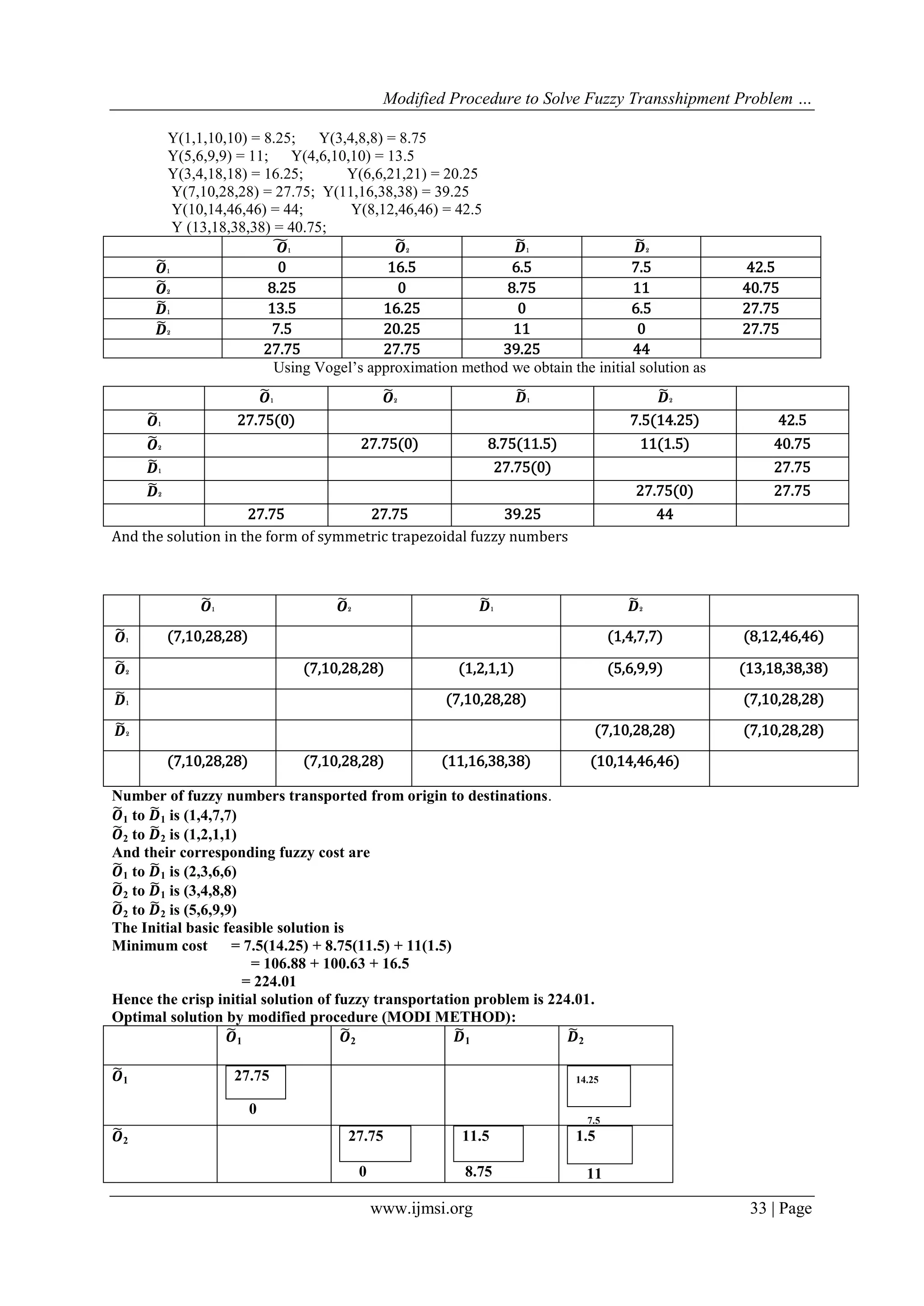
Y(1,1,10,10) = 8.25; Y(3,4,8,8) = 8.75
Y(5,6,9,9) = 11; Y(4,6,10,10) = 13.5
Y(3,4,18,18) = 16.25; Y(6,6,21,21) = 20.25
Y(7,10,28,28) = 27.75; Y(11,16,38,38) = 39.25
Y(10,14,46,46) = 44; Y(8,12,46,46) = 42.5
Y (13,18,38,38) = 40.75;
𝑶1 𝑶2 𝑫1 𝑫2
𝑶1 0 16.5 6.5 7.5 42.5
𝑶2 8.25 0 8.75 11 40.75
𝑫1 13.5 16.25 0 6.5 27.75
𝑫2 7.5 20.25 11 0 27.75
27.75 27.75 39.25 44
Using Vogel’s approximation method we obtain the initial solution as
And the solution in the form of symmetric trapezoidal fuzzy numbers
Number of fuzzy numbers transported from origin to destinations.
𝑶1 to 𝑫1 is (1,4,7,7)
𝑶2 to 𝑫2 is (1,2,1,1)
And their corresponding fuzzy cost are
𝑶1 to 𝑫1 is (2,3,6,6)
𝑶2 to 𝑫1 is (3,4,8,8)
𝑶2 to 𝑫2 is (5,6,9,9)
The Initial basic feasible solution is
Minimum cost = 7.5(14.25) + 8.75(11.5) + 11(1.5)
= 106.88 + 100.63 + 16.5
= 224.01
Hence the crisp initial solution of fuzzy transportation problem is 224.01.
Optimal solution by modified procedure (MODI METHOD):
𝑶1 𝑶2 𝑫1 𝑫2
𝑶1 27.75
0
14.25
7.5
𝑶2 27.75
0 8.75
11.5
11
1.5
𝑶1 𝑶2 𝑫1 𝑫2
𝑶1 (7,10,28,28) (1,4,7,7) (8,12,46,46)
𝑶2 (7,10,28,28) (1,2,1,1) (5,6,9,9) (13,18,38,38)
𝑫1 (7,10,28,28) (7,10,28,28)
𝑫2 (7,10,28,28) (7,10,28,28)
(7,10,28,28) (7,10,28,28) (11,16,38,38) (10,14,46,46)
𝑶1 𝑶2 𝑫1 𝑫2
𝑶1 27.75(0) 7.5(14.25) 42.5
𝑶2 27.75(0) 8.75(11.5) 11(1.5) 40.75
𝑫1 27.75(0) 27.75
𝑫2 27.75(0) 27.75
27.75 27.75 39.25 44
Modified Procedure to Solve Fuzzy Transshipment Problem …
www.ijmsi.org 34 | Page
𝑫1 27.75
0
𝑫2 27.75
0
For occupied cells, 𝒄𝒊𝒋 = 𝒖 𝒊+𝒗 𝒋
And Unoccupied cells:
Opportunity cost =𝒛𝒊𝒋 − 𝒄𝒊𝒋
𝒛𝒊𝒋 − 𝒄𝒊𝒋 = 𝑢𝑖+ 𝑣𝑗 -𝑐𝑖𝑗
𝑶1 𝑶2 𝑫1 𝑫2
𝑶1 27.75
0
16.5 6.5
14.25
7.5
𝑶2
8.25
27.75
0 8.75
11.5
11
1.5
𝑫1
13.5 16.25
27.75
0
6.5
𝑫2
7.5 20.25 11
27.75
0
Here all 𝒛𝒊𝒋 − 𝒄𝒊𝒋≤ 0, the solution obtained is optimum.
Hence optimum transshipment cost = 224.01
Conclusion: In this paper, the fuzzy transshipment problem has been converted into a crisp general
transportation problem using Yager’s ranking index. The cost at the origins and destinations are all symmetric
trapezoidal fuzzy numbers and the solution to the problem is given both as a fuzzy number and also as a ranked
fuzzy number. From MODI method we get the optimum solution.
REFERENCES:
[1.] Aneja, Y.P. and Nair, K.P.K.(1979): bi - criteria transportation problem, Management science, vol.25,pp.73-79.
[2.] Gani,A.N.,Baskaran, and Assarudeen Mohamed S.N.(2011): Transshipment problem in fuzzy environment, International journal
of Math Sci. &Engg. Applications, Vol.5,pp.57-74.
[3.] Garg,R.and Prakash, S.(1985): Time minimizing transshipment problem, Indian Journal of pure and Applied Mathematics,
Vol.16(5),pp.449-460.
[4.] Jat, R.N.,Sharma, S.C., Jain Sanjay, Choudhary Anchal (2014): Solving a fuzzy transportation problem using ranking approach,
International journal of Research in Mathematics & Computation, pp.39-45.
[5.] Kaufmann, A.,(1976): Introduction to the theory of fuzzy sets Academics press New York.
[6.] Orden,A.(1956): Transshipment problem, Management science, Vol. 3, pp.276-285.
[7.] Shore, H.H.,(1970): The transportation problem and the Vogel’s approximation method, Decision Sciences,Vol.1,pp.441-457.
[8.] Zadeh L.A.,(1965): Fuzzy sets, Information and Control, Vol.8,pp.338-353.
[9.] R.E. Bellman and L.A. Zadeh, decision making in a fuzzy environment, Management Science,17(1970).
[10.] A. Nagoor Gani and K.Abdul Razak, Solving transportation problem using fuzzy number, Bulletin of pure and Applied
Sciences,23E(2) (2004) 281-289.
[11.] D.G. Shimshak, J.A.Kaslik and T.D.Barclay, A modification of Vogel’s approximation method through the use of heuristics,
INFOR Journal 19(3) (1981) 259-263.
[12.] G.S. Ramakrishnan, An improvement to Goyal’s modified VAM for the unbalanced transportation problem, Journal of Operation
Research Society, 39(6) (1988) 609-610.
[13.] Operation Research by Kantiswarup, P.K. Gupta, Manmohan Eleventh Edition, Sultan Chand & Sons – New Delhi.
[14.] 14.Yager’s, R.R., (1981) : A procedure for ordering fuzzy subsets of the unit interval, Information Science, Vol.24,PP. 143- 161.

Modified Procedure to Solve Fuzzy Transshipment Problem by using Trapezoidal Fuzzy number.

  • 1.
    International Journal ofMathematics and Statistics Invention (IJMSI) E-ISSN: 2321 – 4767 P-ISSN: 2321 - 4759 www.ijmsi.org Volume 4 Issue 6 || August. 2016 || PP-30-34 www.ijmsi.org 30 | Page Modified Procedure to Solve Fuzzy Transshipment Problem by using Trapezoidal Fuzzy number. S. Mohanapriya1 , V. Jeyanthi 2 M.Sc., M. Phil., Ph.D., 1 Research Scholar, 2 Assistant Professor, Department of Mathematics Sree Narayana Guru College, K.G.Chavadi, Coimbatore- 641 105. Abstract: This paper deals with the large scale transshipment problem in Fuzzy Environment. Here we determine the efficient solutions for the large scale Fuzzy transshipment problem. Vogel’s approximation method (VAM) is a technique for finding the good initial feasible solution to allocation problem. Here Vogel’s Approximation Method (VAM) is used to find the efficient initial solution for the large scale transshipment problem. Keyword: Fuzzy transportation problem, Fuzzy transshipment problem, Vogel’s approximation method, MODI method. AMS Mathematics Subject Classification (2010): 03E72 I. Introduction The transportation model is a special class of the linear programming problem. It deals with the situation in which a commodity is shipped from sources to destinations and their capacities are a1,a2,…,am and b1,b2,…,bn respectively. The objective is to determine the amount shipped from each source to each destination that minimizes the total shipped cost while satisfying both the supply limits and the demand requirements. Orden [6] has extended transportation problem to include the case when transshipment is also allowed. A transportation problem allows only shipment that go directly from a supply point to a demand point. In much situation shipment are allowed between supply point or between demand point. Sometimes there may also be point through which goods can be transshipment on their journey from a supply point to a demand point. Shipping problem with any or all of these characteristics are transshipment problems. Fortunately, the optimal solution to a transshipment problem can be found by solving a transportation problem. In what follows we define a supply point to be a point that can send goods to another point but cannot receive goods from any other point. Similarly, a demand point is a point that can be receive goods from other points but cannot send goods to any other point. A transshipment point is a point that can both receive goods from other points and send goods to other points. Garg.R. et al [3] studied the concept of time minimization in transshipment problem. The concept of Fuzzy set was first introduced and investigated by zadeh [8] and Fuzzy number and arithmetic’s operations with these numbers introduced by Bellman [9] & zadeh [8] and Kaufmann in [5]. In [2,10] Nagoor Gani et al. solved transportation problem using fuzzy number. In this paper ranking of fuzzy trapezoidal number used by Yager’s[14] ranking method to transform fuzzy transshipment problem to crisp one. The Vogel’s approximation method is used to find out the initial basic feasible solution in crisp form. Further, we applied modify procedure to get the optimal solution in crisp form. 2. Preliminaries 2.1 Fuzzy set: A Fuzzy à is defined by à ={ (x, µA(x)): x∊A, µA(x)∊⦋0,1⦌}. In the pair (x,µA(x)),the first elements x belongs to the classical set A, the second element µA(x),belongs to the interval⦋0,1⦌, called membership function. 2.2 Fuzzy number: A fuzzy set à on R must possess at least the following three properties to qualify as a fuzzy number, i. 𝐴 must be a normal fuzzy set; ii. ⍺ 𝐴 must be closed interval for every 𝛼 ∈[0,1]; iii. the support of 𝐴, 0+ 𝐴,must be bounded. 2.3. Trapezoidal Fuzzy Number: A fuzzy number 𝐴 is a trapezoidal fuzzy number by 𝐴 = (a1, a2, a3 a4) are the membership function 𝜇Ã(𝑋)is givenbelow
  • 2.
    Modified Procedure toSolve Fuzzy Transshipment Problem … www.ijmsi.org 31 | Page 𝜇Ã 𝑋 = 𝑥−a1 𝑎2−𝑎1 , 𝑎1 ≤ 𝑋 ≤ 𝑎2 1, 𝑎2 ≤ 𝑋 ≤ 𝑎3 𝑎4−𝑥 𝑎4−𝑎3 , 𝑎3 ≤ 𝑋 ≤ 𝑎4 0, 𝑜𝑡ℎ𝑒𝑟𝑤𝑖𝑠𝑒. 2.4. Function Principal operation of trapezoidal fuzzy number: The following are the operations that can be performed on rectangular fuzzy number; Let 𝐴= (a1,a2,a3,a4) and (b1,b2,b3,b4) then, i. Addition: Ã+𝑩= (a 1 + b 1, a 2 + b 2, a 3 + b 3 ,a 4 + b 4 ) ii. Subtraction: Ã-𝑩= (a 1 - b 1, a 2 - b 2, a 3 - b 3 , a 4 - b 4 ) iii. Multiplication: Ã*𝑩 = (min(a1b1,a1b3,a3b1,a3b3 a4b4,a1b4,a4b1), a2,b2, max(a1b1,a1b3,a3b1,a3b3 a4b4,a1b4,a4b1)) 2.5.∝ −𝒍𝒆𝒗𝒆𝒍 𝒔𝒆𝒕: The ∝ −𝒍𝒆𝒗𝒆𝒍 𝒔𝒆𝒕 of the fuzzy number 𝒂 and 𝒃 is defined as the ordinary set 𝐿 𝛼 (ã,𝑏)for which their degree of their membership function exceed the level 𝛼∊[0,1]. 𝐿 𝛼 (ã,𝑏)={a,b∈ 𝑹 𝒎 | 𝜇ã(𝑎𝑖, 𝑏𝑗 ) ≥ ⍺, 𝑖 = 1,2, … , 𝑚, 𝑗 = 1,2, …,n} 2.6. General Transshipment Problem: A transportation problem in which available commodity frequently moves from one sources to another sources are destination before reaching its actual destination is called transshipment problem such a problem cannot be solved as such by the usual transportation algorithm but slight modification is required before applying it to the transshipment problem following are the chief characteristics of the transshipment problems. a) The numbers of source and destination in the transportation problem are m and n respectively. In transshipment study, however we have m+n sources and destination. b) If Si denotes the ith sources and Dj denotes the jth destination then the commodity can moves along the route Si →Di →Dj , Si →Di →Dj , Si →Di → Si →Dj or in various in other ways. Clearly, transportation cost from Si to Si is zero and the transportation cost from Si to Sj or Si to Di do not have the symmetrical i.e. in general Si → Sj ≠ Si → Si . c) In solving the transshipment problem we first find the optimum solution to the transportation problem, and then proceed in the same fashion as in solving the transportation problem. d) The basic feasible solution 2m+2n-1 basic variable if we omit the variable appearing in the m+n diagonal cells, we are left with m+n-1 basic variables. 2.7. Formulation of the fuzzy transshipment problem [4]: The fuzzy transshipment problem assume that direct route exist from the each sources to each destination. However there are situation in which units may be shipped from one of the sources to other or to other destination before reaching their final destination. This is called a fuzzy transshipment problem. The purpose of the fuzzy transshipment problem with the distinction between a sources and destination is dropped so that the transportation problem with m sources and n destination gives rise to transshipment problem with m+n sources m+n destination. The basic feasible solution to which the problem will involve [(m+n)+(m+n)-1] or 2m+2n-1 basic variables and if we omit the variable appearing in the (m+n) diagonal cells, we are left with m+n-1 basic variables. Thus fuzzy transshipment problem may be written as: Minimize 𝑧=∑i=1 m+n ∑j=1,j≠i m+n 𝑐ij 𝑥ij Subject to ∑j=1,j≠i m+n 𝑥ij-∑j=1,j≠i m+n 𝑥ij =𝑎i, i=1,2,3,…..., ∑j=1,j≠i m+n 𝑥ij-∑j=1,j≠i m+n 𝑥ij =𝑏j, j=m+1,m+2,m+3,m+……..m+n where 𝑥ij ≥0,i,j=1,2,3……m+n, j≠I and ∑i=1, m 𝑎j =∑j=1, m =𝑏j, then the problem is balanced otherwise unbalanced. The above formulation is a fuzzy transshipment model, the transshipment model reduced to transportation form as: Minimize 𝑧=∑i=1 m+n ∑j=1,j≠i m+n 𝑐ij 𝑥ij Subject to ∑j=1 m+n 𝑥ij = 𝑎i +T, i=1,2,3,……,m ∑j=1, m+n 𝑥ij = T, I = m+1,m+2,m+3,m+……..m+n ∑i=1, m+n 𝑥ij = T, j = 1,2,3,……m ∑j=1, m+n 𝑥ij = 𝑏j + T, j = m+1,m+2,m+3,……m+n Where 𝑥ij ≥ 0, i,j = 1,2,3……m+n , j≠i The above mathematical model represents standard transportation problem with (m+n) origin and m+n destination T can be interpreted as a buffer stock at each origin and destination since we assume that any amount goods can be transshipped at each point, T should be large enough to take care of all transshipment. It is clear
  • 3.
    Modified Procedure toSolve Fuzzy Transshipment Problem … www.ijmsi.org 32 | Page that volume of goods transshipped at any point cannot exist the amount produced or received and hence we take T = 𝑎𝑖 𝑚 𝑖=1 or 𝑏𝑗 𝑚 𝑖=1 3. Algorithm [11,12]: The transshipment table in fuzzy environment is look like fuzzy transportation table. Now we can solve the fuzzy transshipment problem using fuzzy Vogel’s approximation method. This proposed method in algorithm form for finding the optimal basic feasible solution in symmetry trapezoidal fuzzy environment and step by step procedure as follows: 1. First transform the transshipment problem into standard transportation problem. 2. Calculate Yager’s ranking index for each cell of transportation table. 3. Replace symmetric trapezoidal number by their respective ranking indices. 4. Solve the resulting transportation problem by using existing Vogel’s method to find the optimal solution. The all step by step procedure is explained in next section of numerical example. 4. Numerical example: Here we consider the transshipment problem with two origins and two destinations Convert the given fuzzy problem into a crisp value problem by using the measure Y(a1,a2,a3,a4) = 0∫1 0.5(a⍺1, a⍺2, a⍺u)d⍺ a⍺1= (a2-a1) ⍺+ a1 a⍺2= (a3-a2) ⍺+ a2 a⍺u=(a4-a3) ⍺+ a4 Y(2,5,18,18) = 0∫1 0.5(3⍺+2, 13⍺+5, 18)d⍺ = 0.50∫1 (16⍺,+25)d⍺ = 0.5[8+25] = 33(0.5) = 16.5 Similarly, we get the following: Y(2,3,6,6) = 6.5; Y(1,4,7,7) = 7.5 𝑫1 𝑫2 Õ1 (2,3,6,6) (1,4,7,7) (1,2,18,18) Õ2 (3,4,8,8) (5,6,9,9) (6,8,10,10) (4,6,10,10) (3,4,18,18) (7,10,28,28) 𝑫1 𝑫2 𝑫1 (0,0,0,0) (2,3,6,6) 𝑫2 (5,6,9,9) (0,0,0,0) Õ1 Õ2 Õ1 (0,0,0,0) (2,5,18,18) Õ2 (1,1,10,10) (0,0,0,0) 𝒐1 𝒐2 𝑫1 𝑫2 𝒐1 (0,0,0,0) (2,5,18,18) (2,3,6.6) (1,4,7,7) (8,12,46,46) 𝒐2 (1,1,10,10) (0,0,0,0) (3,4,8,8) (5,6,9,9) (13,18,3838) 𝑫1 (4,6,10,10) (3,4,18,18) (0,0,0,0) (2,3,6,6) (7,10,28,28) 𝑫2 (1,4,7,7) (6,6,21,21) (5,6,9,9) (0,0,0,0) (7,10,28,28) (7,10,28,28) (7,10,28,28) (11,16,38,38) (10,14,46,46) 𝟎1 𝑶2 𝑫1 (4,6,10,10) (3,4,18,18) 𝑫2 (1,4,7,7) (6,6,21,21)
  • 4.
    Modified Procedure toSolve Fuzzy Transshipment Problem … www.ijmsi.org 33 | Page Y(1,1,10,10) = 8.25; Y(3,4,8,8) = 8.75 Y(5,6,9,9) = 11; Y(4,6,10,10) = 13.5 Y(3,4,18,18) = 16.25; Y(6,6,21,21) = 20.25 Y(7,10,28,28) = 27.75; Y(11,16,38,38) = 39.25 Y(10,14,46,46) = 44; Y(8,12,46,46) = 42.5 Y (13,18,38,38) = 40.75; 𝑶1 𝑶2 𝑫1 𝑫2 𝑶1 0 16.5 6.5 7.5 42.5 𝑶2 8.25 0 8.75 11 40.75 𝑫1 13.5 16.25 0 6.5 27.75 𝑫2 7.5 20.25 11 0 27.75 27.75 27.75 39.25 44 Using Vogel’s approximation method we obtain the initial solution as And the solution in the form of symmetric trapezoidal fuzzy numbers Number of fuzzy numbers transported from origin to destinations. 𝑶1 to 𝑫1 is (1,4,7,7) 𝑶2 to 𝑫2 is (1,2,1,1) And their corresponding fuzzy cost are 𝑶1 to 𝑫1 is (2,3,6,6) 𝑶2 to 𝑫1 is (3,4,8,8) 𝑶2 to 𝑫2 is (5,6,9,9) The Initial basic feasible solution is Minimum cost = 7.5(14.25) + 8.75(11.5) + 11(1.5) = 106.88 + 100.63 + 16.5 = 224.01 Hence the crisp initial solution of fuzzy transportation problem is 224.01. Optimal solution by modified procedure (MODI METHOD): 𝑶1 𝑶2 𝑫1 𝑫2 𝑶1 27.75 0 14.25 7.5 𝑶2 27.75 0 8.75 11.5 11 1.5 𝑶1 𝑶2 𝑫1 𝑫2 𝑶1 (7,10,28,28) (1,4,7,7) (8,12,46,46) 𝑶2 (7,10,28,28) (1,2,1,1) (5,6,9,9) (13,18,38,38) 𝑫1 (7,10,28,28) (7,10,28,28) 𝑫2 (7,10,28,28) (7,10,28,28) (7,10,28,28) (7,10,28,28) (11,16,38,38) (10,14,46,46) 𝑶1 𝑶2 𝑫1 𝑫2 𝑶1 27.75(0) 7.5(14.25) 42.5 𝑶2 27.75(0) 8.75(11.5) 11(1.5) 40.75 𝑫1 27.75(0) 27.75 𝑫2 27.75(0) 27.75 27.75 27.75 39.25 44
  • 5.
    Modified Procedure toSolve Fuzzy Transshipment Problem … www.ijmsi.org 34 | Page 𝑫1 27.75 0 𝑫2 27.75 0 For occupied cells, 𝒄𝒊𝒋 = 𝒖 𝒊+𝒗 𝒋 And Unoccupied cells: Opportunity cost =𝒛𝒊𝒋 − 𝒄𝒊𝒋 𝒛𝒊𝒋 − 𝒄𝒊𝒋 = 𝑢𝑖+ 𝑣𝑗 -𝑐𝑖𝑗 𝑶1 𝑶2 𝑫1 𝑫2 𝑶1 27.75 0 16.5 6.5 14.25 7.5 𝑶2 8.25 27.75 0 8.75 11.5 11 1.5 𝑫1 13.5 16.25 27.75 0 6.5 𝑫2 7.5 20.25 11 27.75 0 Here all 𝒛𝒊𝒋 − 𝒄𝒊𝒋≤ 0, the solution obtained is optimum. Hence optimum transshipment cost = 224.01 Conclusion: In this paper, the fuzzy transshipment problem has been converted into a crisp general transportation problem using Yager’s ranking index. The cost at the origins and destinations are all symmetric trapezoidal fuzzy numbers and the solution to the problem is given both as a fuzzy number and also as a ranked fuzzy number. From MODI method we get the optimum solution. REFERENCES: [1.] Aneja, Y.P. and Nair, K.P.K.(1979): bi - criteria transportation problem, Management science, vol.25,pp.73-79. [2.] Gani,A.N.,Baskaran, and Assarudeen Mohamed S.N.(2011): Transshipment problem in fuzzy environment, International journal of Math Sci. &Engg. Applications, Vol.5,pp.57-74. [3.] Garg,R.and Prakash, S.(1985): Time minimizing transshipment problem, Indian Journal of pure and Applied Mathematics, Vol.16(5),pp.449-460. [4.] Jat, R.N.,Sharma, S.C., Jain Sanjay, Choudhary Anchal (2014): Solving a fuzzy transportation problem using ranking approach, International journal of Research in Mathematics & Computation, pp.39-45. [5.] Kaufmann, A.,(1976): Introduction to the theory of fuzzy sets Academics press New York. [6.] Orden,A.(1956): Transshipment problem, Management science, Vol. 3, pp.276-285. [7.] Shore, H.H.,(1970): The transportation problem and the Vogel’s approximation method, Decision Sciences,Vol.1,pp.441-457. [8.] Zadeh L.A.,(1965): Fuzzy sets, Information and Control, Vol.8,pp.338-353. [9.] R.E. Bellman and L.A. Zadeh, decision making in a fuzzy environment, Management Science,17(1970). [10.] A. Nagoor Gani and K.Abdul Razak, Solving transportation problem using fuzzy number, Bulletin of pure and Applied Sciences,23E(2) (2004) 281-289. [11.] D.G. Shimshak, J.A.Kaslik and T.D.Barclay, A modification of Vogel’s approximation method through the use of heuristics, INFOR Journal 19(3) (1981) 259-263. [12.] G.S. Ramakrishnan, An improvement to Goyal’s modified VAM for the unbalanced transportation problem, Journal of Operation Research Society, 39(6) (1988) 609-610. [13.] Operation Research by Kantiswarup, P.K. Gupta, Manmohan Eleventh Edition, Sultan Chand & Sons – New Delhi. [14.] 14.Yager’s, R.R., (1981) : A procedure for ordering fuzzy subsets of the unit interval, Information Science, Vol.24,PP. 143- 161.