Streptococcus anginosus  group ( Streptococcus milleri )
Streptococcus milleri was  first used to describe a nonhemolytic  Streptococcus species found in oral infections  in 1956.  “ Milleri” was given to the species in honor of W. D. Miller , a famous oral microbiologist and graduate of the dental school at the University of Pennsylvania. Streptococcus anginosus Group: Clinical Significance of an  Important  Group of Pathogens.   Clinical Microbiology Newsletter 2005. Toby Gray, M.D., Department of Pathology,  Virginia Commonwealth University, Medical College of Virginia Campus,Richmond, Virginia
In 1989, it was proposed in the United States to rename under one species name,  Streptococcus anginosus. In Great Britain the designation  S. milleri was preferred . Streptococcus anginosus Group: Clinical Significance of an  Important  Group of Pathogens.   Clinical Microbiology Newsletter 2005. Toby Gray, M.D., Department of Pathology,  Virginia Commonwealth University, Medical College of Virginia Campus,Richmond, Virginia
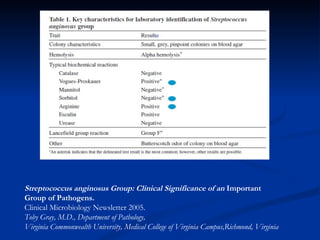
may be β-hemolytic, α-hemolytic, or γ-hemolytic on sheep blood agar S. anginosus group  bacteria are considered to belong to Lancefield group F.  Studies have reported  S. anginosus group strains  presenting with Lancefield group antigens A, C, and G, or even no Lancefield antigen at all. Streptococcus anginosus Group: Clinical Significance of an  Important  Group of Pathogens.   Clinical Microbiology Newsletter 2005. Toby Gray, M.D., Department of Pathology,  Virginia Commonwealth University, Medical College of Virginia Campus,Richmond, Virginia
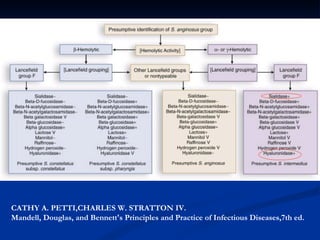
Streptococcus anginosus  Group Streptococcus intermedius   Streptococcus constellatus   S. constellatu s subsp.  constellatus  S. constellatus  subsp.  pharyngis Streptococcus anginosus CATHY A. PETTI,CHARLES W. STRATTON IV. Mandell, Douglas, and Bennett's Principles and Practice of Infectious Diseases,7th ed.
Streptococcus anginosus  Group commensals of the oropharyngeal ( S. intermedius) commensals of  respiratory tract  ( S. intermedius)   gastrointestinal microbiota ( S. anginosus) commensals of urogenital( S. anginosus) CATHY A. PETTI,CHARLES W. STRATTON IV. Mandell, Douglas, and Bennett's Principles and Practice of Infectious Diseases,7th ed.
Streptococcus anginosus  Group microaerophilic or anaerobic growth  environment minute colonies  presence of a characteristic caramel-like odor ( production of a diacetyl metabolite) differentiated from other streptococci by a combination of three rapid test a positive Voges-Proskauer test for acetoin production hydrolysis of arginine failure to ferment sorbitol CATHY A. PETTI,CHARLES W. STRATTON IV. Mandell, Douglas, and Bennett's Principles and Practice of Infectious Diseases,7th ed.
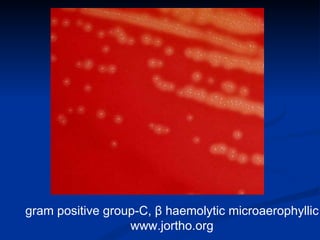
gram positive group - C,  β  haemolytic microaerophyllic www.jortho . org
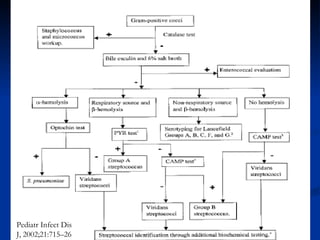
Pediatr Infect Dis J, 2002;21:715–26
CATHY A. PETTI,CHARLES W. STRATTON IV. Mandell, Douglas, and Bennett's Principles and Practice of Infectious Diseases,7th ed.
Streptococcus anginosus Group: Clinical Significance of an  Important  Group of Pathogens.   Clinical Microbiology Newsletter 2005. Toby Gray, M.D., Department of Pathology,  Virginia Commonwealth University, Medical College of Virginia Campus,Richmond, Virginia
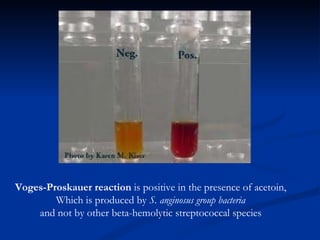
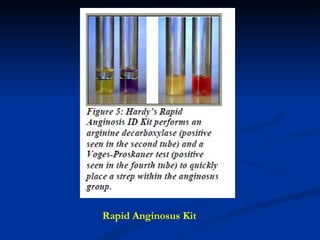
Voges - Proskauer reaction  is positive in the presence of acetoin, Which is produced by  S. anginosus group bacteria and not by other beta-hemolytic streptococcal species
Rapid Anginosus Kit
Identification of  S.anginosus  group PCR assays : ribosomal RNA to identify  S. anginosus species  Genes  for D-ala:D-ala ligases to identify viridans streptococci as belonging to the  S. anginosus  group  Streptococcus anginosus Group: Clinical Significance of an  Important  Group of Pathogens.   Clinical Microbiology Newsletter 2005. Toby Gray, M.D., Department of Pathology,  Virginia Commonwealth University, Medical College of Virginia Campus,Richmond, Virginia
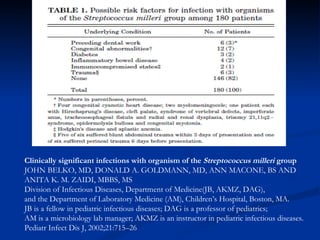
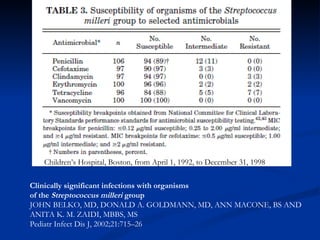
Clinically significant infections with organism of the  Streptococcus milleri  group JOHN BELKO, MD, DONALD A. GOLDMANN, MD, ANN MACONE, BS AND  ANITA K. M. ZAIDI, MBBS, MS Division of Infectious Diseases, Department of Medicine(JB, AKMZ, DAG),  and the Department of Laboratory Medicine (AM), Children’s Hospital, Boston, MA. JB is a fellow in pediatric infectious diseases; DAG is a professor of pediatrics;  AM is a microbiology lab manager; AKMZ is an instructor in pediatric infectious diseases. Pediatr Infect Dis J, 2002;21:715–26
Previous surgery or trauma History of diabetes Immunodeficiency are at a higher risk for infections involving these organisms Streptococcus anginosus Group: Clinical Significance of an  Important  Group of Pathogens.   Clinical Microbiology Newsletter 2005. Toby Gray, M.D., Department of Pathology,  Virginia Commonwealth University, Medical College of Virginia Campus,Richmond, Virginia
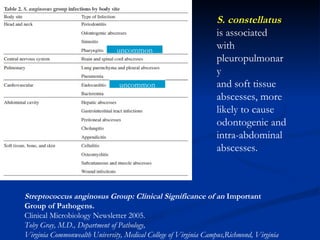
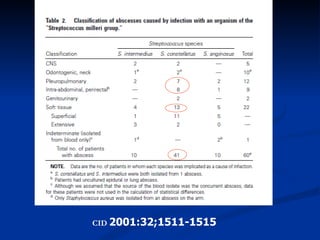
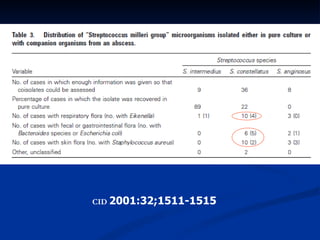
S. constellatus is associated with pleuropulmonary and soft tissue abscesses, more likely to cause odontogenic and intra-abdominal abscesses. Streptococcus anginosus Group: Clinical Significance of an  Important  Group of Pathogens.   Clinical Microbiology Newsletter 2005. Toby Gray, M.D., Department of Pathology,  Virginia Commonwealth University, Medical College of Virginia Campus,Richmond, Virginia uncommon uncommon
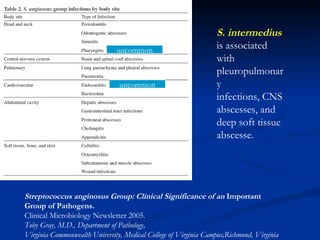
S. intermedius is associated with pleuropulmonary infections, CNS abscesses, and deep soft tissue abscesse. Streptococcus anginosus Group: Clinical Significance of an  Important  Group of Pathogens.   Clinical Microbiology Newsletter 2005. Toby Gray, M.D., Department of Pathology,  Virginia Commonwealth University, Medical College of Virginia Campus,Richmond, Virginia uncommon uncommon
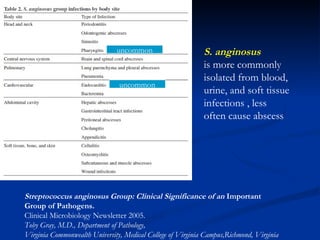
S. anginosus is more commonly isolated from blood, urine, and soft tissue infections , less often cause abscess Streptococcus anginosus Group: Clinical Significance of an  Important  Group of Pathogens.   Clinical Microbiology Newsletter 2005. Toby Gray, M.D., Department of Pathology,  Virginia Commonwealth University, Medical College of Virginia Campus,Richmond, Virginia uncommon uncommon
Pathophysiology of Infection All members of the  S. anginosus  group are able to bind fibronectin via a cell surface protein— promote attachment to tissue S. anginosus   is  able to bind to platelets, fibrin, fibrin clots, and fibrinogen ,  factor in the ability of these pathogens to cause endocarditis. 1. Mandell, Douglas, and Bennett's Principles and Practice of Infectious Diseases,7th ed. 2.Clinical Microbiology Newsletter 2005.
Pathophysiology of Infection A bility of  S. intermedius  to form a polysaccharide capsule that aids in prevention of phagocytosis  P roduction of pyrogeni c  exotoxins ,   intermedilysin ,  is essential for the invasion of human hepatic cells---  cause liver abscess ( S. intermedius) 1. Mandell, Douglas, and Bennett's Principles and Practice of Infectious Diseases,7th ed. 2.Clinical Microbiology Newsletter 2005.
Pathophysiology of Infection Produc tion of  h ydrolytic enzymes :  hyaluronidase,deoxyribonuclease, chondroitin sulfatase, role in microbial nutrition, and assist in liquefaction of pus Production of an acidic environment in abscesses by other bacteria  enhances growth of  S. anginosus  group bacteria in mixed culture . S. anginosus  group bacteria have the means to  inhibit their lysis within neutrophils . 1. Mandell, Douglas, and Bennett's Principles and Practice of Infectious Diseases,7th ed. 2.Clinical Microbiology Newsletter 2005.
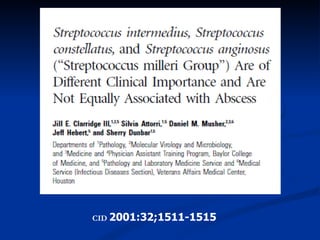
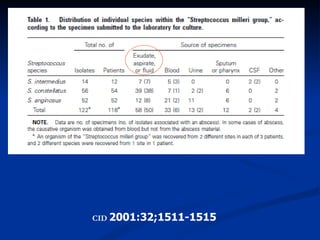
CID  2001:32 ;1511-1515
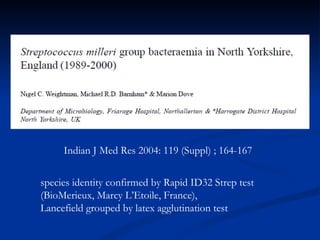
Indian J Med Res 2004 :  119 (Suppl)  ;  164-167 species identity confirmed by Rapid ID32 Strep test  (BioMerieux, Marcy L’Etoile, France), Lancefield grouped by latex agglutination test
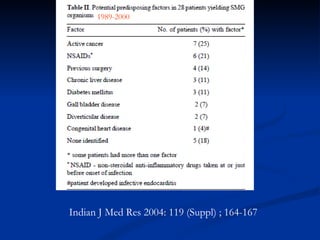
1989-2000 Indian J Med Res 2004 :  119 (Suppl)  ;  164-167
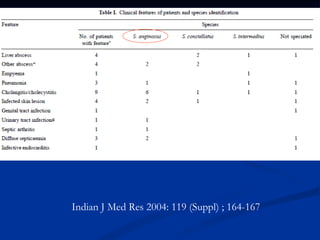
Indian J Med Res 2004 :  119 (Suppl)  ;  164-167
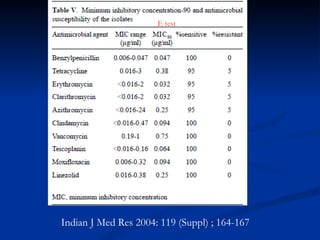
Indian J Med Res 2004 :  119 (Suppl)  ;  164-167 E   test
Clinically significant infections with organisms of the  Streptococcus milleri  group JOHN BELKO, MD, DONALD A. GOLDMANN, MD, ANN MACONE, BS AND  ANITA K. M. ZAIDI, MBBS, MS Pediatr Infect Dis J, 2002;21:715–26 Children’s Hospital, Boston, from April 1, 1992, to December 31, 1998
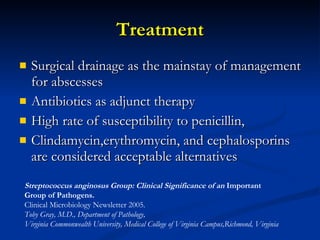
Treatment Surgical drainage as the mainstay of management for abscesses Antibiotics as adjunct therapy High rate of susceptibility to penicillin,  Clindamycin,erythromycin, and cephalosporins are considered acceptable alternatives Streptococcus anginosus Group: Clinical Significance of an  Important  Group of Pathogens.   Clinical Microbiology Newsletter 2005. Toby Gray, M.D., Department of Pathology,  Virginia Commonwealth University, Medical College of Virginia Campus,Richmond, Virginia
thank you.
Streptococcus constellatus

Streptococcus constellatus

  • 1.
    Streptococcus anginosus group ( Streptococcus milleri )
  • 2.
    Streptococcus milleri was first used to describe a nonhemolytic Streptococcus species found in oral infections in 1956. “ Milleri” was given to the species in honor of W. D. Miller , a famous oral microbiologist and graduate of the dental school at the University of Pennsylvania. Streptococcus anginosus Group: Clinical Significance of an Important Group of Pathogens. Clinical Microbiology Newsletter 2005. Toby Gray, M.D., Department of Pathology, Virginia Commonwealth University, Medical College of Virginia Campus,Richmond, Virginia
  • 3.
    In 1989, itwas proposed in the United States to rename under one species name, Streptococcus anginosus. In Great Britain the designation S. milleri was preferred . Streptococcus anginosus Group: Clinical Significance of an Important Group of Pathogens. Clinical Microbiology Newsletter 2005. Toby Gray, M.D., Department of Pathology, Virginia Commonwealth University, Medical College of Virginia Campus,Richmond, Virginia
  • 4.
    may be β-hemolytic,α-hemolytic, or γ-hemolytic on sheep blood agar S. anginosus group bacteria are considered to belong to Lancefield group F. Studies have reported S. anginosus group strains presenting with Lancefield group antigens A, C, and G, or even no Lancefield antigen at all. Streptococcus anginosus Group: Clinical Significance of an Important Group of Pathogens. Clinical Microbiology Newsletter 2005. Toby Gray, M.D., Department of Pathology, Virginia Commonwealth University, Medical College of Virginia Campus,Richmond, Virginia
  • 5.
    Streptococcus anginosus Group Streptococcus intermedius Streptococcus constellatus S. constellatu s subsp. constellatus S. constellatus subsp. pharyngis Streptococcus anginosus CATHY A. PETTI,CHARLES W. STRATTON IV. Mandell, Douglas, and Bennett's Principles and Practice of Infectious Diseases,7th ed.
  • 6.
    Streptococcus anginosus Group commensals of the oropharyngeal ( S. intermedius) commensals of respiratory tract ( S. intermedius) gastrointestinal microbiota ( S. anginosus) commensals of urogenital( S. anginosus) CATHY A. PETTI,CHARLES W. STRATTON IV. Mandell, Douglas, and Bennett's Principles and Practice of Infectious Diseases,7th ed.
  • 7.
    Streptococcus anginosus Group microaerophilic or anaerobic growth environment minute colonies presence of a characteristic caramel-like odor ( production of a diacetyl metabolite) differentiated from other streptococci by a combination of three rapid test a positive Voges-Proskauer test for acetoin production hydrolysis of arginine failure to ferment sorbitol CATHY A. PETTI,CHARLES W. STRATTON IV. Mandell, Douglas, and Bennett's Principles and Practice of Infectious Diseases,7th ed.
  • 8.
    gram positive group- C, β haemolytic microaerophyllic www.jortho . org
  • 9.
    Pediatr Infect DisJ, 2002;21:715–26
  • 10.
    CATHY A. PETTI,CHARLESW. STRATTON IV. Mandell, Douglas, and Bennett's Principles and Practice of Infectious Diseases,7th ed.
  • 11.
    Streptococcus anginosus Group:Clinical Significance of an Important Group of Pathogens. Clinical Microbiology Newsletter 2005. Toby Gray, M.D., Department of Pathology, Virginia Commonwealth University, Medical College of Virginia Campus,Richmond, Virginia
  • 12.
    Voges - Proskauerreaction is positive in the presence of acetoin, Which is produced by S. anginosus group bacteria and not by other beta-hemolytic streptococcal species
  • 13.
  • 14.
    Identification of S.anginosus group PCR assays : ribosomal RNA to identify S. anginosus species Genes for D-ala:D-ala ligases to identify viridans streptococci as belonging to the S. anginosus group Streptococcus anginosus Group: Clinical Significance of an Important Group of Pathogens. Clinical Microbiology Newsletter 2005. Toby Gray, M.D., Department of Pathology, Virginia Commonwealth University, Medical College of Virginia Campus,Richmond, Virginia
  • 15.
    Clinically significant infectionswith organism of the Streptococcus milleri group JOHN BELKO, MD, DONALD A. GOLDMANN, MD, ANN MACONE, BS AND ANITA K. M. ZAIDI, MBBS, MS Division of Infectious Diseases, Department of Medicine(JB, AKMZ, DAG), and the Department of Laboratory Medicine (AM), Children’s Hospital, Boston, MA. JB is a fellow in pediatric infectious diseases; DAG is a professor of pediatrics; AM is a microbiology lab manager; AKMZ is an instructor in pediatric infectious diseases. Pediatr Infect Dis J, 2002;21:715–26
  • 16.
    Previous surgery ortrauma History of diabetes Immunodeficiency are at a higher risk for infections involving these organisms Streptococcus anginosus Group: Clinical Significance of an Important Group of Pathogens. Clinical Microbiology Newsletter 2005. Toby Gray, M.D., Department of Pathology, Virginia Commonwealth University, Medical College of Virginia Campus,Richmond, Virginia
  • 17.
    S. constellatus isassociated with pleuropulmonary and soft tissue abscesses, more likely to cause odontogenic and intra-abdominal abscesses. Streptococcus anginosus Group: Clinical Significance of an Important Group of Pathogens. Clinical Microbiology Newsletter 2005. Toby Gray, M.D., Department of Pathology, Virginia Commonwealth University, Medical College of Virginia Campus,Richmond, Virginia uncommon uncommon
  • 18.
    S. intermedius isassociated with pleuropulmonary infections, CNS abscesses, and deep soft tissue abscesse. Streptococcus anginosus Group: Clinical Significance of an Important Group of Pathogens. Clinical Microbiology Newsletter 2005. Toby Gray, M.D., Department of Pathology, Virginia Commonwealth University, Medical College of Virginia Campus,Richmond, Virginia uncommon uncommon
  • 19.
    S. anginosus ismore commonly isolated from blood, urine, and soft tissue infections , less often cause abscess Streptococcus anginosus Group: Clinical Significance of an Important Group of Pathogens. Clinical Microbiology Newsletter 2005. Toby Gray, M.D., Department of Pathology, Virginia Commonwealth University, Medical College of Virginia Campus,Richmond, Virginia uncommon uncommon
  • 20.
    Pathophysiology of InfectionAll members of the S. anginosus group are able to bind fibronectin via a cell surface protein— promote attachment to tissue S. anginosus is able to bind to platelets, fibrin, fibrin clots, and fibrinogen , factor in the ability of these pathogens to cause endocarditis. 1. Mandell, Douglas, and Bennett's Principles and Practice of Infectious Diseases,7th ed. 2.Clinical Microbiology Newsletter 2005.
  • 21.
    Pathophysiology of InfectionA bility of S. intermedius to form a polysaccharide capsule that aids in prevention of phagocytosis P roduction of pyrogeni c exotoxins , intermedilysin , is essential for the invasion of human hepatic cells--- cause liver abscess ( S. intermedius) 1. Mandell, Douglas, and Bennett's Principles and Practice of Infectious Diseases,7th ed. 2.Clinical Microbiology Newsletter 2005.
  • 22.
    Pathophysiology of InfectionProduc tion of h ydrolytic enzymes : hyaluronidase,deoxyribonuclease, chondroitin sulfatase, role in microbial nutrition, and assist in liquefaction of pus Production of an acidic environment in abscesses by other bacteria enhances growth of S. anginosus group bacteria in mixed culture . S. anginosus group bacteria have the means to inhibit their lysis within neutrophils . 1. Mandell, Douglas, and Bennett's Principles and Practice of Infectious Diseases,7th ed. 2.Clinical Microbiology Newsletter 2005.
  • 23.
    CID 2001:32;1511-1515
  • 24.
    CID 2001:32;1511-1515
  • 25.
    CID 2001:32;1511-1515
  • 26.
    CID 2001:32;1511-1515
  • 27.
    Indian J MedRes 2004 : 119 (Suppl) ; 164-167 species identity confirmed by Rapid ID32 Strep test (BioMerieux, Marcy L’Etoile, France), Lancefield grouped by latex agglutination test
  • 28.
    1989-2000 Indian JMed Res 2004 : 119 (Suppl) ; 164-167
  • 29.
    Indian J MedRes 2004 : 119 (Suppl) ; 164-167
  • 30.
    Indian J MedRes 2004 : 119 (Suppl) ; 164-167 E test
  • 31.
    Clinically significant infectionswith organisms of the Streptococcus milleri group JOHN BELKO, MD, DONALD A. GOLDMANN, MD, ANN MACONE, BS AND ANITA K. M. ZAIDI, MBBS, MS Pediatr Infect Dis J, 2002;21:715–26 Children’s Hospital, Boston, from April 1, 1992, to December 31, 1998
  • 32.
    Treatment Surgical drainageas the mainstay of management for abscesses Antibiotics as adjunct therapy High rate of susceptibility to penicillin, Clindamycin,erythromycin, and cephalosporins are considered acceptable alternatives Streptococcus anginosus Group: Clinical Significance of an Important Group of Pathogens. Clinical Microbiology Newsletter 2005. Toby Gray, M.D., Department of Pathology, Virginia Commonwealth University, Medical College of Virginia Campus,Richmond, Virginia
  • 33.
  • 34.