Unit and Measurement Topic 1
Lecture Outline Basic units and quantity Unit conversion Unit analysis
Physics and measurement Physics attempts to describe nature in an objective way through measurement Measurement are expressed in units; Officially accepted unit are called standard unit Major systems of unit: Metric cgs system – centimeter, gram, second British (used by the U.S.) – feet, pound, second
Basic units and quantity Length, mass and time are the fundamental quantities; combination of them will form all the other unit. Today the most important system is the  Syst ème International (SI), which also based on the metric system – meter, kilogram and second
Length SI unit of length: meter (m) The original definition: one ten-millionth of the distance from the earth equator to either pole The newest definition: ‘The meter is the length of path traveled by light in vacuum during time interval of 1/299,792,458 of a second’
Time SI unit of Time: second (s) The original definition: one second is define as 1/86,400 of a mean solar day (24h/day × 60min/h × 60s/min = 86,400s/day) The newest definition: Time required for 9,192,631,770 periods of radiation emitted by cesium atoms
Mass SI unit of mass: kilogram (kg) The original definition: one kilogram is the mass of 0.10 m 3  of water The newest definition: the standard kilogram is a platinum-iridium cylinder kept at he French Bureau of Weights and measurement


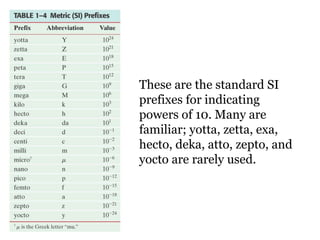
These are the standard SI prefixes for indicating powers of 10. Many are familiar; yotta, zetta, exa, hecto, deka, atto, zepto, and yocto are rarely used.
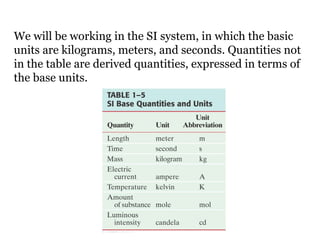
We will be working in the SI system, in which the basic units are kilograms, meters, and seconds. Quantities not in the table are derived quantities, expressed in terms of the base units.
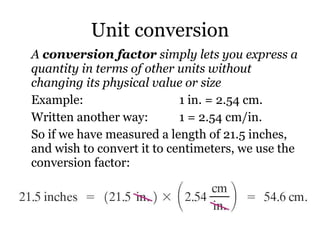
Unit conversion A  conversion factor  simply lets you express a quantity in terms of other units without changing its physical value or size Example:  1 in. = 2.54 cm. Written another way:  1 = 2.54 cm/in. So if we have measured a length of 21.5 inches, and wish to convert it to centimeters, we use the conversion factor:
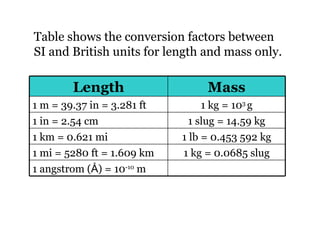
Table shows the conversion factors between SI and British units for length and mass only. 1 angstrom ( Å) = 10 -10  m 1 kg = 0.0685 slug 1 mi = 5280 ft = 1.609 km 1 lb = 0.453 592 kg 1 km = 0.621 mi 1 slug = 14.59 kg 1 in = 2.54 cm 1 kg = 10 3  g 1 m = 39.37 in = 3.281 ft Mass Length
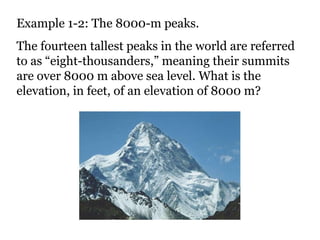
Example 1-2: The 8000-m peaks. The fourteen tallest peaks in the world are referred to as “eight-thousanders,” meaning their summits are over 8000 m above sea level. What is the elevation, in feet, of an elevation of 8000 m?
Unit Analysis A powerful way to check your calculation is to use unit analysis Not only must the numerical values on both sides of an equation be equal, the units must be equal as well
Dimensions Dimensions of a quantity are the base units that make it up; they are generally written using square brackets. Example: Speed = distance/time Dimensions of speed: [ L / T ] In dimensions, mass, length, time, temperature, and electric current is symbolize with M, L, T, K and A respectively.
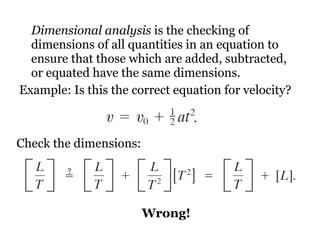
Dimensional analysis  is the checking of dimensions of all quantities in an equation to ensure that those which are added, subtracted, or equated have the same dimensions. Example: Is this the correct equation for velocity? Check the dimensions:  Wrong!

01 unit and measurement

  • 1.
  • 2.
    Lecture Outline Basicunits and quantity Unit conversion Unit analysis
  • 3.
    Physics and measurementPhysics attempts to describe nature in an objective way through measurement Measurement are expressed in units; Officially accepted unit are called standard unit Major systems of unit: Metric cgs system – centimeter, gram, second British (used by the U.S.) – feet, pound, second
  • 4.
    Basic units andquantity Length, mass and time are the fundamental quantities; combination of them will form all the other unit. Today the most important system is the Syst ème International (SI), which also based on the metric system – meter, kilogram and second
  • 5.
    Length SI unitof length: meter (m) The original definition: one ten-millionth of the distance from the earth equator to either pole The newest definition: ‘The meter is the length of path traveled by light in vacuum during time interval of 1/299,792,458 of a second’
  • 6.
    Time SI unitof Time: second (s) The original definition: one second is define as 1/86,400 of a mean solar day (24h/day × 60min/h × 60s/min = 86,400s/day) The newest definition: Time required for 9,192,631,770 periods of radiation emitted by cesium atoms
  • 7.
    Mass SI unitof mass: kilogram (kg) The original definition: one kilogram is the mass of 0.10 m 3 of water The newest definition: the standard kilogram is a platinum-iridium cylinder kept at he French Bureau of Weights and measurement
  • 8.
  • 9.
  • 10.
  • 11.
    These are thestandard SI prefixes for indicating powers of 10. Many are familiar; yotta, zetta, exa, hecto, deka, atto, zepto, and yocto are rarely used.
  • 12.
    We will beworking in the SI system, in which the basic units are kilograms, meters, and seconds. Quantities not in the table are derived quantities, expressed in terms of the base units.
  • 13.
    Unit conversion A conversion factor simply lets you express a quantity in terms of other units without changing its physical value or size Example: 1 in. = 2.54 cm. Written another way: 1 = 2.54 cm/in. So if we have measured a length of 21.5 inches, and wish to convert it to centimeters, we use the conversion factor:
  • 14.
    Table shows theconversion factors between SI and British units for length and mass only. 1 angstrom ( Å) = 10 -10 m 1 kg = 0.0685 slug 1 mi = 5280 ft = 1.609 km 1 lb = 0.453 592 kg 1 km = 0.621 mi 1 slug = 14.59 kg 1 in = 2.54 cm 1 kg = 10 3 g 1 m = 39.37 in = 3.281 ft Mass Length
  • 15.
    Example 1-2: The8000-m peaks. The fourteen tallest peaks in the world are referred to as “eight-thousanders,” meaning their summits are over 8000 m above sea level. What is the elevation, in feet, of an elevation of 8000 m?
  • 16.
    Unit Analysis Apowerful way to check your calculation is to use unit analysis Not only must the numerical values on both sides of an equation be equal, the units must be equal as well
  • 17.
    Dimensions Dimensions ofa quantity are the base units that make it up; they are generally written using square brackets. Example: Speed = distance/time Dimensions of speed: [ L / T ] In dimensions, mass, length, time, temperature, and electric current is symbolize with M, L, T, K and A respectively.
  • 18.
    Dimensional analysis is the checking of dimensions of all quantities in an equation to ensure that those which are added, subtracted, or equated have the same dimensions. Example: Is this the correct equation for velocity? Check the dimensions: Wrong!

Editor's Notes

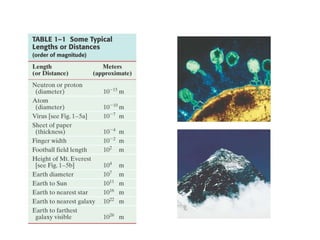
  • #9 Figure 1-5. Caption: Some lengths: (a) viruses (about 10 -7 m long) attacking a cell; (b) Mt. Everest’s height is on the order of 10 4 m (8850 m, to be precise).