Getting
started with
Machine Learning
HELLO!
Thomas Paula
Software Engineer
tsp.thomas@gmail.com
Humberto Marchezi
Software Engineer
hcmarchezi@gmail.com
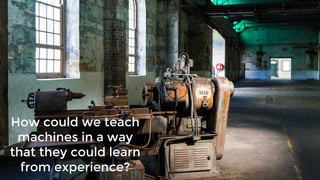
How could we teach
machines in a way
that they could learn
from experience?
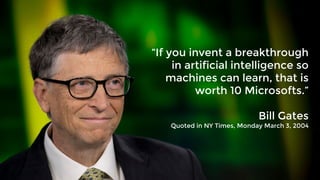
“If you invent a breakthrough
in artificial intelligence so
machines can learn, that is
worth 10 Microsofts.”
Bill Gates
Quoted in NY Times, Monday March 3, 2004
1.
INTRODUCTION Machine what?
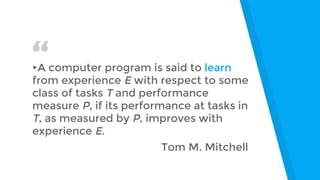
“▸A computer program is said to learn
from experience E with respect to some
class of tasks T and performance
measure P, if its performance at tasks in
T, as measured by P, improves with
experience E.
Tom M. Mitchell
“▸A computer program is said to learn
from experience E with respect to some
class of tasks T and performance
measure P, if its performance at tasks in
T, as measured by P, improves with
experience E.
Tom M. Mitchell
“▸A computer program is said to learn
from experience E with respect to some
class of tasks T and performance
measure P, if its performance at tasks in
T, as measured by P, improves with
experience E.
Tom M. Mitchell
“▸A computer program is said to learn
from experience E with respect to some
class of tasks T and performance
measure P, if its performance at tasks in
T, as measured by P, improves with
experience E.
Tom M. Mitchell
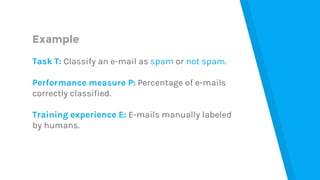
Example
Task T: Classify an e-mail as spam or not spam.
Performance measure P: Percentage of e-mails
correctly classified.
Training experience E: E-mails manually labeled
by humans.
Learning
Paradigms
Supervised Learning
Unsupervised Learning
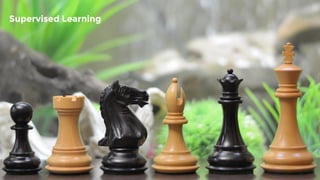
Supervised Learning
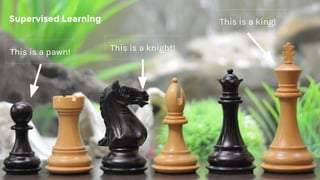
Supervised Learning
This is a pawn! This is a knight!
This is a king!
Supervised Learning
▸Labeled data;
▸Has a “supervisor”;
▸Classifies unseen instances (classification) or
predicts values (regression).
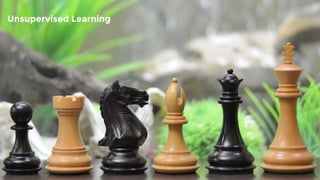
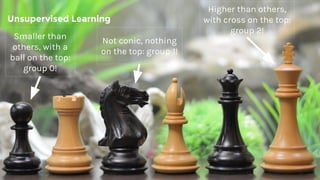
Unsupervised Learning
Smaller than
others, with a
ball on the top:
group 0!
Not conic, nothing
on the top: group 1!
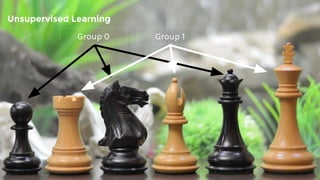
Unsupervised Learning
Higher than others,
with cross on the top:
group 2!
Group 0 Group 1
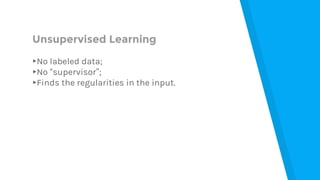
Unsupervised Learning
▸No labeled data;
▸No “supervisor”;
▸Finds the regularities in the input.
Task
Categories
Classification
Regression
Clustering
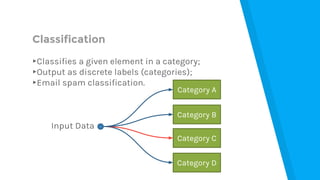
Classification
▸Classifies a given element in a category;
▸Output as discrete labels (categories);
▸Email spam classification.
Category A
Category B
Category C
Category D
Input Data
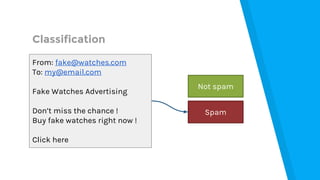
Classification
Not spam
Spam
From: fake@watches.com
To: my@email.com
Fake Watches Advertising
Don’t miss the chance !
Buy fake watches right now !
Click here
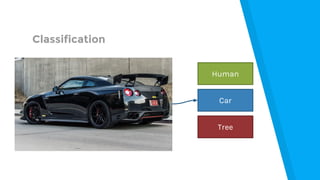
Classification
Human
Tree
Car
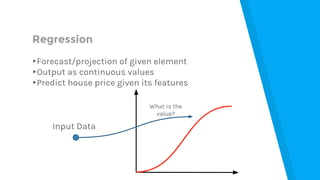
Regression
Input Data
▸Forecast/projection of given element
▸Output as continuous values
▸Predict house price given its features
What is the
value?
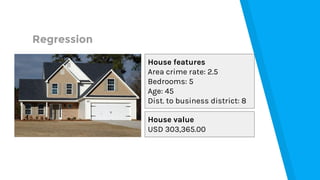
Regression
House features
Area crime rate: 2.5
Bedrooms: 5
Age: 45
Dist. to business district: 8
House value
USD 303,365.00
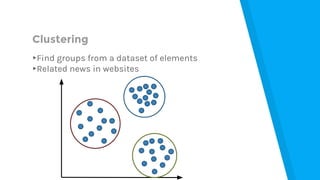
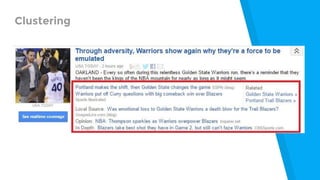
Clustering
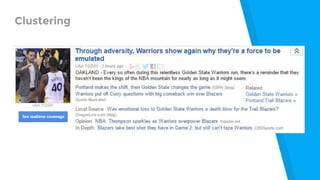
▸Find groups from a dataset of elements
▸Related news in websites
Clustering
Clustering
2.
ALGORITHMS The fun part ☺
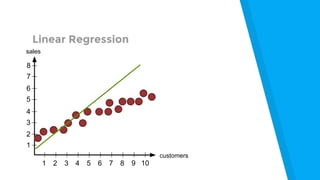
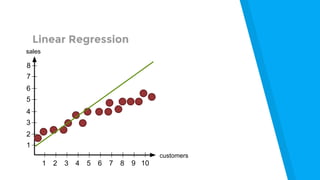
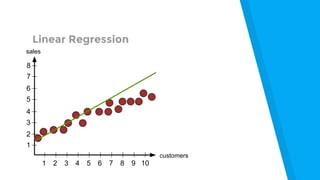
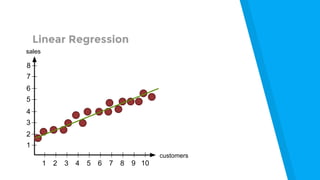
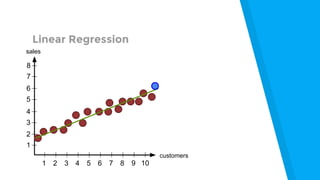
Linear Regression
▸Supervised learning;
▸Regression.
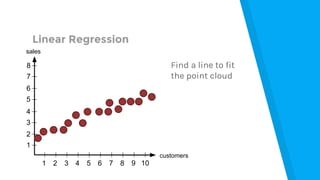
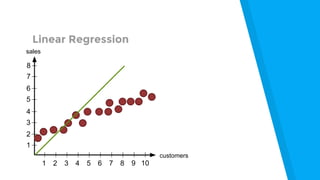
Linear Regression
1 2 3 4 5 6 7 8 9 10
1
2
3
4
5
6
7
8 Find a line to fit
the point cloud
sales
customers
Linear Regression
1 2 3 4 5 6 7 8 9 10
1
2
3
4
5
6
7
8
sales
customers
Linear Regression
1 2 3 4 5 6 7 8 9 10
1
2
3
4
5
6
7
8
sales
customers
Linear Regression
1 2 3 4 5 6 7 8 9 10
1
2
3
4
5
6
7
8
sales
customers
Linear Regression
1 2 3 4 5 6 7 8 9 10
1
2
3
4
5
6
7
8
sales
customers
Linear Regression
1 2 3 4 5 6 7 8 9 10
1
2
3
4
5
6
7
8
sales
customers
Linear Regression
1 2 3 4 5 6 7 8 9 10
1
2
3
4
5
6
7
8
sales
customers
Linear Regression
1 2 3 4 5 6 7 8 9 10
1
2
3
4
5
6
7
8
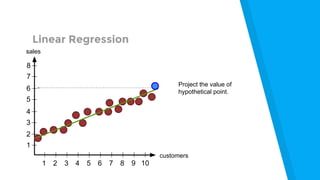
Project the value of
hypothetical point.
sales
customers
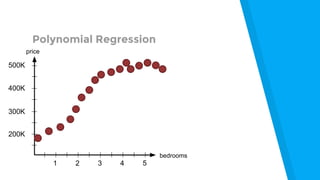
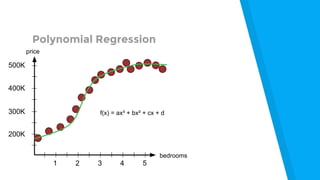
Polynomial Regression
4 5
200K
price
bedrooms
321
300K
400K
500K
Polynomial Regression
4 5
200K
price
bedrooms
321
300K
400K
500K
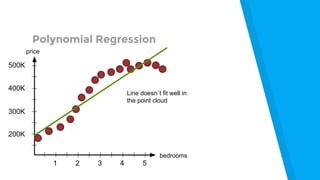
Line doesn´t fit well in
the point cloud
Polynomial Regression
4 5
200K
price
bedrooms
321
300K
400K
500K
f(x) = ax³ + bx² + cx + d
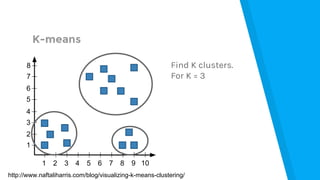
K-means
▸Unsupervised learning;
▸Clustering;
▸Uses K to specify the number of clusters.
K-means
1 2 3 4 5 6 7 8 9 10
1
2
3
4
5
6
7
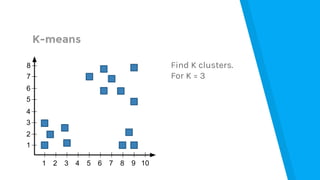
8 Find K clusters.
For K = 3
K-means
1 2 3 4 5 6 7 8 9 10
1
2
3
4
5
6
7
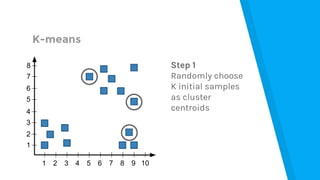
8 Step 1
Randomly choose
K initial samples
as cluster
centroids
K-means
1 2 3 4 5 6 7 8 9 10
1
2
3
4
5
6
7
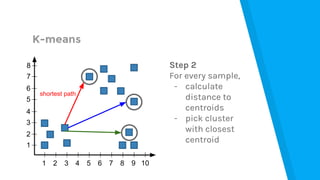
8 Step 2
For every sample,
- calculate
distance to
centroids
- pick cluster
with closest
centroid
shortest path
K-means
1 2 3 4 5 6 7 8 9 10
1
2
3
4
5
6
7
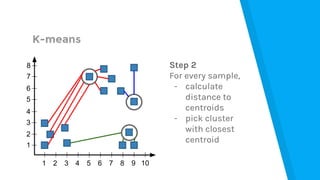
8 Step 2
For every sample,
- calculate
distance to
centroids
- pick cluster
with closest
centroid
K-means
1 2 3 4 5 6 7 8 9 10
1
2
3
4
5
6
7
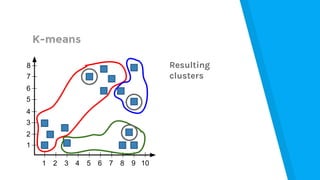
8 Resulting
clusters
K-means
1 2 3 4 5 6 7 8 9 10
1
2
3
4
5
6
7
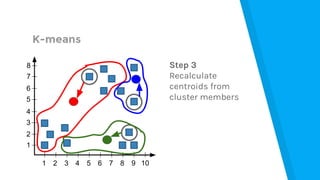
8 Step 3
Recalculate
centroids from
cluster members
K-means
1 2 3 4 5 6 7 8 9 10
1
2
3
4
5
6
7
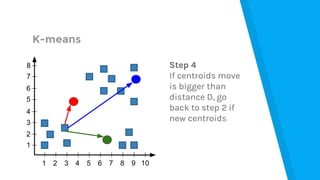
8 Step 4
If centroids move
is bigger than
distance D, go
back to step 2 if
new centroids
K-means
1 2 3 4 5 6 7 8 9 10
1
2
3
4
5
6
7
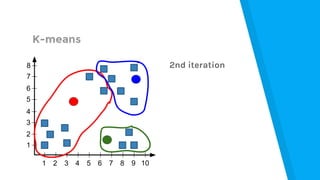
8 2nd iteration
K-means
1 2 3 4 5 6 7 8 9 10
1
2
3
4
5
6
7
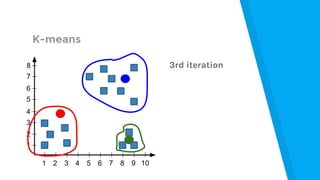
8 3rd iteration
K-means
1 2 3 4 5 6 7 8 9 10
1
2
3
4
5
6
7
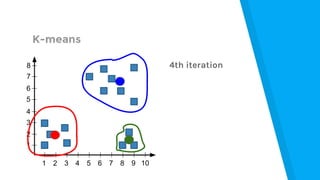
8 4th iteration
K-means
1 2 3 4 5 6 7 8 9 10
1
2
3
4
5
6
7
8 Find K clusters.
For K = 3
http://www.naftaliharris.com/blog/visualizing-k-means-clustering/
K-Nearest Neighbors (K-NN)
▸Supervised learning;
▸Classification and regression;
▸Lazy learning;
▸Uses the k closest instances to classify the
unknown one;
▸Easy to implement.
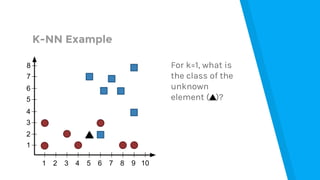
K-NN Example
1 2 3 4 5 6 7 8 9 10
1
2
3
4
5
6
7
8 For k=1, what is
the class of the
unknown
element ( )?
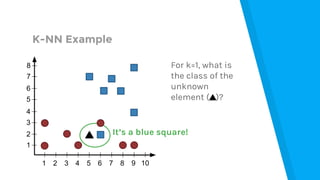
K-NN Example
1 2 3 4 5 6 7 8 9 10
1
2
3
4
5
6
7
8 For k=1, what is
the class of the
unknown
element ( )?
It’s a blue square!
K-NN Example
1 2 3 4 5 6 7 8 9 10
1
2
3
4
5
6
7
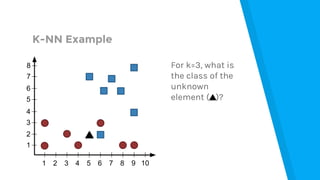
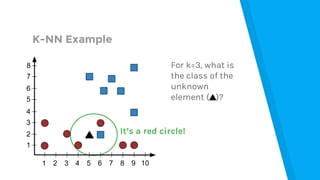
8 For k=3, what is
the class of the
unknown
element ( )?
K-NN Example
1 2 3 4 5 6 7 8 9 10
1
2
3
4
5
6
7
8 For k=3, what is
the class of the
unknown
element ( )?
It’s a red circle!
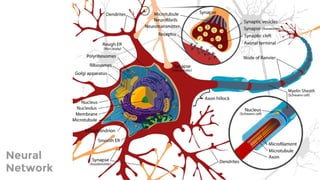
Neural
Network
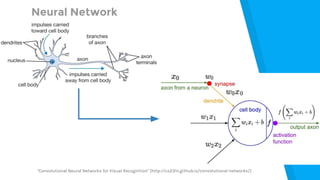
Neural Network
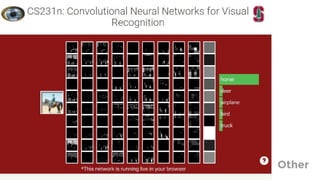
"Convolutional Neural Networks for Visual Recognition" (http://cs231n.github.io/convolutional-networks/)
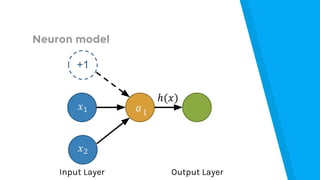
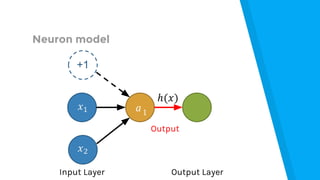
Neuron model
+1
Input Layer Output Layer
a1
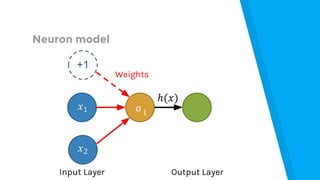
Neuron model
+1
Input Layer Output Layer
a1
Weights
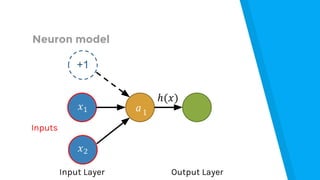
Neuron model
+1
Input Layer Output Layer
a1
Inputs
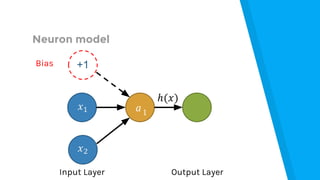
Neuron model
+1
Input Layer Output Layer
a1
Bias
Neuron model
+1
Input Layer Output Layer
a1
Output
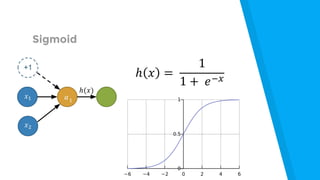
Sigmoid
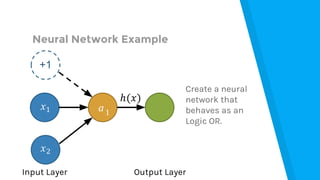
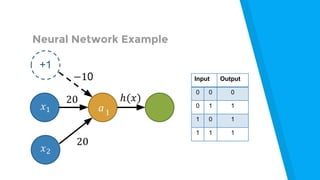
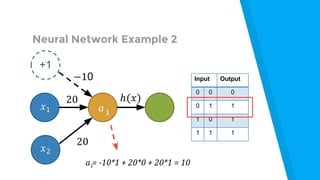
Neural Network Example
Create a neural
network that
behaves as an
Logic OR.
+1
Input Layer Output Layer
a1
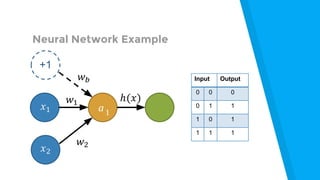
Neural Network Example
+1
Input Output
0 0 0
0 1 1
1 0 1
1 1 1
a1
Neural Network Example
+1
Input Output
0 0 0
0 1 1
1 0 1
1 1 1
a1
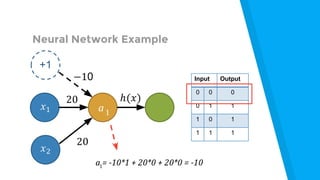
Neural Network Example
+1
Input Output
0 0 0
0 1 1
1 0 1
1 1 1
a1
a = -10*1 + 20*0 + 20*0 = -101
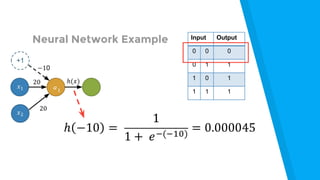
Input Output
0 0 0
0 1 1
1 0 1
1 1 1
Neural Network Example
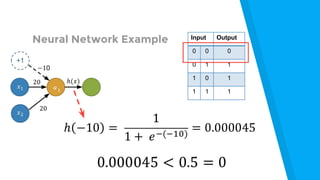
Input Output
0 0 0
0 1 1
1 0 1
1 1 1
Neural Network Example
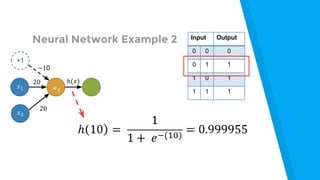
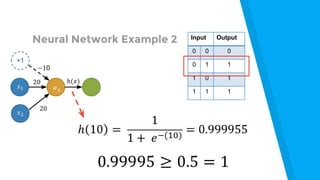
Neural Network Example 2
+1
Input Output
0 0 0
0 1 1
1 0 1
1 1 1
a1
a = -10*1 + 20*0 + 20*1 = 101
Input Output
0 0 0
0 1 1
1 0 1
1 1 1
Neural Network Example 2
Input Output
0 0 0
0 1 1
1 0 1
1 1 1
Neural Network Example 2
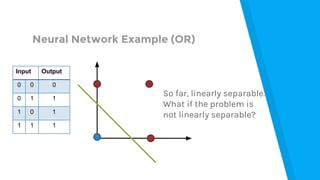
Neural Network Example (OR)
So far, linearly separable.
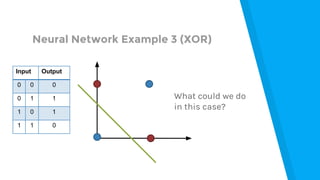
What if the problem is
not linearly separable?
Input Output
0 0 0
0 1 1
1 0 1
1 1 1
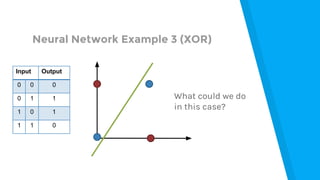
Neural Network Example 3 (XOR)
Input Output
0 0 0
0 1 1
1 0 1
1 1 0
What could we do
in this case?
Neural Network Example 3 (XOR)
Input Output
0 0 0
0 1 1
1 0 1
1 1 0
What could we do
in this case?
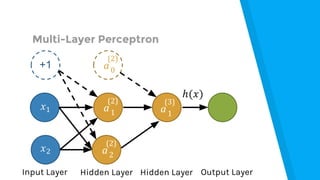
Multi-Layer Perceptron
+1
Input Layer Hidden Layer
a1
(2)
a2
(2)
a0
(2)
Output Layer
a1
(3)
Hidden Layer
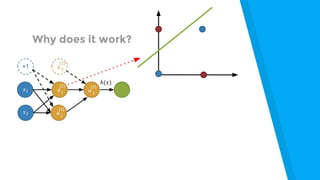
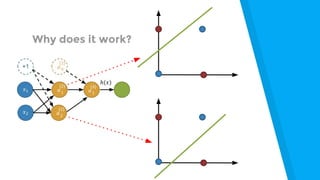
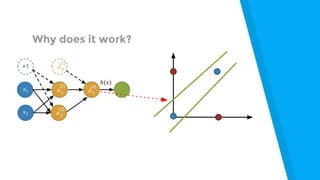
Why does it work?
Why does it work?
Why does it work?
“
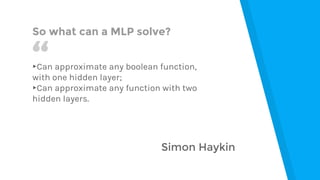
So what can a MLP solve?
▸Can approximate any boolean function,
with one hidden layer;
▸Can approximate any function with two
hidden layers.
Simon Haykin
3.
DEEP LEARNING
“▸A machine learning approach
that attempts to extract high-
level and hierarchical features
from raw data.
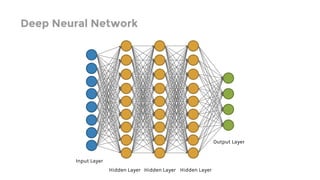
Deep Neural Network
Input Layer
Hidden Layer Hidden Layer Hidden Layer
Output Layer
Where is it used?
▸Speech Recognition;
▸Music Classification;
▸Recommendation;
▸Image Classification;
▸...
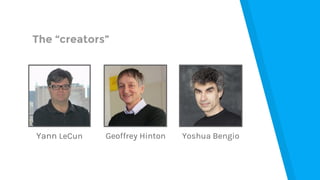
The “creators”
Yann LeCun Geoffrey Hinton Yoshua Bengio
AI Winter
and
the Canadian Mafia
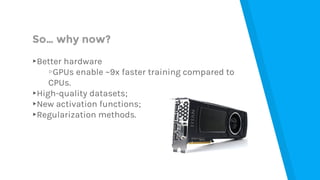
So… why now?
▸Better hardware
▹GPUs enable ~9x faster training compared to
CPUs.
▸High-quality datasets;
▸New activation functions;
▸Regularization methods.
Different Implementations
▸Convolutional Neural Networks (CNN);
▸Deep Belief Networks;
▸Autoencoders;
▸Long Short Term Memory (LSTM)
▸...
3.1
DEEP LEARNING
EXAMPLE
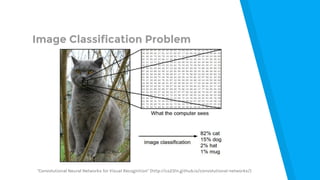
Image Classification Problem
"Convolutional Neural Networks for Visual Recognition" (http://cs231n.github.io/convolutional-networks/)
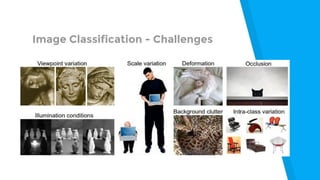
Image Classification - Challenges
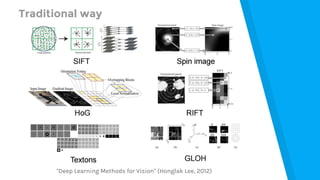
Traditional way
"Deep Learning Methods for Vision" (Honglak Lee, 2012)
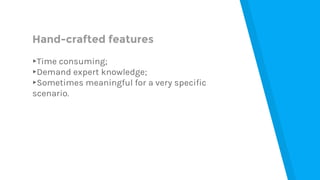
Hand-crafted features
▸Time consuming;
▸Demand expert knowledge;
▸Sometimes meaningful for a very specific
scenario.
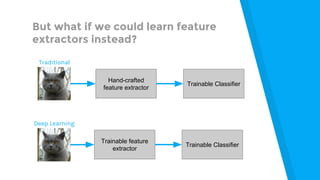
But what if we could learn feature
extractors instead?
Traditional
Hand-crafted
feature extractor
Trainable feature
extractor
Trainable Classifier
Deep Learning
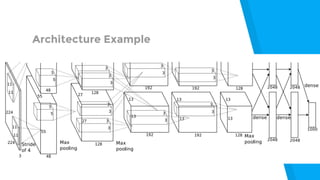
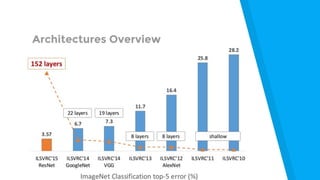
Architecture Example
Architectures Overview
4.
HOW COULD WE
APPLY IT AT OUR
WORK ?
But my work
is not about
Machine Learning...
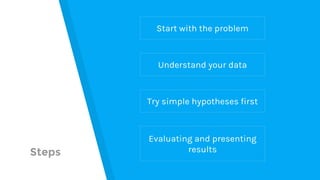
Steps
Start with the problem
Understand your data
Try simple hypotheses first
Evaluating and presenting
results
Start with the problem
Talk to your business contact
Get insights about your
problem domain
Ask about hypothetical
features
Be clear about your intentions
Do not commit with results!
Where is the data ?
▸Application logs
▸User inputs
Search things like:
▸Repetitive tasks by user
▸Customer habits
▸Patterns of system usage by
the user
Start with the problem
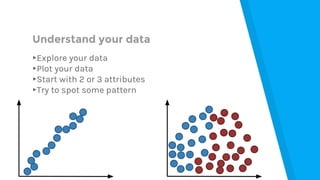
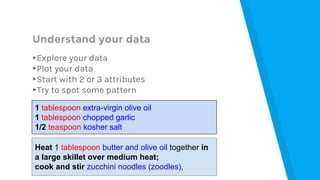
Understand your data
▸Explore your data
▸Plot your data
▸Start with 2 or 3 attributes
▸Try to spot some pattern
Understand your data
1 tablespoon extra-virgin olive oil
1 tablespoon chopped garlic
1/2 teaspoon kosher salt
Heat 1 tablespoon butter and olive oil together in
a large skillet over medium heat;
cook and stir zucchini noodles (zoodles),
▸Explore your data
▸Plot your data
▸Start with 2 or 3 attributes
▸Try to spot some pattern
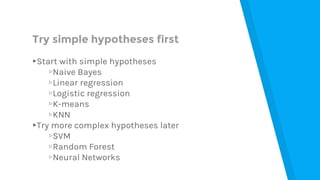
Try simple hypotheses first
▸Start with simple hypotheses
▹Naive Bayes
▹Linear regression
▹Logistic regression
▹K-means
▹KNN
▸Try more complex hypotheses later
▹SVM
▹Random Forest
▹Neural Networks
Evaluating and presenting results
▸Define a metric based on the business goal
▹Error rate
▹F1 score
▸Demonstrate results to business unit
▸Use functional prototypes when possible
Examples
Market Analysis Case
▸Optimize subscription plans
▸Find customer groups
▸Use and analyze the application log
application logs:
[2015-01-05 09:12:34] user id=543 clicked buy button for app id=12
[2015-01-06 08:10:31] user id=143 clicked buy button for book id=786
[2015-01-06 09:22:06] user id=563 clicked buy button for music id=900
[2015-01-06 13:12:34] user id=543 clicked buy button for music id=34
[2015-01-07 15:45:22] user id=890 clicked more details button for movie id=189
[2015-01-07 17:21:14] user id=897 clicked more details button for app id=231
[2015-01-08 08:22:02] user id=239 clicked buy button for book id=786
[2015-01-09 09:00:11] user id=253 clicked buy button for music id=373
[2015-01-09 17:12:56] user id=389 clicked more details button for app id=262
[2015-01-09 20:12:04] user id=141 clicked buy button for app id=145
Market Analysis Case
application logs:
[2015-01-05 09:12:34] user id=543 clicked buy button for app id=12
[2015-01-06 08:10:31] user id=143 clicked buy button for book id=786
[2015-01-06 09:22:06] user id=563 clicked buy button for music id=900
[2015-01-06 13:12:34] user id=543 clicked buy button for music id=34
[2015-01-07 15:45:22] user id=890 clicked more details button for movie id=189
[2015-01-07 17:21:14] user id=897 clicked more details button for app id=231
[2015-01-08 08:22:02] user id=239 clicked buy button for book id=786
[2015-01-09 09:00:11] user id=253 clicked buy button for music id=373
[2015-01-09 17:12:56] user id=389 clicked more details button for app id=262
[2015-01-09 20:12:04] user id=141 clicked buy button for app id=145
▸Optimize subscription plans
▸Find customer groups
▸Use and analyze the application log
Market Analysis Case
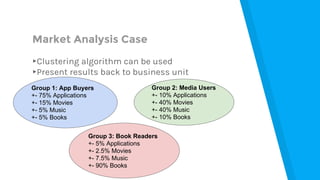
Group 1: App Buyers
+- 75% Applications
+- 15% Movies
+- 5% Music
+- 5% Books
Group 2: Media Users
+- 10% Applications
+- 40% Movies
+- 40% Music
+- 10% Books
Group 3: Book Readers
+- 5% Applications
+- 2.5% Movies
+- 7.5% Music
+- 90% Books
▸Clustering algorithm can be used
▸Present results back to business unit
5.
BOOKS &
COURSES
Books
Machine Learning
Tom Mitchell
Introduction to Data Mining
Pang-Ning Tan
MOOCs
Other
THANK YOU!
Any questions?

Getting Started with Machine Learning