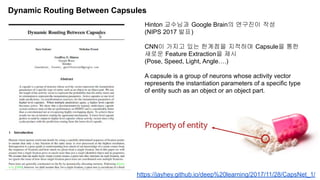
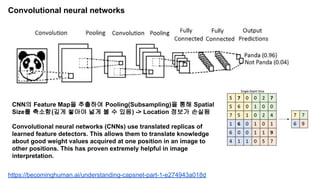
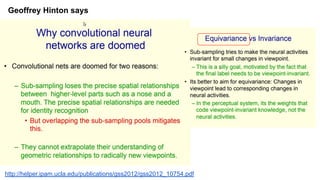
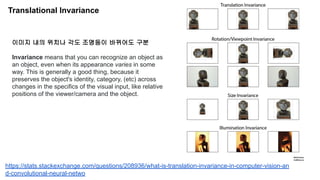
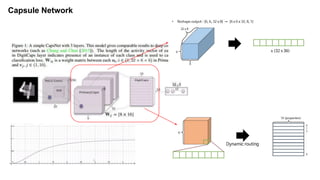
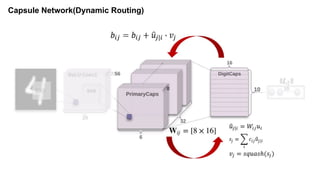
The document discusses capsule networks and their dynamic routing mechanism as proposed by Geoffrey Hinton and the Google Brain team, highlighting their advantages over traditional convolutional neural networks (CNNs) in feature extraction and object recognition under varying conditions. It details the capsule architecture, including how capsules represent instantiation parameters and the routing algorithm used for information exchange between capsules. It also touches on the loss functions used in training these networks and provides references to relevant literature and resources.

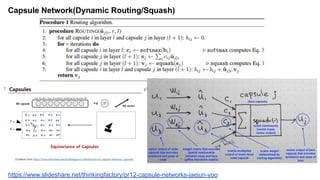
![def capsule(input, b_IJ, idx_j):
with tf.variable_scope('routing'):
w_initializer = np.random.normal(size=[1, 1152, 8, 16], scale=0.01)
W_Ij = tf.Variable(w_initializer, dtype=tf.float32)
W_Ij = tf.tile(W_Ij, [cfg.batch_size, 1, 1, 1])
# calc u_hat
# [8, 16].T x [8, 1] => [16, 1] => [batch_size, 1152, 16, 1]
u_hat = tf.matmul(W_Ij, input, transpose_a=True)
assert u_hat.get_shape() == [cfg.batch_size, 1152, 16, 1]
shape = b_IJ.get_shape().as_list()
size_splits = [idx_j, 1, shape[2] - idx_j - 1]
for r_iter in range(cfg.iter_routing):
c_IJ = tf.nn.softmax(b_IJ, dim=2)
assert c_IJ.get_shape() == [1, 1152, 10, 1]
# line 5:
# weighting u_hat with c_I in the third dim,
# then sum in the second dim, resulting in [batch_size, 1, 16, 1]
b_Il, b_Ij, b_Ir = tf.split(b_IJ, size_splits, axis=2)
c_Il, c_Ij, b_Ir = tf.split(c_IJ, size_splits, axis=2)
assert c_Ij.get_shape() == [1, 1152, 1, 1]
s_j = tf.multiply(c_Ij, u_hat)
s_j = tf.reduce_sum(tf.multiply(c_Ij, u_hat), axis=1, keep_dims=True)
assert s_j.get_shape() == [cfg.batch_size, 1, 16, 1]
# line 6:
# squash using Eq.1, resulting in [batch_size, 1, 16, 1]
v_j = squash(s_j)
assert s_j.get_shape() == [cfg.batch_size, 1, 16, 1]
# line 7:
# tile v_j from [batch_size ,1, 16, 1] to [batch_size, 1152, 16, 1]
# [16, 1].T x [16, 1] => [1, 1], then reduce mean in the
# batch_size dim, resulting in [1, 1152, 1, 1]
v_j_tiled = tf.tile(v_j, [1, 1152, 1, 1])
u_produce_v = tf.matmul(u_hat, v_j_tiled, transpose_a=True)
assert u_produce_v.get_shape() == [cfg.batch_size, 1152, 1, 1]
b_Ij += tf.reduce_sum(u_produce_v, axis=0, keep_dims=True)
b_IJ = tf.concat([b_Il, b_Ij, b_Ir], axis=2)
return(v_j, b_IJ)
def squash(vector):
vec_abs = tf.sqrt(tf.reduce_sum(tf.square(vector))) # a scalar
scalar_factor = tf.square(vec_abs) / (1 + tf.square(vec_abs))
vec_squashed = scalar_factor * tf.divide(vector, vec_abs) # element-wise
return(vec_squashed)
if not self.with_routing:
# the PrimaryCaps layer
# input: [batch_size, 20, 20, 256]
assert input.get_shape() == [cfg.batch_size, 20, 20, 256]
capsules = []
for i in range(self.num_units):
# each capsule i: [batch_size, 6, 6, 32]
with tf.variable_scope('ConvUnit_' + str(i)):
caps_i = tf.contrib.layers.conv2d(input,
self.num_outputs,
self.kernel_size,
self.stride,
padding="VALID")
caps_i = tf.reshape(caps_i, shape=(cfg.batch_size, -1, 1, 1))
capsules.append(caps_i)
assert capsules[0].get_shape() == [cfg.batch_size, 1152, 1, 1]
# [batch_size, 1152, 8, 1]
capsules = tf.concat(capsules, axis=2)
capsules = squash(capsules)
assert capsules.get_shape() == [cfg.batch_size, 1152, 8, 1]
else:
# the DigitCaps layer
# Reshape the input into shape [batch_size, 1152, 8, 1]
self.input = tf.reshape(input, shape=(cfg.batch_size, 1152, 8, 1))
# b_IJ: [1, num_caps_l, num_caps_l_plus_1, 1]
b_IJ = tf.zeros(shape=[1, 1152, 10, 1], dtype=np.float32)
capsules = []
for j in range(self.num_outputs):
with tf.variable_scope('caps_' + str(j)):
caps_j, b_IJ = capsule(input, b_IJ, j)
capsules.append(caps_j)
# Return a tensor with shape [batch_size, 10, 16, 1]
capsules = tf.concat(capsules, axis=1)
assert capsules.get_shape() == [cfg.batch_size, 10, 16, 1]
return(capsules)](https://image.slidesharecdn.com/paperdynamicroutingbetweencapsules-210509101120/85/Paper-dynamic-routing-between-capsules-9-320.jpg)
![Codes
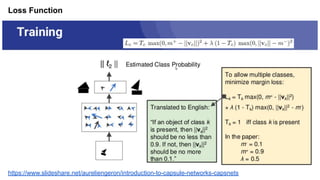
def loss(self):
# 1. The margin loss
# [batch_size, 10, 1, 1]
# max_l = max(0, m_plus-||v_c||)^2
max_l = tf.square(tf.maximum(0., cfg.m_plus - self.v_length))
# max_r = max(0, ||v_c||-m_minus)^2
max_r = tf.square(tf.maximum(0., self.v_length - cfg.m_minus))
assert max_l.get_shape() == [cfg.batch_size, self.num_label, 1, 1]
# reshape: [batch_size, 10, 1, 1] => [batch_size, 10]
max_l = tf.reshape(max_l, shape=(cfg.batch_size, -1))
max_r = tf.reshape(max_r, shape=(cfg.batch_size, -1))
# calc T_c: [batch_size, 10]
# T_c = Y, is my understanding correct? Try it.
T_c = self.Y
# [batch_size, 10], element-wise multiply
L_c = T_c * max_l + cfg.lambda_val * (1 - T_c) * max_r
self.margin_loss = tf.reduce_mean(tf.reduce_sum(L_c, axis=1))
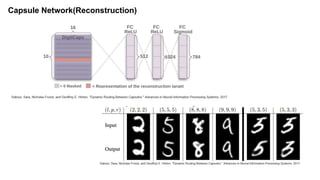
# 2. The reconstruction loss
orgin = tf.reshape(self.X, shape=(cfg.batch_size, -1))
squared = tf.square(self.decoded - orgin)
self.reconstruction_err = tf.reduce_mean(squared)
# 3. Total loss
# The paper uses sum of squared error as reconstruction error, but we
# have used reduce_mean in `# 2 The reconstruction loss` to calculate
# mean squared error. In order to keep in line with the paper,the
# regularization scale should be 0.0005*784=0.392
self.total_loss = self.margin_loss + cfg.regularization_scale *
self.reconstruction_err](https://image.slidesharecdn.com/paperdynamicroutingbetweencapsules-210509101120/85/Paper-dynamic-routing-between-capsules-12-320.jpg)
![References
[논문]
1. Dynamic Routing Between Capsules (2017.11) - NIPS 2017
[블로그]
https://jayhey.github.io/deep%20learning/2017/11/28/CapsNet_1/
https://www.slideshare.net/thinkingfactory/pr12-capsule-networks-jaejun-yoo
https://medium.com/ai%C2%B3-theory-practice-business/understanding-hintons-capsule-networks-part-iii-dyn
amic-routing-between-capsules-349f6d30418
http://helper.ipam.ucla.edu/publications/gss2012/gss2012_10754.pdf
https://towardsdatascience.com/capsule-networks-the-new-deep-learning-network-bd917e6818e8
http://blog.naver.com/PostView.nhn?blogId=sogangori&logNo=221129974140&redirect=Dlog&widgetT
ypeCall=true&directAccess=false
[영상]
http://jaejunyoo.blogspot.com/2018/02/pr12-video-56-capsule-network.html
[Code]
https://github.com/naturomics/CapsNet-Tensorflow](https://image.slidesharecdn.com/paperdynamicroutingbetweencapsules-210509101120/85/Paper-dynamic-routing-between-capsules-18-320.jpg)



![[Lecture 3] AI and Deep Learning: Logistic Regression (Coding)](https://cdn.slidesharecdn.com/ss_thumbnails/lecture3empty-180216132805-thumbnail.jpg?width=640&height=640&fit=bounds)


![[PR12] Capsule Networks - Jaejun Yoo](https://cdn.slidesharecdn.com/ss_thumbnails/pr12capsulenetworks-jaejunyoo-171217144319-thumbnail.jpg?width=640&height=640&fit=bounds)

![[신경망기초] 합성곱신경망](https://cdn.slidesharecdn.com/ss_thumbnails/2-180604135842-thumbnail.jpg?width=640&height=640&fit=bounds)


![[Paper] GIRAFFE: Representing Scenes as Compositional Generative Neural Featu...](https://cdn.slidesharecdn.com/ss_thumbnails/papergirafferepresentingscenesascompositionalgenerativeneuralfeaturefields-210823043723-thumbnail.jpg?width=640&height=640&fit=bounds)
![[Paper] Multiscale Vision Transformers(MVit)](https://cdn.slidesharecdn.com/ss_thumbnails/papermultiscalevisiontransformers-210808092058-thumbnail.jpg?width=640&height=640&fit=bounds)
![[Paper] anti spoofing for face recognition](https://cdn.slidesharecdn.com/ss_thumbnails/paperanti-spoofingforfacerecognition-210508093958-thumbnail.jpg?width=640&height=640&fit=bounds)
![[Paper] attention mechanism(luong)](https://cdn.slidesharecdn.com/ss_thumbnails/paperattentionmechanismluong-210508090926-thumbnail.jpg?width=640&height=640&fit=bounds)
![[Paper] shuffle net an extremely efficient convolutional neural network for ...](https://cdn.slidesharecdn.com/ss_thumbnails/papershufflenetanextremelyefficientconvolutionalneuralnetworkformobiledevices-210424000132-thumbnail.jpg?width=640&height=640&fit=bounds)
![[Paper] EDA : easy data augmentation techniques for boosting performance on t...](https://cdn.slidesharecdn.com/ss_thumbnails/paperedaeasydataaugmentationtechniquesforboostingperformanceontextclassificationtasks-210414133327-thumbnail.jpg?width=640&height=640&fit=bounds)
![[Paper] auto ml part 1](https://cdn.slidesharecdn.com/ss_thumbnails/paperautomlpart1-210413122952-thumbnail.jpg?width=640&height=640&fit=bounds)
![[Paper] eXplainable ai(xai) in computer vision](https://cdn.slidesharecdn.com/ss_thumbnails/paperexplainableaixaiincomputervision-210411093712-thumbnail.jpg?width=640&height=640&fit=bounds)
![[Paper] learning video representations from correspondence proposals](https://cdn.slidesharecdn.com/ss_thumbnails/paperlearningvideorepresentationsfromcorrespondenceproposals-210410235049-thumbnail.jpg?width=640&height=640&fit=bounds)
![[Paper] DetectoRS for Object Detection](https://cdn.slidesharecdn.com/ss_thumbnails/paperdetectorsobjectdetection-210320013551-thumbnail.jpg?width=640&height=640&fit=bounds)


