Descriptive Research Methodologies By Connie McNabb
What is Descriptive Research? Can involve collecting quantitative information Can describe categories of qualitative information such as patterns of interaction when using technology in the classroom. Does not fit neatly into either category
What is Descriptive Research? Involves gathering data that describe events and then organizes, tabulates, depicts, and describes the data. Uses description as a tool to organize data into patterns that emerge during analysis.  Often uses visual aids such as graphs and charts to aid the reader
Descriptive Research takes a “what is” approach What is the best way to provide access to computer equipment in schools? Do teachers hold favorable attitudes toward using computers in schools? What have been the reactions of school administrators to technological innovations in teaching?
Descriptive Research Refers to the nature of the research question The design of the research The way that data will be analyzed for the topic that will be researched The type of research question will determine whether descriptive research approach is appropriate to use.
Descriptive Research Advantages Educational research and experiences may contain many variables that cannot be realistically controlled. Educational research may require observations of life experiences Data collection may be spread over a large number of people over a large geographic area
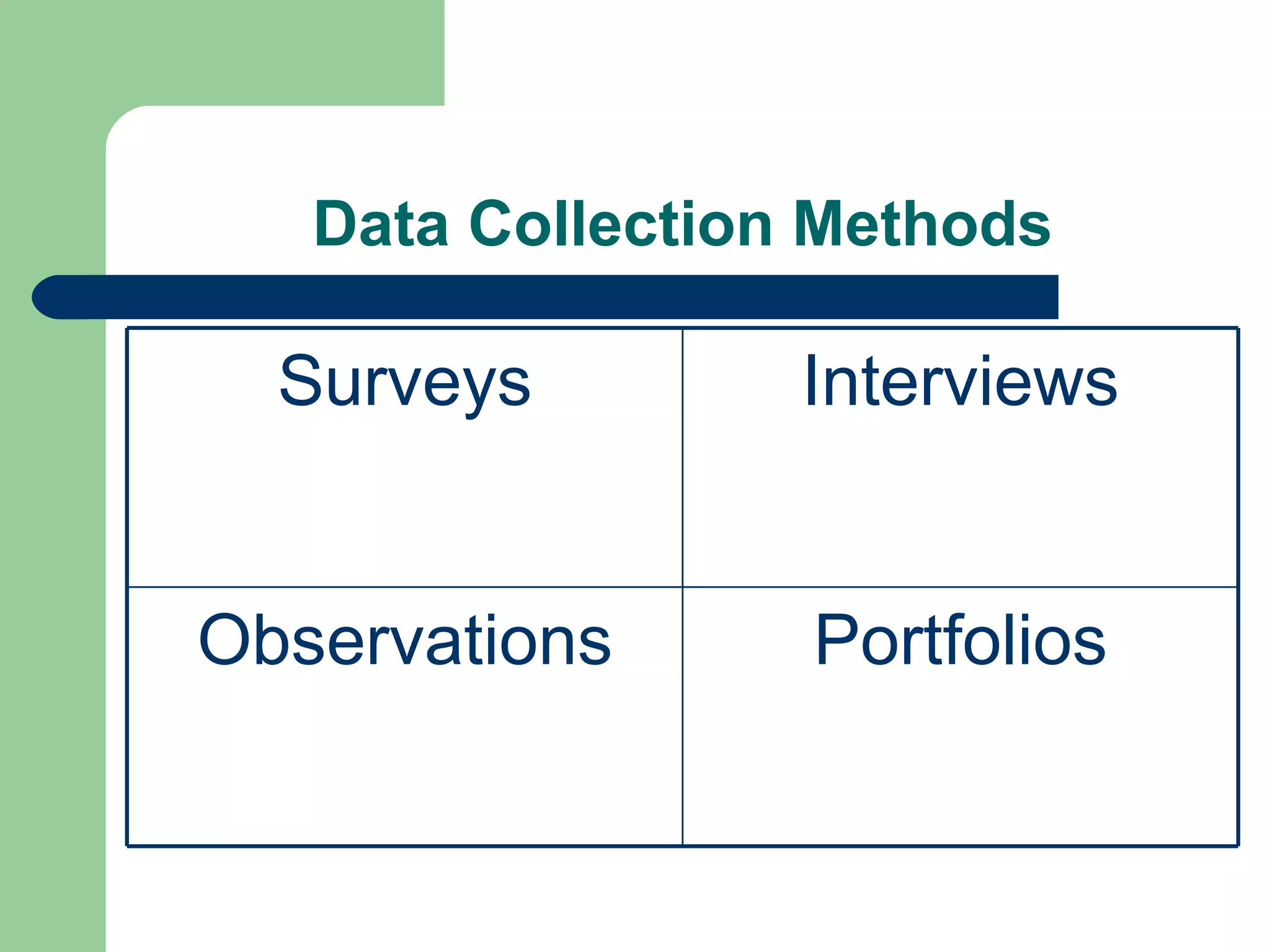
Data Collection Methods Portfolios Observations Interviews Surveys
Descriptive Research 1.  Surveys May be used to reveal summary statistics by showing responses to all possible questionnaire items.  Often provide leads in identifying needed changes May be used to explore relationships between 2 or more variables.
Descriptive Research Critical Components Sound methodology Well-designed data collection instruments
Descriptive Research Survey Forms Written questionnaires Personal interviews Telephone interviews Factors to be considered Sampling Type of population Question Form Question Content Response rates Costs Available facilities Length of data collection Computer assisted techniques for data collection
Descriptive Research 2.  Survey Form - Interviews More time efficient Allow the researcher to establish a rapport with the respondent Allow the acquisition of more in-depth information Allow for interviewer observation Allow the interviewer to obtain visual cues May be personal or telephone interviews
Descriptive Research Survey Form – Personal Interviews Disadvantages Require more staff time Require more travel time
Descriptive Research Survey Form – Telephone Interview Advantages Less expensive Less time-consuming Disadvantages Limited telephone access Lack of interviewer’s ability to observe the respondent and obtain visual cues
Descriptive Research Survey Form – Mailed Questionnaires Advantages Ability to reach large number of people across a wide geographic area Ease and low cost of distribution Minimal amount of staff required Allows respondents to respond in their time frame Disadvantages Lower response rate Need to design a survey instrument with a simple format
Descriptive Research Survey Form – Mailed Questionnaires A letter of transmittal should accompany mailed questionnaires. Should state purpose and importance of research Should state importance of responding Should give a time frame to respond Should include a confidentiality statement Should include an offer to share results Should include a thank-you note to the respondent
Descriptive Research Characteristics of a Good Survey Good questioning techniques Use complete sentences  Offer a limited set of answers Interesting Worded so that questions mean the same to all Provide definitions for confusing terms Uses the “I don’t know” answer very carefully
Descriptive Research 3. Observational Research Methods Naturally occurring behaviors observed in natural contexts  Contexts that are contrived to be realistic
Descriptive Research Observational Research Methods Require direct observation of behavior Data gathered without intermediary instruments Can yield a wealth of invaluable information Can be a complicated process
Descriptive Research Observational Research Methods Can be employed productively to support many purposes in educational technology Can be used to determine how people interact with technology in various stages of design and implementation
Descriptive Research Observation Research Methods How do learners interact with a specific program? How do learners interact with a new hardware system? Observation makes it possible to explore the implementation of a particular technological innovation and assess the instructional outcomes.
Descriptive Research Observational Research Methods 2 Forms of Observational Research Structured Unstructured
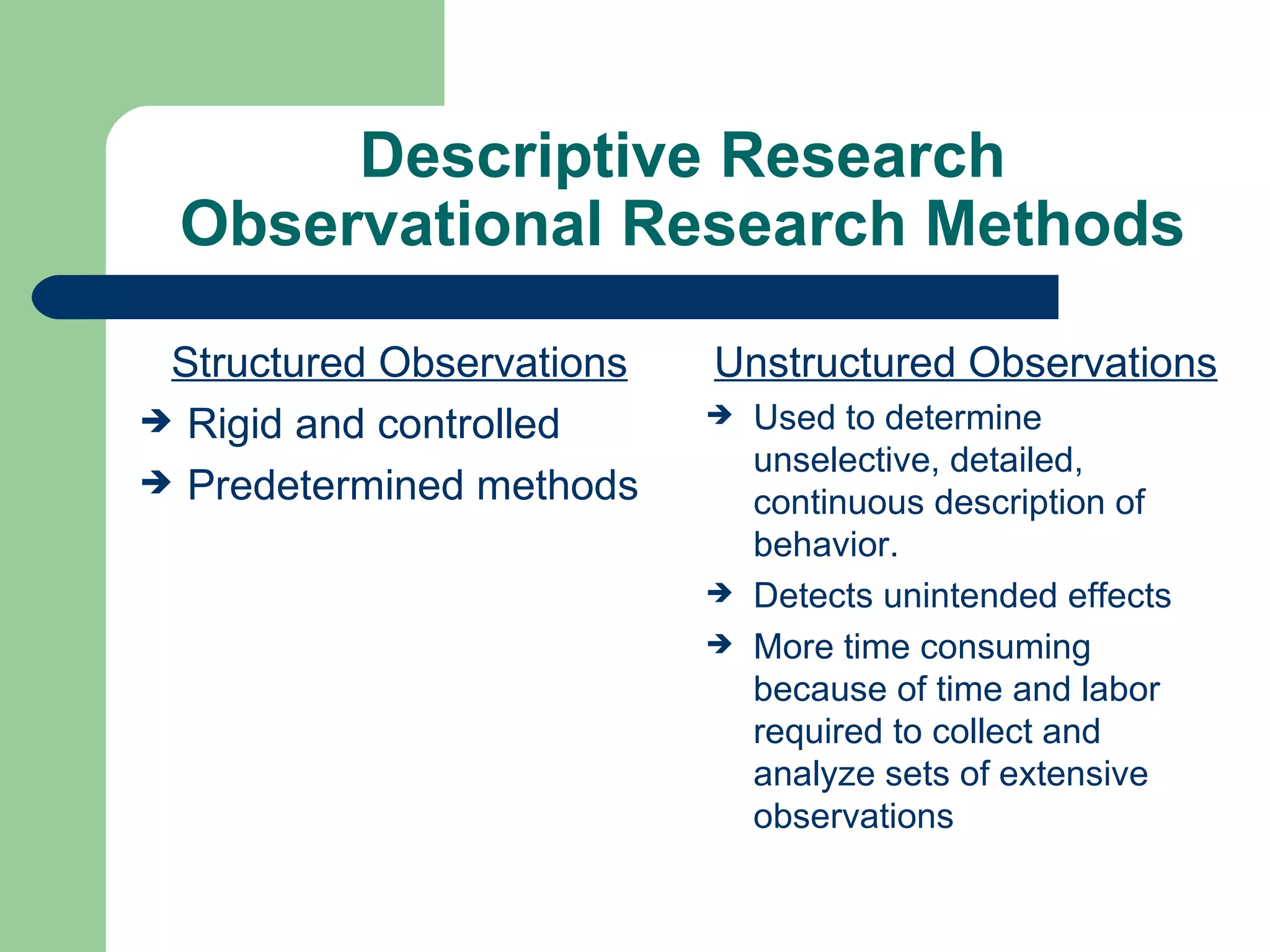
Descriptive Research Observational Research Methods Structured Observations Rigid and controlled Predetermined methods Unstructured Observations Used to determine unselective, detailed, continuous description of behavior.  Detects unintended effects More time consuming because of time and labor required to collect and analyze sets of extensive observations
Descriptive Research Observational Research Methods Develop observation form May be paper and pencil or electronic May use a rating scale to evaluate behavior A 3-point rating scale is sufficient
Descriptive Research Observational Research Methods Newer Mediated Observation Techniques Audio Videotape Computers provide on-line monitoring (process of capturing characteristics of the human-computer interaction automatically) Keystroke records Audit trails Logging data
Descriptive Research 4.  Portfolios Provide a descriptive measure of student work based on actual performance Consist of learner-created products that reflect the processes of learning and development over time
Impact and Future of  Descriptive Research Although descriptive studies are important, most educational studies involve questions about cause. What causes underachievement? Will multimedia cause students to be more motivated or lead to high achievement levels?
Impact and Future of Descriptive Research Not always easy to isolate variable that will explain those causes, so descriptive research can play an important role in providing information from another perspective. By gathering descriptions of “what is” and comparing them to “what we would like” educators can see the area that needs to be addressed.
Impact and Future  of Descriptive Research Descriptive Research methods have gained acceptance Number of descriptive studies published in research journals has increased Descriptive research leads to prescriptions that instructional designers and educators can heed as they consider future direction
Descriptive Research The End

Descriptive Method

  • 1.
  • 2.
    What is DescriptiveResearch? Can involve collecting quantitative information Can describe categories of qualitative information such as patterns of interaction when using technology in the classroom. Does not fit neatly into either category
  • 3.
    What is DescriptiveResearch? Involves gathering data that describe events and then organizes, tabulates, depicts, and describes the data. Uses description as a tool to organize data into patterns that emerge during analysis. Often uses visual aids such as graphs and charts to aid the reader
  • 4.
    Descriptive Research takesa “what is” approach What is the best way to provide access to computer equipment in schools? Do teachers hold favorable attitudes toward using computers in schools? What have been the reactions of school administrators to technological innovations in teaching?
  • 5.
    Descriptive Research Refersto the nature of the research question The design of the research The way that data will be analyzed for the topic that will be researched The type of research question will determine whether descriptive research approach is appropriate to use.
  • 6.
    Descriptive Research AdvantagesEducational research and experiences may contain many variables that cannot be realistically controlled. Educational research may require observations of life experiences Data collection may be spread over a large number of people over a large geographic area
  • 7.
    Data Collection MethodsPortfolios Observations Interviews Surveys
  • 8.
    Descriptive Research 1. Surveys May be used to reveal summary statistics by showing responses to all possible questionnaire items. Often provide leads in identifying needed changes May be used to explore relationships between 2 or more variables.
  • 9.
    Descriptive Research CriticalComponents Sound methodology Well-designed data collection instruments
  • 10.
    Descriptive Research SurveyForms Written questionnaires Personal interviews Telephone interviews Factors to be considered Sampling Type of population Question Form Question Content Response rates Costs Available facilities Length of data collection Computer assisted techniques for data collection
  • 11.
    Descriptive Research 2. Survey Form - Interviews More time efficient Allow the researcher to establish a rapport with the respondent Allow the acquisition of more in-depth information Allow for interviewer observation Allow the interviewer to obtain visual cues May be personal or telephone interviews
  • 12.
    Descriptive Research SurveyForm – Personal Interviews Disadvantages Require more staff time Require more travel time
  • 13.
    Descriptive Research SurveyForm – Telephone Interview Advantages Less expensive Less time-consuming Disadvantages Limited telephone access Lack of interviewer’s ability to observe the respondent and obtain visual cues
  • 14.
    Descriptive Research SurveyForm – Mailed Questionnaires Advantages Ability to reach large number of people across a wide geographic area Ease and low cost of distribution Minimal amount of staff required Allows respondents to respond in their time frame Disadvantages Lower response rate Need to design a survey instrument with a simple format
  • 15.
    Descriptive Research SurveyForm – Mailed Questionnaires A letter of transmittal should accompany mailed questionnaires. Should state purpose and importance of research Should state importance of responding Should give a time frame to respond Should include a confidentiality statement Should include an offer to share results Should include a thank-you note to the respondent
  • 16.
    Descriptive Research Characteristicsof a Good Survey Good questioning techniques Use complete sentences Offer a limited set of answers Interesting Worded so that questions mean the same to all Provide definitions for confusing terms Uses the “I don’t know” answer very carefully
  • 17.
    Descriptive Research 3.Observational Research Methods Naturally occurring behaviors observed in natural contexts Contexts that are contrived to be realistic
  • 18.
    Descriptive Research ObservationalResearch Methods Require direct observation of behavior Data gathered without intermediary instruments Can yield a wealth of invaluable information Can be a complicated process
  • 19.
    Descriptive Research ObservationalResearch Methods Can be employed productively to support many purposes in educational technology Can be used to determine how people interact with technology in various stages of design and implementation
  • 20.
    Descriptive Research ObservationResearch Methods How do learners interact with a specific program? How do learners interact with a new hardware system? Observation makes it possible to explore the implementation of a particular technological innovation and assess the instructional outcomes.
  • 21.
    Descriptive Research ObservationalResearch Methods 2 Forms of Observational Research Structured Unstructured
  • 22.
    Descriptive Research ObservationalResearch Methods Structured Observations Rigid and controlled Predetermined methods Unstructured Observations Used to determine unselective, detailed, continuous description of behavior. Detects unintended effects More time consuming because of time and labor required to collect and analyze sets of extensive observations
  • 23.
    Descriptive Research ObservationalResearch Methods Develop observation form May be paper and pencil or electronic May use a rating scale to evaluate behavior A 3-point rating scale is sufficient
  • 24.
    Descriptive Research ObservationalResearch Methods Newer Mediated Observation Techniques Audio Videotape Computers provide on-line monitoring (process of capturing characteristics of the human-computer interaction automatically) Keystroke records Audit trails Logging data
  • 25.
    Descriptive Research 4. Portfolios Provide a descriptive measure of student work based on actual performance Consist of learner-created products that reflect the processes of learning and development over time
  • 26.
    Impact and Futureof Descriptive Research Although descriptive studies are important, most educational studies involve questions about cause. What causes underachievement? Will multimedia cause students to be more motivated or lead to high achievement levels?
  • 27.
    Impact and Futureof Descriptive Research Not always easy to isolate variable that will explain those causes, so descriptive research can play an important role in providing information from another perspective. By gathering descriptions of “what is” and comparing them to “what we would like” educators can see the area that needs to be addressed.
  • 28.
    Impact and Future of Descriptive Research Descriptive Research methods have gained acceptance Number of descriptive studies published in research journals has increased Descriptive research leads to prescriptions that instructional designers and educators can heed as they consider future direction
  • 29.