N-ACETYLCYSTEINE (NAC):
ITS USES AND ABUSES
By: HAIFA ALSHWIKH
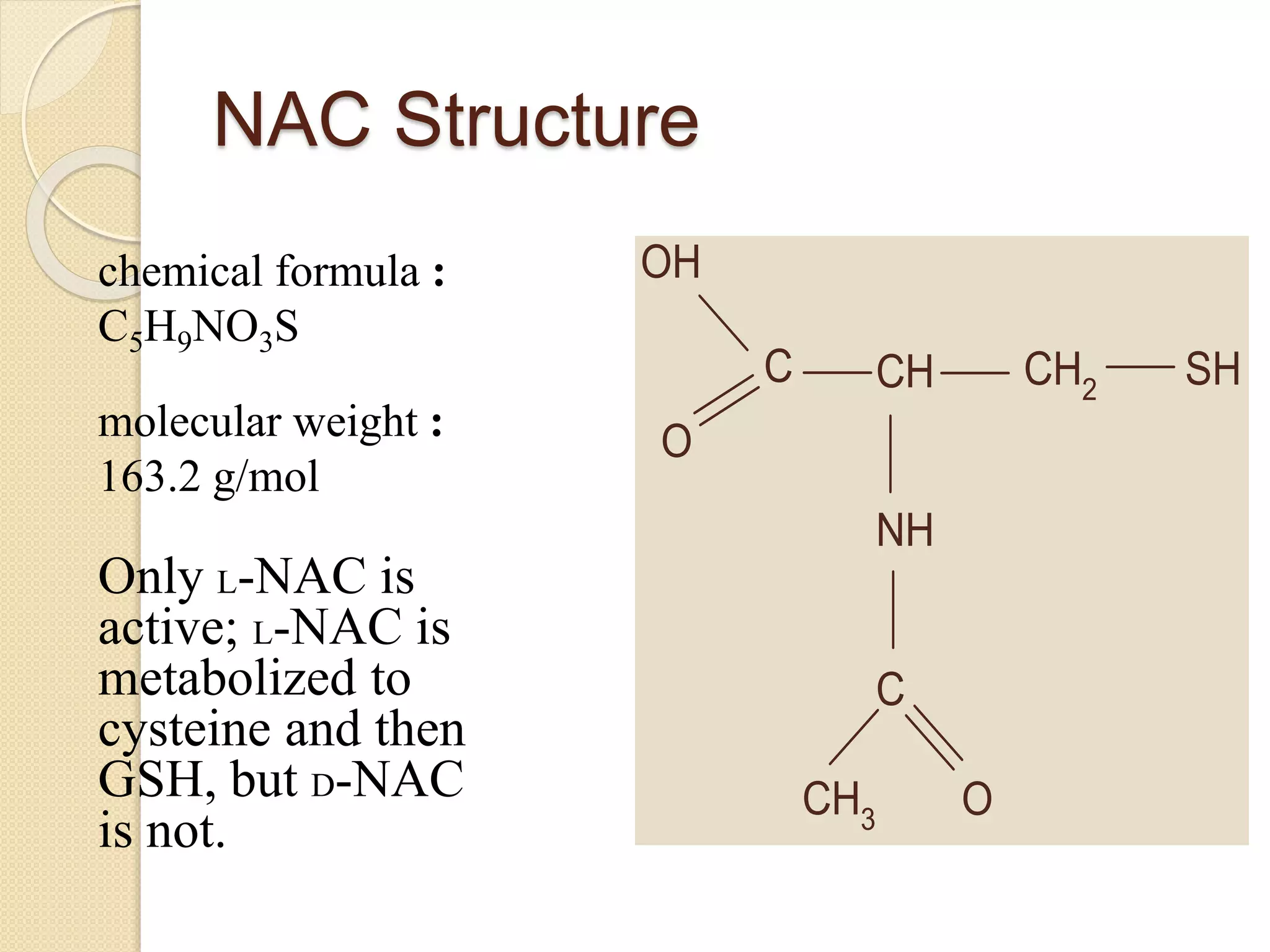
NAC Structure
chemical formula :
C5H9NO3S
molecular weight :
163.2 g/mol
Only L-NAC is
active; L-NAC is
metabolized to
cysteine and then
GSH, but D-NAC
is not.
C CH CH2
SH
NH
C
CH3 O
O
OH
Metabolism of NAC
N-Acetylcysteine 12/2002
Society For Free Radical Biology
and Medicine
Erc
al &
Gur
er-
Orh
an
3
Oral NAC administration
Extensive first-pass metabolism in
liver and intestine
3% of NAC
excreted in feces
Rapid absorption
LIVER
INTESTINE
NAC
deacetylation
cysteine
glutamate
Glutamylcystein
ee
+
glycine
GSH
+
GSH
synthase
glutamate-cysteine ligase
NAC uses
Some people use N-acetyl cysteine for
chronic bronchitis, chronic obstructive pulmonary
disease (COPD), hay fever, a lung condition
called fibrosing alveolitis, head and neck cancer,
and lung cancer. It is also used for treating some
forms ofepilepsy; ear infections; complications
of kidney dialysis; chronic fatigue syndrome (CFS);
an autoimmune disorder called Sjogren’s
syndrome; preventing sports injury
complications; radiation treatment; increasing
immunity to flu and H1N1 (swine) flu; and for
detoxifying heavy metals such as mercury, lead,
and cadmium.
N-acetyl cysteine is sometimes inhaled (breathed into the
lungs) or delivered through a tube in the throat to treat
certain lung disorders such as pneumonia,
bronchitis,emphysema, cystic fibrosis, and others
N-acetyl cysteine is also used for preventing alcoholic liver
damage; for protecting against environmental pollutants
including carbon monoxide, chloroform, urethanes and
certain herbicides; for reducing toxicity
of ifosfamide and doxorubicin, drugs that are used for
cancer treatment; as a hangover remedy; for preventing
kidney damage due to certain X-ray dyes; and for human
immunodeficiency virus (HIV).
Possibly Effective for:
Preventing problems such as heart attack and stroke in people with
serious kidney disease. The risk reduction can be as much as 40%.
However, N-acetyl cysteine doesn’t reduce the overall risk of death
or death from heart disease in these people.
Chest pain (angina).
Preventing complications of chronic bronchitis.
Preventing complications of lung disease (chronic obstructive
pulmonary disease, COPD).
Preventing side effects of ifosfamide (Ifex), which is used for certain
types of cancer.
Preventing kidney problems with dyes used during some X-ray
exams.
Reducing homocysteine levels, a possible risk factor for heart
disease.
Reducing symptoms of the flu.
Reducing symptoms of hair pulling.
Treating some types of epilepsy seizures.
Treating a lung disease called fibrosing alveolitis.
Dr. Aidah Abu El Soud Alkaissi
An-Najah National University
Faculty of Nursing
Timing of NAC Administration
The optimal time is within the first eight hours following
acetaminophen ingestion
During this period and regardless of the amount ingested and the
acetaminophen level, NAC is uniformly effective
After the eight-hour post-ingestion period, the efficacy of NAC
decreases progressively
N-ACETYLCYSTEINE
Very effective – 100% within 8 hours
Oral in U.S. – IV in Europe
Dose: 140mg/kg load, 70mg/kg Q 4hrs
Traditional – 72 hours
Short course – reassess at 20 hours
INTRAVENOUS NAC
Oral preparation vs Acetadote®
Concern is anaphylactoid reactions
Indications:
Can’t tolerate oral NAC
Contraindication to oral therapy
Ongoing GI decon (coingestant)
Fulminant hepatic failure?
Pregnant patient?
Dr. Aidah Abu El Soud Alkaissi
An-Najah National University
Faculty of Nursing
Efficacy of NAC
Results of the Multi-center Oral N-Acetylcysteine trial suggest that
NAC is beneficial up to 24 hours after ingestion
Other studies comparing a 48-hour oral protocol in the United
States vs. a 20-hour intravenous NAC protocol in Britain found
that both modalities were effective if started within 8-10 hours of
ingestion
A 72-hour oral NAC protocol appeared to be more effective for
high-risk patients presenting late (i.e., 16-24 hours following
ingestion)
Dr. Aidah Abu El Soud Alkaissi
An-Najah National University
Faculty of Nursing
Prior to the advent of an antidote, the mortality rate of patients at
probable risk of hepatotoxicity (> 200 µg/ml at four hours)
was reported between 5.3% and 24%
The overall mortality rates reported with the 20-hour intravenous
NAC protocol and the 72-hour oral protocol were 2% and
0.68%, respectively
No fatalities were reported in any protocol in which NAC
therapy was instituted within 10 hours of ingestion
Dr. Aidah Abu El Soud Alkaissi
An-Najah National University
Faculty of Nursing
Timing of NAC Administration
If a patient with acetaminophen overdose presents more than
eight hours after ingestion;
an acetaminophen level should be sent to the lab,
NAC should be started immediately for those with suspected
significant ingestions while awaiting the result
decisions regarding whether NAC therapy should be
continued or discontinued depend on the result of the
acetaminophen level
Dr. Aidah Abu El Soud Alkaissi
An-Najah National University
Faculty of Nursing
PO administration of NAC - ADULT
140 mg/kg loading dose,
followed by 70 mg/kg q4h for 17 additional doses
(total 1330 mg/kg over 72 h)
Dr. Aidah Abu El Soud Alkaissi
An-Najah National University
Faculty of Nursing
Dosage for NAC infusion - ADULT
(1) 150mg/kg IV infusion in 200mL 5% dextrose over
15 minutes, then
(2) 50mg/kg IV infusion in 500mL 5% dextrose over
4 hours, then
(3) 100mg/kg IV infusion in 1000mL 5% dextrose over
16 hours
Dr. Aidah Abu El Soud Alkaissi
An-Najah National University
Faculty of Nursing
Adverse reactions to NAC and their
management
Adverse effects which may be localised to the area surrounding the
infusion site or may be more generalised
These usually occur during the first 30 minutes of administration
when large amounts of NAC are being given rapidly
They include nausea, flushing, itching, erythematous rash, urticaria,
angioedema, bronchospasm and, rarely, hypotension or
hypertension
Dr. Aidah Abu El Soud Alkaissi
An-Najah National University
Faculty of Nursing
Delayed NAC Therapy
Recently, a randomized blinded trial from Britain evaluated the efficacy
of late NAC therapy in patients with fulminant liver failure and Grade
III or IV hepatic encephalopathy
The investigators demonstrated significant improvement in survival rate
(48% vs 20%) with NAC therapy and decreased incidence of elevated
intracranial pressure and systemic hypotension
Dr. Aidah Abu El Soud Alkaissi
An-Najah National University
Faculty of Nursing
Delayed NAC Therapy
In another study examining effects of NAC on the
microcirculation of different organs in patients with either
Grade III or IV hepatic coma and fulminant liver failure from
different etiologies, the authors discovered that NAC increased
cardiac index, decreased vascular resistance, and improved
oxygen delivery and extraction
This evidence supports NAC therapy for acetaminophen-toxic
patients regardless of the time of ingestion, the optimal dose
and duration of late NAC therapy remains undefined
NAC in Acetaminophen Poisoning and as a
Mucolytic Agent
Probably one of the most common clinical uses of NAC is
thetreatment of acetaminophen poisoning (Tylenol).
Acetaminophen is metabolized in the liver upon
digestionand the resulting metabolite, N-acetyl
benzoquinoneimine,reacts to deplete the hepatic
glutathione pool. NAC acts toreplenish these GSH
levels.
NAC is useful as a mucolytic agent for treatment of
chronicbronchitis and other pulmonary diseases.
Administration ofNAC decreases cough severity
and diaphragm fatigue.NAC’s sulfhydryl group reacts
and splits disulfide bonds inthe mucous bronchial
secretions. Because the mucus isbroken down into
smaller, less viscous units, NAC isreferred to as
“slime loosener”. N-Acetylcysteine 12/2002
Society For Free Radical Biology
and Medicine
Erc
al &
Gur
er-
Orh
an
18
Mucolytics:
Mucomyst (N-Acetylcysteine)
cont.
Aerosol dose is 2-5ml of
10%
10% is as effective as 20%
when aerosolized and is
not as irritating
Side effects/Pre-cautions:
Bronchospasm
May need a concurrent
bronchodilator
Decreased ciliary activity
Patient may need to be
suctioned if he can’t cough
effectively
Nausea/rhinorrhea
Reacts with metal and
rubber
Shelf life is 96 hours after
opening
Should be refrigerated
Purple streaks when too old
Inactivates some
antibiotics if they are
aerosolized with
Mucomyst
NAC in HIV Infection
Individuals with HIV usually have decreased GSH and
cysteine levels. The net loss of sulfur in asymptomatic
HIV+ patients is equivalent to a mean loss of about 10
g of cysteine per day. NAC can completely inhibit
inflammatory stimulations of HIV replication by
supplementation of GSH.
Breitkreutz R. et al. AIDS Res Hum Retroviruses 16: 203-
9, 2000.
Roederer M. et al. AIDS Res Hum Retroviruses 8: 209-
217, 1992.
NAC can inhibit NF-B activation leading to inhibition of
stimulated viral transcription and replication.
Roederer M. et al. Proc Natl Acad Sci USA 87: 4884-
4888, 1990.
N-Acetylcysteine 12/2002
Society For Free Radical Biology
and Medicine
Erc
al &
Gur
er-
Orh
an
20
NAC in Cancer
According to research findings, certain types of cancer
including lung, skin, head and neck, mammary, and liver can
be potentially treated with NAC.
Many in vitro studies conducted on human melanoma,
prostate, and astrocytoma cell lines have helped to prove
NAC’s efficacy as a chemopreventive agent. NAC has been
found to be effective in inhibiting cell growth and proliferation
in all mentioned cell lines.
Results from both cell culture and animal studies indicate that
NAC administration can selectively protect normal cells, but
not malignant ones, from chemotherapy and radiation
toxicity.
De Flora S et al. Toxicol. Lett. 53: W4/L2, 1992.
De Flora S et al. Respiration 50: S43-S49, 1986.
De Flora S et al. Int J Cancer 67: 842-848, 1996.
Redondo et al. Cytokine 12: 374-378, 2000.
Chiao JW et al. Int J Oncol. 16:1215-1219, 2000.
N-Acetylcysteine 12/2002
Society For Free Radical Biology
and Medicine
Erc
al &
Gur
er-
Orh
an
21
NAC as a Metal Chelator
NAC has been shown to be more effective than
calcium EDTA or dimercaptosuccinic acid for
the excretion of chromium and boron.
Banner W Jr. et al. Toxicol. Appl. Pharmacol. 83: 142-147,
1986.
It also has the ability to promote the urinary
excretion of cadmium but not of lead. However,
an antioxidant role was suggested for NAC in
lead toxicity which can be attributed to it’s free
–SH group.
Ottenwalder H & Simon P. Arch. Toxicol. 60: 401-402, 1987.
Ercal N. et al. Free Radic. Biol. Med. 21:157-161, 1996.
N-Acetylcysteine 12/2002
Society For Free Radical Biology
and Medicine
Erc
al &
Gur
er-
Orh
an
22
NAC in Heart Diseases
NAC acts by breaking up disulfide bonds and lowering
homocysteine and lipoprotein levels.
By replenishing depleted GSH, NAC helps to protect against
ischemic and reperfusion damage.
NAC helps to increase nitroglycerin activity. NAC especially
potentiates the coronary dilating and anti-platelet effects of
nitroglycerin and limits the development of hemodynamic
tolerance to nitroglycerin.
Clinical signs of myocardial ischemia, such as ST-depression, do
not occur if patients are prophylactically treated with NAC.
Gavish D & Breslow JL. Lancet 14:202-210, 1991.
Hultberg B et al. Clin Chim Acta 262: 39-51, 1997.
Wiklund O et al. Atherosclerosis 119: 99-106, 1996.
Winniford MD et al. Circulation 73:138-142, 1986.
N-Acetylcysteine 12/2002
Society For Free Radical Biology
and Medicine
Erc
al &
Gur
er-
Orh
an
23
N-ACETYL CYSTEINE SIDE EFFECTS &
SAFETY
N-acetyl cysteine is LIKELY SAFE for most adults, when used
as a prescription medication. It can cause nausea, vomiting,
and diarrhea or constipation. Rarely, it can cause rashes,
fever, headache, drowsiness, low blood pressure, and liver
problems.
When inhaled (breathed into the lungs), it can also cause
swelling in the mouth, runny nose, drowsiness, clamminess,
and chest tightness.
N-acetyl cysteine has an unpleasant odor that may make it
hard to take. Side effects common to high oral doses include
nausea, vomiting, and other gastrointestinal disturbances.
Intravenous administration has been shown, in some cases, to cause
allergic reactions usually in the form of rash or angioedema.
NAC is not recommended to be administered in conjunction with
charcoal as the charcoal may interfere with the absorption of NAC.
Since the pharmacokinetics of NAC are significantly altered in
patients with
chronic liver diseases, NAC administration should be carefully
adjusted
Pregnancy or breast-feeding: N-acetyl cysteine
is POSSIBLY SAFE when taken by mouth, delivered
through a hole in the windpipe, or breathed in. N-
acetyl cysteine crosses the placenta, but there is no
evidence so far linking it with harm to the unborn child
or mother. However, N-acetyl cysteine should only be
used in pregnant women when clearly needed, such
as in cases of acetaminophen toxicity.
Allergy: Don’t use N-acetyl cysteine if you are allergic
to acetyl cysteine.
Asthma: There is a concern that N-acetyl cysteine
might cause bronchospasm in people with asthma if
inhaled or taken by mouth or through a tube in the
windpipe. If you take N-acetyl cysteine and have
asthma, you should be monitored by your healthcare
provider.
Warnings and Contraindications
NAC may have a protective effect on normal tissue in
individuals utilizing many cancer
chemotherapeutic agents;
42-47
however, two studies noted that NAC inhibits cytotoxicity
of the
cancer chemotherapy drug cisplatin,
48,49
and an animal study suggests NAC might reduce the
anti-neoplastic action of doxorubicin. These combinations
should be avoided unless further
information recommends otherwise.
50
Dosage of NAC for Various Diseases
Disease Dosage
Acetaminophen
Poisoning (human)
140 mg/kg followed by 17 subsequent
doses of 70 mg/kg every 4 h
Chronic Bronchitis
(human)
600-1500 mg/day in 3 divided doses
HIV infection (human) 800-8000 mg/day
Cancer treatment and
prevention
High doses (2-4 g daily)
Information is still preliminary
Chelation in metal
toxicity (animal)
250-1500 mg/day
Heart Diseases 2-4 g daily for 8 weeks
N-Acetylcysteine 12/2002
Society For Free Radical Biology
and Medicine Ercal & Gurer-Orhan 27
Caution in Dosage
Caution is needed in scheduling the dosage of NAC
when used in HIV+ patients. In overdoses of NAC,
excessive cysteine catabolism in the liver is associated
with the production of protons and may inhibit urea
production in favor of glutamine production, eventually to
the point that toxic ammonia accumulates. Therefore,
instead of supplying a constant dose of NAC, Breitkreutz
R et al. suggested “NAC treatment with individually
adjusted doses” where they decreased NAC dose
whenever the plasma glutamine level exceeds a certain
limit.
Breitkreutz et al. J Mol Med 78: 55-62, 2000
Dröge W, Holm E. FASEB J 11: 1077-1089, 1997
N-Acetylcysteine 12/2002
Society For Free Radical Biology
and Medicine
Erc
al &
Gur
er-
Orh
an
28
Caution in Infection and Septic
States
NAC has been found to suppress respiratory burst
but to augment neutrophil phagocytosis in intensive
care patients. For certain pathophysiological
mechanisms (such as ischemia/reperfusion, or
endothelial cell activation), the effects of NAC might
be favorable. However, during infection or septic
states, a reduced respiratory burst might be
detrimental.
Heller AR et al. Crit Care Med 29: 272-276, 2001
N-Acetylcysteine 12/2002
Society For Free Radical Biology
and Medicine
Erc
al &
Gur
er-
Orh
an
29
Caution in Antiviral
Monotherapies
It was observed that NAC
enhances contact dependent growth of HIV in
resting peripheral blood mononuclear cells in
vitro.
increases the recovery of HIV from human
peripheral blood mononuclear cell in severe
combined immunodeficiency mice.
These might be important points to be considered
for further investigations and clinical applications
of NAC.
Chen P et al. AIDS 11: 33-41, 1997
N-Acetylcysteine 12/2002
Society For Free Radical Biology
and Medicine
Erc
al &
Gur
er-
Orh
an
30
Conclusions
Recent studies suggest a new and important role for
an old, “designated (but not approved) orphan
drug”, NAC, in many clinical situations in which
GSH deficiency and/or oxidative stress are
involved such as HIV, rheumatoid arthritis,
Parkinson’s disease, Alzheimer’s disease,
diabetes, hepatitis, organ transplantation and
others.
Even though NAC has a long history of use in
humans and its safety and pharmacokinetics are
well established, caution needs to be taken in
applications to new pathophysiologies.
N-Acetylcysteine 12/2002
Society For Free Radical Biology
and Medicine
Erc
al &
Gur
er-
Orh
an
31
Thank you

Nac

  • 1.
    N-ACETYLCYSTEINE (NAC): ITS USESAND ABUSES By: HAIFA ALSHWIKH
  • 2.
    NAC Structure chemical formula: C5H9NO3S molecular weight : 163.2 g/mol Only L-NAC is active; L-NAC is metabolized to cysteine and then GSH, but D-NAC is not. C CH CH2 SH NH C CH3 O O OH
  • 3.
    Metabolism of NAC N-Acetylcysteine12/2002 Society For Free Radical Biology and Medicine Erc al & Gur er- Orh an 3 Oral NAC administration Extensive first-pass metabolism in liver and intestine 3% of NAC excreted in feces Rapid absorption LIVER INTESTINE NAC deacetylation cysteine glutamate Glutamylcystein ee + glycine GSH + GSH synthase glutamate-cysteine ligase
  • 4.
    NAC uses Some peopleuse N-acetyl cysteine for chronic bronchitis, chronic obstructive pulmonary disease (COPD), hay fever, a lung condition called fibrosing alveolitis, head and neck cancer, and lung cancer. It is also used for treating some forms ofepilepsy; ear infections; complications of kidney dialysis; chronic fatigue syndrome (CFS); an autoimmune disorder called Sjogren’s syndrome; preventing sports injury complications; radiation treatment; increasing immunity to flu and H1N1 (swine) flu; and for detoxifying heavy metals such as mercury, lead, and cadmium.
  • 5.
    N-acetyl cysteine issometimes inhaled (breathed into the lungs) or delivered through a tube in the throat to treat certain lung disorders such as pneumonia, bronchitis,emphysema, cystic fibrosis, and others N-acetyl cysteine is also used for preventing alcoholic liver damage; for protecting against environmental pollutants including carbon monoxide, chloroform, urethanes and certain herbicides; for reducing toxicity of ifosfamide and doxorubicin, drugs that are used for cancer treatment; as a hangover remedy; for preventing kidney damage due to certain X-ray dyes; and for human immunodeficiency virus (HIV).
  • 6.
    Possibly Effective for: Preventingproblems such as heart attack and stroke in people with serious kidney disease. The risk reduction can be as much as 40%. However, N-acetyl cysteine doesn’t reduce the overall risk of death or death from heart disease in these people. Chest pain (angina). Preventing complications of chronic bronchitis. Preventing complications of lung disease (chronic obstructive pulmonary disease, COPD). Preventing side effects of ifosfamide (Ifex), which is used for certain types of cancer. Preventing kidney problems with dyes used during some X-ray exams. Reducing homocysteine levels, a possible risk factor for heart disease. Reducing symptoms of the flu. Reducing symptoms of hair pulling. Treating some types of epilepsy seizures. Treating a lung disease called fibrosing alveolitis.
  • 7.
    Dr. Aidah AbuEl Soud Alkaissi An-Najah National University Faculty of Nursing Timing of NAC Administration The optimal time is within the first eight hours following acetaminophen ingestion During this period and regardless of the amount ingested and the acetaminophen level, NAC is uniformly effective After the eight-hour post-ingestion period, the efficacy of NAC decreases progressively
  • 8.
    N-ACETYLCYSTEINE Very effective –100% within 8 hours Oral in U.S. – IV in Europe Dose: 140mg/kg load, 70mg/kg Q 4hrs Traditional – 72 hours Short course – reassess at 20 hours
  • 9.
    INTRAVENOUS NAC Oral preparationvs Acetadote® Concern is anaphylactoid reactions Indications: Can’t tolerate oral NAC Contraindication to oral therapy Ongoing GI decon (coingestant) Fulminant hepatic failure? Pregnant patient?
  • 10.
    Dr. Aidah AbuEl Soud Alkaissi An-Najah National University Faculty of Nursing Efficacy of NAC Results of the Multi-center Oral N-Acetylcysteine trial suggest that NAC is beneficial up to 24 hours after ingestion Other studies comparing a 48-hour oral protocol in the United States vs. a 20-hour intravenous NAC protocol in Britain found that both modalities were effective if started within 8-10 hours of ingestion A 72-hour oral NAC protocol appeared to be more effective for high-risk patients presenting late (i.e., 16-24 hours following ingestion)
  • 11.
    Dr. Aidah AbuEl Soud Alkaissi An-Najah National University Faculty of Nursing Prior to the advent of an antidote, the mortality rate of patients at probable risk of hepatotoxicity (> 200 µg/ml at four hours) was reported between 5.3% and 24% The overall mortality rates reported with the 20-hour intravenous NAC protocol and the 72-hour oral protocol were 2% and 0.68%, respectively No fatalities were reported in any protocol in which NAC therapy was instituted within 10 hours of ingestion
  • 12.
    Dr. Aidah AbuEl Soud Alkaissi An-Najah National University Faculty of Nursing Timing of NAC Administration If a patient with acetaminophen overdose presents more than eight hours after ingestion; an acetaminophen level should be sent to the lab, NAC should be started immediately for those with suspected significant ingestions while awaiting the result decisions regarding whether NAC therapy should be continued or discontinued depend on the result of the acetaminophen level
  • 13.
    Dr. Aidah AbuEl Soud Alkaissi An-Najah National University Faculty of Nursing PO administration of NAC - ADULT 140 mg/kg loading dose, followed by 70 mg/kg q4h for 17 additional doses (total 1330 mg/kg over 72 h)
  • 14.
    Dr. Aidah AbuEl Soud Alkaissi An-Najah National University Faculty of Nursing Dosage for NAC infusion - ADULT (1) 150mg/kg IV infusion in 200mL 5% dextrose over 15 minutes, then (2) 50mg/kg IV infusion in 500mL 5% dextrose over 4 hours, then (3) 100mg/kg IV infusion in 1000mL 5% dextrose over 16 hours
  • 15.
    Dr. Aidah AbuEl Soud Alkaissi An-Najah National University Faculty of Nursing Adverse reactions to NAC and their management Adverse effects which may be localised to the area surrounding the infusion site or may be more generalised These usually occur during the first 30 minutes of administration when large amounts of NAC are being given rapidly They include nausea, flushing, itching, erythematous rash, urticaria, angioedema, bronchospasm and, rarely, hypotension or hypertension
  • 16.
    Dr. Aidah AbuEl Soud Alkaissi An-Najah National University Faculty of Nursing Delayed NAC Therapy Recently, a randomized blinded trial from Britain evaluated the efficacy of late NAC therapy in patients with fulminant liver failure and Grade III or IV hepatic encephalopathy The investigators demonstrated significant improvement in survival rate (48% vs 20%) with NAC therapy and decreased incidence of elevated intracranial pressure and systemic hypotension
  • 17.
    Dr. Aidah AbuEl Soud Alkaissi An-Najah National University Faculty of Nursing Delayed NAC Therapy In another study examining effects of NAC on the microcirculation of different organs in patients with either Grade III or IV hepatic coma and fulminant liver failure from different etiologies, the authors discovered that NAC increased cardiac index, decreased vascular resistance, and improved oxygen delivery and extraction This evidence supports NAC therapy for acetaminophen-toxic patients regardless of the time of ingestion, the optimal dose and duration of late NAC therapy remains undefined
  • 18.
    NAC in AcetaminophenPoisoning and as a Mucolytic Agent Probably one of the most common clinical uses of NAC is thetreatment of acetaminophen poisoning (Tylenol). Acetaminophen is metabolized in the liver upon digestionand the resulting metabolite, N-acetyl benzoquinoneimine,reacts to deplete the hepatic glutathione pool. NAC acts toreplenish these GSH levels. NAC is useful as a mucolytic agent for treatment of chronicbronchitis and other pulmonary diseases. Administration ofNAC decreases cough severity and diaphragm fatigue.NAC’s sulfhydryl group reacts and splits disulfide bonds inthe mucous bronchial secretions. Because the mucus isbroken down into smaller, less viscous units, NAC isreferred to as “slime loosener”. N-Acetylcysteine 12/2002 Society For Free Radical Biology and Medicine Erc al & Gur er- Orh an 18
  • 19.
    Mucolytics: Mucomyst (N-Acetylcysteine) cont. Aerosol doseis 2-5ml of 10% 10% is as effective as 20% when aerosolized and is not as irritating Side effects/Pre-cautions: Bronchospasm May need a concurrent bronchodilator Decreased ciliary activity Patient may need to be suctioned if he can’t cough effectively Nausea/rhinorrhea Reacts with metal and rubber Shelf life is 96 hours after opening Should be refrigerated Purple streaks when too old Inactivates some antibiotics if they are aerosolized with Mucomyst
  • 20.
    NAC in HIVInfection Individuals with HIV usually have decreased GSH and cysteine levels. The net loss of sulfur in asymptomatic HIV+ patients is equivalent to a mean loss of about 10 g of cysteine per day. NAC can completely inhibit inflammatory stimulations of HIV replication by supplementation of GSH. Breitkreutz R. et al. AIDS Res Hum Retroviruses 16: 203- 9, 2000. Roederer M. et al. AIDS Res Hum Retroviruses 8: 209- 217, 1992. NAC can inhibit NF-B activation leading to inhibition of stimulated viral transcription and replication. Roederer M. et al. Proc Natl Acad Sci USA 87: 4884- 4888, 1990. N-Acetylcysteine 12/2002 Society For Free Radical Biology and Medicine Erc al & Gur er- Orh an 20
  • 21.
    NAC in Cancer Accordingto research findings, certain types of cancer including lung, skin, head and neck, mammary, and liver can be potentially treated with NAC. Many in vitro studies conducted on human melanoma, prostate, and astrocytoma cell lines have helped to prove NAC’s efficacy as a chemopreventive agent. NAC has been found to be effective in inhibiting cell growth and proliferation in all mentioned cell lines. Results from both cell culture and animal studies indicate that NAC administration can selectively protect normal cells, but not malignant ones, from chemotherapy and radiation toxicity. De Flora S et al. Toxicol. Lett. 53: W4/L2, 1992. De Flora S et al. Respiration 50: S43-S49, 1986. De Flora S et al. Int J Cancer 67: 842-848, 1996. Redondo et al. Cytokine 12: 374-378, 2000. Chiao JW et al. Int J Oncol. 16:1215-1219, 2000. N-Acetylcysteine 12/2002 Society For Free Radical Biology and Medicine Erc al & Gur er- Orh an 21
  • 22.
    NAC as aMetal Chelator NAC has been shown to be more effective than calcium EDTA or dimercaptosuccinic acid for the excretion of chromium and boron. Banner W Jr. et al. Toxicol. Appl. Pharmacol. 83: 142-147, 1986. It also has the ability to promote the urinary excretion of cadmium but not of lead. However, an antioxidant role was suggested for NAC in lead toxicity which can be attributed to it’s free –SH group. Ottenwalder H & Simon P. Arch. Toxicol. 60: 401-402, 1987. Ercal N. et al. Free Radic. Biol. Med. 21:157-161, 1996. N-Acetylcysteine 12/2002 Society For Free Radical Biology and Medicine Erc al & Gur er- Orh an 22
  • 23.
    NAC in HeartDiseases NAC acts by breaking up disulfide bonds and lowering homocysteine and lipoprotein levels. By replenishing depleted GSH, NAC helps to protect against ischemic and reperfusion damage. NAC helps to increase nitroglycerin activity. NAC especially potentiates the coronary dilating and anti-platelet effects of nitroglycerin and limits the development of hemodynamic tolerance to nitroglycerin. Clinical signs of myocardial ischemia, such as ST-depression, do not occur if patients are prophylactically treated with NAC. Gavish D & Breslow JL. Lancet 14:202-210, 1991. Hultberg B et al. Clin Chim Acta 262: 39-51, 1997. Wiklund O et al. Atherosclerosis 119: 99-106, 1996. Winniford MD et al. Circulation 73:138-142, 1986. N-Acetylcysteine 12/2002 Society For Free Radical Biology and Medicine Erc al & Gur er- Orh an 23
  • 24.
    N-ACETYL CYSTEINE SIDEEFFECTS & SAFETY N-acetyl cysteine is LIKELY SAFE for most adults, when used as a prescription medication. It can cause nausea, vomiting, and diarrhea or constipation. Rarely, it can cause rashes, fever, headache, drowsiness, low blood pressure, and liver problems. When inhaled (breathed into the lungs), it can also cause swelling in the mouth, runny nose, drowsiness, clamminess, and chest tightness. N-acetyl cysteine has an unpleasant odor that may make it hard to take. Side effects common to high oral doses include nausea, vomiting, and other gastrointestinal disturbances. Intravenous administration has been shown, in some cases, to cause allergic reactions usually in the form of rash or angioedema. NAC is not recommended to be administered in conjunction with charcoal as the charcoal may interfere with the absorption of NAC. Since the pharmacokinetics of NAC are significantly altered in patients with chronic liver diseases, NAC administration should be carefully adjusted
  • 25.
    Pregnancy or breast-feeding:N-acetyl cysteine is POSSIBLY SAFE when taken by mouth, delivered through a hole in the windpipe, or breathed in. N- acetyl cysteine crosses the placenta, but there is no evidence so far linking it with harm to the unborn child or mother. However, N-acetyl cysteine should only be used in pregnant women when clearly needed, such as in cases of acetaminophen toxicity. Allergy: Don’t use N-acetyl cysteine if you are allergic to acetyl cysteine. Asthma: There is a concern that N-acetyl cysteine might cause bronchospasm in people with asthma if inhaled or taken by mouth or through a tube in the windpipe. If you take N-acetyl cysteine and have asthma, you should be monitored by your healthcare provider.
  • 26.
    Warnings and Contraindications NACmay have a protective effect on normal tissue in individuals utilizing many cancer chemotherapeutic agents; 42-47 however, two studies noted that NAC inhibits cytotoxicity of the cancer chemotherapy drug cisplatin, 48,49 and an animal study suggests NAC might reduce the anti-neoplastic action of doxorubicin. These combinations should be avoided unless further information recommends otherwise. 50
  • 27.
    Dosage of NACfor Various Diseases Disease Dosage Acetaminophen Poisoning (human) 140 mg/kg followed by 17 subsequent doses of 70 mg/kg every 4 h Chronic Bronchitis (human) 600-1500 mg/day in 3 divided doses HIV infection (human) 800-8000 mg/day Cancer treatment and prevention High doses (2-4 g daily) Information is still preliminary Chelation in metal toxicity (animal) 250-1500 mg/day Heart Diseases 2-4 g daily for 8 weeks N-Acetylcysteine 12/2002 Society For Free Radical Biology and Medicine Ercal & Gurer-Orhan 27
  • 28.
    Caution in Dosage Cautionis needed in scheduling the dosage of NAC when used in HIV+ patients. In overdoses of NAC, excessive cysteine catabolism in the liver is associated with the production of protons and may inhibit urea production in favor of glutamine production, eventually to the point that toxic ammonia accumulates. Therefore, instead of supplying a constant dose of NAC, Breitkreutz R et al. suggested “NAC treatment with individually adjusted doses” where they decreased NAC dose whenever the plasma glutamine level exceeds a certain limit. Breitkreutz et al. J Mol Med 78: 55-62, 2000 Dröge W, Holm E. FASEB J 11: 1077-1089, 1997 N-Acetylcysteine 12/2002 Society For Free Radical Biology and Medicine Erc al & Gur er- Orh an 28
  • 29.
    Caution in Infectionand Septic States NAC has been found to suppress respiratory burst but to augment neutrophil phagocytosis in intensive care patients. For certain pathophysiological mechanisms (such as ischemia/reperfusion, or endothelial cell activation), the effects of NAC might be favorable. However, during infection or septic states, a reduced respiratory burst might be detrimental. Heller AR et al. Crit Care Med 29: 272-276, 2001 N-Acetylcysteine 12/2002 Society For Free Radical Biology and Medicine Erc al & Gur er- Orh an 29
  • 30.
    Caution in Antiviral Monotherapies Itwas observed that NAC enhances contact dependent growth of HIV in resting peripheral blood mononuclear cells in vitro. increases the recovery of HIV from human peripheral blood mononuclear cell in severe combined immunodeficiency mice. These might be important points to be considered for further investigations and clinical applications of NAC. Chen P et al. AIDS 11: 33-41, 1997 N-Acetylcysteine 12/2002 Society For Free Radical Biology and Medicine Erc al & Gur er- Orh an 30
  • 31.
    Conclusions Recent studies suggesta new and important role for an old, “designated (but not approved) orphan drug”, NAC, in many clinical situations in which GSH deficiency and/or oxidative stress are involved such as HIV, rheumatoid arthritis, Parkinson’s disease, Alzheimer’s disease, diabetes, hepatitis, organ transplantation and others. Even though NAC has a long history of use in humans and its safety and pharmacokinetics are well established, caution needs to be taken in applications to new pathophysiologies. N-Acetylcysteine 12/2002 Society For Free Radical Biology and Medicine Erc al & Gur er- Orh an 31
  • 32.