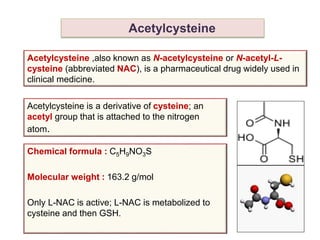
Acetylcysteine ,also known as N-acetylcysteine or N-acetyl-L-
cysteine (abbreviated NAC), is a pharmaceutical drug widely used in
clinical medicine.
Acetylcysteine
Acetylcysteine is a derivative of cysteine; an
acetyl group that is attached to the nitrogen
atom.
Chemical formula : C5H9NO3S
Molecular weight : 163.2 g/mol
Only L-NAC is active; L-NAC is metabolized to
cysteine and then GSH.
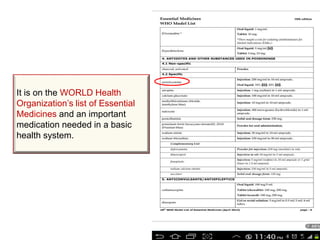
It is on the WORLD Health
Organization’s list of Essential
Medicines and an important
medication needed in a basic
health system.
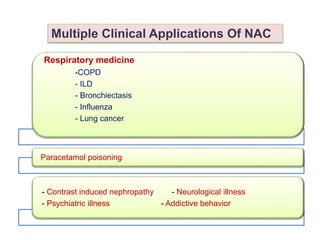
Multiple Clinical Applications Of NAC
Respiratory medicine
-COPD
- ILD
- Bronchiectasis
- Influenza
- Lung cancer
Paracetamol poisoning
- Contrast induced nephropathy - Neurological illness
- Psychiatric illness - Addictive behavior
NAC in COPD
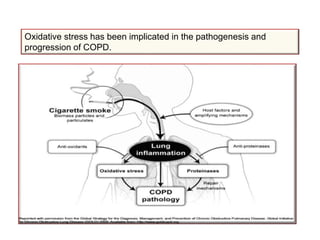
Oxidative stress has been implicated in the pathogenesis and
progression of COPD.
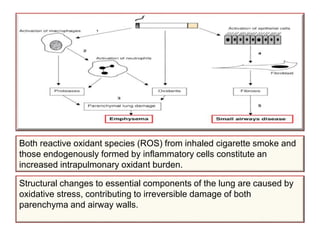
Structural changes to essential components of the lung are caused by
oxidative stress, contributing to irreversible damage of both
parenchyma and airway walls.
Both reactive oxidant species (ROS) from inhaled cigarette smoke and
those endogenously formed by inflammatory cells constitute an
increased intrapulmonary oxidant burden.
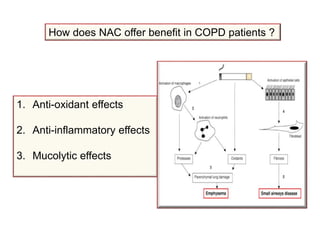
How does NAC offer benefit in COPD patients ?
1. Anti-oxidant effects
2. Anti-inflammatory effects
3. Mucolytic effects
N-acetylcysteine –
1. Reduces clinical symptom
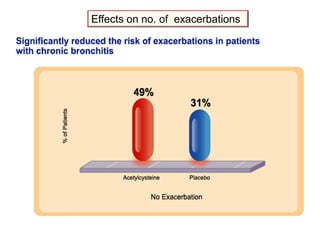
2. Reduces severity and no. of exacerbations and
3. Reduces the accelerated lung function decline.
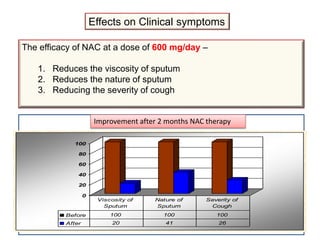
Effects on Clinical symptoms
The efficacy of NAC at a dose of 600 mg/day –
1. Reduces the viscosity of sputum
2. Reduces the nature of sputum
3. Reducing the severity of cough
0
20
40
60
80
100
Before 100 100 100
After 20 41 26
Viscosity of
Sputum
Nature of
Sputum
Severity of
Cough
Improvement after 2 months NAC therapy
Non-smokers
healthy
Smokers
without COPD
Smokers with
COPD
Bacterial colonies
Before After
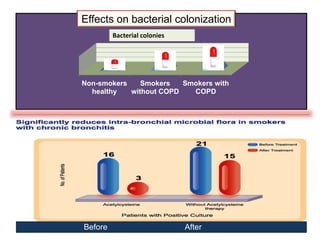
Treatment with NAC: Bacterial colonization
Effects on bacterial colonization
Before 1
year
after 1
year
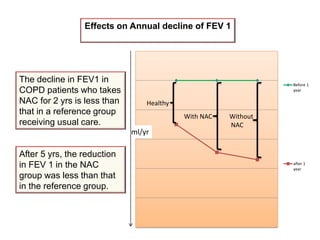
Effects on Annual decline of FEV 1
ml/yr
Healthy
With NAC Without
NAC
The decline in FEV1 in
COPD patients who takes
NAC for 2 yrs is less than
that in a reference group
receiving usual care.
After 5 yrs, the reduction
in FEV 1 in the NAC
group was less than that
in the reference group.
Effects on no. of exacerbations
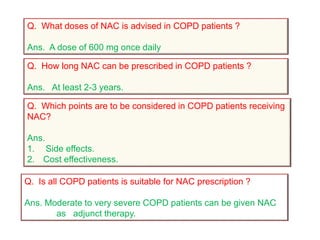
Q. What doses of NAC is advised in COPD patients ?
Ans. A dose of 600 mg once daily
Q. How long NAC can be prescribed in COPD patients ?
Ans. At least 2-3 years.
Q. Is all COPD patients is suitable for NAC prescription ?
Ans. Moderate to very severe COPD patients can be given NAC
as adjunct therapy.
Q. Which points are to be considered in COPD patients receiving
NAC?
Ans.
1. Side effects.
2. Cost effectiveness.
COPD
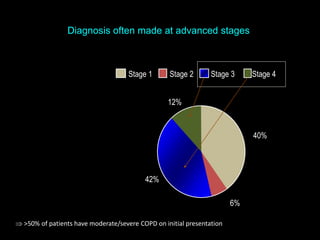
Diagnosis often made at advanced stages
 >50% of patients have moderate/severe COPD on initial presentation
40%
6%
42%
12%
Stage 1 Stage 2 Stage 3 Stage 4
NAC in ILD
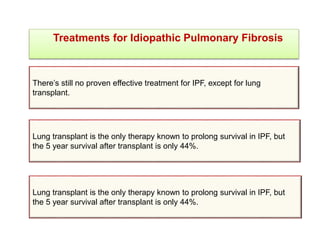
Treatments for Idiopathic Pulmonary Fibrosis
There’s still no proven effective treatment for IPF, except for lung
transplant.
Lung transplant is the only therapy known to prolong survival in IPF, but
the 5 year survival after transplant is only 44%.
Lung transplant is the only therapy known to prolong survival in IPF, but
the 5 year survival after transplant is only 44%.
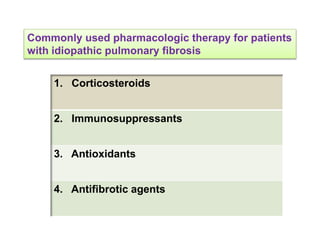
Commonly used pharmacologic therapy for patients
with idiopathic pulmonary fibrosis
1. Corticosteroids
2. Immunosuppressants
3. Antioxidants
4. Antifibrotic agents
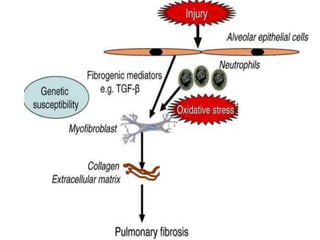
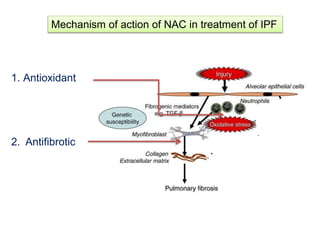
Mechanism of action of NAC in treatment of IPF
1. Antioxidant
2. Antifibrotic
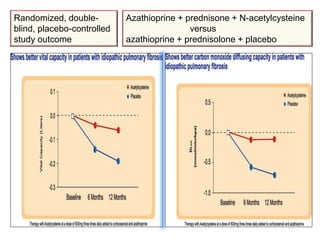
Azathioprine + prednisone + N-acetylcysteine
versus
azathioprine + prednisolone + placebo
Randomized, double-
blind, placebo-controlled
study outcome
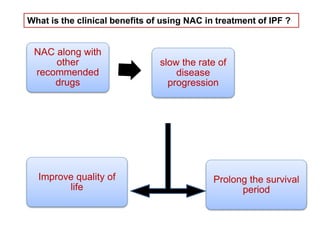
What is the clinical benefits of using NAC in treatment of IPF ?
NAC along with
other
recommended
drugs
slow the rate of
disease
progression
Improve the quaProlong the survival
periodlity of life
Improve quality of
life
Prolong the survival
period
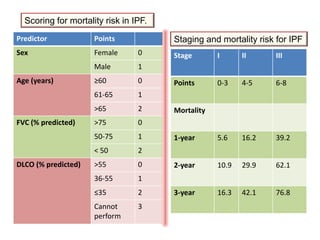
Stage I II III
Points 0-3 4-5 6-8
Mortality
1-year 5.6 16.2 39.2
2-year 10.9 29.9 62.1
3-year 16.3 42.1 76.8
Predictor Points
Sex Female 0
Male 1
Age (years) ≥60 0
61-65 1
>65 2
FVC (% predicted) >75 0
50-75 1
< 50 2
DLCO (% predicted) >55 0
36-55 1
≤35 2
Cannot
perform
3
Scoring for mortality risk in IPF.
Staging and mortality risk for IPF
Other than IPF, N-Acetylcysteine is recommended in ILD
with marked fibrotic changes like –
1. Connective tissue associated interstitial lung diseases,
2. Asbestosis,
3. Sarcoidosis,
4. Hypersensitivity pneumonitis,
5. Drug induced lung disease
NAC in Bronchiectasis
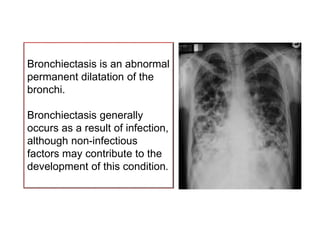
Bronchiectasis is an abnormal
permanent dilatation of the
bronchi.
Bronchiectasis generally
occurs as a result of infection,
although non-infectious
factors may contribute to the
development of this condition.
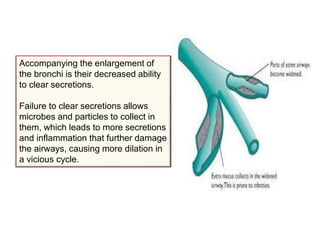
Accompanying the enlargement of
the bronchi is their decreased ability
to clear secretions.
Failure to clear secretions allows
microbes and particles to collect in
them, which leads to more secretions
and inflammation that further damage
the airways, causing more dilation in
a vicious cycle.
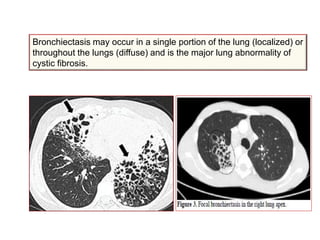
Bronchiectasis may occur in a single portion of the lung (localized) or
throughout the lungs (diffuse) and is the major lung abnormality of
cystic fibrosis.
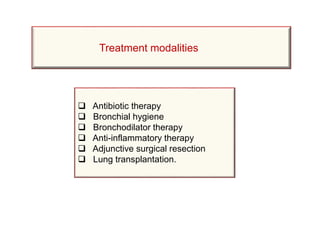
 Antibiotic therapy
 Bronchial hygiene
 Bronchodilator therapy
 Anti-inflammatory therapy
 Adjunctive surgical resection
 Lung transplantation.
Treatment modalities
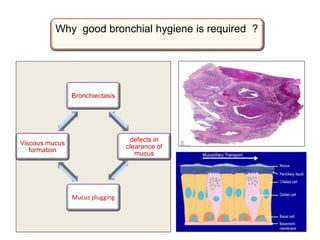
Why good bronchial hygiene is required ?
Bronchiectasis
defects in
clearance of
mucus
Mucus plugging
Viscous mucus
formation
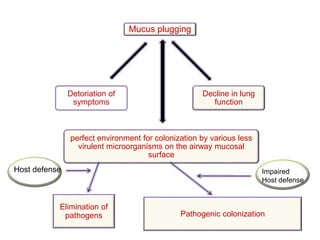
Mucus plugging
Decline in lung
function
perfect environment for colonization by various less
virulent microorganisms on the airway mucosal
surface
Detoriation of
symptoms
Elimination of
pathogens
Host defense
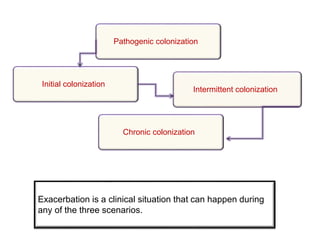
Pathogenic colonization
Impaired
Host defense
Pathogenic colonization
Initial colonization
Intermittent colonization
Chronic colonization
Exacerbation is a clinical situation that can happen during
any of the three scenarios.
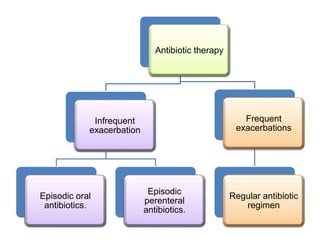
Antibiotic therapy
Infrequent
exacerbation
Episodic oral
antibiotics.
Episodic
perenteral
antibiotics.
Frequent
exacerbations
Regular antibiotic
regimen
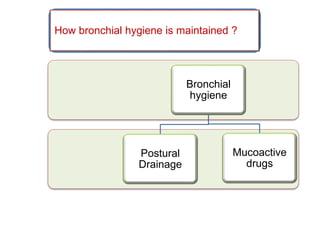
Bronchial
hygiene
Postural
Drainage
Mucoactive
drugs
How bronchial hygiene is maintained ?
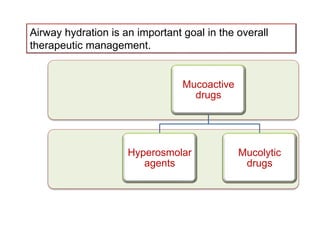
Airway hydration is an important goal in the overall
therapeutic management.
Mucoactive
drugs
Hyperosmolar
agents
Mucolytic
drugs
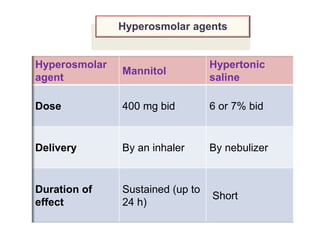
Hyperosmolar
agent
Mannitol
Hypertonic
saline
Dose 400 mg bid 6 or 7% bid
Delivery By an inhaler By nebulizer
Duration of
effect
Sustained (up to
24 h)
Short
Hyperosmolar agents
N-acetylcysteine
N-acetylcysteine (NAC) is commonly used in the treatment of BE
patients.
Benefits may come from -
1. It is a mucolytic agent that disrupts the disulfide bonds in mucus
when inhaled.
2. The benefits of this agent may come from its antioxidant properties.
3. NAC has also antibacterial properties by reducing the ability of
bacteria to adhere to epithelial cells.
Q. What doses of NAC is advised in Bronchiectasis patients ?
Ans. A dose of 600-1200 mg once or two divided doses daily
NAC in Influenza
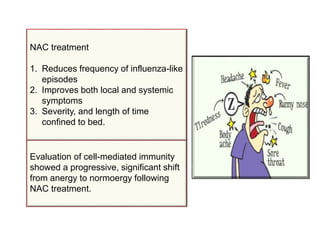
Evaluation of cell-mediated immunity
showed a progressive, significant shift
from anergy to normoergy following
NAC treatment.
NAC treatment
1. Reduces frequency of influenza-like
episodes
2. Improves both local and systemic
symptoms
3. Severity, and length of time
confined to bed.
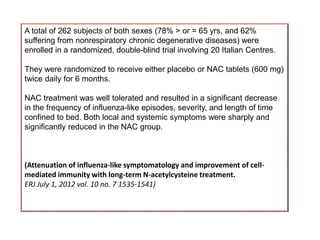
A total of 262 subjects of both sexes (78% > or = 65 yrs, and 62%
suffering from nonrespiratory chronic degenerative diseases) were
enrolled in a randomized, double-blind trial involving 20 Italian Centres.
They were randomized to receive either placebo or NAC tablets (600 mg)
twice daily for 6 months.
NAC treatment was well tolerated and resulted in a significant decrease
in the frequency of influenza-like episodes, severity, and length of time
confined to bed. Both local and systemic symptoms were sharply and
significantly reduced in the NAC group.
(Attenuation of influenza-like symptomatology and improvement of cell-
mediated immunity with long-term N-acetylcysteine treatment.
ERJ July 1, 2012 vol. 10 no. 7 1535-1541)
NAC in Lung Cancer
– According to research findings, certain types of cancer
including lung, skin, head and neck, mammary, and liver
can be potentially treated with NAC.
– Results from both cell culture and animal studies indicate
that NAC administration can selectively protect normal
cells, but not malignant ones, from chemotherapy and
radiation toxicity.
NAC In Respiratory Diseases

NAC In Respiratory Diseases

  • 2.
    Acetylcysteine ,also knownas N-acetylcysteine or N-acetyl-L- cysteine (abbreviated NAC), is a pharmaceutical drug widely used in clinical medicine. Acetylcysteine Acetylcysteine is a derivative of cysteine; an acetyl group that is attached to the nitrogen atom. Chemical formula : C5H9NO3S Molecular weight : 163.2 g/mol Only L-NAC is active; L-NAC is metabolized to cysteine and then GSH.
  • 3.
    It is onthe WORLD Health Organization’s list of Essential Medicines and an important medication needed in a basic health system.
  • 4.
    Multiple Clinical ApplicationsOf NAC Respiratory medicine -COPD - ILD - Bronchiectasis - Influenza - Lung cancer Paracetamol poisoning - Contrast induced nephropathy - Neurological illness - Psychiatric illness - Addictive behavior
  • 5.
  • 6.
    Oxidative stress hasbeen implicated in the pathogenesis and progression of COPD.
  • 7.
    Structural changes toessential components of the lung are caused by oxidative stress, contributing to irreversible damage of both parenchyma and airway walls. Both reactive oxidant species (ROS) from inhaled cigarette smoke and those endogenously formed by inflammatory cells constitute an increased intrapulmonary oxidant burden.
  • 8.
    How does NACoffer benefit in COPD patients ? 1. Anti-oxidant effects 2. Anti-inflammatory effects 3. Mucolytic effects
  • 9.
    N-acetylcysteine – 1. Reducesclinical symptom 2. Reduces severity and no. of exacerbations and 3. Reduces the accelerated lung function decline.
  • 10.
    Effects on Clinicalsymptoms The efficacy of NAC at a dose of 600 mg/day – 1. Reduces the viscosity of sputum 2. Reduces the nature of sputum 3. Reducing the severity of cough 0 20 40 60 80 100 Before 100 100 100 After 20 41 26 Viscosity of Sputum Nature of Sputum Severity of Cough Improvement after 2 months NAC therapy
  • 11.
    Non-smokers healthy Smokers without COPD Smokers with COPD Bacterialcolonies Before After Treatment with NAC: Bacterial colonization Effects on bacterial colonization
  • 12.
    Before 1 year after 1 year Effectson Annual decline of FEV 1 ml/yr Healthy With NAC Without NAC The decline in FEV1 in COPD patients who takes NAC for 2 yrs is less than that in a reference group receiving usual care. After 5 yrs, the reduction in FEV 1 in the NAC group was less than that in the reference group.
  • 13.
    Effects on no.of exacerbations
  • 14.
    Q. What dosesof NAC is advised in COPD patients ? Ans. A dose of 600 mg once daily Q. How long NAC can be prescribed in COPD patients ? Ans. At least 2-3 years. Q. Is all COPD patients is suitable for NAC prescription ? Ans. Moderate to very severe COPD patients can be given NAC as adjunct therapy. Q. Which points are to be considered in COPD patients receiving NAC? Ans. 1. Side effects. 2. Cost effectiveness.
  • 15.
    COPD Diagnosis often madeat advanced stages  >50% of patients have moderate/severe COPD on initial presentation 40% 6% 42% 12% Stage 1 Stage 2 Stage 3 Stage 4
  • 17.
  • 19.
    Treatments for IdiopathicPulmonary Fibrosis There’s still no proven effective treatment for IPF, except for lung transplant. Lung transplant is the only therapy known to prolong survival in IPF, but the 5 year survival after transplant is only 44%. Lung transplant is the only therapy known to prolong survival in IPF, but the 5 year survival after transplant is only 44%.
  • 20.
    Commonly used pharmacologictherapy for patients with idiopathic pulmonary fibrosis 1. Corticosteroids 2. Immunosuppressants 3. Antioxidants 4. Antifibrotic agents
  • 21.
    Mechanism of actionof NAC in treatment of IPF 1. Antioxidant 2. Antifibrotic
  • 22.
    Azathioprine + prednisone+ N-acetylcysteine versus azathioprine + prednisolone + placebo Randomized, double- blind, placebo-controlled study outcome
  • 23.
    What is theclinical benefits of using NAC in treatment of IPF ? NAC along with other recommended drugs slow the rate of disease progression Improve the quaProlong the survival periodlity of life Improve quality of life Prolong the survival period
  • 24.
    Stage I IIIII Points 0-3 4-5 6-8 Mortality 1-year 5.6 16.2 39.2 2-year 10.9 29.9 62.1 3-year 16.3 42.1 76.8 Predictor Points Sex Female 0 Male 1 Age (years) ≥60 0 61-65 1 >65 2 FVC (% predicted) >75 0 50-75 1 < 50 2 DLCO (% predicted) >55 0 36-55 1 ≤35 2 Cannot perform 3 Scoring for mortality risk in IPF. Staging and mortality risk for IPF
  • 25.
    Other than IPF,N-Acetylcysteine is recommended in ILD with marked fibrotic changes like – 1. Connective tissue associated interstitial lung diseases, 2. Asbestosis, 3. Sarcoidosis, 4. Hypersensitivity pneumonitis, 5. Drug induced lung disease
  • 26.
  • 27.
    Bronchiectasis is anabnormal permanent dilatation of the bronchi. Bronchiectasis generally occurs as a result of infection, although non-infectious factors may contribute to the development of this condition.
  • 28.
    Accompanying the enlargementof the bronchi is their decreased ability to clear secretions. Failure to clear secretions allows microbes and particles to collect in them, which leads to more secretions and inflammation that further damage the airways, causing more dilation in a vicious cycle.
  • 29.
    Bronchiectasis may occurin a single portion of the lung (localized) or throughout the lungs (diffuse) and is the major lung abnormality of cystic fibrosis.
  • 30.
     Antibiotic therapy Bronchial hygiene  Bronchodilator therapy  Anti-inflammatory therapy  Adjunctive surgical resection  Lung transplantation. Treatment modalities
  • 31.
    Why good bronchialhygiene is required ? Bronchiectasis defects in clearance of mucus Mucus plugging Viscous mucus formation
  • 32.
    Mucus plugging Decline inlung function perfect environment for colonization by various less virulent microorganisms on the airway mucosal surface Detoriation of symptoms Elimination of pathogens Host defense Pathogenic colonization Impaired Host defense
  • 33.
    Pathogenic colonization Initial colonization Intermittentcolonization Chronic colonization Exacerbation is a clinical situation that can happen during any of the three scenarios.
  • 34.
  • 35.
  • 36.
    Airway hydration isan important goal in the overall therapeutic management. Mucoactive drugs Hyperosmolar agents Mucolytic drugs
  • 37.
    Hyperosmolar agent Mannitol Hypertonic saline Dose 400 mgbid 6 or 7% bid Delivery By an inhaler By nebulizer Duration of effect Sustained (up to 24 h) Short Hyperosmolar agents
  • 38.
    N-acetylcysteine N-acetylcysteine (NAC) iscommonly used in the treatment of BE patients. Benefits may come from - 1. It is a mucolytic agent that disrupts the disulfide bonds in mucus when inhaled. 2. The benefits of this agent may come from its antioxidant properties. 3. NAC has also antibacterial properties by reducing the ability of bacteria to adhere to epithelial cells. Q. What doses of NAC is advised in Bronchiectasis patients ? Ans. A dose of 600-1200 mg once or two divided doses daily
  • 39.
  • 40.
    Evaluation of cell-mediatedimmunity showed a progressive, significant shift from anergy to normoergy following NAC treatment. NAC treatment 1. Reduces frequency of influenza-like episodes 2. Improves both local and systemic symptoms 3. Severity, and length of time confined to bed.
  • 41.
    A total of262 subjects of both sexes (78% > or = 65 yrs, and 62% suffering from nonrespiratory chronic degenerative diseases) were enrolled in a randomized, double-blind trial involving 20 Italian Centres. They were randomized to receive either placebo or NAC tablets (600 mg) twice daily for 6 months. NAC treatment was well tolerated and resulted in a significant decrease in the frequency of influenza-like episodes, severity, and length of time confined to bed. Both local and systemic symptoms were sharply and significantly reduced in the NAC group. (Attenuation of influenza-like symptomatology and improvement of cell- mediated immunity with long-term N-acetylcysteine treatment. ERJ July 1, 2012 vol. 10 no. 7 1535-1541)
  • 42.
  • 43.
    – According toresearch findings, certain types of cancer including lung, skin, head and neck, mammary, and liver can be potentially treated with NAC. – Results from both cell culture and animal studies indicate that NAC administration can selectively protect normal cells, but not malignant ones, from chemotherapy and radiation toxicity.