Medical
Communication
Skills
Dr.Hadi Awad Hmoud
MB.Ch.B, FICMS-S, LMCC-Canada, MRCS-Ireland
Doctor – Patient Relationship:
1- Physicians have a duty to act in the best interests
of their patients according to the principle of the
ethics.
2- An effective doctor-patient relationship is
necessary for supplying of good quality of health
care for the patient.
3-Patients are qualified by law and moral values to
be treated with respect, and without discrimination
during all stages of the physician-patient
relationship, even if the relationship faces
termination.
4-A mutual understanding of the patient’s
expectations of the physician, and the physician’s
expectations of the patient.
5-Availability of strong basis and clear guidelines
for discussing options to achieve expected goals
of care.
6- Offering a powerful efforts for healing, and a
source of comfortable care in situations where
healing is unreachable.
7- Availability of resource for learning by both
parties (the patient and the physician) about
guidelines and advances of this relationship. And
for the ethics principles.
8- Availability of tools for navigating the stressful
circumstances that accompany acute medical
illnesses
9- Availability of a framework for maintaining open
discussion and a positive relationship even when
there is uncertainty about the medical outcome.
10-Must be trustful relationships.
11-Must be respectful relation. (Formal barriers).
12-Mutual decision making relationship. (Doctor
provides the advantages, skills, experience,
knowledge and the patient judges, assess and then
decides).
13-Must be honest and confidential relationship.
(Doctor keeps with confidentiality of patient’s
records, unless there are some exemptions, and the
patient being honest while telling history and
demanding health care resources).
14-Doctor has the right to accept or refuse patient’s
demand for care, but this decision should not be
based on:
Race, Religion, Gender, Sexual orientation,
financial means, Ethnic background, Relations or
Nationality.
There should not be any patient group exclusion,
such as those known to be difficult patients, and
terminally or severely ill patients.
Emergency situations are exception for this right
(accepting and rejecting), as it is mandatory for
doctor to provide care for all without rejecting of
any of them.
15-Once doctor has accepted patient into his/her
care, then he/she may terminate this care for
reasonable reasons e.g.:
It is not emergency case.
The Patient has been transferred to another
physician, by patient’s preference or doctor’s
advices for the patient to get better and advance
care.
The Patient is satisfied that no more care is
needed after proving him/her with adequate
management and information.
 The Doctor is satisfied that he/she will not be able
to provide adequate care for that patient, because
of their scientific or skills limitations which
should be discussed in details with patient.
 The doctor has noticed there will be some social
impact or patient misunderstanding of the
formality of this relationship, e.g. sexual
harassment and abuse.
 The doctor becomes certain that patient is
abusing this relation for some unacceptable
personal advantages, e.g. patient is seeking illicit
drugs.
 Patient needs some decisions which are against
the doctor beliefs.
16-The doctor should have kept respectful
professional boundaries with patient, these include:
Emotional, physical and sexual boundaries.
Remember to:
Have opposite sex nurse while examining
opposite sex patient.
Respect patient’s privacy and dignity while
examining patient, especially when examine the
private or genital areas. And always make sure
patient is well covered after your examination has
been done. And remember that, a good doctor –
family relationship may be curative for the patient
and supportive for the family.
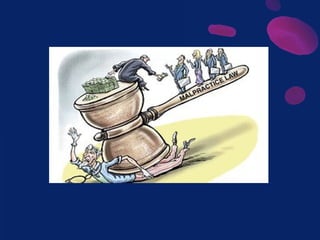
Medical malpractice or negligence:
Professional negligence or malpractice,
means any act or misconduct by a health care
provider in which the treatment provided falls
below the accepted standard of practice in
the medical profession, which may cause
injury or death to the patient, which can be
involving medical error.
1-A duty was exchanged without formal notice
about this change.
2-A duty was breached: the health care provider
failed to adhere to the standard measures of care.
3-The breach caused an injury: The breach of duty
was a cause of the injury.
4-Damage: Non-physical damage (which may be
emotional), although it is ethically unacceptable, but
still there is no basis for the legal sue, regardless of
whether the medical provider was negligent.
Patient abuse or neglect:
Abuse or neglect is any act or failure to act, which
brought unnecessary suffering, misery or harm to
the patient. It might be verbal, physical or sexual
aspect of assaulting a patient. Also it includes
depriving the patient from the necessary food,
protection, and medical care. Abuse and neglect
can be encountered in various places and
situations such as hospitals, nursing homes,
clinics and home visits.
Harms at clinical setting or hospital:
1-Misdiagnosis:A doctor has made a wrong
diagnoses of a patient’s condition or disease (a
cardiac angina has been wrongly diagnosed as a
dyspepsia).
2-Under-diagnosis:A doctor was not able to fully
recognize the cause of patient signs and symptoms
(a gastric cancer has been under-estimated as a
dyspepsia).
3-Overdiagnosis:Something benign is diagnosed as
a symptom or sign associated with cancer, where
non-specific cancer marker is identified. E.g:(simple
dyspepsia has been diagnosed as a gastric cancer).
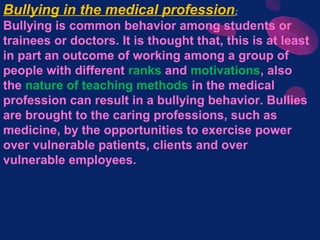
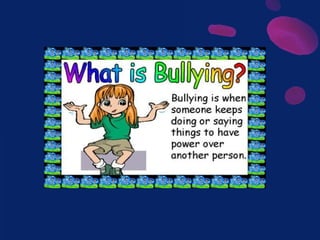
Bullying in the medical profession:
Bullying is common behavior among students or
trainees or doctors. It is thought that, this is at least
in part an outcome of working among a group of
people with different ranks and motivations, also
the nature of teaching methods in the medical
profession can result in a bullying behavior. Bullies
are brought to the caring professions, such as
medicine, by the opportunities to exercise power
over vulnerable patients, clients and over
vulnerable employees.
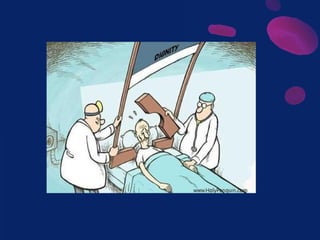
Bullying of medical students:
Medical students, are vulnerable because of their
relatively weak position in health care system,
therefore, they may experience verbal abuse,
humiliation and harassment (non-sexual or sexual)
and discrimination based on gender and race by
staff or even patients.
In one study, around 35% of medical students
reported having been bullied. Around one in four of
the 1,000 students questioned said they had been
bullied by a doctor, while one in six had been bullied
by a nurse.
What is crucial for dying patient?
Dying patient is a daily confrontation for every
medical professional, it raises many issues, for
example:
1-Control of pain and other physical symptoms.
2-Involvement of people important to the patient,
like family members, friends and beloved ones.
Death occurs within a social context of family,
friends, and caregivers.
3-A degree of acceptance by the patient.
Death acceptance doesn't mean that the patient
likes what is going on, and it doesn't mean that a
patient has no hopes, it just means that he/she can
be realistic and ready for this destiny.
4-A medical understanding of the patient's own
disease. Most patients, families, and caregivers
come to physicians in order to learn something
about what is happening medically, and it is
important to recognize their need for information in
a way that does not interfere with the patient
confidentiality.
5-A process of care should guide patient to
understand and decide. One great physician does
not equal great care, because the doctor is crippled
if works alone (remember TEAM work) it needs a
coordinated system of healthcare providers.
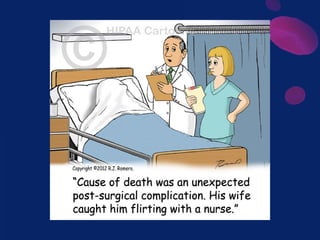
CONFIDENTIALITY: in general is a set of rules
that, limits access or imposes restrictions on certain
types of information. It is applied to discussions
between doctors and patients. Legal and ethical
rules prevent physicians from revealing discussions
with patients. This rule dates back to at least the
Hippocratic Oath, which reads: Whatever, in
connection with my professional service, or not in
connection with it, I see or hear, in the life of men,
which ought not to be spoken of abroad, I will not
breach the rule, that it should be kept secret.
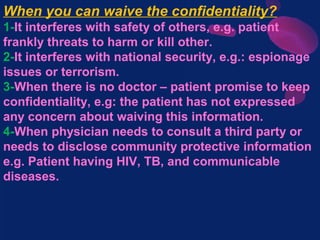
When you can waive the confidentiality?
1-It interferes with safety of others, e.g. patient
frankly threats to harm or kill other.
2-It interferes with national security, e.g.: espionage
issues or terrorism.
3-When there is no doctor – patient promise to keep
confidentiality, e.g: the patient has not expressed
any concern about waiving this information.
4-When physician needs to consult a third party or
needs to disclose community protective information
e.g. Patient having HIV, TB, and communicable
diseases.
Medical communication skill

Medical communication skill

  • 1.
  • 2.
    Doctor – PatientRelationship: 1- Physicians have a duty to act in the best interests of their patients according to the principle of the ethics. 2- An effective doctor-patient relationship is necessary for supplying of good quality of health care for the patient. 3-Patients are qualified by law and moral values to be treated with respect, and without discrimination during all stages of the physician-patient relationship, even if the relationship faces termination.
  • 3.
    4-A mutual understandingof the patient’s expectations of the physician, and the physician’s expectations of the patient. 5-Availability of strong basis and clear guidelines for discussing options to achieve expected goals of care. 6- Offering a powerful efforts for healing, and a source of comfortable care in situations where healing is unreachable.
  • 4.
    7- Availability ofresource for learning by both parties (the patient and the physician) about guidelines and advances of this relationship. And for the ethics principles. 8- Availability of tools for navigating the stressful circumstances that accompany acute medical illnesses 9- Availability of a framework for maintaining open discussion and a positive relationship even when there is uncertainty about the medical outcome.
  • 5.
    10-Must be trustfulrelationships. 11-Must be respectful relation. (Formal barriers). 12-Mutual decision making relationship. (Doctor provides the advantages, skills, experience, knowledge and the patient judges, assess and then decides). 13-Must be honest and confidential relationship. (Doctor keeps with confidentiality of patient’s records, unless there are some exemptions, and the patient being honest while telling history and demanding health care resources).
  • 6.
    14-Doctor has theright to accept or refuse patient’s demand for care, but this decision should not be based on: Race, Religion, Gender, Sexual orientation, financial means, Ethnic background, Relations or Nationality. There should not be any patient group exclusion, such as those known to be difficult patients, and terminally or severely ill patients. Emergency situations are exception for this right (accepting and rejecting), as it is mandatory for doctor to provide care for all without rejecting of any of them.
  • 7.
    15-Once doctor hasaccepted patient into his/her care, then he/she may terminate this care for reasonable reasons e.g.: It is not emergency case. The Patient has been transferred to another physician, by patient’s preference or doctor’s advices for the patient to get better and advance care. The Patient is satisfied that no more care is needed after proving him/her with adequate management and information.
  • 8.
     The Doctoris satisfied that he/she will not be able to provide adequate care for that patient, because of their scientific or skills limitations which should be discussed in details with patient.  The doctor has noticed there will be some social impact or patient misunderstanding of the formality of this relationship, e.g. sexual harassment and abuse.  The doctor becomes certain that patient is abusing this relation for some unacceptable personal advantages, e.g. patient is seeking illicit drugs.  Patient needs some decisions which are against the doctor beliefs.
  • 9.
    16-The doctor shouldhave kept respectful professional boundaries with patient, these include: Emotional, physical and sexual boundaries. Remember to: Have opposite sex nurse while examining opposite sex patient. Respect patient’s privacy and dignity while examining patient, especially when examine the private or genital areas. And always make sure patient is well covered after your examination has been done. And remember that, a good doctor – family relationship may be curative for the patient and supportive for the family.
  • 11.
    Medical malpractice ornegligence: Professional negligence or malpractice, means any act or misconduct by a health care provider in which the treatment provided falls below the accepted standard of practice in the medical profession, which may cause injury or death to the patient, which can be involving medical error.
  • 12.
    1-A duty wasexchanged without formal notice about this change. 2-A duty was breached: the health care provider failed to adhere to the standard measures of care. 3-The breach caused an injury: The breach of duty was a cause of the injury. 4-Damage: Non-physical damage (which may be emotional), although it is ethically unacceptable, but still there is no basis for the legal sue, regardless of whether the medical provider was negligent.
  • 14.
    Patient abuse orneglect: Abuse or neglect is any act or failure to act, which brought unnecessary suffering, misery or harm to the patient. It might be verbal, physical or sexual aspect of assaulting a patient. Also it includes depriving the patient from the necessary food, protection, and medical care. Abuse and neglect can be encountered in various places and situations such as hospitals, nursing homes, clinics and home visits.
  • 16.
    Harms at clinicalsetting or hospital: 1-Misdiagnosis:A doctor has made a wrong diagnoses of a patient’s condition or disease (a cardiac angina has been wrongly diagnosed as a dyspepsia). 2-Under-diagnosis:A doctor was not able to fully recognize the cause of patient signs and symptoms (a gastric cancer has been under-estimated as a dyspepsia). 3-Overdiagnosis:Something benign is diagnosed as a symptom or sign associated with cancer, where non-specific cancer marker is identified. E.g:(simple dyspepsia has been diagnosed as a gastric cancer).
  • 18.
    Bullying in themedical profession: Bullying is common behavior among students or trainees or doctors. It is thought that, this is at least in part an outcome of working among a group of people with different ranks and motivations, also the nature of teaching methods in the medical profession can result in a bullying behavior. Bullies are brought to the caring professions, such as medicine, by the opportunities to exercise power over vulnerable patients, clients and over vulnerable employees.
  • 20.
    Bullying of medicalstudents: Medical students, are vulnerable because of their relatively weak position in health care system, therefore, they may experience verbal abuse, humiliation and harassment (non-sexual or sexual) and discrimination based on gender and race by staff or even patients. In one study, around 35% of medical students reported having been bullied. Around one in four of the 1,000 students questioned said they had been bullied by a doctor, while one in six had been bullied by a nurse.
  • 22.
    What is crucialfor dying patient? Dying patient is a daily confrontation for every medical professional, it raises many issues, for example: 1-Control of pain and other physical symptoms. 2-Involvement of people important to the patient, like family members, friends and beloved ones. Death occurs within a social context of family, friends, and caregivers. 3-A degree of acceptance by the patient. Death acceptance doesn't mean that the patient likes what is going on, and it doesn't mean that a patient has no hopes, it just means that he/she can be realistic and ready for this destiny.
  • 23.
    4-A medical understandingof the patient's own disease. Most patients, families, and caregivers come to physicians in order to learn something about what is happening medically, and it is important to recognize their need for information in a way that does not interfere with the patient confidentiality. 5-A process of care should guide patient to understand and decide. One great physician does not equal great care, because the doctor is crippled if works alone (remember TEAM work) it needs a coordinated system of healthcare providers.
  • 25.
    CONFIDENTIALITY: in generalis a set of rules that, limits access or imposes restrictions on certain types of information. It is applied to discussions between doctors and patients. Legal and ethical rules prevent physicians from revealing discussions with patients. This rule dates back to at least the Hippocratic Oath, which reads: Whatever, in connection with my professional service, or not in connection with it, I see or hear, in the life of men, which ought not to be spoken of abroad, I will not breach the rule, that it should be kept secret.
  • 26.
    When you canwaive the confidentiality? 1-It interferes with safety of others, e.g. patient frankly threats to harm or kill other. 2-It interferes with national security, e.g.: espionage issues or terrorism. 3-When there is no doctor – patient promise to keep confidentiality, e.g: the patient has not expressed any concern about waiving this information. 4-When physician needs to consult a third party or needs to disclose community protective information e.g. Patient having HIV, TB, and communicable diseases.