Plastics
Compression Molding
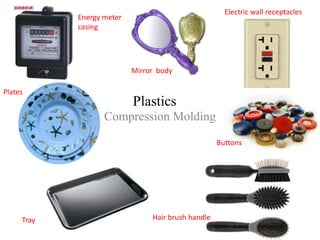
Energy meter
casing
Plates
Tray
Buttons
Electric wall receptacles
Hair brush handle
Mirror body
Compression molding
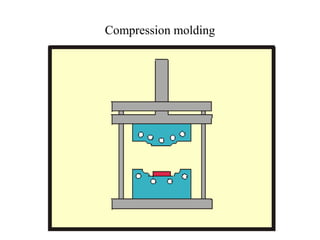
• Compression molding is a process in which a molding polymer is squeezed
into a preheated mold taking a shape of the mold cavity and performing
curing due to heat and pressure applied to the material.
• The method is used mostly for molding thermosets, but some
thermoplastics parts may also be produced by compression molding.
• Compression molding is a method of molding in which the molding
material, generally preheated, is first placed in an open, heated mold cavity.
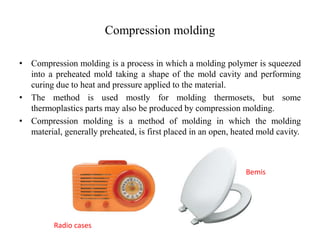
Bemis
Radio cases
Compression molding
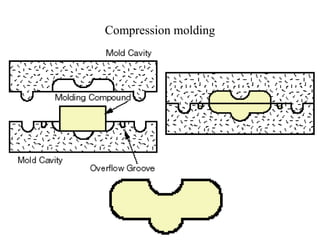
• The mold is closed with a top force, pressure is applied to force the
material into contact with all mold areas, while heat and pressure are
maintained until the molding material has cured.
• The process employs thermosetting resins in a partially cured stage, either
in the form of granules, putty-like masses, or preforms.
• The advantage of compression molding is its ability to mold large, fairly
intricate parts.
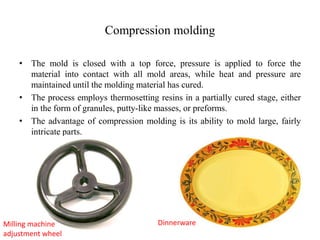
Milling machine
adjustment wheel
Dinnerware
Compression molding
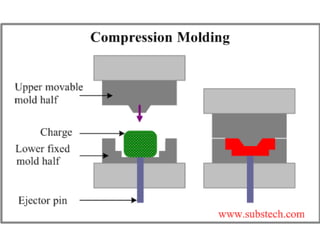
• The method uses a split mold mounted in a hydraulic press
• Compression molding process involves the following steps:
• A pre-weighed amount of a polymer mixed with additives and fillers
(charge) is placed into the lower half of the mold.
• The charge may be in form of powders, pellets, putty-like masses or pre-
formed blanks.
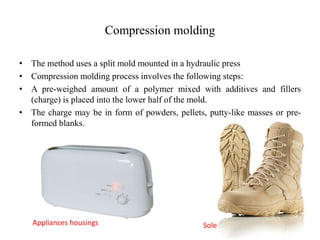
SoleAppliances housings
Compression molding
• The charge is usually preheated prior to placement into the mold.
• Preheated polymer becomes softer resulting in shortening the molding
cycle time.
• The upper half of the mold moves downwards, pressing on the polymer
charge and forcing it to fill the mold cavity.
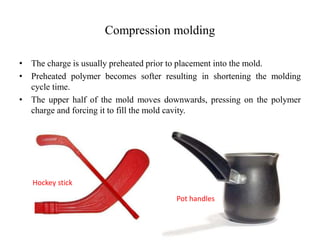
Pot handles
Hockey stick
Compression molding
• The mold, equipped with a heating system, provides curing (cross-linking)
of the polymer (if thermoset is processed).
• The mold is opened and the part is removed from it by means of the ejector
pin.
• If thermosetting resin is molded, the mold may be open in hot state – cured
thermosets maintain their shape and dimensions even in hot state.
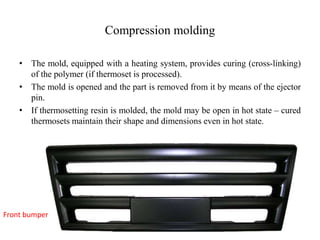
Front bumper
Compression molding
Compression molding
Compression molding
Compression molding
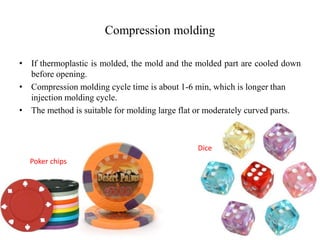
• If thermoplastic is molded, the mold and the molded part are cooled down
before opening.
• Compression molding cycle time is about 1-6 min, which is longer than
injection molding cycle.
• The method is suitable for molding large flat or moderately curved parts.
Dice
Poker chips
Compression molding
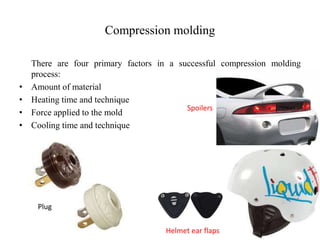
There are four primary factors in a successful compression molding
process:
• Amount of material
• Heating time and technique
• Force applied to the mold
• Cooling time and technique
Spoilers
Plug
Helmet ear flaps
Compression molding
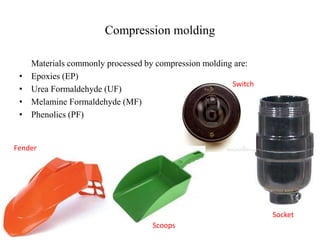
Materials commonly processed by compression molding are:
• Epoxies (EP)
• Urea Formaldehyde (UF)
• Melamine Formaldehyde (MF)
• Phenolics (PF)
Socket
Switch
Fender
Scoops

Compression molding

  • 1.
  • 2.
    Compression molding • Compressionmolding is a process in which a molding polymer is squeezed into a preheated mold taking a shape of the mold cavity and performing curing due to heat and pressure applied to the material. • The method is used mostly for molding thermosets, but some thermoplastics parts may also be produced by compression molding. • Compression molding is a method of molding in which the molding material, generally preheated, is first placed in an open, heated mold cavity. Bemis Radio cases
  • 3.
    Compression molding • Themold is closed with a top force, pressure is applied to force the material into contact with all mold areas, while heat and pressure are maintained until the molding material has cured. • The process employs thermosetting resins in a partially cured stage, either in the form of granules, putty-like masses, or preforms. • The advantage of compression molding is its ability to mold large, fairly intricate parts. Milling machine adjustment wheel Dinnerware
  • 5.
    Compression molding • Themethod uses a split mold mounted in a hydraulic press • Compression molding process involves the following steps: • A pre-weighed amount of a polymer mixed with additives and fillers (charge) is placed into the lower half of the mold. • The charge may be in form of powders, pellets, putty-like masses or pre- formed blanks. SoleAppliances housings
  • 6.
    Compression molding • Thecharge is usually preheated prior to placement into the mold. • Preheated polymer becomes softer resulting in shortening the molding cycle time. • The upper half of the mold moves downwards, pressing on the polymer charge and forcing it to fill the mold cavity. Pot handles Hockey stick
  • 7.
    Compression molding • Themold, equipped with a heating system, provides curing (cross-linking) of the polymer (if thermoset is processed). • The mold is opened and the part is removed from it by means of the ejector pin. • If thermosetting resin is molded, the mold may be open in hot state – cured thermosets maintain their shape and dimensions even in hot state. Front bumper
  • 8.
  • 9.
  • 10.
  • 11.
    Compression molding • Ifthermoplastic is molded, the mold and the molded part are cooled down before opening. • Compression molding cycle time is about 1-6 min, which is longer than injection molding cycle. • The method is suitable for molding large flat or moderately curved parts. Dice Poker chips
  • 12.
    Compression molding There arefour primary factors in a successful compression molding process: • Amount of material • Heating time and technique • Force applied to the mold • Cooling time and technique Spoilers Plug Helmet ear flaps
  • 13.
    Compression molding Materials commonlyprocessed by compression molding are: • Epoxies (EP) • Urea Formaldehyde (UF) • Melamine Formaldehyde (MF) • Phenolics (PF) Socket Switch Fender Scoops