SUB-FIELDS AND KEY CONCEPTS
INTRODUCTIONTO LINGUISTICS
Essential Questions
 What is language? What are its properties?
 How did it/does it evolve?
 How does language serve as a medium of
communication?
 How does language serve as a medium of
thinking?
 What is common to all languages?
 How do languages differ?
Properties of Language
 Arbitrariness: there’s no natural connection between a
linguistic form and its meaning
 Discreteness: sounds are meaningfully distinct
 Productivity: infinite number of possible utterances
 Displacement: allows users to talk about things and events
not present in the immediate environment
 Duality: language is organized at two levels or layers
simultaneously
 CulturalTransmission: language is passed on from one
generation to the next
Sub-fields of structure-focused linguistics
include:
 Phonetics – study of the physical properties of
speech production and perception
 Phonology – description of the systems and patterns
of speech sounds in a language; deals with the
abstract representation of sounds
 Morphology – study of internal structures of words
and how they can be modified
 Syntax – study of how words combine to form
grammatical sentences
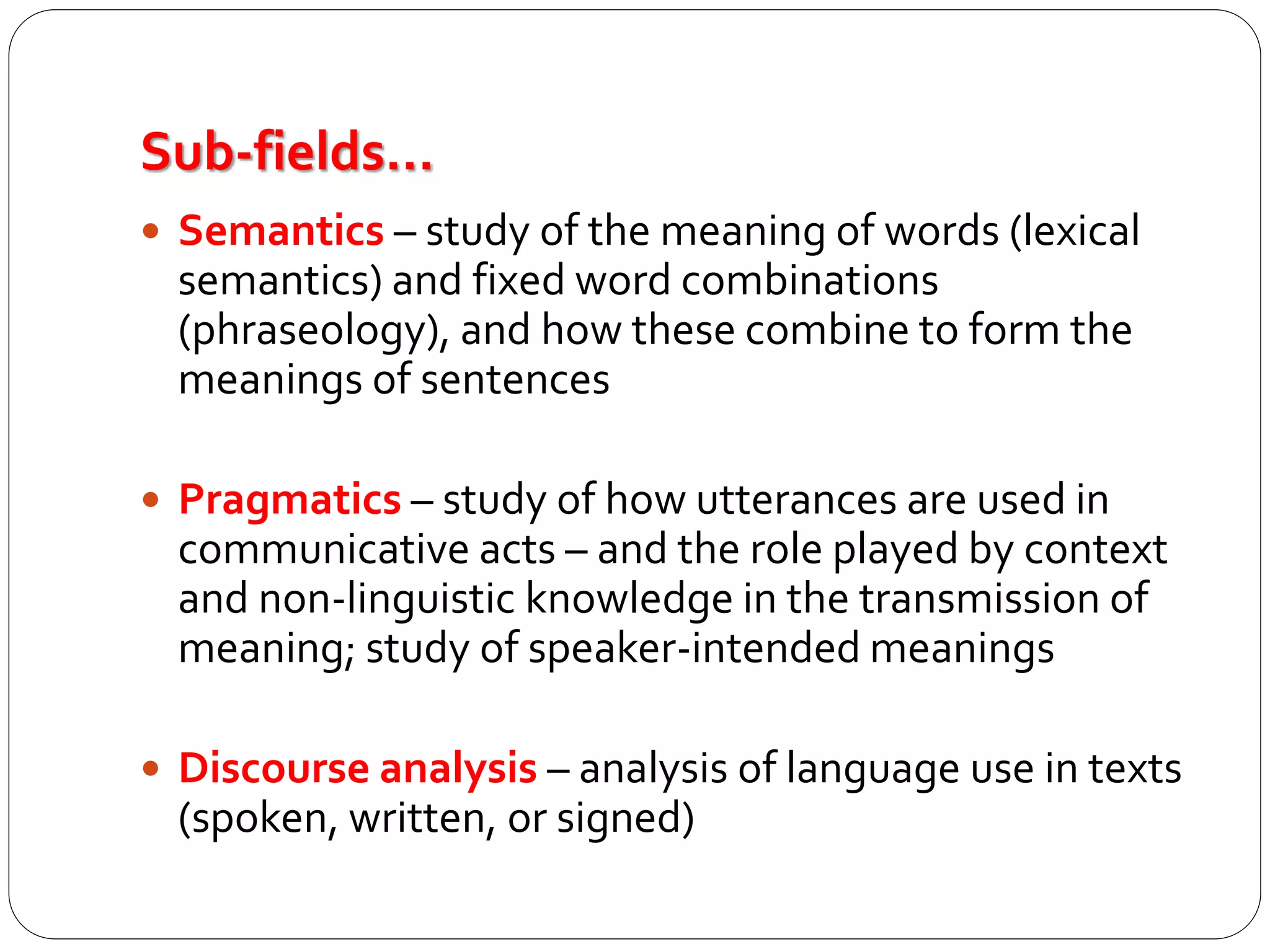
Sub-fields…
 Semantics – study of the meaning of words (lexical
semantics) and fixed word combinations
(phraseology), and how these combine to form the
meanings of sentences
 Pragmatics – study of how utterances are used in
communicative acts – and the role played by context
and non-linguistic knowledge in the transmission of
meaning; study of speaker-intended meanings
 Discourse analysis – analysis of language use in texts
(spoken, written, or signed)
KEY CONCEPTS
Key Concepts in PHONETICS
 Phonetic Description of Consonants
Aspects in Describing Consonants:
-Voicing Aspect [voiced/ voiceless]
- Place of Articulation [bilabial, velar, alveolar]
- Manner of Articulation [stop, fricative, nasal]
 Phonetic Description ofVowels
The 12-vowel-sound system of English
 International Phonetic Alphabet (IPA)
Universal system of symbols
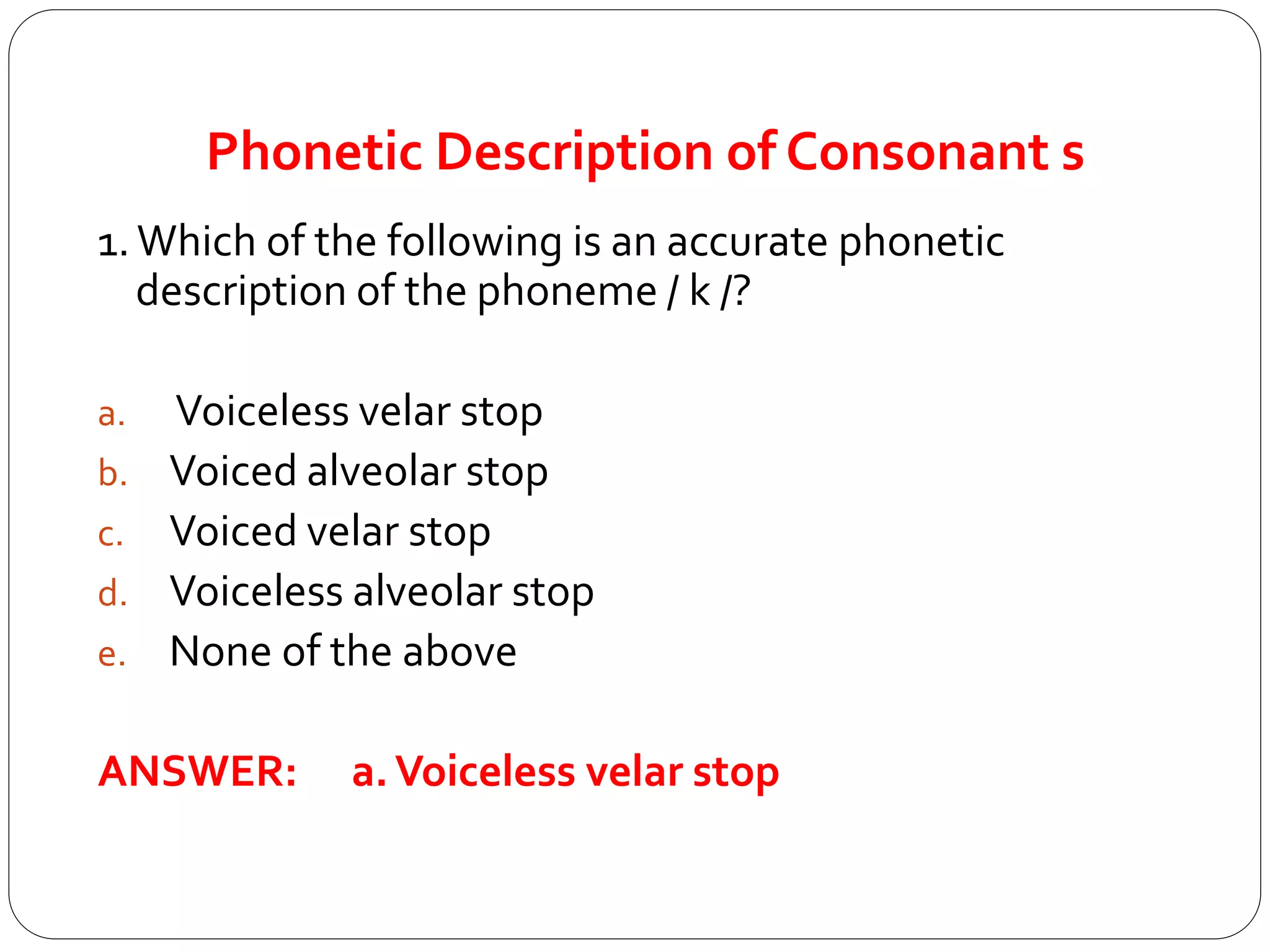
Phonetic Description of Consonant s
1.Which of the following is an accurate phonetic
description of the phoneme / k /?
a. Voiceless velar stop
b. Voiced alveolar stop
c. Voiced velar stop
d. Voiceless alveolar stop
e. None of the above
ANSWER: a.Voiceless velar stop
Phonetic Description of Consonant s
2.Which of the following is a BILABIAL NASAL?
a. [ n ]
b. [ b ]
c. [ p ]
d. [ m ]
e. [ f ]
ANSWER: d. [ m ]
Phonetic Description ofVowels
3.Which of the following is phonetically described as “high
front tense unrounded” vowel?
a. [ i ]
b. [ u ]
c. [ α ]
d. [ e ]
e. None of the above
ANSWER: a. [ i ]
Phonetic Description ofVowels
4.Which of the following is the accurate phonetic
description of the sound [ e ], as in bake [beIk]?
a. Mid back lax round vowel
b. Mid front tense unrounded vowel
c. High front lax unrounded vowel
d. Low front tense unrounded vowel
e. None of the above
ANSWER: b. Mid front tense unrounded
Phonetic Description ofVowels
 Jaw height [ high, mid, low ]
 Tongue position [ front, central, back ]
 Lip shape [ rounded, unrounded ]
 tension
 Mid back lax round vowel / a / as in law
 Mid front tense unrounded vowel / a / as in bake
 High front lax unrounded vowel / I / as in sick
 Low front tense unrounded vowel / a / as in cat
Key Concepts in PHONOLOGY
 Phonemes smallest unit of sound / b /
 Phones version of a sound-type produced in actual speech [ b ]
 Allophones versions of one phoneme [aspirated, flapped, dental]
 Minimal pairs bat-vat; wet-wit...
 Syllables and clusters
Onset - the beginning consonant of a syllable
Nucleus – the vowel in the syllable
Coda – the terminal consonant following the nucleus
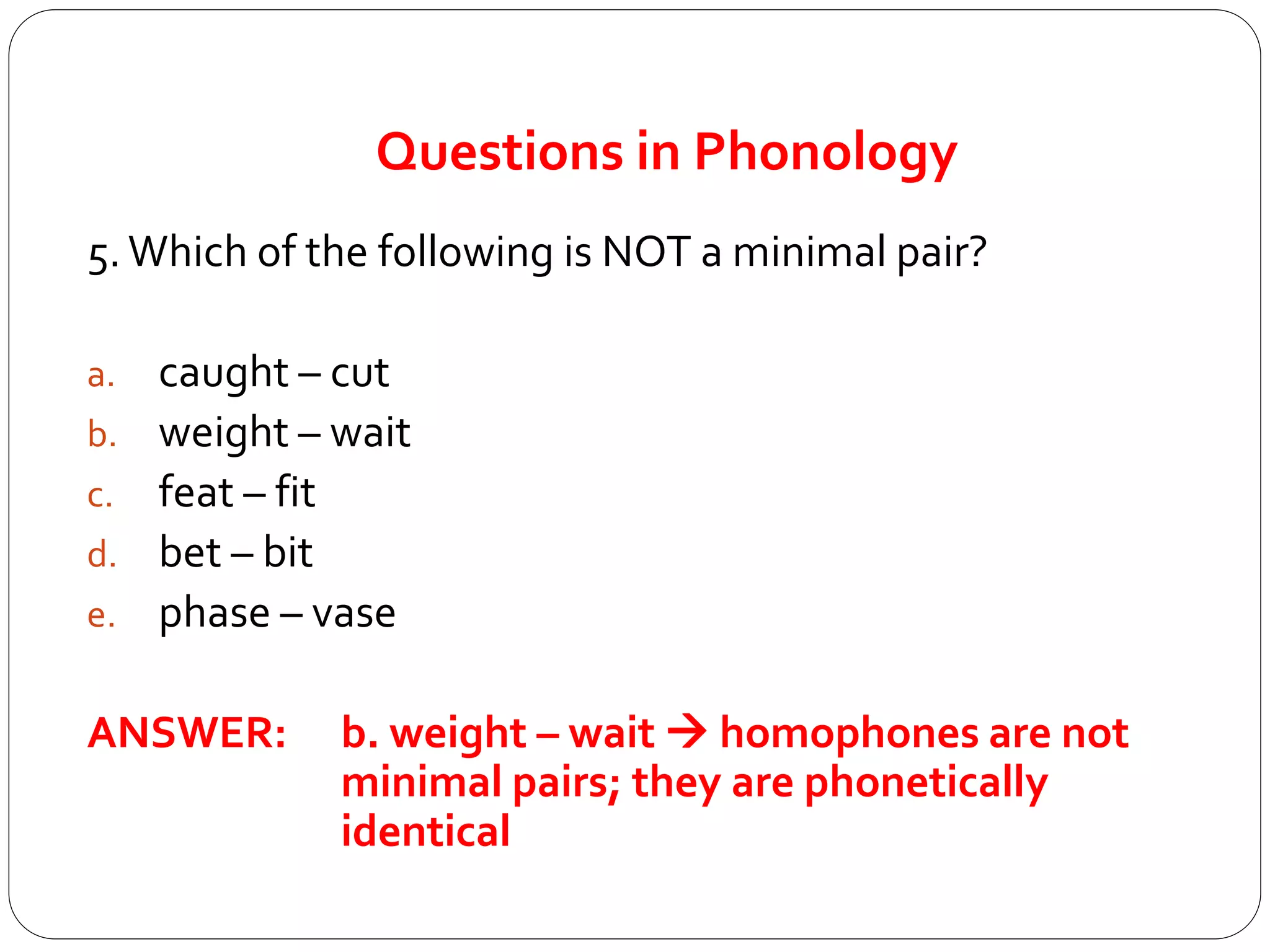
Questions in Phonology
5.Which of the following is NOT a minimal pair?
a. caught – cut
b. weight – wait
c. feat – fit
d. bet – bit
e. phase – vase
ANSWER: b. weight – wait  homophones are not
minimal pairs; they are phonetically
identical
Questions in Phonology
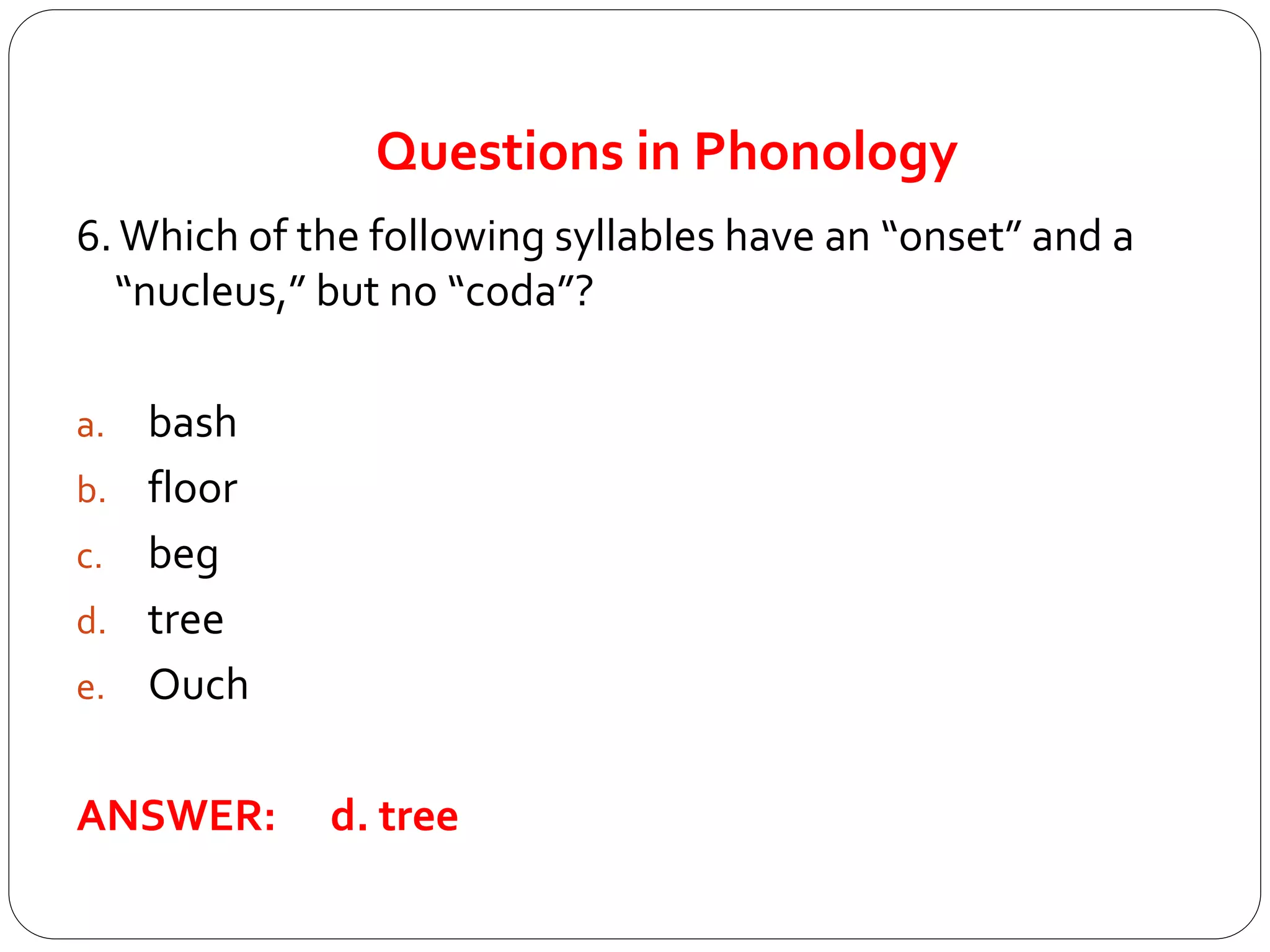
6.Which of the following syllables have an “onset” and a
“nucleus,” but no “coda”?
a. bash
b. floor
c. beg
d. tree
e. Ouch
ANSWER: d. tree
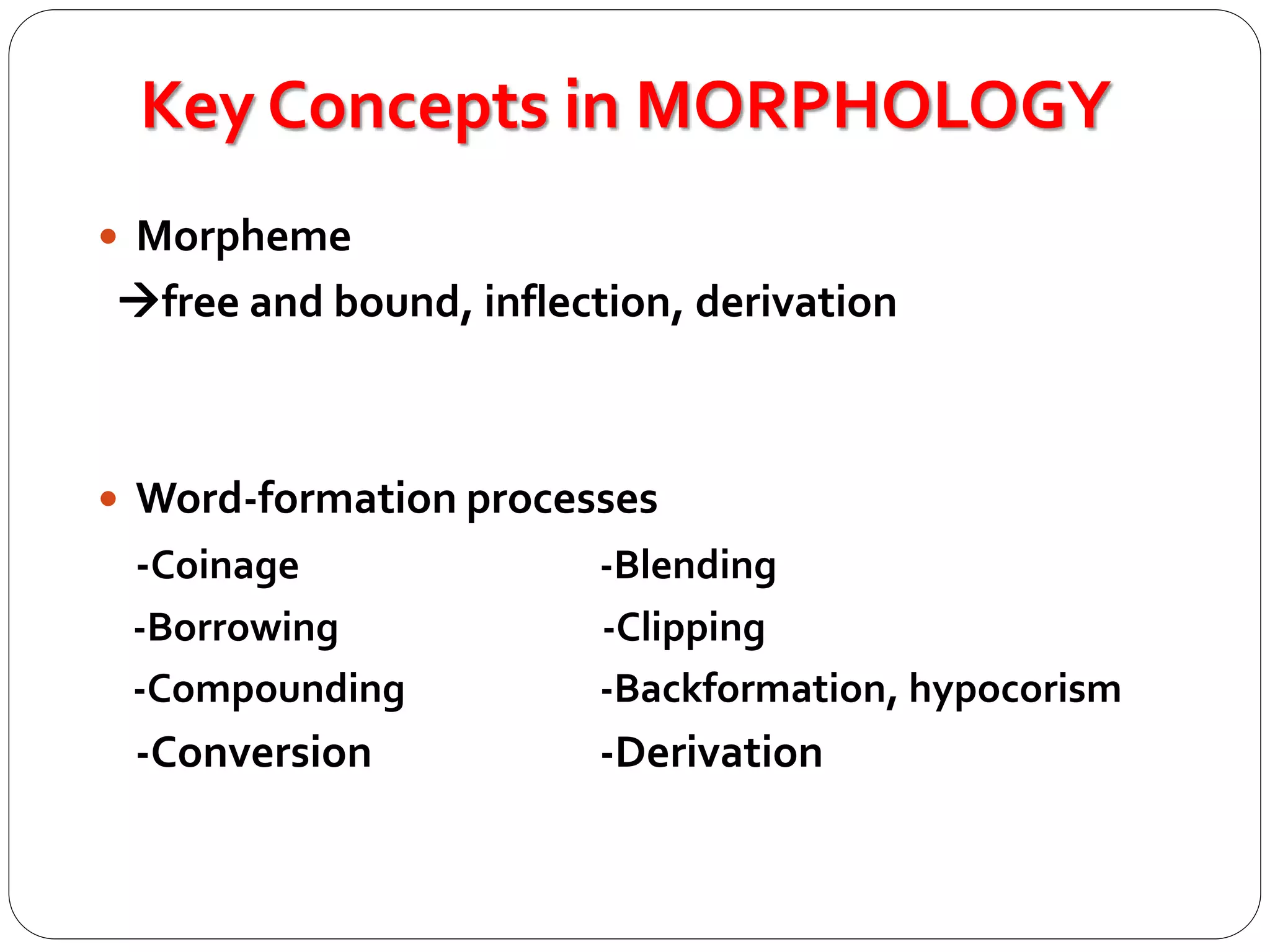
Key Concepts in MORPHOLOGY
 Morpheme
free and bound, inflection, derivation
 Word-formation processes
-Coinage -Blending
-Borrowing -Clipping
-Compounding -Backformation, hypocorism
-Conversion -Derivation
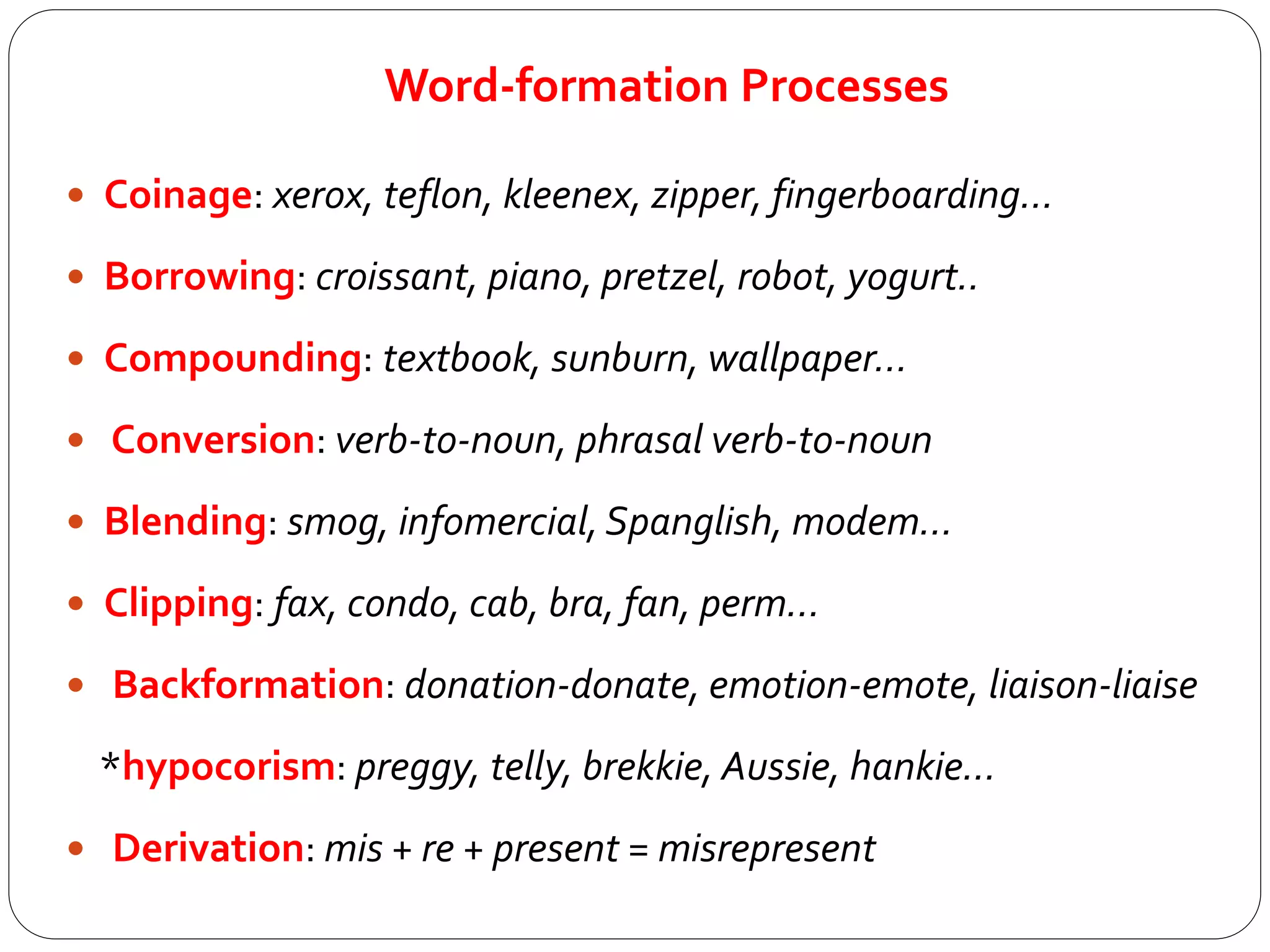
Word-formation Processes
 Coinage: xerox, teflon, kleenex, zipper, fingerboarding…
 Borrowing: croissant, piano, pretzel, robot, yogurt..
 Compounding: textbook, sunburn, wallpaper…
 Conversion: verb-to-noun, phrasal verb-to-noun
 Blending: smog, infomercial,Spanglish, modem…
 Clipping: fax, condo, cab, bra, fan, perm…
 Backformation: donation-donate, emotion-emote, liaison-liaise
*hypocorism: preggy, telly, brekkie, Aussie, hankie…
 Derivation: mis + re + present = misrepresent
Questions in Morphology
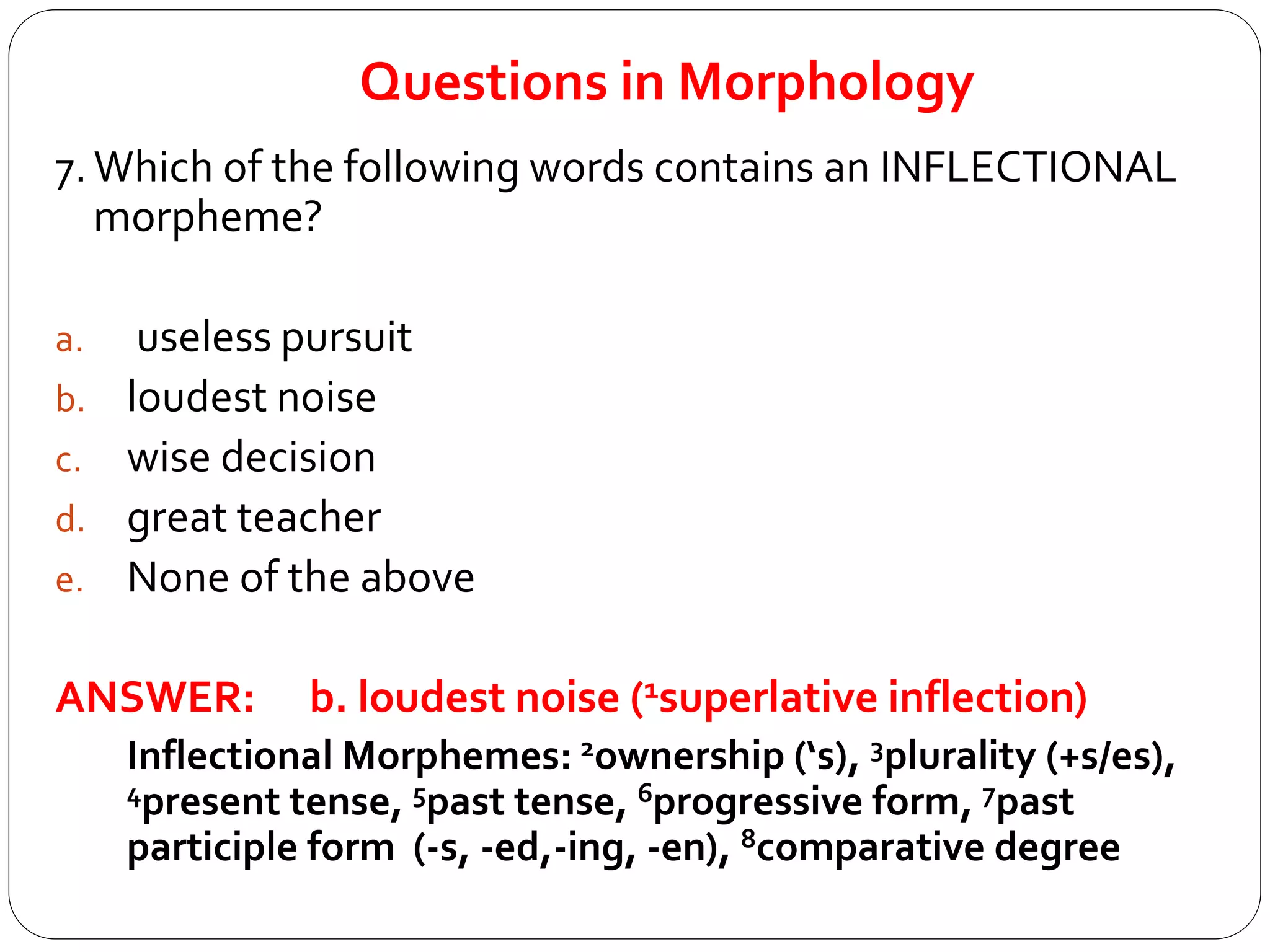
7.Which of the following words contains an INFLECTIONAL
morpheme?
a. useless pursuit
b. loudest noise
c. wise decision
d. great teacher
e. None of the above
ANSWER: b. loudest noise (1superlative inflection)
Inflectional Morphemes: 2ownership (‘s), 3plurality (+s/es),
4present tense, 5past tense, 6progressive form, 7past
participle form (-s, -ed,-ing, -en), 8comparative degree
Questions in Morphology
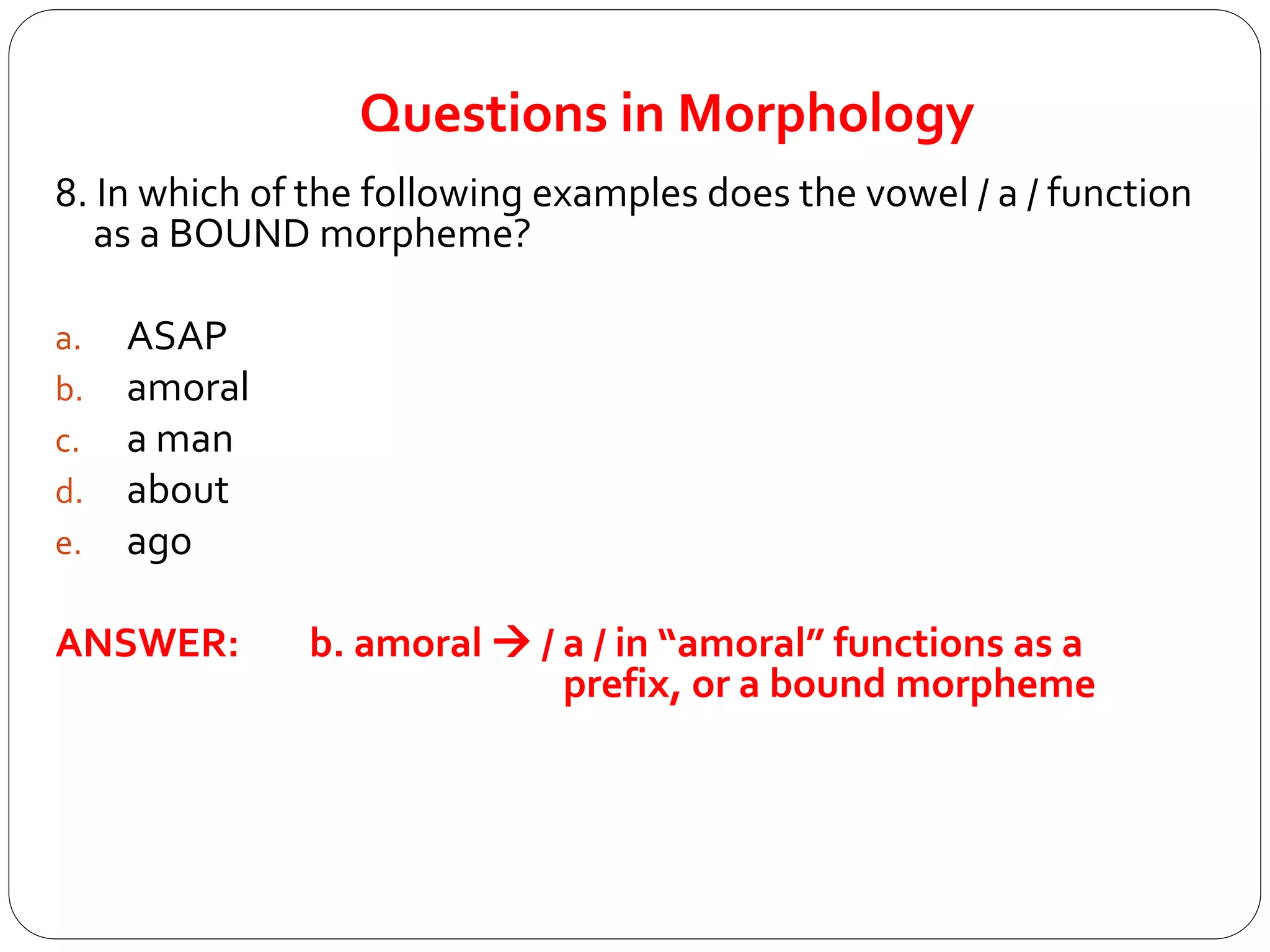
8. In which of the following examples does the vowel / a / function
as a BOUND morpheme?
a. ASAP
b. amoral
c. a man
d. about
e. ago
ANSWER: b. amoral  / a / in “amoral” functions as a
prefix, or a bound morpheme
Questions in Morphology
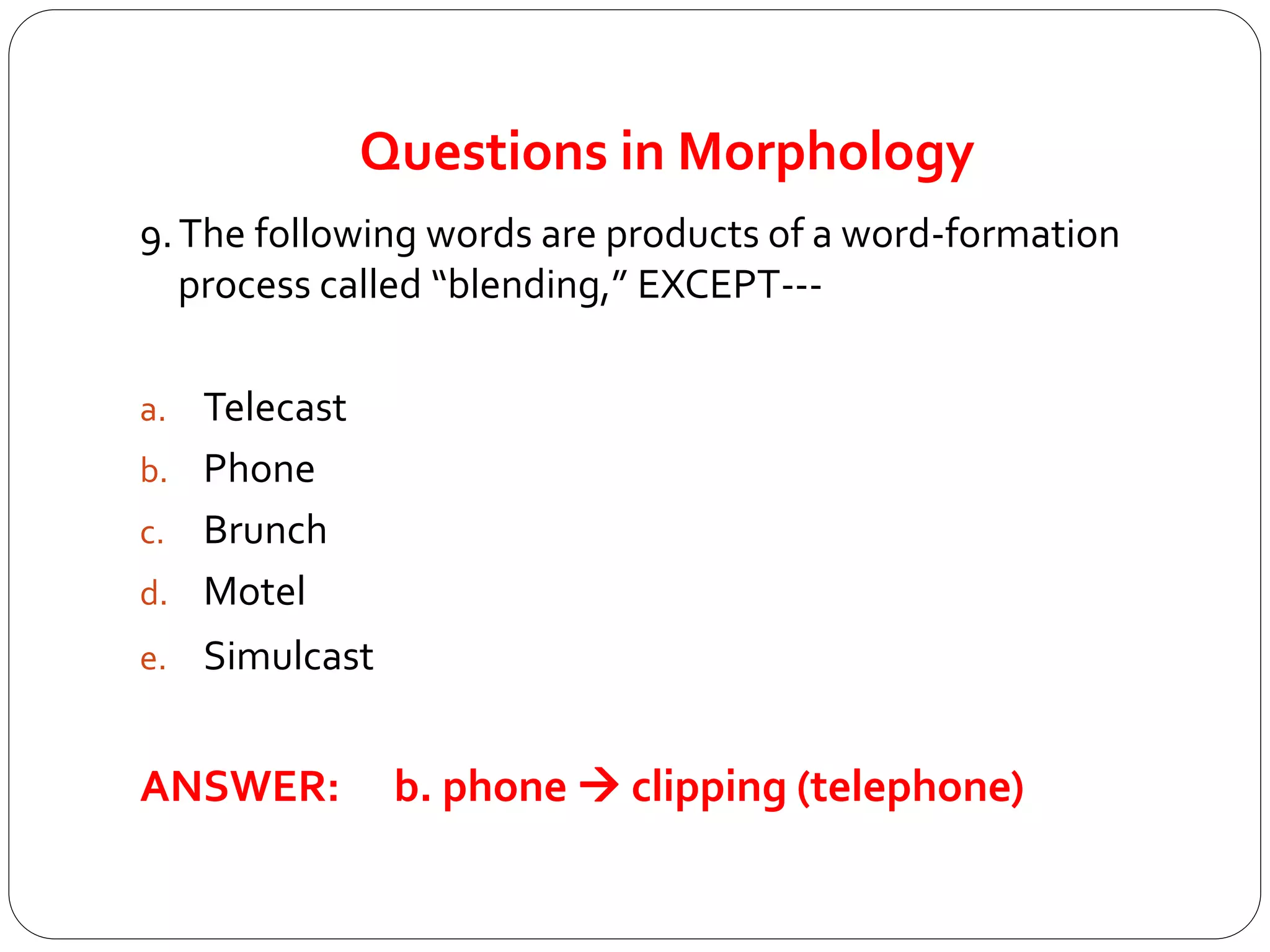
9.The following words are products of a word-formation
process called “blending,” EXCEPT---
a. Telecast
b. Phone
c. Brunch
d. Motel
e. Simulcast
ANSWER: b. phone  clipping (telephone)
Questions in Morphology
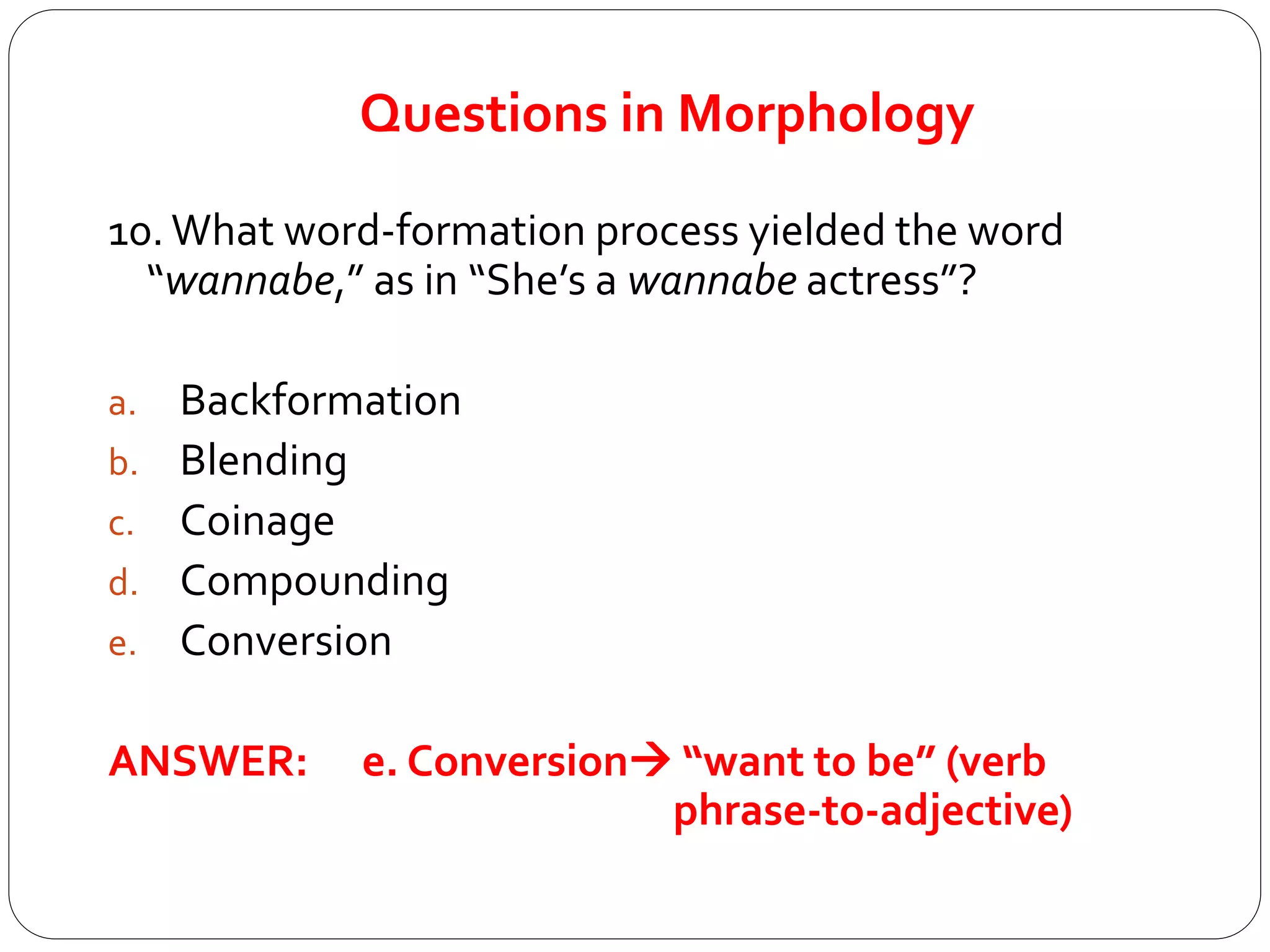
10. What word-formation process yielded the word
“wannabe,” as in “She’s a wannabe actress”?
a. Backformation
b. Blending
c. Coinage
d. Compounding
e. Conversion
ANSWER: e. Conversion “want to be” (verb
phrase-to-adjective)
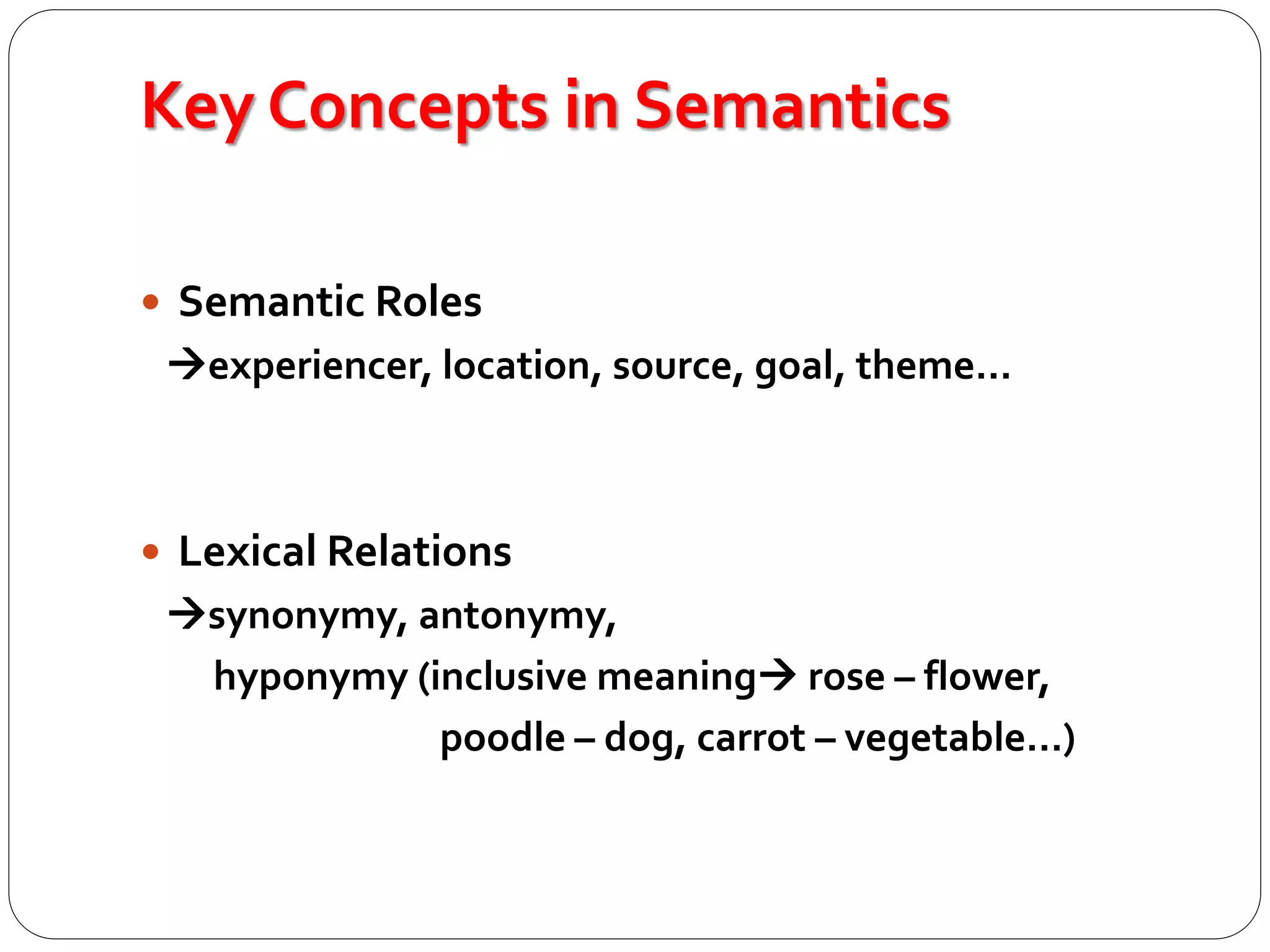
Key Concepts in Semantics
 Semantic Roles
experiencer, location, source, goal, theme…
 Lexical Relations
synonymy, antonymy,
hyponymy (inclusive meaning rose – flower,
poodle – dog, carrot – vegetable…)
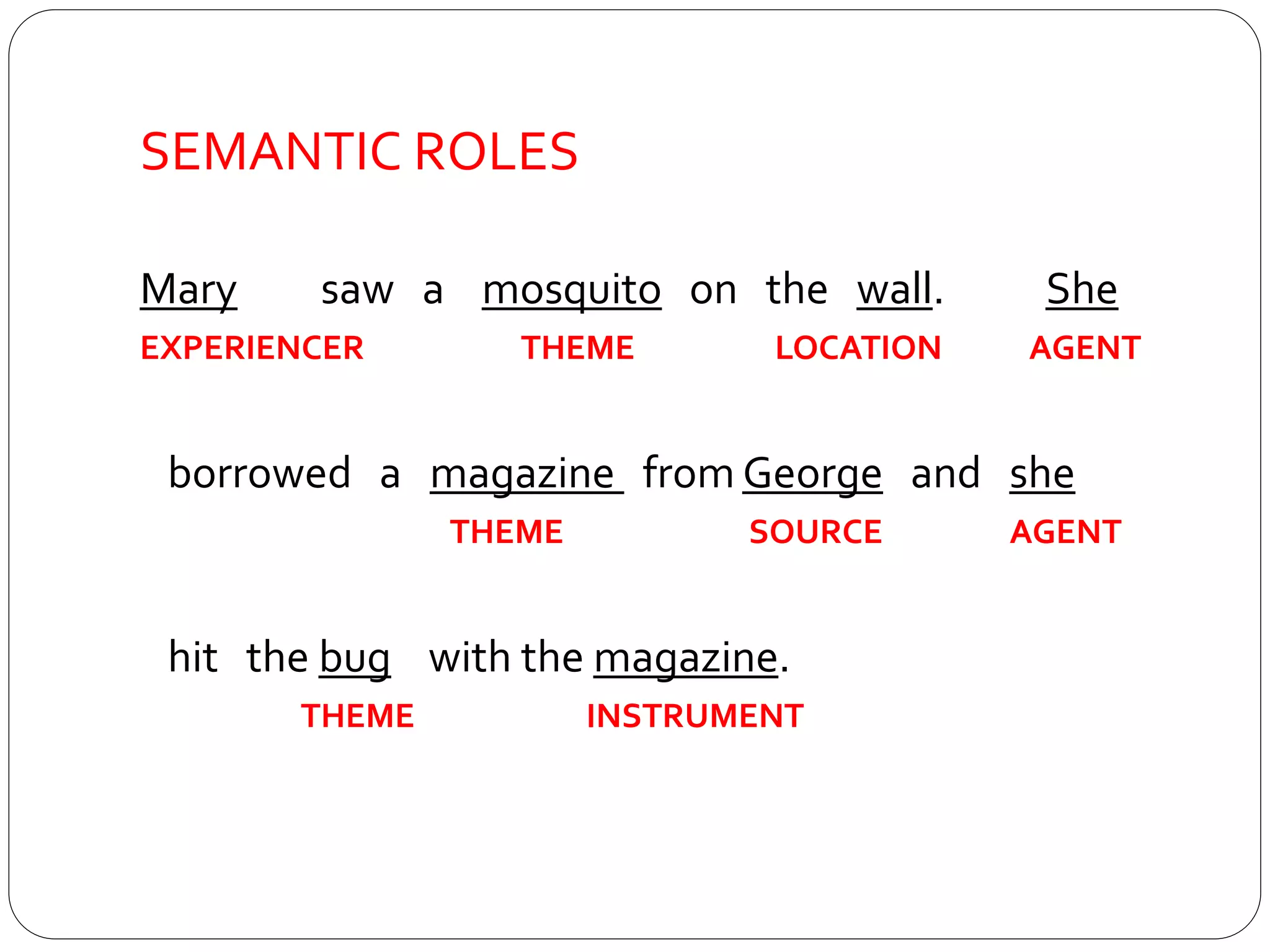
SEMANTIC ROLES
Mary saw a mosquito on the wall. She
EXPERIENCER THEME LOCATION AGENT
borrowed a magazine from George and she
THEME SOURCE AGENT
hit the bug with the magazine.
THEME INSTRUMENT
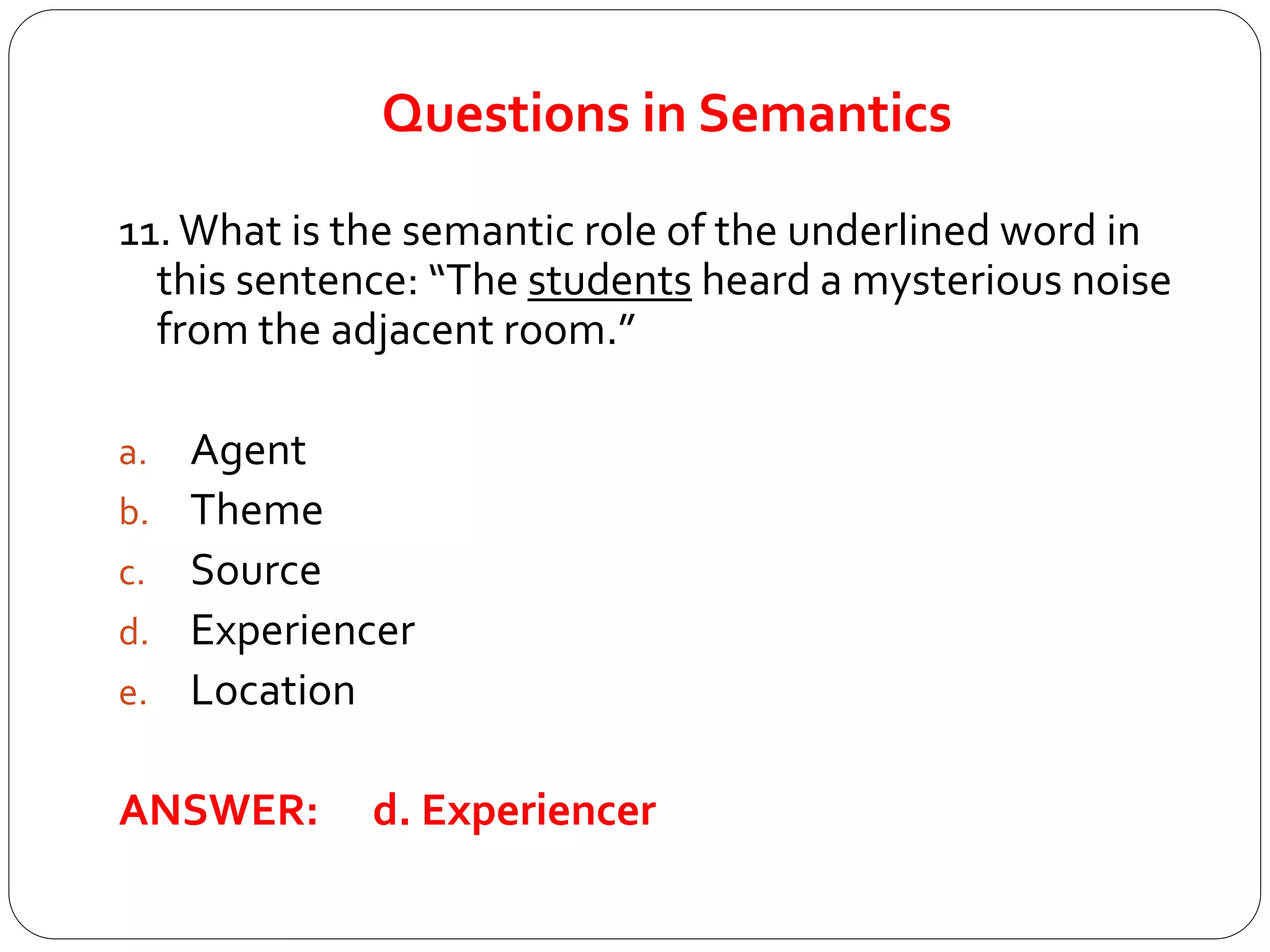
Questions in Semantics
11.What is the semantic role of the underlined word in
this sentence: “The students heard a mysterious noise
from the adjacent room.”
a. Agent
b. Theme
c. Source
d. Experiencer
e. Location
ANSWER: d. Experiencer
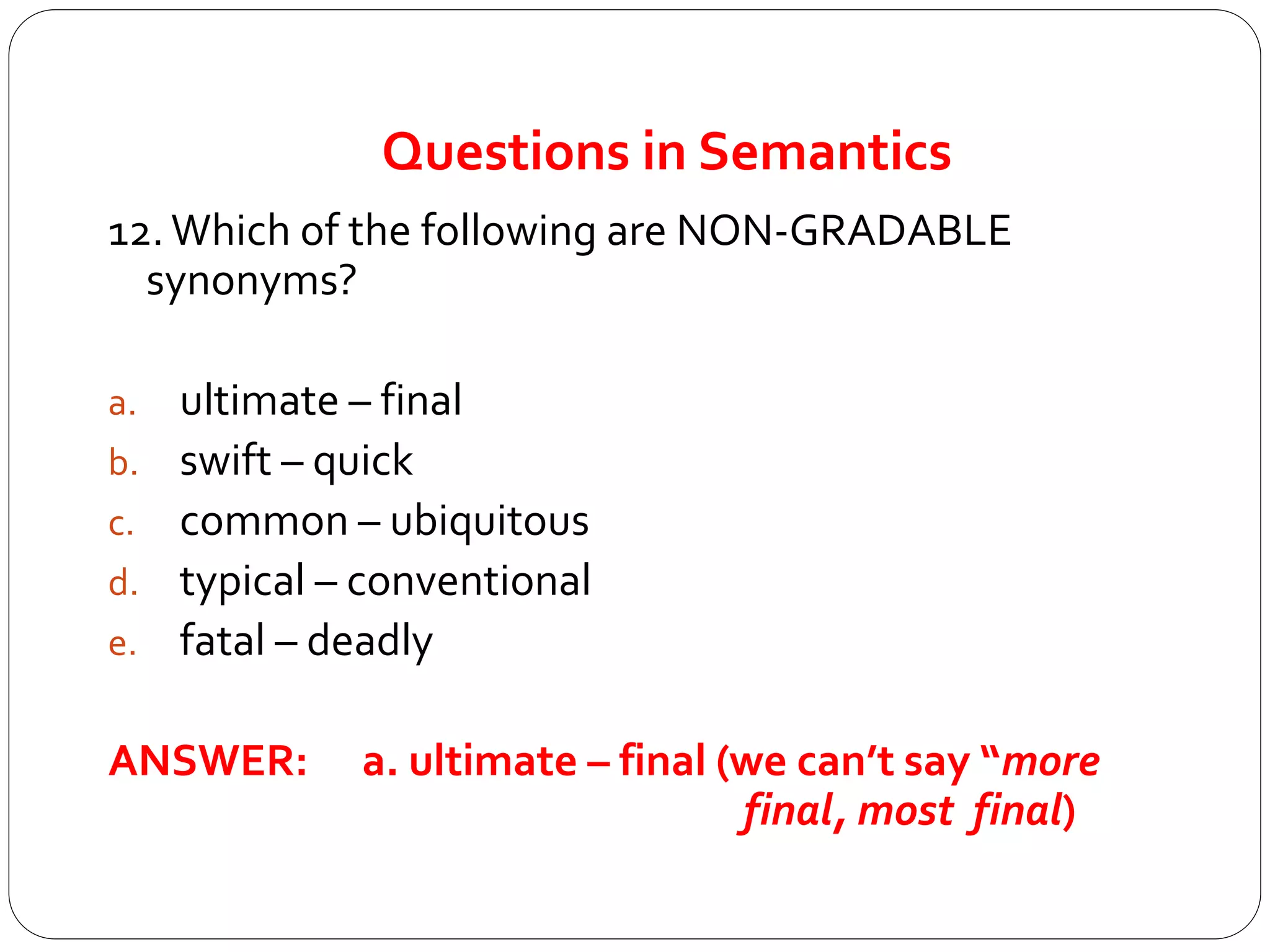
Questions in Semantics
12.Which of the following are NON-GRADABLE
synonyms?
a. ultimate – final
b. swift – quick
c. common – ubiquitous
d. typical – conventional
e. fatal – deadly
ANSWER: a. ultimate – final (we can’t say “more
final, most final)
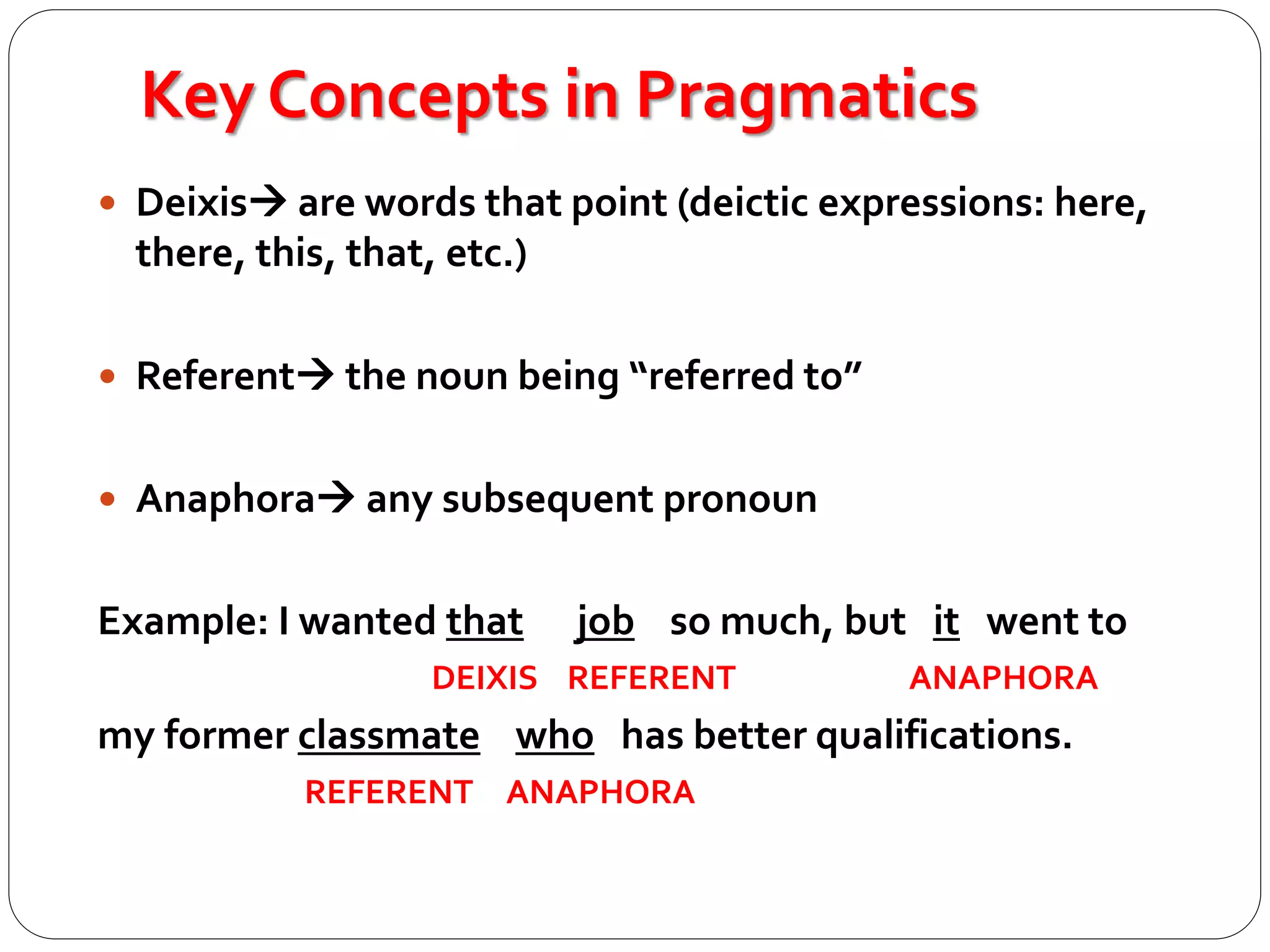
Key Concepts in Pragmatics
 Deixis are words that point (deictic expressions: here,
there, this, that, etc.)
 Referent the noun being “referred to”
 Anaphora any subsequent pronoun
Example: I wanted that job so much, but it went to
DEIXIS REFERENT ANAPHORA
my former classmate who has better qualifications.
REFERENT ANAPHORA
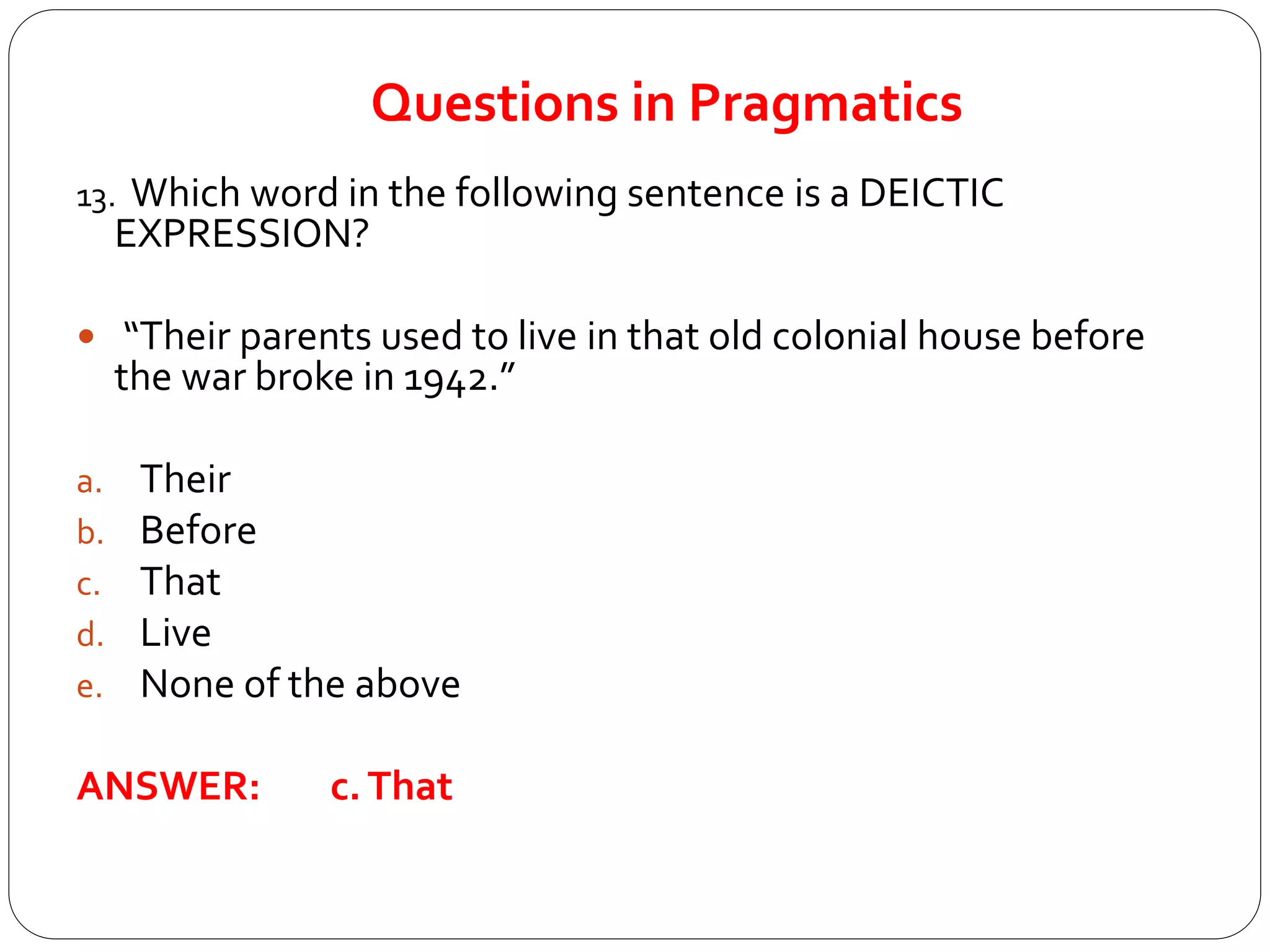
Questions in Pragmatics
13. Which word in the following sentence is a DEICTIC
EXPRESSION?
 “Their parents used to live in that old colonial house before
the war broke in 1942.”
a. Their
b. Before
c. That
d. Live
e. None of the above
ANSWER: c.That
Key Concepts in Discourse Analysis
 Types of text/ text genres
 Style and register
 Coherence and cohesion
-cohesive/ transitional devices
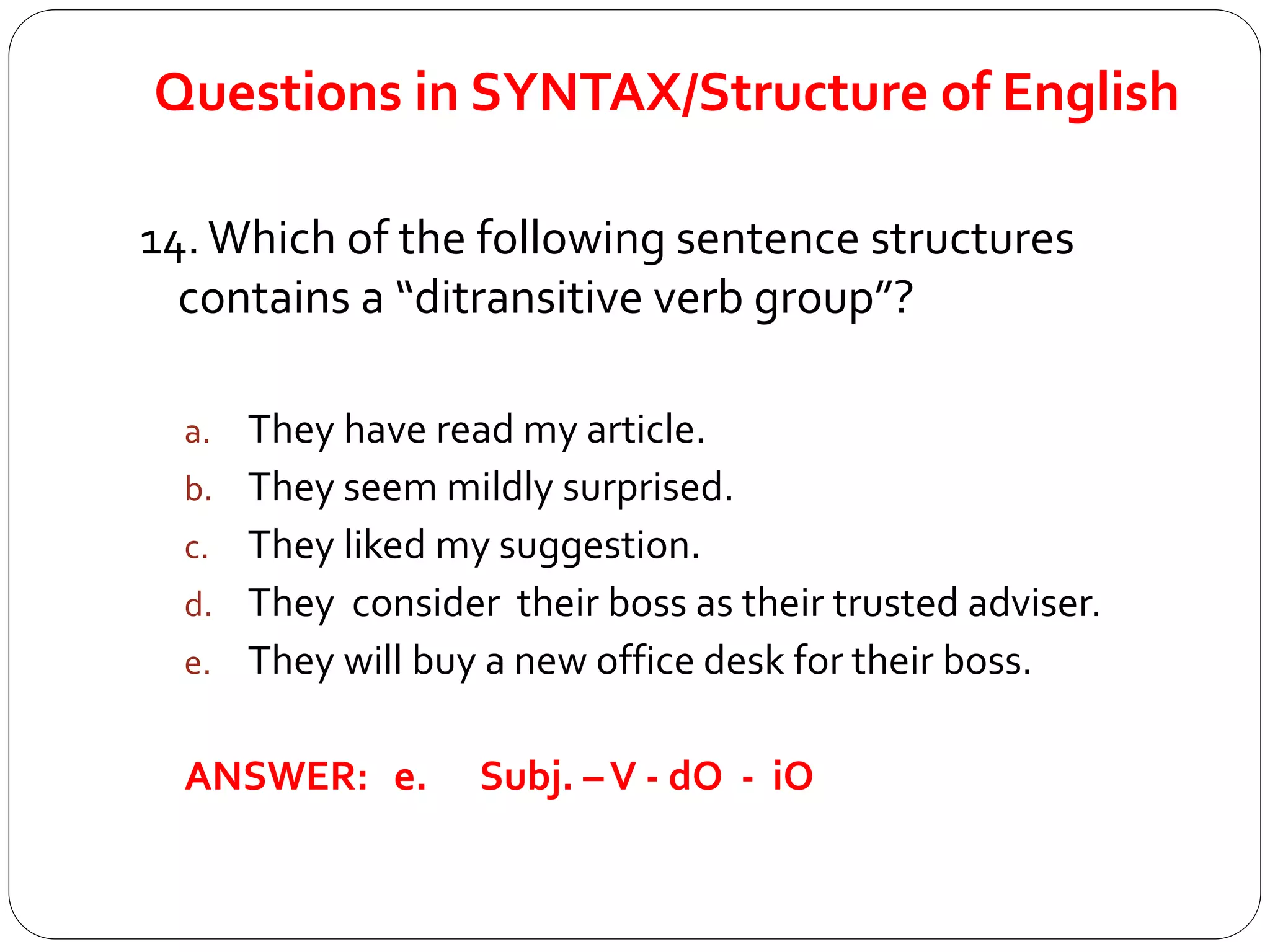
Questions in SYNTAX/Structure of English
14. Which of the following sentence structures
contains a “ditransitive verb group”?
a. They have read my article.
b. They seem mildly surprised.
c. They liked my suggestion.
d. They consider their boss as their trusted adviser.
e. They will buy a new office desk for their boss.
ANSWER: e. Subj. –V - dO - iO
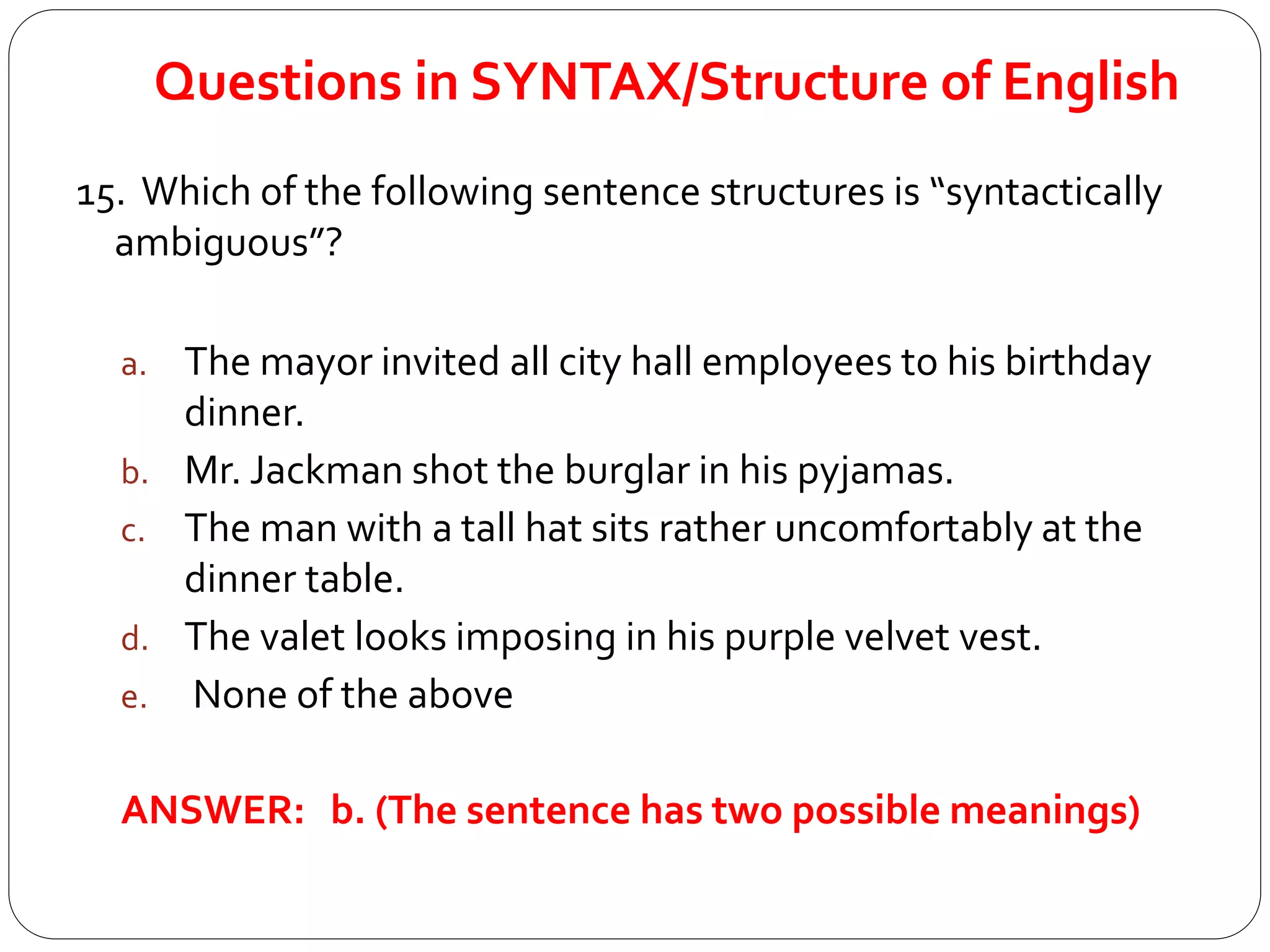
Questions in SYNTAX/Structure of English
15. Which of the following sentence structures is “syntactically
ambiguous”?
a. The mayor invited all city hall employees to his birthday
dinner.
b. Mr. Jackman shot the burglar in his pyjamas.
c. The man with a tall hat sits rather uncomfortably at the
dinner table.
d. The valet looks imposing in his purple velvet vest.
e. None of the above
ANSWER: b. (The sentence has two possible meanings)
Questions in SYNTAX/Structure of English
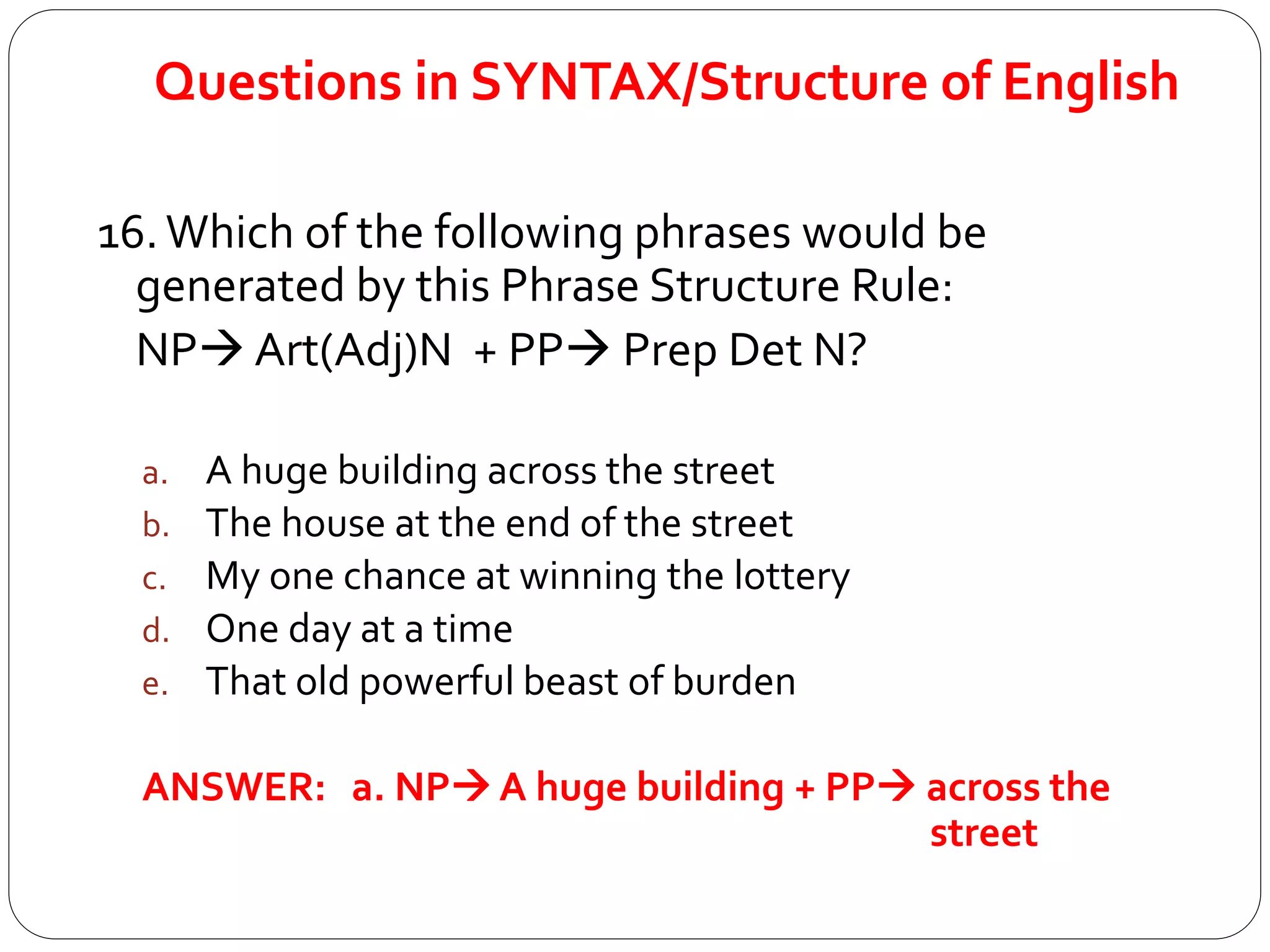
16.Which of the following phrases would be
generated by this Phrase Structure Rule:
NP Art(Adj)N + PP Prep Det N?
a. A huge building across the street
b. The house at the end of the street
c. My one chance at winning the lottery
d. One day at a time
e. That old powerful beast of burden
ANSWER: a. NP A huge building + PP across the
street
Questions in SYNTAX/Structure of English
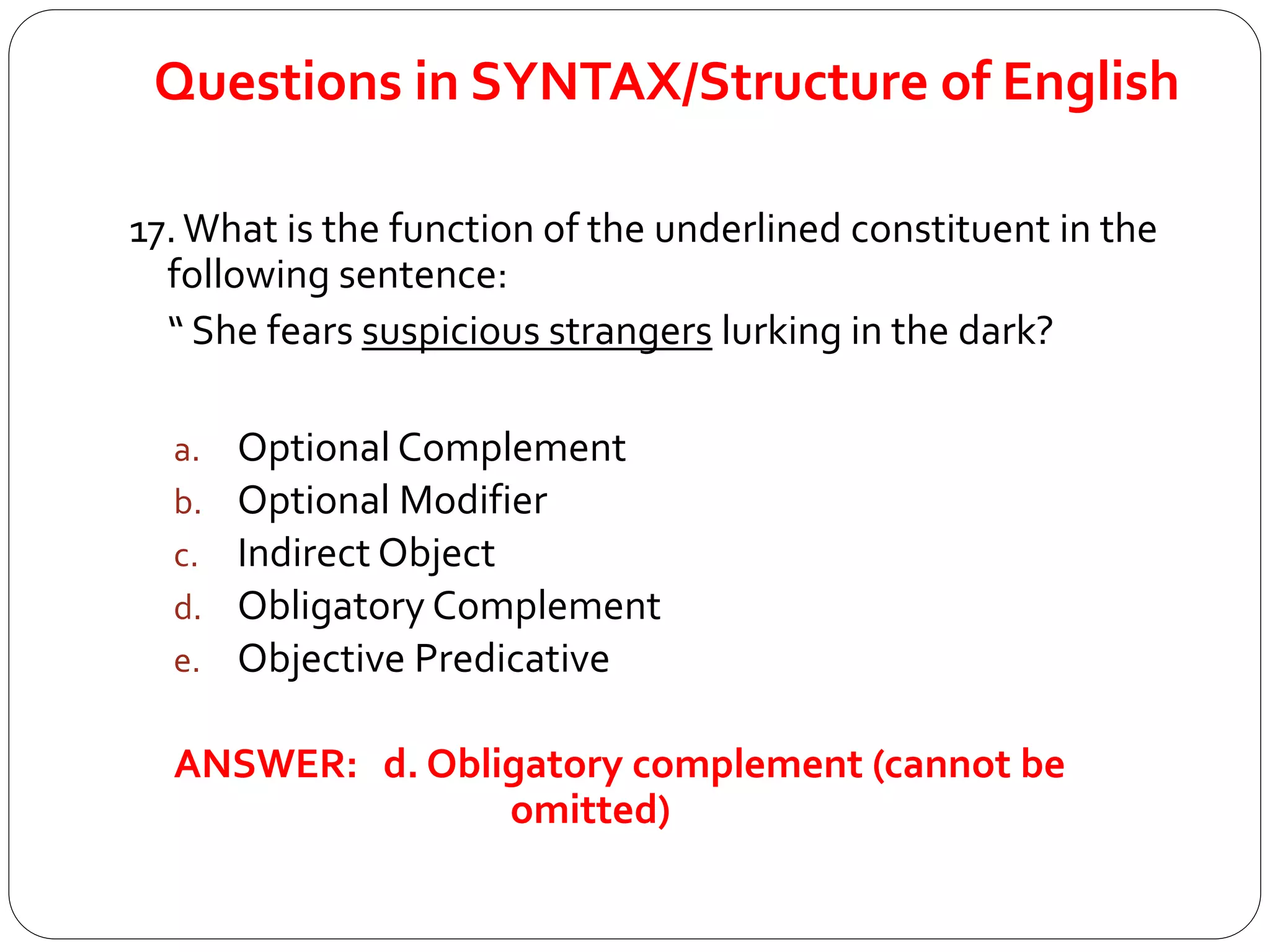
17.What is the function of the underlined constituent in the
following sentence:
“ She fears suspicious strangers lurking in the dark?
a. Optional Complement
b. Optional Modifier
c. Indirect Object
d. Obligatory Complement
e. Objective Predicative
ANSWER: d. Obligatory complement (cannot be
omitted)
Questions in SYNTAX/Structure of English
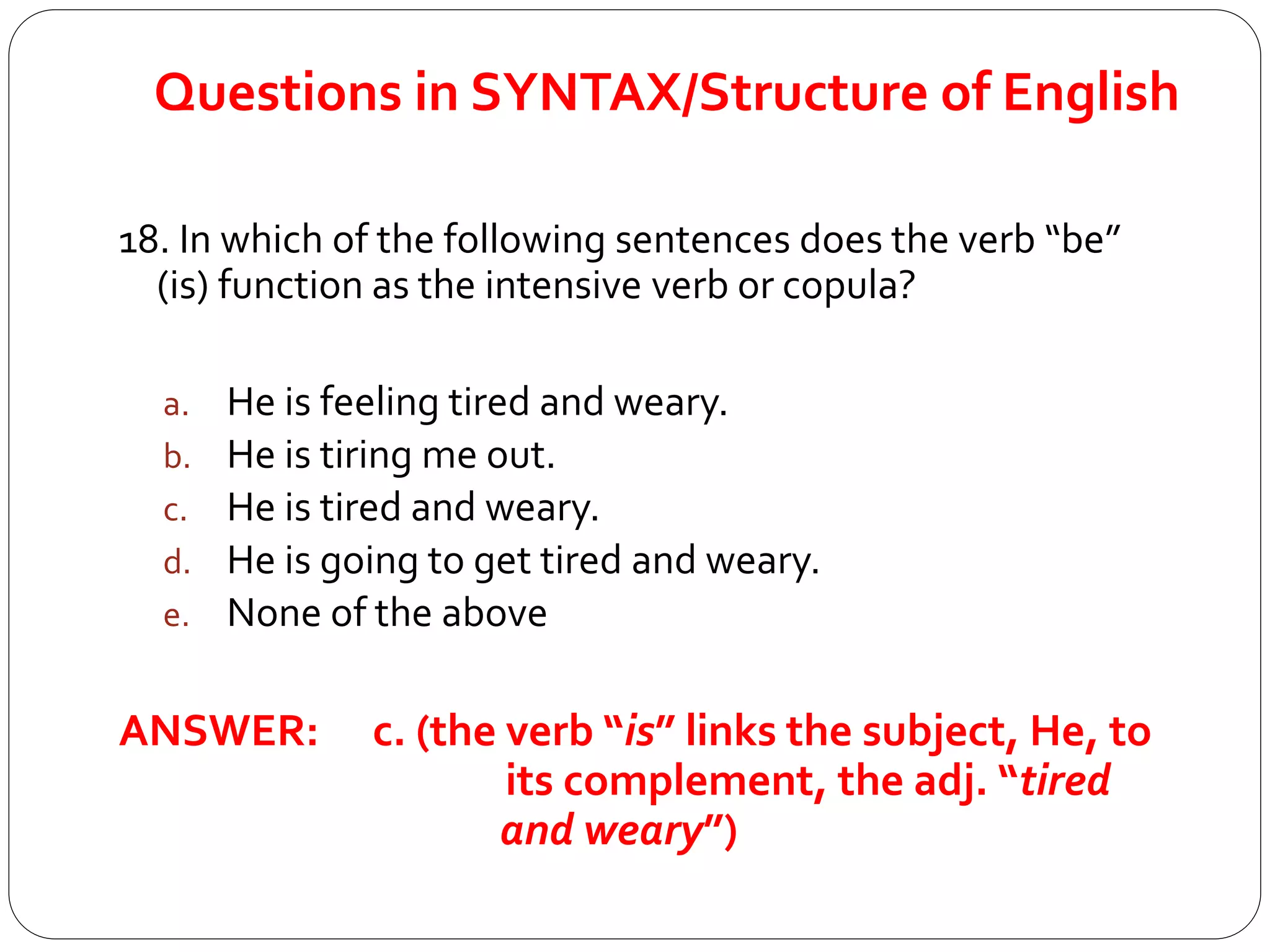
18. In which of the following sentences does the verb “be”
(is) function as the intensive verb or copula?
a. He is feeling tired and weary.
b. He is tiring me out.
c. He is tired and weary.
d. He is going to get tired and weary.
e. None of the above
ANSWER: c. (the verb “is” links the subject, He, to
its complement, the adj. “tired
and weary”)
Questions in SYNTAX/Structure of English
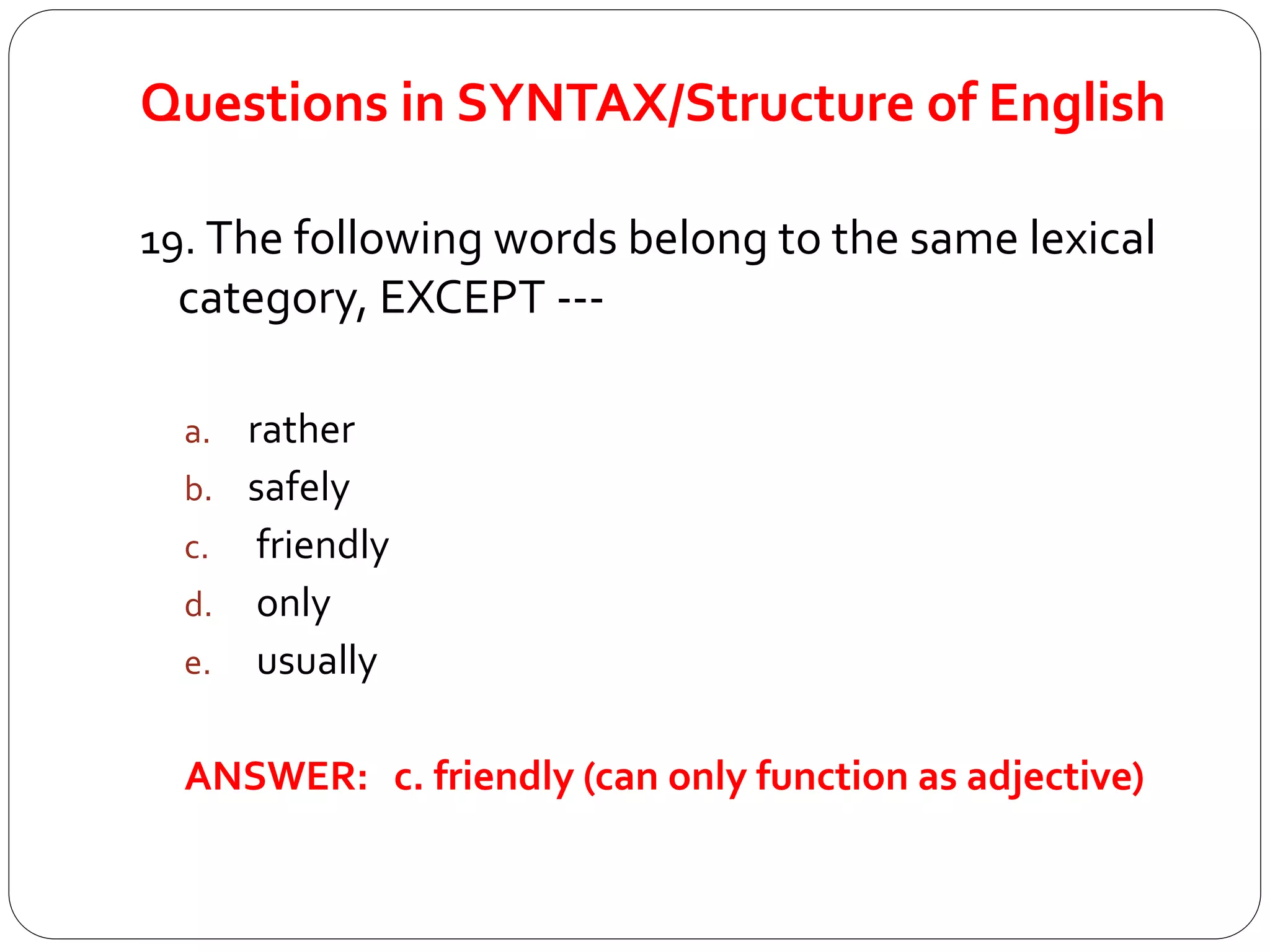
19. The following words belong to the same lexical
category, EXCEPT ---
a. rather
b. safely
c. friendly
d. only
e. usually
ANSWER: c. friendly (can only function as adjective)
Questions in SYNTAX/Structure of English
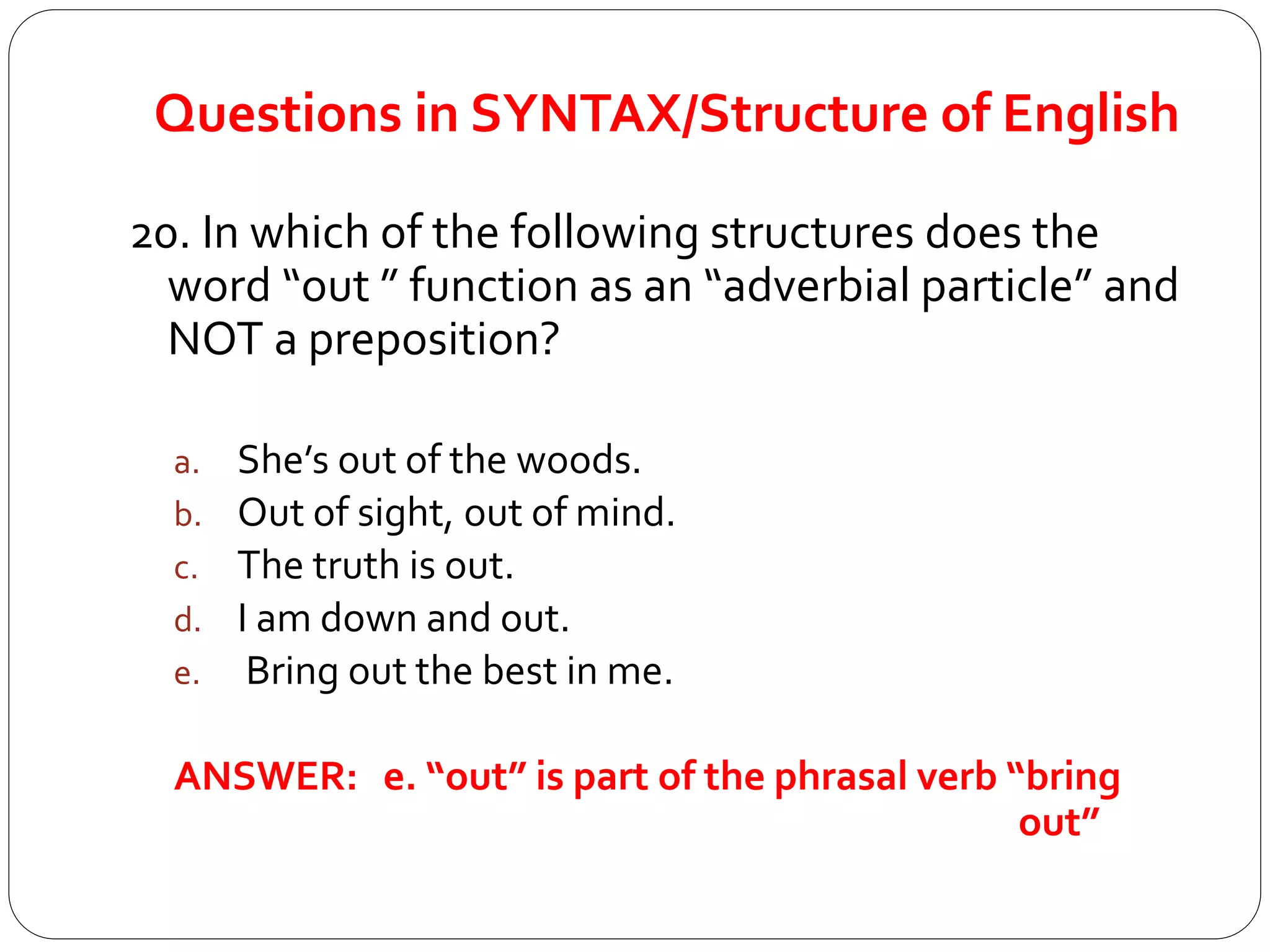
20. In which of the following structures does the
word “out ” function as an “adverbial particle” and
NOT a preposition?
a. She’s out of the woods.
b. Out of sight, out of mind.
c. The truth is out.
d. I am down and out.
e. Bring out the best in me.
ANSWER: e. “out” is part of the phrasal verb “bring
out”

Introduction to linguistics: A Quick Review

  • 1.
    SUB-FIELDS AND KEYCONCEPTS INTRODUCTIONTO LINGUISTICS
  • 2.
    Essential Questions  Whatis language? What are its properties?  How did it/does it evolve?  How does language serve as a medium of communication?  How does language serve as a medium of thinking?  What is common to all languages?  How do languages differ?
  • 3.
    Properties of Language Arbitrariness: there’s no natural connection between a linguistic form and its meaning  Discreteness: sounds are meaningfully distinct  Productivity: infinite number of possible utterances  Displacement: allows users to talk about things and events not present in the immediate environment  Duality: language is organized at two levels or layers simultaneously  CulturalTransmission: language is passed on from one generation to the next
  • 4.
    Sub-fields of structure-focusedlinguistics include:  Phonetics – study of the physical properties of speech production and perception  Phonology – description of the systems and patterns of speech sounds in a language; deals with the abstract representation of sounds  Morphology – study of internal structures of words and how they can be modified  Syntax – study of how words combine to form grammatical sentences
  • 5.
    Sub-fields…  Semantics –study of the meaning of words (lexical semantics) and fixed word combinations (phraseology), and how these combine to form the meanings of sentences  Pragmatics – study of how utterances are used in communicative acts – and the role played by context and non-linguistic knowledge in the transmission of meaning; study of speaker-intended meanings  Discourse analysis – analysis of language use in texts (spoken, written, or signed)
  • 6.
  • 7.
    Key Concepts inPHONETICS  Phonetic Description of Consonants Aspects in Describing Consonants: -Voicing Aspect [voiced/ voiceless] - Place of Articulation [bilabial, velar, alveolar] - Manner of Articulation [stop, fricative, nasal]  Phonetic Description ofVowels The 12-vowel-sound system of English  International Phonetic Alphabet (IPA) Universal system of symbols
  • 8.
    Phonetic Description ofConsonant s 1.Which of the following is an accurate phonetic description of the phoneme / k /? a. Voiceless velar stop b. Voiced alveolar stop c. Voiced velar stop d. Voiceless alveolar stop e. None of the above ANSWER: a.Voiceless velar stop
  • 9.
    Phonetic Description ofConsonant s 2.Which of the following is a BILABIAL NASAL? a. [ n ] b. [ b ] c. [ p ] d. [ m ] e. [ f ] ANSWER: d. [ m ]
  • 10.
    Phonetic Description ofVowels 3.Whichof the following is phonetically described as “high front tense unrounded” vowel? a. [ i ] b. [ u ] c. [ α ] d. [ e ] e. None of the above ANSWER: a. [ i ]
  • 11.
    Phonetic Description ofVowels 4.Whichof the following is the accurate phonetic description of the sound [ e ], as in bake [beIk]? a. Mid back lax round vowel b. Mid front tense unrounded vowel c. High front lax unrounded vowel d. Low front tense unrounded vowel e. None of the above ANSWER: b. Mid front tense unrounded
  • 12.
    Phonetic Description ofVowels Jaw height [ high, mid, low ]  Tongue position [ front, central, back ]  Lip shape [ rounded, unrounded ]  tension  Mid back lax round vowel / a / as in law  Mid front tense unrounded vowel / a / as in bake  High front lax unrounded vowel / I / as in sick  Low front tense unrounded vowel / a / as in cat
  • 13.
    Key Concepts inPHONOLOGY  Phonemes smallest unit of sound / b /  Phones version of a sound-type produced in actual speech [ b ]  Allophones versions of one phoneme [aspirated, flapped, dental]  Minimal pairs bat-vat; wet-wit...  Syllables and clusters Onset - the beginning consonant of a syllable Nucleus – the vowel in the syllable Coda – the terminal consonant following the nucleus
  • 14.
    Questions in Phonology 5.Whichof the following is NOT a minimal pair? a. caught – cut b. weight – wait c. feat – fit d. bet – bit e. phase – vase ANSWER: b. weight – wait  homophones are not minimal pairs; they are phonetically identical
  • 15.
    Questions in Phonology 6.Whichof the following syllables have an “onset” and a “nucleus,” but no “coda”? a. bash b. floor c. beg d. tree e. Ouch ANSWER: d. tree
  • 16.
    Key Concepts inMORPHOLOGY  Morpheme free and bound, inflection, derivation  Word-formation processes -Coinage -Blending -Borrowing -Clipping -Compounding -Backformation, hypocorism -Conversion -Derivation
  • 17.
    Word-formation Processes  Coinage:xerox, teflon, kleenex, zipper, fingerboarding…  Borrowing: croissant, piano, pretzel, robot, yogurt..  Compounding: textbook, sunburn, wallpaper…  Conversion: verb-to-noun, phrasal verb-to-noun  Blending: smog, infomercial,Spanglish, modem…  Clipping: fax, condo, cab, bra, fan, perm…  Backformation: donation-donate, emotion-emote, liaison-liaise *hypocorism: preggy, telly, brekkie, Aussie, hankie…  Derivation: mis + re + present = misrepresent
  • 18.
    Questions in Morphology 7.Whichof the following words contains an INFLECTIONAL morpheme? a. useless pursuit b. loudest noise c. wise decision d. great teacher e. None of the above ANSWER: b. loudest noise (1superlative inflection) Inflectional Morphemes: 2ownership (‘s), 3plurality (+s/es), 4present tense, 5past tense, 6progressive form, 7past participle form (-s, -ed,-ing, -en), 8comparative degree
  • 19.
    Questions in Morphology 8.In which of the following examples does the vowel / a / function as a BOUND morpheme? a. ASAP b. amoral c. a man d. about e. ago ANSWER: b. amoral  / a / in “amoral” functions as a prefix, or a bound morpheme
  • 20.
    Questions in Morphology 9.Thefollowing words are products of a word-formation process called “blending,” EXCEPT--- a. Telecast b. Phone c. Brunch d. Motel e. Simulcast ANSWER: b. phone  clipping (telephone)
  • 21.
    Questions in Morphology 10.What word-formation process yielded the word “wannabe,” as in “She’s a wannabe actress”? a. Backformation b. Blending c. Coinage d. Compounding e. Conversion ANSWER: e. Conversion “want to be” (verb phrase-to-adjective)
  • 22.
    Key Concepts inSemantics  Semantic Roles experiencer, location, source, goal, theme…  Lexical Relations synonymy, antonymy, hyponymy (inclusive meaning rose – flower, poodle – dog, carrot – vegetable…)
  • 23.
    SEMANTIC ROLES Mary sawa mosquito on the wall. She EXPERIENCER THEME LOCATION AGENT borrowed a magazine from George and she THEME SOURCE AGENT hit the bug with the magazine. THEME INSTRUMENT
  • 24.
    Questions in Semantics 11.Whatis the semantic role of the underlined word in this sentence: “The students heard a mysterious noise from the adjacent room.” a. Agent b. Theme c. Source d. Experiencer e. Location ANSWER: d. Experiencer
  • 25.
    Questions in Semantics 12.Whichof the following are NON-GRADABLE synonyms? a. ultimate – final b. swift – quick c. common – ubiquitous d. typical – conventional e. fatal – deadly ANSWER: a. ultimate – final (we can’t say “more final, most final)
  • 26.
    Key Concepts inPragmatics  Deixis are words that point (deictic expressions: here, there, this, that, etc.)  Referent the noun being “referred to”  Anaphora any subsequent pronoun Example: I wanted that job so much, but it went to DEIXIS REFERENT ANAPHORA my former classmate who has better qualifications. REFERENT ANAPHORA
  • 27.
    Questions in Pragmatics 13.Which word in the following sentence is a DEICTIC EXPRESSION?  “Their parents used to live in that old colonial house before the war broke in 1942.” a. Their b. Before c. That d. Live e. None of the above ANSWER: c.That
  • 28.
    Key Concepts inDiscourse Analysis  Types of text/ text genres  Style and register  Coherence and cohesion -cohesive/ transitional devices
  • 29.
    Questions in SYNTAX/Structureof English 14. Which of the following sentence structures contains a “ditransitive verb group”? a. They have read my article. b. They seem mildly surprised. c. They liked my suggestion. d. They consider their boss as their trusted adviser. e. They will buy a new office desk for their boss. ANSWER: e. Subj. –V - dO - iO
  • 30.
    Questions in SYNTAX/Structureof English 15. Which of the following sentence structures is “syntactically ambiguous”? a. The mayor invited all city hall employees to his birthday dinner. b. Mr. Jackman shot the burglar in his pyjamas. c. The man with a tall hat sits rather uncomfortably at the dinner table. d. The valet looks imposing in his purple velvet vest. e. None of the above ANSWER: b. (The sentence has two possible meanings)
  • 31.
    Questions in SYNTAX/Structureof English 16.Which of the following phrases would be generated by this Phrase Structure Rule: NP Art(Adj)N + PP Prep Det N? a. A huge building across the street b. The house at the end of the street c. My one chance at winning the lottery d. One day at a time e. That old powerful beast of burden ANSWER: a. NP A huge building + PP across the street
  • 32.
    Questions in SYNTAX/Structureof English 17.What is the function of the underlined constituent in the following sentence: “ She fears suspicious strangers lurking in the dark? a. Optional Complement b. Optional Modifier c. Indirect Object d. Obligatory Complement e. Objective Predicative ANSWER: d. Obligatory complement (cannot be omitted)
  • 33.
    Questions in SYNTAX/Structureof English 18. In which of the following sentences does the verb “be” (is) function as the intensive verb or copula? a. He is feeling tired and weary. b. He is tiring me out. c. He is tired and weary. d. He is going to get tired and weary. e. None of the above ANSWER: c. (the verb “is” links the subject, He, to its complement, the adj. “tired and weary”)
  • 34.
    Questions in SYNTAX/Structureof English 19. The following words belong to the same lexical category, EXCEPT --- a. rather b. safely c. friendly d. only e. usually ANSWER: c. friendly (can only function as adjective)
  • 35.
    Questions in SYNTAX/Structureof English 20. In which of the following structures does the word “out ” function as an “adverbial particle” and NOT a preposition? a. She’s out of the woods. b. Out of sight, out of mind. c. The truth is out. d. I am down and out. e. Bring out the best in me. ANSWER: e. “out” is part of the phrasal verb “bring out”