The Three Levels of
Comprehension
2
Essentials of Reading
Comprehension
First, you must accurately label the three basic
elements of a passage.
• The topic or subject of the passage (not the author’s
opinion).
– The topic will help you answer questions about the main
idea of the passage.
• The setting of the passage.
– Describes the breadth of the topic, placing the topic in a
precise context.
– Be careful to avoid wrong answer choices that belong to a
setting different from that of the passage.
3
Essentials of Reading
Comprehension
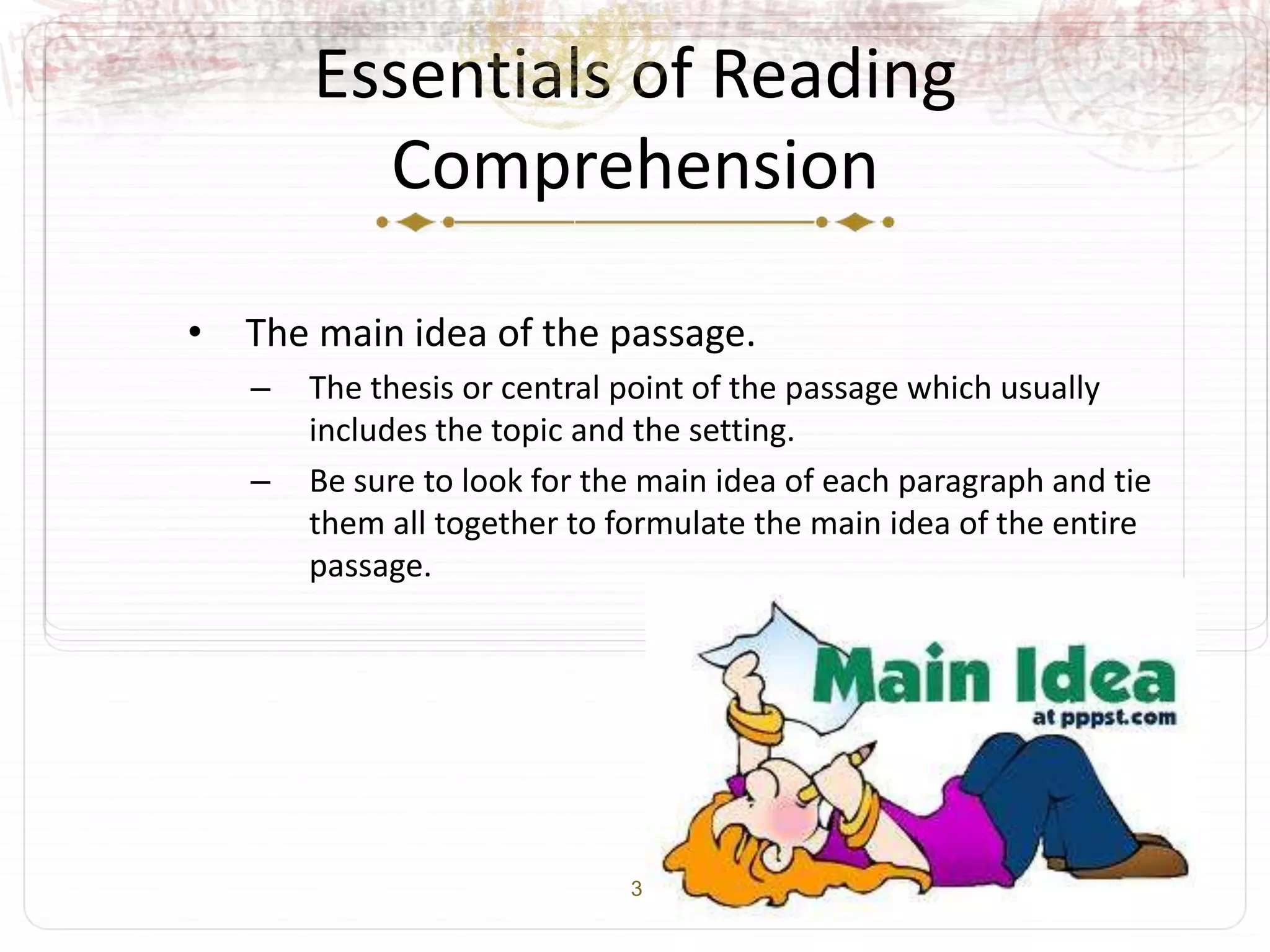
• The main idea of the passage.
– The thesis or central point of the passage which usually
includes the topic and the setting.
– Be sure to look for the main idea of each paragraph and tie
them all together to formulate the main idea of the entire
passage.
4
The three levels of comprehension
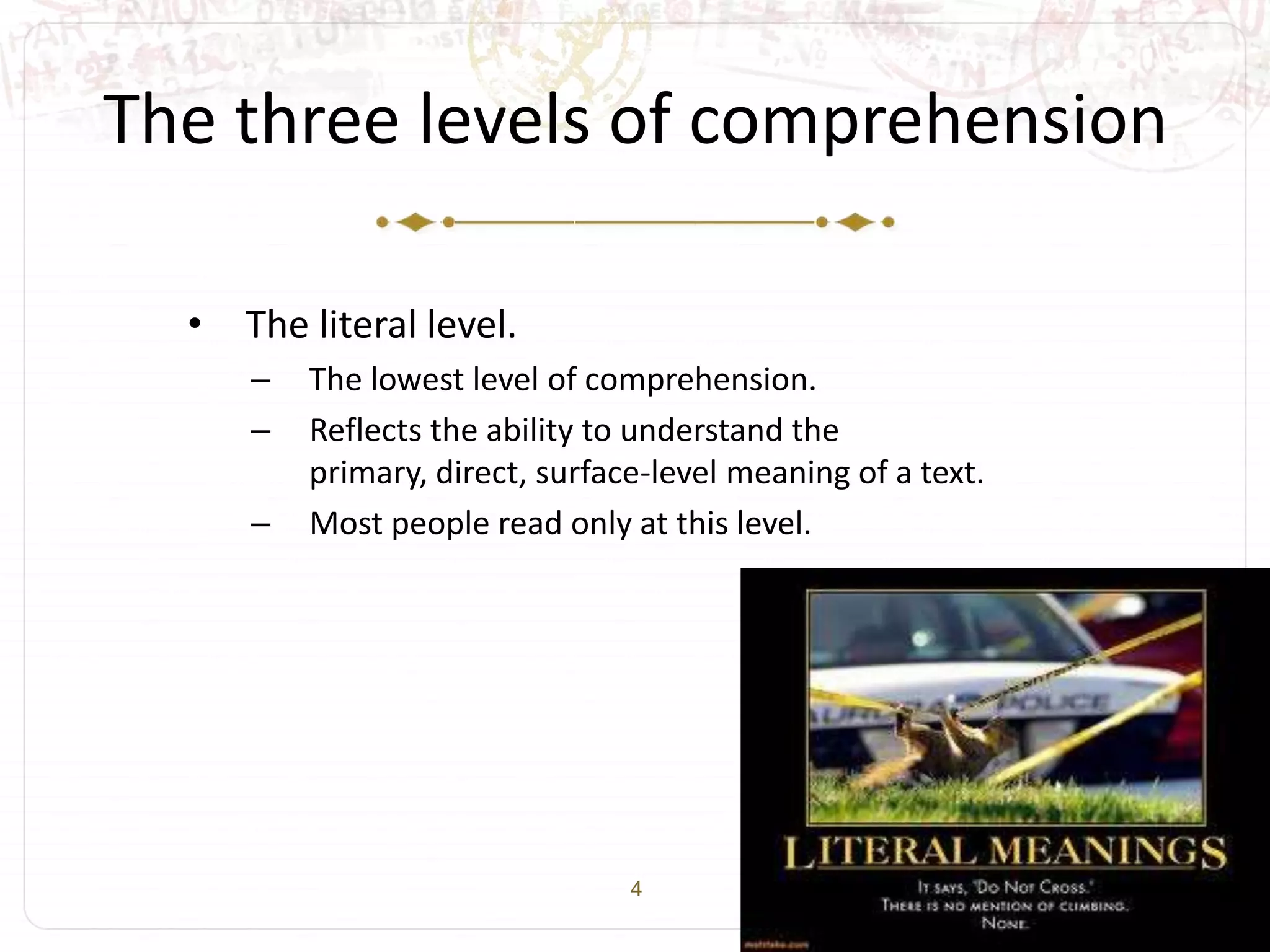
• The literal level.
– The lowest level of comprehension.
– Reflects the ability to understand the
primary, direct, surface-level meaning of a text.
– Most people read only at this level.
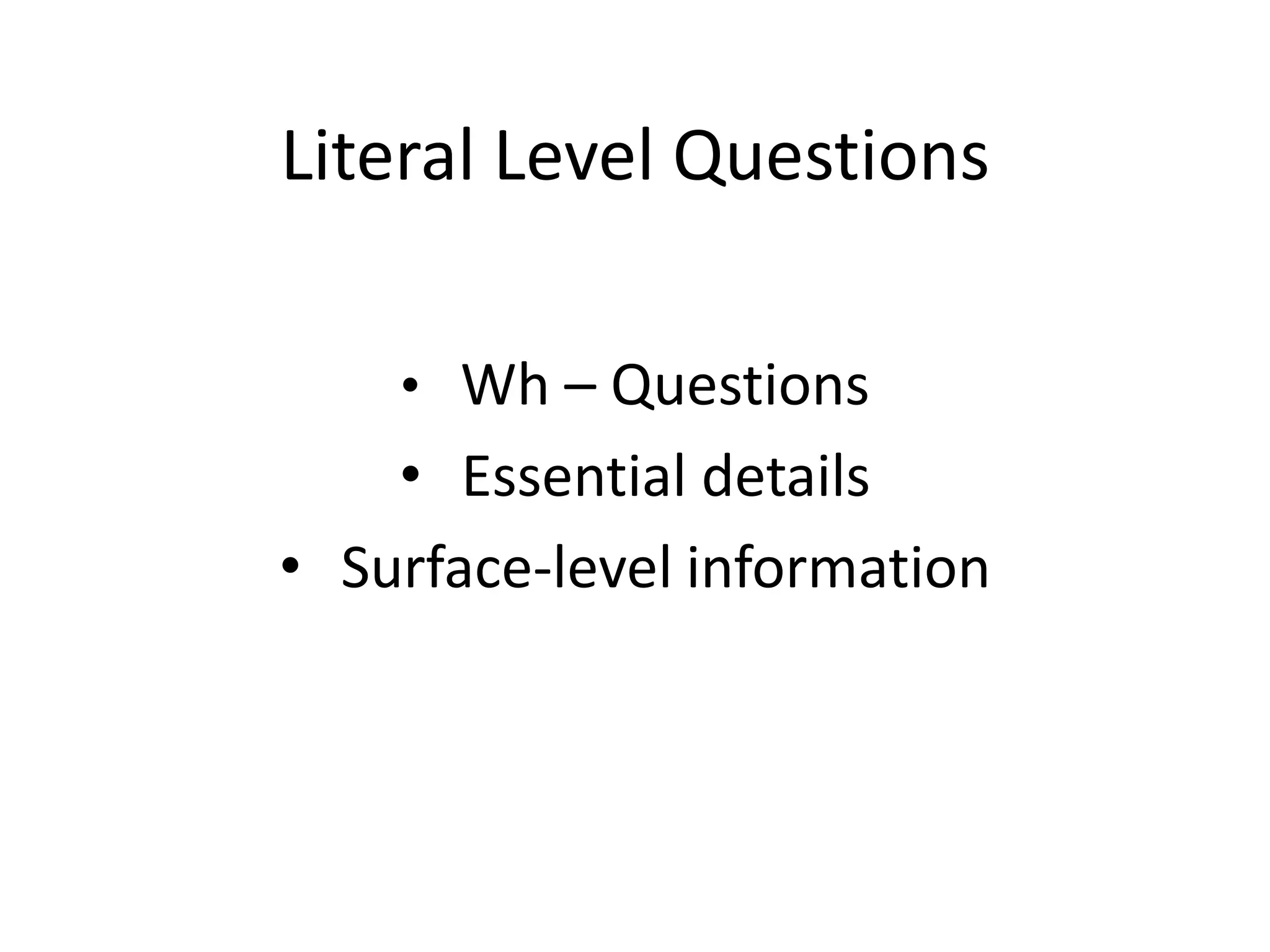
Literal Level Questions
• Wh – Questions
• Essential details
• Surface-level information
6
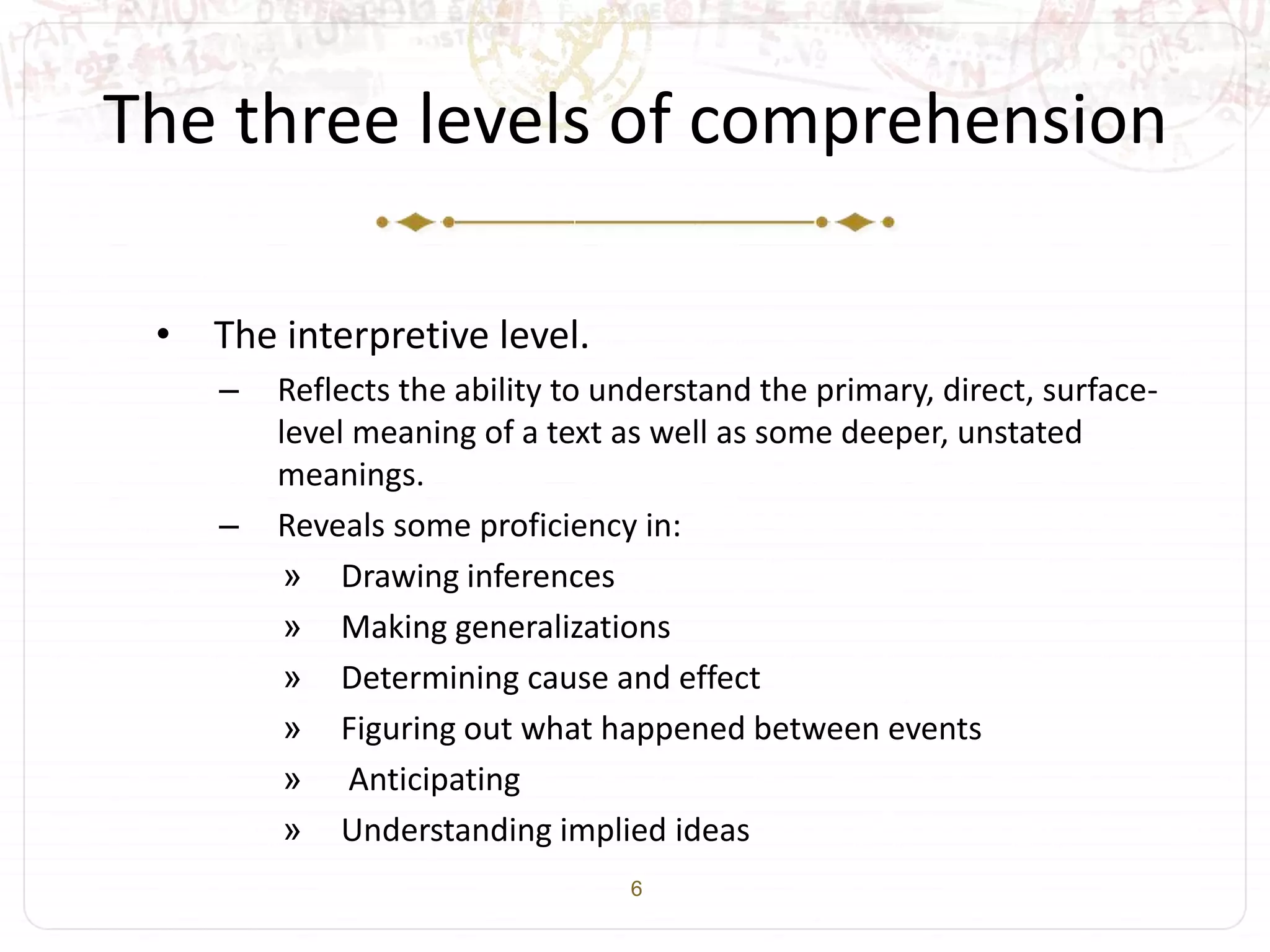
The three levels of comprehension
• The interpretive level.
– Reflects the ability to understand the primary, direct, surface-
level meaning of a text as well as some deeper, unstated
meanings.
– Reveals some proficiency in:
» Drawing inferences
» Making generalizations
» Determining cause and effect
» Figuring out what happened between events
» Anticipating
» Understanding implied ideas
7
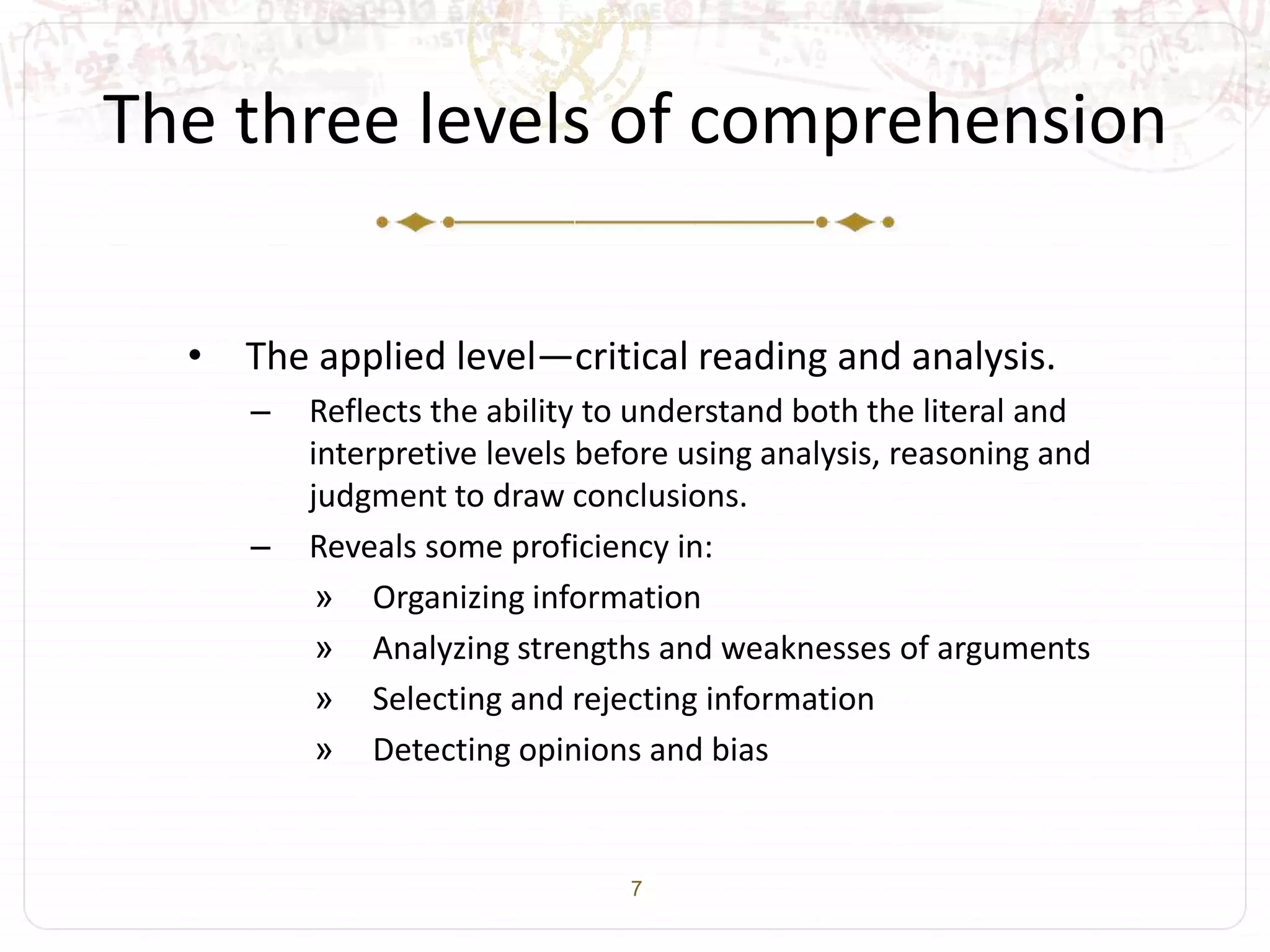
The three levels of comprehension
• The applied level—critical reading and analysis.
– Reflects the ability to understand both the literal and
interpretive levels before using analysis, reasoning and
judgment to draw conclusions.
– Reveals some proficiency in:
» Organizing information
» Analyzing strengths and weaknesses of arguments
» Selecting and rejecting information
» Detecting opinions and bias
8
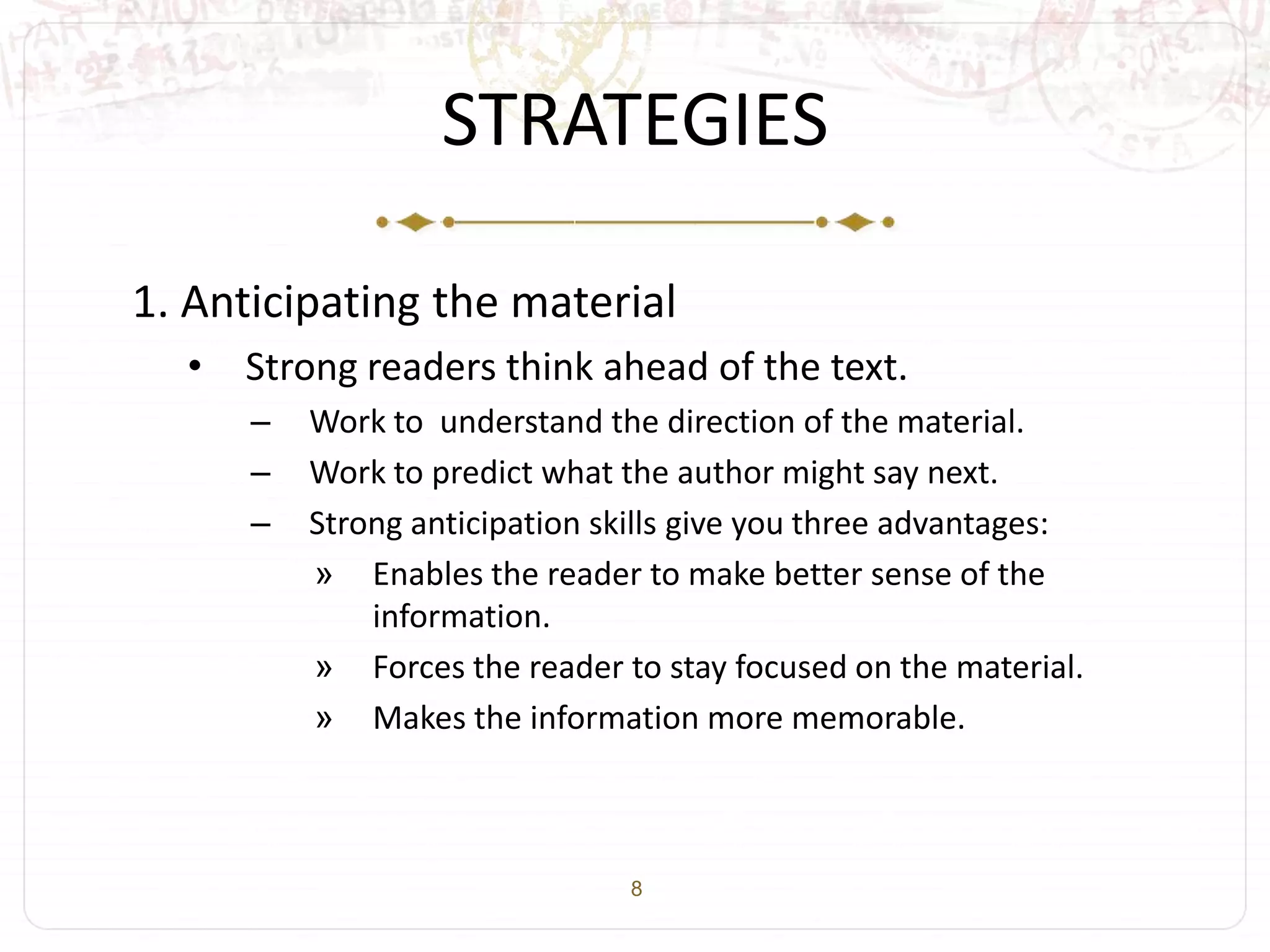
STRATEGIES
1. Anticipating the material
• Strong readers think ahead of the text.
– Work to understand the direction of the material.
– Work to predict what the author might say next.
– Strong anticipation skills give you three advantages:
» Enables the reader to make better sense of the
information.
» Forces the reader to stay focused on the material.
» Makes the information more memorable.
9
STRATEGIES
1. Anticipating the material
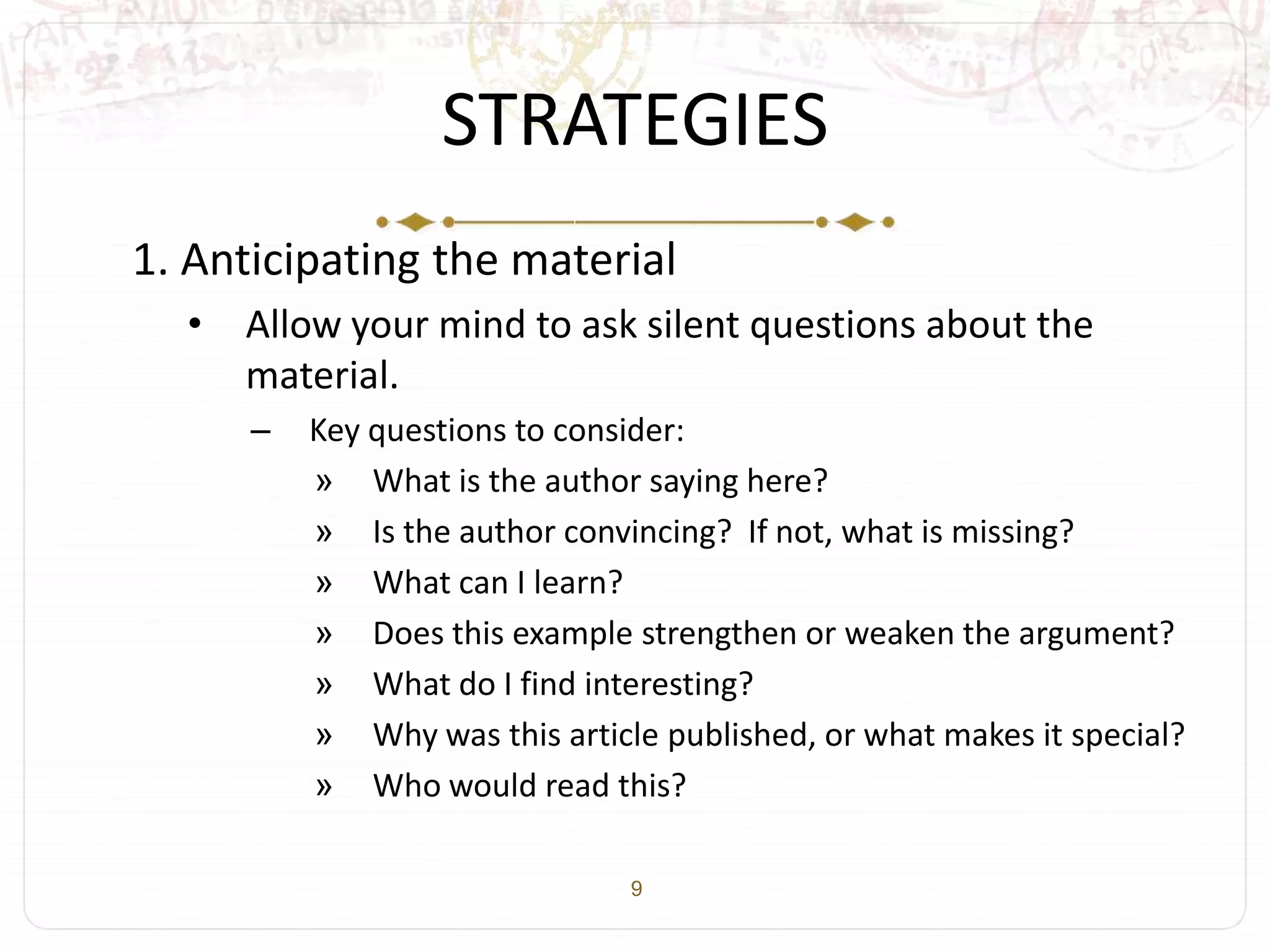
• Allow your mind to ask silent questions about the
material.
– Key questions to consider:
» What is the author saying here?
» Is the author convincing? If not, what is missing?
» What can I learn?
» Does this example strengthen or weaken the argument?
» What do I find interesting?
» Why was this article published, or what makes it special?
» Who would read this?
10
STRATEGIES
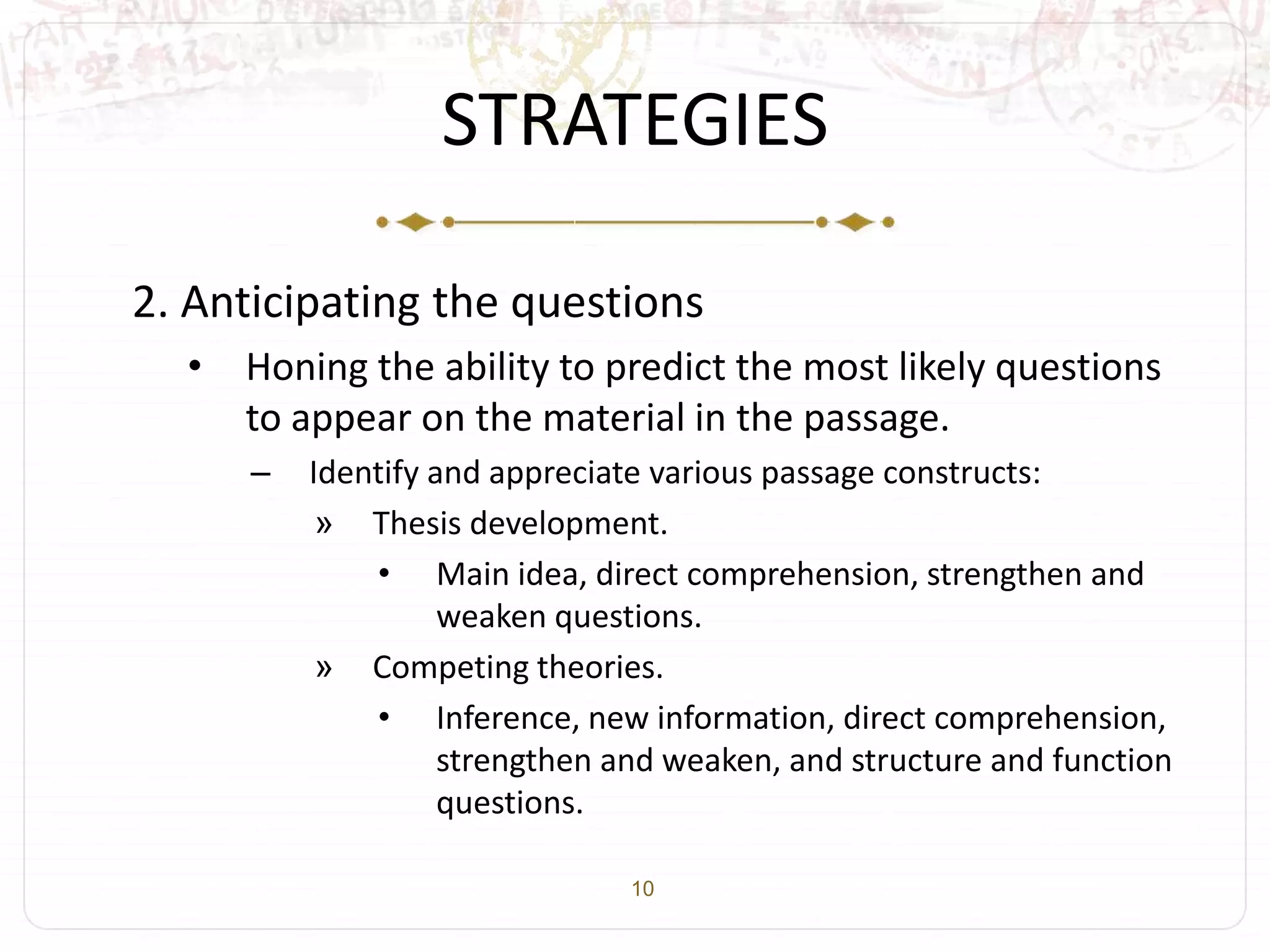
2. Anticipating the questions
• Honing the ability to predict the most likely questions
to appear on the material in the passage.
– Identify and appreciate various passage constructs:
» Thesis development.
• Main idea, direct comprehension, strengthen and
weaken questions.
» Competing theories.
• Inference, new information, direct comprehension,
strengthen and weaken, and structure and function
questions.
11
STRATEGIES
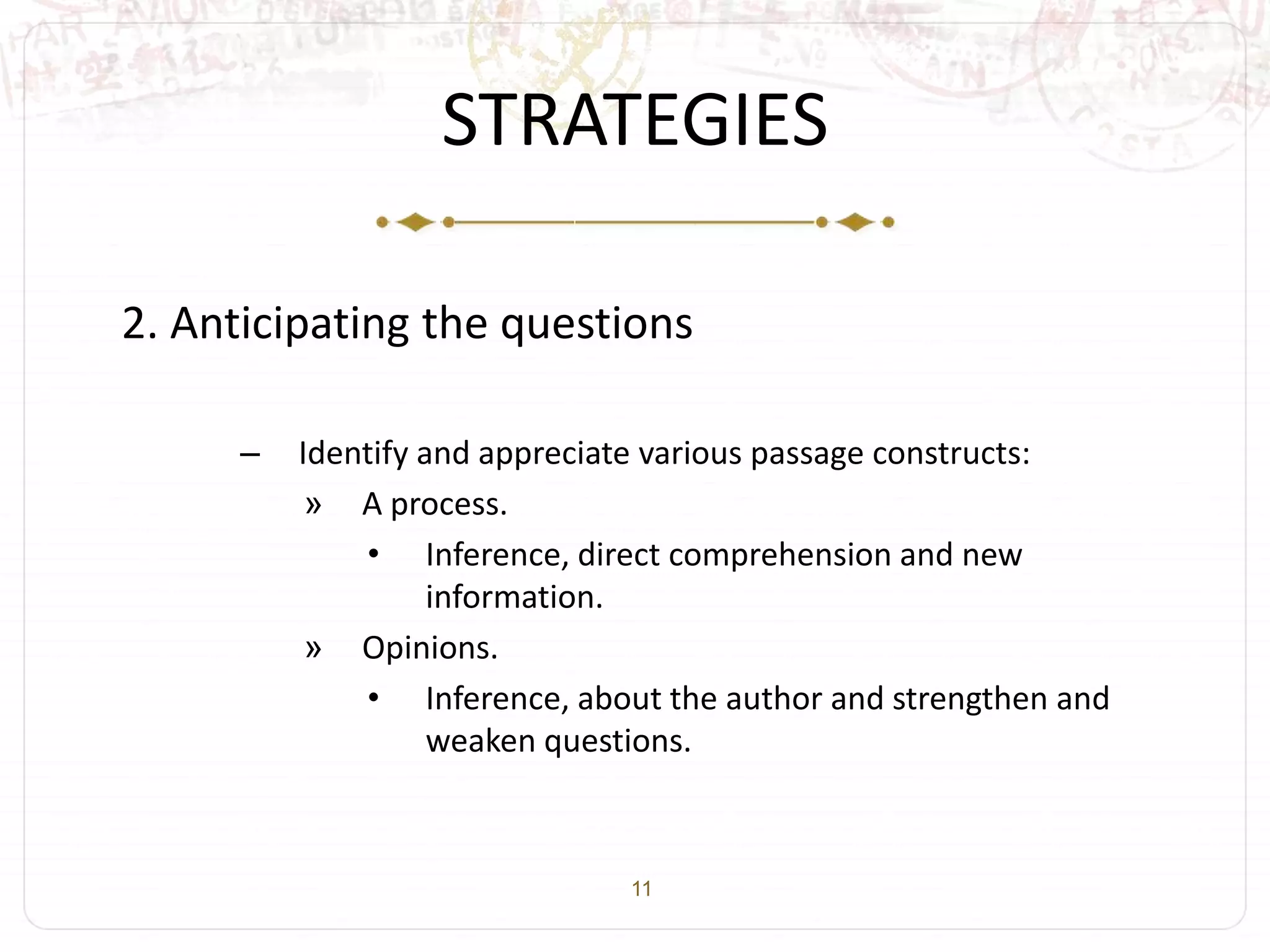
2. Anticipating the questions
– Identify and appreciate various passage constructs:
» A process.
• Inference, direct comprehension and new
information.
» Opinions.
• Inference, about the author and strengthen and
weaken questions.
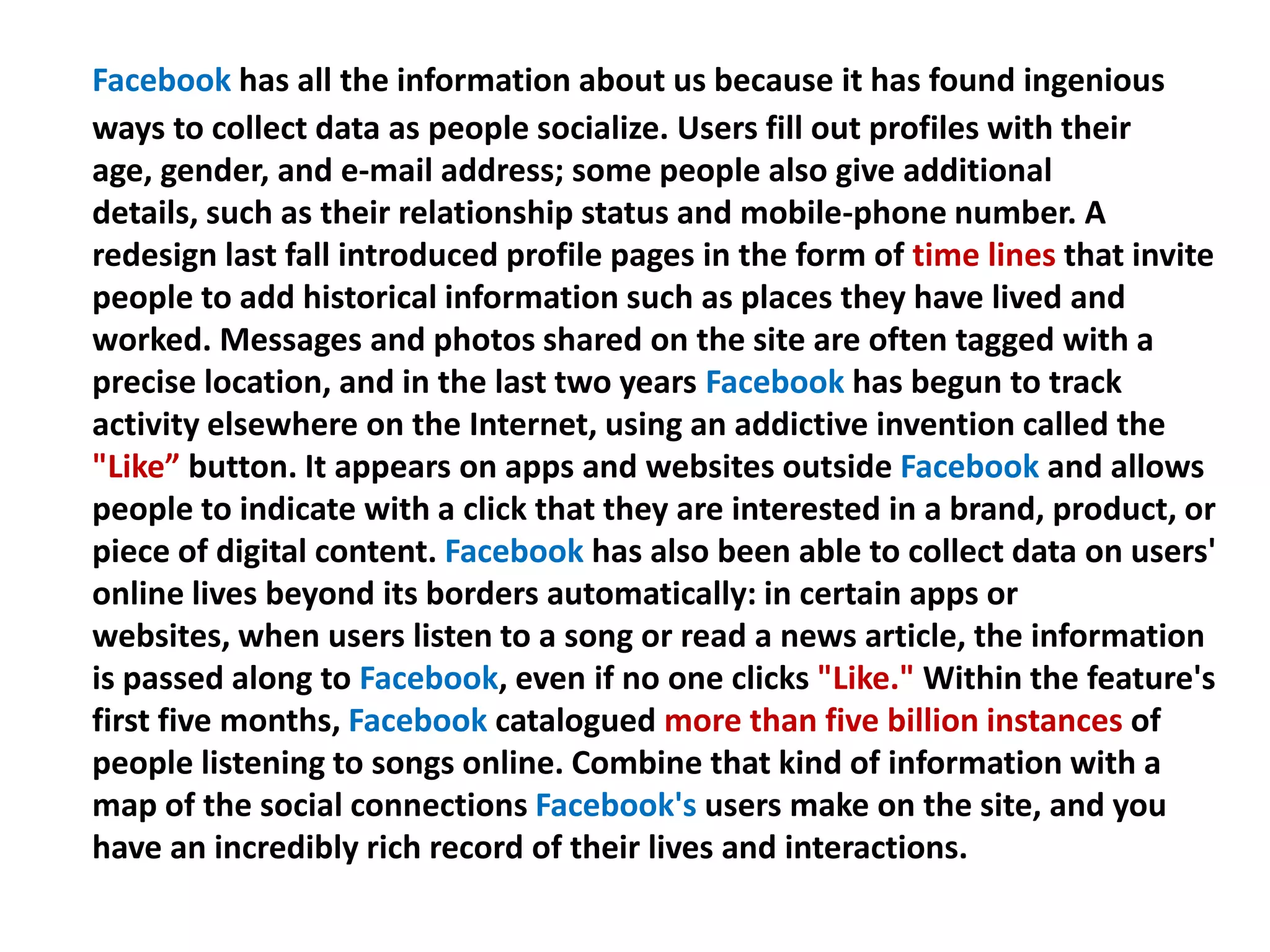
Facebook has all the information about us because it has found ingenious
ways to collect data as people socialize. Users fill out profiles with their
age, gender, and e-mail address; some people also give additional
details, such as their relationship status and mobile-phone number. A
redesign last fall introduced profile pages in the form of time lines that invite
people to add historical information such as places they have lived and
worked. Messages and photos shared on the site are often tagged with a
precise location, and in the last two years Facebook has begun to track
activity elsewhere on the Internet, using an addictive invention called the
"Like” button. It appears on apps and websites outside Facebook and allows
people to indicate with a click that they are interested in a brand, product, or
piece of digital content. Facebook has also been able to collect data on users'
online lives beyond its borders automatically: in certain apps or
websites, when users listen to a song or read a news article, the information
is passed along to Facebook, even if no one clicks "Like." Within the feature's
first five months, Facebook catalogued more than five billion instances of
people listening to songs online. Combine that kind of information with a
map of the social connections Facebook's users make on the site, and you
have an incredibly rich record of their lives and interactions.
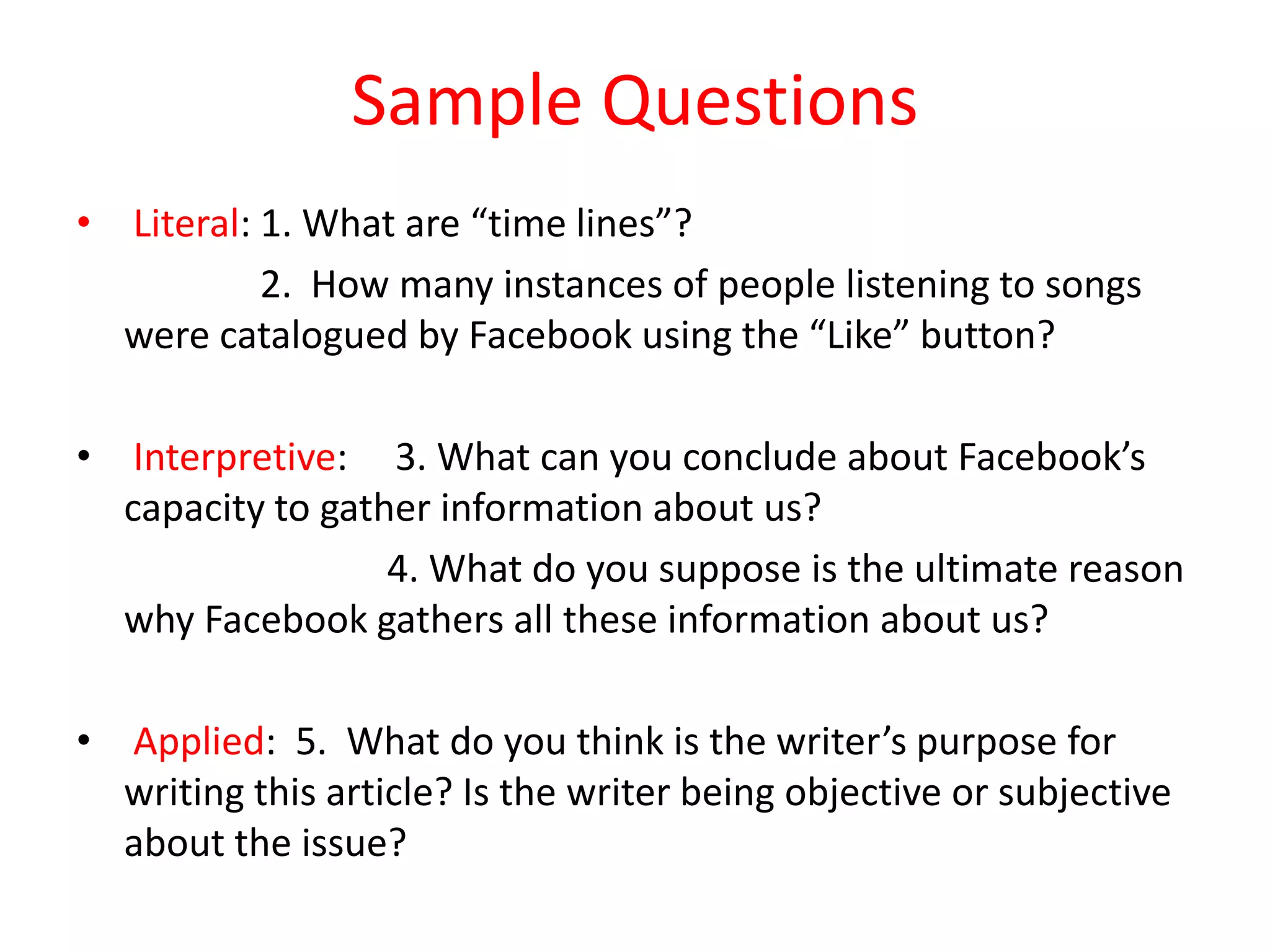
Sample Questions
• Literal: 1. What are “time lines”?
2. How many instances of people listening to songs
were catalogued by Facebook using the “Like” button?
• Interpretive: 3. What can you conclude about Facebook’s
capacity to gather information about us?
4. What do you suppose is the ultimate reason
why Facebook gathers all these information about us?
• Applied: 5. What do you think is the writer’s purpose for
writing this article? Is the writer being objective or subjective
about the issue?
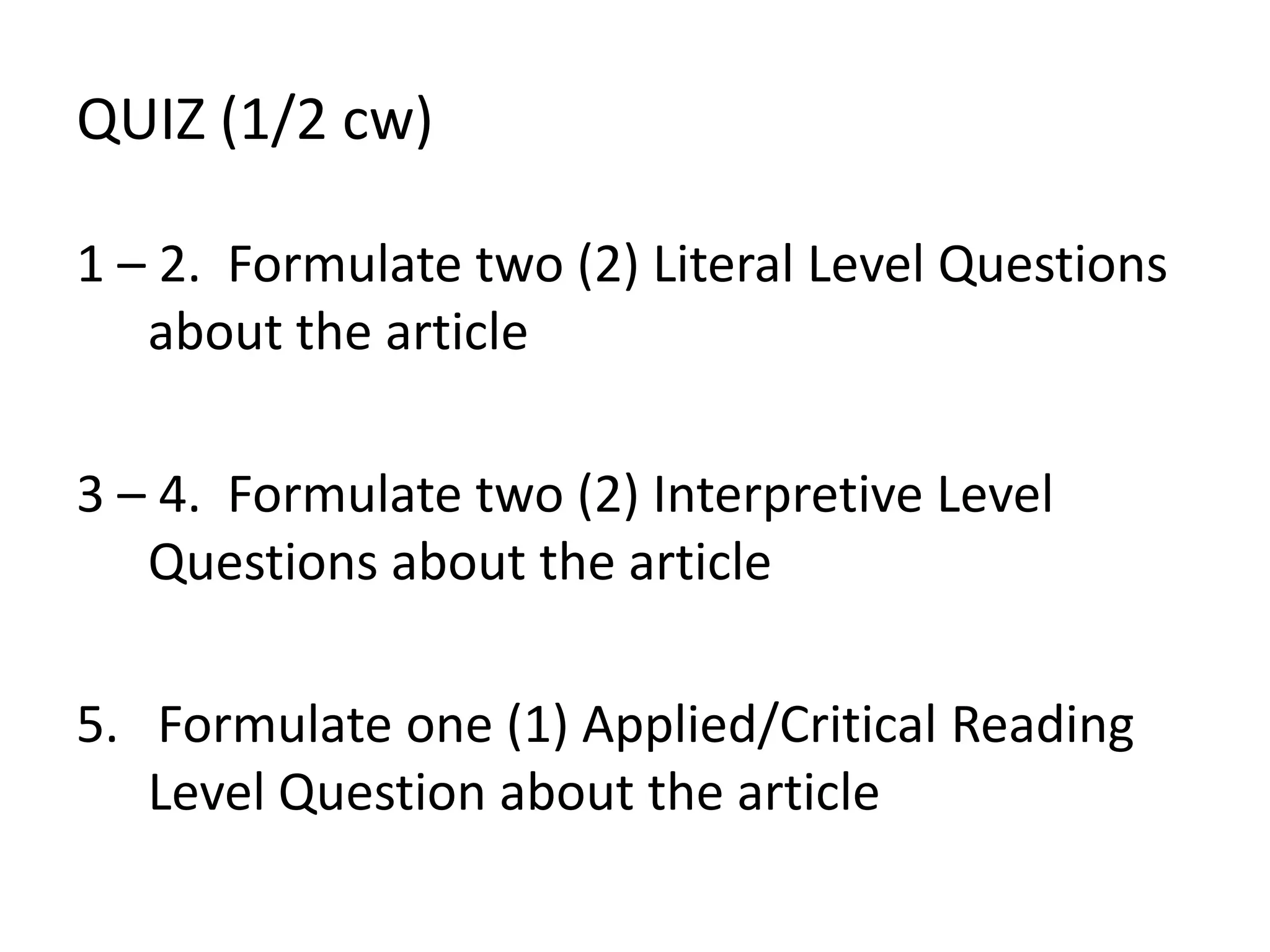
QUIZ (1/2 cw)
1 – 2. Formulate two (2) Literal Level Questions
about the article
3 – 4. Formulate two (2) Interpretive Level
Questions about the article
5. Formulate one (1) Applied/Critical Reading
Level Question about the article
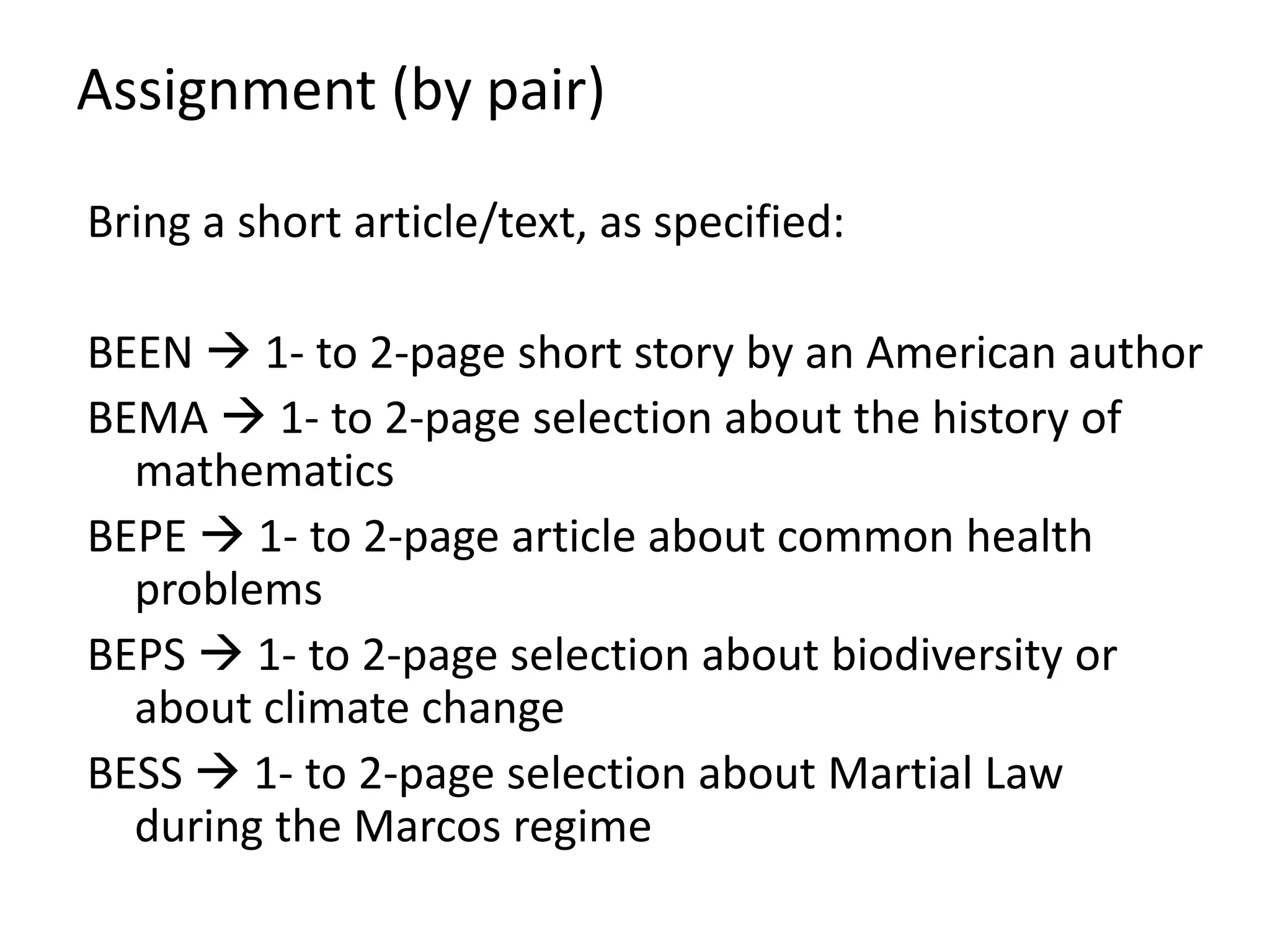
Assignment (by pair)
Bring a short article/text, as specified:
BEEN  1- to 2-page short story by an American author
BEMA  1- to 2-page selection about the history of
mathematics
BEPE  1- to 2-page article about common health
problems
BEPS  1- to 2-page selection about biodiversity or
about climate change
BESS  1- to 2-page selection about Martial Law
during the Marcos regime

Levels of comprehension-LET Review

  • 1.
    The Three Levelsof Comprehension
  • 2.
    2 Essentials of Reading Comprehension First,you must accurately label the three basic elements of a passage. • The topic or subject of the passage (not the author’s opinion). – The topic will help you answer questions about the main idea of the passage. • The setting of the passage. – Describes the breadth of the topic, placing the topic in a precise context. – Be careful to avoid wrong answer choices that belong to a setting different from that of the passage.
  • 3.
    3 Essentials of Reading Comprehension •The main idea of the passage. – The thesis or central point of the passage which usually includes the topic and the setting. – Be sure to look for the main idea of each paragraph and tie them all together to formulate the main idea of the entire passage.
  • 4.
    4 The three levelsof comprehension • The literal level. – The lowest level of comprehension. – Reflects the ability to understand the primary, direct, surface-level meaning of a text. – Most people read only at this level.
  • 5.
    Literal Level Questions •Wh – Questions • Essential details • Surface-level information
  • 6.
    6 The three levelsof comprehension • The interpretive level. – Reflects the ability to understand the primary, direct, surface- level meaning of a text as well as some deeper, unstated meanings. – Reveals some proficiency in: » Drawing inferences » Making generalizations » Determining cause and effect » Figuring out what happened between events » Anticipating » Understanding implied ideas
  • 7.
    7 The three levelsof comprehension • The applied level—critical reading and analysis. – Reflects the ability to understand both the literal and interpretive levels before using analysis, reasoning and judgment to draw conclusions. – Reveals some proficiency in: » Organizing information » Analyzing strengths and weaknesses of arguments » Selecting and rejecting information » Detecting opinions and bias
  • 8.
    8 STRATEGIES 1. Anticipating thematerial • Strong readers think ahead of the text. – Work to understand the direction of the material. – Work to predict what the author might say next. – Strong anticipation skills give you three advantages: » Enables the reader to make better sense of the information. » Forces the reader to stay focused on the material. » Makes the information more memorable.
  • 9.
    9 STRATEGIES 1. Anticipating thematerial • Allow your mind to ask silent questions about the material. – Key questions to consider: » What is the author saying here? » Is the author convincing? If not, what is missing? » What can I learn? » Does this example strengthen or weaken the argument? » What do I find interesting? » Why was this article published, or what makes it special? » Who would read this?
  • 10.
    10 STRATEGIES 2. Anticipating thequestions • Honing the ability to predict the most likely questions to appear on the material in the passage. – Identify and appreciate various passage constructs: » Thesis development. • Main idea, direct comprehension, strengthen and weaken questions. » Competing theories. • Inference, new information, direct comprehension, strengthen and weaken, and structure and function questions.
  • 11.
    11 STRATEGIES 2. Anticipating thequestions – Identify and appreciate various passage constructs: » A process. • Inference, direct comprehension and new information. » Opinions. • Inference, about the author and strengthen and weaken questions.
  • 12.
    Facebook has allthe information about us because it has found ingenious ways to collect data as people socialize. Users fill out profiles with their age, gender, and e-mail address; some people also give additional details, such as their relationship status and mobile-phone number. A redesign last fall introduced profile pages in the form of time lines that invite people to add historical information such as places they have lived and worked. Messages and photos shared on the site are often tagged with a precise location, and in the last two years Facebook has begun to track activity elsewhere on the Internet, using an addictive invention called the "Like” button. It appears on apps and websites outside Facebook and allows people to indicate with a click that they are interested in a brand, product, or piece of digital content. Facebook has also been able to collect data on users' online lives beyond its borders automatically: in certain apps or websites, when users listen to a song or read a news article, the information is passed along to Facebook, even if no one clicks "Like." Within the feature's first five months, Facebook catalogued more than five billion instances of people listening to songs online. Combine that kind of information with a map of the social connections Facebook's users make on the site, and you have an incredibly rich record of their lives and interactions.
  • 13.
    Sample Questions • Literal:1. What are “time lines”? 2. How many instances of people listening to songs were catalogued by Facebook using the “Like” button? • Interpretive: 3. What can you conclude about Facebook’s capacity to gather information about us? 4. What do you suppose is the ultimate reason why Facebook gathers all these information about us? • Applied: 5. What do you think is the writer’s purpose for writing this article? Is the writer being objective or subjective about the issue?
  • 14.
    QUIZ (1/2 cw) 1– 2. Formulate two (2) Literal Level Questions about the article 3 – 4. Formulate two (2) Interpretive Level Questions about the article 5. Formulate one (1) Applied/Critical Reading Level Question about the article
  • 15.
    Assignment (by pair) Bringa short article/text, as specified: BEEN  1- to 2-page short story by an American author BEMA  1- to 2-page selection about the history of mathematics BEPE  1- to 2-page article about common health problems BEPS  1- to 2-page selection about biodiversity or about climate change BESS  1- to 2-page selection about Martial Law during the Marcos regime