Mrs.G.Chandraprabha,M.Sc.,M.Phil.,
Assistant Professor
Department of IT
V.V.Vanniaperumal College for Women
Virudhunagar
Graph Coloring problem
Using Backtracking
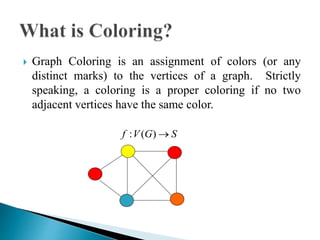
 Graph Coloring is an assignment of colors (or any
distinct marks) to the vertices of a graph. Strictly
speaking, a coloring is a proper coloring if no two
adjacent vertices have the same color.
SGVf )(:
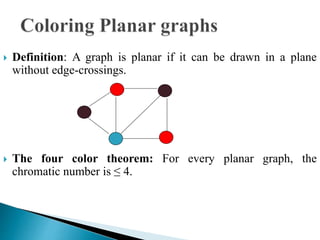
 Definition: A graph is planar if it can be drawn in a plane
without edge-crossings.
 The four color theorem: For every planar graph, the
chromatic number is ≤ 4.
 The four color theorem states that any planar map can
be colored with at most four colors.
 In graph terminology, this means that using at most
four colors, any planar graph can have its nodes colored
such that no two adjacent nodes have the same color.
 Four-color conjecture – Francis Guthrie, 1852 (F.G.)
 Many incomplete proofs (Kempe).
 5-color theorem proved in 1890 (Heawood)
 4-color theorem finally proved in 1977 (Appel, Haken)
◦ First major computer-based proof
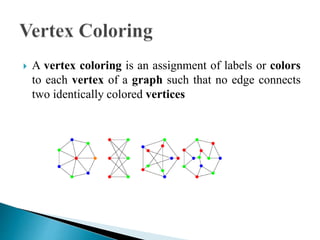
 A vertex coloring is an assignment of labels or colors
to each vertex of a graph such that no edge connects
two identically colored vertices
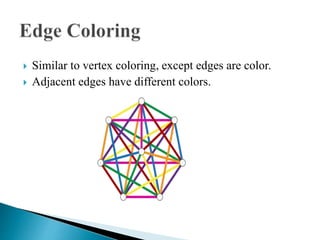
 Similar to vertex coloring, except edges are color.
 Adjacent edges have different colors.
 Every edge-coloring problem can be transformed into a
vertex-coloring problem
 Coloring the edges of graph G is the same as coloring
the vertices in L(G)
 Not every vertex-coloring problem can be transformed
to an edge-coloring problem
 Every graph has a line graph, but not every graph is a
line graph of some other graph
 K-Coloring
◦ A k-coloring of a graph G is a mapping of V(G) onto
the integers 1..k such that adjacent vertices map into
different integers.
◦ A k-coloring partitions V(G) into k disjoint subsets
such that vertices from different subsets have
different colors.
 K-colorable
◦ A graph G is k-colorable if it has a k-coloring.
 Chromatic Number
◦ The smallest integer k for which G is k-colorable is
called the chromatic number of G, is denoted by the
χ(G).
The idea is to assign colors one by one to different
vertices, starting from the vertex 0. Before assigning a
color, we check for safety by considering already
assigned colors to the adjacent vertices.
If we find a color assignment which is safe, we mark
the color assignment as part of solution.
If we do not a find color due to clashes then we
backtrack and return false.
Backtracking Algorithm
NP: the class of decision problems that are solvable in
polynomial time on a nondeterministic machine (or with a
nondeterministic algorithm)
 (A deterministic computer is what we know)
 A nondeterministic computer is one that can “guess” the right
answer or solution think of a nondeterministic computer as a
parallel machine that can freely spawn an infinite number of
processes
 Thus NP can also be thought of as the class of problems
whose solutions can be verified in polynomial time
 Note that NP stands for “Nondeterministic Polynomial-time”
 Fractional Knapsack
 Sorting
 Others?
◦ Graph Coloring
◦ Satisfiability (SAT)
 the problem of deciding whether a given
Boolean formula is satisfiable.
 Many problems can be formulated as a graph coloring
problem including Time Tabling, Scheduling, Register
Allocation, Channel Assignment.
 A lot of research has been done in this area so much is
already known about the problem space.
Thank You

Graph coloring problem

  • 1.
    Mrs.G.Chandraprabha,M.Sc.,M.Phil., Assistant Professor Department ofIT V.V.Vanniaperumal College for Women Virudhunagar Graph Coloring problem Using Backtracking
  • 2.
     Graph Coloringis an assignment of colors (or any distinct marks) to the vertices of a graph. Strictly speaking, a coloring is a proper coloring if no two adjacent vertices have the same color. SGVf )(:
  • 3.
     Definition: Agraph is planar if it can be drawn in a plane without edge-crossings.  The four color theorem: For every planar graph, the chromatic number is ≤ 4.
  • 4.
     The fourcolor theorem states that any planar map can be colored with at most four colors.  In graph terminology, this means that using at most four colors, any planar graph can have its nodes colored such that no two adjacent nodes have the same color.  Four-color conjecture – Francis Guthrie, 1852 (F.G.)  Many incomplete proofs (Kempe).  5-color theorem proved in 1890 (Heawood)  4-color theorem finally proved in 1977 (Appel, Haken) ◦ First major computer-based proof
  • 5.
     A vertexcoloring is an assignment of labels or colors to each vertex of a graph such that no edge connects two identically colored vertices
  • 6.
     Similar tovertex coloring, except edges are color.  Adjacent edges have different colors.
  • 7.
     Every edge-coloringproblem can be transformed into a vertex-coloring problem  Coloring the edges of graph G is the same as coloring the vertices in L(G)  Not every vertex-coloring problem can be transformed to an edge-coloring problem  Every graph has a line graph, but not every graph is a line graph of some other graph
  • 8.
     K-Coloring ◦ Ak-coloring of a graph G is a mapping of V(G) onto the integers 1..k such that adjacent vertices map into different integers. ◦ A k-coloring partitions V(G) into k disjoint subsets such that vertices from different subsets have different colors.
  • 9.
     K-colorable ◦ Agraph G is k-colorable if it has a k-coloring.  Chromatic Number ◦ The smallest integer k for which G is k-colorable is called the chromatic number of G, is denoted by the χ(G).
  • 10.
    The idea isto assign colors one by one to different vertices, starting from the vertex 0. Before assigning a color, we check for safety by considering already assigned colors to the adjacent vertices. If we find a color assignment which is safe, we mark the color assignment as part of solution. If we do not a find color due to clashes then we backtrack and return false. Backtracking Algorithm
  • 11.
    NP: the classof decision problems that are solvable in polynomial time on a nondeterministic machine (or with a nondeterministic algorithm)  (A deterministic computer is what we know)  A nondeterministic computer is one that can “guess” the right answer or solution think of a nondeterministic computer as a parallel machine that can freely spawn an infinite number of processes  Thus NP can also be thought of as the class of problems whose solutions can be verified in polynomial time  Note that NP stands for “Nondeterministic Polynomial-time”
  • 12.
     Fractional Knapsack Sorting  Others? ◦ Graph Coloring ◦ Satisfiability (SAT)  the problem of deciding whether a given Boolean formula is satisfiable.
  • 13.
     Many problemscan be formulated as a graph coloring problem including Time Tabling, Scheduling, Register Allocation, Channel Assignment.  A lot of research has been done in this area so much is already known about the problem space.
  • 14.