Graph Coloring Using
Backtracking
 Graph Coloring is a process of assigning colors
to the vertices of a graph.
 It ensures that no two adjacent vertices of the
graph are colored with the same color.
 Chromatic Number is the minimum number of
colors required to properly color any graph.
The Chromatic Number:
 The chromatic number of a graph is the
smallest number of colors needed to
properly color its vertices.
 Finding the chromatic number for a given
graph is a challenging problem, and it falls
into the NP-complete category.
Graph Coloring Algorithm:
There exists no efficient algorithm for coloring a graph
with minimum number of colors.
Graph Coloring is a NP complete problem.
Backtracking Algorithm for
Graph Coloring
Here’s how the backtracking algorithm works for
graph coloring:
1. Start with an empty coloring for the graph.
2. Choose an uncolored vertex.
3. Try assigning a color to that vertex.
4. Check if the assignment is valid (i.e., no
adjacent vertices have the same color).
5. If valid, move on to the next uncolored
vertex.
6. If not valid, backtrack and try a different
color for the previous vertex.
7. Repeat steps 3-6 until all vertices are
colored or until no valid color assignment is
Graph coloring has practical applications
:
Scheduling: Assigning time slots to tasks without
conflicts.
Sudoku: Solving Sudoku puzzles involves graph coloring.
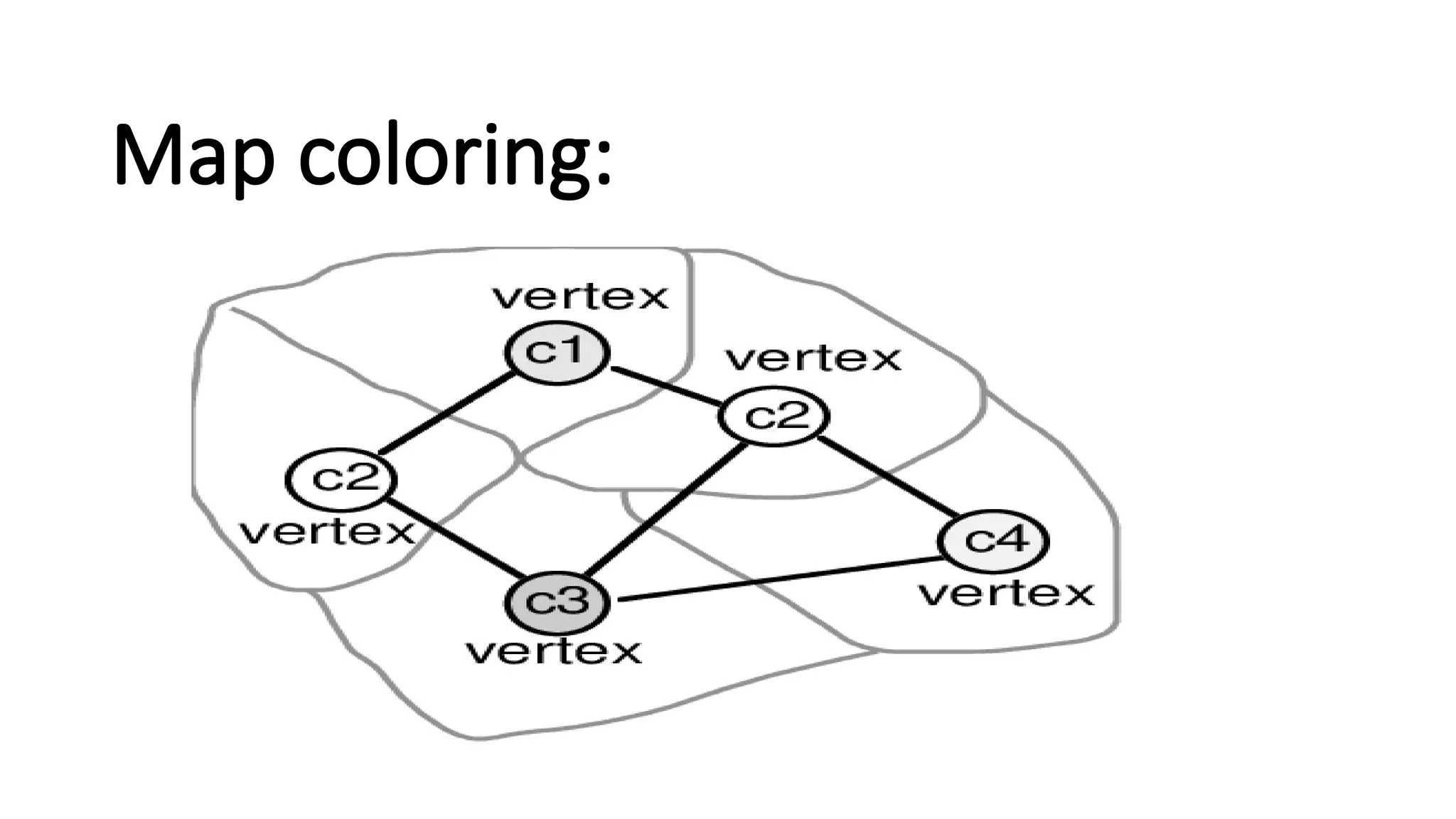
Map Coloring: Ensuring that adjacent regions on a map
have different colors.
Map coloring:
StudentA-C1,C3
StudentB-C1,C4,C5
StudentC-C2,C6S
StudentD-C2,C3,C6
StudentE-C3,C4
StudentF-C3,C5
StudentG-C5,C6
Scheduling courses
Example of graph coloring
Algorithm:
Algorithm mColoring(k)
{
// g(1:n, 1:n)boolean adjacency matrix.
// k index (node) of the next vertex to color.
Repeat
{
nextvalue(k); // assign to x[k] a legal color.
if(x[k]==0) then
return; // no new color possible
if(k=n) then
print(x[1: n]);
else
mcoloring(k+1);
}until(false)
Algorithm NextValue(k)
{
//x[1],x[2],---x[k-1] have been assigned integer values
//in the range [1, m]
repeat {
x[k]=(x[k]+1)mod (m+1); //next highest color
if(x[k]=0) then
return; // all colors have been used.
for j=1 to n do
{
if ((g[k,j]≠0) and (x[k]=x[j]))then //To check whether
//the same
color used
break;
}
if(j=n+1) then
return; //new color found
} until(false)
Complexity Analysis :
In this method each vertex has M different choices
of colors. So the total time complexity is MV
,
where M is the number of colours and V is the
number of vertices.

graph coloring back tracking and applications in realA time.pptx

  • 1.
  • 2.
     Graph Coloringis a process of assigning colors to the vertices of a graph.  It ensures that no two adjacent vertices of the graph are colored with the same color.  Chromatic Number is the minimum number of colors required to properly color any graph.
  • 3.
    The Chromatic Number: The chromatic number of a graph is the smallest number of colors needed to properly color its vertices.  Finding the chromatic number for a given graph is a challenging problem, and it falls into the NP-complete category.
  • 4.
    Graph Coloring Algorithm: Thereexists no efficient algorithm for coloring a graph with minimum number of colors. Graph Coloring is a NP complete problem.
  • 5.
    Backtracking Algorithm for GraphColoring Here’s how the backtracking algorithm works for graph coloring: 1. Start with an empty coloring for the graph. 2. Choose an uncolored vertex. 3. Try assigning a color to that vertex.
  • 6.
    4. Check ifthe assignment is valid (i.e., no adjacent vertices have the same color). 5. If valid, move on to the next uncolored vertex. 6. If not valid, backtrack and try a different color for the previous vertex. 7. Repeat steps 3-6 until all vertices are colored or until no valid color assignment is
  • 7.
    Graph coloring haspractical applications : Scheduling: Assigning time slots to tasks without conflicts. Sudoku: Solving Sudoku puzzles involves graph coloring. Map Coloring: Ensuring that adjacent regions on a map have different colors.
  • 8.
  • 9.
  • 10.
  • 11.
    Algorithm: Algorithm mColoring(k) { // g(1:n,1:n)boolean adjacency matrix. // k index (node) of the next vertex to color. Repeat { nextvalue(k); // assign to x[k] a legal color. if(x[k]==0) then return; // no new color possible if(k=n) then print(x[1: n]); else mcoloring(k+1); }until(false)
  • 12.
    Algorithm NextValue(k) { //x[1],x[2],---x[k-1] havebeen assigned integer values //in the range [1, m] repeat { x[k]=(x[k]+1)mod (m+1); //next highest color if(x[k]=0) then return; // all colors have been used. for j=1 to n do { if ((g[k,j]≠0) and (x[k]=x[j]))then //To check whether //the same color used break; } if(j=n+1) then return; //new color found } until(false)
  • 13.
    Complexity Analysis : Inthis method each vertex has M different choices of colors. So the total time complexity is MV , where M is the number of colours and V is the number of vertices.