Town planning
Industrial cities
Why the Industrial Revolution Started in
Great Britain
1760 AD – 1840 AD in England
1800s-1900s in France and Germany
1840s -1920s in United States
That Nation of Shopkeepers!
-- Napoleon Bonaparte
How did the world go from this?
To this?
Before the Industrial Revolution: Cottage Industry
After industrial revolution
Definitions of Industrial Revolution and Industrialization
• Industrial Revolution: a period of increased output of
goods made by machines and new inventions; a series of
dramatic changes in the way work was done
• Industrialization: the process of developing machine
production of goods that led to a better quality of life for
people and also caused immense suffering
Location
• Industrial revolution started specifically in
Britain in 18th century.
• It swept across Western Europe and much of
North America.
• Late to Asian country's
Origins---Why England?
• Agricultural Revolution
– Horse and steel plow
– Fertilizer use
– Yields improved 300% 1700-1850
• Growth of foreign trade for manufactured goods
– Foreign colonies
– Increase in ships and size
• Successful wars and foreign conquest
Origins – Why England?
• Factors in England
– No civil strife
– Government favored trade
– Laissez-faire capitalism
– Large middle class
– Island geography
– Mobile population
– Everyone lived within 20 miles of
navigable river
– Tradition of experimental science
– Weak guilds
Life in England Before the Industrial Revolution?
• 8 out of 10 worked in countryside
• Subsistence farming
• Cottage industries - factories rarely employed more
than 50 people
• Handmade – buttons, needles, cloth, bricks, pottery,
bread etc.
• Developing towns – Liverpool,
Birmingham, Glasgow
How many objects do you have
about you or can you see in the
room that are handmade?
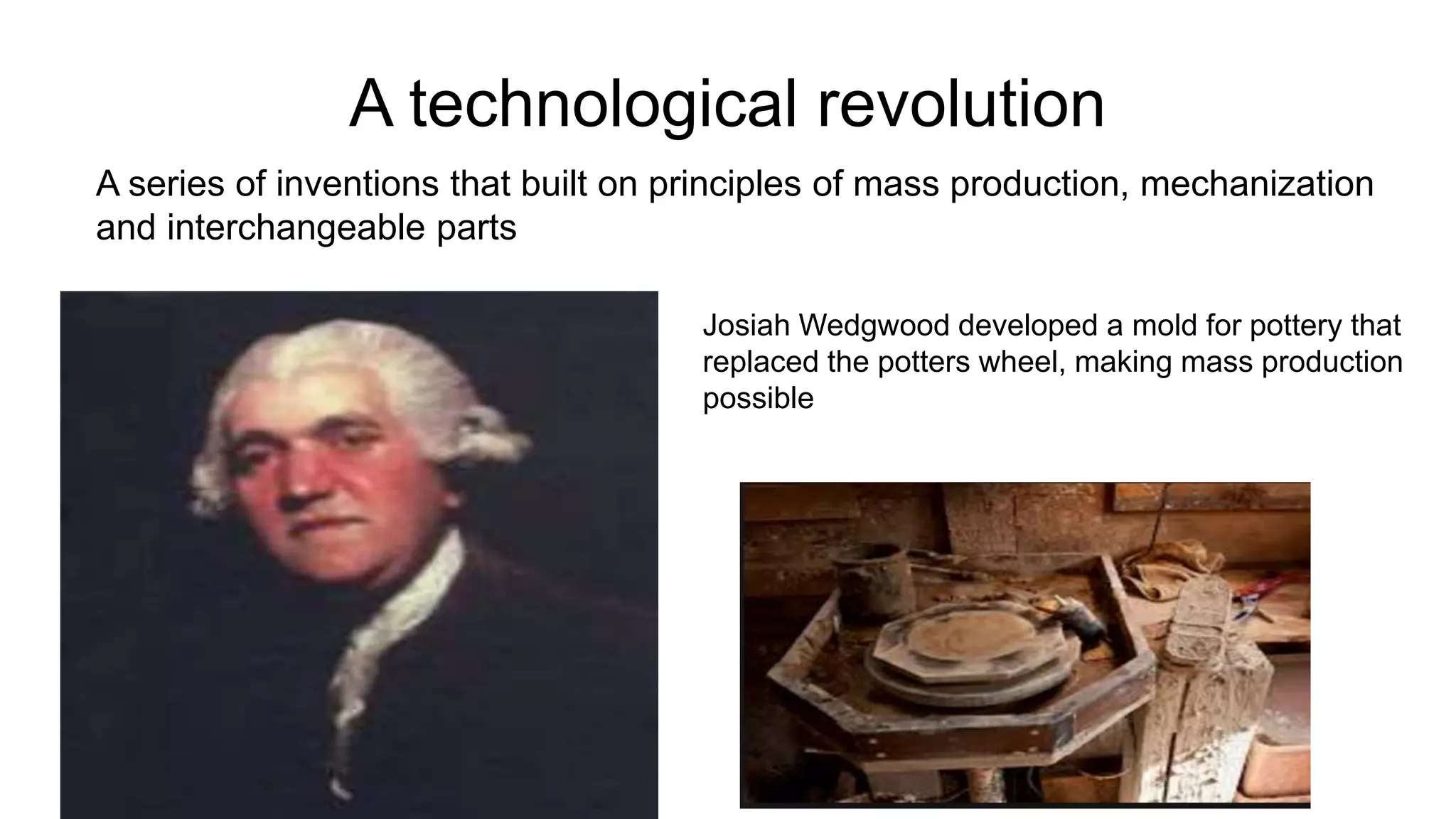
A technological revolution
A series of inventions that built on principles of mass production, mechanization
and interchangeable parts
Josiah Wedgwood developed a mold for pottery that
replaced the potters wheel, making mass production
possible
INVENTION OF BUILDING MATERIALS
• CAST IRON, AN ESSENTIALLY BRITTLE MATERIAL, IS
APPROXIMATELY FOUR TIMES AS RESISTANT TO COMPRESSION
AS STONE.
• WROUGHT IRON, WHICH IS FORTY TIMES AS RESISTANT TO
TENSION AND BENDING AS STONE, IS ONLY FOUR TIMES HEAVIER.
IT CAN BE FORM AND MOLDED INTO ANY SHAPE.
• GLASS CAN BE MANUFACTURED IN LARGER SIZES AND VOLUMES.
• SOLID STRUCTURES COULD BE REPLACED BY SKELETON
STRUCTURES, MAKING IT POSSIBLE TO ERECT BUILDINGS OF
ALMOST UNRESTRICTED HEIGHT.
• BUILDINGS COULD BE CONSTRUCTED INTO ANY SHAPE AND IN
SHORT TIME.
Crystal palace
Eiffel tower
The iron bridges
• Brooklyn Bridge, Brooklyn, New York 1869-1883
• Clifton Suspension Bridge, Bristol, England 1836-1864
• Tower Bridge London
BROOKLYN BRIDGE, BROOKLYN,
NEW YORK 1869-1883;
JOHN AUGUSTUS ROEBLING
Length - 5,989 feet Distance of roadbed
above water - 135 feet Bridge
Style - Suspension Bridge. Tower Structure
- Stone masonry
Conclusions
• Style=Gothic piers, Structural Expressionist cables and
bridge deck
• Date=1869 to 1883
• Location=East River. Park Row, Manhattan to Adams
Street, Brooklyn.
• Architect=John Augustus Roebling, completed by son,
Washington Augustus Roebling
TOWER BRIDGE, LONDON, 1886-1894, SIR HORACE JONES
Conclusions
• It was opened by Edward 7th when he was Prince of
Wales
• 8 years in construction, using 5 major contractors and
over 400 labourers.
• completed and opened in the year 1894.
• two piers were sunk into the river bed to support the
weight of the bridge.
• A massive 11,000 tons of steel used for the walkways
and towers.
the iron
railroad station
Central Railroad Station, New Castle on tyne, England,
1846-55
St. Pancreas Station, London
• CENTRAL RAILROAD STATION, NEW CASTLE ON TYNE, ENGLAND,
1846-55; JOHN DOBSON
• The National Rail station has 12 platforms
• ST. PANCRAS STATION, LONDON, 1864-68; WILLIAM H. BARLOW,
• R.M. ORDISH
• Height (architectural) = 82.30 m
• Floors above ground = 6
Conclusions
• It was designed by William Henry Barlow and building
work started in 1863
• The station which has a single span roof of 243 feet
• length of 689 ft
• 100 ft above ground
• four Type AF High Friction Clamps fixing is used for roof
The iron
market place
Covered Market , Berlin 1865-1868
City Market Hall, Paris
Galleria Vittoro Emmanuel II, Milan
GALLERIA
VITTOROEMMANU
EL II MILAN, 1865-
67, GUISEPPE
MEGONI
• GALLERIA VITTORO, EMMANUEL II MILAN, 1865-67,
GUISEPPE MEGNONI
Conclusions
• it was originally designed in 1861 and built by Giuseppe
Mengoni between 1865 and 1877.
• The street is covered over by an arching glass and cast
iron roof, a popular design for nineteenth-century arcades
• The central octagonal space is topped with a glass dome
The iron commercial buildings
MchierFactory, Noisel-sur-marne
Bradbury Building, Los Angles, California
Commodities Exchange, Amsterdam
• MENIER FACTORY, NOISEL-SUR-MARNE , FRANCE,
1871-1872, JULES SAULNIER
• THE BRADBURY BUILDING, LOS ANGELES,
CALIFORNIA, 1889-93; GEORGE H WYMAN
• THE BRADBURY BUILDING, LOS ANGELES, CALIFORNIA,
1889-93; GEORGE H WYMAN
Conclusions
• The Bradbury Buildingis an architectural landmark in Los Angeles,
California
• Built:1893
• Architect:George H. Wyman
• Architecturalstyle(s):Italian Renaissance Revival, Romanesque
Revival
By 1850:
Zones of Industrialization
on the European Continent
• Northeast France.
• Belgium.
• The Netherlands.
• Western German states.
• Northern Italy
• East Germany  Saxony
TRANSPORT
Canal bargespulled
by mules
Ships powered bysails Horse-drawn wagons,
carts, and carriages
TrainsSteamshipsAutomobiles
TRANSPORT
•Rivers played a major role in the transportation of finished products fromthe
factories to the coast.
•The Severn, Thames, and the Trent were the most navigable rivers in England.
• RIVER- • CANAL-
•The main international seaports of England were London, Bristol, and Liverpool
•The British began to build canals in the late 18th Century.
•In 1720, roads gained importance for the Industrial Revolution.
•ROADS- •RAILWAYS-
•Railways meant the end for canals .Railways were to transform Britain inthe
nineteenth century.
Geography/naturalresources
• Wood was the main source of energy which was replaced by coal (morepotent)
• Coal mines were available near the sea.
Cultureandit‘simpactonArchitectureandCityPlanning
• Small industries and farming having very small amount of royal people
• After banks etc the lifestyle improved dramatically
• Middle class increased and this section also consumed most of the products and lived a
royal life style
• mass of the people to achieve the income, education and leisure time necessary to
enjoy fine books, good music, and beautiful sculptures and paintings.
• inventions such as the printing press, radio and television that enabled works of culture to
reach more people at lower cost, enabled men to acquire great wealth, part of which
they returned to society by financing libraries, symphony orchestras, museums and
scholarships for promising writers and artists, and encouraged the growth of democracy,
thus providing the atmosphere of freedom so necessary for writers and artists to produce
great works.
Living Standards
•Houses had to be in direct
vicinity tofactories
•Lodging of workersin
overcrowdedhouses.
Formation ofSlums:
•Lack of sanitation gave
way to unhealthy living
conditions
Increased workhours
Insecure working
Conditions
PLANNINGFORHOUSES
•They are built in courts the principle is that 3
walls are shared with other houses reducing
the amount of materialsused,.
•it was very compact and streets were very tight
and would not allow for light or sufficient air to
enter the house.
•A lobby/living space and an upstairs room, the kitchen
and toilets were communal and often shared between
16 households.
•Each house could have from 1 to 3 families living inside
and even possible animals.
•The courtyards had privies (outdoor toilets) cooking,
storage areas and wastepool (hole to receive waste
from the house)
.
Back-back houses
•BUILT IN DOUBLE ROWS
•NO WINDOWS AT FRONT
• NO BACKYARDS
• A SEWER DOWN MIDDLE OF
STREET
•BUILT CRAMMED CLOSE
TOGETHER VERY NARROW
STREETS BETWEEN THEM.
The “Dark Days” of Industrialization
EVOLUTION OFPLANNING
The Middle Class
As the Working class struggled for a livelihood in the
slums, the middle
class factory owners lived in detached houses near the
countryside
City centre: Shopsand
services
Inner City: Factoriesand
run downhouses
Suburbs: Parks&
houses
LAND USE PATTERN
Pattern of land-use changed radically: It was determined by radial transport route beginning at town
centre
•Low rent residential area is near to industrial district (heavy and low industries and
warehouses)
•High rent residential areas are in the outskirts of cities (suburbs)
CITY PLANNING
Housing for worker with garden in front
1000 houses 20 feetwide
Arcades for workshops
560 houses 28 feetwide
Retail shops
296 houses 38 feetwide
Winter promenadearcade
120 houses 54 feet wide
Public buildings, churches
24 mansions 80 feetwide
Central square
PERFORMANCE CRITERIA
•Character A distinct sense of place responding to the local context
•Continuity and enclosure Continuity of frontages, defined public &privatespaces
•Quality of public realm safe, attractive, lively and functional public space
•Ease of movement An accessible, well connected, pedestrianfriendly
•legilibility A readily understandable, easily navigable environment
•Adaptability flexible & adaptable public & private environment
•diversity A varied environment offering a range of experiences
URBAN DESIGN OBJECTIVES
•The steel city of Jamshedpur originated in a small
company town in the backwaters of eastern India as a new
experiment in urbanism in 1907.
•When Delhi was being conceived in 1911 as imperial
capital, an industrial town with modern town planning
principles, new modes of spatiality and lifestyle associated
with industrialization was taking shape.
•Unlike Delhi and Chandigarh, Jamshedpur was an
indigenous industrial development initiated, financed and
built by Indians using local resources albeit foreign
expertise.
Jamshetji Nusserwanji Tata
(3rd Mar’1839- 19th May’ 1904)
Industrial city jamshedpur
•J.N.Tata conceived the dream of this industrial township. He travelled to many of the industrial towns of North
America in pursuit of technology for setting up a steel plant.
•His efforts set in motion the search of sites rich in Iron ore and coal mines. Though he did not live to see his
dream come true, but his efforts culminated in the discovery of iron ore mines in GURUMAHISINI HILLS of
Mayurbhanj (presently a district of Odisha).
•Thus an iron and steel plant was perceived in Sakchi village (72 km from the hills).
•The site of the steel plant was well connected by Railways through the KALIMATI railway station on the
BOMBAY-CALCUTTA route.
•Sound business management policy, philanthropic motives and the desire to make Industrial township an
envied and emulated concept throughout India gave birth to JAMSHEDPUR.
origin
Sahlin and Kennedy Plan 1912 Small industrial town
Temple Plan 1920 Full fledged industrial township
Stoke’s Plan 1936 Expansion of Temple plan with
emphasis on housing
Koenigsberger’s Plan 1944-45 Garden city+ neighbourhood unit
in planning circles.
•Unlike the planning of Delhi and Chandigarh, which were planned
and conceived all at a single time, this town was planned in various
stages.
•The reason behind these several stages was growth in the
production of the steel plant due to World War I and World War II
and hence growth in population of workers.
STAGES OF PLANNING
SAHLIN AND KENNEDY PLAN
•The Pittsburgh firm of Julian Kennedy and Axel Sahlin was awarded the contract for the designing and
engineering works of Tata Steel Plant. They built the original colony between 1909-12 for housing
managers and skilled workers.
•There is a little influence of the garden city/suburb ideal of the ‘new’ American company.
•Site exigencies dictated the stratified pattern of housing on high ground
on the ridge spurs on the north-west and western fringes of the steel plant to ensure protection from the
factory dust carried by the prevailing western winds.
•The colony was laid out in the grid-iron (North American settlement pattern) with alphabetically named
‘roads’ running east-west and numbered ‘avenues’ running north-south.
•There is no evidence of a planned town centre or public park system
SAHLIN AND KENNEDY PLAN
TOWNSHIP
NORTHERN
TOWN(covenanted
officers)
SOUTHERN
TOWN(Skilled
workers)
G TOWN (middle
income group )
R.N TOWN
(workers)
•The plan ignored the acute need for
housing laborers with the result that
clusters of mud huts sprang up around
the towns and close to the factory
gates.
SAHLIN AND KENNEDY PLAN
FREDRICK C. TEMPLE PLAN
•As the Steel production of the plant grew (due to World War I), population of the township increased
and the old Kennedy plan became obsolete.
•Fredrick C. Temple, sanitary officer for Orissa and Bihar states was appointed as the Chief Engineer
for planning of Jamshedpur.
•Temple’s work was influenced by :
•Study of lifestyle of local tribal people.
•Concept of Garden city of Letchworth.
•Design of industrial village of New Earswick.
•The fact that “A township already existed around the steel plant” played a detrimental factor in the
planning thus making it somewhat different from other industrial townships of its time.
FREDRICK C. TEMPLE PLAN
•The principles of Temple’s planning were:
•Gravitational Sewerage system.
•Street system adapted to contours.
•Parkway system in natural drains.
•Temple proposed housing of 12 units per acre, balancing it with 1-1 ½ acre plots of bungalows
and ¼ acre plots quarters.
•He designed the quarters in 3 blocks with the 4th one serving as open space.
•He advocated that the problem of housing could be solved by improving the sanitation and
preserving the infrastructure of the squatter settlements and the lifestyle of the tribal people
respectively.
FREDRICK C. TEMPLE PLAN
MAJOR P.G.W.STOKES PLAN
•Due to the further expansion of Tata Steel in 1930, the township was in immediate need of
housing.
•Stokes strived a lot to propose an effective plan for this growing township.
•According to his report his work was very much influenced by Earnest Burges (1925) who
proposed that cities develop outward from central business and manufacturing districts with
working class population nearest to the core.
•Stokes did not have much to do beyond Temple’s plan. His main work was to quench the
shortage of housing.
MAJOR P.G.W.STOKES PLAN
•Constrained by the existing mixed and stratified
housing of Jamshedpur, Stoke had to conform to
Homer Hoyt’s wedge shaped urban model that
stipulated segmented growth along transport
arteries.
•Officers’ bungalows were made in North town
along the E-W straight mile road.
•Workers’ housing was provided in north and
west in Sakchi and Kadma respectively.
•To further satisfy the need, he had to provide
workers’ housing in Burma mines (S-E of the
steel plant) but this exposed the residents to the
smoke and dust of the plant.
OTTO KEONIGSBERGER’S PLAN
• The primary motive of Keonigsberger was to implement GARDEN CITY concepts in his
Master plan for Jamshedpur, but his motive was partially satisfied.
• He was reluctant to give up and endeavoured to put in GARDEN CITY principles wherever
space permitted.
• The major problem was that Jamshedpur did not develop as a Garden city. BUSTEES had
developed on the periphery of the industrial area.
•His contention was that linear growth along transportation arteries was the best solution to the
problems posed by the concentric growth around the place of employment.
OTTO KEONIGSBERGER’S PLAN
• Massive urban surgery was untenable, so Keonigsberger proposed for a
garden suburb on the forested slopes of Dalma Hills for 200 medium
income families who could do the daily commute 7
miles to the Steel Plant.
• This was All the bungalows and cottages disappeared behind tree foliage and
gardens.
• The only public building besides the club/rest house would be the
Inspection Bungalow overlooking the Dam on one side and terraced hill-garden
with a bandstand on the other.
• Intention was to build a leafy suburb at a suitable distance from industrial
pollution and haphazard urban growth.
• This unbuilt proposal represented what Tata Steel desired all of Jamshedpur
to be.
PRESENT DAY JAMSHEDPURJAMSHEDPUR URBAN AGGLOMERATION (JUA)
•Tata Steel remained the largest employer and the physical core of Jamshedpur. New industries and their
settlements were built first towards the east and later after independence in 1947 across the river
Kharkai on the west.
•A multinucleated pattern emerged with industries as the nuclei of settlement growth that minimized the
distance between residence and workplace.
•Some of these industries were established by the Tatas, others were acquired and became subsidiaries.
•Tinplate, Cable, Steel and Wire Industries built their housing in a grid iron pattern on a ridge parallel to the
main NW-SE ridge.
•The tribal villages that had deteriorated into bustees were now transformed into planned housing colonies.
•The Tata Engineering and Locomotive Company (TELCO) built housing for its employees in the village
Jojobera.
JAMSHEDPUR URBAN AGGLOMERATION (JUA)
•Golmuri was developed by Tinplate Company
• Sidhgora by Indian Oxygen and Tata Steel.
•Baridih was developed by Tube Company.
•The satellite township of Adityapur came up in the 1960’s across the river Kharkhai as a result of state
government initiative in planning an industrial complex which incorporated 83 villages and is spread over 53 square
miles with much of the development concentrated along the main artery—Tata- Kandra Road.
• About 700 industries provide goods and services to Tata Steel although serviced by poorly planned residential
and commercial development.
• JUA 2027 Master Plan was drawn up by Superior Global Infrastructure of New Delhi in collaboration with the
Philadelphia based landscape planning firm of Wallace
Roberts &Todd at the behest of state govt.
•The scope of planning covered the core of Jamshedpur, Adityapur, Mango, Jugsalai and seven villages,
altogether covering an area of 149.23 sq. kms.
JAMSHEDPUR URBAN AGGLOMERATION (JUA)
• Journal of Planning History of Jamshedpur (2011) -
Prof. Amita Sinha ( Department of Landscape Architecture, University of Illinois)
Jatinder Singh (Chief Architect, JUSCO)
BIBLIOGRAPHY
THANKYOU . . . .
- Shruti gavankar
- Pillai hoc college of architecture

Industrial city

  • 1.
  • 2.
    Why the IndustrialRevolution Started in Great Britain 1760 AD – 1840 AD in England 1800s-1900s in France and Germany 1840s -1920s in United States
  • 3.
    That Nation ofShopkeepers! -- Napoleon Bonaparte
  • 4.
    How did theworld go from this?
  • 5.
  • 7.
    Before the IndustrialRevolution: Cottage Industry
  • 8.
  • 9.
    Definitions of IndustrialRevolution and Industrialization • Industrial Revolution: a period of increased output of goods made by machines and new inventions; a series of dramatic changes in the way work was done • Industrialization: the process of developing machine production of goods that led to a better quality of life for people and also caused immense suffering
  • 10.
    Location • Industrial revolutionstarted specifically in Britain in 18th century. • It swept across Western Europe and much of North America. • Late to Asian country's
  • 11.
    Origins---Why England? • AgriculturalRevolution – Horse and steel plow – Fertilizer use – Yields improved 300% 1700-1850 • Growth of foreign trade for manufactured goods – Foreign colonies – Increase in ships and size • Successful wars and foreign conquest
  • 12.
    Origins – WhyEngland? • Factors in England – No civil strife – Government favored trade – Laissez-faire capitalism – Large middle class – Island geography – Mobile population – Everyone lived within 20 miles of navigable river – Tradition of experimental science – Weak guilds
  • 13.
    Life in EnglandBefore the Industrial Revolution? • 8 out of 10 worked in countryside • Subsistence farming • Cottage industries - factories rarely employed more than 50 people • Handmade – buttons, needles, cloth, bricks, pottery, bread etc. • Developing towns – Liverpool, Birmingham, Glasgow How many objects do you have about you or can you see in the room that are handmade?
  • 14.
    A technological revolution Aseries of inventions that built on principles of mass production, mechanization and interchangeable parts Josiah Wedgwood developed a mold for pottery that replaced the potters wheel, making mass production possible
  • 15.
    INVENTION OF BUILDINGMATERIALS • CAST IRON, AN ESSENTIALLY BRITTLE MATERIAL, IS APPROXIMATELY FOUR TIMES AS RESISTANT TO COMPRESSION AS STONE. • WROUGHT IRON, WHICH IS FORTY TIMES AS RESISTANT TO TENSION AND BENDING AS STONE, IS ONLY FOUR TIMES HEAVIER. IT CAN BE FORM AND MOLDED INTO ANY SHAPE. • GLASS CAN BE MANUFACTURED IN LARGER SIZES AND VOLUMES. • SOLID STRUCTURES COULD BE REPLACED BY SKELETON STRUCTURES, MAKING IT POSSIBLE TO ERECT BUILDINGS OF ALMOST UNRESTRICTED HEIGHT. • BUILDINGS COULD BE CONSTRUCTED INTO ANY SHAPE AND IN SHORT TIME.
  • 16.
  • 17.
    The iron bridges •Brooklyn Bridge, Brooklyn, New York 1869-1883 • Clifton Suspension Bridge, Bristol, England 1836-1864 • Tower Bridge London BROOKLYN BRIDGE, BROOKLYN, NEW YORK 1869-1883; JOHN AUGUSTUS ROEBLING Length - 5,989 feet Distance of roadbed above water - 135 feet Bridge Style - Suspension Bridge. Tower Structure - Stone masonry
  • 18.
    Conclusions • Style=Gothic piers,Structural Expressionist cables and bridge deck • Date=1869 to 1883 • Location=East River. Park Row, Manhattan to Adams Street, Brooklyn. • Architect=John Augustus Roebling, completed by son, Washington Augustus Roebling
  • 19.
    TOWER BRIDGE, LONDON,1886-1894, SIR HORACE JONES
  • 20.
    Conclusions • It wasopened by Edward 7th when he was Prince of Wales • 8 years in construction, using 5 major contractors and over 400 labourers. • completed and opened in the year 1894. • two piers were sunk into the river bed to support the weight of the bridge. • A massive 11,000 tons of steel used for the walkways and towers.
  • 21.
    the iron railroad station CentralRailroad Station, New Castle on tyne, England, 1846-55 St. Pancreas Station, London
  • 22.
    • CENTRAL RAILROADSTATION, NEW CASTLE ON TYNE, ENGLAND, 1846-55; JOHN DOBSON • The National Rail station has 12 platforms
  • 23.
    • ST. PANCRASSTATION, LONDON, 1864-68; WILLIAM H. BARLOW, • R.M. ORDISH • Height (architectural) = 82.30 m • Floors above ground = 6
  • 24.
    Conclusions • It wasdesigned by William Henry Barlow and building work started in 1863 • The station which has a single span roof of 243 feet • length of 689 ft • 100 ft above ground • four Type AF High Friction Clamps fixing is used for roof
  • 25.
    The iron market place CoveredMarket , Berlin 1865-1868 City Market Hall, Paris Galleria Vittoro Emmanuel II, Milan
  • 26.
    GALLERIA VITTOROEMMANU EL II MILAN,1865- 67, GUISEPPE MEGONI
  • 27.
    • GALLERIA VITTORO,EMMANUEL II MILAN, 1865-67, GUISEPPE MEGNONI
  • 28.
    Conclusions • it wasoriginally designed in 1861 and built by Giuseppe Mengoni between 1865 and 1877. • The street is covered over by an arching glass and cast iron roof, a popular design for nineteenth-century arcades • The central octagonal space is topped with a glass dome
  • 29.
    The iron commercialbuildings MchierFactory, Noisel-sur-marne Bradbury Building, Los Angles, California Commodities Exchange, Amsterdam
  • 30.
    • MENIER FACTORY,NOISEL-SUR-MARNE , FRANCE, 1871-1872, JULES SAULNIER
  • 31.
    • THE BRADBURYBUILDING, LOS ANGELES, CALIFORNIA, 1889-93; GEORGE H WYMAN
  • 32.
    • THE BRADBURYBUILDING, LOS ANGELES, CALIFORNIA, 1889-93; GEORGE H WYMAN
  • 33.
    Conclusions • The BradburyBuildingis an architectural landmark in Los Angeles, California • Built:1893 • Architect:George H. Wyman • Architecturalstyle(s):Italian Renaissance Revival, Romanesque Revival
  • 34.
    By 1850: Zones ofIndustrialization on the European Continent • Northeast France. • Belgium. • The Netherlands. • Western German states. • Northern Italy • East Germany  Saxony
  • 35.
    TRANSPORT Canal bargespulled by mules Shipspowered bysails Horse-drawn wagons, carts, and carriages TrainsSteamshipsAutomobiles
  • 36.
    TRANSPORT •Rivers played amajor role in the transportation of finished products fromthe factories to the coast. •The Severn, Thames, and the Trent were the most navigable rivers in England. • RIVER- • CANAL- •The main international seaports of England were London, Bristol, and Liverpool •The British began to build canals in the late 18th Century. •In 1720, roads gained importance for the Industrial Revolution. •ROADS- •RAILWAYS- •Railways meant the end for canals .Railways were to transform Britain inthe nineteenth century.
  • 37.
    Geography/naturalresources • Wood wasthe main source of energy which was replaced by coal (morepotent) • Coal mines were available near the sea.
  • 38.
    Cultureandit‘simpactonArchitectureandCityPlanning • Small industriesand farming having very small amount of royal people • After banks etc the lifestyle improved dramatically • Middle class increased and this section also consumed most of the products and lived a royal life style • mass of the people to achieve the income, education and leisure time necessary to enjoy fine books, good music, and beautiful sculptures and paintings. • inventions such as the printing press, radio and television that enabled works of culture to reach more people at lower cost, enabled men to acquire great wealth, part of which they returned to society by financing libraries, symphony orchestras, museums and scholarships for promising writers and artists, and encouraged the growth of democracy, thus providing the atmosphere of freedom so necessary for writers and artists to produce great works. Living Standards •Houses had to be in direct vicinity tofactories •Lodging of workersin overcrowdedhouses. Formation ofSlums: •Lack of sanitation gave way to unhealthy living conditions Increased workhours Insecure working Conditions
  • 39.
    PLANNINGFORHOUSES •They are builtin courts the principle is that 3 walls are shared with other houses reducing the amount of materialsused,. •it was very compact and streets were very tight and would not allow for light or sufficient air to enter the house. •A lobby/living space and an upstairs room, the kitchen and toilets were communal and often shared between 16 households. •Each house could have from 1 to 3 families living inside and even possible animals. •The courtyards had privies (outdoor toilets) cooking, storage areas and wastepool (hole to receive waste from the house) .
  • 40.
    Back-back houses •BUILT INDOUBLE ROWS •NO WINDOWS AT FRONT • NO BACKYARDS • A SEWER DOWN MIDDLE OF STREET •BUILT CRAMMED CLOSE TOGETHER VERY NARROW STREETS BETWEEN THEM. The “Dark Days” of Industrialization
  • 41.
    EVOLUTION OFPLANNING The MiddleClass As the Working class struggled for a livelihood in the slums, the middle class factory owners lived in detached houses near the countryside City centre: Shopsand services Inner City: Factoriesand run downhouses Suburbs: Parks& houses
  • 42.
    LAND USE PATTERN Patternof land-use changed radically: It was determined by radial transport route beginning at town centre •Low rent residential area is near to industrial district (heavy and low industries and warehouses) •High rent residential areas are in the outskirts of cities (suburbs)
  • 43.
    CITY PLANNING Housing forworker with garden in front 1000 houses 20 feetwide Arcades for workshops 560 houses 28 feetwide Retail shops 296 houses 38 feetwide Winter promenadearcade 120 houses 54 feet wide Public buildings, churches 24 mansions 80 feetwide Central square
  • 44.
    PERFORMANCE CRITERIA •Character Adistinct sense of place responding to the local context •Continuity and enclosure Continuity of frontages, defined public &privatespaces •Quality of public realm safe, attractive, lively and functional public space •Ease of movement An accessible, well connected, pedestrianfriendly •legilibility A readily understandable, easily navigable environment •Adaptability flexible & adaptable public & private environment •diversity A varied environment offering a range of experiences URBAN DESIGN OBJECTIVES
  • 45.
    •The steel cityof Jamshedpur originated in a small company town in the backwaters of eastern India as a new experiment in urbanism in 1907. •When Delhi was being conceived in 1911 as imperial capital, an industrial town with modern town planning principles, new modes of spatiality and lifestyle associated with industrialization was taking shape. •Unlike Delhi and Chandigarh, Jamshedpur was an indigenous industrial development initiated, financed and built by Indians using local resources albeit foreign expertise. Jamshetji Nusserwanji Tata (3rd Mar’1839- 19th May’ 1904) Industrial city jamshedpur
  • 47.
    •J.N.Tata conceived thedream of this industrial township. He travelled to many of the industrial towns of North America in pursuit of technology for setting up a steel plant. •His efforts set in motion the search of sites rich in Iron ore and coal mines. Though he did not live to see his dream come true, but his efforts culminated in the discovery of iron ore mines in GURUMAHISINI HILLS of Mayurbhanj (presently a district of Odisha). •Thus an iron and steel plant was perceived in Sakchi village (72 km from the hills). •The site of the steel plant was well connected by Railways through the KALIMATI railway station on the BOMBAY-CALCUTTA route. •Sound business management policy, philanthropic motives and the desire to make Industrial township an envied and emulated concept throughout India gave birth to JAMSHEDPUR. origin
  • 48.
    Sahlin and KennedyPlan 1912 Small industrial town Temple Plan 1920 Full fledged industrial township Stoke’s Plan 1936 Expansion of Temple plan with emphasis on housing Koenigsberger’s Plan 1944-45 Garden city+ neighbourhood unit in planning circles. •Unlike the planning of Delhi and Chandigarh, which were planned and conceived all at a single time, this town was planned in various stages. •The reason behind these several stages was growth in the production of the steel plant due to World War I and World War II and hence growth in population of workers. STAGES OF PLANNING
  • 49.
  • 50.
    •The Pittsburgh firmof Julian Kennedy and Axel Sahlin was awarded the contract for the designing and engineering works of Tata Steel Plant. They built the original colony between 1909-12 for housing managers and skilled workers. •There is a little influence of the garden city/suburb ideal of the ‘new’ American company. •Site exigencies dictated the stratified pattern of housing on high ground on the ridge spurs on the north-west and western fringes of the steel plant to ensure protection from the factory dust carried by the prevailing western winds. •The colony was laid out in the grid-iron (North American settlement pattern) with alphabetically named ‘roads’ running east-west and numbered ‘avenues’ running north-south. •There is no evidence of a planned town centre or public park system SAHLIN AND KENNEDY PLAN
  • 51.
    TOWNSHIP NORTHERN TOWN(covenanted officers) SOUTHERN TOWN(Skilled workers) G TOWN (middle incomegroup ) R.N TOWN (workers) •The plan ignored the acute need for housing laborers with the result that clusters of mud huts sprang up around the towns and close to the factory gates. SAHLIN AND KENNEDY PLAN
  • 52.
  • 53.
    •As the Steelproduction of the plant grew (due to World War I), population of the township increased and the old Kennedy plan became obsolete. •Fredrick C. Temple, sanitary officer for Orissa and Bihar states was appointed as the Chief Engineer for planning of Jamshedpur. •Temple’s work was influenced by : •Study of lifestyle of local tribal people. •Concept of Garden city of Letchworth. •Design of industrial village of New Earswick. •The fact that “A township already existed around the steel plant” played a detrimental factor in the planning thus making it somewhat different from other industrial townships of its time. FREDRICK C. TEMPLE PLAN
  • 54.
    •The principles ofTemple’s planning were: •Gravitational Sewerage system. •Street system adapted to contours. •Parkway system in natural drains. •Temple proposed housing of 12 units per acre, balancing it with 1-1 ½ acre plots of bungalows and ¼ acre plots quarters. •He designed the quarters in 3 blocks with the 4th one serving as open space. •He advocated that the problem of housing could be solved by improving the sanitation and preserving the infrastructure of the squatter settlements and the lifestyle of the tribal people respectively. FREDRICK C. TEMPLE PLAN
  • 55.
  • 56.
    •Due to thefurther expansion of Tata Steel in 1930, the township was in immediate need of housing. •Stokes strived a lot to propose an effective plan for this growing township. •According to his report his work was very much influenced by Earnest Burges (1925) who proposed that cities develop outward from central business and manufacturing districts with working class population nearest to the core. •Stokes did not have much to do beyond Temple’s plan. His main work was to quench the shortage of housing. MAJOR P.G.W.STOKES PLAN
  • 57.
    MAJOR P.G.W.STOKES PLAN •Constrainedby the existing mixed and stratified housing of Jamshedpur, Stoke had to conform to Homer Hoyt’s wedge shaped urban model that stipulated segmented growth along transport arteries. •Officers’ bungalows were made in North town along the E-W straight mile road. •Workers’ housing was provided in north and west in Sakchi and Kadma respectively. •To further satisfy the need, he had to provide workers’ housing in Burma mines (S-E of the steel plant) but this exposed the residents to the smoke and dust of the plant.
  • 58.
  • 59.
    • The primarymotive of Keonigsberger was to implement GARDEN CITY concepts in his Master plan for Jamshedpur, but his motive was partially satisfied. • He was reluctant to give up and endeavoured to put in GARDEN CITY principles wherever space permitted. • The major problem was that Jamshedpur did not develop as a Garden city. BUSTEES had developed on the periphery of the industrial area. •His contention was that linear growth along transportation arteries was the best solution to the problems posed by the concentric growth around the place of employment. OTTO KEONIGSBERGER’S PLAN
  • 60.
    OTTO KEONIGSBERGER’S PLAN •Massive urban surgery was untenable, so Keonigsberger proposed for a garden suburb on the forested slopes of Dalma Hills for 200 medium income families who could do the daily commute 7 miles to the Steel Plant. • This was All the bungalows and cottages disappeared behind tree foliage and gardens. • The only public building besides the club/rest house would be the Inspection Bungalow overlooking the Dam on one side and terraced hill-garden with a bandstand on the other. • Intention was to build a leafy suburb at a suitable distance from industrial pollution and haphazard urban growth. • This unbuilt proposal represented what Tata Steel desired all of Jamshedpur to be.
  • 61.
    PRESENT DAY JAMSHEDPURJAMSHEDPURURBAN AGGLOMERATION (JUA)
  • 62.
    •Tata Steel remainedthe largest employer and the physical core of Jamshedpur. New industries and their settlements were built first towards the east and later after independence in 1947 across the river Kharkai on the west. •A multinucleated pattern emerged with industries as the nuclei of settlement growth that minimized the distance between residence and workplace. •Some of these industries were established by the Tatas, others were acquired and became subsidiaries. •Tinplate, Cable, Steel and Wire Industries built their housing in a grid iron pattern on a ridge parallel to the main NW-SE ridge. •The tribal villages that had deteriorated into bustees were now transformed into planned housing colonies. •The Tata Engineering and Locomotive Company (TELCO) built housing for its employees in the village Jojobera. JAMSHEDPUR URBAN AGGLOMERATION (JUA)
  • 63.
    •Golmuri was developedby Tinplate Company • Sidhgora by Indian Oxygen and Tata Steel. •Baridih was developed by Tube Company. •The satellite township of Adityapur came up in the 1960’s across the river Kharkhai as a result of state government initiative in planning an industrial complex which incorporated 83 villages and is spread over 53 square miles with much of the development concentrated along the main artery—Tata- Kandra Road. • About 700 industries provide goods and services to Tata Steel although serviced by poorly planned residential and commercial development. • JUA 2027 Master Plan was drawn up by Superior Global Infrastructure of New Delhi in collaboration with the Philadelphia based landscape planning firm of Wallace Roberts &Todd at the behest of state govt. •The scope of planning covered the core of Jamshedpur, Adityapur, Mango, Jugsalai and seven villages, altogether covering an area of 149.23 sq. kms. JAMSHEDPUR URBAN AGGLOMERATION (JUA)
  • 64.
    • Journal ofPlanning History of Jamshedpur (2011) - Prof. Amita Sinha ( Department of Landscape Architecture, University of Illinois) Jatinder Singh (Chief Architect, JUSCO) BIBLIOGRAPHY
  • 65.
    THANKYOU . .. . - Shruti gavankar - Pillai hoc college of architecture