BCH CODES
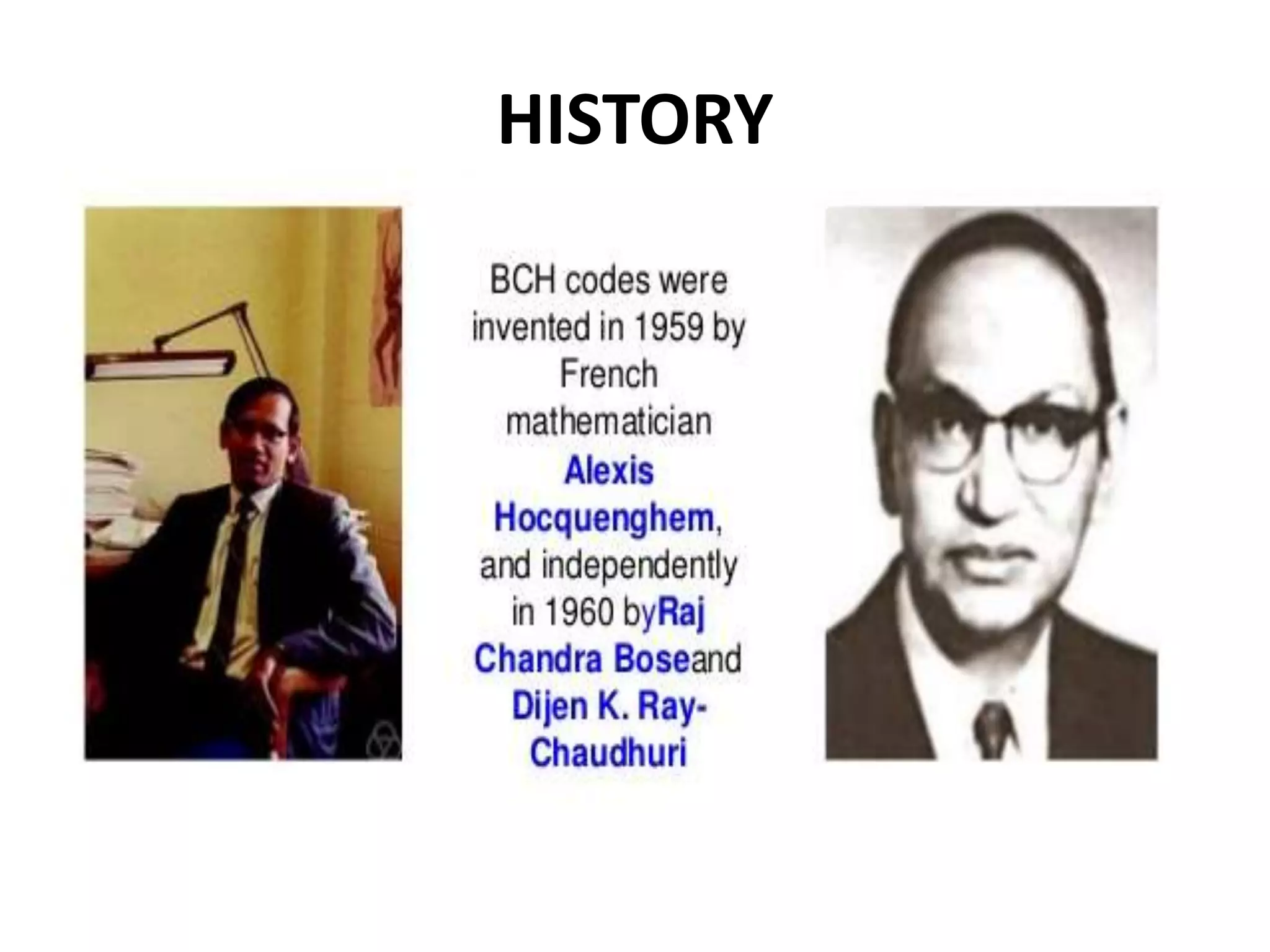
HISTORY
WHY CODING ?
• 2 Key system parameters available for designer
– Ch BW
– Transmitted Sig Power
• Hence we go for modulation schemes but error
performance is an issue – hence error control coding
• Another motivation is to reduce Eb/ N0 for a fixed BER
to reduce Tx power to reduce hardware cost
IMPLICATIONS OF CH CAP THEOREM
• Block Codes
Divide the message into blocks, each of k bits,
called datawords. Then add r redundant bit to
make length n=k+r
The resulting n-bit blocks are called
codewords.
• Convolution Codes
Absence of memory (nutshell- serial input no
blocks)
ERROR CORRECTION CODES
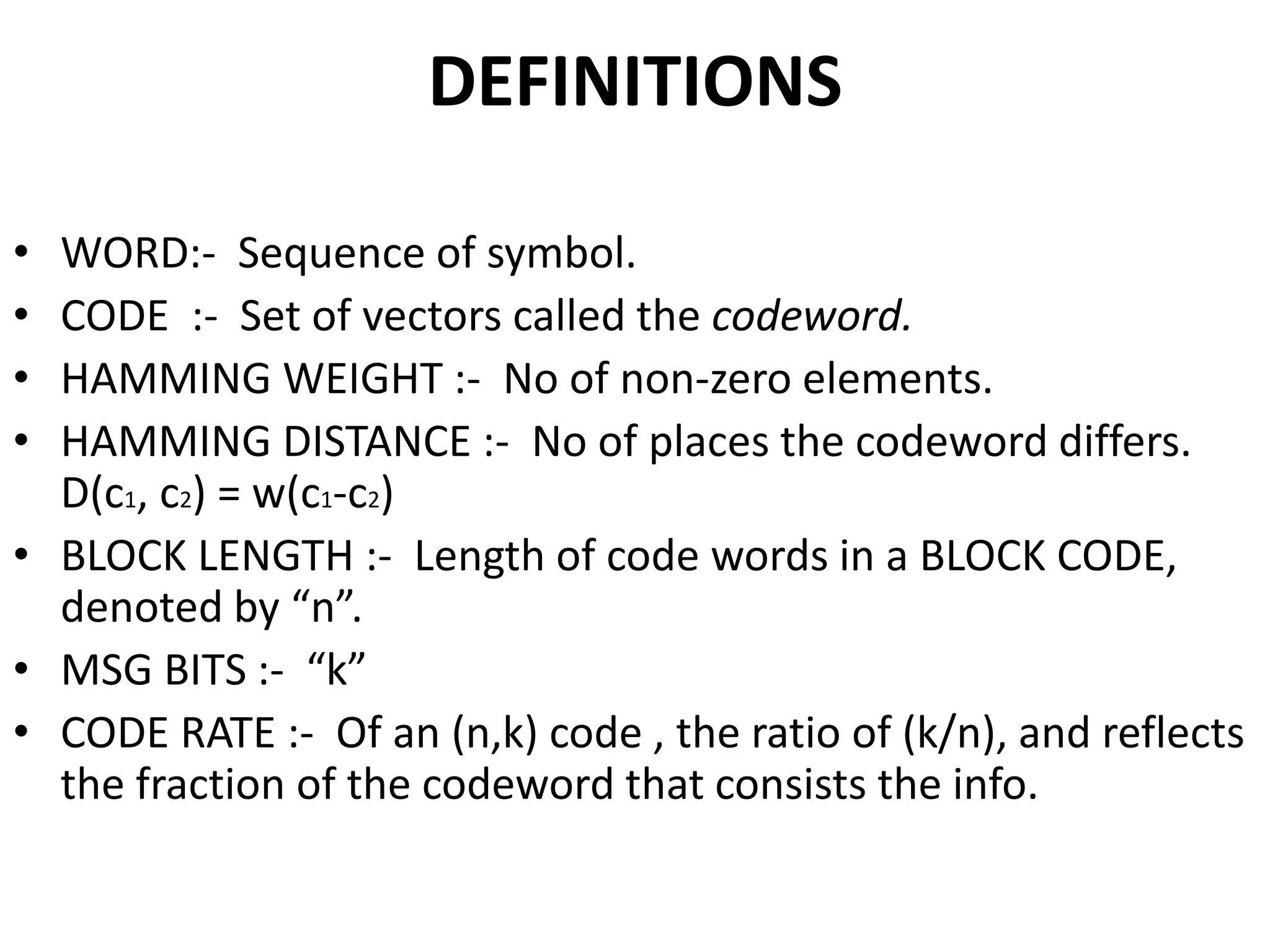
DEFINITIONS
• WORD:- Sequence of symbol.
• CODE :- Set of vectors called the codeword.
• HAMMING WEIGHT :- No of non-zero elements.
• HAMMING DISTANCE :- No of places the codeword differs.
D(c1, c2) = w(c1-c2)
• BLOCK LENGTH :- Length of code words in a BLOCK CODE,
denoted by “n”.
• MSG BITS :- “k”
• CODE RATE :- Of an (n,k) code , the ratio of (k/n), and reflects
the fraction of the codeword that consists the info.
• MINIMUM DISTANCE :- Minimum hamming
distance b/w any two codes.
• MINIMUM WEIGHT(w) :- The smallest weight of
any nonzero codeword.
DEFINITIONS
LINEAR CODES
• Properties
– Addition of two codewords gives third codeword.
– All zero code is also a codeword.
– Minimum distance = minimum weight.
LINEAR CODES
K- msg bits (m0, m1, m2, m3,…………… mk-1) b-parity bits (b0, b1, b2,
b3,…………… bn-k-1)
Codeword(c0, c1, c2, c3,…………… cn-1)
n – code length
Ci = bi (parity bit) i= 0,1,2,………n-k-1.
mi+k-n(msg bits) i= n-k, n-k+1, ……..n-1
• The (n-k) parity bits are linear sum of k msg bits.
• bi = p0i m0 + p1i m1 + ………….+ pk-1i mk-1
• Where the coeff are defined as follows:-
pij = 1 if bi depends on mj
0 otherwise
LINEAR CODES
Coefficient matrix P
p00 p01 …….. P0n-k-1
p10 p11 …….. P1,n-k-1
P = . . .
. . .
pk-1,0 pk-1,1 ……. Pk-1,n-k-1
Where pi = 0 or 1
Identity Matrix : Ik =
1 0 0 0…. 0
0 1 0 0…. 0
0 0 1 0…. 0
. . . .
. . . .
0 0 0 1 ….1
 All code words can be obtained as linear combination of
basis vectors.
 The basis vectors can be designated as {𝑔1, 𝑔2, 𝑔3,….., 𝑔 𝑘}
 For a linear code, there exists a k by n generator matrix such
that
𝑐1∗𝑛 = 𝑚1∗𝑘 . 𝐺 𝑘∗𝑛
where c={𝑐1, 𝑐2, ….., 𝑐 𝑛} and m={𝑚1, 𝑚2, ……., 𝑚 𝑘}
GENERATOR MATRIX
G = [ 𝐼 𝑘 P]
C = m.G = [m mP]
Message
part Parity part
m=(1110) and G = =
c= m.G = 𝒎 𝟏 𝒈 𝟏 + 𝒎 𝟐 𝒈 𝟐 + 𝒎 𝟑 𝒈 𝟑 + 𝒎 𝟒 𝒈 𝟒
= 1. 𝒈 𝟏 + 𝟏. 𝒈 𝟐 + 𝟏. 𝒈 𝟑 + 𝟎. 𝒈 𝟒
c = (1101000) + (0110100) + (1110010)
= (0101110)
1 1 0 1 0 0 0
0 1 1 0 1 0 0
1 1 1 0 0 1 0
1 0 1 0 0 0 1
𝒈 𝟎
𝒈 𝟏
𝒈 𝟐
𝒈 𝟑
Example:
Let us consider (7, 4) linear code where k=4 and n=7
• For decoding we require to separate the parity
bits and also find out if there was an error.
• We use a parity check matrix H s.t
H = [ PT I n-k ]
And H GT = 0
c HT = 0
Thus m c
c 0 null vector
GENERATOR
MATRIX
PARITY
CHECK
MATRIX T
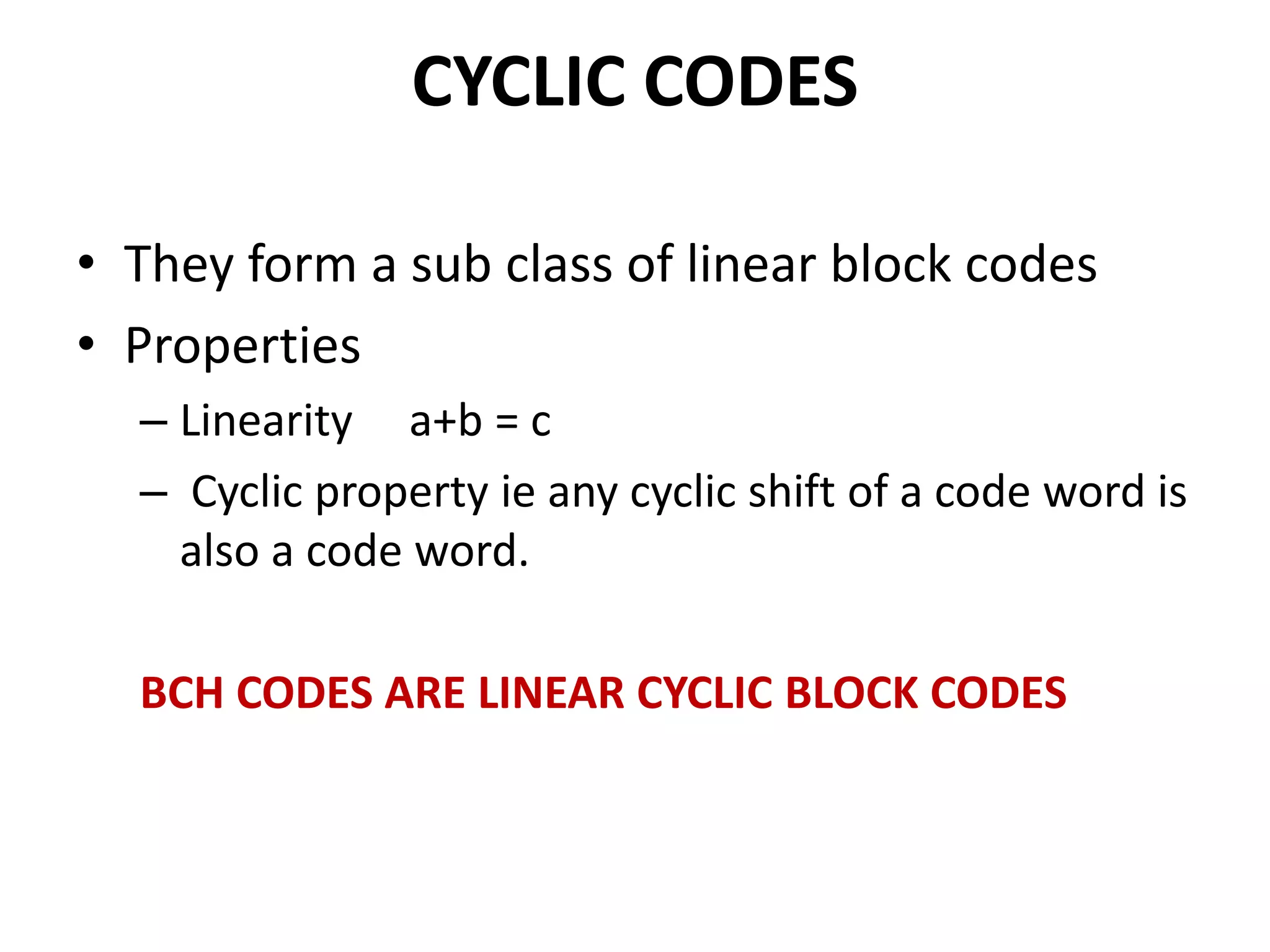
CYCLIC CODES
• They form a sub class of linear block codes
• Properties
– Linearity a+b = c
– Cyclic property ie any cyclic shift of a code word is
also a code word.
BCH CODES ARE LINEAR CYCLIC BLOCK CODES
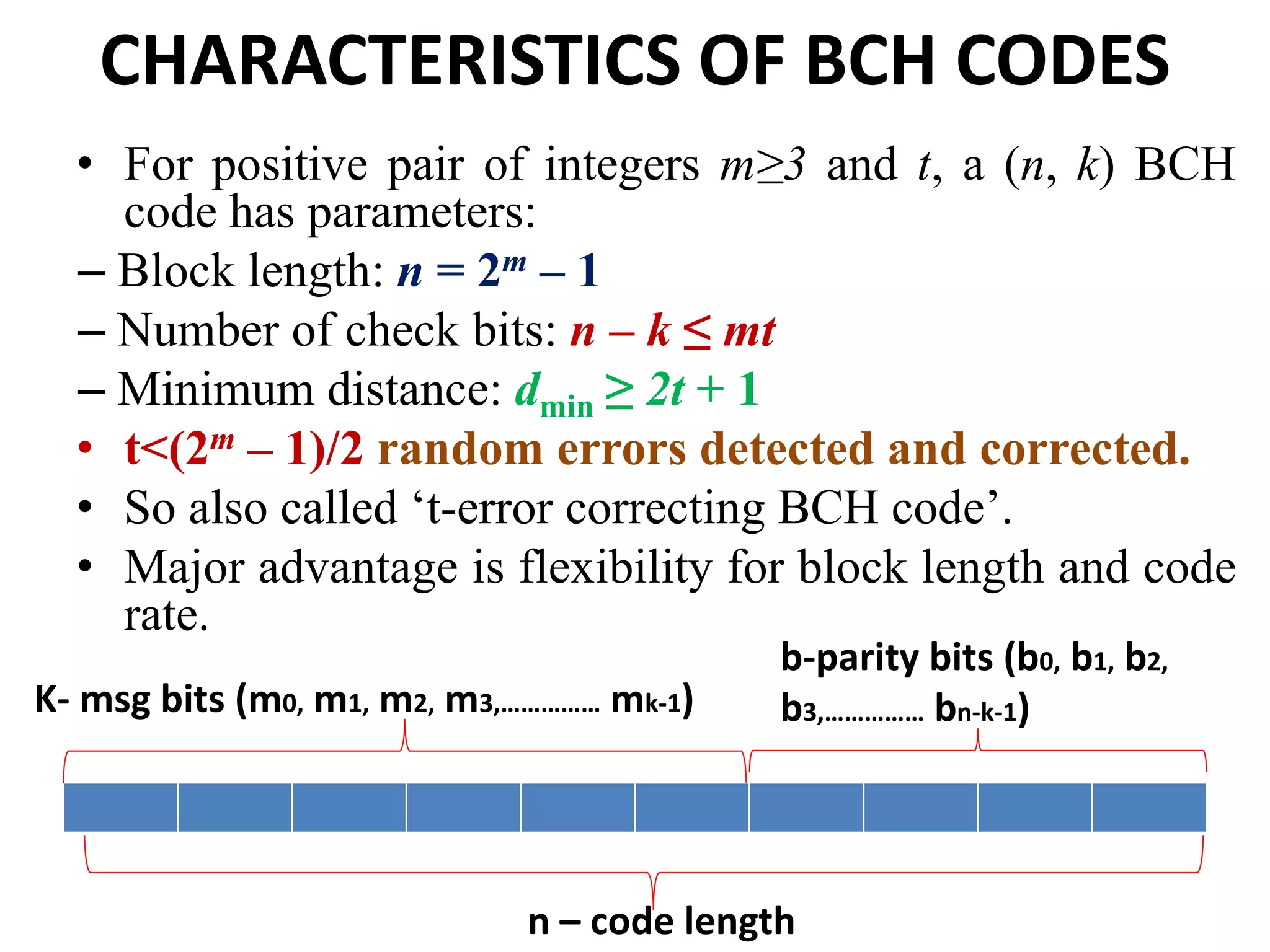
CHARACTERISTICS OF BCH CODES
• For positive pair of integers m≥3 and t, a (n, k) BCH
code has parameters:
– Block length: n = 2m – 1
– Number of check bits: n – k ≤ mt
– Minimum distance: dmin ≥ 2t + 1
• t<(2m – 1)/2 random errors detected and corrected.
• So also called ‘t-error correcting BCH code’.
• Major advantage is flexibility for block length and code
rate.
K- msg bits (m0, m1, m2, m3,…………… mk-1)
b-parity bits (b0, b1, b2,
b3,…………… bn-k-1)
n – code length
MANIFESTATION OF CHARACTERISTICS
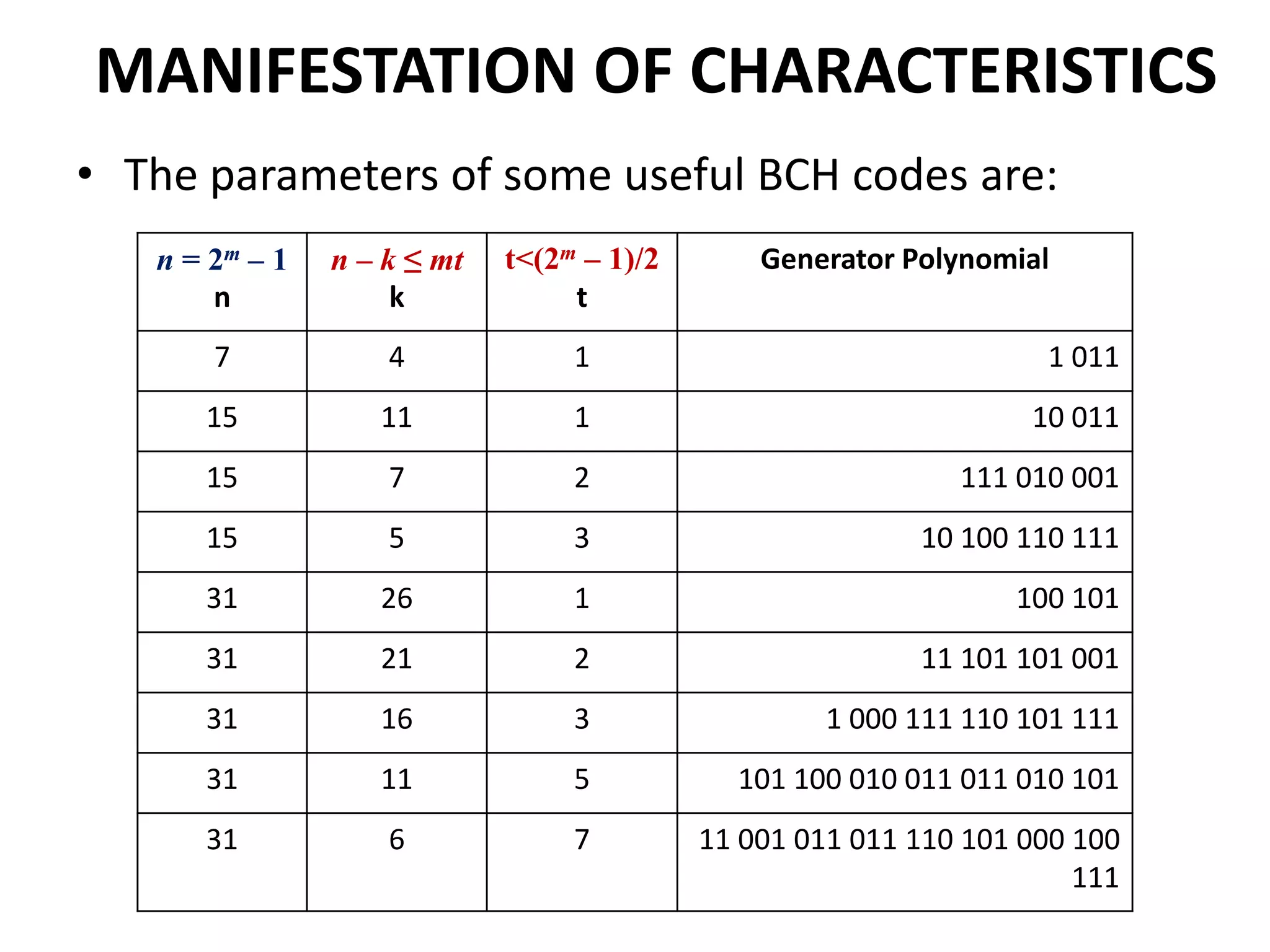
• The parameters of some useful BCH codes are:
n = 2m – 1
n
n – k ≤ mt
k
t<(2m – 1)/2
t
Generator Polynomial
7 4 1 1 011
15 11 1 10 011
15 7 2 111 010 001
15 5 3 10 100 110 111
31 26 1 100 101
31 21 2 11 101 101 001
31 16 3 1 000 111 110 101 111
31 11 5 101 100 010 011 011 010 101
31 6 7 11 001 011 011 110 101 000 100
111
• Generator polynomial g(x)  specified in
terms of its roots from Galois Field GF(2k).
• g(x) has α,α2,…, α2t and their conjugates as its
roots.
• We choose g(x) from xn + 1 polynomial factors
by taking xn-k as highest term.
CHARACTERISTICS OF BCH CODES
Galois
Field
Root Elements Min Poly
Genr Poly
GALOIS FIELD
• Evariste Galois (1832)
Field +, -,
x, /
Ring
+, -
x
Gp
+, -
AXIOMS FOR FINITE FIELDS
1. Field F is closed under + and x iea+b and a.b are in F if a & b are in
F
2. Associative law : (a+b)+c = a+(b+c), a.(b.c) = (a.b).c
3. Commutative law : a+b=b+a, a.b=b.a
4. Distributive : a.(b+c)= a.b+a.c
5. Identity elements 1 & 0 must exist in F s.t
6. a+0 =a
7. a.1 = a
8. For any a there is additive inverse s.t a+(-a)=0
9. For any a except 0 there is multiplicative inverse (a= 𝑎−1
) s.t
a(𝑎−1) =1
10. A field with finite elements is called Galois Field denoted by
GF(q).
11. If 1st 8 properties are satisfied then its called a ring.
STRUCTURE OF FINITE FIELDS
• Gaolis Field : Fq ={0, α, α2, …, αq-1}.
• Primitive element : An element α in a finite field
Fq is called a primitive element (or generator) of
Fq if Fq ={0, α, α2, …, αq-1}.
For q = pm
• Where : q represents the number of elements in
the field.
p is a prime number
α is the primitive element
ord[α] = q-1 and αq-1 = 1
m is degree of primitive polynomial
• Now, π(α) is a primitive polynomial ϵ Fp [α] = 0
of degree m
• Example : Consider the field GF(5)=(0,1,2,3,4) , we will check if 2
and 3 are primitive elements
• 2 𝑜 = 1 (mod 5) = 1 3 𝑜 = 1 (mod 5) = 1
• 21 = 2 (mod 5) = 2 31 = 3 (mod 5) = 3
• 22 = 4 (mod 5) = 4 32 = 9 (mod 5) = 4
• 23 = 8 (mod 5) = 3 33 = 27 (mod 5) = 3
MODULAR ARITHMETIC
• Use only limited range of integers.
• We, define upper limit, called a ,modulus N.
• Then use only the integers 0 to N-1.
• This is modulo-N arithmetic.
Modulo-2 Arithmetic
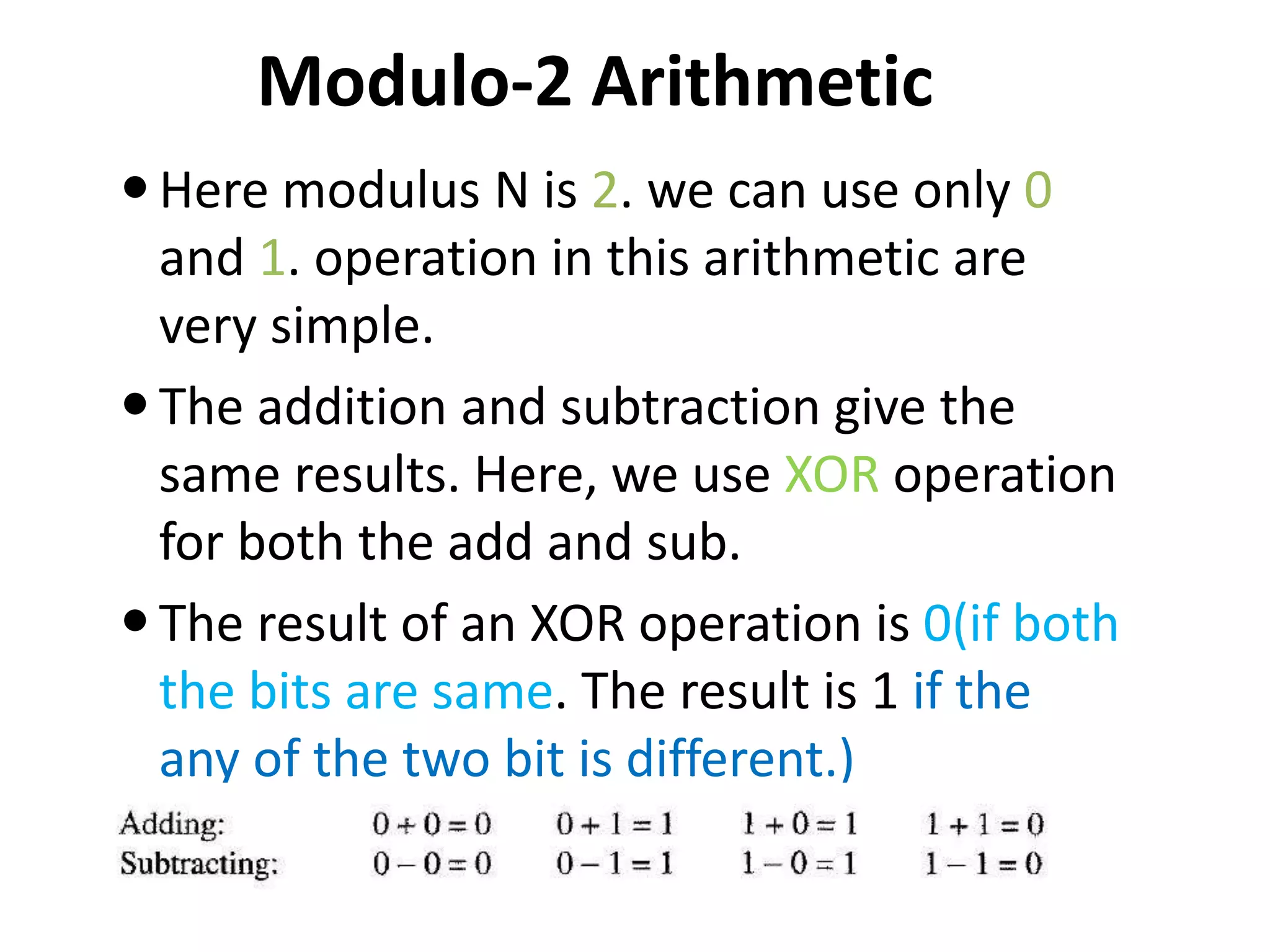
Here modulus N is 2. we can use only 0
and 1. operation in this arithmetic are
very simple.
The addition and subtraction give the
same results. Here, we use XOR operation
for both the add and sub.
The result of an XOR operation is 0(if both
the bits are same. The result is 1 if the
any of the two bit is different.)
MODULO OPS
Mod 5 addition Mod 5 multiplication
for GF(5)
MIN POLY
• If βϵFqit is a root of xq -1 which is a poly with coeff in Fp[x]
• Min poly of β is : Mβ[x] = poly of least degree in Fp[x]
s.t Mβ[β] = 0 ie……
• Min poly is always monic.
• Mβ(x) = π(x− 𝜸)
𝜸𝛜conjugates of β = β,βp , βp2 ………..
Example of GF(16)
• Generator poly g(x)
• Message D: (0110011)
• Data: d(x)=x⁵+x⁴+x+1
• So code C(x)=d(x).g(x)
= (x⁵+x⁴+x+1)(x¹⁰+x⁹+x⁸+x⁶+x⁵+x³+1)
= x¹⁵+2x¹⁴+2x¹³+x¹²+2x¹¹+4x¹⁰+3x⁹+2x⁸
+2x⁷+2x⁶+2x⁵+2x⁴+x³+x+1
= x¹⁵+x¹²+ x⁹+ x³+x+1
• Codeword, C: (1001001000001011)
BLOCK DIAGRAM
Block diagram of (15,7) BCH Encoder
Mistake…..????

Bch codes

  • 1.
  • 2.
  • 3.
  • 4.
    • 2 Keysystem parameters available for designer – Ch BW – Transmitted Sig Power • Hence we go for modulation schemes but error performance is an issue – hence error control coding • Another motivation is to reduce Eb/ N0 for a fixed BER to reduce Tx power to reduce hardware cost IMPLICATIONS OF CH CAP THEOREM
  • 5.
    • Block Codes Dividethe message into blocks, each of k bits, called datawords. Then add r redundant bit to make length n=k+r The resulting n-bit blocks are called codewords. • Convolution Codes Absence of memory (nutshell- serial input no blocks) ERROR CORRECTION CODES
  • 6.
    DEFINITIONS • WORD:- Sequenceof symbol. • CODE :- Set of vectors called the codeword. • HAMMING WEIGHT :- No of non-zero elements. • HAMMING DISTANCE :- No of places the codeword differs. D(c1, c2) = w(c1-c2) • BLOCK LENGTH :- Length of code words in a BLOCK CODE, denoted by “n”. • MSG BITS :- “k” • CODE RATE :- Of an (n,k) code , the ratio of (k/n), and reflects the fraction of the codeword that consists the info.
  • 7.
    • MINIMUM DISTANCE:- Minimum hamming distance b/w any two codes. • MINIMUM WEIGHT(w) :- The smallest weight of any nonzero codeword. DEFINITIONS
  • 8.
    LINEAR CODES • Properties –Addition of two codewords gives third codeword. – All zero code is also a codeword. – Minimum distance = minimum weight.
  • 9.
    LINEAR CODES K- msgbits (m0, m1, m2, m3,…………… mk-1) b-parity bits (b0, b1, b2, b3,…………… bn-k-1) Codeword(c0, c1, c2, c3,…………… cn-1) n – code length Ci = bi (parity bit) i= 0,1,2,………n-k-1. mi+k-n(msg bits) i= n-k, n-k+1, ……..n-1
  • 10.
    • The (n-k)parity bits are linear sum of k msg bits. • bi = p0i m0 + p1i m1 + ………….+ pk-1i mk-1 • Where the coeff are defined as follows:- pij = 1 if bi depends on mj 0 otherwise LINEAR CODES
  • 11.
    Coefficient matrix P p00p01 …….. P0n-k-1 p10 p11 …….. P1,n-k-1 P = . . . . . . pk-1,0 pk-1,1 ……. Pk-1,n-k-1 Where pi = 0 or 1 Identity Matrix : Ik = 1 0 0 0…. 0 0 1 0 0…. 0 0 0 1 0…. 0 . . . . . . . . 0 0 0 1 ….1
  • 12.
     All codewords can be obtained as linear combination of basis vectors.  The basis vectors can be designated as {𝑔1, 𝑔2, 𝑔3,….., 𝑔 𝑘}  For a linear code, there exists a k by n generator matrix such that 𝑐1∗𝑛 = 𝑚1∗𝑘 . 𝐺 𝑘∗𝑛 where c={𝑐1, 𝑐2, ….., 𝑐 𝑛} and m={𝑚1, 𝑚2, ……., 𝑚 𝑘} GENERATOR MATRIX
  • 13.
    G = [𝐼 𝑘 P] C = m.G = [m mP] Message part Parity part m=(1110) and G = = c= m.G = 𝒎 𝟏 𝒈 𝟏 + 𝒎 𝟐 𝒈 𝟐 + 𝒎 𝟑 𝒈 𝟑 + 𝒎 𝟒 𝒈 𝟒 = 1. 𝒈 𝟏 + 𝟏. 𝒈 𝟐 + 𝟏. 𝒈 𝟑 + 𝟎. 𝒈 𝟒 c = (1101000) + (0110100) + (1110010) = (0101110) 1 1 0 1 0 0 0 0 1 1 0 1 0 0 1 1 1 0 0 1 0 1 0 1 0 0 0 1 𝒈 𝟎 𝒈 𝟏 𝒈 𝟐 𝒈 𝟑 Example: Let us consider (7, 4) linear code where k=4 and n=7
  • 14.
    • For decodingwe require to separate the parity bits and also find out if there was an error. • We use a parity check matrix H s.t H = [ PT I n-k ] And H GT = 0 c HT = 0 Thus m c c 0 null vector GENERATOR MATRIX PARITY CHECK MATRIX T
  • 15.
    CYCLIC CODES • Theyform a sub class of linear block codes • Properties – Linearity a+b = c – Cyclic property ie any cyclic shift of a code word is also a code word. BCH CODES ARE LINEAR CYCLIC BLOCK CODES
  • 16.
    CHARACTERISTICS OF BCHCODES • For positive pair of integers m≥3 and t, a (n, k) BCH code has parameters: – Block length: n = 2m – 1 – Number of check bits: n – k ≤ mt – Minimum distance: dmin ≥ 2t + 1 • t<(2m – 1)/2 random errors detected and corrected. • So also called ‘t-error correcting BCH code’. • Major advantage is flexibility for block length and code rate. K- msg bits (m0, m1, m2, m3,…………… mk-1) b-parity bits (b0, b1, b2, b3,…………… bn-k-1) n – code length
  • 17.
    MANIFESTATION OF CHARACTERISTICS •The parameters of some useful BCH codes are: n = 2m – 1 n n – k ≤ mt k t<(2m – 1)/2 t Generator Polynomial 7 4 1 1 011 15 11 1 10 011 15 7 2 111 010 001 15 5 3 10 100 110 111 31 26 1 100 101 31 21 2 11 101 101 001 31 16 3 1 000 111 110 101 111 31 11 5 101 100 010 011 011 010 101 31 6 7 11 001 011 011 110 101 000 100 111
  • 18.
    • Generator polynomialg(x)  specified in terms of its roots from Galois Field GF(2k). • g(x) has α,α2,…, α2t and their conjugates as its roots. • We choose g(x) from xn + 1 polynomial factors by taking xn-k as highest term. CHARACTERISTICS OF BCH CODES Galois Field Root Elements Min Poly Genr Poly
  • 19.
    GALOIS FIELD • EvaristeGalois (1832) Field +, -, x, / Ring +, - x Gp +, -
  • 20.
    AXIOMS FOR FINITEFIELDS 1. Field F is closed under + and x iea+b and a.b are in F if a & b are in F 2. Associative law : (a+b)+c = a+(b+c), a.(b.c) = (a.b).c 3. Commutative law : a+b=b+a, a.b=b.a 4. Distributive : a.(b+c)= a.b+a.c 5. Identity elements 1 & 0 must exist in F s.t 6. a+0 =a 7. a.1 = a 8. For any a there is additive inverse s.t a+(-a)=0 9. For any a except 0 there is multiplicative inverse (a= 𝑎−1 ) s.t a(𝑎−1) =1 10. A field with finite elements is called Galois Field denoted by GF(q). 11. If 1st 8 properties are satisfied then its called a ring.
  • 21.
    STRUCTURE OF FINITEFIELDS • Gaolis Field : Fq ={0, α, α2, …, αq-1}. • Primitive element : An element α in a finite field Fq is called a primitive element (or generator) of Fq if Fq ={0, α, α2, …, αq-1}. For q = pm • Where : q represents the number of elements in the field. p is a prime number α is the primitive element ord[α] = q-1 and αq-1 = 1 m is degree of primitive polynomial • Now, π(α) is a primitive polynomial ϵ Fp [α] = 0 of degree m
  • 22.
    • Example :Consider the field GF(5)=(0,1,2,3,4) , we will check if 2 and 3 are primitive elements • 2 𝑜 = 1 (mod 5) = 1 3 𝑜 = 1 (mod 5) = 1 • 21 = 2 (mod 5) = 2 31 = 3 (mod 5) = 3 • 22 = 4 (mod 5) = 4 32 = 9 (mod 5) = 4 • 23 = 8 (mod 5) = 3 33 = 27 (mod 5) = 3
  • 23.
    MODULAR ARITHMETIC • Useonly limited range of integers. • We, define upper limit, called a ,modulus N. • Then use only the integers 0 to N-1. • This is modulo-N arithmetic.
  • 24.
    Modulo-2 Arithmetic Here modulusN is 2. we can use only 0 and 1. operation in this arithmetic are very simple. The addition and subtraction give the same results. Here, we use XOR operation for both the add and sub. The result of an XOR operation is 0(if both the bits are same. The result is 1 if the any of the two bit is different.)
  • 25.
    MODULO OPS Mod 5addition Mod 5 multiplication for GF(5)
  • 26.
    MIN POLY • IfβϵFqit is a root of xq -1 which is a poly with coeff in Fp[x] • Min poly of β is : Mβ[x] = poly of least degree in Fp[x] s.t Mβ[β] = 0 ie…… • Min poly is always monic. • Mβ(x) = π(x− 𝜸) 𝜸𝛜conjugates of β = β,βp , βp2 ……….. Example of GF(16) • Generator poly g(x)
  • 27.
    • Message D:(0110011) • Data: d(x)=x⁵+x⁴+x+1 • So code C(x)=d(x).g(x) = (x⁵+x⁴+x+1)(x¹⁰+x⁹+x⁸+x⁶+x⁵+x³+1) = x¹⁵+2x¹⁴+2x¹³+x¹²+2x¹¹+4x¹⁰+3x⁹+2x⁸ +2x⁷+2x⁶+2x⁵+2x⁴+x³+x+1 = x¹⁵+x¹²+ x⁹+ x³+x+1 • Codeword, C: (1001001000001011)
  • 28.
    BLOCK DIAGRAM Block diagramof (15,7) BCH Encoder Mistake…..????