Electric Energy Lesson 6
Electricity Use Has Dramatically Changed Our Daily Lives Before electricity became available over 100 years ago, houses were lit with kerosene lamps, food was cooled in iceboxes, and rooms were warmed by wood-burning or coal-burning stoves.
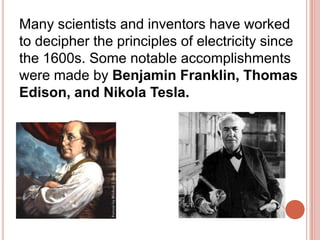
Many scientists and inventors have worked to decipher the principles of electricity since the 1600s. Some notable accomplishments were made by Benjamin Franklin, Thomas Edison, and Nikola Tesla.
Contributions Benjamin Franklin demonstrated that lightning is electricity. Thomas Edison invented the first long-lasting incandescent light bulb.
What would be …Without electricity.Like air and water, we tend to take electricity for granted.We use electricity to do many jobs for us every day — from lighting, heating, and cooling our homes to powering our televisions and computers.
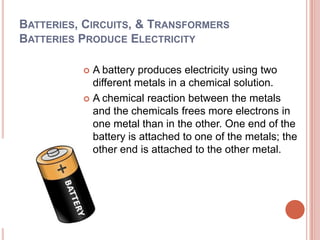
Batteries, Circuits, & TransformersBatteries Produce ElectricityA battery produces electricity using two different metals in a chemical solution. A chemical reaction between the metals and the chemicals frees more electrons in one metal than in the other. One end of the battery is attached to one of the metals; the other end is attached to the other metal.
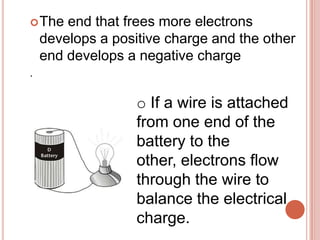
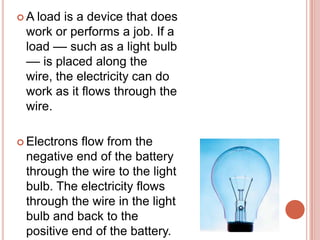
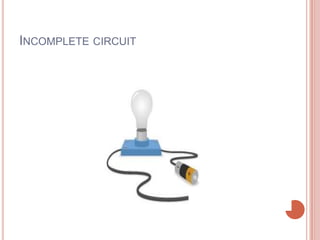
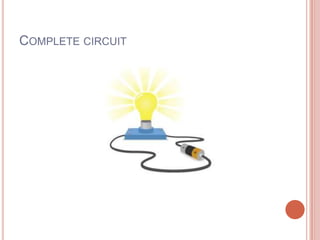
The end that frees more electrons develops a positive charge and the other end develops a negative charge. If a wire is attached from one end of the battery to the other, electrons flow through the wire to balance the electrical charge.A load is a device that does work or performs a job. If a load –– such as a light bulb –– is placed along the wire, the electricity can do work as it flows through the wire.Electrons flow from the negative end of the battery through the wire to the light bulb. The electricity flows through the wire in the light bulb and back to the positive end of the battery.
Incomplete circuit
Complete circuit
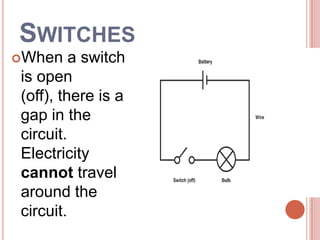
SwitchesWhen a switch is open (off), there is a gap in the circuit. Electricity cannot travel around the circuit.
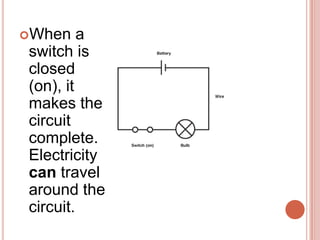
When a switch is closed (on), it makes the circuit complete. Electricity can travel around the circuit.
See what happens when you make changes to the circuit.http://www.bbc.co.uk/schools/ks2bitesize/science/physical_processes/changing_circuits/play.shtml
Lesson 6 electric energy

Lesson 6 electric energy

  • 1.
  • 2.
    Electricity Use HasDramatically Changed Our Daily Lives Before electricity became available over 100 years ago, houses were lit with kerosene lamps, food was cooled in iceboxes, and rooms were warmed by wood-burning or coal-burning stoves.
  • 3.
    Many scientists andinventors have worked to decipher the principles of electricity since the 1600s. Some notable accomplishments were made by Benjamin Franklin, Thomas Edison, and Nikola Tesla.
  • 4.
    Contributions Benjamin Franklindemonstrated that lightning is electricity. Thomas Edison invented the first long-lasting incandescent light bulb.
  • 5.
    What would be…Without electricity.Like air and water, we tend to take electricity for granted.We use electricity to do many jobs for us every day — from lighting, heating, and cooling our homes to powering our televisions and computers.
  • 6.
    Batteries, Circuits, &TransformersBatteries Produce ElectricityA battery produces electricity using two different metals in a chemical solution. A chemical reaction between the metals and the chemicals frees more electrons in one metal than in the other. One end of the battery is attached to one of the metals; the other end is attached to the other metal.
  • 7.
    The end thatfrees more electrons develops a positive charge and the other end develops a negative charge. If a wire is attached from one end of the battery to the other, electrons flow through the wire to balance the electrical charge.A load is a device that does work or performs a job. If a load –– such as a light bulb –– is placed along the wire, the electricity can do work as it flows through the wire.Electrons flow from the negative end of the battery through the wire to the light bulb. The electricity flows through the wire in the light bulb and back to the positive end of the battery.
  • 8.
  • 9.
  • 10.
    SwitchesWhen a switchis open (off), there is a gap in the circuit. Electricity cannot travel around the circuit.
  • 11.
    When a switchis closed (on), it makes the circuit complete. Electricity can travel around the circuit.
  • 12.
    See what happenswhen you make changes to the circuit.http://www.bbc.co.uk/schools/ks2bitesize/science/physical_processes/changing_circuits/play.shtml